React, Redux,
ES2015
React
Why React?
Components
VirtualDOM
JSX
Components
Breaking UI into a compoent hierarchy is logical
They usually great at one thing
Components are highly reusable epecially in large apps
JSX is great for this
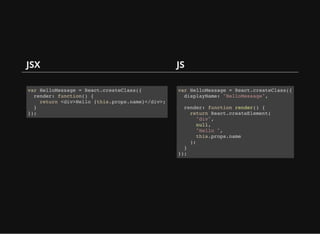
JSX JS
var HelloMessage = React.createClass({
render: function() {
return <div>Hello {this.props.name}</div>;
}
});
var HelloMessage = React.createClass({
displayName: "HelloMessage",
render: function render() {
return React.createElement(
"div",
null,
"Hello ",
this.props.name
);
}
});
VirtualDOM
Efficiency
It has full event system
No direct DOM manipulations... Well you can manipulate DOM
directly if you want
Data Flow - Flux
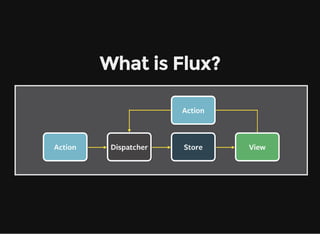
What is Flux?
Redux
What is Redux?
Is it Flux? Yes, and no
One store to rule them all.
Three principles of Redux make state mutations predictable and
reversable
Three principles of Redux
1. Single source of truth
2. State is read-only
3. Mutations are written as pure functions - reducers
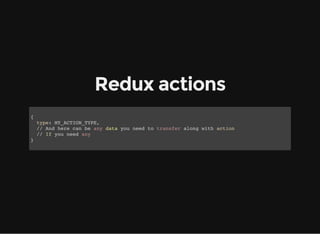
Redux actions
{
type: MY_ACTION_TYPE,
// And here can be any data you need to transfer along with action
// If you need any
}
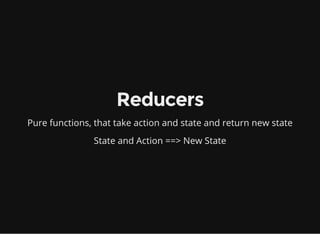
Reducers
Pure functions, that take action and state and return new state
State and Action ==> New State
Reducer composition
It helps to split data handling logic, when each of reducers is
managing its own part of the global state
Redux provides util combineReducers()that makes it easy to use.
Store
Holds application state
Allows access to state
Allows state to be updated
Data Flow
1. You call store.dispatch(action)
2. Redux store calls the root reducer
3. The Redux store saves state returned by the root reducer.
Middleware
It provides a third-party extension point between dispatching an
action, and the moment it reaches the reducer.
ES2015
Modules
Static module structure
Helps avoid global variables
Support for cyclic dependencies between modules
Class
Lambda functions
New function creation syntax
Lexical binding
Has no 'arguments'
Examples
function () { return 1; }
() => { return 1; }
() => 1
function (a) { return a * 2; }
(a) => { return a * 2; }
(a) => a * 2
a => a * 2
function (a, b) { return a * b; }
(a, b) => { return a * b; }
(a, b) => a * b
function () { return arguments[0]; }
(...args) => args[0] // ES6 rest syntax helps to work without 'arguments'
() => {} // undefined
() => ({}) // {}
Spread operator
Math.max(-1, 5, 11, 3) // 11
Math.max(...[-1, 5, 11, 3]) // 11
Math.max(-1, ...[5, 11], 3) // 11
// example from Tic Tac Toe React
// with ES6 spread operator
function getMaxElement(arr) {
return Math.max(...arr);
}
// without ES6 spread
function getMaxElement(arr) {
return Math.max.apply(null, arr);
}
Rest operator
function f(x, ...y) {
···
}
f('a', 'b', 'c'); // x = 'a'; y = ['b', 'c']
f(); // x = undefined; y = []
Destructuring
// Can work with objects
let {one, two} = {one: 1, two: 2} // one = 1, two = 2
// And arrays
let [,,x] = ['a', 'b', 'c', 'd']; // x = 'c'
// Is that it? Nope, array destructuring works with iterable objects
// Like strings
let [x,y] = 'abc'; // x='a'; y=['b', 'c']
// And Set
let [x, y] = new Set(['x', 'y']); // x = 'x', y = 'y'
// and etc.
// It's works great with rest operator
let [x,...y] = 'abc'; // x='a'; y=['b', 'c']
// And looks great in functions
function ([x, y, ...rest]) {...}
let, const
let and const are block scoped
let and const don't get hoisted have TDZ (Temporal Dead Zone)
Variables defined with let/const can't be defined more than once
in the same scope
Template strings
// Can contain multiline strings
let multiline = `line 1
line2`; // and spaces matter
let x = 1;
// Can evaluate variables, or expressions inside ${...}
let str = `${x + 41}` // str = '42'
// Can be tagged
function firstString(stringsArray, ...allValues) { // using the new ES6 rest syntax
// allValues is array of values passed inside ${}
return stringsArray[0];
}
let firstStr = firstString `Some text ${x} bla-bla`;
// firstStr = 'Some text ';
Async stuff
Promises
Generators
ES7 Proposals
The End
Useful links:
-
-
-
-
Why React?
Flux overview
Redux documentation
ES6 Overview
My email: maxim.petruck@lingvokot.com
Our organization on Github: github.com/Lingvokot

React, Redux, ES2015 by Max Petruck

  • 1.
  • 2.
  • 3.
  • 4.
    Components Breaking UI intoa compoent hierarchy is logical They usually great at one thing Components are highly reusable epecially in large apps JSX is great for this
  • 5.
    JSX JS var HelloMessage= React.createClass({ render: function() { return <div>Hello {this.props.name}</div>; } }); var HelloMessage = React.createClass({ displayName: "HelloMessage", render: function render() { return React.createElement( "div", null, "Hello ", this.props.name ); } });
  • 6.
    VirtualDOM Efficiency It has fullevent system No direct DOM manipulations... Well you can manipulate DOM directly if you want
  • 7.
  • 8.
  • 9.
  • 10.
    What is Redux? Is it Flux?Yes, and no One store to rule them all. Three principles of Redux make state mutations predictable and reversable
  • 11.
    Three principles of Redux 1. Single sourceof truth 2. State is read-only 3. Mutations are written as pure functions - reducers
  • 12.
    Redux actions { type: MY_ACTION_TYPE, // Andhere can be any data you need to transfer along with action // If you need any }
  • 13.
    Reducers Pure functions, thattake action and state and return new state State and Action ==> New State
  • 14.
    Reducer composition It helps tosplit data handling logic, when each of reducers is managing its own part of the global state Redux provides util combineReducers()that makes it easy to use.
  • 15.
    Store Holds application state Allowsaccess to state Allows state to be updated
  • 16.
    Data Flow 1. You callstore.dispatch(action) 2. Redux store calls the root reducer 3. The Redux store saves state returned by the root reducer.
  • 17.
    Middleware It provides athird-party extension point between dispatching an action, and the moment it reaches the reducer.
  • 18.
  • 19.
    Modules Static module structure Helpsavoid global variables Support for cyclic dependencies between modules
  • 20.
  • 21.
    Lambda functions New function creationsyntax Lexical binding Has no 'arguments'
  • 22.
    Examples function () {return 1; } () => { return 1; } () => 1 function (a) { return a * 2; } (a) => { return a * 2; } (a) => a * 2 a => a * 2 function (a, b) { return a * b; } (a, b) => { return a * b; } (a, b) => a * b function () { return arguments[0]; } (...args) => args[0] // ES6 rest syntax helps to work without 'arguments' () => {} // undefined () => ({}) // {}
  • 23.
    Spread operator Math.max(-1, 5, 11,3) // 11 Math.max(...[-1, 5, 11, 3]) // 11 Math.max(-1, ...[5, 11], 3) // 11 // example from Tic Tac Toe React // with ES6 spread operator function getMaxElement(arr) { return Math.max(...arr); } // without ES6 spread function getMaxElement(arr) { return Math.max.apply(null, arr); }
  • 24.
    Rest operator function f(x, ...y){ ··· } f('a', 'b', 'c'); // x = 'a'; y = ['b', 'c'] f(); // x = undefined; y = []
  • 25.
    Destructuring // Can workwith objects let {one, two} = {one: 1, two: 2} // one = 1, two = 2 // And arrays let [,,x] = ['a', 'b', 'c', 'd']; // x = 'c' // Is that it? Nope, array destructuring works with iterable objects // Like strings let [x,y] = 'abc'; // x='a'; y=['b', 'c'] // And Set let [x, y] = new Set(['x', 'y']); // x = 'x', y = 'y' // and etc. // It's works great with rest operator let [x,...y] = 'abc'; // x='a'; y=['b', 'c'] // And looks great in functions function ([x, y, ...rest]) {...}
  • 26.
    let, const let and constare block scoped let and const don't get hoisted have TDZ (Temporal Dead Zone) Variables defined with let/const can't be defined more than once in the same scope
  • 27.
    Template strings // Can containmultiline strings let multiline = `line 1 line2`; // and spaces matter let x = 1; // Can evaluate variables, or expressions inside ${...} let str = `${x + 41}` // str = '42' // Can be tagged function firstString(stringsArray, ...allValues) { // using the new ES6 rest syntax // allValues is array of values passed inside ${} return stringsArray[0]; } let firstStr = firstString `Some text ${x} bla-bla`; // firstStr = 'Some text ';
  • 28.
  • 29.
    The End Useful links: - - - - Why React? Fluxoverview Redux documentation ES6 Overview My email: maxim.petruck@lingvokot.com Our organization on Github: github.com/Lingvokot