








React Native in Production
Build Native Mobile Apps using JavaScript and React
Kim Seokjun aka alma
Front-end web developer at SOCAR
Working as DevOps
- react.js, react-native, node.js, express.js, docker
Interested in
- go, tensorflow, functional programming
React.js React Native
WHY REACT-NATIVE?
오늘부터 2차 모집중!
http://zerocar.socar.kr
WHY? 1. To avoid risk mixing
Single bug may affect two services
SOCAR is already huge and complex application
WHY? 2. Not much to share with SOCAR
ZEROCAR is running over SOCAR
but in behavioral standpoint it’s not
WHY? 3. Minimize features and quick updates
Feature list was too long for 3 weeks
So decided to spec out most and focus on criticals
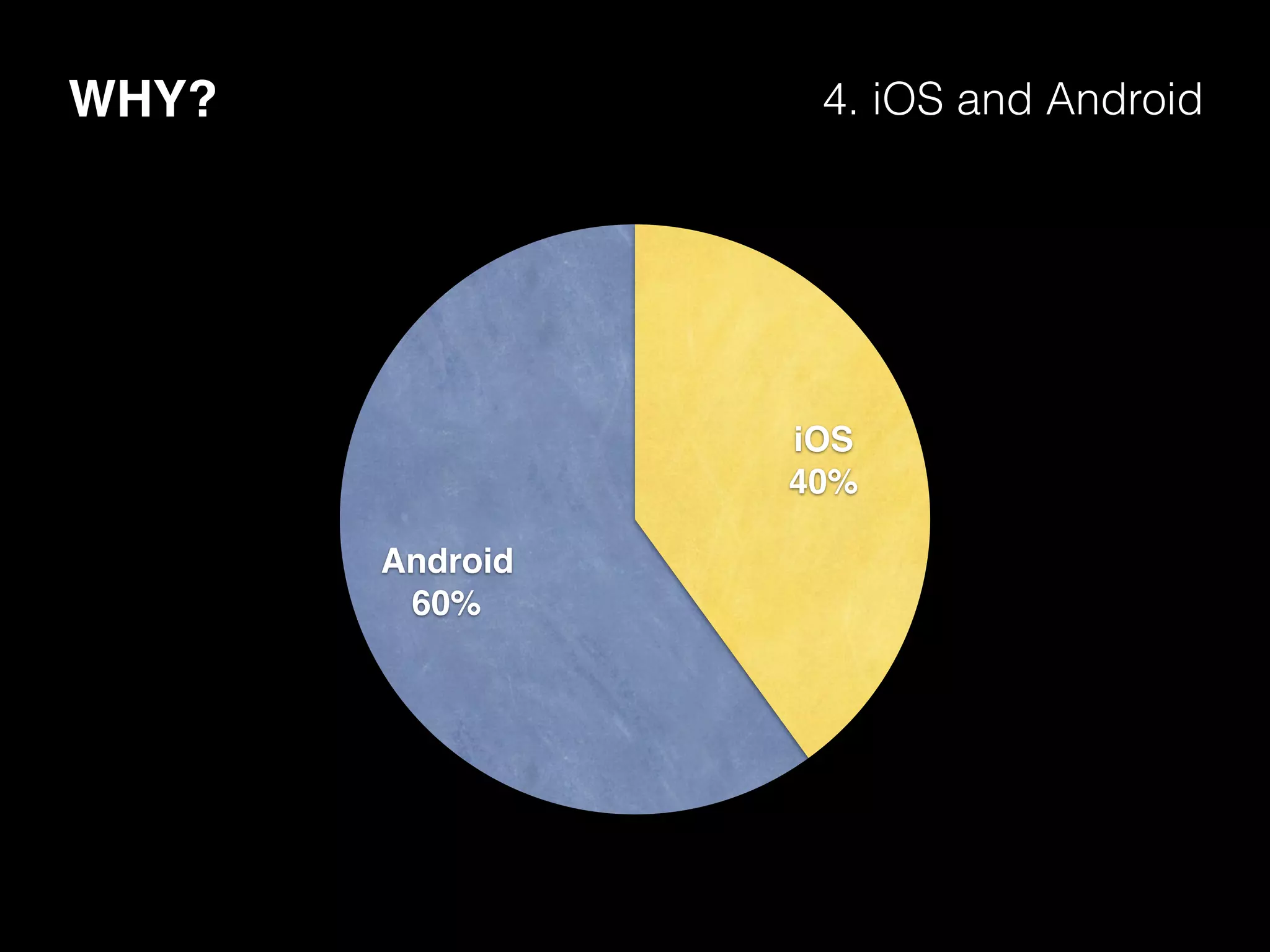
WHY? 4. iOS and Android
Android
60%
iOS
40%
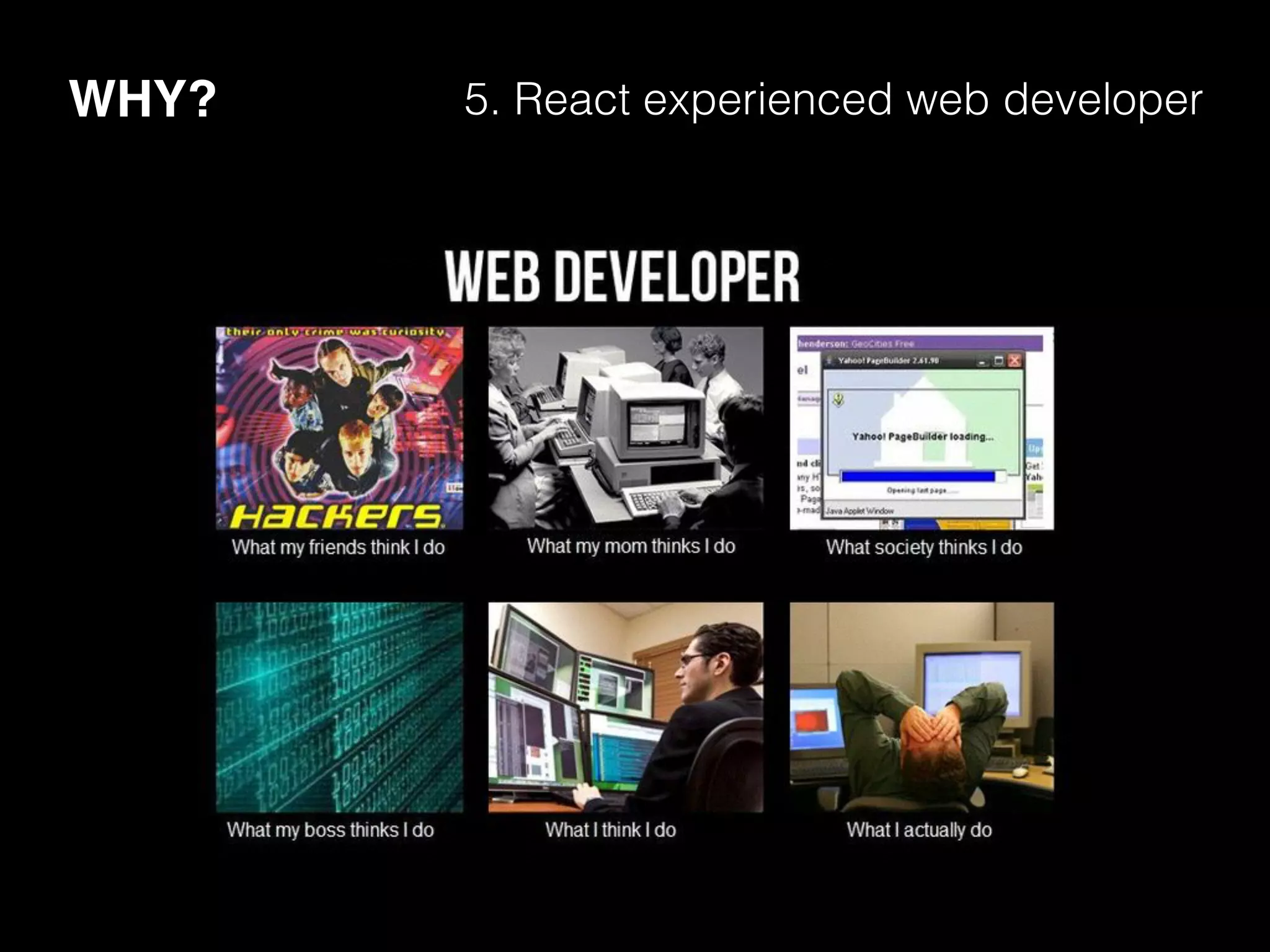
WHY? 5. React experienced web developer
OPTIONS
Cordova + React
NativeScript
React Native
PROS
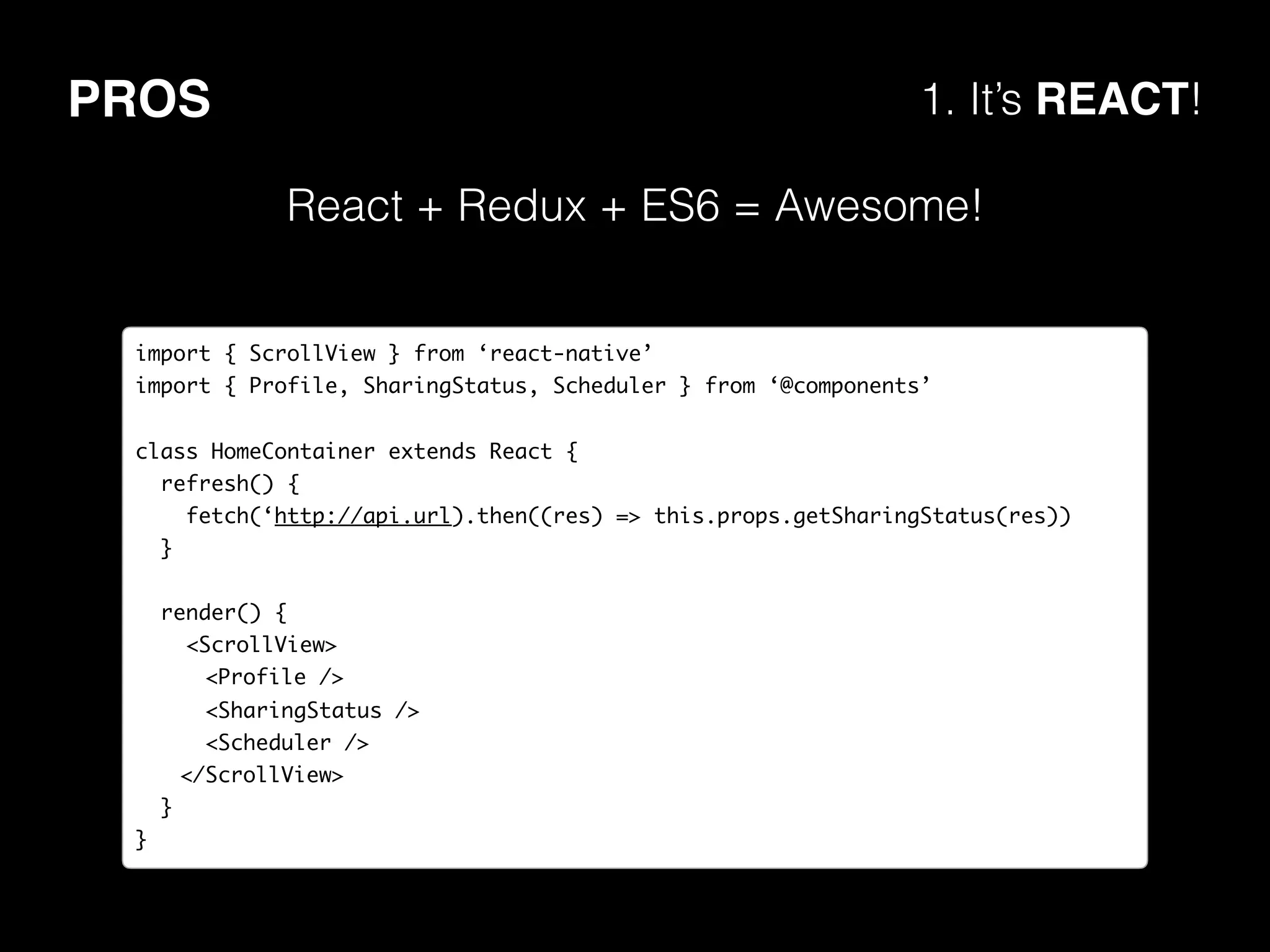
PROS 1. It’s REACT!
React + Redux + ES6 = Awesome!
import { ScrollView } from ‘react-native’
import { Profile, SharingStatus, Scheduler } from ‘@components’
class HomeContainer extends React {
refresh() {
fetch(‘http://api.url).then((res) => this.props.getSharingStatus(res))
}
render() {
<ScrollView>
<Profile />
<SharingStatus />
<Scheduler />
</ScrollView>
}
}
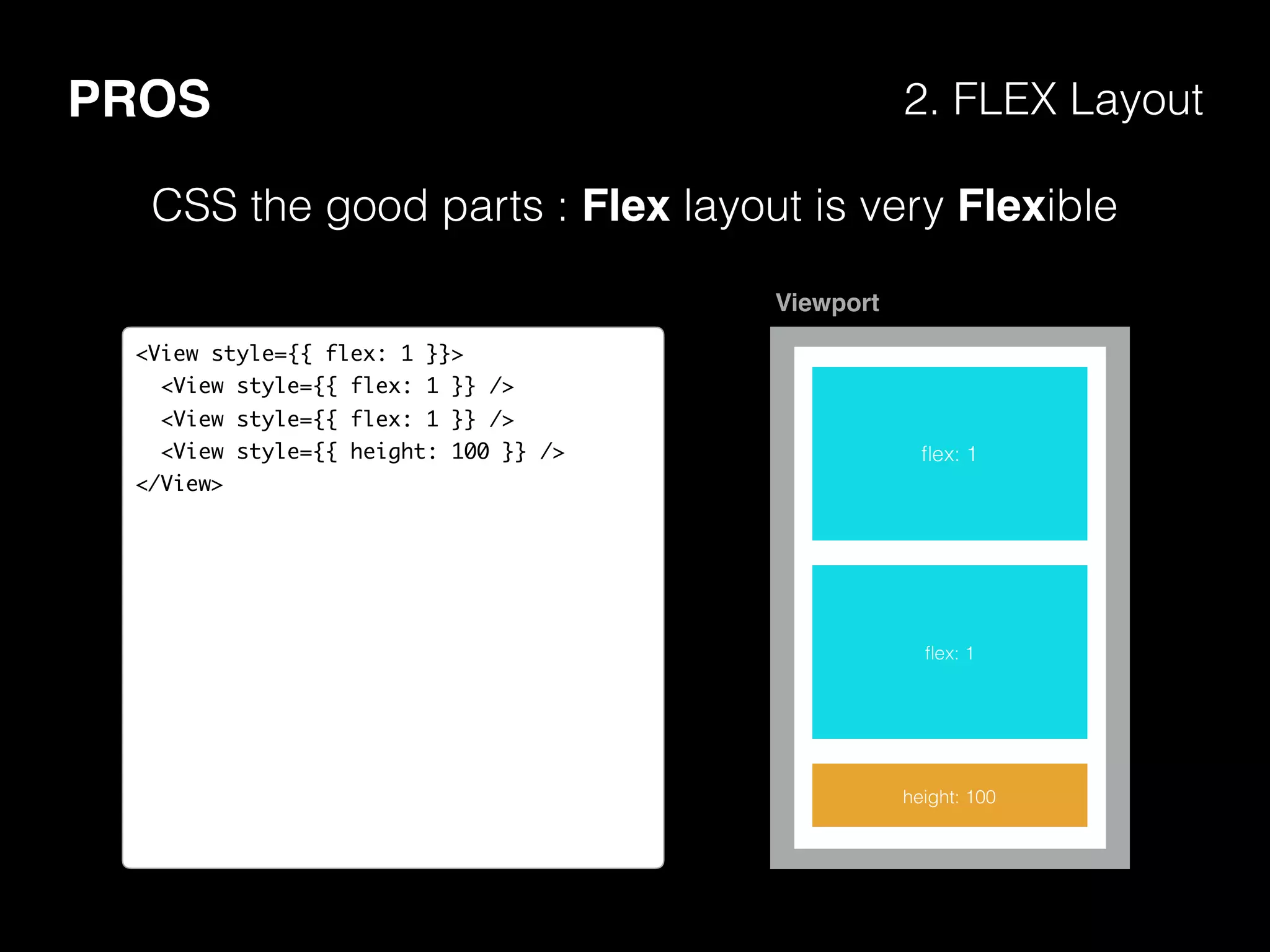
PROS 2. FLEX Layout
CSS the good parts : Flex layout is very Flexible
<View style={{ flex: 1 }}>
<View style={{ flex: 1 }} />
<View style={{ height: 100 }} />
</View>
height: 100
flex: 1
flex: 1
Viewport
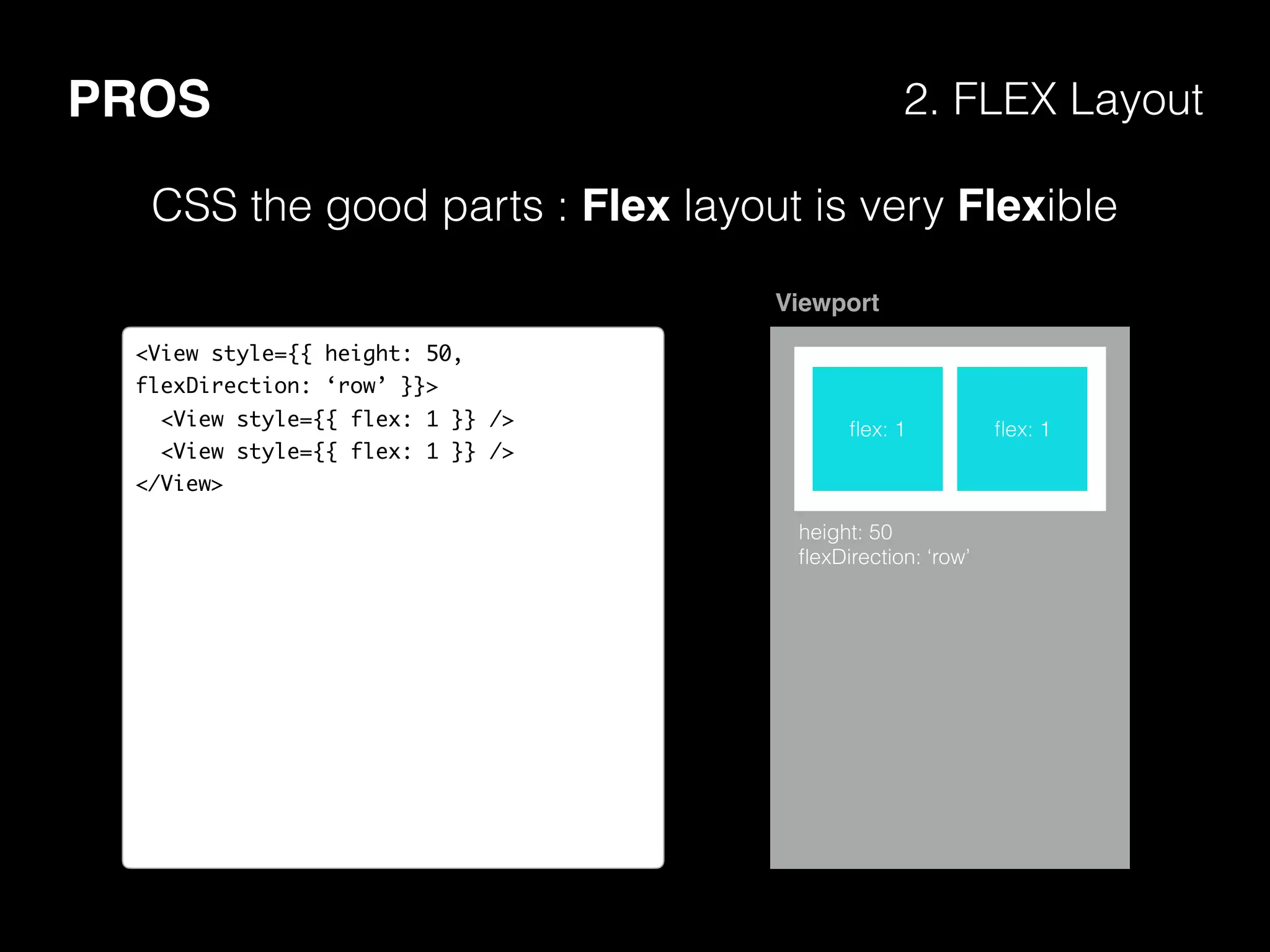
PROS 2. FLEX Layout
CSS the good parts : Flex layout is very Flexible
flex: 1 flex: 1
Viewport
<View style={{ height: 50,
flexDirection: ‘row’ }}>
<View style={{ flex: 1 }} />
</View>
height: 50
flexDirection: ‘row’
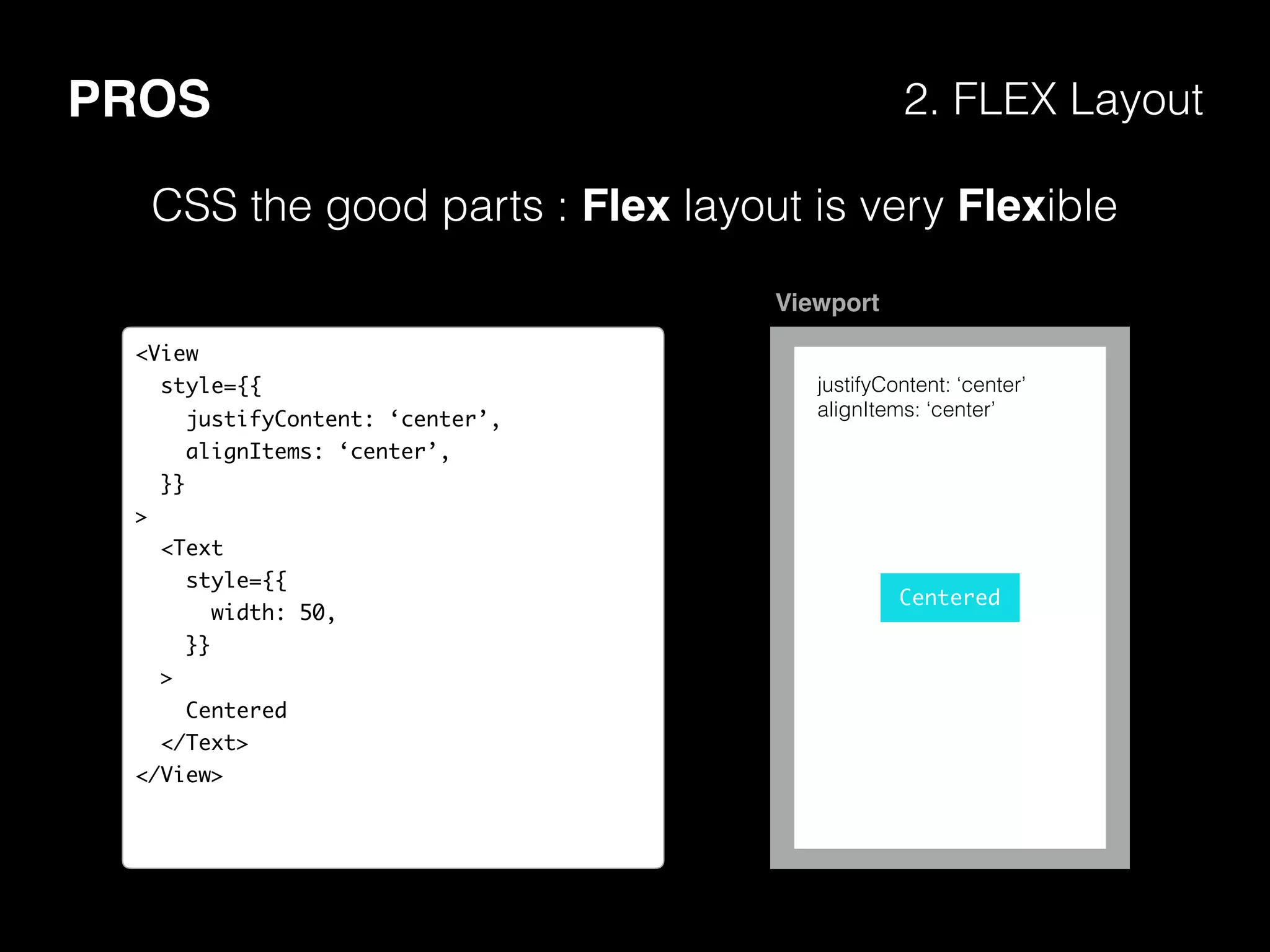
PROS 2. FLEX Layout
CSS the good parts : Flex layout is very Flexible
<View
style={{
justifyContent: ‘center’,
alignItems: ‘center’,
}}
>
<Text
style={{
width: 50,
}}
>
Centered
</Text>
</View>
Centered
Viewport
justifyContent: ‘center’
alignItems: ‘center’
PROS 3. No compile, Hot-reload
Thank you Dan!
I love you!
Really!
Love you!
My Jesus!
Dan Abramov, author of Redux and React Hot Reloader
PROS 4. The Javascript
Lodash
Moment.js
Accounting
PROS 4. The Javascript
Lodash : the functional programming
const getCamelCased = (text: string) => {
if (!text) return null;
return text.replace(/-([a-z])/g, (g) => g[1].toUpperCase());
};
const getButtonStyle = (className) => {
if (!className) return null;
return _.chain(['btn', 'normal', ...className.split(/s/)])
.map(elem => styles[getCamelCased(elem)])
.value();
};
PROS 4. The Javascript
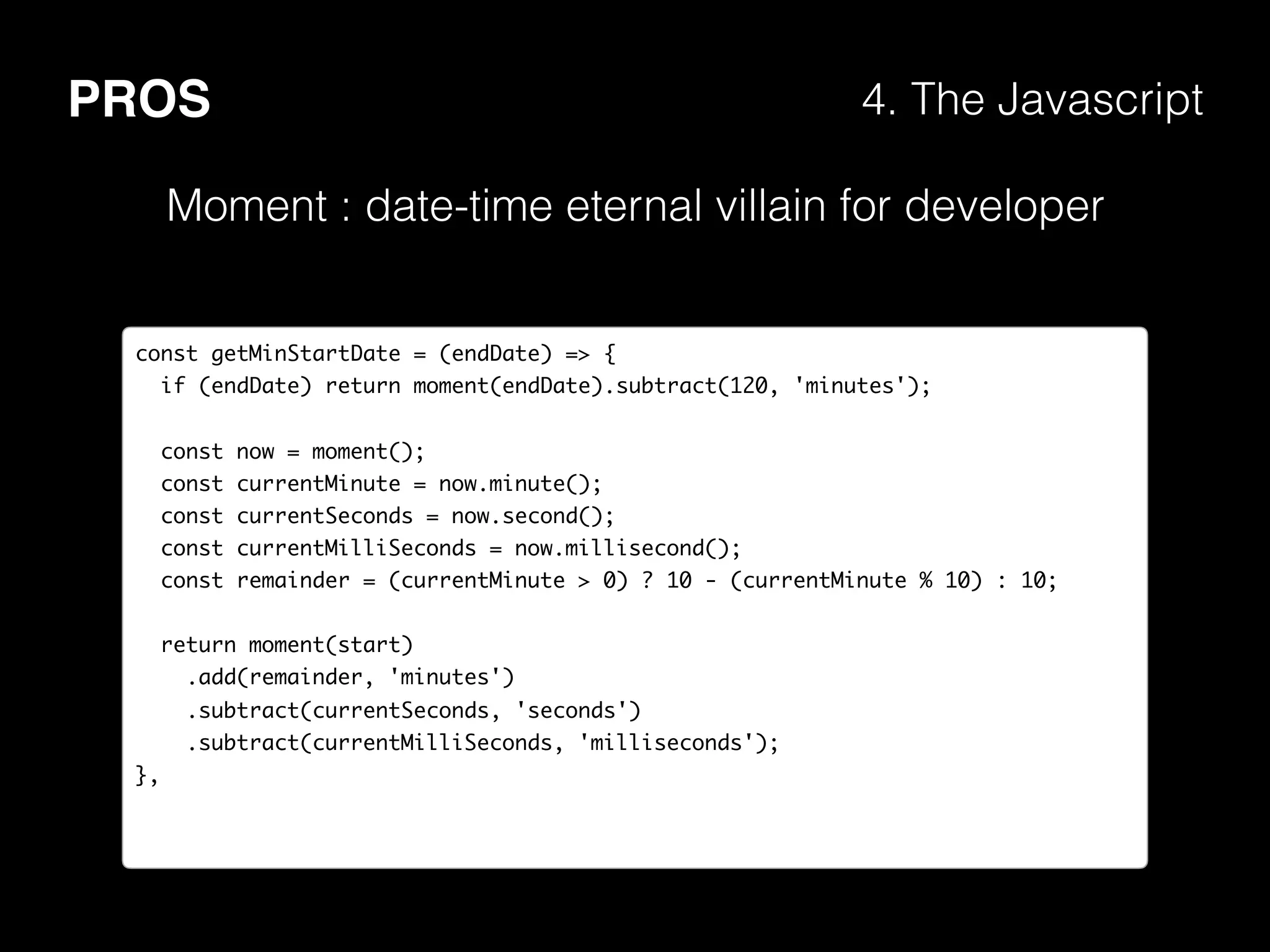
Moment : date-time eternal villain for developer
const getMinStartDate = (endDate) => {
if (endDate) return moment(endDate).subtract(120, 'minutes');
const now = moment();
const currentMinute = now.minute();
const currentSeconds = now.second();
const currentMilliSeconds = now.millisecond();
const remainder = (currentMinute > 0) ? 10 - (currentMinute % 10) : 10;
return moment(start)
.add(remainder, 'minutes')
.subtract(currentSeconds, 'seconds')
.subtract(currentMilliSeconds, 'milliseconds');
},
PROS 4. The Javascript
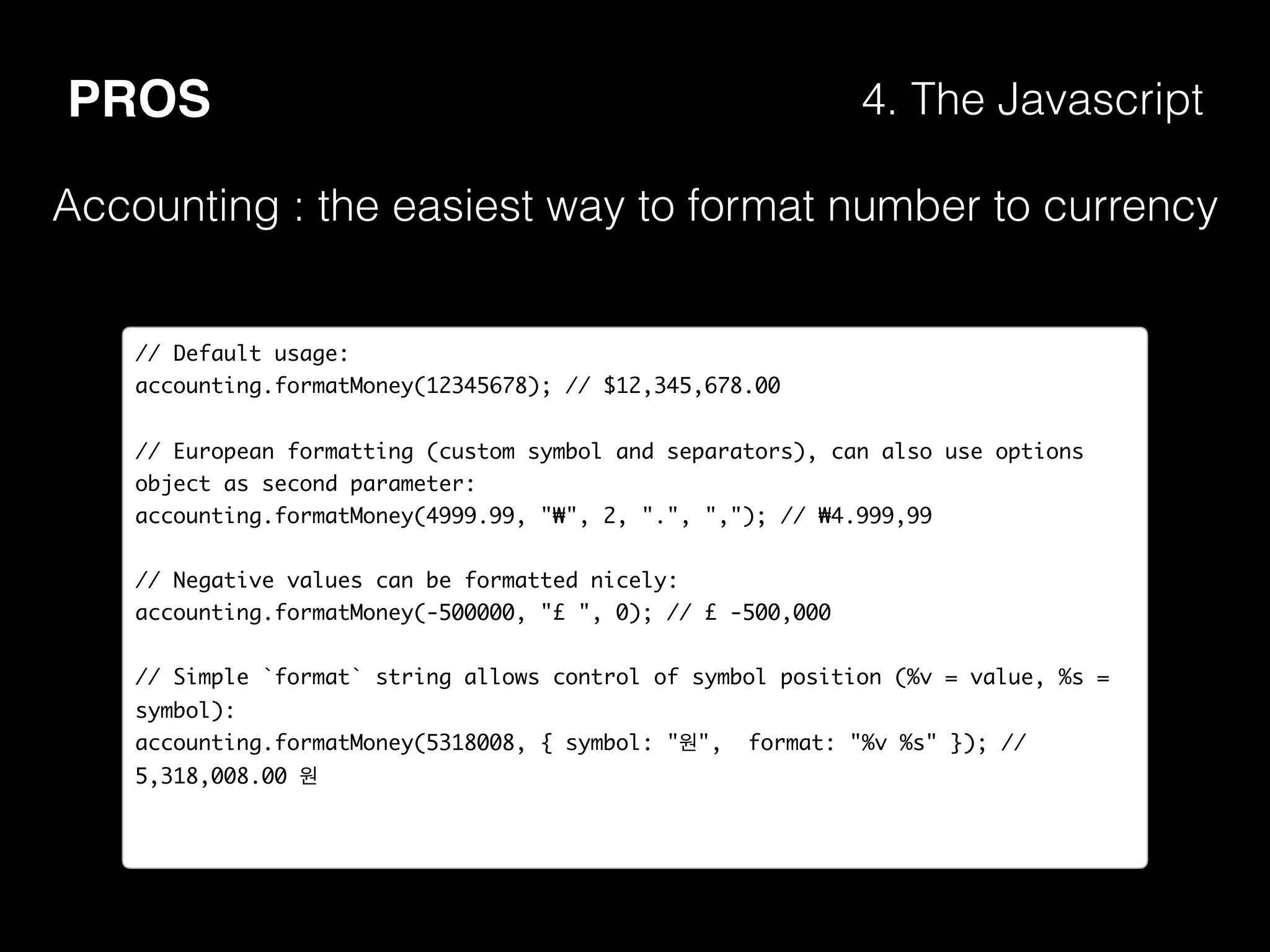
Accounting : the easiest way to format number to currency
// Default usage:
accounting.formatMoney(12345678); // $12,345,678.00
// European formatting (custom symbol and separators), can also use options
object as second parameter:
accounting.formatMoney(4999.99, "₩", 2, ".", ","); // ₩4.999,99
// Negative values can be formatted nicely:
accounting.formatMoney(-500000, "£ ", 0); // £ -500,000
// Simple `format` string allows control of symbol position (%v = value, %s =
symbol):
accounting.formatMoney(5318008, { symbol: "원", format: "%v %s" }); //
5,318,008.00 원
PROS 5. CodePush
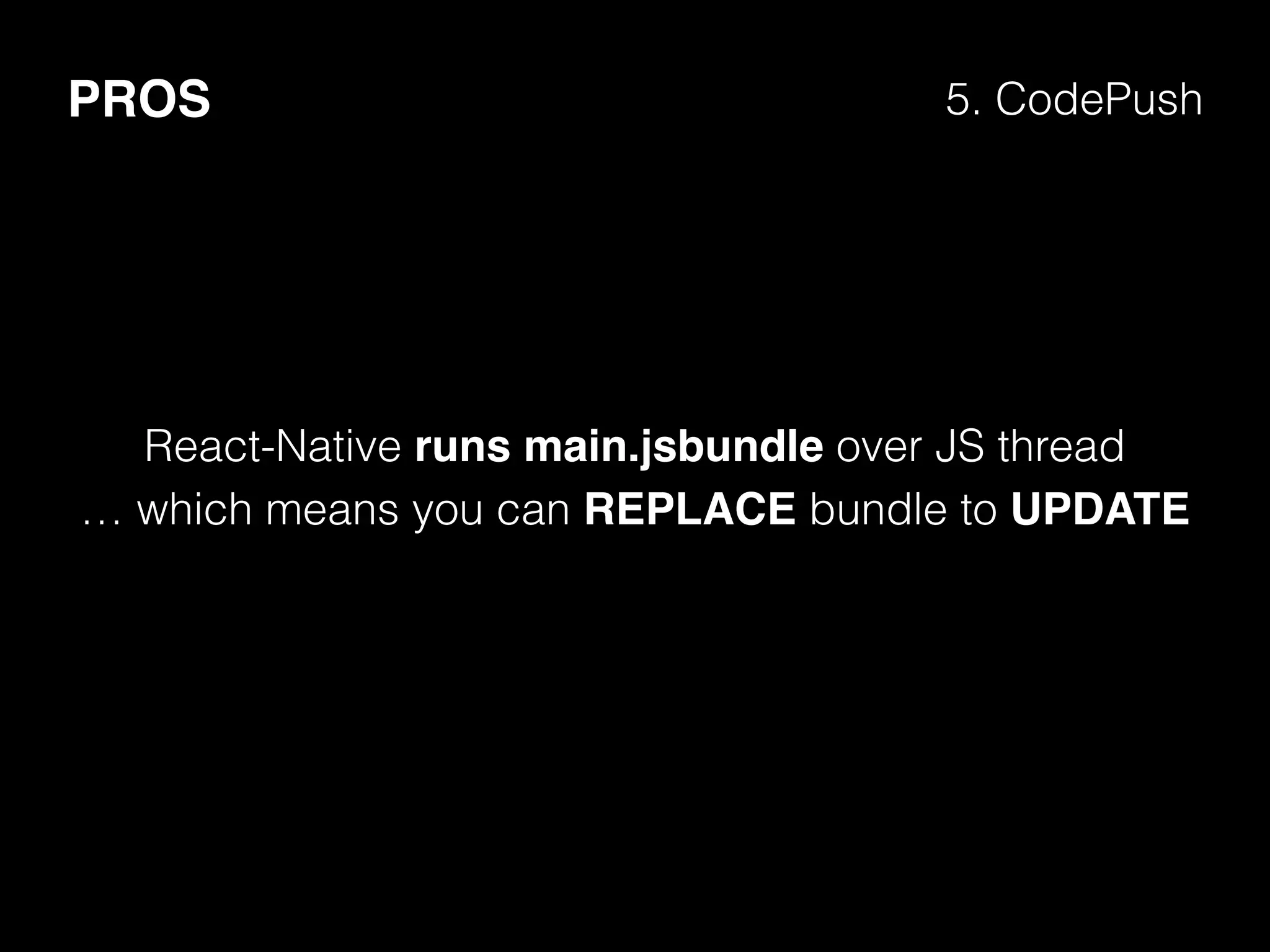
React-Native runs main.jsbundle over JS thread
… which means you can REPLACE bundle to UPDATE
PROS 5. CodePush
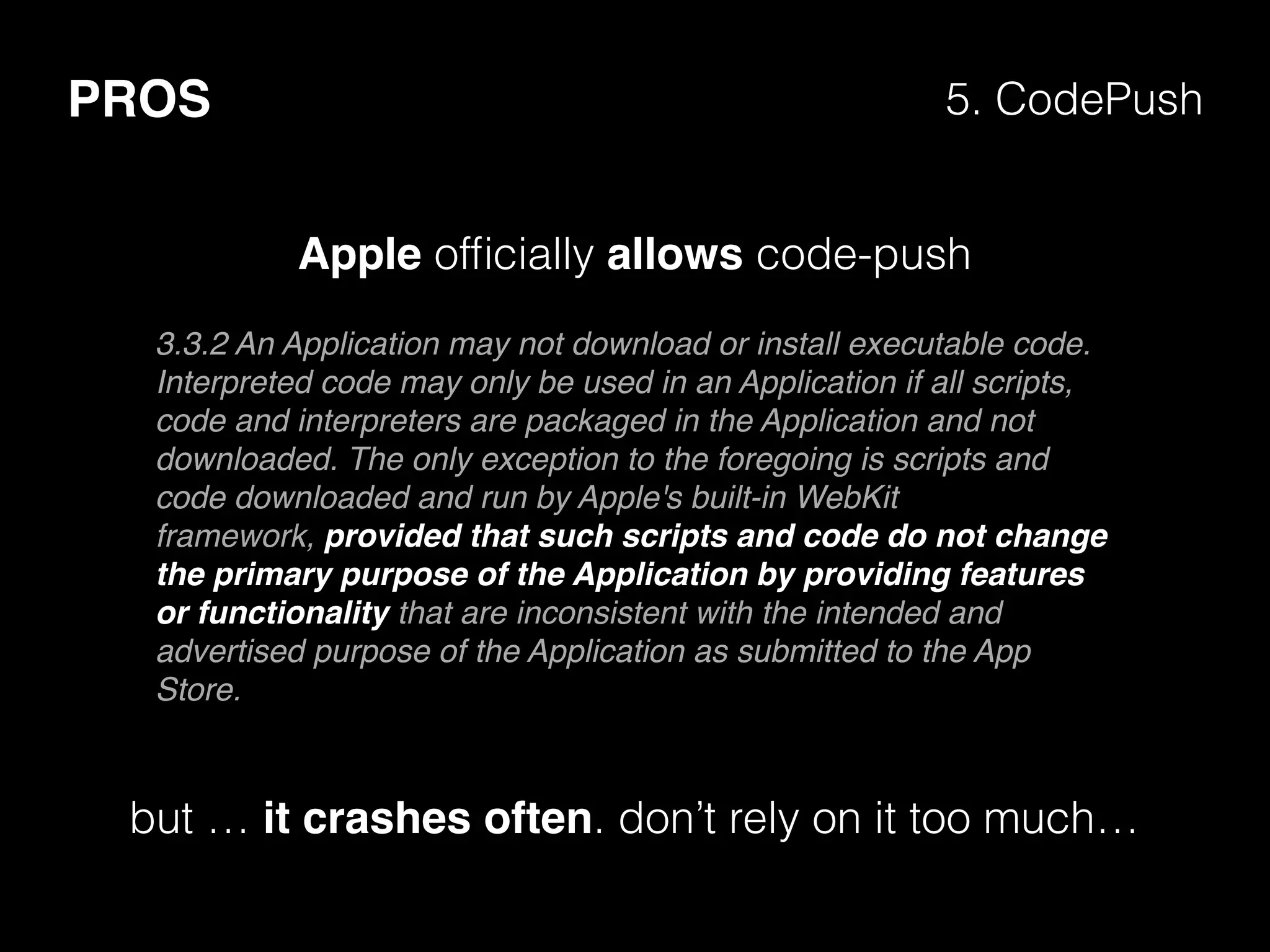
3.3.2 An Application may not download or install executable code.
Interpreted code may only be used in an Application if all scripts,
code and interpreters are packaged in the Application and not
downloaded. The only exception to the foregoing is scripts and
code downloaded and run by Apple's built-in WebKit
framework, provided that such scripts and code do not change
the primary purpose of the Application by providing features
or functionality that are inconsistent with the intended and
advertised purpose of the Application as submitted to the App
Store.
but … it crashes often. don’t rely on it too much…
Apple officially allows code-push
PROS 6. Unit Test
Integration test sucks
1. difficult to write test,
2. impossible to keep it updated
3. takes forever but unreliable
PROS 6. Unit Test
MOCHA ENZYMECHAI
PROS 6. Unit Test
Writing test for react-native is actually fun and easy
Mocha, Enzyme and Chai make it possible
PROS 6. Unit Test
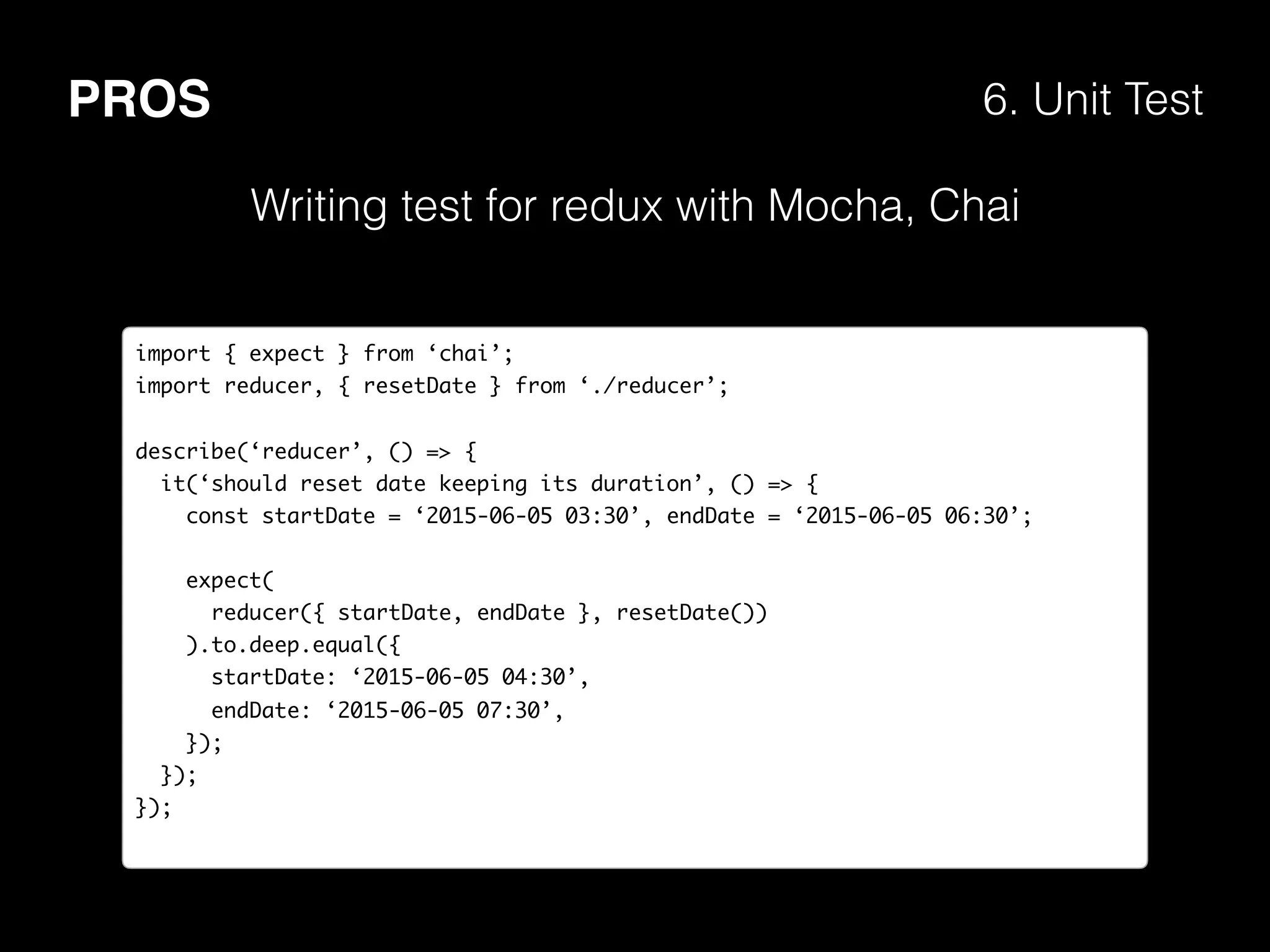
import { expect } from ‘chai’;
import reducer, { resetDate } from ‘./reducer’;
describe(‘reducer’, () => {
it(‘should reset date keeping its duration’, () => {
const startDate = ‘2015-06-05 03:30’, endDate = ‘2015-06-05 06:30’;
expect(
reducer({ startDate, endDate }, resetDate())
).to.deep.equal({
startDate: ‘2015-06-05 04:30’,
endDate: ‘2015-06-05 07:30’,
});
});
});
Writing test for redux with Mocha, Chai
PROS 6. Unit Test
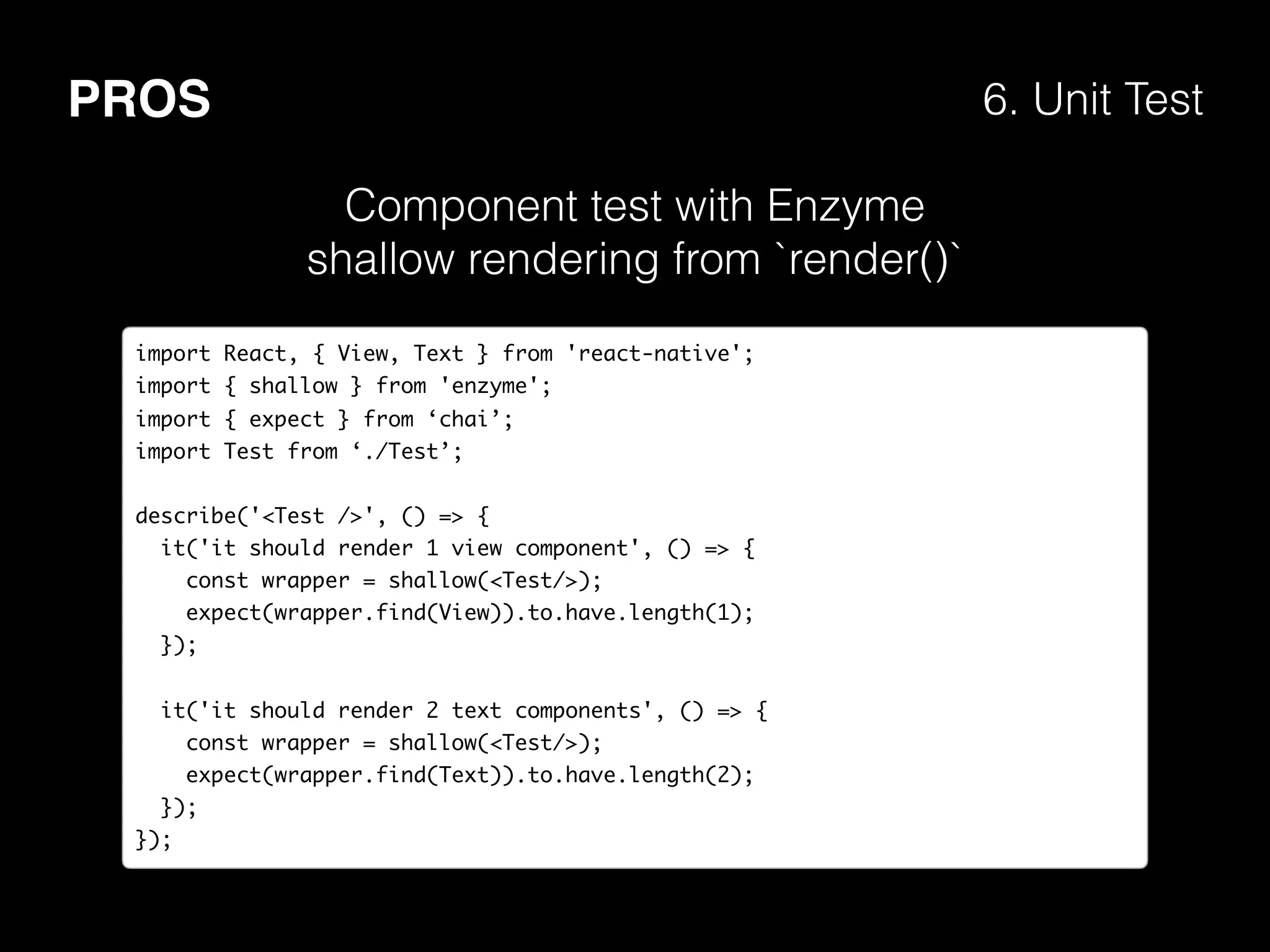
import React, { View, Text } from 'react-native';
import { shallow } from 'enzyme';
import { expect } from ‘chai’;
import Test from ‘./Test’;
describe('<Test />', () => {
it('it should render 1 view component', () => {
const wrapper = shallow(<Test/>);
expect(wrapper.find(View)).to.have.length(1);
});
it('it should render 2 text components', () => {
const wrapper = shallow(<Test/>);
expect(wrapper.find(Text)).to.have.length(2);
});
});
Component test with Enzyme
shallow rendering from `render()`
CONS
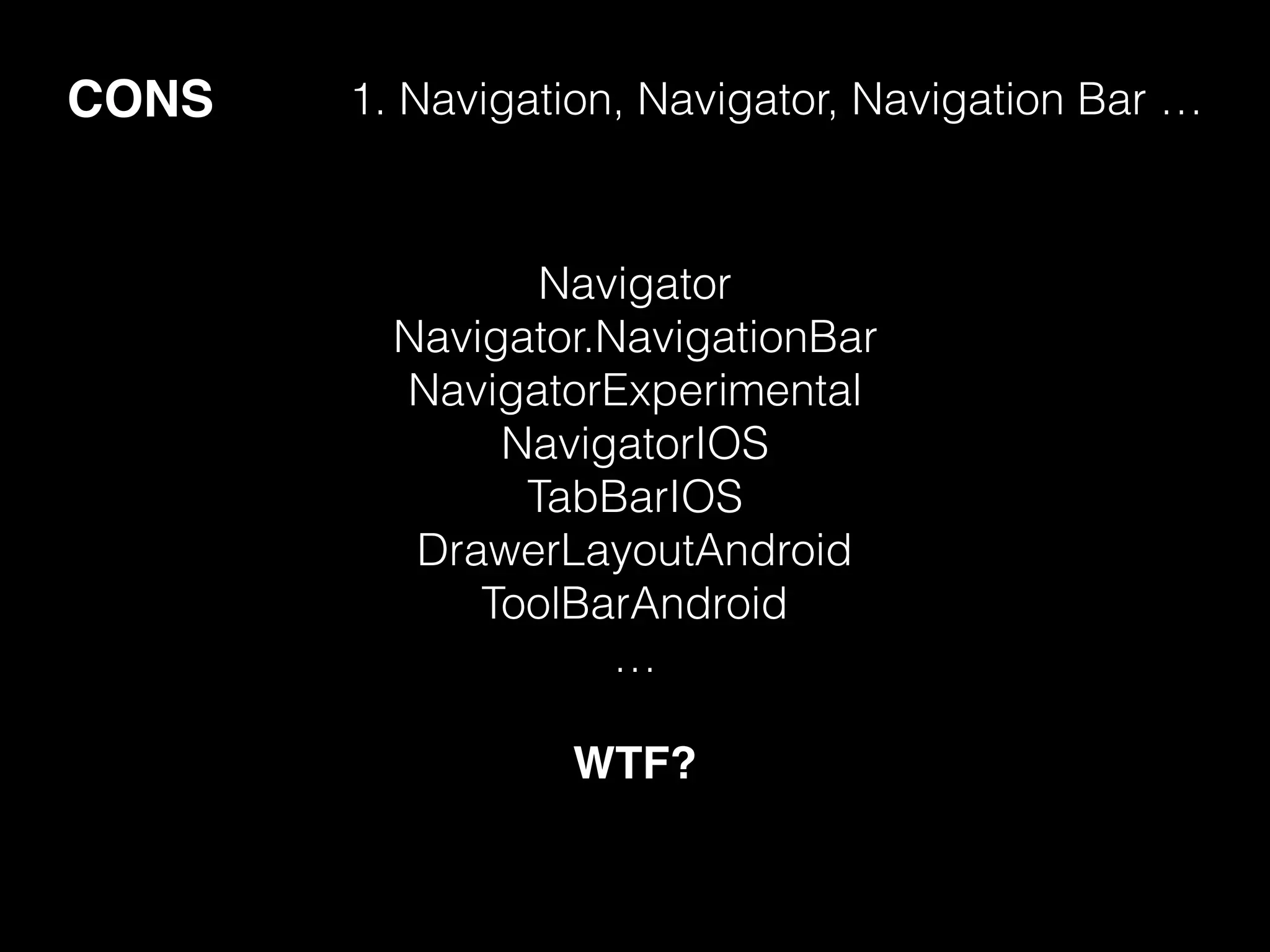
CONS 1. Navigation, Navigator, Navigation Bar …
Navigator
Navigator.NavigationBar
NavigatorExperimental
NavigatorIOS
TabBarIOS
DrawerLayoutAndroid
ToolBarAndroid
…
WTF?
CONS 2. Poor documentation, frequent updates
Pooooooooooooor documentation
frequent breaking changes updates
CONS 3. Native Modules
Comparably easier than others
But it take time, efforts and native developer
CONS 4. Schrodinger’s cat in the box
You know nothing Jon Snow inside
CONS 5. Performance
Everyone talks about this but we never felt that yet
performance has never been an issue
there are a lot of other problems to solve…
CONS 5. Performance
Don’t forget this is not meant to work for everything
it has pros and cons and things getting better
but it is true that native app is faster in many ways
POST-MORTEM
POST-MORTEM
Easy to develop
Okay to distribute
Hard to keep it updated
POST-MORTEM
DOs
use redux and code-push
abstract react-native apis
wrap components with container
use npm private registry to share validation
use setState carefully
POST-MORTEM
DON’Ts
don’t believe in react-native packages
use carefully custom router to maximize native experience
don’t think of it as native environment
code-push has problem with redux
nesting components is harmful
SUMMARY
Easy for web front-end developer
Apple allows code-push update for sure
It is almost impossible to catch run-time crash
react-native packages always make problems
build just broke sometimes especially on android
POST-MORTEM
POST-MORTEM
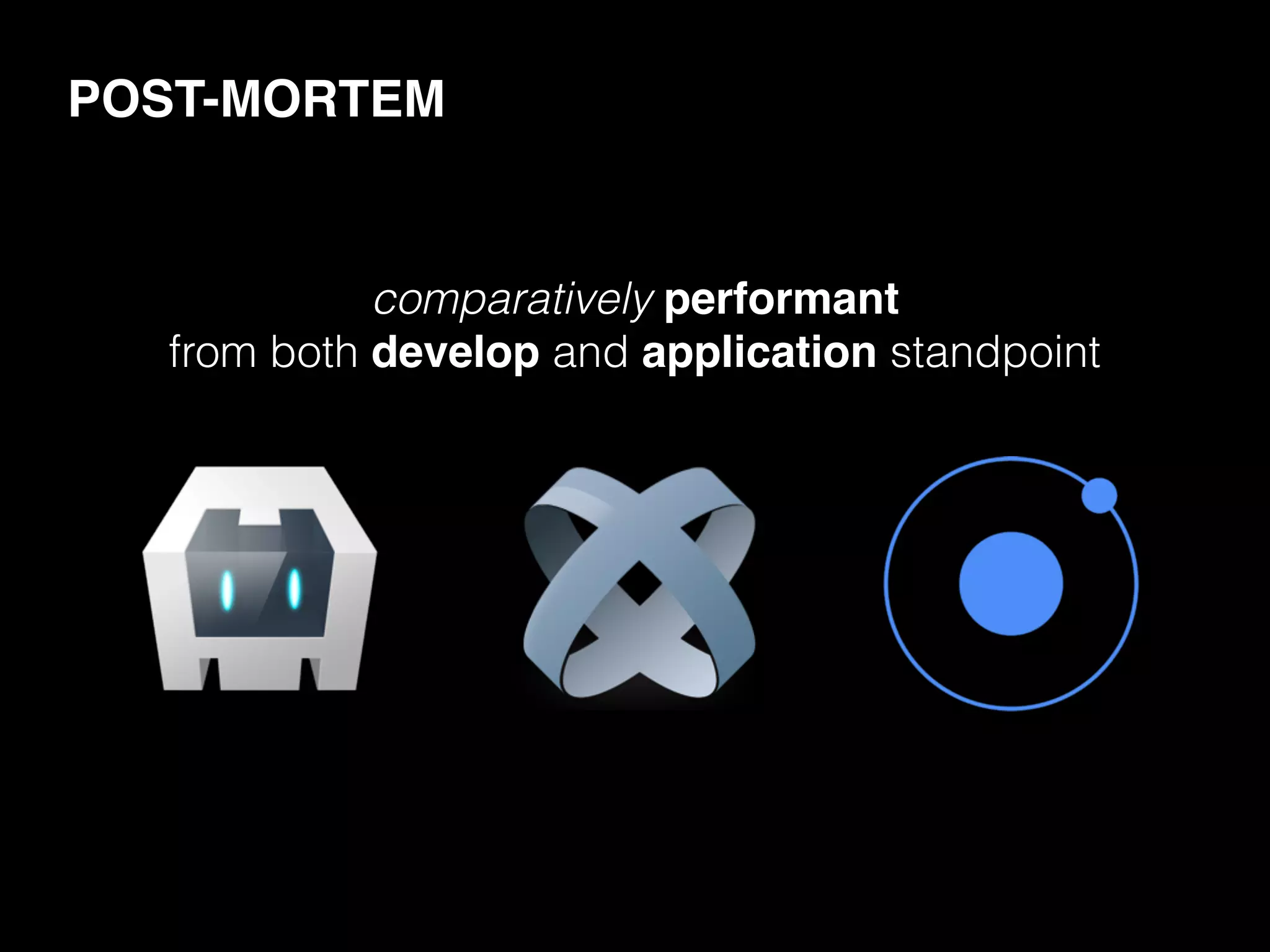
comparatively performant
from both develop and application standpoint
POST-MORTEM
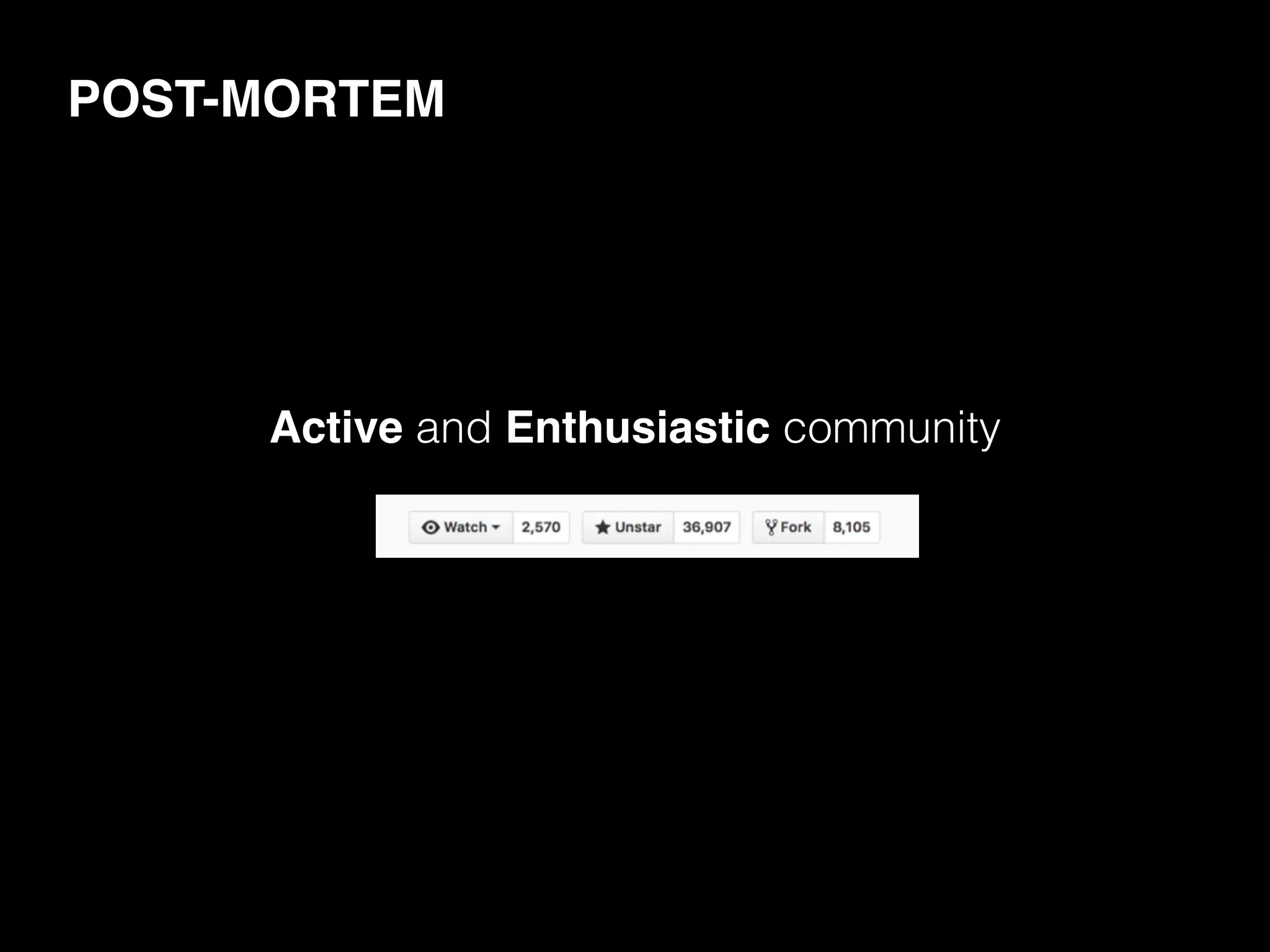
Active and Enthusiastic community
CONCLUSION
Applicable for production use
WE ARE HIRING
JOIN TO WORK TOGETHER
http://socar.recruiter.co.kr
http://seokjun.kr
More stories…

React Native in Production

  • 1.
    React Native inProduction Build Native Mobile Apps using JavaScript and React
  • 2.
    Kim Seokjun akaalma Front-end web developer at SOCAR Working as DevOps - react.js, react-native, node.js, express.js, docker Interested in - go, tensorflow, functional programming
  • 3.
  • 5.
  • 6.
  • 7.
  • 8.
    WHY? 1. Toavoid risk mixing Single bug may affect two services SOCAR is already huge and complex application
  • 9.
    WHY? 2. Notmuch to share with SOCAR ZEROCAR is running over SOCAR but in behavioral standpoint it’s not
  • 10.
    WHY? 3. Minimizefeatures and quick updates Feature list was too long for 3 weeks So decided to spec out most and focus on criticals
  • 11.
    WHY? 4. iOSand Android Android 60% iOS 40%
  • 12.
    WHY? 5. Reactexperienced web developer
  • 13.
  • 14.
  • 15.
    PROS 1. It’sREACT! React + Redux + ES6 = Awesome! import { ScrollView } from ‘react-native’ import { Profile, SharingStatus, Scheduler } from ‘@components’ class HomeContainer extends React { refresh() { fetch(‘http://api.url).then((res) => this.props.getSharingStatus(res)) } render() { <ScrollView> <Profile /> <SharingStatus /> <Scheduler /> </ScrollView> } }
  • 16.
    PROS 2. FLEXLayout CSS the good parts : Flex layout is very Flexible <View style={{ flex: 1 }}> <View style={{ flex: 1 }} /> <View style={{ flex: 1 }} /> <View style={{ height: 100 }} /> </View> height: 100 flex: 1 flex: 1 Viewport
  • 17.
    PROS 2. FLEXLayout CSS the good parts : Flex layout is very Flexible flex: 1 flex: 1 Viewport <View style={{ height: 50, flexDirection: ‘row’ }}> <View style={{ flex: 1 }} /> <View style={{ flex: 1 }} /> </View> height: 50 flexDirection: ‘row’
  • 18.
    PROS 2. FLEXLayout CSS the good parts : Flex layout is very Flexible <View style={{ justifyContent: ‘center’, alignItems: ‘center’, }} > <Text style={{ width: 50, }} > Centered </Text> </View> Centered Viewport justifyContent: ‘center’ alignItems: ‘center’
  • 19.
    PROS 3. Nocompile, Hot-reload Thank you Dan! I love you! Really! Love you! My Jesus! Dan Abramov, author of Redux and React Hot Reloader
  • 20.
    PROS 4. TheJavascript Lodash Moment.js Accounting
  • 21.
    PROS 4. TheJavascript Lodash : the functional programming const getCamelCased = (text: string) => { if (!text) return null; return text.replace(/-([a-z])/g, (g) => g[1].toUpperCase()); }; const getButtonStyle = (className) => { if (!className) return null; return _.chain(['btn', 'normal', ...className.split(/s/)]) .map(elem => styles[getCamelCased(elem)]) .value(); };
  • 22.
    PROS 4. TheJavascript Moment : date-time eternal villain for developer const getMinStartDate = (endDate) => { if (endDate) return moment(endDate).subtract(120, 'minutes'); const now = moment(); const currentMinute = now.minute(); const currentSeconds = now.second(); const currentMilliSeconds = now.millisecond(); const remainder = (currentMinute > 0) ? 10 - (currentMinute % 10) : 10; return moment(start) .add(remainder, 'minutes') .subtract(currentSeconds, 'seconds') .subtract(currentMilliSeconds, 'milliseconds'); },
  • 23.
    PROS 4. TheJavascript Accounting : the easiest way to format number to currency // Default usage: accounting.formatMoney(12345678); // $12,345,678.00 // European formatting (custom symbol and separators), can also use options object as second parameter: accounting.formatMoney(4999.99, "₩", 2, ".", ","); // ₩4.999,99 // Negative values can be formatted nicely: accounting.formatMoney(-500000, "£ ", 0); // £ -500,000 // Simple `format` string allows control of symbol position (%v = value, %s = symbol): accounting.formatMoney(5318008, { symbol: "원", format: "%v %s" }); // 5,318,008.00 원
  • 24.
    PROS 5. CodePush React-Nativeruns main.jsbundle over JS thread … which means you can REPLACE bundle to UPDATE
  • 25.
    PROS 5. CodePush 3.3.2An Application may not download or install executable code. Interpreted code may only be used in an Application if all scripts, code and interpreters are packaged in the Application and not downloaded. The only exception to the foregoing is scripts and code downloaded and run by Apple's built-in WebKit framework, provided that such scripts and code do not change the primary purpose of the Application by providing features or functionality that are inconsistent with the intended and advertised purpose of the Application as submitted to the App Store. but … it crashes often. don’t rely on it too much… Apple officially allows code-push
  • 26.
    PROS 6. UnitTest Integration test sucks 1. difficult to write test, 2. impossible to keep it updated 3. takes forever but unreliable
  • 27.
    PROS 6. UnitTest MOCHA ENZYMECHAI
  • 28.
    PROS 6. UnitTest Writing test for react-native is actually fun and easy Mocha, Enzyme and Chai make it possible
  • 29.
    PROS 6. UnitTest import { expect } from ‘chai’; import reducer, { resetDate } from ‘./reducer’; describe(‘reducer’, () => { it(‘should reset date keeping its duration’, () => { const startDate = ‘2015-06-05 03:30’, endDate = ‘2015-06-05 06:30’; expect( reducer({ startDate, endDate }, resetDate()) ).to.deep.equal({ startDate: ‘2015-06-05 04:30’, endDate: ‘2015-06-05 07:30’, }); }); }); Writing test for redux with Mocha, Chai
  • 30.
    PROS 6. UnitTest import React, { View, Text } from 'react-native'; import { shallow } from 'enzyme'; import { expect } from ‘chai’; import Test from ‘./Test’; describe('<Test />', () => { it('it should render 1 view component', () => { const wrapper = shallow(<Test/>); expect(wrapper.find(View)).to.have.length(1); }); it('it should render 2 text components', () => { const wrapper = shallow(<Test/>); expect(wrapper.find(Text)).to.have.length(2); }); }); Component test with Enzyme shallow rendering from `render()`
  • 31.
  • 32.
    CONS 1. Navigation,Navigator, Navigation Bar … Navigator Navigator.NavigationBar NavigatorExperimental NavigatorIOS TabBarIOS DrawerLayoutAndroid ToolBarAndroid … WTF?
  • 33.
    CONS 2. Poordocumentation, frequent updates Pooooooooooooor documentation frequent breaking changes updates
  • 34.
    CONS 3. NativeModules Comparably easier than others But it take time, efforts and native developer
  • 35.
    CONS 4. Schrodinger’scat in the box You know nothing Jon Snow inside
  • 36.
    CONS 5. Performance Everyonetalks about this but we never felt that yet performance has never been an issue there are a lot of other problems to solve…
  • 37.
    CONS 5. Performance Don’tforget this is not meant to work for everything it has pros and cons and things getting better but it is true that native app is faster in many ways
  • 38.
  • 39.
    POST-MORTEM Easy to develop Okayto distribute Hard to keep it updated
  • 40.
    POST-MORTEM DOs use redux andcode-push abstract react-native apis wrap components with container use npm private registry to share validation use setState carefully
  • 41.
    POST-MORTEM DON’Ts don’t believe inreact-native packages use carefully custom router to maximize native experience don’t think of it as native environment code-push has problem with redux nesting components is harmful
  • 42.
    SUMMARY Easy for webfront-end developer Apple allows code-push update for sure It is almost impossible to catch run-time crash react-native packages always make problems build just broke sometimes especially on android POST-MORTEM
  • 43.
    POST-MORTEM comparatively performant from bothdevelop and application standpoint
  • 44.
  • 45.
  • 46.
  • 48.
    WE ARE HIRING JOINTO WORK TOGETHER http://socar.recruiter.co.kr
  • 49.