Reaching Ethical Maturity:
The Ethical Development of
Public Relations Practice
Module Two | Lesson Two
Lesson Two | Principles
Lesson Overview
• Ethical development in public relations
• Public relations models:
– Press agentry/publicity
– Public information
– Two-way asymmetrical
– Two-way symmetrical
• TARES
• Pillars of public relations ethics
Lesson Two | Principles
Ethical Progression of
Moral Obligations
• Themselves
• Clients
• Organizations/employers
• Profession/colleagues
• Society
Lesson Two | Principles
Press Agentry Model
• Publicity
• Focus on self-interest
• Teleology orientation
– Outcome more important than the process
Lesson Two | Principles
Discussion Question
Explain how the press agentry model
exemplifies a teleological approach.
What are the ethical advantages/
disadvantages of this practice of
public relations?
Lesson Two | Principles
Public Information Model
• “Journalist in residence”
• Focus on truthful and accurate information
• Deontology orientation
– Professional codes of ethics guide behavior
Lesson Two | Principles
Discussion Question
How does the application of the PRSA
code of ethics represent a
deontological approach in the public
information model of public relations?
Lesson Two | Principles
Two-Way Asymmetrical Model
• Persuasive communication
• Feedback loop offers an “other” ethical
perspective
• Teleology orientation
– Risks/Benefits assessment to maximize benefit
and minimize harm
Lesson Two | Principles
Discussion Question
How does the two-way asymmetrical
public relations model offer an “other”
perspective absent from the two lesser
models? Why is this perspective
important to ethical development?
Lesson Two | Principles
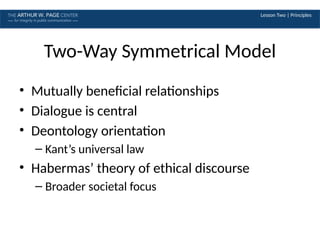
Two-Way Symmetrical Model
• Mutually beneficial relationships
• Dialogue is central
• Deontology orientation
– Kant’s universal law
• Habermas’ theory of ethical discourse
– Broader societal focus
Lesson Two | Principles
Discussion Question
How does Habermas’ theory of ethical
discourse support the ethical practice
of two-way symmetrical
public relations?
Lesson Two | Principles
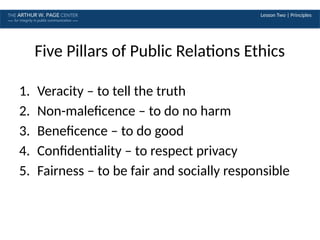
Five Pillars of Public Relations Ethics
1. Veracity – to tell the truth
2. Non-maleficence – to do no harm
3. Beneficence – to do good
4. Confidentiality – to respect privacy
5. Fairness – to be fair and socially responsible
Lesson Two | Principles
Discussion Question
How might the pillars of ethical public
relations guide the ethical behavior of
public relations professionals?

ReachingEthicalMaturitylesson_two_PP.pptx

  • 1.
    Reaching Ethical Maturity: TheEthical Development of Public Relations Practice Module Two | Lesson Two
  • 2.
    Lesson Two |Principles Lesson Overview • Ethical development in public relations • Public relations models: – Press agentry/publicity – Public information – Two-way asymmetrical – Two-way symmetrical • TARES • Pillars of public relations ethics
  • 3.
    Lesson Two |Principles Ethical Progression of Moral Obligations • Themselves • Clients • Organizations/employers • Profession/colleagues • Society
  • 4.
    Lesson Two |Principles Press Agentry Model • Publicity • Focus on self-interest • Teleology orientation – Outcome more important than the process
  • 5.
    Lesson Two |Principles Discussion Question Explain how the press agentry model exemplifies a teleological approach. What are the ethical advantages/ disadvantages of this practice of public relations?
  • 6.
    Lesson Two |Principles Public Information Model • “Journalist in residence” • Focus on truthful and accurate information • Deontology orientation – Professional codes of ethics guide behavior
  • 7.
    Lesson Two |Principles Discussion Question How does the application of the PRSA code of ethics represent a deontological approach in the public information model of public relations?
  • 8.
    Lesson Two |Principles Two-Way Asymmetrical Model • Persuasive communication • Feedback loop offers an “other” ethical perspective • Teleology orientation – Risks/Benefits assessment to maximize benefit and minimize harm
  • 9.
    Lesson Two |Principles Discussion Question How does the two-way asymmetrical public relations model offer an “other” perspective absent from the two lesser models? Why is this perspective important to ethical development?
  • 10.
    Lesson Two |Principles Two-Way Symmetrical Model • Mutually beneficial relationships • Dialogue is central • Deontology orientation – Kant’s universal law • Habermas’ theory of ethical discourse – Broader societal focus
  • 11.
    Lesson Two |Principles Discussion Question How does Habermas’ theory of ethical discourse support the ethical practice of two-way symmetrical public relations?
  • 12.
    Lesson Two |Principles Five Pillars of Public Relations Ethics 1. Veracity – to tell the truth 2. Non-maleficence – to do no harm 3. Beneficence – to do good 4. Confidentiality – to respect privacy 5. Fairness – to be fair and socially responsible
  • 13.
    Lesson Two |Principles Discussion Question How might the pillars of ethical public relations guide the ethical behavior of public relations professionals?