A Customer Journey
RE-ENGINEERING
THE JOB LEVELLING
ARCHITECTURE
We wish to re-design our job levelling architecture in entirety, changing
our job roles, levels and job grading design, primarily to prepare the
organization for the expected business growth & potential expansion while
also being in line with industry trends in this space. We are looking for the
exercise to be comprehensive including Job descriptions and Career paths,
with our employees being mapped to job levels as per the new
architecture.
AN INVITATION
A MOBILITY MAJOR’S LEADERSHIP TEAM
The benefits of job levelling for reward are enduring,
bringing consistency and a hierarchy for the
management of pay and benefits. A well researched and
resolute job levelling framework can define roles in an
organization, assign relative value of jobs in an
organization and create contribution specific job bands.
There are three significant areas of impact for a well
defined job levelling Framework.
a. Focus on Roles and not Jobs: By defining positions
in a broader accountability sense than task-based jobs, it
leads to fewer roles than jobs, which are more
sustainable being less likely to change. This in turn
means clearer career paths, with role descriptions being
central
​a central place for role-specific performance, recruitment
and competence requirements.
​b. A Career Architecture : The grouping of roles into
bands based on responsibilities and contributions
provides a focus for career pathing and development
work.
​c. Consistency and Scalability for Growth: The job
levelling and grading architecture plays a crucial role in
ensuring consistency of roles across the organization.
As an organization grows, a carefully crafted job levelling
architecture stays relevant.
TheProject
JOB LEVELING
& GRADING
INDUSTRY
RESEARCH & BEST
PRACTICES
ORG
STRUCTURAL
ANALYSIS
INTERNAL JOB
ANALYSIS
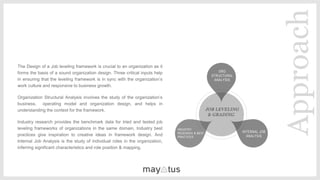
​The Design of a Job leveling framework is crucial to an organization as it
forms the basis of a sound organization design. Three critical inputs help
in ensuring that the leveling framework is in sync with the organization’s
work culture and responsive to business growth.
​Organization Structural Analysis involves the study of the organization’s
business, operating model and organization design, and helps in
understanding the context for the framework.
​Industry research provides the benchmark data for tried and tested job
leveling frameworks of organizations in the same domain. Industry best
practices give inspiration to creative ideas in framework design. And
Internal Job Analysis is the study of individual roles in the organization,
inferring significant characteristics and role position & mapping.
Approach
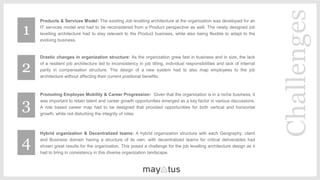
​Products & Services Model: The existing Job levelling architecture at the organization was developed for an
IT services model and had to be reconsidered from a Product perspective as well. The newly designed job
levelling architecture had to stay relevant to the Product business, while also being flexible to adapt to the
evolving business.
Drastic changes in organization structure: As the organization grew fast in business and in size, the lack
of a resilient job architecture led to inconsistency in job titling, individual responsibilities and lack of internal
parity in compensation structure. The design of a new system had to also map employees to the job
architecture without affecting their current positional benefits.
Promoting Employee Mobility & Career Progression: Given that the organization is in a niche business, it
was important to retain talent and career growth opportunities emerged as a key factor in various discussions.
A role based career map had to be designed that provided opportunities for both vertical and horizontal
growth, while not disturbing the integrity of roles.
Hybrid organization & Decentralized teams: A hybrid organization structure with each Geography, client
and Business domain having a structure of its own, with decentralized teams for critical deliverables had
shown great results for the organization. This posed a challenge for the job levelling architecture design as it
had to bring in consistency in this diverse organization landscape.
Challenges
1
2
3
4
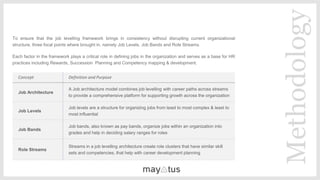
​To ensure that the job levelling framework brings in consistency without disrupting current organizational
structure, three focal points where brought in, namely Job Levels, Job Bands and Role Streams.
​Each factor in the framework plays a critical role in defining jobs in the organization and serves as a base for HR
practices including Rewards, Succession Planning and Competency mapping & development.
Concept Definition and Purpose
Job Architecture
​A Job architecture model combines job levelling with career paths across streams
to provide a comprehensive platform for supporting growth across the organization
​Job Levels
​Job levels are a structure for organizing jobs from least to most complex & least to
most influential
​Job Bands
​Job bands, also known as pay bands, organize jobs within an organization into
grades and help in deciding salary ranges for roles
​Role Streams
​Streams in a job levelling architecture create role clusters that have similar skill
sets and competencies, that help with career development planning
Methodology
Result
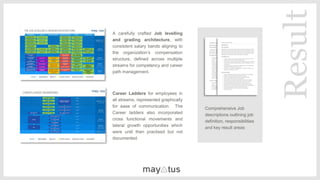
​A carefully crafted Job levelling
and grading architecture, with
consistent salary bands aligning to
the organization’s compensation
structure, defined across multiple
streams for competency and career
path management.
​Career Ladders for employees in
all streams, represented graphically
for ease of communication. The
Career ladders also incorporated
cross functional movements and
lateral growth opportunities which
were until then practised but not
documented.
​Comprehensive Job
descriptions outlining job
definition, responsibilities
and key result areas
​TALENT ACQUISITION & RETENTION: A Market aligned job structure designed to attract and retain Talent.
​RESILIENT TO GROWTH: A job levelling architecture that is designed to be future proof, creating provisions to ensure
that it stays relevant as the organization grows to a maximum of 10,000 member business.
​CONSISTENCY IN COMPENSATION BANDS: A Single banding structure across technical and non-technical roles can
help to align with the internal compensation grid – maintain internal parity.
​GREATER GROWTH OPTIONS FOR EMPLOYEES: More leveling under each grade to accommodate multiple roles
which leverages years of experience vs potential. Designation hierarchy helps employee aspiration over all and reduces
attrition.
​A FIRST STEP IN COMPETENCY MANAGEMENT: Stream definition helps to build and develop competencies. It can
make hiring more effective with Competency based evaluation based on position KRA.
​EFFECTIVE PERFORMANCE MANAGEMENT: Goal setting/measurement when aligned to KRA, can bring in
objectivity in the process. The same effect can be beneficial in salary increment indexing and internal promotions.
Benefits
I speak for the entire Leadership team
when I say that Mayotus is the first HR
Consultant who has spent so much time
to understand the business and
delivered a completely tailored solution.
We are very excited with the new job
levelling architecture !
Director & Chief Advisor, The Mobility Major
CONTACT US
Pradeepa Ravindran, Chief Strategist
pradeepa@mayotus.consulting
91 89392 11122
Mayotus is a professional consulting services company that
helps Organizations improve performance through effective
people. We offer consulting, technology and solutions in the
area of Human Capital Management.
www.mayotus.consulting

Re engineering the Job levelling architecture

  • 1.
    A Customer Journey RE-ENGINEERING THEJOB LEVELLING ARCHITECTURE
  • 2.
    We wish tore-design our job levelling architecture in entirety, changing our job roles, levels and job grading design, primarily to prepare the organization for the expected business growth & potential expansion while also being in line with industry trends in this space. We are looking for the exercise to be comprehensive including Job descriptions and Career paths, with our employees being mapped to job levels as per the new architecture. AN INVITATION A MOBILITY MAJOR’S LEADERSHIP TEAM
  • 3.
    The benefits ofjob levelling for reward are enduring, bringing consistency and a hierarchy for the management of pay and benefits. A well researched and resolute job levelling framework can define roles in an organization, assign relative value of jobs in an organization and create contribution specific job bands. There are three significant areas of impact for a well defined job levelling Framework. a. Focus on Roles and not Jobs: By defining positions in a broader accountability sense than task-based jobs, it leads to fewer roles than jobs, which are more sustainable being less likely to change. This in turn means clearer career paths, with role descriptions being central ​a central place for role-specific performance, recruitment and competence requirements. ​b. A Career Architecture : The grouping of roles into bands based on responsibilities and contributions provides a focus for career pathing and development work. ​c. Consistency and Scalability for Growth: The job levelling and grading architecture plays a crucial role in ensuring consistency of roles across the organization. As an organization grows, a carefully crafted job levelling architecture stays relevant. TheProject
  • 4.
    JOB LEVELING & GRADING INDUSTRY RESEARCH& BEST PRACTICES ORG STRUCTURAL ANALYSIS INTERNAL JOB ANALYSIS ​The Design of a Job leveling framework is crucial to an organization as it forms the basis of a sound organization design. Three critical inputs help in ensuring that the leveling framework is in sync with the organization’s work culture and responsive to business growth. ​Organization Structural Analysis involves the study of the organization’s business, operating model and organization design, and helps in understanding the context for the framework. ​Industry research provides the benchmark data for tried and tested job leveling frameworks of organizations in the same domain. Industry best practices give inspiration to creative ideas in framework design. And Internal Job Analysis is the study of individual roles in the organization, inferring significant characteristics and role position & mapping. Approach
  • 5.
    ​Products & ServicesModel: The existing Job levelling architecture at the organization was developed for an IT services model and had to be reconsidered from a Product perspective as well. The newly designed job levelling architecture had to stay relevant to the Product business, while also being flexible to adapt to the evolving business. Drastic changes in organization structure: As the organization grew fast in business and in size, the lack of a resilient job architecture led to inconsistency in job titling, individual responsibilities and lack of internal parity in compensation structure. The design of a new system had to also map employees to the job architecture without affecting their current positional benefits. Promoting Employee Mobility & Career Progression: Given that the organization is in a niche business, it was important to retain talent and career growth opportunities emerged as a key factor in various discussions. A role based career map had to be designed that provided opportunities for both vertical and horizontal growth, while not disturbing the integrity of roles. Hybrid organization & Decentralized teams: A hybrid organization structure with each Geography, client and Business domain having a structure of its own, with decentralized teams for critical deliverables had shown great results for the organization. This posed a challenge for the job levelling architecture design as it had to bring in consistency in this diverse organization landscape. Challenges 1 2 3 4
  • 6.
    ​To ensure thatthe job levelling framework brings in consistency without disrupting current organizational structure, three focal points where brought in, namely Job Levels, Job Bands and Role Streams. ​Each factor in the framework plays a critical role in defining jobs in the organization and serves as a base for HR practices including Rewards, Succession Planning and Competency mapping & development. Concept Definition and Purpose Job Architecture ​A Job architecture model combines job levelling with career paths across streams to provide a comprehensive platform for supporting growth across the organization ​Job Levels ​Job levels are a structure for organizing jobs from least to most complex & least to most influential ​Job Bands ​Job bands, also known as pay bands, organize jobs within an organization into grades and help in deciding salary ranges for roles ​Role Streams ​Streams in a job levelling architecture create role clusters that have similar skill sets and competencies, that help with career development planning Methodology
  • 7.
    Result ​A carefully craftedJob levelling and grading architecture, with consistent salary bands aligning to the organization’s compensation structure, defined across multiple streams for competency and career path management. ​Career Ladders for employees in all streams, represented graphically for ease of communication. The Career ladders also incorporated cross functional movements and lateral growth opportunities which were until then practised but not documented. ​Comprehensive Job descriptions outlining job definition, responsibilities and key result areas
  • 8.
    ​TALENT ACQUISITION &RETENTION: A Market aligned job structure designed to attract and retain Talent. ​RESILIENT TO GROWTH: A job levelling architecture that is designed to be future proof, creating provisions to ensure that it stays relevant as the organization grows to a maximum of 10,000 member business. ​CONSISTENCY IN COMPENSATION BANDS: A Single banding structure across technical and non-technical roles can help to align with the internal compensation grid – maintain internal parity. ​GREATER GROWTH OPTIONS FOR EMPLOYEES: More leveling under each grade to accommodate multiple roles which leverages years of experience vs potential. Designation hierarchy helps employee aspiration over all and reduces attrition. ​A FIRST STEP IN COMPETENCY MANAGEMENT: Stream definition helps to build and develop competencies. It can make hiring more effective with Competency based evaluation based on position KRA. ​EFFECTIVE PERFORMANCE MANAGEMENT: Goal setting/measurement when aligned to KRA, can bring in objectivity in the process. The same effect can be beneficial in salary increment indexing and internal promotions. Benefits
  • 9.
    I speak forthe entire Leadership team when I say that Mayotus is the first HR Consultant who has spent so much time to understand the business and delivered a completely tailored solution. We are very excited with the new job levelling architecture ! Director & Chief Advisor, The Mobility Major
  • 10.
    CONTACT US Pradeepa Ravindran,Chief Strategist pradeepa@mayotus.consulting 91 89392 11122 Mayotus is a professional consulting services company that helps Organizations improve performance through effective people. We offer consulting, technology and solutions in the area of Human Capital Management. www.mayotus.consulting