Agenda and discussion points 
• New Age of Banking 
– Technology 
• Changes throughout the years 
• Budgeting & Cash flow 
– Steps 
– Financial Wellness 
– Investing 
• Borrowing for your Needs 
– Credit 
• Cards 
• Line of Credit/Loans 
• Credit Bureau 
– Debt Servicing Ratios 
• Questions and Answers?
New Age of Banking 
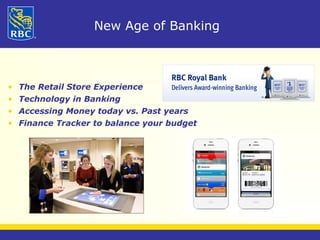
• The Retail Store Experience 
• Technology in Banking 
• Accessing Money today vs. Past years 
• Finance Tracker to balance your budget
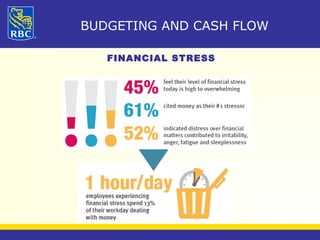
BUDGETING AND CASH FLOW 
FINANCIAL STRESS
BUDGETING AND CASH FLOW 
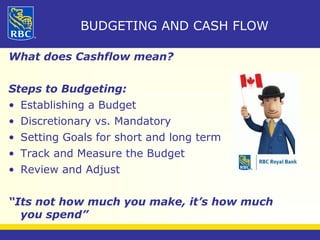
What does Cashflow mean? 
Steps to Budgeting: 
• Establishing a Budget 
• Discretionary vs. Mandatory 
• Setting Goals for short and long term 
• Track and Measure the Budget 
• Review and Adjust 
“Its not how much you make, it’s how much 
you spend”
BUDGETING AND CASH FLOW 
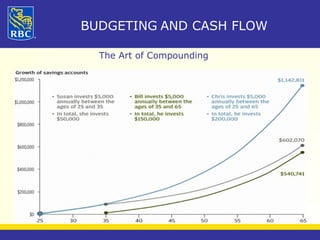
The Art of Compounding
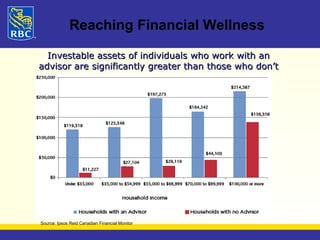
Reaching Financial Wellness 
Investable assets of individuals wwhhoo wwoorrkk wwiitthh aann 
aaddvviissoorr aarree ssiiggnniiffiiccaannttllyy ggrreeaatteerr tthhaann tthhoossee wwhhoo ddoonn’’tt 
Source: Ipsos Reid Canadian Financial Monitor
BORROWING FOR YOUR NEEDS 
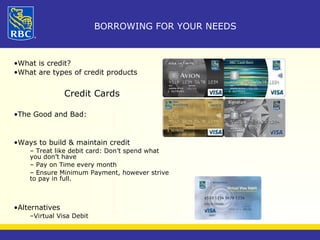
•What is credit? 
•What are types of credit products 
Credit Cards 
•The Good and Bad: 
•Ways to build & maintain credit 
– Treat like debit card: Don’t spend what 
you don’t have 
– Pay on Time every month 
– Ensure Minimum Payment, however strive 
to pay in full. 
•Alternatives 
–Virtual Visa Debit
BORROWING FOR YOUR NEEDS 
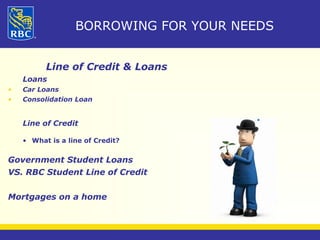
Line of Credit & Loans 
Loans 
• Car Loans 
• Consolidation Loan 
Line of Credit 
• What is a line of Credit? 
Government Student Loans 
VS. RBC Student Line of Credit 
Mortgages on a home
BORROWING FOR YOUR NEEDS 
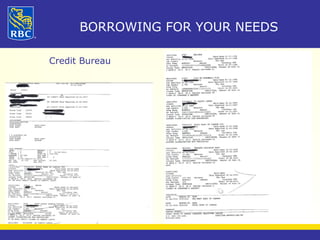
Credit Bureau
BORROWING FOR YOUR NEEDS 
Applying for Credit 
- Debt Servicing Ratios 
- Other Considerations for credit 
applications
RBC Royal Bank ** Great Student Banking 
Extended Hours of Business ** Post Secondary Lending 
7 Locations in Tri-Cities ** Co-Op & Work Experience

Rbc powerpoint presentation

  • 1.
    Agenda and discussionpoints • New Age of Banking – Technology • Changes throughout the years • Budgeting & Cash flow – Steps – Financial Wellness – Investing • Borrowing for your Needs – Credit • Cards • Line of Credit/Loans • Credit Bureau – Debt Servicing Ratios • Questions and Answers?
  • 2.
    New Age ofBanking • The Retail Store Experience • Technology in Banking • Accessing Money today vs. Past years • Finance Tracker to balance your budget
  • 3.
    BUDGETING AND CASHFLOW FINANCIAL STRESS
  • 4.
    BUDGETING AND CASHFLOW What does Cashflow mean? Steps to Budgeting: • Establishing a Budget • Discretionary vs. Mandatory • Setting Goals for short and long term • Track and Measure the Budget • Review and Adjust “Its not how much you make, it’s how much you spend”
  • 5.
    BUDGETING AND CASHFLOW The Art of Compounding
  • 6.
    Reaching Financial Wellness Investable assets of individuals wwhhoo wwoorrkk wwiitthh aann aaddvviissoorr aarree ssiiggnniiffiiccaannttllyy ggrreeaatteerr tthhaann tthhoossee wwhhoo ddoonn’’tt Source: Ipsos Reid Canadian Financial Monitor
  • 7.
    BORROWING FOR YOURNEEDS •What is credit? •What are types of credit products Credit Cards •The Good and Bad: •Ways to build & maintain credit – Treat like debit card: Don’t spend what you don’t have – Pay on Time every month – Ensure Minimum Payment, however strive to pay in full. •Alternatives –Virtual Visa Debit
  • 8.
    BORROWING FOR YOURNEEDS Line of Credit & Loans Loans • Car Loans • Consolidation Loan Line of Credit • What is a line of Credit? Government Student Loans VS. RBC Student Line of Credit Mortgages on a home
  • 9.
    BORROWING FOR YOURNEEDS Credit Bureau
  • 10.
    BORROWING FOR YOURNEEDS Applying for Credit - Debt Servicing Ratios - Other Considerations for credit applications
  • 11.
    RBC Royal Bank** Great Student Banking Extended Hours of Business ** Post Secondary Lending 7 Locations in Tri-Cities ** Co-Op & Work Experience

Editor's Notes

  • #2 Today we will be covering the following topics…read above
  • #3 RETAIL STORE EXPERIENCE: RBC is not only Canada’s largest Financial Institution but also a leader in innovation. Recently over the last few years we have opened new locations we call RBC Retail Stores. In fact one of these are in Port Coquitlam at Fremont Village. ASK: What do you think of when you think of a Retail Store in a Mall? How are you served, How do you interact with the products? - Much like other retail stores, we are available in the store to Welcome our clients as they enter, show them where to go, answer any questions they may have, or educate them with financial advice using our various forms of technology. - Usually a bank account, investment, or loan are not things you can “try on for size, or take for a test drive”…but with technology we can provide real examples and even personalize them for the individual to ensure they are getting value. We encourage you to visit this new RBC location in Port Coquitlam (Near Walmart & Canadian Tire). Compare our award winning design and customer experience against your existing bank. TECHNOLOGY IN BANKING: TRIVIA: What is this called and what is it used for? Answer: Cheque Register, used to balance one’s bank account manually. Today many RBC clients will use their bank account or credit cards and before they know it they have no idea where their money has gone. Due to conflicting priorities they don’t have time to “balance the books”. RBC has introduced RBC FINANCE TRACKER which will automatically track and categorize our clients transactions for their review. You can establish budgets and goals, and even have e-mail or text alerts sent to you “let’s say for example, when your dinning out is reaching near $500 in the month”. RBC has always prioritized technology as a way to remain relevant, improve our client experience, be accessible to our clients, and be Canada’s leading financial service provider. Here’s where we have come from: In 1972 RBC launched Canada’s first ATM in Toronto. In 1980 RBC expanded it’s ATM’s all across Canada. In 1995 RBC created Canada’s first Bank to have information available thru the “World Wide Web” In 2008 we had our 5 millionth customer log into RBC Online Banking. 2008 RBC went into the Mobile frontier, by creating an application available on cell phone mobile browser. Today many of our clients will do all of their banking thru their mobile device (smart phone or IPAD). Including check account activity, pay bills, transfer funds, do foreign exchange, and more. RBC also has client cards with Chip and Pin technology to improve security against fraud. Interac Tap technology for convinience and speed. Interac e-transfer allowing our clients to pay someone electronically by simply knowing their e-mail or phone number (sent by e-mail or text) BANK OF THE FUTURE- RBC continues to innovate and is currently working “e-wallet or virtual wallet technology” ASK: Who is a regular customer at Starbucks?…who can show me a Starbucks card?... Who can show me their Starbucks App on their phone? This will likely be the case for RBC clients in future….your cell phone could have a tap feature, or barcode feature to complete purchases in store. You will have access to your bank account or even a credit card all virtually thru your mobile device.
  • #4 Financial Stress is considered the #1 form of Stress. Leads to relationship strain (a contributor toward separations or divorce) , effects focus and performance at work, and can cause a negative physical and psychological effect on your body. Studies Show: Employees that are experiencing financial stress spend 13% of the work day dealing or thinking about their financial situation ultimately; effecting productivity. It may also impact their disposition at work as the study indicates at 52% of employees indicated that distress over financial matters contributes to irritability, anger, fatigue and sleeplessness In 2013 RBC again shows innovation by bringing the Bank to the workplace to provide seminars, one on one financial advice, and providing specialized financial benefits to employees working at these companies. ASK: When a person experiences Stress what is a common reaction? Answer: Often people with avoid or ignore the problem. When people say a human reaction to a threat is “Fight or Flight”…many people choose the “Flight” option and turn their back on their financial issues. This feels good in the short term but only creates a bigger financial and emotional burden in the future.
  • #5 ASK: What do you think Cashflow means? Cash flow is the movement of money into or out of a business, project, or financial product. It is usually measured during a specified, limited period of time. Managing Cashflow is the single most important factor to one’s financial security and success. As the below quote says: It doesn’t matter how much you make…but rather how you manage the resources you do have. Steps to Budgeting: Establishing a Budget: You should first look at what incoming cashflow you receive before you can determine what you can spend. What forms of income do you have? How reliable is your income? What frequency do you get paid? Discretionary VS. Mandatory Spending - Distinguishing between NEEDS and WANTS. Many times your discretionary expenses can be varied while your mandatory expenses are fixed. For example, Housing cost, loan repayment, car insurance are examples of Mandatory or Fixed expenses. While clothing, dining out, and I Tunes purchases are Discretionary and Variable expenses. Setting GOALS: For most people, you want to achieve more than a balanced budget, which means income and expenses balance to zero. You want to achieve goals to better your future. Setting goals and plans on how to achieve them is the first step in actually realizing these goals. Short Term: For example SHORT TERM, at this time you may want to save for post secondary school, a post graduation vacation, your own car purchase by the time you turn 19, and so on. These may be shorter term goals which generally you strive to complete within the next few years. Long Term: LONG term might be to save a down payment for home purchase, save money for retirement, or planning for supporting a family. Setting yourself realistic long and short term goals and developing a strategy to achieve them will go a long way in achieving financial wellness. Track & Measure the Budget: Much like a New Years Resolution to “Eat Healthier, Workout More, or watch less TV”, these best plans often are forgotten or ignored as the months pass. Before you know it, it’s 6 months later and you need to re-commit and measure your success against your budget goals.RBC FINANCE TRACKER, is a great way to do this. Review and Adjust: It is important to refresh your cashflow budget from time to time. Maybe your previously set goals were a stretch, or maybe you added a new expense since your last review. Possibly you got an increase in pay or are consistently working more hours. Any of these will have a change on your cashflow and should be factored into your budget. It’s recommended to review your budget every 6-12 months, or anytime you have a change in circumstances affecting your cashflow.
  • #6 Defining Compound Interest: Ask: How many people here have heard of compound interest? Or “compounding your money?” Definition: Compound interest is “Interest calculated on the initial principal and also on the accumulated interest of previous periods of a deposit. Compound interest can be thought of as “interest on interest,” and will make a deposit grow at a faster rate than simple interest, which is interest calculated only on the principal amount.” Additionally, the more times your money compounds, the faster your money will grow. Example: For Example, the amount of compound interest accrued on $100 compounded at 10% annually will be lower than that on $100 compounded at 5% semi-annually over the same time period. Graph: Intuitively, it makes sense that Chris would end up with the most money. He invested for the longest period of time and therefore should accumulate the most wealth; however, by delving deeper you can see that the amount Bill has saved is larger than the amounts saved by Susan or Bill ($200,000 as opposed to $50,000 and $150,000). What is more interesting is that Susan, who saved for just 10 years, has more wealth than Bill, who saved for 30 years. This discrepancy between Bill and Susan is explained by compound interest. You see, all of the investment returns that Susan earned in her 10 years of saving is snowballing — big time. It’s to the point that Bill can’t catch up, even if he saves for an additional 20 years. Questions: Does Anyone notice anything about the figures on this graph? Answer: if you haven’t noticed, Chris’ savings are just the savings of Bill and Susan combined. The moral of the lesson: The longer you wait to start saving for retirement, the more you miss out on the benefits of the incredible power of compound interest.
  • #7 This slide shows the advantage of working with an financial advisor. A good Financial Advisor will help you track your success, overcome challenges, stay the course in tough times, and keep you on track in pursuit of your goals. Much like you’re family doctor, an advisor will help remedy problem areas, prescribe actions to take, and encourage you to be proactive in your health and wellbeing. Graph: Investable assets of individuals who work with an advisor are significantly greater than those who don’t Expert advice can play an important role in helping you make informed financial decisions. No matter how much you make…statistics show that your Net Worth will be better when working with a trusted advisor. A Financial Advisor should NOT: be a close family member or friend, someone who only is a “cheerleader”, or someone who only tells you what you want to here. You should look for someone who challenges you to improve, shows you an un-bias approach with pros and cons, and someone that is committed to help you succeed in developing and sustaining your financial wellness.
  • #8 ASK: How would you describe credit? Answer: Credit is an ability to borrow funds based on pre-arranged terms. There will be a set amount (limit), interest rates, payment amounts, payment frequency, and so on. Types of Credit: Credit cards, loans, line of credit, overdraft and Mortgages. THE BAD: ASK: What are some of the dangers or “bad” things about credit or credit cards? Answer: Allows you to spend beyond your means, easy to spend with little thought for how much (impulse spending), usually high interest cost, if mis-managed will damage your credit bureau, THE GOOD: ASK: What are some of the good things or benefits of using credit cards? Answer: Zero borrowing costs if paid in full and on time (Grace Period), Security and protection against fraud, reward points (travel, cashback, merchandise, gift cards, and more), Insurance against loss, theft, damage (90days), Extending manufactures warranty. Additionally, provides other personal insurance such as travel medical or car rental. Can help reduce bank account fees by funnelling transactions through credit card. Builds credit, which in turn, provides a track record that can illustrate you are a good borrower. Ways to build credit & Maintain (read presentation slide) Alternatives: Explain RBC Virtual Visa Debit, perfect for students like you as you are too young to apply for credit on your own. Will debit your RBC bank account so not actually borrowing any money. However, it has features of a visa such as the ability for online purchases such as concert tickets, I Tunes, travel bookings, without asking to borrow Mom or Dad’s credit card.
  • #9 Loan: have fixed amount you are borrowing, with a pre determined length to repay. As a result they become a fixed payment amount or “Mandarory Expense”. Best example of this would be a car purchase. Line of Credit: Available to those who are well established financially. Similar to a credit card but with a much lower rate. You have the ability to borrow, payoff and then borrow again. Can be dangerous for some as the required payments are very low. STUDENT LOANS: Government: - Approval required through Federal Government. Approval is based on family income and savings being UNDER certain thresholds. - No Repayment or interest cost while studying. - Future interest cost is tax deductible. - Government loans are protected against bankruptcy….will always need to repay. Bank: Student Loan (Student RCL) - approved on normal credit approval basis (income to support, credit experience, and so on). - Often require co-signor - Interest only payments while student, 6 months later converts to a fixed payment plan (Loan). - Preferred interest rate (Prime + 1%). Student interest cost is NOT tax deductible. - Special loan programs for Professional Designation education: Including: optometry, veterinary medicine, pharmacy, podiatry, nursing, chiropractic, law, engineering, occupational therapy, physiotherapy, MBA/EMBA and accountancy. Mortgages: - loans for purchase of residential property; home, townhome, condo, etc. - require at least 5% of purchase price as down payment (borrow 95%). If buying $500,000 home you would need $25,000 down payment. - Many first time buyers will require to add a “default insurance” premium on their mortgage unless they have 20%+ down payment. - As you pay down your mortgage and your home value increases, other home equity products become available (homeline of credit). These provide lower rates and larger limits than other lines of credit.
  • #10 This is a Sample Credit Bureau: -Talk about R1, R2, and so on. -Accounts, Limits, balances updated monthly. Including credit card, loans, mortgages, line of credit. 2 years worth of repayment history found on each account, plus an indication of how many 30, 60, and 90 day late payments you have had in past years. Any collection accounts, judgments, or other issues. Also shows how many credit bureau pulled (applications made) in the last year Takes 7 Years to clear a poor credit history. Start good habits to avoid the pitfalls of poor credit. Your Credit Bureau is key for your ability to get approved for future loans, credit cards, or even a mortgage. Essentially, a credit bureau report determines the likelihood of a person to pay back their debt. What you do today WILL impact you in future.
  • #11 Debt Servicing Ratios: No matter how good your relationship with a lender, or how good your credit bureau history is, we always will look to see if you can afford your payments. According to CMHC: The Total Debt Service (TDS) ratio measures the percentage of gross annual income required to cover annual payments associated with housing and all other debt obligations, such as payments on car loans, credit cards, personal loans, etc. Ratio is set at 40% with room to adjust. ***So if someone makes $50,000 income per year. Their Total payments could only be $20,000 of payments to cover housing, loans, credit cards, and so on. Other Considerations: Savings habits, job stability, job tenure, Net Worth (what you own less what you owe), and of course credit history.