
A questionnaire and measure of
       ‘e-health readiness’
               and
      ‘e-health inequalities’
 for use in intervention studies
               Ray Jones
      Professor Health Informatics
          Plymouth University
What is the impact of……
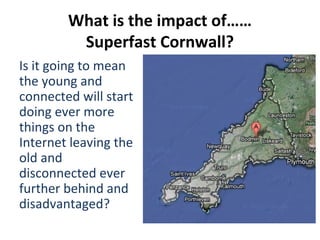
         Superfast Cornwall?
Is it going to mean
the young and
connected will start
doing ever more
things on the
Internet leaving the
old and
disconnected ever
further behind and
disadvantaged?
How do we measure digital inequality?
      Binary: have or haven’t


Typically
•Number with home Internet
•Number used Internet in last 3 months
How do we measure digital inequality?
      Binary: have or haven’t


Or perhaps
•Have been able to do X on Internet
(access+skill)
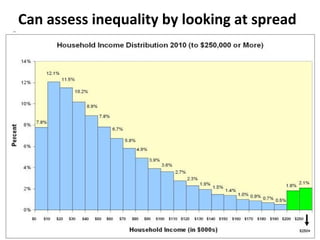
Can assess inequality by looking at spread
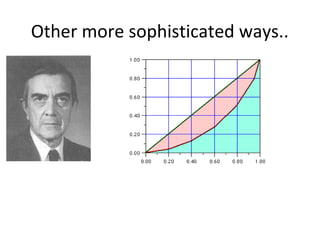
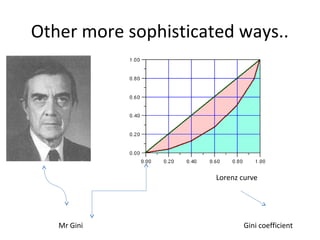
Other more sophisticated ways..


                      Lorenz curve


   Mr Gini                    Gini coefficient
e-health readiness:
        ability to use Internet for health

              e-health inequality:
spread (SD) of distribution of e-health readiness
e-health readiness:
        ability to use Internet for health

              e-health inequality:
spread (SD) of distribution of e-health readiness


Interventions are ‘good’ if they improve e-health
readiness and at least do not increase e-health
inequality, preferably decrease it:
e-health readiness:
         ability to use Internet for health

              e-health inequality:
spread (SD) of distribution of e-health readiness

Interventions are ‘good’ if they improve e-health
readiness but at least do not increase e-health
inequality, preferably decrease it:

Why? (i) fairness, (ii) efficiency of health services
Things you know about
• Differences in use of Internet: about 80% of people had
  used Internet in last 3 months

• Differences by age (personal skill and interest)

• Differences by urban/rural (physical availability)

• Some people have support to help, others don’t

• Some people will consider Internet expensive
E-health inequalities you may not have
             thought about
• 35% of GPs in Southend had a website compared to
  94% in Harrogate

• Many US practices use pre-consultation computer-
  interviews but these are rarely used in the UK.

• Most UK renal patients have access to their renal
  medical record online but few if any stroke patients have
  such facility.

• Use of a globally available online cognitive behavioural
  therapy site for depression, varied 30-fold by postcode
  area across UK
Plymouth E-health Readiness
            Questionnaire (PERQ)
•   3 stage process of piloting
•   Self-completed questionnaire
•   Used in population survey to check validity
•   Produces an e-health readiness score (0-9)
•   From four subscores:
    –   Provision
    –   Personal
    –   Support
    –   Economic
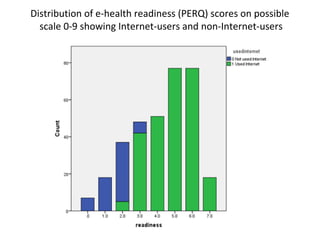
Distribution of e-health readiness (PERQ) scores on possible
  scale 0-9 showing Internet-users and non-Internet-users
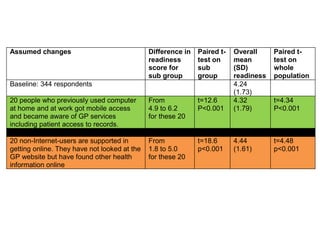
Assumed changes                               Difference in   Paired t-   Overall     Paired t-
                                              readiness       test on     mean        test on
                                              score for       sub         (SD)        whole
                                              sub group       group       readiness   population
Baseline: 344 respondents                                                 4.24
                                                                          (1.73)
20 people who previously used computer        From            t=12.6      4.32        t=4.34
at home and at work got mobile access         4.9 to 6.2      P<0.001     (1.79)      P<0.001
and became aware of GP services               for these 20
including patient access to records.

20 non-Internet-users are supported in        From            t=18.6      4.44        t=4.48
getting online. They have not looked at the   1.8 to 5.0      p<0.001     (1.61)      p<0.001
GP website but have found other health        for these 20
information online
• If you would like to use PERQ and its scoring
  system, or would like to collaborate on its
  further development, please get in touch
• Ray.jones@plymouth.ac.uk

A questionnaire and measure of e-health readiness and e-health inequality - Ray Jones

  • 1.
    A questionnaire andmeasure of ‘e-health readiness’ and ‘e-health inequalities’ for use in intervention studies Ray Jones Professor Health Informatics Plymouth University
  • 2.
    What is theimpact of……
  • 3.
    What is theimpact of…… Superfast Cornwall? Is it going to mean the young and connected will start doing ever more things on the Internet leaving the old and disconnected ever further behind and disadvantaged?
  • 4.
    How do wemeasure digital inequality? Binary: have or haven’t Typically •Number with home Internet •Number used Internet in last 3 months
  • 5.
    How do wemeasure digital inequality? Binary: have or haven’t Or perhaps •Have been able to do X on Internet (access+skill)
  • 6.
    Can assess inequalityby looking at spread
  • 7.
  • 8.
    Other more sophisticatedways.. Lorenz curve Mr Gini Gini coefficient
  • 9.
    e-health readiness: ability to use Internet for health e-health inequality: spread (SD) of distribution of e-health readiness
  • 10.
    e-health readiness: ability to use Internet for health e-health inequality: spread (SD) of distribution of e-health readiness Interventions are ‘good’ if they improve e-health readiness and at least do not increase e-health inequality, preferably decrease it:
  • 11.
    e-health readiness: ability to use Internet for health e-health inequality: spread (SD) of distribution of e-health readiness Interventions are ‘good’ if they improve e-health readiness but at least do not increase e-health inequality, preferably decrease it: Why? (i) fairness, (ii) efficiency of health services
  • 12.
    Things you knowabout • Differences in use of Internet: about 80% of people had used Internet in last 3 months • Differences by age (personal skill and interest) • Differences by urban/rural (physical availability) • Some people have support to help, others don’t • Some people will consider Internet expensive
  • 13.
    E-health inequalities youmay not have thought about • 35% of GPs in Southend had a website compared to 94% in Harrogate • Many US practices use pre-consultation computer- interviews but these are rarely used in the UK. • Most UK renal patients have access to their renal medical record online but few if any stroke patients have such facility. • Use of a globally available online cognitive behavioural therapy site for depression, varied 30-fold by postcode area across UK
  • 14.
    Plymouth E-health Readiness Questionnaire (PERQ) • 3 stage process of piloting • Self-completed questionnaire • Used in population survey to check validity • Produces an e-health readiness score (0-9) • From four subscores: – Provision – Personal – Support – Economic
  • 15.
    Distribution of e-healthreadiness (PERQ) scores on possible scale 0-9 showing Internet-users and non-Internet-users
  • 16.
    Assumed changes Difference in Paired t- Overall Paired t- readiness test on mean test on score for sub (SD) whole sub group group readiness population Baseline: 344 respondents 4.24 (1.73) 20 people who previously used computer From t=12.6 4.32 t=4.34 at home and at work got mobile access 4.9 to 6.2 P<0.001 (1.79) P<0.001 and became aware of GP services for these 20 including patient access to records. 20 non-Internet-users are supported in From t=18.6 4.44 t=4.48 getting online. They have not looked at the 1.8 to 5.0 p<0.001 (1.61) p<0.001 GP website but have found other health for these 20 information online
  • 17.
    • If youwould like to use PERQ and its scoring system, or would like to collaborate on its further development, please get in touch • Ray.jones@plymouth.ac.uk