ACTIVITY
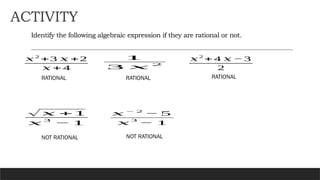
Identify the following algebraic expression if they are rational or not.
𝑥2
+3 𝑥 +2
𝑥 + 4
RATIONAL
1
3 𝑥
2
RATIONAL
𝑥2
+ 4 𝑥 − 3
2
RATIONAL
√ 𝑥 + 1
𝑥
3
− 1
NOT RATIONAL
𝑥 − 2
− 5
𝑥
3
− 1
NOT RATIONAL
SOLVING
RATIONAL
EQUATIONS
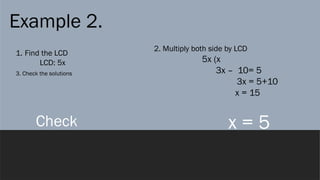
Example 2.
1. Find the LCD
LCD: 5x
2. Multiply both side by LCD
5x (x
3x – 10= 5
3x = 5+10
x = 15
x = 5
3. Check the solutions
Check
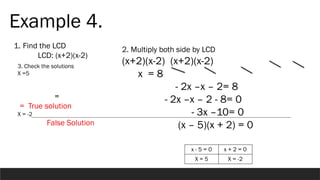
Example 4.
1. Find the LCD
LCD: (x+2)(x-2)
2. Multiply both side by LCD
(x+2)(x-2) (x+2)(x-2)
x = 8
- 2x –x – 2= 8
- 2x –x – 2 - 8= 0
- 3x –10= 0
(x – 5)(x + 2) = 0
3. Check the solutions
X =5
=
= True solution
X = -2
False Solution
x - 5 = 0 x + 2 = 0
X = 5 X = -2
Click icon to add picture
HOW TO FACTOR?
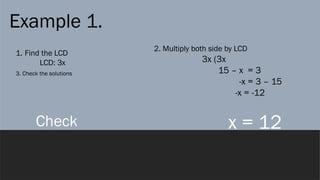
Example 1.
1. Find the LCD
LCD: 3x
2. Multiply both side by LCD
3x (3x
15 – x = 3
-x = 3 – 15
-x = -12
x = 12
3. Check the solutions
Check
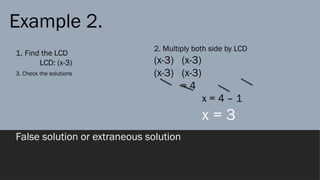
Example 2.
1. Find the LCD
LCD: (x-3)
2. Multiply both side by LCD
(x-3) (x-3)
(x-3) (x-3)
= 4
x = 4 – 1
x = 3
3. Check the solutions
False solution or extraneous solution
SOLVING
RATIONAL
EQUATIONS
DOMAIN
and
RANGE
FUNCTIONS
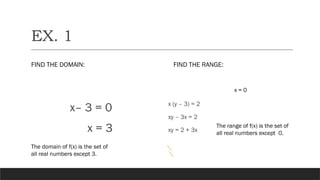
EX. 1
FIND THE DOMAIN:
x– 3 = 0
x = 3
FIND THE RANGE:
x (y – 3) = 2
xy – 3x = 2
xy = 2 + 3x
x = 0
The domain of f(x) is the set of
all real numbers except 3.
The range of f(x) is the set of
all real numbers except 0.
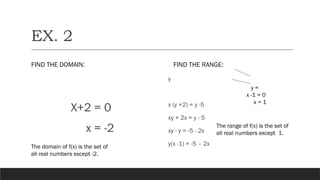
EX. 2
FIND THE DOMAIN:
X+2 = 0
x = -2
FIND THE RANGE:
y
x (y +2) = y -5
xy + 2x = y - 5
xy - y = -5 - 2x
y(x -1) = -5 – 2x
y =
x -1 = 0
x = 1
The domain of f(x) is the set of
all real numbers except -2.
The range of f(x) is the set of
all real numbers except 1.
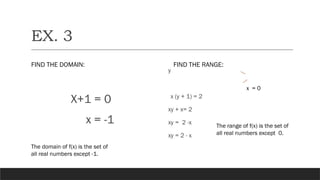
EX. 3
FIND THE DOMAIN:
X+1 = 0
x = -1
FIND THE RANGE:
y
x (y + 1) = 2
xy + x= 2
xy = 2 -x
xy = 2 - x
x = 0
The domain of f(x) is the set of
all real numbers except -1.
The range of f(x) is the set of
all real numbers except 0.
RATIONAL
FUNCTIONS,
EQUATIONS
AND
INEQUALITIES
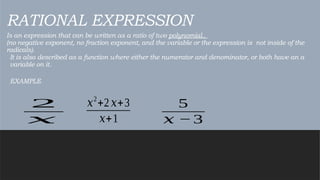
RATIONAL EXPRESSION
Is an expression that can be written as a ratio of two polynomial..
(no negative exponent, no fraction exponent, and the variable or the expression is not inside of the
radicals).
It is also described as a function where either the numerator and denominator, or both have an a
variable on it.
EXAMPLE
2
𝑥
𝑥2
+2 𝑥+3
𝑥+1
5
𝑥 −3
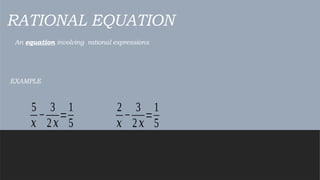
RATIONAL EQUATION
An equation involving rational expressions
EXAMPLE
5
𝑥
−
3
2𝑥
=
1
5
2
𝑥
−
3
2𝑥
=
1
5
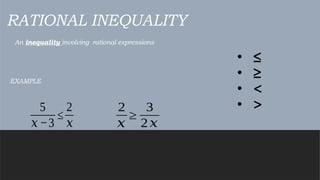
RATIONAL INEQUALITY
An inequality involving rational expressions
EXAMPLE
5
𝑥 −3
≤
2
𝑥
2
𝑥
≥
3
2𝑥
• ≤
• ≥
• <
• >
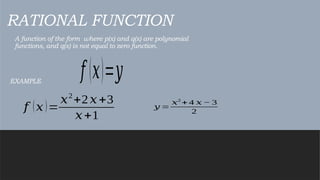
RATIONAL FUNCTION
A function of the form where p(x) and q(x) are polynomial
functions, and q(x) is not equal to zero function.
EXAMPLE
𝑓 (𝑥)=
𝑥2
+2𝑥+3
𝑥+1
𝑓 (𝑥)=𝑦
𝑦 =
𝑥2
+ 4 𝑥 − 3
2
SOLVING
RATIONAL
EQUATIONS
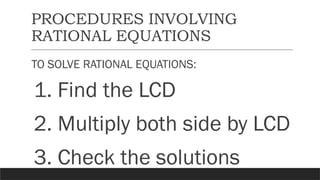
PROCEDURES INVOLVING
RATIONAL EQUATIONS
TO SOLVE RATIONAL EQUATIONS:
1. Find the LCD
2. Multiply both side by LCD
3. Check the solutions
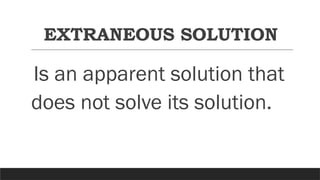
EXTRANEOUS SOLUTION
Is an apparent solution that
does not solve its solution.
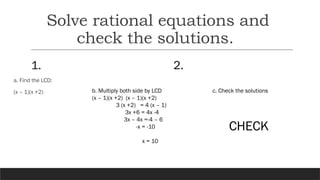
Solve rational equations and
check the solutions.

1.
a. Find the LCD:
(x – 1)(x +2)
2.
b. Multiply both side by LCD
(x – 1)(x +2) (x – 1)(x +2)
3 (x +2) = 4 (x – 1)
3x +6 = 4x -4
3x – 4x =-4 – 6
-x = -10
x = 10
c. Check the solutions
CHECK
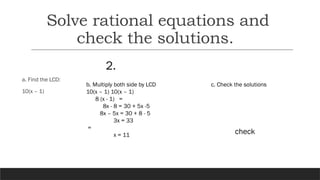
2.
a. Find the LCD:
10(x – 1)
b. Multiply both side by LCD
10(x – 1) 10(x – 1)
8 (x - 1) =
8x - 8 = 30 + 5x -5
8x – 5x = 30 + 8 - 5
3x = 33
=
x = 11
c. Check the solutions
check
Solve rational equations and
check the solutions.
FIND THE
DOMAIN AND
RANGE
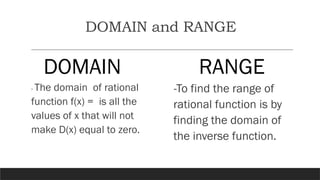
DOMAIN and RANGE
DOMAIN
- The domain of rational
function f(x) = is all the
values of x that will not
make D(x) equal to zero.
RANGE
-To find the range of
rational function is by
finding the domain of
the inverse function.
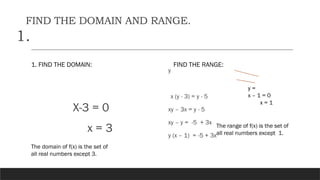
FIND THE DOMAIN AND RANGE.
1.
1. FIND THE DOMAIN:
X-3 = 0
x = 3
FIND THE RANGE:
y
x (y - 3) = y - 5
xy – 3x = y - 5
xy – y = -5 + 3x
y (x – 1) = -5 + 3x
y =
x – 1 = 0
x = 1
The domain of f(x) is the set of
all real numbers except 3.
The range of f(x) is the set of
all real numbers except 1.
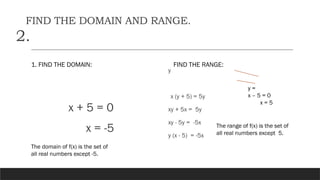
FIND THE DOMAIN AND RANGE.
2.
1. FIND THE DOMAIN:
x + 5 = 0
x = -5
FIND THE RANGE:
y
x (y + 5) = 5y
xy + 5x = 5y
xy - 5y = -5x
y (x - 5) = -5x
y =
x – 5 = 0
x = 5
The domain of f(x) is the set of
all real numbers except -5.
The range of f(x) is the set of
all real numbers except 5.
GROUP
ACTIVITY
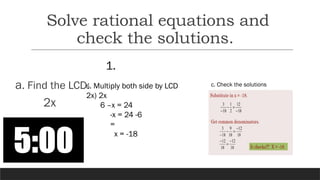
1.
a. Find the LCD:
2x
b. Multiply both side by LCD
2x) 2x
6 –x = 24
-x = 24 -6
=
x = -18
c. Check the solutions
Solve rational equations and
check the solutions.
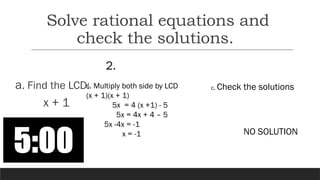
2.
a. Find the LCD:
x + 1
b. Multiply both side by LCD
(x + 1)(x + 1)
5x = 4 (x +1) - 5
5x = 4x + 4 – 5
5x -4x = -1
x = -1
c. Check the solutions
NO SOLUTION
Solve rational equations and
check the solutions.
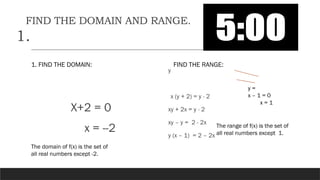
FIND THE DOMAIN AND RANGE.
1.
1. FIND THE DOMAIN:
X+2 = 0
x = --2
FIND THE RANGE:
y
x (y + 2) = y - 2
xy + 2x = y - 2
xy – y = 2 - 2x
y (x – 1) = 2 – 2x
y =
x – 1 = 0
x = 1
The domain of f(x) is the set of
all real numbers except -2.
The range of f(x) is the set of
all real numbers except 1.
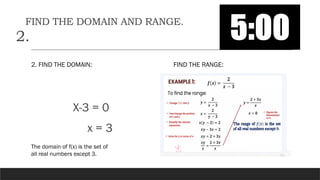
FIND THE DOMAIN AND RANGE.
2.
2. FIND THE DOMAIN:
X-3 = 0
x = 3
FIND THE RANGE:
The domain of f(x) is the set of
all real numbers except 3.
FIND THE DOMAIN AND RANGE.
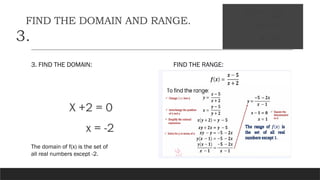
3.
3. FIND THE DOMAIN:
X +2 = 0
x = -2
FIND THE RANGE:
The domain of f(x) is the set of
all real numbers except -2.
QUARTER 2
(SUMMATIVE # 1)
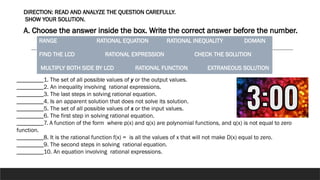
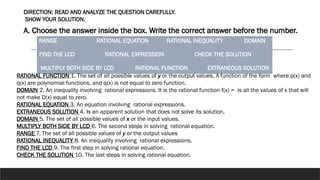
DIRECTION: READ AND ANALYZE THE QUESTION CAREFULLY.
SHOW YOUR SOLUTION.
A. Choose the answer inside the box. Write the correct answer before the number.
RANGE RATIONAL EQUATION RATIONAL INEQUALITY DOMAIN
FIND THE LCD RATIONAL EXPRESSION CHECK THE SOLUTION
MULTIPLY BOTH SIDE BY LCD RATIONAL FUNCTION EXTRANEOUS SOLUTION
_________1. The set of all possible values of y or the output values.
_________2. An inequality involving rational expressions.
_________3. The last steps in solving rational equation.
_________4. Is an apparent solution that does not solve its solution.
_________5. The set of all possible values of x or the input values.
_________6. The first step in solving rational equation.
_________7. A function of the form where p(x) and q(x) are polynomial functions, and q(x) is not equal to zero
function.
_________8. It is the rational function f(x) = is all the values of x that will not make D(x) equal to zero.
_________9. The second steps in solving rational equation.
_________10. An equation involving rational expressions.
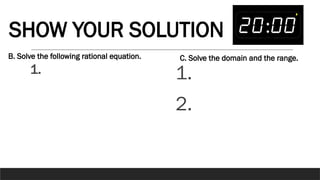
B. Solve the following rational equation.
1. 1.
2.
C. Solve the domain and the range.
SHOW YOUR SOLUTION
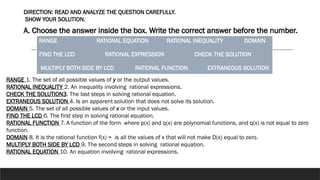
DIRECTION: READ AND ANALYZE THE QUESTION CAREFULLY.
SHOW YOUR SOLUTION.
A. Choose the answer inside the box. Write the correct answer before the number.
RANGE RATIONAL EQUATION RATIONAL INEQUALITY DOMAIN
FIND THE LCD RATIONAL EXPRESSION CHECK THE SOLUTION
MULTIPLY BOTH SIDE BY LCD RATIONAL FUNCTION EXTRANEOUS SOLUTION
RATIONAL FUNCTION 1. The set of all possible values of y or the output values. A function of the form where p(x) and
q(x) are polynomial functions, and q(x) is not equal to zero function.
DOMAIN 2. An inequality involving rational expressions. It is the rational function f(x) = is all the values of x that will
not make D(x) equal to zero.
RATIONAL EQUATION 3. An equation involving rational expressions.
EXTRANEOUS SOLUTION 4. Is an apparent solution that does not solve its solution.
DOMAIN 5. The set of all possible values of x or the input values.
MULTIPLY BOTH SIDE BY LCD 6. The second steps in solving rational equation.
RANGE 7. The set of all possible values of y or the output values
RATIONAL INEQUALITY 8. An inequality involving rational expressions.
FIND THE LCD 9. The first step in solving rational equation.
CHECK THE SOLUTION 10. The last steps in solving rational equation.
DIRECTION: READ AND ANALYZE THE QUESTION CAREFULLY.
SHOW YOUR SOLUTION.
A. Choose the answer inside the box. Write the correct answer before the number.
RANGE RATIONAL EQUATION RATIONAL INEQUALITY DOMAIN
FIND THE LCD RATIONAL EXPRESSION CHECK THE SOLUTION
MULTIPLY BOTH SIDE BY LCD RATIONAL FUNCTION EXTRANEOUS SOLUTION
RANGE 1. The set of all possible values of y or the output values.
RATIONAL INEQUALITY 2. An inequality involving rational expressions.
CHECK THE SOLUTION3. The last steps in solving rational equation.
EXTRANEOUS SOLUTION 4. Is an apparent solution that does not solve its solution.
DOMAIN 5. The set of all possible values of x or the input values.
FIND THE LCD 6. The first step in solving rational equation.
RATIONAL FUNCTION 7. A function of the form where p(x) and q(x) are polynomial functions, and q(x) is not equal to zero
function.
DOMAIN 8. It is the rational function f(x) = is all the values of x that will not make D(x) equal to zero.
MULTIPLY BOTH SIDE BY LCD 9. The second steps in solving rational equation.
RATIONAL EQUATION 10. An equation involving rational expressions.
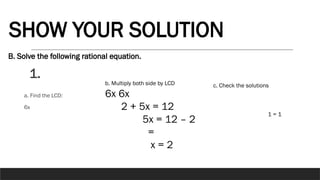
B. Solve the following rational equation.
1.
SHOW YOUR SOLUTION
a. Find the LCD:
6x
b. Multiply both side by LCD
6x 6x
2 + 5x = 12
5x = 12 – 2
=
x = 2
c. Check the solutions
1 = 1
B. Solve the following rational equation.
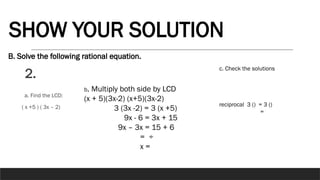
2.
SHOW YOUR SOLUTION
a. Find the LCD:
( x +5 ) ( 3x – 2)
b. Multiply both side by LCD
(x + 5)(3x-2) (x+5)(3x-2)
3 (3x -2) = 3 (x +5)
9x - 6 = 3x + 15
9x – 3x = 15 + 6
= ÷
x =
c. Check the solutions
reciprocal 3 () = 3 ()
=
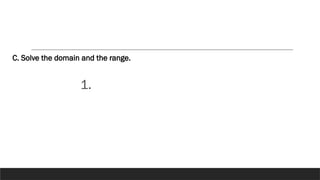
1.
C. Solve the domain and the range.
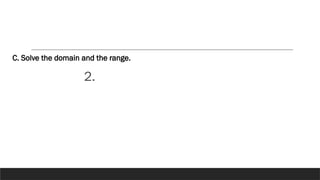
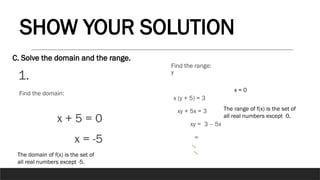
2.
C. Solve the domain and the range.
1.
C. Solve the domain and the range.
SHOW YOUR SOLUTION
x + 5 = 0
x = -5
Find the domain:
The domain of f(x) is the set of
all real numbers except -5.
y
x (y + 5) = 3
xy + 5x = 3
xy = 3 – 5x
=
Find the range:
x = 0
The range of f(x) is the set of
all real numbers except 0.
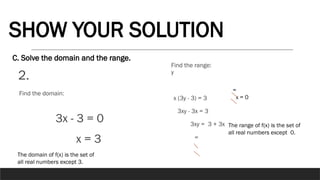
2.
C. Solve the domain and the range.
SHOW YOUR SOLUTION
3x - 3 = 0
x = 3
Find the domain:
The domain of f(x) is the set of
all real numbers except 3.
y
x (3y - 3) = 3
3xy - 3x = 3
3xy = 3 + 3x
=
Find the range:
=
x = 0
The range of f(x) is the set of
all real numbers except 0.
SOLVING
RATIONAL
EQUATIONS
SOLVING
RATIONAL
INEQUALITIES
RATIONAL FUNCTIONS, EQUATIONS AND INEQUALITIES.pptx

RATIONAL FUNCTIONS, EQUATIONS AND INEQUALITIES.pptx

  • 1.
    ACTIVITY Identify the followingalgebraic expression if they are rational or not. 𝑥2 +3 𝑥 +2 𝑥 + 4 RATIONAL 1 3 𝑥 2 RATIONAL 𝑥2 + 4 𝑥 − 3 2 RATIONAL √ 𝑥 + 1 𝑥 3 − 1 NOT RATIONAL 𝑥 − 2 − 5 𝑥 3 − 1 NOT RATIONAL
  • 2.
  • 3.
    Example 2. 1. Findthe LCD LCD: 5x 2. Multiply both side by LCD 5x (x 3x – 10= 5 3x = 5+10 x = 15 x = 5 3. Check the solutions Check
  • 4.
    Example 4. 1. Findthe LCD LCD: (x+2)(x-2) 2. Multiply both side by LCD (x+2)(x-2) (x+2)(x-2) x = 8 - 2x –x – 2= 8 - 2x –x – 2 - 8= 0 - 3x –10= 0 (x – 5)(x + 2) = 0 3. Check the solutions X =5 = = True solution X = -2 False Solution x - 5 = 0 x + 2 = 0 X = 5 X = -2
  • 5.
    Click icon toadd picture HOW TO FACTOR?
  • 7.
    Example 1. 1. Findthe LCD LCD: 3x 2. Multiply both side by LCD 3x (3x 15 – x = 3 -x = 3 – 15 -x = -12 x = 12 3. Check the solutions Check
  • 8.
    Example 2. 1. Findthe LCD LCD: (x-3) 2. Multiply both side by LCD (x-3) (x-3) (x-3) (x-3) = 4 x = 4 – 1 x = 3 3. Check the solutions False solution or extraneous solution
  • 9.
  • 10.
  • 11.
    EX. 1 FIND THEDOMAIN: x– 3 = 0 x = 3 FIND THE RANGE: x (y – 3) = 2 xy – 3x = 2 xy = 2 + 3x x = 0 The domain of f(x) is the set of all real numbers except 3. The range of f(x) is the set of all real numbers except 0.
  • 12.
    EX. 2 FIND THEDOMAIN: X+2 = 0 x = -2 FIND THE RANGE: y x (y +2) = y -5 xy + 2x = y - 5 xy - y = -5 - 2x y(x -1) = -5 – 2x y = x -1 = 0 x = 1 The domain of f(x) is the set of all real numbers except -2. The range of f(x) is the set of all real numbers except 1.
  • 13.
    EX. 3 FIND THEDOMAIN: X+1 = 0 x = -1 FIND THE RANGE: y x (y + 1) = 2 xy + x= 2 xy = 2 -x xy = 2 - x x = 0 The domain of f(x) is the set of all real numbers except -1. The range of f(x) is the set of all real numbers except 0.
  • 14.
  • 15.
    RATIONAL EXPRESSION Is anexpression that can be written as a ratio of two polynomial.. (no negative exponent, no fraction exponent, and the variable or the expression is not inside of the radicals). It is also described as a function where either the numerator and denominator, or both have an a variable on it. EXAMPLE 2 𝑥 𝑥2 +2 𝑥+3 𝑥+1 5 𝑥 −3
  • 16.
    RATIONAL EQUATION An equationinvolving rational expressions EXAMPLE 5 𝑥 − 3 2𝑥 = 1 5 2 𝑥 − 3 2𝑥 = 1 5
  • 17.
    RATIONAL INEQUALITY An inequalityinvolving rational expressions EXAMPLE 5 𝑥 −3 ≤ 2 𝑥 2 𝑥 ≥ 3 2𝑥 • ≤ • ≥ • < • >
  • 18.
    RATIONAL FUNCTION A functionof the form where p(x) and q(x) are polynomial functions, and q(x) is not equal to zero function. EXAMPLE 𝑓 (𝑥)= 𝑥2 +2𝑥+3 𝑥+1 𝑓 (𝑥)=𝑦 𝑦 = 𝑥2 + 4 𝑥 − 3 2
  • 19.
  • 20.
    PROCEDURES INVOLVING RATIONAL EQUATIONS TOSOLVE RATIONAL EQUATIONS: 1. Find the LCD 2. Multiply both side by LCD 3. Check the solutions
  • 21.
    EXTRANEOUS SOLUTION Is anapparent solution that does not solve its solution.
  • 22.
    Solve rational equationsand check the solutions. 1. a. Find the LCD: (x – 1)(x +2) 2. b. Multiply both side by LCD (x – 1)(x +2) (x – 1)(x +2) 3 (x +2) = 4 (x – 1) 3x +6 = 4x -4 3x – 4x =-4 – 6 -x = -10 x = 10 c. Check the solutions CHECK
  • 23.
    2. a. Find theLCD: 10(x – 1) b. Multiply both side by LCD 10(x – 1) 10(x – 1) 8 (x - 1) = 8x - 8 = 30 + 5x -5 8x – 5x = 30 + 8 - 5 3x = 33 = x = 11 c. Check the solutions check Solve rational equations and check the solutions.
  • 24.
  • 25.
    DOMAIN and RANGE DOMAIN -The domain of rational function f(x) = is all the values of x that will not make D(x) equal to zero. RANGE -To find the range of rational function is by finding the domain of the inverse function.
  • 26.
    FIND THE DOMAINAND RANGE. 1. 1. FIND THE DOMAIN: X-3 = 0 x = 3 FIND THE RANGE: y x (y - 3) = y - 5 xy – 3x = y - 5 xy – y = -5 + 3x y (x – 1) = -5 + 3x y = x – 1 = 0 x = 1 The domain of f(x) is the set of all real numbers except 3. The range of f(x) is the set of all real numbers except 1.
  • 27.
    FIND THE DOMAINAND RANGE. 2. 1. FIND THE DOMAIN: x + 5 = 0 x = -5 FIND THE RANGE: y x (y + 5) = 5y xy + 5x = 5y xy - 5y = -5x y (x - 5) = -5x y = x – 5 = 0 x = 5 The domain of f(x) is the set of all real numbers except -5. The range of f(x) is the set of all real numbers except 5.
  • 28.
  • 29.
    1. a. Find theLCD: 2x b. Multiply both side by LCD 2x) 2x 6 –x = 24 -x = 24 -6 = x = -18 c. Check the solutions Solve rational equations and check the solutions.
  • 30.
    2. a. Find theLCD: x + 1 b. Multiply both side by LCD (x + 1)(x + 1) 5x = 4 (x +1) - 5 5x = 4x + 4 – 5 5x -4x = -1 x = -1 c. Check the solutions NO SOLUTION Solve rational equations and check the solutions.
  • 31.
    FIND THE DOMAINAND RANGE. 1. 1. FIND THE DOMAIN: X+2 = 0 x = --2 FIND THE RANGE: y x (y + 2) = y - 2 xy + 2x = y - 2 xy – y = 2 - 2x y (x – 1) = 2 – 2x y = x – 1 = 0 x = 1 The domain of f(x) is the set of all real numbers except -2. The range of f(x) is the set of all real numbers except 1.
  • 32.
    FIND THE DOMAINAND RANGE. 2. 2. FIND THE DOMAIN: X-3 = 0 x = 3 FIND THE RANGE: The domain of f(x) is the set of all real numbers except 3.
  • 33.
    FIND THE DOMAINAND RANGE. 3. 3. FIND THE DOMAIN: X +2 = 0 x = -2 FIND THE RANGE: The domain of f(x) is the set of all real numbers except -2.
  • 34.
  • 35.
    DIRECTION: READ ANDANALYZE THE QUESTION CAREFULLY. SHOW YOUR SOLUTION. A. Choose the answer inside the box. Write the correct answer before the number. RANGE RATIONAL EQUATION RATIONAL INEQUALITY DOMAIN FIND THE LCD RATIONAL EXPRESSION CHECK THE SOLUTION MULTIPLY BOTH SIDE BY LCD RATIONAL FUNCTION EXTRANEOUS SOLUTION _________1. The set of all possible values of y or the output values. _________2. An inequality involving rational expressions. _________3. The last steps in solving rational equation. _________4. Is an apparent solution that does not solve its solution. _________5. The set of all possible values of x or the input values. _________6. The first step in solving rational equation. _________7. A function of the form where p(x) and q(x) are polynomial functions, and q(x) is not equal to zero function. _________8. It is the rational function f(x) = is all the values of x that will not make D(x) equal to zero. _________9. The second steps in solving rational equation. _________10. An equation involving rational expressions.
  • 36.
    B. Solve thefollowing rational equation. 1. 1. 2. C. Solve the domain and the range. SHOW YOUR SOLUTION
  • 37.
    DIRECTION: READ ANDANALYZE THE QUESTION CAREFULLY. SHOW YOUR SOLUTION. A. Choose the answer inside the box. Write the correct answer before the number. RANGE RATIONAL EQUATION RATIONAL INEQUALITY DOMAIN FIND THE LCD RATIONAL EXPRESSION CHECK THE SOLUTION MULTIPLY BOTH SIDE BY LCD RATIONAL FUNCTION EXTRANEOUS SOLUTION RATIONAL FUNCTION 1. The set of all possible values of y or the output values. A function of the form where p(x) and q(x) are polynomial functions, and q(x) is not equal to zero function. DOMAIN 2. An inequality involving rational expressions. It is the rational function f(x) = is all the values of x that will not make D(x) equal to zero. RATIONAL EQUATION 3. An equation involving rational expressions. EXTRANEOUS SOLUTION 4. Is an apparent solution that does not solve its solution. DOMAIN 5. The set of all possible values of x or the input values. MULTIPLY BOTH SIDE BY LCD 6. The second steps in solving rational equation. RANGE 7. The set of all possible values of y or the output values RATIONAL INEQUALITY 8. An inequality involving rational expressions. FIND THE LCD 9. The first step in solving rational equation. CHECK THE SOLUTION 10. The last steps in solving rational equation.
  • 38.
    DIRECTION: READ ANDANALYZE THE QUESTION CAREFULLY. SHOW YOUR SOLUTION. A. Choose the answer inside the box. Write the correct answer before the number. RANGE RATIONAL EQUATION RATIONAL INEQUALITY DOMAIN FIND THE LCD RATIONAL EXPRESSION CHECK THE SOLUTION MULTIPLY BOTH SIDE BY LCD RATIONAL FUNCTION EXTRANEOUS SOLUTION RANGE 1. The set of all possible values of y or the output values. RATIONAL INEQUALITY 2. An inequality involving rational expressions. CHECK THE SOLUTION3. The last steps in solving rational equation. EXTRANEOUS SOLUTION 4. Is an apparent solution that does not solve its solution. DOMAIN 5. The set of all possible values of x or the input values. FIND THE LCD 6. The first step in solving rational equation. RATIONAL FUNCTION 7. A function of the form where p(x) and q(x) are polynomial functions, and q(x) is not equal to zero function. DOMAIN 8. It is the rational function f(x) = is all the values of x that will not make D(x) equal to zero. MULTIPLY BOTH SIDE BY LCD 9. The second steps in solving rational equation. RATIONAL EQUATION 10. An equation involving rational expressions.
  • 39.
    B. Solve thefollowing rational equation. 1. SHOW YOUR SOLUTION a. Find the LCD: 6x b. Multiply both side by LCD 6x 6x 2 + 5x = 12 5x = 12 – 2 = x = 2 c. Check the solutions 1 = 1
  • 40.
    B. Solve thefollowing rational equation. 2. SHOW YOUR SOLUTION a. Find the LCD: ( x +5 ) ( 3x – 2) b. Multiply both side by LCD (x + 5)(3x-2) (x+5)(3x-2) 3 (3x -2) = 3 (x +5) 9x - 6 = 3x + 15 9x – 3x = 15 + 6 = ÷ x = c. Check the solutions reciprocal 3 () = 3 () =
  • 41.
    1. C. Solve thedomain and the range.
  • 42.
    2. C. Solve thedomain and the range.
  • 43.
    1. C. Solve thedomain and the range. SHOW YOUR SOLUTION x + 5 = 0 x = -5 Find the domain: The domain of f(x) is the set of all real numbers except -5. y x (y + 5) = 3 xy + 5x = 3 xy = 3 – 5x = Find the range: x = 0 The range of f(x) is the set of all real numbers except 0.
  • 44.
    2. C. Solve thedomain and the range. SHOW YOUR SOLUTION 3x - 3 = 0 x = 3 Find the domain: The domain of f(x) is the set of all real numbers except 3. y x (3y - 3) = 3 3xy - 3x = 3 3xy = 3 + 3x = Find the range: = x = 0 The range of f(x) is the set of all real numbers except 0.
  • 45.
  • 47.