Rare mental disorders
M o h s e n R a z fi z a d e - P a r s a D a v o u d i p a n a h - R e z a A h m a d i - F a t e m e A m i r i
P A G E 0 2
Contents
Clinical lycantrophy
01.
Depersonalization disorder
02.
Stendhal syndrome
03.
Apotemnophilia
04.
Alien hand syndrome
05.
Capgras syndrome
06.
C O N T E N T S
07.
12.
11.
10.
09.
08.
Autocannibalism
Todd syndrome
Paris syndrome
Factitious disorder
Kluver-bucy syndrome
Diogenes syndrome
P A G E 0 3
Clinical lycantrophy
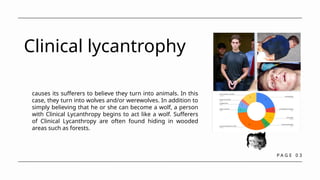
causes its sufferers to believe they turn into animals. In this
case, they turn into wolves and/or werewolves. In addition to
simply believing that he or she can become a wolf, a person
with Clinical Lycanthropy begins to act like a wolf. Sufferers
of Clinical Lycanthropy are often found hiding in wooded
areas such as forests.
P A G E 0 4
Depersonalization/
Derealization
Disorder
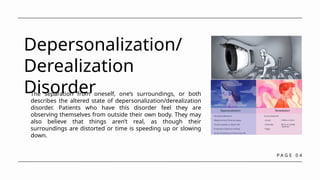
The separation from oneself, one’s surroundings, or both
describes the altered state of depersonalization/derealization
disorder. Patients who have this disorder feel they are
observing themselves from outside their own body. They may
also believe that things aren’t real, as though their
surroundings are distorted or time is speeding up or slowing
down.
P A G E 0 5
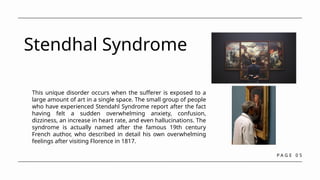
Stendhal Syndrome
This unique disorder occurs when the sufferer is exposed to a
large amount of art in a single space. The small group of people
who have experienced Stendahl Syndrome report after the fact
having felt a sudden overwhelming anxiety, confusion,
dizziness, an increase in heart rate, and even hallucinations. The
syndrome is actually named after the famous 19th century
French author, who described in detail his own overwhelming
feelings after visiting Florence in 1817.
P A G E 0 6
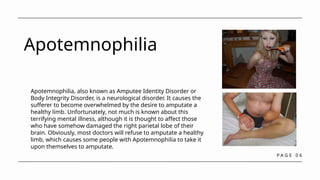
Apotemnophilia
Apotemnophilia, also known as Amputee Identity Disorder or
Body Integrity Disorder, is a neurological disorder. It causes the
sufferer to become overwhelmed by the desire to amputate a
healthy limb. Unfortunately, not much is known about this
terrifying mental illness, although it is thought to affect those
who have somehow damaged the right parietal lobe of their
brain. Obviously, most doctors will refuse to amputate a healthy
limb, which causes some people with Apotemnophilia to take it
upon themselves to amputate.
P A G E 0 7
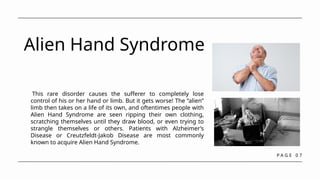
Alien Hand Syndrome
This rare disorder causes the sufferer to completely lose
control of his or her hand or limb. But it gets worse! The “alien”
limb then takes on a life of its own, and oftentimes people with
Alien Hand Syndrome are seen ripping their own clothing,
scratching themselves until they draw blood, or even trying to
strangle themselves or others. Patients with Alzheimer’s
Disease or Creutzfeldt-Jakob Disease are most commonly
known to acquire Alien Hand Syndrome.
P A G E 0 8
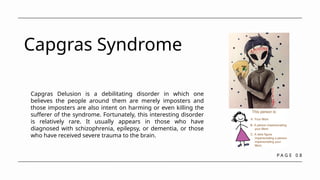
Capgras Syndrome
Capgras Delusion is a debilitating disorder in which one
believes the people around them are merely imposters and
those imposters are also intent on harming or even killing the
sufferer of the syndrome. Fortunately, this interesting disorder
is relatively rare. It usually appears in those who have
diagnosed with schizophrenia, epilepsy, or dementia, or those
who have received severe trauma to the brain.
P A G E 0 9
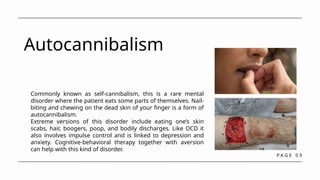
Autocannibalism
Commonly known as self-cannibalism, this is a rare mental
disorder where the patient eats some parts of themselves. Nail-
biting and chewing on the dead skin of your finger is a form of
autocannibalism.
Extreme versions of this disorder include eating one’s skin
scabs, hair, boogers, poop, and bodily discharges. Like OCD it
also involves impulse control and is linked to depression and
anxiety. Cognitive-behavioral therapy together with aversion
can help with this kind of disorder.
P A G E 1 0
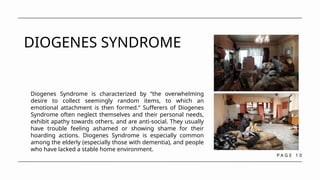
DIOGENES SYNDROME
Diogenes Syndrome is characterized by “the overwhelming
desire to collect seemingly random items, to which an
emotional attachment is then formed.” Sufferers of Diogenes
Syndrome often neglect themselves and their personal needs,
exhibit apathy towards others, and are anti-social. They usually
have trouble feeling ashamed or showing shame for their
hoarding actions. Diogenes Syndrome is especially common
among the elderly (especially those with dementia), and people
who have lacked a stable home environment.
P A G E 1 1
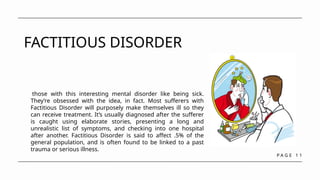
FACTITIOUS DISORDER
those with this interesting mental disorder like being sick.
They’re obsessed with the idea, in fact. Most sufferers with
Factitious Disorder will purposely make themselves ill so they
can receive treatment. It’s usually diagnosed after the sufferer
is caught using elaborate stories, presenting a long and
unrealistic list of symptoms, and checking into one hospital
after another. Factitious Disorder is said to affect .5% of the
general population, and is often found to be linked to a past
trauma or serious illness.
P A G E 1 2
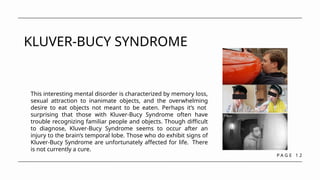
KLUVER-BUCY SYNDROME
This interesting mental disorder is characterized by memory loss,
sexual attraction to inanimate objects, and the overwhelming
desire to eat objects not meant to be eaten. Perhaps it’s not
surprising that those with Kluver-Bucy Syndrome often have
trouble recognizing familiar people and objects. Though difficult
to diagnose, Kluver-Bucy Syndrome seems to occur after an
injury to the brain’s temporal lobe. Those who do exhibit signs of
Kluver-Bucy Syndrome are unfortunately affected for life. There
is not currently a cure.
P A G E 1 3
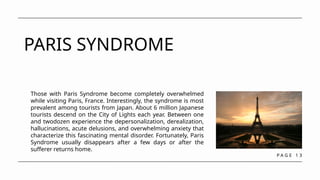
PARIS SYNDROME
Those with Paris Syndrome become completely overwhelmed
while visiting Paris, France. Interestingly, the syndrome is most
prevalent among tourists from Japan. About 6 million Japanese
tourists descend on the City of Lights each year. Between one
and twodozen experience the depersonalization, derealization,
hallucinations, acute delusions, and overwhelming anxiety that
characterize this fascinating mental disorder. Fortunately, Paris
Syndrome usually disappears after a few days or after the
sufferer returns home.
P A G E 1 4
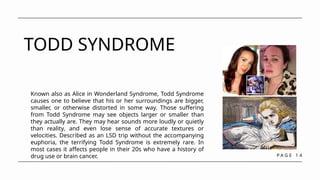
TODD SYNDROME
Known also as Alice in Wonderland Syndrome, Todd Syndrome
causes one to believe that his or her surroundings are bigger,
smaller, or otherwise distorted in some way. Those suffering
from Todd Syndrome may see objects larger or smaller than
they actually are. They may hear sounds more loudly or quietly
than reality, and even lose sense of accurate textures or
velocities. Described as an LSD trip without the accompanying
euphoria, the terrifying Todd Syndrome is extremely rare. In
most cases it affects people in their 20s who have a history of
drug use or brain cancer.
P A G E 1 5
T H A N K S !
Thanks!

rare mental disorders eng presentation.pptx

  • 1.
    Rare mental disorders Mo h s e n R a z fi z a d e - P a r s a D a v o u d i p a n a h - R e z a A h m a d i - F a t e m e A m i r i
  • 2.
    P A GE 0 2 Contents Clinical lycantrophy 01. Depersonalization disorder 02. Stendhal syndrome 03. Apotemnophilia 04. Alien hand syndrome 05. Capgras syndrome 06. C O N T E N T S 07. 12. 11. 10. 09. 08. Autocannibalism Todd syndrome Paris syndrome Factitious disorder Kluver-bucy syndrome Diogenes syndrome
  • 3.
    P A GE 0 3 Clinical lycantrophy causes its sufferers to believe they turn into animals. In this case, they turn into wolves and/or werewolves. In addition to simply believing that he or she can become a wolf, a person with Clinical Lycanthropy begins to act like a wolf. Sufferers of Clinical Lycanthropy are often found hiding in wooded areas such as forests.
  • 4.
    P A GE 0 4 Depersonalization/ Derealization Disorder The separation from oneself, one’s surroundings, or both describes the altered state of depersonalization/derealization disorder. Patients who have this disorder feel they are observing themselves from outside their own body. They may also believe that things aren’t real, as though their surroundings are distorted or time is speeding up or slowing down.
  • 5.
    P A GE 0 5 Stendhal Syndrome This unique disorder occurs when the sufferer is exposed to a large amount of art in a single space. The small group of people who have experienced Stendahl Syndrome report after the fact having felt a sudden overwhelming anxiety, confusion, dizziness, an increase in heart rate, and even hallucinations. The syndrome is actually named after the famous 19th century French author, who described in detail his own overwhelming feelings after visiting Florence in 1817.
  • 6.
    P A GE 0 6 Apotemnophilia Apotemnophilia, also known as Amputee Identity Disorder or Body Integrity Disorder, is a neurological disorder. It causes the sufferer to become overwhelmed by the desire to amputate a healthy limb. Unfortunately, not much is known about this terrifying mental illness, although it is thought to affect those who have somehow damaged the right parietal lobe of their brain. Obviously, most doctors will refuse to amputate a healthy limb, which causes some people with Apotemnophilia to take it upon themselves to amputate.
  • 7.
    P A GE 0 7 Alien Hand Syndrome This rare disorder causes the sufferer to completely lose control of his or her hand or limb. But it gets worse! The “alien” limb then takes on a life of its own, and oftentimes people with Alien Hand Syndrome are seen ripping their own clothing, scratching themselves until they draw blood, or even trying to strangle themselves or others. Patients with Alzheimer’s Disease or Creutzfeldt-Jakob Disease are most commonly known to acquire Alien Hand Syndrome.
  • 8.
    P A GE 0 8 Capgras Syndrome Capgras Delusion is a debilitating disorder in which one believes the people around them are merely imposters and those imposters are also intent on harming or even killing the sufferer of the syndrome. Fortunately, this interesting disorder is relatively rare. It usually appears in those who have diagnosed with schizophrenia, epilepsy, or dementia, or those who have received severe trauma to the brain.
  • 9.
    P A GE 0 9 Autocannibalism Commonly known as self-cannibalism, this is a rare mental disorder where the patient eats some parts of themselves. Nail- biting and chewing on the dead skin of your finger is a form of autocannibalism. Extreme versions of this disorder include eating one’s skin scabs, hair, boogers, poop, and bodily discharges. Like OCD it also involves impulse control and is linked to depression and anxiety. Cognitive-behavioral therapy together with aversion can help with this kind of disorder.
  • 10.
    P A GE 1 0 DIOGENES SYNDROME Diogenes Syndrome is characterized by “the overwhelming desire to collect seemingly random items, to which an emotional attachment is then formed.” Sufferers of Diogenes Syndrome often neglect themselves and their personal needs, exhibit apathy towards others, and are anti-social. They usually have trouble feeling ashamed or showing shame for their hoarding actions. Diogenes Syndrome is especially common among the elderly (especially those with dementia), and people who have lacked a stable home environment.
  • 11.
    P A GE 1 1 FACTITIOUS DISORDER those with this interesting mental disorder like being sick. They’re obsessed with the idea, in fact. Most sufferers with Factitious Disorder will purposely make themselves ill so they can receive treatment. It’s usually diagnosed after the sufferer is caught using elaborate stories, presenting a long and unrealistic list of symptoms, and checking into one hospital after another. Factitious Disorder is said to affect .5% of the general population, and is often found to be linked to a past trauma or serious illness.
  • 12.
    P A GE 1 2 KLUVER-BUCY SYNDROME This interesting mental disorder is characterized by memory loss, sexual attraction to inanimate objects, and the overwhelming desire to eat objects not meant to be eaten. Perhaps it’s not surprising that those with Kluver-Bucy Syndrome often have trouble recognizing familiar people and objects. Though difficult to diagnose, Kluver-Bucy Syndrome seems to occur after an injury to the brain’s temporal lobe. Those who do exhibit signs of Kluver-Bucy Syndrome are unfortunately affected for life. There is not currently a cure.
  • 13.
    P A GE 1 3 PARIS SYNDROME Those with Paris Syndrome become completely overwhelmed while visiting Paris, France. Interestingly, the syndrome is most prevalent among tourists from Japan. About 6 million Japanese tourists descend on the City of Lights each year. Between one and twodozen experience the depersonalization, derealization, hallucinations, acute delusions, and overwhelming anxiety that characterize this fascinating mental disorder. Fortunately, Paris Syndrome usually disappears after a few days or after the sufferer returns home.
  • 14.
    P A GE 1 4 TODD SYNDROME Known also as Alice in Wonderland Syndrome, Todd Syndrome causes one to believe that his or her surroundings are bigger, smaller, or otherwise distorted in some way. Those suffering from Todd Syndrome may see objects larger or smaller than they actually are. They may hear sounds more loudly or quietly than reality, and even lose sense of accurate textures or velocities. Described as an LSD trip without the accompanying euphoria, the terrifying Todd Syndrome is extremely rare. In most cases it affects people in their 20s who have a history of drug use or brain cancer.
  • 15.
    P A GE 1 5 T H A N K S ! Thanks!