PLASMA
Cutting & Gouging
ESAB 1904-2004
A CENTURY OF INNOVATION
ESAB Welding & Cutting Products
THREE CUTTING METHODS
MECHANICAL
Saw, Drill,
Punch, Shear
CHEMICAL
Oxy-Fuel
THERMAL
Plasma, Laser,
Electron Beam
WHAT IS A PLASMA ARC?
• PLASMA - a fluid part of the blood
• PLASMA - an ionized gas (Air)
• When a gas is heated above 17,000 0
F,
electrons are free to move. The gas
conducts electricity
THE PLASMA SYSTEM
POWER
SOURCE/
CONTROL
AIR
REGULATOR /
FILTER
SPARE
PARTS KIT
Work Clamp
Torch
GTAW (TIG) ARC
WELD PUDDLE
SHIELDING GAS
TUNGSTEN ELECTRODE
GAS CUP
OPEN ARC
GTAW (TIG) ARC = OPEN ARC
• Excellent heat source - 35,000 0
F
• Arc lacks intensity or focus
• Arc lacks needed velocity to blow molten
metal from kerf
• Excellent for welding - unsuitable for cutting
or gouging
PLASMA = CONSTRICTED ARC
• Constriction
focuses the arc
• Increases arc
temperature
• Flow of gas
controls plasma
velocity
• Increases arc
voltage
TEMPERATURE DIFFERENCE
THERMAL SOURCE REQUIREMENTS
• High temperature - to melt metal
• Highly focused and intense source - to make a
narrow kerf
• High velocity gas stream - to blow the molten
metal from the kerf
END VIEW OF A TYPICAL PLASMA KERF
KERF
• The narrow cut or void left by the
cutting process
HIGH SPEED LOW SPEED
DROSS FORMATION
• The molten metal that was blown through the
kerf and sticks (welds itself) to the bottom edge
of the plate
• Low travel speed - easily removed
• High travel speed - Very difficult to remove
CONVENTIONAL TORCH
DUAL FLOW TORCH
HIGH FREQUENCY STARTING
• High Frequency (HF) starting
requires an arc of about
10,000 volt at 1.5 MHz
• This high voltage arc jumps
the electrode to nozzle gap
and ionizes a path through
the gas
• When the cutting tip touches
the work piece the main arc
flows through this ionized
path
• The PT-31XL torch uses a
HF start
PLASMA
GAS (air)
IONIZED
GAS
High Frequency
PILOT ARC STARTING
• Pilot arc torches also require High
Frequency to ionize the gas in the
torch
• A low current (pilot arc) flows
through the HF path. The plasma
gas(air) blows this arc through the
nozzle
• When the pilot arc comes close
enough to the work piece the main
cutting arc transfers and takes the
place of the pilot arc
• Advantage - The cutting tip does
not have to touch the work piece
resulting in longer life
PLASMA
GAS
PILOT ARC BRIGHT ZONE
HOT PLASMA
(CONDUCTIVE)
The PT-25, 26, 27 and PT-121
torches
use a PILOT ARC start.
PILOT ARC
• After two seconds of *preflow the HF energizes and the
PILOT ARC fires
* Preflow: The gas (air) flow prior to the High Frequency and Pilot Arc
(Click on image to play video)
OPERATING TIPS
The Do's and Don'ts
PT-25 / PT-26 / PT-27
TORCH SETUP
• With the POWER turned "OFF" - Check the torch
consumables for wear and proper assembly
• With the POWER turned "ON" and the AIR CHECK
switch in the "ON" position - set the air pressure per
the instruction literature (usually 65-75 psi.)
AIR SETUP
AIR SUPPLY
• Contaminated air supply will shorten electrode and
nozzle life.
• Check filter bowl for water or oil.
• An additional air filter/dryer may be necessary. Available
for less than $100.
WHEN TO CHANGE CONSUMABLES
• Cut speed and quality will deteriorate when the
nozzle (tip) or electrode become damaged.
TECHNIQUE
(Click on image to play video)
PLASMA TORCH ARC STARTING
PILOT ARC - START
PT-25, 26, 27
PLACE TIP 1/4” ABOVE
PLATE - DO NOT TOUCH
PLATE !
• Always start at the edge -
With some metal under the tip
PT-34, PT-31XL PT-25, PT-26 or PT-27
EDGE STARTS
EDGE STARTS
• NEVER PLACE THE TIP OVER THE EDGE -
WITHOUT METAL UNDER THE TIP
PT-31XL, PT-34 PT-25, 26 or PT-27
• Never pierce with the torch in the vertical
position and the tip touching the plate
PIERCE STARTS
PT-25
PT-26 / PT-27
ANGLE TORCH TO BLOW MOLTEN METAL
AWAY FROM CUTTING TIP AND TORCH HEAD
PIERCE STARTS
Pierce Starts
• Angle torch to blow molten metal away from cutting
tip and torch head
• NEVER pierce with the torch in the vertical position
(Click on image to play video)
DRAG CUTTING
• Hold the tip against a straight edge
• Follow a template for irregular shapes
(Click on image to play video)
DRAG CUTTING TECHNIQUE
• You can drag the PT-31XL or PT-34 torch on the plate
• Hold the tip against a straight edge
• Follow a template for irregular shapes
CUTTING WITH A CONSTANT STAND OFF
• Hold the torch nozzle
approximately 5mm
above the plate
• Torch angled of 5o
to
15o
to plate surface
(Click on image to play video)
DRAG CUTTING WITH STAND OFF GUIDE
• Use stand off guide to optimize consumable life
(Click on image to play video)
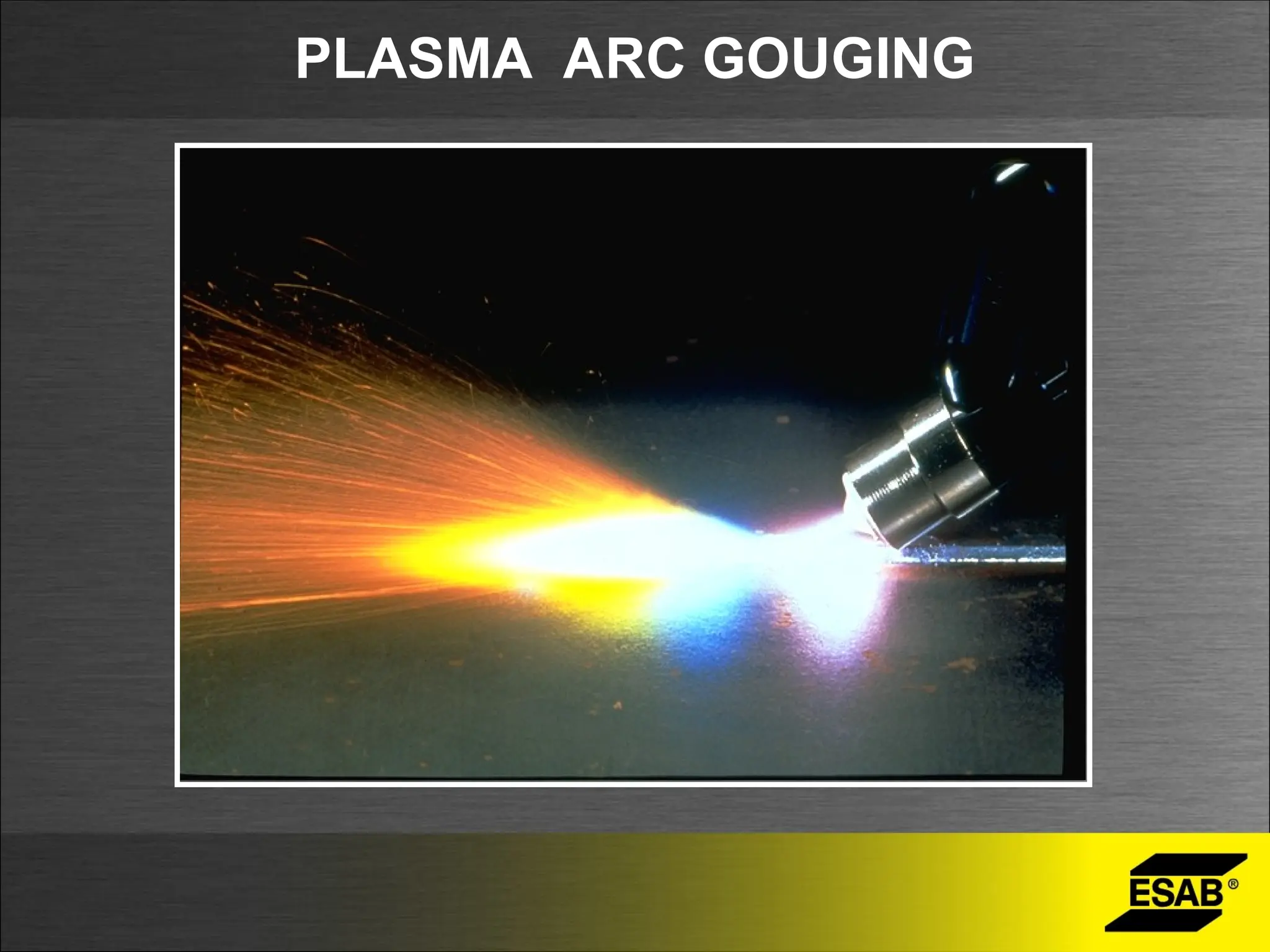
PLASMA ARC GOUGING
PLASMA GOUGES
AL CS SS
Plasma Gouging
• Torch angled 30o
to plate surface
• Arc washes the surface instead of cutting
AL CS SS
(Click on image to play video)
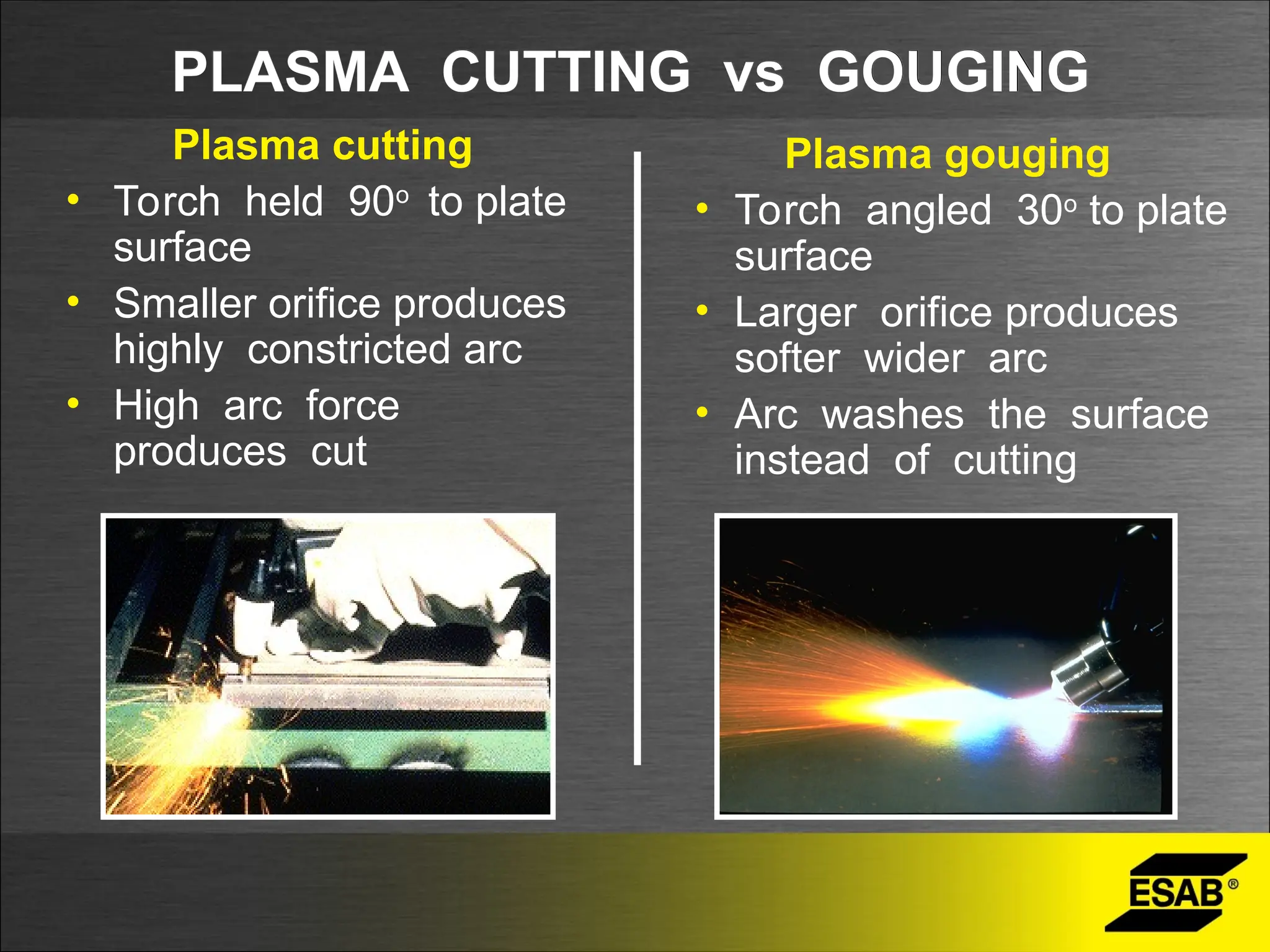
PLASMA CUTTING vs GOUGING
Plasma cutting
• Torch held 90o
to plate
surface
• Smaller orifice produces
highly constricted arc
• High arc force
produces cut
Plasma gouging
• Torch angled 30o
to plate
surface
• Larger orifice produces
softer wider arc
• Arc washes the surface
instead of cutting
PLASMA GOUGING vs CARBON ARC GOUGING
• Lower fume levels
• Lower noise levels
• High quality surface
• Lower cost
ESAB 1904-2004
A CENTURY OF INNOVATION
ESAB Welding & Cutting Products
THE END
Thank You

Plasma Arc Machining Unconventional Machining processes

  • 1.
    PLASMA Cutting & Gouging ESAB1904-2004 A CENTURY OF INNOVATION ESAB Welding & Cutting Products
  • 2.
    THREE CUTTING METHODS MECHANICAL Saw,Drill, Punch, Shear CHEMICAL Oxy-Fuel THERMAL Plasma, Laser, Electron Beam
  • 3.
    WHAT IS APLASMA ARC? • PLASMA - a fluid part of the blood • PLASMA - an ionized gas (Air) • When a gas is heated above 17,000 0 F, electrons are free to move. The gas conducts electricity
  • 4.
    THE PLASMA SYSTEM POWER SOURCE/ CONTROL AIR REGULATOR/ FILTER SPARE PARTS KIT Work Clamp Torch
  • 5.
    GTAW (TIG) ARC WELDPUDDLE SHIELDING GAS TUNGSTEN ELECTRODE GAS CUP OPEN ARC
  • 6.
    GTAW (TIG) ARC= OPEN ARC • Excellent heat source - 35,000 0 F • Arc lacks intensity or focus • Arc lacks needed velocity to blow molten metal from kerf • Excellent for welding - unsuitable for cutting or gouging
  • 7.
    PLASMA = CONSTRICTEDARC • Constriction focuses the arc • Increases arc temperature • Flow of gas controls plasma velocity • Increases arc voltage
  • 8.
  • 9.
    THERMAL SOURCE REQUIREMENTS •High temperature - to melt metal • Highly focused and intense source - to make a narrow kerf • High velocity gas stream - to blow the molten metal from the kerf
  • 10.
    END VIEW OFA TYPICAL PLASMA KERF KERF • The narrow cut or void left by the cutting process
  • 11.
    HIGH SPEED LOWSPEED DROSS FORMATION • The molten metal that was blown through the kerf and sticks (welds itself) to the bottom edge of the plate • Low travel speed - easily removed • High travel speed - Very difficult to remove
  • 12.
  • 13.
  • 14.
    HIGH FREQUENCY STARTING •High Frequency (HF) starting requires an arc of about 10,000 volt at 1.5 MHz • This high voltage arc jumps the electrode to nozzle gap and ionizes a path through the gas • When the cutting tip touches the work piece the main arc flows through this ionized path • The PT-31XL torch uses a HF start PLASMA GAS (air) IONIZED GAS High Frequency
  • 15.
    PILOT ARC STARTING •Pilot arc torches also require High Frequency to ionize the gas in the torch • A low current (pilot arc) flows through the HF path. The plasma gas(air) blows this arc through the nozzle • When the pilot arc comes close enough to the work piece the main cutting arc transfers and takes the place of the pilot arc • Advantage - The cutting tip does not have to touch the work piece resulting in longer life PLASMA GAS PILOT ARC BRIGHT ZONE HOT PLASMA (CONDUCTIVE) The PT-25, 26, 27 and PT-121 torches use a PILOT ARC start.
  • 16.
    PILOT ARC • Aftertwo seconds of *preflow the HF energizes and the PILOT ARC fires * Preflow: The gas (air) flow prior to the High Frequency and Pilot Arc (Click on image to play video)
  • 17.
    OPERATING TIPS The Do'sand Don'ts PT-25 / PT-26 / PT-27
  • 18.
    TORCH SETUP • Withthe POWER turned "OFF" - Check the torch consumables for wear and proper assembly
  • 19.
    • With thePOWER turned "ON" and the AIR CHECK switch in the "ON" position - set the air pressure per the instruction literature (usually 65-75 psi.) AIR SETUP
  • 20.
    AIR SUPPLY • Contaminatedair supply will shorten electrode and nozzle life. • Check filter bowl for water or oil. • An additional air filter/dryer may be necessary. Available for less than $100.
  • 21.
    WHEN TO CHANGECONSUMABLES • Cut speed and quality will deteriorate when the nozzle (tip) or electrode become damaged.
  • 22.
  • 23.
    PLASMA TORCH ARCSTARTING PILOT ARC - START PT-25, 26, 27 PLACE TIP 1/4” ABOVE PLATE - DO NOT TOUCH PLATE !
  • 24.
    • Always startat the edge - With some metal under the tip PT-34, PT-31XL PT-25, PT-26 or PT-27 EDGE STARTS
  • 25.
    EDGE STARTS • NEVERPLACE THE TIP OVER THE EDGE - WITHOUT METAL UNDER THE TIP PT-31XL, PT-34 PT-25, 26 or PT-27
  • 26.
    • Never piercewith the torch in the vertical position and the tip touching the plate PIERCE STARTS PT-25 PT-26 / PT-27
  • 27.
    ANGLE TORCH TOBLOW MOLTEN METAL AWAY FROM CUTTING TIP AND TORCH HEAD PIERCE STARTS
  • 28.
    Pierce Starts • Angletorch to blow molten metal away from cutting tip and torch head • NEVER pierce with the torch in the vertical position (Click on image to play video)
  • 29.
    DRAG CUTTING • Holdthe tip against a straight edge • Follow a template for irregular shapes (Click on image to play video)
  • 30.
    DRAG CUTTING TECHNIQUE •You can drag the PT-31XL or PT-34 torch on the plate • Hold the tip against a straight edge • Follow a template for irregular shapes
  • 31.
    CUTTING WITH ACONSTANT STAND OFF • Hold the torch nozzle approximately 5mm above the plate • Torch angled of 5o to 15o to plate surface (Click on image to play video)
  • 32.
    DRAG CUTTING WITHSTAND OFF GUIDE • Use stand off guide to optimize consumable life (Click on image to play video)
  • 33.
  • 34.
  • 35.
    Plasma Gouging • Torchangled 30o to plate surface • Arc washes the surface instead of cutting AL CS SS (Click on image to play video)
  • 36.
    PLASMA CUTTING vsGOUGING Plasma cutting • Torch held 90o to plate surface • Smaller orifice produces highly constricted arc • High arc force produces cut Plasma gouging • Torch angled 30o to plate surface • Larger orifice produces softer wider arc • Arc washes the surface instead of cutting
  • 37.
    PLASMA GOUGING vsCARBON ARC GOUGING • Lower fume levels • Lower noise levels • High quality surface • Lower cost
  • 38.
    ESAB 1904-2004 A CENTURYOF INNOVATION ESAB Welding & Cutting Products THE END Thank You