RELATED TO DESIGN OF SAMPLING SURVEY
-chandana priya
* RANDAM SAMPLING
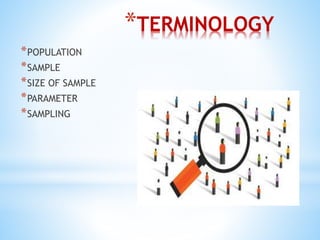
*TERMINOLOGY
*POPULATION
*SAMPLE
*SIZE OF SAMPLE
*PARAMETER
*SAMPLING
POPULATION/UNIVERSE
• Population in statistics means the whole of the information
Which comes under the preview of statistical information.
(or)
• A population is the pool of individuals from which a statistical
sample is drawn for a study.
• Ex: marks obtained by students in a class
 Population is divided into 2 types:
• Finite Population:
The population is said to be finite when the number of items
in the population can be expressed as a definite quantity
Ex: The population of weights of students in class 10th
• Infinite population:
The population is said to be infinite when the number of
items in the population cannot be expressed as a definite quanty
Ex :water drop in a ocean or stars in the sky
SAMPLE
• A selection of a group of individuals or items from a
population in such a way that the group represents the popln is
called a sample.
• Sample size should be always smaller than the population size.
• Ex: we will check whether rice is cooked or not.
SIZE OF SAMPLE:
• The number of individuals or items include in a finite sample is
called the size of the sample.
PARAMETER:
• Any statistical measure computed from population data is
known as parameter
• Ex: population mean(µ) population parameter(θ)
SAMPLING:
• It is the process od selecting a sample from a population is
called sampling
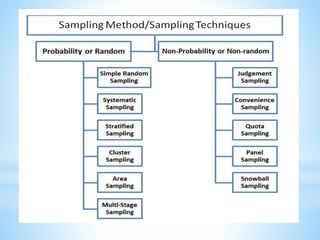
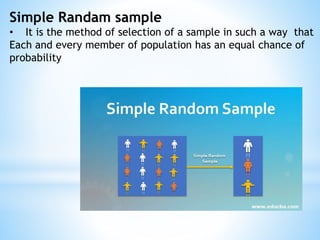
Simple Randam sample
• It is the method of selection of a sample in such a way that
Each and every member of population has an equal chance of
probability
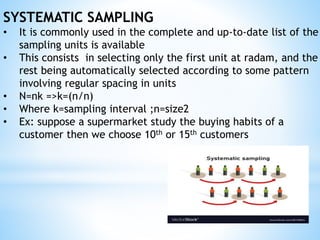
SYSTEMATIC SAMPLING
• It is commonly used in the complete and up-to-date list of the
sampling units is available
• This consists in selecting only the first unit at radam, and the
rest being automatically selected according to some pattern
involving regular spacing in units
• N=nk =>k=(n/n)
• Where k=sampling interval ;n=size2
• Ex: suppose a supermarket study the buying habits of a
customer then we choose 10th or 15th customers
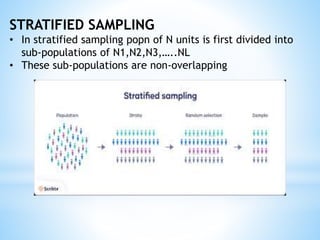
STRATIFIED SAMPLING
• In stratified sampling popn of N units is first divided into
sub-populations of N1,N2,N3,…..NL
• These sub-populations are non-overlapping
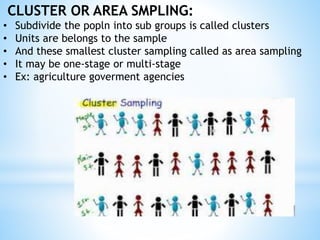
CLUSTER OR AREA SMPLING:
• Subdivide the popln into sub groups is called clusters
• Units are belongs to the sample
• And these smallest cluster sampling called as area sampling
• It may be one-stage or multi-stage
• Ex: agriculture goverment agencies
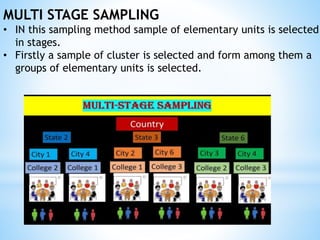
MULTI STAGE SAMPLING
• IN this sampling method sample of elementary units is selected
in stages.
• Firstly a sample of cluster is selected and form among them a
groups of elementary units is selected.
RANDAM SAMPLING.pptx

RANDAM SAMPLING.pptx

  • 1.
    RELATED TO DESIGNOF SAMPLING SURVEY -chandana priya * RANDAM SAMPLING
  • 2.
  • 3.
    POPULATION/UNIVERSE • Population instatistics means the whole of the information Which comes under the preview of statistical information. (or) • A population is the pool of individuals from which a statistical sample is drawn for a study. • Ex: marks obtained by students in a class  Population is divided into 2 types: • Finite Population: The population is said to be finite when the number of items in the population can be expressed as a definite quantity Ex: The population of weights of students in class 10th • Infinite population: The population is said to be infinite when the number of items in the population cannot be expressed as a definite quanty Ex :water drop in a ocean or stars in the sky
  • 4.
    SAMPLE • A selectionof a group of individuals or items from a population in such a way that the group represents the popln is called a sample. • Sample size should be always smaller than the population size. • Ex: we will check whether rice is cooked or not. SIZE OF SAMPLE: • The number of individuals or items include in a finite sample is called the size of the sample. PARAMETER: • Any statistical measure computed from population data is known as parameter • Ex: population mean(µ) population parameter(θ) SAMPLING: • It is the process od selecting a sample from a population is called sampling
  • 6.
    Simple Randam sample •It is the method of selection of a sample in such a way that Each and every member of population has an equal chance of probability
  • 7.
    SYSTEMATIC SAMPLING • Itis commonly used in the complete and up-to-date list of the sampling units is available • This consists in selecting only the first unit at radam, and the rest being automatically selected according to some pattern involving regular spacing in units • N=nk =>k=(n/n) • Where k=sampling interval ;n=size2 • Ex: suppose a supermarket study the buying habits of a customer then we choose 10th or 15th customers
  • 8.
    STRATIFIED SAMPLING • Instratified sampling popn of N units is first divided into sub-populations of N1,N2,N3,…..NL • These sub-populations are non-overlapping
  • 9.
    CLUSTER OR AREASMPLING: • Subdivide the popln into sub groups is called clusters • Units are belongs to the sample • And these smallest cluster sampling called as area sampling • It may be one-stage or multi-stage • Ex: agriculture goverment agencies
  • 10.
    MULTI STAGE SAMPLING •IN this sampling method sample of elementary units is selected in stages. • Firstly a sample of cluster is selected and form among them a groups of elementary units is selected.