Millennials
A Challenge and a Gift to the
Workforce
By Randall Blum, Consultant
Research Contributors
•Robert Half
•Capstrat Inc.
•Frank Magic & Associates
•Time Enterprises
•PEW Research Center
•CISCOWorldTechnology
•Wall Street Journal
•Drake University
Topics
I.Why AreThey Important?
II.Who AreThey?
III.How DoWe ManageThem?
I.Why AreThey Important?
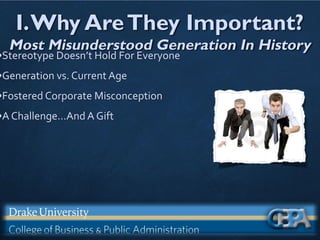
Most Misunderstood Generation In History
•Stereotype Doesn’t Hold For Everyone
•Generation vs. Current Age
•Fostered Corporate Misconception
•A Challenge...And A Gift
I.Why AreThey Important?
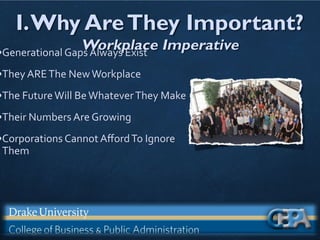
Workplace Imperative
•Generational Gaps Always Exist
•They AREThe NewWorkplace
•The FutureWill BeWhateverThey Make
•Their Numbers Are Growing
•Corporations Cannot AffordTo Ignore
Them
II.Who AreThey?
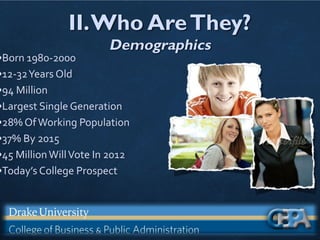
Demographics
•Born 1980-2000
•12-32Years Old
•94 Million
•Largest Single Generation
•28% OfWorking Population
•37% By 2015
•45 MillionWillVote In 2012
•Today’s College Prospect
II.Who AreThey?
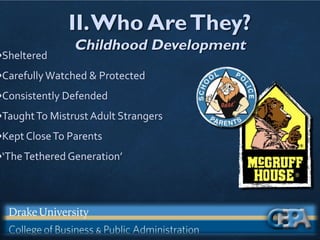
Childhood Development
•Sheltered
•CarefullyWatched & Protected
•Consistently Defended
•TaughtTo Mistrust Adult Strangers
•Kept CloseTo Parents
•‘TheTethered Generation’
II.Who AreThey?
Childhood Development
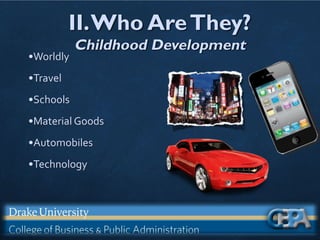
•Worldly
•Travel
•Schools
•Material Goods
•Automobiles
•Technology
II.Who AreThey?
Childhood Development
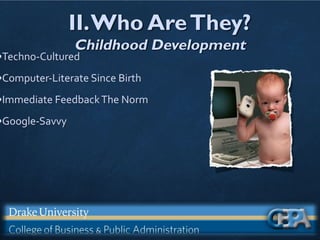
•Techno-Cultured
•Computer-Literate Since Birth
•Immediate FeedbackThe Norm
•Google-Savvy
II.Who AreThey?
Childhood Development
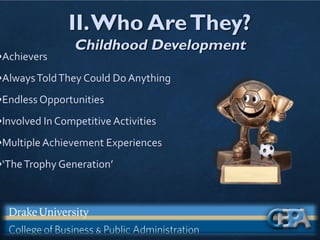
•Achievers
•AlwaysToldThey Could Do Anything
•Endless Opportunities
•Involved In Competitive Activities
•Multiple Achievement Experiences
•‘TheTrophy Generation’
II.Who AreThey?
Childhood Development
•Group-Oriented
•Ruthlessly Reliant On Peer Networks
•Rule-Centered Friendships
•Extraordinarily Interdependent
•Relaxed, But Careful Sexual Norms
II.Who AreThey?
Childhood Development
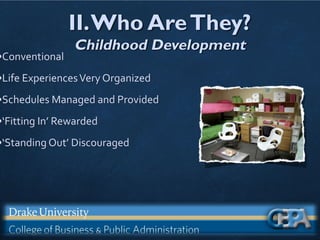
•Conventional
•Life ExperiencesVery Organized
•Schedules Managed and Provided
•‘Fitting In’ Rewarded
•‘Standing Out’ Discouraged
II.Who AreThey?
Childhood Development
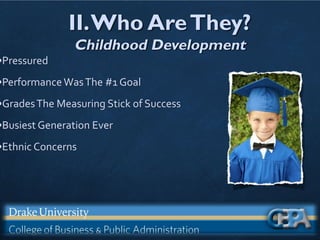
•Pressured
•PerformanceWasThe #1 Goal
•GradesThe Measuring Stick of Success
•Busiest Generation Ever
•Ethnic Concerns
II.Who AreThey?
Childhood Development
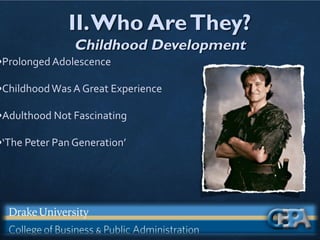
•Prolonged Adolescence
•ChildhoodWas A Great Experience
•Adulthood Not Fascinating
•‘The Peter Pan Generation’
II.Who AreThey?
Relevant Experiences
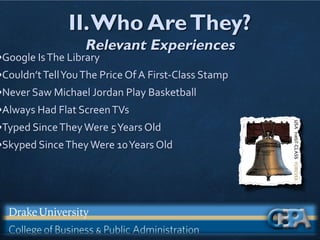
•Google IsThe Library
•Couldn’tTellYouThe Price Of A First-Class Stamp
•Never Saw Michael Jordan Play Basketball
•Always Had Flat ScreenTVs
•Typed SinceTheyWere 5Years Old
•Skyped SinceTheyWere 10Years Old
II.Who AreThey?
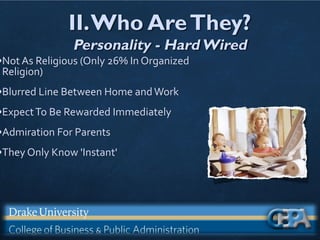
Personality - HardWired
•Not As Religious (Only 26% In Organized
Religion)
•Blurred Line Between Home andWork
•ExpectTo Be Rewarded Immediately
•Admiration For Parents
•They Only Know 'Instant'
II.Who AreThey?
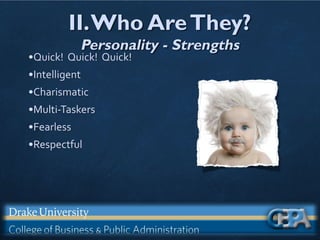
Personality - Strengths
•Quick! Quick! Quick!
•Intelligent
•Charismatic
•Multi-Taskers
•Fearless
•Respectful
II.Who AreThey?
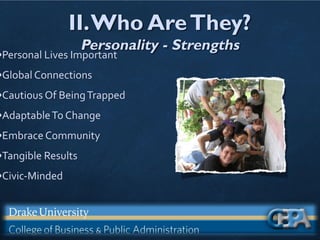
Personality - Strengths
•Personal Lives Important
•Global Connections
•Cautious Of BeingTrapped
•AdaptableTo Change
•Embrace Community
•Tangible Results
•Civic-Minded
II.Who AreThey?
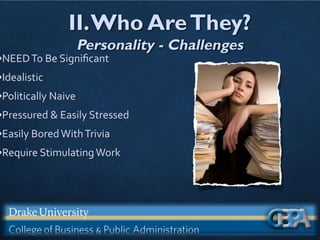
Personality - Challenges
•NEEDTo Be Significant
•Idealistic
•Politically Naive
•Pressured & Easily Stressed
•Easily BoredWithTrivia
•Require StimulatingWork
II.Who AreThey?
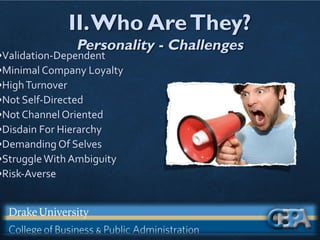
Personality - Challenges
•Validation-Dependent
•Minimal Company Loyalty
•HighTurnover
•Not Self-Directed
•Not Channel Oriented
•Disdain For Hierarchy
•Demanding Of Selves
•StruggleWith Ambiguity
•Risk-Averse
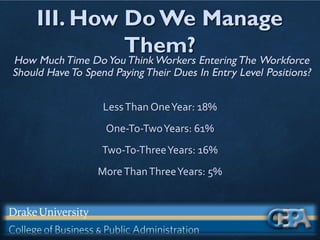
III. How Do We Manage
Them?
How MuchTime DoYouThinkWorkers EnteringThe Workforce
Should HaveTo Spend PayingTheir Dues In Entry Level Positions?
LessThan OneYear: 18%
One-To-TwoYears: 61%
Two-To-ThreeYears: 16%
MoreThanThreeYears: 5%
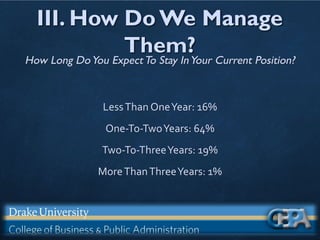
III. How Do We Manage
Them?
How Long DoYou ExpectTo Stay InYour Current Position?
LessThan OneYear: 16%
One-To-TwoYears: 64%
Two-To-ThreeYears: 19%
MoreThanThreeYears: 1%
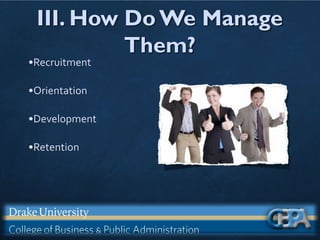
III. How Do We Manage
Them?
•Recruitment
•Orientation
•Development
•Retention
III. How Do We Manage
Them?
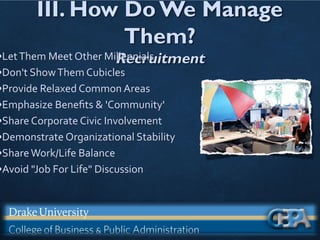
Recruitment
•LetThem Meet Other Millennials
•Don't ShowThem Cubicles
•Provide Relaxed Common Areas
•Emphasize Benefits & 'Community'
•Share Corporate Civic Involvement
•Demonstrate Organizational Stability
•ShareWork/Life Balance
•Avoid "Job For Life" Discussion
III. How Do We Manage
Them?
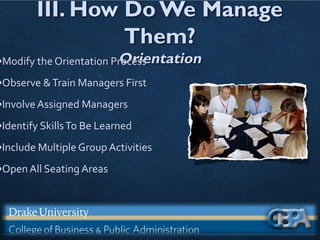
Orientation
•Modify the Orientation Process
•Observe &Train Managers First
•Involve Assigned Managers
•Identify SkillsTo Be Learned
•Include Multiple Group Activities
•Open All Seating Areas
III. How Do We Manage
Them?
Orientation
•Provide Experiential Learning
•Make StrategiesTransparent
•Identify Key AttributesTo Success
•Give Managers FreedomTo Reward
•Explain 'Meritocracy'
•Describe Engagement Policies
III. How Do We Manage
Them?
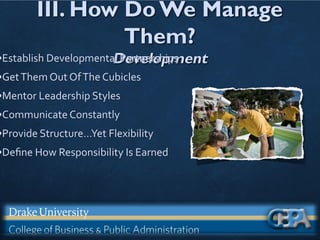
Development
•Establish Developmental Partnerships
•GetThem Out OfThe Cubicles
•Mentor Leadership Styles
•Communicate Constantly
•Provide Structure…Yet Flexibility
•Define How Responsibility Is Earned
III. How Do We Manage
Them?
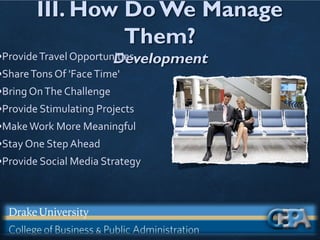
Development
•ProvideTravel Opportunities
•ShareTons Of 'FaceTime'
•Bring OnThe Challenge
•Provide Stimulating Projects
•MakeWork More Meaningful
•Stay One Step Ahead
•Provide Social Media Strategy
III. How Do We Manage
Them?
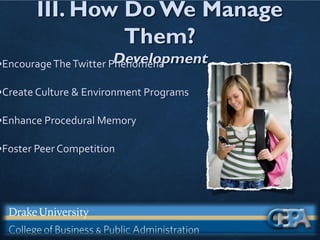
Development
•EncourageTheTwitter Phenomena
•Create Culture & Environment Programs
•Enhance Procedural Memory
•Foster Peer Competition
III. How Do We Manage
Them?
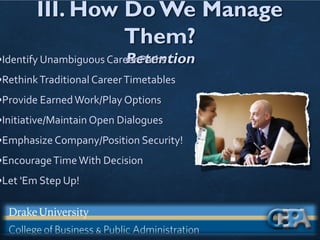
Retention
•Identify Unambiguous Career Paths
•RethinkTraditional CareerTimetables
•Provide EarnedWork/Play Options
•Initiative/Maintain Open Dialogues
•Emphasize Company/Position Security!
•EncourageTimeWith Decision
•Let 'Em Step Up!
III. How Do We Manage
Them?
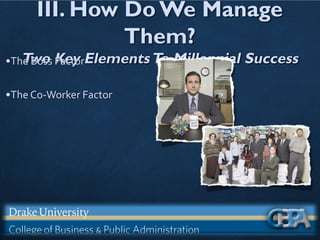
Two Key ElementsTo Millennial Success
•The Boss Factor
•The Co-Worker Factor
III. How Do We Manage
Them?
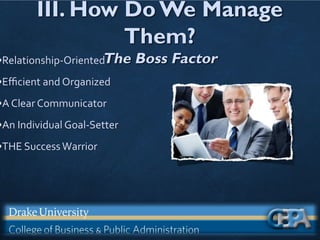
The Boss Factor
•Relationship-Oriented
•Efficient and Organized
•A Clear Communicator
•An Individual Goal-Setter
•THE SuccessWarrior
III. How Do We Manage
Them?
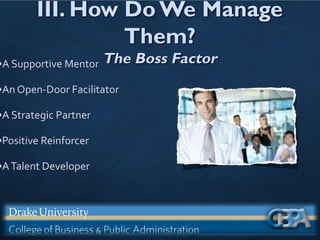
The Boss Factor
•A Supportive Mentor
•An Open-Door Facilitator
•A Strategic Partner
•Positive Reinforcer
•ATalent Developer
III. How Do We Manage
Them?
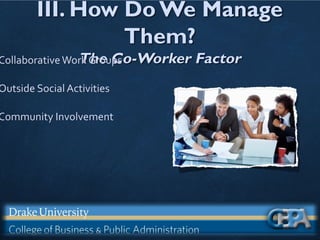
The Co-Worker Factor
CollaborativeWork Groups
Outside Social Activities
Community Involvement
Summary
I.Why AreThey Important?
II.Who AreThey?
III.How DoWe ManageThem?
I.Why AreThey Important?
Myths
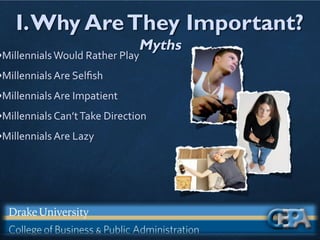
•MillennialsWould Rather Play
•Millennials Are Selfish
•Millennials Are Impatient
•Millennials Can’tTake Direction
•Millennials Are Lazy
II.Who AreThey?
Generational Comparison
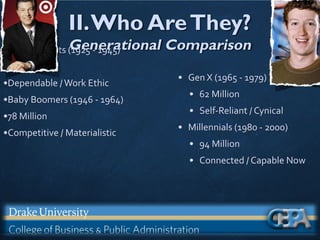
•Traditionalists (1925 - 1945)
•38 Million
•Dependable /Work Ethic
•Baby Boomers (1946 - 1964)
•78 Million
•Competitive / Materialistic
• Gen X (1965 - 1979)
• 62 Million
• Self-Reliant / Cynical
• Millennials (1980 - 2000)
• 94 Million
• Connected / Capable Now
II.Who AreThey?
Childhood Development
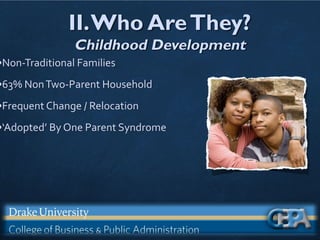
•Non-Traditional Families
•63% NonTwo-Parent Household
•Frequent Change / Relocation
•‘Adopted’ By One Parent Syndrome
II.Who AreThey?
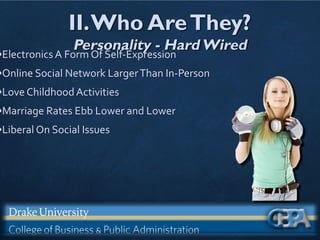
Personality - HardWired
•Electronics A Form Of Self-Expression
•Online Social Network LargerThan In-Person
•Love Childhood Activities
•Marriage Rates Ebb Lower and Lower
•Liberal On Social Issues

Randall Blum on the Millennial Workforce

  • 1.
    Millennials A Challenge anda Gift to the Workforce By Randall Blum, Consultant
  • 2.
    Research Contributors •Robert Half •CapstratInc. •Frank Magic & Associates •Time Enterprises •PEW Research Center •CISCOWorldTechnology •Wall Street Journal •Drake University
  • 3.
    Topics I.Why AreThey Important? II.WhoAreThey? III.How DoWe ManageThem?
  • 4.
    I.Why AreThey Important? MostMisunderstood Generation In History •Stereotype Doesn’t Hold For Everyone •Generation vs. Current Age •Fostered Corporate Misconception •A Challenge...And A Gift
  • 5.
    I.Why AreThey Important? WorkplaceImperative •Generational Gaps Always Exist •They AREThe NewWorkplace •The FutureWill BeWhateverThey Make •Their Numbers Are Growing •Corporations Cannot AffordTo Ignore Them
  • 6.
    II.Who AreThey? Demographics •Born 1980-2000 •12-32YearsOld •94 Million •Largest Single Generation •28% OfWorking Population •37% By 2015 •45 MillionWillVote In 2012 •Today’s College Prospect
  • 7.
    II.Who AreThey? Childhood Development •Sheltered •CarefullyWatched& Protected •Consistently Defended •TaughtTo Mistrust Adult Strangers •Kept CloseTo Parents •‘TheTethered Generation’
  • 8.
  • 9.
    II.Who AreThey? Childhood Development •Techno-Cultured •Computer-LiterateSince Birth •Immediate FeedbackThe Norm •Google-Savvy
  • 10.
    II.Who AreThey? Childhood Development •Achievers •AlwaysToldTheyCould Do Anything •Endless Opportunities •Involved In Competitive Activities •Multiple Achievement Experiences •‘TheTrophy Generation’
  • 11.
    II.Who AreThey? Childhood Development •Group-Oriented •RuthlesslyReliant On Peer Networks •Rule-Centered Friendships •Extraordinarily Interdependent •Relaxed, But Careful Sexual Norms
  • 12.
    II.Who AreThey? Childhood Development •Conventional •LifeExperiencesVery Organized •Schedules Managed and Provided •‘Fitting In’ Rewarded •‘Standing Out’ Discouraged
  • 13.
    II.Who AreThey? Childhood Development •Pressured •PerformanceWasThe#1 Goal •GradesThe Measuring Stick of Success •Busiest Generation Ever •Ethnic Concerns
  • 14.
    II.Who AreThey? Childhood Development •ProlongedAdolescence •ChildhoodWas A Great Experience •Adulthood Not Fascinating •‘The Peter Pan Generation’
  • 15.
    II.Who AreThey? Relevant Experiences •GoogleIsThe Library •Couldn’tTellYouThe Price Of A First-Class Stamp •Never Saw Michael Jordan Play Basketball •Always Had Flat ScreenTVs •Typed SinceTheyWere 5Years Old •Skyped SinceTheyWere 10Years Old
  • 16.
    II.Who AreThey? Personality -HardWired •Not As Religious (Only 26% In Organized Religion) •Blurred Line Between Home andWork •ExpectTo Be Rewarded Immediately •Admiration For Parents •They Only Know 'Instant'
  • 17.
    II.Who AreThey? Personality -Strengths •Quick! Quick! Quick! •Intelligent •Charismatic •Multi-Taskers •Fearless •Respectful
  • 18.
    II.Who AreThey? Personality -Strengths •Personal Lives Important •Global Connections •Cautious Of BeingTrapped •AdaptableTo Change •Embrace Community •Tangible Results •Civic-Minded
  • 19.
    II.Who AreThey? Personality -Challenges •NEEDTo Be Significant •Idealistic •Politically Naive •Pressured & Easily Stressed •Easily BoredWithTrivia •Require StimulatingWork
  • 20.
    II.Who AreThey? Personality -Challenges •Validation-Dependent •Minimal Company Loyalty •HighTurnover •Not Self-Directed •Not Channel Oriented •Disdain For Hierarchy •Demanding Of Selves •StruggleWith Ambiguity •Risk-Averse
  • 21.
    III. How DoWe Manage Them? How MuchTime DoYouThinkWorkers EnteringThe Workforce Should HaveTo Spend PayingTheir Dues In Entry Level Positions? LessThan OneYear: 18% One-To-TwoYears: 61% Two-To-ThreeYears: 16% MoreThanThreeYears: 5%
  • 22.
    III. How DoWe Manage Them? How Long DoYou ExpectTo Stay InYour Current Position? LessThan OneYear: 16% One-To-TwoYears: 64% Two-To-ThreeYears: 19% MoreThanThreeYears: 1%
  • 23.
    III. How DoWe Manage Them? •Recruitment •Orientation •Development •Retention
  • 24.
    III. How DoWe Manage Them? Recruitment •LetThem Meet Other Millennials •Don't ShowThem Cubicles •Provide Relaxed Common Areas •Emphasize Benefits & 'Community' •Share Corporate Civic Involvement •Demonstrate Organizational Stability •ShareWork/Life Balance •Avoid "Job For Life" Discussion
  • 25.
    III. How DoWe Manage Them? Orientation •Modify the Orientation Process •Observe &Train Managers First •Involve Assigned Managers •Identify SkillsTo Be Learned •Include Multiple Group Activities •Open All Seating Areas
  • 26.
    III. How DoWe Manage Them? Orientation •Provide Experiential Learning •Make StrategiesTransparent •Identify Key AttributesTo Success •Give Managers FreedomTo Reward •Explain 'Meritocracy' •Describe Engagement Policies
  • 27.
    III. How DoWe Manage Them? Development •Establish Developmental Partnerships •GetThem Out OfThe Cubicles •Mentor Leadership Styles •Communicate Constantly •Provide Structure…Yet Flexibility •Define How Responsibility Is Earned
  • 28.
    III. How DoWe Manage Them? Development •ProvideTravel Opportunities •ShareTons Of 'FaceTime' •Bring OnThe Challenge •Provide Stimulating Projects •MakeWork More Meaningful •Stay One Step Ahead •Provide Social Media Strategy
  • 29.
    III. How DoWe Manage Them? Development •EncourageTheTwitter Phenomena •Create Culture & Environment Programs •Enhance Procedural Memory •Foster Peer Competition
  • 30.
    III. How DoWe Manage Them? Retention •Identify Unambiguous Career Paths •RethinkTraditional CareerTimetables •Provide EarnedWork/Play Options •Initiative/Maintain Open Dialogues •Emphasize Company/Position Security! •EncourageTimeWith Decision •Let 'Em Step Up!
  • 31.
    III. How DoWe Manage Them? Two Key ElementsTo Millennial Success •The Boss Factor •The Co-Worker Factor
  • 32.
    III. How DoWe Manage Them? The Boss Factor •Relationship-Oriented •Efficient and Organized •A Clear Communicator •An Individual Goal-Setter •THE SuccessWarrior
  • 33.
    III. How DoWe Manage Them? The Boss Factor •A Supportive Mentor •An Open-Door Facilitator •A Strategic Partner •Positive Reinforcer •ATalent Developer
  • 34.
    III. How DoWe Manage Them? The Co-Worker Factor CollaborativeWork Groups Outside Social Activities Community Involvement
  • 35.
    Summary I.Why AreThey Important? II.WhoAreThey? III.How DoWe ManageThem?
  • 36.
    I.Why AreThey Important? Myths •MillennialsWouldRather Play •Millennials Are Selfish •Millennials Are Impatient •Millennials Can’tTake Direction •Millennials Are Lazy
  • 37.
    II.Who AreThey? Generational Comparison •Traditionalists(1925 - 1945) •38 Million •Dependable /Work Ethic •Baby Boomers (1946 - 1964) •78 Million •Competitive / Materialistic • Gen X (1965 - 1979) • 62 Million • Self-Reliant / Cynical • Millennials (1980 - 2000) • 94 Million • Connected / Capable Now
  • 38.
    II.Who AreThey? Childhood Development •Non-TraditionalFamilies •63% NonTwo-Parent Household •Frequent Change / Relocation •‘Adopted’ By One Parent Syndrome
  • 39.
    II.Who AreThey? Personality -HardWired •Electronics A Form Of Self-Expression •Online Social Network LargerThan In-Person •Love Childhood Activities •Marriage Rates Ebb Lower and Lower •Liberal On Social Issues