PRESENTED BY:
Janhavi Kanthak
Kathan Bhatt
Lokendra Singh Rathore
Parthiv Thakkar
Vishal Budhiraja
PRESENTED TO:
Prof. Jacob Alexander
CASE
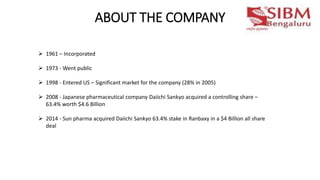
ABOUT THE COMPANY
 1961 – Incorporated
 1973 - Went public
 1998 - Entered US – Significant market for the company (28% in 2005)
 2008 - Japanese pharmaceutical company Daiichi Sankyo acquired a controlling share –
63.4% worth $4.6 Billion
 2014 - Sun pharma acquired Daiichi Sankyo 63.4% stake in Ranbaxy in a $4 Billion all share
deal
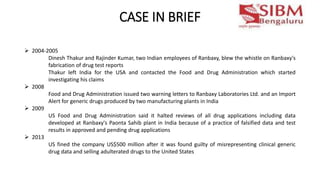
CASE IN BRIEF
 2004-2005
Dinesh Thakur and Rajinder Kumar, two Indian employees of Ranbaxy, blew the whistle on Ranbaxy's
fabrication of drug test reports
Thakur left India for the USA and contacted the Food and Drug Administration which started
investigating his claims
 2008
Food and Drug Administration issued two warning letters to Ranbaxy Laboratories Ltd. and an Import
Alert for generic drugs produced by two manufacturing plants in India
 2009
US Food and Drug Administration said it halted reviews of all drug applications including data
developed at Ranbaxy's Paonta Sahib plant in India because of a practice of falsified data and test
results in approved and pending drug applications
 2013
US fined the company US$500 million after it was found guilty of misrepresenting clinical generic
drug data and selling adulterated drugs to the United States
ANGLO SAXON MODEL
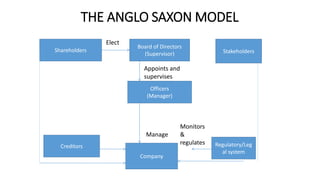
 Anglo-Saxon model of corporate governance is a system of supervision and control over the corporation,
functioning in the United States, Canada, Australia and the United Kingdom.
 Supervision is exercised mostly by investors who expressed theirs favour or disapproval for the actions
of management by the buying/selling shares of the company and voting during the general meetings of
shareholders.
 Anglo-Saxon model implies a strong emphasis on the results achieved by the company and security of their
shareholders.
Shareholders
Board of Directors
(Supervisor) Stakeholders
Officers
(Manager)
Company
Regulatory/Leg
al system
Creditors
Elect
Appoints and
supervises
Manage
Monitors
&
regulates
THE ANGLO SAXON MODEL
NARESH CHANDRA COMMITTEE
The section 4.7 of the report is about of the independent directors. The
independent director should periodically review legal compliance reports prepared
by the company.
If this section had been followed the independent director could have been able
to identify the huge risk investment made by the company.
The committee also recommends separate executive sessions of the Audit
Committee with both internal and external Auditors as well as the Management
Accounting Standards
Review the continuous disclosure requirements under the listing
agreement
The company is also required and to harmonise the accounting
standards and financial disclosures on par with international
practices.
Clause 1.3.2 Narayan Murthy committee guidelines : SEBI set up an
Accounting Standards
RISK MANAGEMENT
 The Board members should be informed about the risk assessment.
 These procedures should be periodically reviewed to ensure a properly
defined framework.
 Management should place a report before the entire Board of Directors every
quarter documenting the business risks faced by the company and any
limitations to the risk taking capacity of the corporation.
 This document should be formally approved by the Board.
Clause 3.5 from Narayan Murthy committee
WHISTEL BLOWER PROTECTION
 Mandatory recommendation Personnel who observe an unethical or improper practice (not necessarily
a violation of law) should be able to approach the audit committee without necessarily informing their
supervisors. Companies shall take measures to ensure that this right of access is communicated to all
employees through means of internal circulars, etc. The employment and other personnel policies of the
company shall contain provisions protecting “whistle blowers” from unfair termination and other unfair
prejudicial employment practices.
 Mandatory recommendation Companies shall annually affirm that they have not denied any personnel
access to the audit committee of the company (in respect of matters involving alleged misconduct) and
that they have provided protection to “whistle blowers” from unfair termination and other unfair or
prejudicial employment practices. The appointment, removal and terms of remuneration of the chief
internal auditor must be subject to review by the Audit Committee.
Clause 3.11 from Narayan Murthy committee
REFERENCES
http://www.thehindubusinessline.com/bline/2003/04/08/stories/2003040802200400.htm
http://www.business-standard.com/article/opinion/corporate-governance-failure-at-ranbaxy-
113060900607_1.html#
http://www.sebi.gov.in/cms/sebi_data/attachdocs/1453278327759.pdf
http://www.sebi.gov.in/commreport/corpgov.pdf
http://www.thehindubusinessline.com/opinion/columns/all-you-wanted-to-know-about-whistleblower-
protection/article7444193.ece
http://www.sebi.gov.in/cms/sebi_data/attachdocs/1378192045802.pdf
THANK YOU

Ranbaxy Corporate Governance

  • 1.
    PRESENTED BY: Janhavi Kanthak KathanBhatt Lokendra Singh Rathore Parthiv Thakkar Vishal Budhiraja PRESENTED TO: Prof. Jacob Alexander CASE
  • 2.
    ABOUT THE COMPANY 1961 – Incorporated  1973 - Went public  1998 - Entered US – Significant market for the company (28% in 2005)  2008 - Japanese pharmaceutical company Daiichi Sankyo acquired a controlling share – 63.4% worth $4.6 Billion  2014 - Sun pharma acquired Daiichi Sankyo 63.4% stake in Ranbaxy in a $4 Billion all share deal
  • 3.
    CASE IN BRIEF 2004-2005 Dinesh Thakur and Rajinder Kumar, two Indian employees of Ranbaxy, blew the whistle on Ranbaxy's fabrication of drug test reports Thakur left India for the USA and contacted the Food and Drug Administration which started investigating his claims  2008 Food and Drug Administration issued two warning letters to Ranbaxy Laboratories Ltd. and an Import Alert for generic drugs produced by two manufacturing plants in India  2009 US Food and Drug Administration said it halted reviews of all drug applications including data developed at Ranbaxy's Paonta Sahib plant in India because of a practice of falsified data and test results in approved and pending drug applications  2013 US fined the company US$500 million after it was found guilty of misrepresenting clinical generic drug data and selling adulterated drugs to the United States
  • 4.
    ANGLO SAXON MODEL Anglo-Saxon model of corporate governance is a system of supervision and control over the corporation, functioning in the United States, Canada, Australia and the United Kingdom.  Supervision is exercised mostly by investors who expressed theirs favour or disapproval for the actions of management by the buying/selling shares of the company and voting during the general meetings of shareholders.  Anglo-Saxon model implies a strong emphasis on the results achieved by the company and security of their shareholders.
  • 5.
    Shareholders Board of Directors (Supervisor)Stakeholders Officers (Manager) Company Regulatory/Leg al system Creditors Elect Appoints and supervises Manage Monitors & regulates THE ANGLO SAXON MODEL
  • 6.
    NARESH CHANDRA COMMITTEE Thesection 4.7 of the report is about of the independent directors. The independent director should periodically review legal compliance reports prepared by the company. If this section had been followed the independent director could have been able to identify the huge risk investment made by the company. The committee also recommends separate executive sessions of the Audit Committee with both internal and external Auditors as well as the Management
  • 7.
    Accounting Standards Review thecontinuous disclosure requirements under the listing agreement The company is also required and to harmonise the accounting standards and financial disclosures on par with international practices. Clause 1.3.2 Narayan Murthy committee guidelines : SEBI set up an Accounting Standards
  • 8.
    RISK MANAGEMENT  TheBoard members should be informed about the risk assessment.  These procedures should be periodically reviewed to ensure a properly defined framework.  Management should place a report before the entire Board of Directors every quarter documenting the business risks faced by the company and any limitations to the risk taking capacity of the corporation.  This document should be formally approved by the Board. Clause 3.5 from Narayan Murthy committee
  • 9.
    WHISTEL BLOWER PROTECTION Mandatory recommendation Personnel who observe an unethical or improper practice (not necessarily a violation of law) should be able to approach the audit committee without necessarily informing their supervisors. Companies shall take measures to ensure that this right of access is communicated to all employees through means of internal circulars, etc. The employment and other personnel policies of the company shall contain provisions protecting “whistle blowers” from unfair termination and other unfair prejudicial employment practices.  Mandatory recommendation Companies shall annually affirm that they have not denied any personnel access to the audit committee of the company (in respect of matters involving alleged misconduct) and that they have provided protection to “whistle blowers” from unfair termination and other unfair or prejudicial employment practices. The appointment, removal and terms of remuneration of the chief internal auditor must be subject to review by the Audit Committee. Clause 3.11 from Narayan Murthy committee
  • 10.
  • 11.