Project Report on<br />“Corporate Governanace”<br />A detailed study <br />Submitted in partial fulfillment of the requirement for the award of degree of<br />In area of SEM-IV “SERVICE MANAGEMENT”<br />Submitted by<br />Appasaheb Jadhav  17<br />Chetan Jagtap         18<br />Ashish Jawharkar  19<br />Varun Jethwa       20<br />2514600301625<br />SARASWATI COLLEGE OF ENGINEERING,<br />Department of<br />Master of Management Studies (MMS)<br />Kharghar, Navi Mumbai<br />Batch: 2009 – 2011<br />INTRODUCTION<br />Corporate governance is the set of processes, customs, policies, laws, and institutions affecting the way a corporation (or company) is directed, administered or controlled. Corporate governance also includes the relationships among the many stakeholders involved and the goals for which the corporation is governed. In simpler terms it means the extent to which companies are run in an open & honest manner.<br />Corporate governance has three key constituents namely: the Shareholders, the Board of Directors & the Management. Other stakeholders include employees, customers, creditors, suppliers, regulators, and the community at large. The concept of corporate governance identifies their roles & responsibilities as well as their rights in the context of the company. It emphasises accountability, transparency & fairness in the management of a company by its Board, so as to achieve sustained prosperity for all the stakeholders. <br />Corporate governance is a synonym for sound management, transparency & disclosure. Transparency refers to creation of an environment whereby decisions & actions of the corporate are made visible, accessible & understandable. Disclosure refers to the process of providing information as well as its timely dissemination. <br />In A Board Culture of Corporate Governance, business author Gabrielle O'Donovan defines corporate governance as “An internal system encompassing policies, processes and people, which serves the needs of shareholders and other stakeholders, by directing and controlling management activities with good business savvy, objectivity, accountability and integrity”. Sound corporate governance is reliant on external marketplace commitment and legislation, plus a healthy board culture which safeguards policies and processes.<br />BACKGROUND<br />As mentioned earlier, the term ‘corporate governance’ is related to the extent to which the companies are transparent & accountable about their business. Corporate governance today has become a major issue of interest in most of the corporate boardrooms, academic circles & even governments around the globe. <br />In the 19th century, state corporation laws enhanced the rights of corporate boards to govern without unanimous consent of shareholders in exchange for statutory benefits like appraisal rights, to make corporate governance more efficient. Since that time and because most large publicly traded corporations in the US are incorporated under corporate administration-friendly Delaware law and because the US's wealth has been increasingly securitized into various corporate entities and institutions, the rights of individual owners and shareholders have become increasingly derivative and dissipated. The concerns of shareholders over administration pay and stock losses periodically has led to more frequent calls for corporate governance reforms.<br /> In the 20th century, in the immediate aftermath of the Wall Street Crash of 1929, legal scholars such as Adolf Augustus Berle, Edwin Dodd, and Gardiner C. Means pondered on the changing role of the modern corporation in society. From the Chicago school of economics, Ronald Coase's \"
The Nature of the Firm\"
 (1937) introduced the notion of transaction costs into the understanding of why firms are founded and how they continue to behave. Fifty y`ears later, Eugene Fama and Michael Jensen's \"
The Separation of Ownership and Control\"
 (1983, Journal of Law and Economics) firmly established agency theory as a way of understanding corporate governance: the firm is seen as a series of contracts. Agency theory's dominance was highlighted in a 1989 article by Kathleen Eisenhardt (\"
Agency theory: an assessement and review\"
, Academy of Management Review).<br />The expansion of US after World War II through the emergence of multinational corporations saw the establishment of the managerial class. Accordingly, the following Harvard Business School management professors published influential monographs studying their prominence: Myles Mace (entrepreneurship), Alfred D. Chandler, Jr. (business history), Jay Lorsch (organizational behavior) and Elizabeth MacIver (organizational behaviour). According to Lorsch and MacIver \"
Many large corporations have dominant control over business affairs without sufficient accountability or monitoring by their board of directors.\"
<br />Since the late 1970’s, corporate governance has been the subject of significant debate in the U.S. and around the globe. Bold, broad efforts to reform corporate governance have been driven, in part, by the needs and desires of shareowners to exercise their rights of corporate ownership and to increase the value of their shares and, therefore, wealth. Over the past three decades, corporate directors’ duties have expanded greatly beyond their traditional legal responsibility of duty of loyalty to the corporation and its shareowners. <br />In the first half of the 1990s, the issue of corporate governance in the U.S. received considerable press attention due to the wave of CEO dismissals (e.g.: IBM, Kodak, Honeywell) by their boards. The California Public Employees' Retirement System (CalPERS) led a wave of institutional shareholder activism (something only very rarely seen before), as a way of ensuring that corporate value would not be destroyed by the now traditionally cozy relationships between the CEO and the board of directors (e.g., by the unrestrained issuance of stock options, not infrequently back dated).<br />In 1997, the East Asian Financial Crisis saw the economies of Thailand, Indonesia, South Korea, Malaysia and The Philippines severely affected by the exit of foreign capital after property assets collapsed. The lack of corporate governance mechanisms in these countries highlighted the weaknesses of the institutions in their economies.<br />In the early 2000s, the massive bankruptcies (and criminal malfeasance) of Enron and Worldcom, as well as lesser corporate debacles, such as Adelphia Communications, AOL, Qwest, Arthur Andersen, Global Crossing, Tyco, etc. led to increased shareholder and governmental interest in corporate governance. Because these triggered some of the largest insolvencies, the public confidence in the corporate sector was sapped. The popular perception was that corporate leadership was fraught with greed & excess. Inadequancies & failure of the existing systems, brought to the fore, the need for norms & codes to remedy them.  This resulted in the passage of the Sarbanes-Oxley Act of 2002, (popularly known as Sox) by the United States.<br />In India however, only when the Securities Exchange Board of India (SEBI), introduced Clause 49 in the Listing Agreement, for the first time in the financial year 2000-2001, that the listed companies started embracing the concept of corporate governance. This clause was based on the Kumara Mangalam Birla Committee constituted by SEBI. After these recommendations were in place for about four years, SEBI, in order to evaluate & improve the existing practices, set up a committee under the Chairmanship of Mr. N.R. Narayana Murthy during 2002-2003.At the same time, the Ministry of Corporate Affairs set up a committee under the Chairmanship of Shri. Naresh Chandra to examine the various corporate governance issues. The recommendations of the committee however, faced widespread protests & representations from the industry, forcing SEBI to revise them. <br />Finally, on the 29th October, 2004, SEBI announced the revised Clause 49, which was implemented by the end of the financial year 2004-2005. Apart from Clause 49 of the Listing Agreement, corporate governance is also regulated through the provisions of the Companies Act, 1956. The respective provisions have been introduced in the Companies Act by Companies Amendment Act, 2000.<br />DEFINITIONS OF CORPORATE GOVERNANCE<br />\"
Corporate governance is a field in economics that investigates how to secure/motivate efficient management of corporations by the use of incentive mechanisms, such as contracts, organizational designs and legislation. This is often limited to the question of improving financial performance, for example, how the corporate owners can secure/motivate that the corporate managers will deliver a competitive rate of return\"
 - www.encycogov.com, Mathiesen [2002]. <br />“Corporate governance deals with the ways in which suppliers of finance to corporations assure themselves of getting a return on their investment”. <br />-The Journal of Finance, Shleifer and Vishny [1997]. <br />\"
Corporate governance is the system by which business corporations are directed and controlled. The corporate governance structure specifies the distribution of rights and responsibilities among different participants in the corporation, such as, the board, managers, shareholders and other stakeholders, and spells out the rules and procedures for making decisions on corporate affairs. By doing this, it also provides the structure through which the company objectives are set, and the means of attaining those objectives and monitoring performance\"
. <br />OECD April 1999. OECD's definition is consistent with the one presented by Cadbury [1992, page 15]. <br />\"
Corporate governance - which can be defined narrowly as the relationship of a company to its shareholders or, more broadly, as its relationship to society\"
.                 - From an article in Financial Times [1997]. <br />\"
Corporate governance is about promoting corporate fairness, transparency and accountability\"
. - J. Wolfensohn, (President of the Word bank, as quoted by an article in Financial Times, June 21, 1999). <br />“Some commentators take too narrow a view, and say it (corporate governance) is the fancy term for the way in which directors and auditors handle their responsibilities towards shareholders. Others use the expression as if it were synonymous with shareholder democracy. Corporate governance is a topic recently conceived, as yet ill-defined, and consequently blurred at the edges…corporate governance as a subject, as an objective, or as a regime to be followed for the good of shareholders, employees, customers, bankers and indeed for the reputation and standing of our nation and its economy” Maw et al. [1994]. <br />Sir Adrian Cadbury in his preface to the World Bank publication – ‘Corporate Governance: A framework for implementation’, said, “Corporate governance is holding the balance between economic & social goals and between individual & community goals. The aim is to align as nearly as possible, the interests of individuals, corporations & society”.<br />The Cadbury Committee U.K, defined corporate governance as follows:<br />“It is a system by which companies are directed & controlled”. <br />SCOPE  &  IMPORTANCE OF CORPORATE GOVERNANCE<br />Corporate governance is all about ethics in business. It is about transparency, openness & fair play in all aspects of business operations. The key aspects to corporate governance include:<br />Accountability of Board of Directors & their constituent responsibilities to the ultimate owners- the shareholders.<br />Transparency, i.e. right to information, timeliness & integrity of the information produced.<br />Clarity in responsibilities to enhance accountability.<br />Quality & competence of Directors and their track record.<br />Checks & balances in the process of governance.<br />Adherence to the rules, laws & spirit of codes. <br />An active & involved board consisting of professional & truly independent directors plays an important role in creating trust between a company & its’ investors and is the best guarantor of good corporate governance.<br />Good corporate governance is integral to the very existence of a company. It is important for the following reasons:<br />Corporate governance ensures that a properly structured Board, capable of taking independent & objective decisions is at the helm of affairs of the company. This lays down the framework for creating long-term trust between the company & external providers of capital.<br />It improves strategic thinking at the top by inducting independent directors who bring a wealth of experience & a host of new ideas.<br />It rationalizes the management & monitoring of risk that a corporation faces globally.<br />Corporate governance emphasises the adoption of transparent procedures & practices by the Board, thereby ensuring integrity in financial reports.<br />It limits the liability of top management & directors, by carefully articulating the decision making process.<br />It inspires & strengthens investors’ confidence by ensuring that there are adequate number of non-executive & independent directors on the Board, to look after the interests & well-being of all the stakeholders.<br />Corporate governance helps provide a degree of confidence that is necessary for the proper functioning of a market economy, as it contemplates adherence to ethical business standards.<br />Finally, globalisation of the market place has ushered in an era wherein the quality of corporate governance has become a crucial determinant of survival of corporates. Compatibility of corporate governance practices with global standards has also become an important constituent of corporate success. Thus, good corporate governance is a necessary pre-requisite for the success of Indian corporates.<br />THE SARBANES-OXLEY ACT<br />                             The Sarbanes-Oxley Act (often referred to as Sox) is a legislation enacted in response to the high-profile financial scandals like Enron, WorldCom, Tyco, AOL, etc. so as to protect the shareholders & general public from accounting errors & fraudulent practices in the enterprise. The Act is administered by the Securities & Exchange Commission (SEC), which sets deadlines for compliance & publishes rules on requirements. The Act is not a set of business practices & does not specify how a business should store records; rather it defines which records are to be stored & for how long. The legislation not only affects the financial side of corporations but also the IT Departments of these, whose job is to store their electronic records. The Sarbanes-Oxley Act states that all business records, including electronic records & electronic messages must be saved for not less than five years. The consequences of non-compliance are fines, imprisonment or both.  <br />The following sections of the Act contain three rules that affect the management of electronic records. <br />1) The first rule deals with destruction, alteration & falsification of records.
Sec 802 (a) states that, “Whoever knowingly alters, destroys, mutilates, conceals, covers up, falsifies or makes a false entry in any record, document or tangible object with the intent to impede, obstruct or influence the investigation or proper administration of any matter within the jurisdiction of any department or agency of the United States or any case filed under Title 11, or in relation to or contemplation of any such matter or case, shall be fined under this title, imprisoned not more than 20 years, or both.
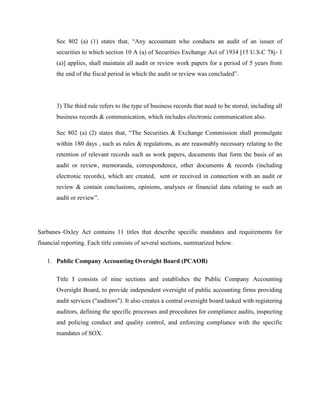
2) The second rule defines the retention period for storage of records. Best practices indicate that corporations securely store all business records using the same guidelines as set for public accountants.Sec 802 (a) (1) states that, “Any accountant who conducts an audit of an issuer of securities to which section 10 A (a) of Securities Exchange Act of 1934 [15 U.S.C 78j- 1 (a)] applies, shall maintain all audit or review work papers for a period of 5 years from the end of the fiscal period in which the audit or review was concluded”.<br />3) The third rule refers to the type of business records that need to be stored, including all business records & communication, which includes electronic communication also.Sec 802 (a) (2) states that, “The Securities & Exchange Commission shall promulgate within 180 days , such as rules & regulations, as are reasonably necessary relating to the retention of relevant records such as work papers, documents that form the basis of an audit or review, memoranda, correspondence, other documents & records (including electronic records), which are created,  sent or received in connection with an audit or review & contain conclusions, opinions, analyses or financial data relating to such an audit or review”.<br />             <br />Sarbanes–Oxley Act contains 11 titles that describe specific mandates and requirements for financial reporting. Each title consists of several sections, summarized below.<br />Public Company Accounting Oversight Board (PCAOB) <br />Title I consists of nine sections and establishes the Public Company Accounting Oversight Board, to provide independent oversight of public accounting firms providing audit services (\"
auditors\"
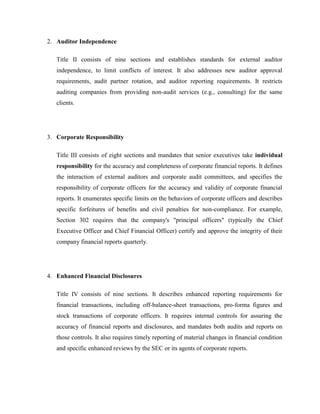
). It also creates a central oversight board tasked with registering auditors, defining the specific processes and procedures for compliance audits, inspecting and policing conduct and quality control, and enforcing compliance with the specific mandates of SOX.<br />Auditor Independence <br />Title II consists of nine sections and establishes standards for external auditor independence, to limit conflicts of interest. It also addresses new auditor approval requirements, audit partner rotation, and auditor reporting requirements. It restricts auditing companies from providing non-audit services (e.g., consulting) for the same clients.<br />Corporate Responsibility <br />Title III consists of eight sections and mandates that senior executives take individual responsibility for the accuracy and completeness of corporate financial reports. It defines the interaction of external auditors and corporate audit committees, and specifies the responsibility of corporate officers for the accuracy and validity of corporate financial reports. It enumerates specific limits on the behaviors of corporate officers and describes specific forfeitures of benefits and civil penalties for non-compliance. For example, Section 302 requires that the company's \"
principal officers\"
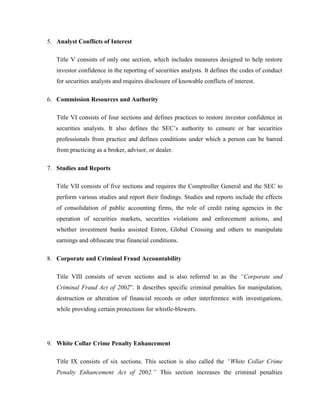
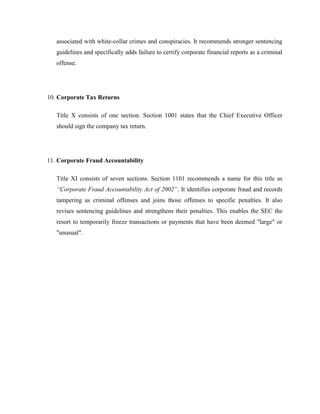
 (typically the Chief Executive Officer and Chief Financial Officer) certify and approve the integrity of their company financial reports quarterly.<br />Enhanced Financial Disclosures <br />Title IV consists of nine sections. It describes enhanced reporting requirements for financial transactions, including off-balance-sheet transactions, pro-forma figures and stock transactions of corporate officers. It requires internal controls for assuring the accuracy of financial reports and disclosures, and mandates both audits and reports on those controls. It also requires timely reporting of material changes in financial condition and specific enhanced reviews by the SEC or its agents of corporate reports.<br />Analyst Conflicts of Interest <br />Title V consists of only one section, which includes measures designed to help restore investor confidence in the reporting of securities analysts. It defines the codes of conduct for securities analysts and requires disclosure of knowable conflicts of interest.<br />Commission Resources and Authority <br />Title VI consists of four sections and defines practices to restore investor confidence in securities analysts. It also defines the SEC’s authority to censure or bar securities professionals from practice and defines conditions under which a person can be barred from practicing as a broker, advisor, or dealer.<br />Studies and Reports <br />Title VII consists of five sections and requires the Comptroller General and the SEC to perform various studies and report their findings. Studies and reports include the effects of consolidation of public accounting firms, the role of credit rating agencies in the operation of securities markets, securities violations and enforcement actions, and whether investment banks assisted Enron, Global Crossing and others to manipulate earnings and obfuscate true financial conditions.<br />Corporate and Criminal Fraud Accountability <br />Title VIII consists of seven sections and is also referred to as the “Corporate and Criminal Fraud Act of 2002”. It describes specific criminal penalties for manipulation, destruction or alteration of financial records or other interference with investigations, while providing certain protections for whistle-blowers.<br />White Collar Crime Penalty Enhancement <br />Title IX consists of six sections. This section is also called the “White Collar Crime Penalty Enhancement Act of 2002.” This section increases the criminal penalties associated with white-collar crimes and conspiracies. It recommends stronger sentencing guidelines and specifically adds failure to certify corporate financial reports as a criminal offense.<br />Corporate Tax Returns <br />Title X consists of one section. Section 1001 states that the Chief Executive Officer should sign the company tax return.<br />Corporate Fraud Accountability <br />Title XI consists of seven sections. Section 1101 recommends a name for this title as “Corporate Fraud Accountability Act of 2002”. It identifies corporate fraud and records tampering as criminal offenses and joins those offenses to specific penalties. It also revises sentencing guidelines and strengthens their penalties. This enables the SEC the resort to temporarily freeze transactions or payments that have been deemed \"
large\"
 or \"
unusual\"
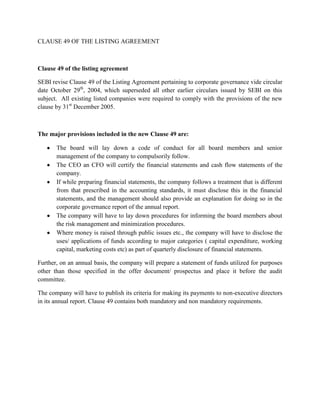
.<br />CLAUSE 49 OF THE LISTING AGREEMENT<br />Clause 49 of the listing agreement<br />SEBI revise Clause 49 of the Listing Agreement pertaining to corporate governance vide circular date October 29th, 2004, which superseded all other earlier circulars issued by SEBI on this subject.  All existing listed companies were required to comply with the provisions of the new clause by 31st December 2005.<br />The major provisions included in the new Clause 49 are:<br />The board will lay down a code of conduct for all board members and senior management of the company to compulsorily follow.
The CEO an CFO will certify the financial statements and cash flow statements of the company.
If while preparing financial statements, the company follows a treatment that is different from that prescribed in the accounting standards, it must disclose this in the financial statements, and the management should also provide an explanation for doing so in the corporate governance report of the annual report.
The company will have to lay down procedures for informing the board members about the risk management and minimization procedures.
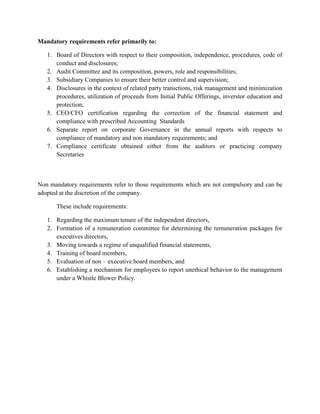
Where money is raised through public issues etc., the company will have to disclose the uses/ applications of funds according to major categories ( capital expenditure, working capital, marketing costs etc) as part of quarterly disclosure of financial statements.Further, on an annual basis, the company will prepare a statement of funds utilized for purposes other than those specified in the offer document/ prospectus and place it before the audit committee.<br />The company will have to publish its criteria for making its payments to non-executive directors in its annual report. Clause 49 contains both mandatory and non mandatory requirements.<br />Mandatory requirements refer primarily to:<br />Board of Directors with respect to their composition, independence, procedures, code of conduct and disclosures;
Audit Committee and its composition, powers, role and responsibilities;
Subsidiary Companies to ensure their better control and supervision;
Disclosures in the context of related party transctions, risk management and minimization procedures, utilization of proceeds from Initial Public Offerings, inverstor education and protection;
CEO/CFO certification regarding the correction of the financial statement and compliance with prescribed Accounting  Standards
Separate report on corporate Governance in the annual reports with respects to compliance of mandatory and non mandatory requirements; and
Compliance certificate obtained either from the auditors or practicing company SecretariesNon mandatory requirements refer to those requirements which are not compulsory and can be adopted at the discretion of the company.<br />These include requirements:<br />Regarding the maximum tenure of the independent directors,
Formation of a remuneration committee for determining the remuneration packages for executives directors,
Moving towards a regime of unqualified financial statements,
Training of board members,
Evaluation of non – executive board members, and
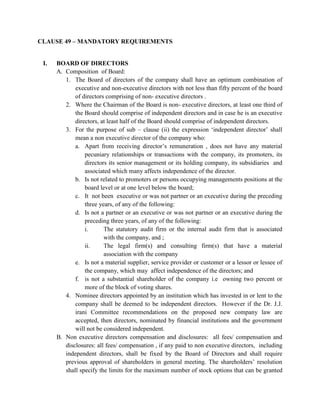
Establishing a mechanism for employees to report unethical behavior to the management under a Whistle Blower Policy.CLAUSE 49 – MANDATORY REQUIREMENTS<br />BOARD OF DIRECTORS
Composition  of Board:
The Board of directors of the company shall have an optimum combination of executive and non-executive directors with not less than fifty percent of the board of directors comprising of non- executive directors .
Where the Chairman of the Board is non- executive directors, at least one third of the Board should comprise of independent directors and in case he is an executive directors, at least half of the Board should comprise of independent directors.
For the purpose of sub – clause (ii) the expression ‘independent director’ shall mean a non executive director of the company who:
Apart from receiving director’s remuneration , does not have any material pecuniary relationships or transactions with the company, its promoters, its directors its senior management or its holding company, its subsidiaries  and associated which many affects independence of the director.
Is not related to promoters or persons occupying managements positions at the board level or at one level below the board;
It  not been  executive or was not partner or an executive during the preceding three years, of any of the following:
Is not a partner or an executive or was not partner or an executive during the preceding three years, of any of the following:

Corporate governance project

  • 1.
    Project Report on<br/>“Corporate Governanace”<br />A detailed study <br />Submitted in partial fulfillment of the requirement for the award of degree of<br />In area of SEM-IV “SERVICE MANAGEMENT”<br />Submitted by<br />Appasaheb Jadhav 17<br />Chetan Jagtap 18<br />Ashish Jawharkar 19<br />Varun Jethwa 20<br />2514600301625<br />SARASWATI COLLEGE OF ENGINEERING,<br />Department of<br />Master of Management Studies (MMS)<br />Kharghar, Navi Mumbai<br />Batch: 2009 – 2011<br />INTRODUCTION<br />Corporate governance is the set of processes, customs, policies, laws, and institutions affecting the way a corporation (or company) is directed, administered or controlled. Corporate governance also includes the relationships among the many stakeholders involved and the goals for which the corporation is governed. In simpler terms it means the extent to which companies are run in an open & honest manner.<br />Corporate governance has three key constituents namely: the Shareholders, the Board of Directors & the Management. Other stakeholders include employees, customers, creditors, suppliers, regulators, and the community at large. The concept of corporate governance identifies their roles & responsibilities as well as their rights in the context of the company. It emphasises accountability, transparency & fairness in the management of a company by its Board, so as to achieve sustained prosperity for all the stakeholders. <br />Corporate governance is a synonym for sound management, transparency & disclosure. Transparency refers to creation of an environment whereby decisions & actions of the corporate are made visible, accessible & understandable. Disclosure refers to the process of providing information as well as its timely dissemination. <br />In A Board Culture of Corporate Governance, business author Gabrielle O'Donovan defines corporate governance as “An internal system encompassing policies, processes and people, which serves the needs of shareholders and other stakeholders, by directing and controlling management activities with good business savvy, objectivity, accountability and integrity”. Sound corporate governance is reliant on external marketplace commitment and legislation, plus a healthy board culture which safeguards policies and processes.<br />BACKGROUND<br />As mentioned earlier, the term ‘corporate governance’ is related to the extent to which the companies are transparent & accountable about their business. Corporate governance today has become a major issue of interest in most of the corporate boardrooms, academic circles & even governments around the globe. <br />In the 19th century, state corporation laws enhanced the rights of corporate boards to govern without unanimous consent of shareholders in exchange for statutory benefits like appraisal rights, to make corporate governance more efficient. Since that time and because most large publicly traded corporations in the US are incorporated under corporate administration-friendly Delaware law and because the US's wealth has been increasingly securitized into various corporate entities and institutions, the rights of individual owners and shareholders have become increasingly derivative and dissipated. The concerns of shareholders over administration pay and stock losses periodically has led to more frequent calls for corporate governance reforms.<br /> In the 20th century, in the immediate aftermath of the Wall Street Crash of 1929, legal scholars such as Adolf Augustus Berle, Edwin Dodd, and Gardiner C. Means pondered on the changing role of the modern corporation in society. From the Chicago school of economics, Ronald Coase's \" The Nature of the Firm\" (1937) introduced the notion of transaction costs into the understanding of why firms are founded and how they continue to behave. Fifty y`ears later, Eugene Fama and Michael Jensen's \" The Separation of Ownership and Control\" (1983, Journal of Law and Economics) firmly established agency theory as a way of understanding corporate governance: the firm is seen as a series of contracts. Agency theory's dominance was highlighted in a 1989 article by Kathleen Eisenhardt (\" Agency theory: an assessement and review\" , Academy of Management Review).<br />The expansion of US after World War II through the emergence of multinational corporations saw the establishment of the managerial class. Accordingly, the following Harvard Business School management professors published influential monographs studying their prominence: Myles Mace (entrepreneurship), Alfred D. Chandler, Jr. (business history), Jay Lorsch (organizational behavior) and Elizabeth MacIver (organizational behaviour). According to Lorsch and MacIver \" Many large corporations have dominant control over business affairs without sufficient accountability or monitoring by their board of directors.\" <br />Since the late 1970’s, corporate governance has been the subject of significant debate in the U.S. and around the globe. Bold, broad efforts to reform corporate governance have been driven, in part, by the needs and desires of shareowners to exercise their rights of corporate ownership and to increase the value of their shares and, therefore, wealth. Over the past three decades, corporate directors’ duties have expanded greatly beyond their traditional legal responsibility of duty of loyalty to the corporation and its shareowners. <br />In the first half of the 1990s, the issue of corporate governance in the U.S. received considerable press attention due to the wave of CEO dismissals (e.g.: IBM, Kodak, Honeywell) by their boards. The California Public Employees' Retirement System (CalPERS) led a wave of institutional shareholder activism (something only very rarely seen before), as a way of ensuring that corporate value would not be destroyed by the now traditionally cozy relationships between the CEO and the board of directors (e.g., by the unrestrained issuance of stock options, not infrequently back dated).<br />In 1997, the East Asian Financial Crisis saw the economies of Thailand, Indonesia, South Korea, Malaysia and The Philippines severely affected by the exit of foreign capital after property assets collapsed. The lack of corporate governance mechanisms in these countries highlighted the weaknesses of the institutions in their economies.<br />In the early 2000s, the massive bankruptcies (and criminal malfeasance) of Enron and Worldcom, as well as lesser corporate debacles, such as Adelphia Communications, AOL, Qwest, Arthur Andersen, Global Crossing, Tyco, etc. led to increased shareholder and governmental interest in corporate governance. Because these triggered some of the largest insolvencies, the public confidence in the corporate sector was sapped. The popular perception was that corporate leadership was fraught with greed & excess. Inadequancies & failure of the existing systems, brought to the fore, the need for norms & codes to remedy them. This resulted in the passage of the Sarbanes-Oxley Act of 2002, (popularly known as Sox) by the United States.<br />In India however, only when the Securities Exchange Board of India (SEBI), introduced Clause 49 in the Listing Agreement, for the first time in the financial year 2000-2001, that the listed companies started embracing the concept of corporate governance. This clause was based on the Kumara Mangalam Birla Committee constituted by SEBI. After these recommendations were in place for about four years, SEBI, in order to evaluate & improve the existing practices, set up a committee under the Chairmanship of Mr. N.R. Narayana Murthy during 2002-2003.At the same time, the Ministry of Corporate Affairs set up a committee under the Chairmanship of Shri. Naresh Chandra to examine the various corporate governance issues. The recommendations of the committee however, faced widespread protests & representations from the industry, forcing SEBI to revise them. <br />Finally, on the 29th October, 2004, SEBI announced the revised Clause 49, which was implemented by the end of the financial year 2004-2005. Apart from Clause 49 of the Listing Agreement, corporate governance is also regulated through the provisions of the Companies Act, 1956. The respective provisions have been introduced in the Companies Act by Companies Amendment Act, 2000.<br />DEFINITIONS OF CORPORATE GOVERNANCE<br />\" Corporate governance is a field in economics that investigates how to secure/motivate efficient management of corporations by the use of incentive mechanisms, such as contracts, organizational designs and legislation. This is often limited to the question of improving financial performance, for example, how the corporate owners can secure/motivate that the corporate managers will deliver a competitive rate of return\" - www.encycogov.com, Mathiesen [2002]. <br />“Corporate governance deals with the ways in which suppliers of finance to corporations assure themselves of getting a return on their investment”. <br />-The Journal of Finance, Shleifer and Vishny [1997]. <br />\" Corporate governance is the system by which business corporations are directed and controlled. The corporate governance structure specifies the distribution of rights and responsibilities among different participants in the corporation, such as, the board, managers, shareholders and other stakeholders, and spells out the rules and procedures for making decisions on corporate affairs. By doing this, it also provides the structure through which the company objectives are set, and the means of attaining those objectives and monitoring performance\" . <br />OECD April 1999. OECD's definition is consistent with the one presented by Cadbury [1992, page 15]. <br />\" Corporate governance - which can be defined narrowly as the relationship of a company to its shareholders or, more broadly, as its relationship to society\" . - From an article in Financial Times [1997]. <br />\" Corporate governance is about promoting corporate fairness, transparency and accountability\" . - J. Wolfensohn, (President of the Word bank, as quoted by an article in Financial Times, June 21, 1999). <br />“Some commentators take too narrow a view, and say it (corporate governance) is the fancy term for the way in which directors and auditors handle their responsibilities towards shareholders. Others use the expression as if it were synonymous with shareholder democracy. Corporate governance is a topic recently conceived, as yet ill-defined, and consequently blurred at the edges…corporate governance as a subject, as an objective, or as a regime to be followed for the good of shareholders, employees, customers, bankers and indeed for the reputation and standing of our nation and its economy” Maw et al. [1994]. <br />Sir Adrian Cadbury in his preface to the World Bank publication – ‘Corporate Governance: A framework for implementation’, said, “Corporate governance is holding the balance between economic & social goals and between individual & community goals. The aim is to align as nearly as possible, the interests of individuals, corporations & society”.<br />The Cadbury Committee U.K, defined corporate governance as follows:<br />“It is a system by which companies are directed & controlled”. <br />SCOPE & IMPORTANCE OF CORPORATE GOVERNANCE<br />Corporate governance is all about ethics in business. It is about transparency, openness & fair play in all aspects of business operations. The key aspects to corporate governance include:<br />Accountability of Board of Directors & their constituent responsibilities to the ultimate owners- the shareholders.<br />Transparency, i.e. right to information, timeliness & integrity of the information produced.<br />Clarity in responsibilities to enhance accountability.<br />Quality & competence of Directors and their track record.<br />Checks & balances in the process of governance.<br />Adherence to the rules, laws & spirit of codes. <br />An active & involved board consisting of professional & truly independent directors plays an important role in creating trust between a company & its’ investors and is the best guarantor of good corporate governance.<br />Good corporate governance is integral to the very existence of a company. It is important for the following reasons:<br />Corporate governance ensures that a properly structured Board, capable of taking independent & objective decisions is at the helm of affairs of the company. This lays down the framework for creating long-term trust between the company & external providers of capital.<br />It improves strategic thinking at the top by inducting independent directors who bring a wealth of experience & a host of new ideas.<br />It rationalizes the management & monitoring of risk that a corporation faces globally.<br />Corporate governance emphasises the adoption of transparent procedures & practices by the Board, thereby ensuring integrity in financial reports.<br />It limits the liability of top management & directors, by carefully articulating the decision making process.<br />It inspires & strengthens investors’ confidence by ensuring that there are adequate number of non-executive & independent directors on the Board, to look after the interests & well-being of all the stakeholders.<br />Corporate governance helps provide a degree of confidence that is necessary for the proper functioning of a market economy, as it contemplates adherence to ethical business standards.<br />Finally, globalisation of the market place has ushered in an era wherein the quality of corporate governance has become a crucial determinant of survival of corporates. Compatibility of corporate governance practices with global standards has also become an important constituent of corporate success. Thus, good corporate governance is a necessary pre-requisite for the success of Indian corporates.<br />THE SARBANES-OXLEY ACT<br /> The Sarbanes-Oxley Act (often referred to as Sox) is a legislation enacted in response to the high-profile financial scandals like Enron, WorldCom, Tyco, AOL, etc. so as to protect the shareholders & general public from accounting errors & fraudulent practices in the enterprise. The Act is administered by the Securities & Exchange Commission (SEC), which sets deadlines for compliance & publishes rules on requirements. The Act is not a set of business practices & does not specify how a business should store records; rather it defines which records are to be stored & for how long. The legislation not only affects the financial side of corporations but also the IT Departments of these, whose job is to store their electronic records. The Sarbanes-Oxley Act states that all business records, including electronic records & electronic messages must be saved for not less than five years. The consequences of non-compliance are fines, imprisonment or both. <br />The following sections of the Act contain three rules that affect the management of electronic records. <br />1) The first rule deals with destruction, alteration & falsification of records.
  • 2.
    Sec 802 (a)states that, “Whoever knowingly alters, destroys, mutilates, conceals, covers up, falsifies or makes a false entry in any record, document or tangible object with the intent to impede, obstruct or influence the investigation or proper administration of any matter within the jurisdiction of any department or agency of the United States or any case filed under Title 11, or in relation to or contemplation of any such matter or case, shall be fined under this title, imprisoned not more than 20 years, or both.
  • 3.
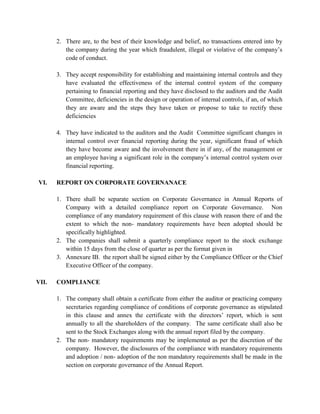
    2) The secondrule defines the retention period for storage of records. Best practices indicate that corporations securely store all business records using the same guidelines as set for public accountants.Sec 802 (a) (1) states that, “Any accountant who conducts an audit of an issuer of securities to which section 10 A (a) of Securities Exchange Act of 1934 [15 U.S.C 78j- 1 (a)] applies, shall maintain all audit or review work papers for a period of 5 years from the end of the fiscal period in which the audit or review was concluded”.<br />3) The third rule refers to the type of business records that need to be stored, including all business records & communication, which includes electronic communication also.Sec 802 (a) (2) states that, “The Securities & Exchange Commission shall promulgate within 180 days , such as rules & regulations, as are reasonably necessary relating to the retention of relevant records such as work papers, documents that form the basis of an audit or review, memoranda, correspondence, other documents & records (including electronic records), which are created, sent or received in connection with an audit or review & contain conclusions, opinions, analyses or financial data relating to such an audit or review”.<br /> <br />Sarbanes–Oxley Act contains 11 titles that describe specific mandates and requirements for financial reporting. Each title consists of several sections, summarized below.<br />Public Company Accounting Oversight Board (PCAOB) <br />Title I consists of nine sections and establishes the Public Company Accounting Oversight Board, to provide independent oversight of public accounting firms providing audit services (\" auditors\" ). It also creates a central oversight board tasked with registering auditors, defining the specific processes and procedures for compliance audits, inspecting and policing conduct and quality control, and enforcing compliance with the specific mandates of SOX.<br />Auditor Independence <br />Title II consists of nine sections and establishes standards for external auditor independence, to limit conflicts of interest. It also addresses new auditor approval requirements, audit partner rotation, and auditor reporting requirements. It restricts auditing companies from providing non-audit services (e.g., consulting) for the same clients.<br />Corporate Responsibility <br />Title III consists of eight sections and mandates that senior executives take individual responsibility for the accuracy and completeness of corporate financial reports. It defines the interaction of external auditors and corporate audit committees, and specifies the responsibility of corporate officers for the accuracy and validity of corporate financial reports. It enumerates specific limits on the behaviors of corporate officers and describes specific forfeitures of benefits and civil penalties for non-compliance. For example, Section 302 requires that the company's \" principal officers\" (typically the Chief Executive Officer and Chief Financial Officer) certify and approve the integrity of their company financial reports quarterly.<br />Enhanced Financial Disclosures <br />Title IV consists of nine sections. It describes enhanced reporting requirements for financial transactions, including off-balance-sheet transactions, pro-forma figures and stock transactions of corporate officers. It requires internal controls for assuring the accuracy of financial reports and disclosures, and mandates both audits and reports on those controls. It also requires timely reporting of material changes in financial condition and specific enhanced reviews by the SEC or its agents of corporate reports.<br />Analyst Conflicts of Interest <br />Title V consists of only one section, which includes measures designed to help restore investor confidence in the reporting of securities analysts. It defines the codes of conduct for securities analysts and requires disclosure of knowable conflicts of interest.<br />Commission Resources and Authority <br />Title VI consists of four sections and defines practices to restore investor confidence in securities analysts. It also defines the SEC’s authority to censure or bar securities professionals from practice and defines conditions under which a person can be barred from practicing as a broker, advisor, or dealer.<br />Studies and Reports <br />Title VII consists of five sections and requires the Comptroller General and the SEC to perform various studies and report their findings. Studies and reports include the effects of consolidation of public accounting firms, the role of credit rating agencies in the operation of securities markets, securities violations and enforcement actions, and whether investment banks assisted Enron, Global Crossing and others to manipulate earnings and obfuscate true financial conditions.<br />Corporate and Criminal Fraud Accountability <br />Title VIII consists of seven sections and is also referred to as the “Corporate and Criminal Fraud Act of 2002”. It describes specific criminal penalties for manipulation, destruction or alteration of financial records or other interference with investigations, while providing certain protections for whistle-blowers.<br />White Collar Crime Penalty Enhancement <br />Title IX consists of six sections. This section is also called the “White Collar Crime Penalty Enhancement Act of 2002.” This section increases the criminal penalties associated with white-collar crimes and conspiracies. It recommends stronger sentencing guidelines and specifically adds failure to certify corporate financial reports as a criminal offense.<br />Corporate Tax Returns <br />Title X consists of one section. Section 1001 states that the Chief Executive Officer should sign the company tax return.<br />Corporate Fraud Accountability <br />Title XI consists of seven sections. Section 1101 recommends a name for this title as “Corporate Fraud Accountability Act of 2002”. It identifies corporate fraud and records tampering as criminal offenses and joins those offenses to specific penalties. It also revises sentencing guidelines and strengthens their penalties. This enables the SEC the resort to temporarily freeze transactions or payments that have been deemed \" large\" or \" unusual\" .<br />CLAUSE 49 OF THE LISTING AGREEMENT<br />Clause 49 of the listing agreement<br />SEBI revise Clause 49 of the Listing Agreement pertaining to corporate governance vide circular date October 29th, 2004, which superseded all other earlier circulars issued by SEBI on this subject. All existing listed companies were required to comply with the provisions of the new clause by 31st December 2005.<br />The major provisions included in the new Clause 49 are:<br />The board will lay down a code of conduct for all board members and senior management of the company to compulsorily follow.
  • 4.
    The CEO anCFO will certify the financial statements and cash flow statements of the company.
  • 5.
    If while preparingfinancial statements, the company follows a treatment that is different from that prescribed in the accounting standards, it must disclose this in the financial statements, and the management should also provide an explanation for doing so in the corporate governance report of the annual report.
  • 6.
    The company willhave to lay down procedures for informing the board members about the risk management and minimization procedures.
  • 7.
    Where money israised through public issues etc., the company will have to disclose the uses/ applications of funds according to major categories ( capital expenditure, working capital, marketing costs etc) as part of quarterly disclosure of financial statements.Further, on an annual basis, the company will prepare a statement of funds utilized for purposes other than those specified in the offer document/ prospectus and place it before the audit committee.<br />The company will have to publish its criteria for making its payments to non-executive directors in its annual report. Clause 49 contains both mandatory and non mandatory requirements.<br />Mandatory requirements refer primarily to:<br />Board of Directors with respect to their composition, independence, procedures, code of conduct and disclosures;
  • 8.
    Audit Committee andits composition, powers, role and responsibilities;
  • 9.
    Subsidiary Companies toensure their better control and supervision;
  • 10.
    Disclosures in thecontext of related party transctions, risk management and minimization procedures, utilization of proceeds from Initial Public Offerings, inverstor education and protection;
  • 11.
    CEO/CFO certification regardingthe correction of the financial statement and compliance with prescribed Accounting Standards
  • 12.
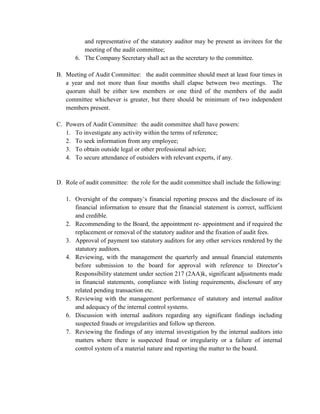
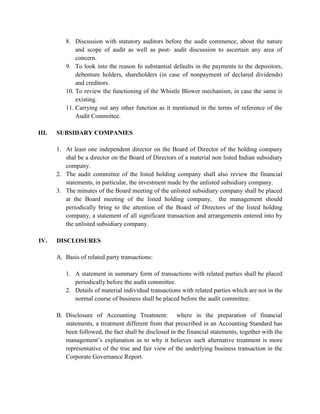
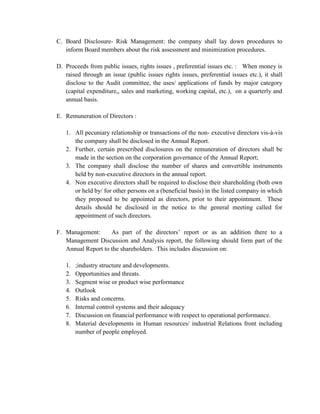
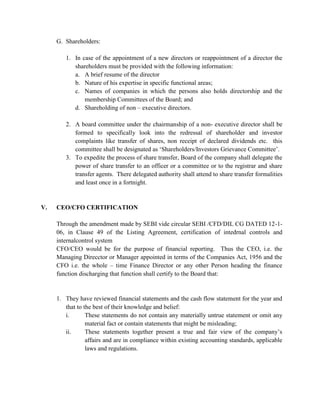
    Separate report oncorporate Governance in the annual reports with respects to compliance of mandatory and non mandatory requirements; and
  • 13.
    Compliance certificate obtainedeither from the auditors or practicing company SecretariesNon mandatory requirements refer to those requirements which are not compulsory and can be adopted at the discretion of the company.<br />These include requirements:<br />Regarding the maximum tenure of the independent directors,
  • 14.
    Formation of aremuneration committee for determining the remuneration packages for executives directors,
  • 15.
    Moving towards aregime of unqualified financial statements,
  • 16.
  • 17.
    Evaluation of non– executive board members, and
  • 18.
    Establishing a mechanismfor employees to report unethical behavior to the management under a Whistle Blower Policy.CLAUSE 49 – MANDATORY REQUIREMENTS<br />BOARD OF DIRECTORS
  • 19.
  • 20.
    The Board ofdirectors of the company shall have an optimum combination of executive and non-executive directors with not less than fifty percent of the board of directors comprising of non- executive directors .
  • 21.
    Where the Chairmanof the Board is non- executive directors, at least one third of the Board should comprise of independent directors and in case he is an executive directors, at least half of the Board should comprise of independent directors.
  • 22.
    For the purposeof sub – clause (ii) the expression ‘independent director’ shall mean a non executive director of the company who:
  • 23.
    Apart from receivingdirector’s remuneration , does not have any material pecuniary relationships or transactions with the company, its promoters, its directors its senior management or its holding company, its subsidiaries and associated which many affects independence of the director.
  • 24.
    Is not relatedto promoters or persons occupying managements positions at the board level or at one level below the board;
  • 25.
    It notbeen executive or was not partner or an executive during the preceding three years, of any of the following:
  • 26.
    Is not apartner or an executive or was not partner or an executive during the preceding three years, of any of the following: