A STUDY ON EMPLOYEES
OPINION ON TRAINING
AND DEVELOPMENT
PROGROMME
AT MEHALA CARONA
TEXTILES (P) LTD, GOBI.
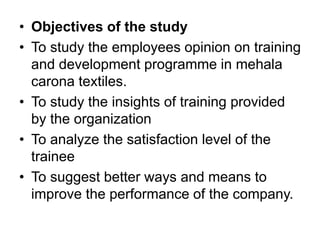
• Objectives of the study
• To study the employees opinion on training
and development programme in mehala
carona textiles.
• To study the insights of training provided
by the organization
• To analyze the satisfaction level of the
trainee
• To suggest better ways and means to
improve the performance of the company.
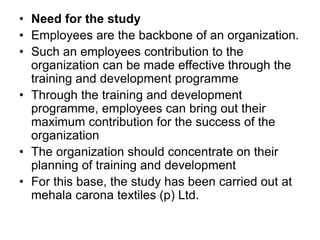
• Need for the study
• Employees are the backbone of an organization.
• Such an employees contribution to the
organization can be made effective through the
training and development programme
• Through the training and development
programme, employees can bring out their
maximum contribution for the success of the
organization
• The organization should concentrate on their
planning of training and development
• For this base, the study has been carried out at
mehala carona textiles (p) Ltd.
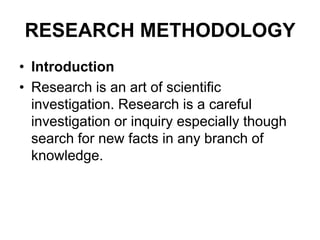
RESEARCH METHODOLOGY
• Introduction
• Research is an art of scientific
investigation. Research is a careful
investigation or inquiry especially though
search for new facts in any branch of
knowledge.
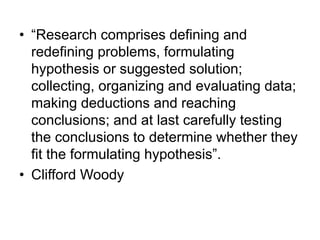
• “Research comprises defining and
redefining problems, formulating
hypothesis or suggested solution;
collecting, organizing and evaluating data;
making deductions and reaching
conclusions; and at last carefully testing
the conclusions to determine whether they
fit the formulating hypothesis”.
• Clifford Woody
• Research Design
• A research design is purely and simply
the framework or plan study that guides
the collection and analysis of data.
• “A research design is the arrangements
of condition and analysis of data in a
manner that aims to combine relevance to
the research purpose with economy in
procedure.
• Sample Design
• Sampling design is thee process of
obtaining information about an entire
population. The items selected are called
the samples, their selection process or
technique is called sample design and the
survey conducted on the basis of sample
is described as sample survey.
• Sample Unit
• The target population would be
sampled. The employees of Mahala
carona Textiles Pvt. Ltd are chosen as a
population target.
• Sample Size
• The sample size chosen for the
research is two hundred samples.
• Sampling Procedure
• Samples are selected as probability
samples based on simple Random
sampling. When population elements are
selected for inclusion in the sample based
on the case of access, it can be called
simple Random sampling.
• Method of Data collection
• There are two types of data collection
viz
• Primary data
• Secondary data
• Primary data are data freshly gathered for
a specific purpose or for a specific
research project. The method of collected
information by questionnaire method
carried out in a structured way.
• First selection of the questionnaire deal
with the queries relation to the personal
details of the employees.
• Second selection of the questionnaire deal
with the queries relating to the job
satisfaction level of the employees.
FINDINGS
• 45% of the Respondents are in the age group of
20 -30days
• 65% of the Respondents are belonging under
male category
• 45% of the Respondents are belonging under
Graduate level.
• 40% of the Respondents 3-4 years of
Experience
• 65% of the Respondents are un married
• 45% of the Respondents are belong under the
method of job instruction
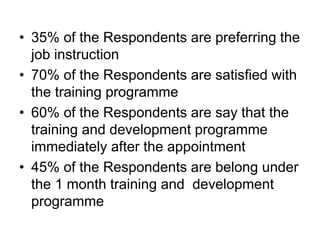
• 35% of the Respondents are preferring the
job instruction
• 70% of the Respondents are satisfied with
the training programme
• 60% of the Respondents are say that the
training and development programme
immediately after the appointment
• 45% of the Respondents are belong under
the 1 month training and development
programme
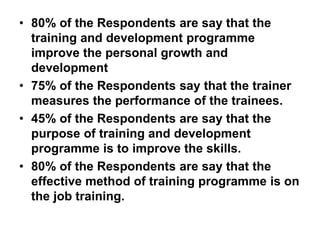
• 80% of the Respondents are say that the
training and development programme
improve the personal growth and
development
• 75% of the Respondents say that the trainer
measures the performance of the trainees.
• 45% of the Respondents are say that the
purpose of training and development
programme is to improve the skills.
• 80% of the Respondents are say that the
effective method of training programme is on
the job training.
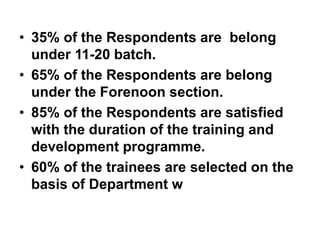
• 35% of the Respondents are belong
under 11-20 batch.
• 65% of the Respondents are belong
under the Forenoon section.
• 85% of the Respondents are satisfied
with the duration of the training and
development programme.
• 60% of the trainees are selected on the
basis of Department w

ramya mba marketing segmentation presentation

  • 1.
    A STUDY ONEMPLOYEES OPINION ON TRAINING AND DEVELOPMENT PROGROMME AT MEHALA CARONA TEXTILES (P) LTD, GOBI.
  • 2.
    • Objectives ofthe study • To study the employees opinion on training and development programme in mehala carona textiles. • To study the insights of training provided by the organization • To analyze the satisfaction level of the trainee • To suggest better ways and means to improve the performance of the company.
  • 3.
    • Need forthe study • Employees are the backbone of an organization. • Such an employees contribution to the organization can be made effective through the training and development programme • Through the training and development programme, employees can bring out their maximum contribution for the success of the organization • The organization should concentrate on their planning of training and development • For this base, the study has been carried out at mehala carona textiles (p) Ltd.
  • 4.
    RESEARCH METHODOLOGY • Introduction •Research is an art of scientific investigation. Research is a careful investigation or inquiry especially though search for new facts in any branch of knowledge.
  • 5.
    • “Research comprisesdefining and redefining problems, formulating hypothesis or suggested solution; collecting, organizing and evaluating data; making deductions and reaching conclusions; and at last carefully testing the conclusions to determine whether they fit the formulating hypothesis”. • Clifford Woody
  • 6.
    • Research Design •A research design is purely and simply the framework or plan study that guides the collection and analysis of data. • “A research design is the arrangements of condition and analysis of data in a manner that aims to combine relevance to the research purpose with economy in procedure.
  • 7.
    • Sample Design •Sampling design is thee process of obtaining information about an entire population. The items selected are called the samples, their selection process or technique is called sample design and the survey conducted on the basis of sample is described as sample survey.
  • 8.
    • Sample Unit •The target population would be sampled. The employees of Mahala carona Textiles Pvt. Ltd are chosen as a population target.
  • 9.
    • Sample Size •The sample size chosen for the research is two hundred samples.
  • 10.
    • Sampling Procedure •Samples are selected as probability samples based on simple Random sampling. When population elements are selected for inclusion in the sample based on the case of access, it can be called simple Random sampling.
  • 11.
    • Method ofData collection • There are two types of data collection viz • Primary data • Secondary data
  • 12.
    • Primary dataare data freshly gathered for a specific purpose or for a specific research project. The method of collected information by questionnaire method carried out in a structured way. • First selection of the questionnaire deal with the queries relation to the personal details of the employees. • Second selection of the questionnaire deal with the queries relating to the job satisfaction level of the employees.
  • 13.
    FINDINGS • 45% ofthe Respondents are in the age group of 20 -30days • 65% of the Respondents are belonging under male category • 45% of the Respondents are belonging under Graduate level. • 40% of the Respondents 3-4 years of Experience • 65% of the Respondents are un married • 45% of the Respondents are belong under the method of job instruction
  • 14.
    • 35% ofthe Respondents are preferring the job instruction • 70% of the Respondents are satisfied with the training programme • 60% of the Respondents are say that the training and development programme immediately after the appointment • 45% of the Respondents are belong under the 1 month training and development programme
  • 15.
    • 80% ofthe Respondents are say that the training and development programme improve the personal growth and development • 75% of the Respondents say that the trainer measures the performance of the trainees. • 45% of the Respondents are say that the purpose of training and development programme is to improve the skills. • 80% of the Respondents are say that the effective method of training programme is on the job training.
  • 16.
    • 35% ofthe Respondents are belong under 11-20 batch. • 65% of the Respondents are belong under the Forenoon section. • 85% of the Respondents are satisfied with the duration of the training and development programme. • 60% of the trainees are selected on the basis of Department w