A Summer TrainingReport
On
Recruitment and Selection System
In Healthcare Industry
( With Reference to Indus International
Hospital)
PRESENTED BY:
ARUN KUMAR
2.
Healthcare Industry
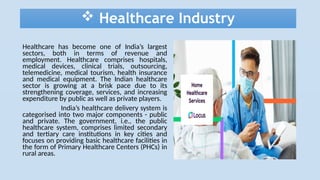
Healthcarehas become one of India’s largest
sectors, both in terms of revenue and
employment. Healthcare comprises hospitals,
medical devices, clinical trials, outsourcing,
telemedicine, medical tourism, health insurance
and medical equipment. The Indian healthcare
sector is growing at a brisk pace due to its
strengthening coverage, services, and increasing
expenditure by public as well as private players.
India’s healthcare delivery system is
categorised into two major components - public
and private. The government, i.e., the public
healthcare system, comprises limited secondary
and tertiary care institutions in key cities and
focuses on providing basic healthcare facilities in
the form of Primary Healthcare Centers (PHCs) in
rural areas.
3.
Introduction of Company
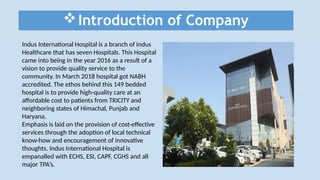
IndusInternational Hospital is a branch of Indus
Healthcare that has seven Hospitals. This Hospital
came into being in the year 2016 as a result of a
vision to provide quality service to the
community. In March 2018 hospital got NABH
accredited. The ethos behind this 149 bedded
hospital is to provide high-quality care at an
affordable cost to patients from TRICITY and
neighboring states of Himachal, Punjab and
Haryana.
Emphasis is laid on the provision of cost-effective
services through the adoption of local technical
know-how and encouragement of innovative
thoughts. Indus International Hospital is
empanalled with ECHS, ESI, CAPF, CGHS and all
major TPA’s.
4.
Introduction of Topic
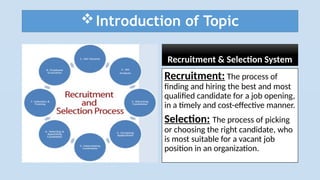
Recruitment& Selection System
Recruitment: The process of
finding and hiring the best and most
qualified candidate for a job opening,
in a timely and cost-effective manner.
Selection: The process of picking
or choosing the right candidate, who
is most suitable for a vacant job
position in an organization.
5.
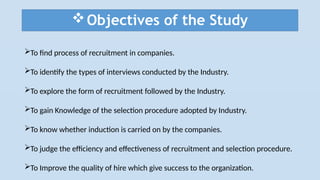
Objectives of theStudy
To find process of recruitment in companies.
To identify the types of interviews conducted by the Industry.
To explore the form of recruitment followed by the Industry.
To gain Knowledge of the selection procedure adopted by Industry.
To know whether induction is carried on by the companies.
To judge the efficiency and effectiveness of recruitment and selection procedure.
To Improve the quality of hire which give success to the organization.
6.
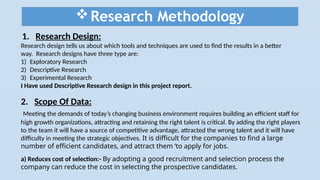
Research Methodology
1. ResearchDesign:
Research design tells us about which tools and techniques are used to find the results in a better
way. Research designs have three type are:
1) Exploratory Research
2) Descriptive Research
3) Experimental Research
I Have used Descriptive Research design in this project report.
2. Scope Of Data:
Meeting the demands of today’s changing business environment requires building an efficient staff for
high growth organizations, attracting and retaining the right talent is critical. By adding the right players
to the team it will have a source of competitive advantage, attracted the wrong talent and it will have
difficulty in meeting the strategic objectives. It is difficult for the companies to find a large
number of efficient candidates, and attract them ‘to apply for jobs.
a) Reduces cost of selection:- By adopting a good recruitment and selection process the
company can reduce the cost in selecting the prospective candidates.
7.
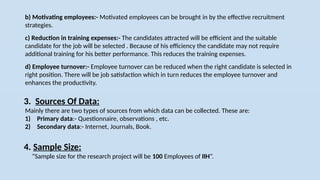
b) Motivating employees:-Motivated employees can be brought in by the effective recruitment
strategies.
c) Reduction in training expenses:- The candidates attracted will be efficient and the suitable
candidate for the job will be selected . Because of his efficiency the candidate may not require
additional training for his better performance. This reduces the training expenses.
d) Employee turnover:- Employee turnover can be reduced when the right candidate is selected in
right position. There will be job satisfaction which in turn reduces the employee turnover and
enhances the productivity.
4. Sample Size:
“Sample size for the research project will be 100 Employees of IIH”.
3. Sources Of Data:
Mainly there are two types of sources from which data can be collected. These are:
1) Primary data:- Questionnaire, observations , etc.
2) Secondary data:- Internet, Journals, Book.
8.
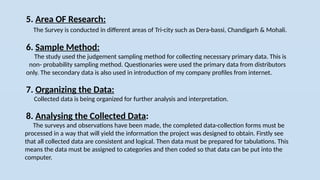
5. Area OFResearch:
The Survey is conducted in different areas of Tri-city such as Dera-bassi, Chandigarh & Mohali.
6. Sample Method:
The study used the judgement sampling method for collecting necessary primary data. This is
non- probability sampling method. Questionaries were used the primary data from distributors
only. The secondary data is also used in introduction of my company profiles from internet.
7. Organizing the Data:
Collected data is being organized for further analysis and interpretation.
8. Analysing the Collected Data:
The surveys and observations have been made, the completed data-collection forms must be
processed in a way that will yield the information the project was designed to obtain. Firstly see
that all collected data are consistent and logical. Then data must be prepared for tabulations. This
means the data must be assigned to categories and then coded so that data can be put into the
computer.
9.
Limitations of theStudy
In the given short time it is very difficult to cover all
area aspect of the firm.
Employees keeping some data confidential due to
competition.
The study is based on the assumption that
information provided by the respondent are true
or false.
No Employee was ready to share information due
to job security.
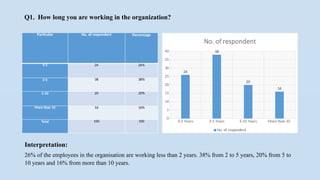
Q1. How longyou are working in the organization?
Particular No. of respondent Percentage
0-2 26 26%
2-5 38 38%
5-10 20 20%
More than 10 16 16%
Total 100 100 0-2 Years 2-5 Years 5-10 Years More than 10
0
5
10
15
20
25
30
35
40
26
38
20
16
No. of respondent
No. of respondent
Interpretation:
26% of the employees in the organisation are working less than 2 years. 38% from 2 to 5 years, 20% from 5 to
10 years and 16% from more than 10 years.
12.
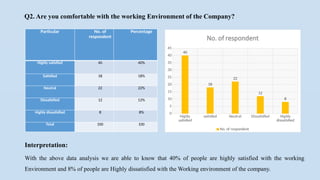
Q2. Are youcomfortable with the working Environment of the Company?
Particular No. of
respondent
Percentage
Highly satisfied 40 40%
Satisfied 18 18%
Neutral 22 22%
Dissatisfied 12 12%
Highly dissatisfied 8 8%
Total 100 100
Highly
satisfied
satisfied Neutral Dissatisfied Highly
dissatisfied
0
5
10
15
20
25
30
35
40
45
40
18
22
12
8
No. of respondent
No. of respondent
Interpretation:
With the above data analysis we are able to know that 40% of people are highly satisfied with the working
Environment and 8% of people are Highly dissatisfied with the Working environment of the company.
13.
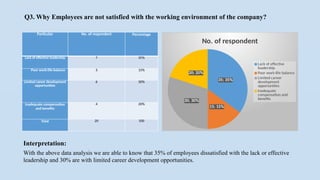
Q3. Why Employeesare not satisfied with the working environment of the company?
Particular No. of respondent Percentage
Lack of effective leadership 7 35%
Poor work-life balance 3 15%
Limited career development
opportunities
6 30%
Inadequate compensation
and benefits
4 20%
Total 20 100
35; 35%
15; 15%
30; 30%
20; 20%
No. of respondent
Lack of effective
leadership
Poor work-life balance
Limited career
development
opportunities
Inadequate
compensation and
benefits
Interpretation:
With the above data analysis we are able to know that 35% of employees dissatisfied with the lack or effective
leadership and 30% are with limited career development opportunities.
14.
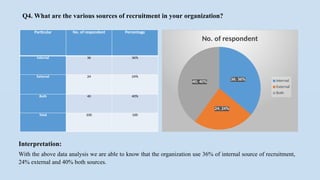
Q4. What arethe various sources of recruitment in your organization?
Particular No. of respondent Percentage
Internal 36 36%
External 24 24%
Both 40 40%
Total 100 100
36; 36%
24; 24%
40; 40%
No. of respondent
Internal
External
Both
Interpretation:
With the above data analysis we are able to know that the organization use 36% of internal source of recruitment,
24% external and 40% both sources.
15.
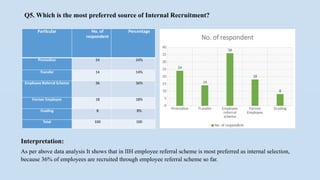
Q5. Which isthe most preferred source of Internal Recruitment?
Particular No. of
respondent
Percentage
Promotion 24 24%
Transfer 14 14%
Employee Referral Scheme 36 36%
Former Employee 18 18%
Grading 8 8%
Total 100 100
Promotion Transfer Employee
referral
scheme
Former
Employee
Grading
0
5
10
15
20
25
30
35
40
24
14
36
18
8
No. of respondent
No. of respondent
Interpretation:
As per above data analysis It shows that in IIH employee referral scheme is most preferred as internal selection,
because 36% of employees are recruited through employee referral scheme so far.
16.
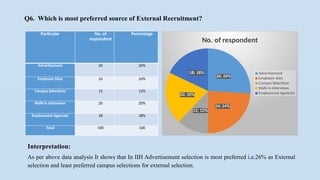
Q6. Which ismost preferred source of External Recruitment?
Particular No. of
respondent
Percentage
Advertisement 26 26%
Employee Sites 24 24%
Campus Selections 12 12%
Walk-in Interviews 20 20%
Employment Agencies 18 18%
Total 100 100
26; 26%
24; 24%
12; 12%
20; 20%
18; 18%
No. of respondent
Advertisement
Employee sites
Campus Selections
Walk-in Interviews
Employment Agencies
Interpretation:
As per above data analysis It shows that In IIH Advertisement selection is most preferred i.e.26% as External
selection and least preferred campus selections for external selection.
17.
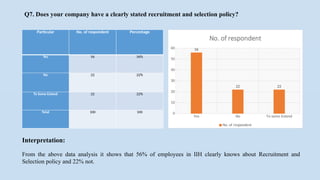
Q7. Does yourcompany have a clearly stated recruitment and selection policy?
Particular No. of respondent Percentage
Yes 56 56%
No 22 22%
To Some Extend 22 22%
Total 100 100
Yes No To some Extend
0
10
20
30
40
50
60 56
22 22
No. of respondent
No. of respondent
Interpretation:
From the above data analysis it shows that 56% of employees in IIH clearly knows about Recruitment and
Selection policy and 22% not.
18.
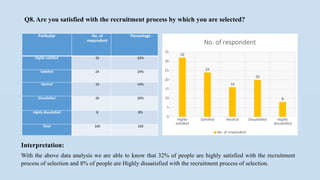
Q8. Are yousatisfied with the recruitment process by which you are selected?
Particular No. of
respondent
Percentage
Highly satisfied 32 32%
Satisfied 24 24%
Neutral 16 16%
Dissatisfied 20 20%
Highly dissatisfied 8 8%
Total 100 100
Highly
satisfied
Satisfied Neutral Dissatisfied Highly
dissatisfied
0
5
10
15
20
25
30
35
32
24
16
20
8
No. of respondent
No. of respondent
Interpretation:
With the above data analysis we are able to know that 32% of people are highly satisfied with the recruitment
process of selection and 8% of people are Highly dissatisfied with the recruitment process of selection.
19.
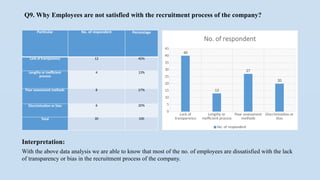
Q9. Why Employeesare not satisfied with the recruitment process of the company?
Particular No. of respondent Percentage
Lack of transparency 12 40%
Lengthy or inefficient
process
4 13%
Poor assessment methods 8 27%
Discrimination or bias 6 20%
Total 30 100
Lack of
transparency
Lengthy or
inefficient process
Poor assessment
methods
Discrimination or
bias
0
5
10
15
20
25
30
35
40
45
40
13
27
20
No. of respondent
No. of respondent
Interpretation:
With the above data analysis we are able to know that most of the no. of employees are dissatisfied with the lack
of transparency or bias in the recruitment process of the company.
20.
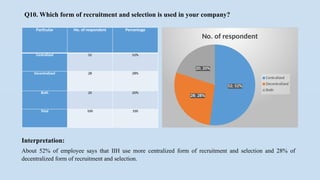
Q10. Which formof recruitment and selection is used in your company?
Particular No. of respondent Percentage
Centralized 52 52%
Decentralized 28 28%
Both 20 20%
Total 100 100
52; 52%
28; 28%
20; 20%
No. of respondent
Centralized
Decentralized
Both
Interpretation:
About 52% of employee says that IIH use more centralized form of recruitment and selection and 28% of
decentralized form of recruitment and selection.
21.
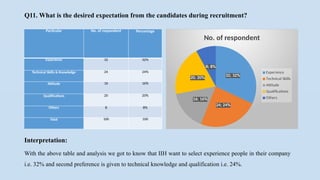
Q11. What isthe desired expectation from the candidates during recruitment?
Particular No. of respondent Percentage
Experience 32 32%
Technical Skills & Knowledge 24 24%
Attitude 16 16%
Qualifications 20 20%
Others 8 8%
Total 100 100
32; 32%
24; 24%
16; 16%
20; 20%
8; 8%
No. of respondent
Experience
Technical Skills
Attitude
Qualifications
Others
Interpretation:
With the above table and analysis we got to know that IIH want to select experience people in their company
i.e. 32% and second preference is given to technical knowledge and qualification i.e. 24%.
22.
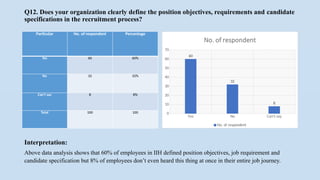
Q12. Does yourorganization clearly define the position objectives, requirements and candidate
specifications in the recruitment process?
Particular No. of respondent Percentage
Yes 60 60%
No 32 32%
Can’t say 8 8%
Total 100 100
Yes No Can't say
0
10
20
30
40
50
60
70
60
32
8
No. of respondent
No. of respondent
Interpretation:
Above data analysis shows that 60% of employees in IIH defined position objectives, job requirement and
candidate specification but 8% of employees don’t even heard this thing at once in their entire job journey.
23.
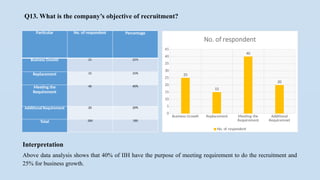
Q13. What isthe company’s objective of recruitment?
Particular No. of respondent Percentage
Business Growth 25 25%
Replacement 15 15%
Meeting the
Requirement
40 40%
Additional Requirement 20 20%
Total 100 100
Business Growth Replacement Meeting the
Requirement
Additional
Requiremnet
0
5
10
15
20
25
30
35
40
45
25
15
40
20
No. of respondent
No. of respondent
Interpretation
Above data analysis shows that 40% of IIH have the purpose of meeting requirement to do the recruitment and
25% for business growth.
24.
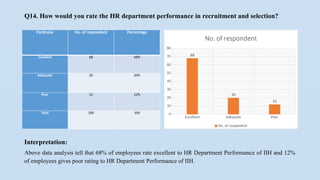
Q14. How wouldyou rate the HR department performance in recruitment and selection?
Particular No. of respondent Percentage
Excellent 68 68%
Adequate 20 20%
Poor 12 12%
Total 100 100
Excellent Adequate Poor
0
10
20
30
40
50
60
70
80
68
20
12
No. of respondent
No. of respondent
Interpretation:
Above data analysis tell that 68% of employees rate excellent to HR Department Performance of IIH and 12%
of employees gives poor rating to HR Department Performance of IIH.
25.
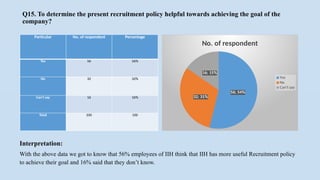
Q15. To determinethe present recruitment policy helpful towards achieving the goal of the
company?
Particular No. of respondent Percentage
Yes 56 56%
No 32 32%
Can’t say 16 16%
Total 100 100
56; 54%
32; 31%
16; 15%
No. of respondent
Yes
No
Can't say
Interpretation:
With the above data we got to know that 56% employees of IIH think that IIH has more useful Recruitment policy
to achieve their goal and 16% said that they don’t know.
26.
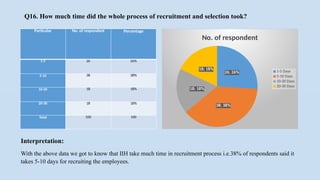
Q16. How muchtime did the whole process of recruitment and selection took?
Particular No. of respondent Percentage
1-5 26 26%
5-10 38 38%
10-20 18 18%
20-30 18 18%
Total 100 100
26; 26%
38; 38%
18; 18%
18; 18%
No. of respondent
1-5 Days
5-10 Days
10-20 Days
20-30 Days
Interpretation:
With the above data we got to know that IIH take much time in recruitment process i.e.38% of respondents said it
takes 5-10 days for recruiting the employees.
27.
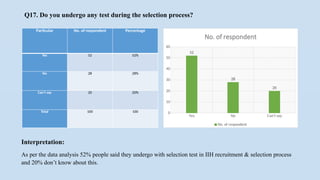
Q17. Do youundergo any test during the selection process?
Particular No. of respondent Percentage
Yes 52 52%
No 28 28%
Can’t say 20 20%
Total 100 100
Yes No Can't say
0
10
20
30
40
50
60
52
28
20
No. of respondent
No. of respondent
Interpretation:
As per the data analysis 52% people said they undergo with selection test in IIH recruitment & selection process
and 20% don’t know about this.
28.
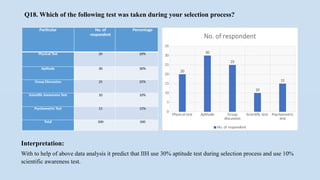
Q18. Which ofthe following test was taken during your selection process?
Particular No. of
respondent
Percentage
Physical Test 20 20%
Aptitude 30 30%
Group Discussion 25 25%
Scientific Awareness Test 10 10%
Psychometric Test 15 15%
Total 100 100
Physical test Aptitude Group
discussion
Scientific test Psychometric
test
0
5
10
15
20
25
30
35
20
30
25
10
15
No. of respondent
No. of respondent
Interpretation:
With to help of above data analysis it predict that IIH use 30% aptitude test during selection process and use 10%
scientific awareness test.
29.
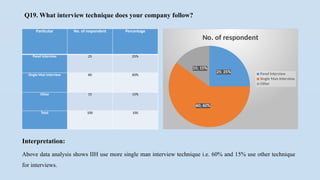
Q19. What interviewtechnique does your company follow?
Particular No. of respondent Percentage
Panel Interview 25 25%
Single Man Interview 60 60%
Other 15 15%
Total 100 100
25; 25%
60; 60%
15; 15%
No. of respondent
Panel Interview
Single Man Interview
Other
Interpretation:
Above data analysis shows IIH use more single man interview technique i.e. 60% and 15% use other technique
for interviews.
30.
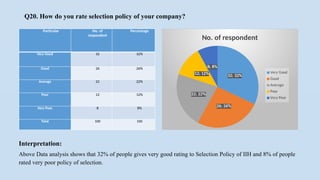
Q20. How doyou rate selection policy of your company?
Particular No. of
respondent
Percentage
Very Good 32 32%
Good 26 26%
Average 22 22%
Poor 12 12%
Very Poor 8 8%
Total 100 100
32; 32%
26; 26%
22; 22%
12; 12%
8; 8%
No. of respondent
Very Good
Good
Average
Poor
Very Poor
Interpretation:
Above Data analysis shows that 32% of people gives very good rating to Selection Policy of IIH and 8% of people
rated very poor policy of selection.
31.
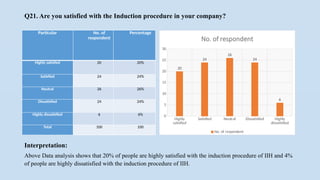
Q21. Are yousatisfied with the Induction procedure in your company?
Particular No. of
respondent
Percentage
Highly satisfied 20 20%
Satisfied 24 24%
Neutral 26 26%
Dissatisfied 24 24%
Highly dissatisfied 6 6%
Total 100 100
Highly
satisfied
Satisfied Neutral Dissatisfied Highly
dissatisfied
0
5
10
15
20
25
30
20
24
26
24
6
No. of respondent
No. of respondent
Interpretation:
Above Data analysis shows that 20% of people are highly satisfied with the induction procedure of IIH and 4%
of people are highly dissatisfied with the induction procedure of IIH.
32.
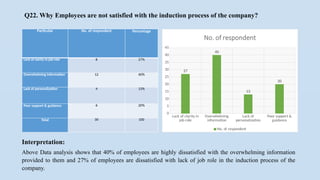
Q22. Why Employeesare not satisfied with the induction process of the company?
Particular No. of respondent Percentage
Lack of clarity in job role 8 27%
Overwhelming information 12 40%
Lack of personalization 4 13%
Poor support & guidance 6 20%
Total 30 100
Lack of clarity in
job role
Overwhelming
information
Lack of
personalization
Poor support &
guidance
0
5
10
15
20
25
30
35
40
45
27
40
13
20
No. of respondent
No. of respondent
Interpretation:
Above Data analysis shows that 40% of employees are highly dissatisfied with the overwhelming information
provided to them and 27% of employees are dissatisfied with lack of job role in the induction process of the
company.
33.
Q23. Do youthink e-recruitment (like web portals, social website) helpful to get efficient
employees in your company?
Particular No. of respondent Percentage
Yes 60 60%
No 25 25%
Can’t say 15 15%
Total 100 100
60; 60%
25; 25%
15; 15%
No. of respondent
Yes
No
Can't say
Interpretation:
The above data analysis shows that 60% employees of IIH thinks that e-recruitment helps to get efficient
employees in the organization and 15% employees thinks it’s not.
34.
Q24. Would youlike to give any suggestions to change the current Recruitment & Selection
process of the company?
Particular No. of respondent Percentage
Yes Absolutely 25 25%
No Requirement 60 60%
Can’t say 15 15%
Total 100 100
Yes Absolutely No Requirement Can't Say
0
10
20
30
40
50
60
70
25
60
15
No. of respondent
No. of respondent
Interpretation:
The above data analysis shows that 60% employees of IIH thinks that the company should not required any
changes in recruitment & selection process but 25% employees thinks that it should be changed.
35.
Findings
The processof recruitment & selection which is followed by the company is helpful to meet the company’s
manpower requirement to some extent.
The recruitment & selection policy of company is clearly stated but no up-dation according to the company’s
objective.
Company is highly dependent on employee’s referral for higher position and for lower posts company prefers job
portals and outsourcing.
Company is recruiting right candidate for right job but some respondents are disagree so, selection process needs
improvement and proper verification of recruitee.
Too much time taken by the HRD in recruiting some urgent posts.
After analysis it is better to get the manpower by internal source as they are aware about that candidate skill and
behaviour but sometimes company will not get right candidate.
36.
Suggestions
The Organizationshould go for campus placement on large scale as source of external recruitment so, that capable
students make contribution in growth of industry.
During training procedure, the organization should give preference to job rotation because in job rotation, employees
feel’s some changes regarding place, environment etc. and take more interest in their work.
To make easy and congenial environment in organization, it is necessary that the managers should interact with their
supervisors on regular basis.
It is necessary that the managers provide the more facilities of counselling to their employees so, that it will increase the
efficiency of employees.
The organization should give more emphasis on counselling and problem solving techniques.
The HR should used modern techniques to evaluate the performance & development of employees.
37.
Conclusion
Effective HR ManagementRequired. It is the heart of the entire HR
system in the organization The effectiveness of many other HR
activities like selection and training depends on the quality of the
new employees attracted through recruitment process. Policies
should always be reviewed because they are influenced by the
changing environment. To increase awareness on the threat of
wrong appointments, management should get specific training on
recruitment process. HR practitioners should be on guard against
all misconduct and should be advocates for professional approach
in the entire system.
In the end, organizational results have improved as a result
of better recruitment and selection strategies. More effectively,
recruitment of organizations and selection of candidates, the more
likely they are to hire and retain employees. In addition, the
effectiveness of the organization's selection system can affect the
down-line business results, such as productivity and financial
performance. Therefore, investing money in the development of a
comprehensive and valid selection system is well spent.
38.
Bibliography
Books Referred
Robins, D(1998): Human Resource Management, Publisher-Prentice Hall, New York.
Abraham, Jose P, 1998, "To Grapple With Attrition", Publisher- Human Capital
Rao, J.M., 1998, "Scouting for Talent ",Publisher- Human Capital
Ashwathappa, K, (1997) Human Resource and personnel Management, Tata McGraw Hill131.
Gupta, C.B. (1996) Human Resource Management, Sultan Chand & Sons.
Kothari, C.R, (2008) Research Methodology, Publishers- New Age International.
Websites
https://www.indushospital.in/Indus-International-Hospital
https://www.indushospital.in/contact/contact-us
https://www.investindia.gov.in/sector/healthcare
Other
Review of HRM manual given by HR Department at IIH.