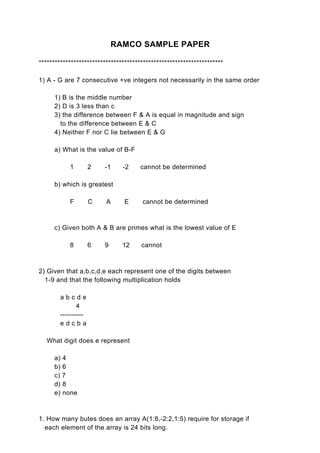
RAMCO SAMPLE PAPER

*********************************************************************

1) A - G are 7 consecutive +ve integers not necessarily in the same order

     1) B is the middle number
     2) D is 3 less than c
     3) the difference between F & A is equal in magnitude and sign
       to the difference between E & C
     4) Neither F nor C lie between E & G

     a) What is the value of B-F

           1         2   -1    -2     cannot be determined

     b) which is greatest

           F         C   A      E     cannot be determined


     c) Given both A & B are primes what is the lowest value of E

           8         6   9     12     cannot


2) Given that a,b,c,d,e each represent one of the digits between
  1-9 and that the following multiplication holds

        abcde
               4
        ----------
        edcba

  What digit does e represent

     a) 4
     b) 6
     c) 7
     d) 8
     e) none


1. How many butes does an array A(1:8,-2:2,1:5) require for storage if
  each element of the array is 24 bits long.
200       480       600     800    none


2.   begin

             i:=0;
             j:=0; | block d

     loop:


             if(i != 0)
                    i := i-1;
             else
                    i := i+1;

             i := i+1;      | block a
             j := j+1;      | block b

             if (j <= 25)
                    goto loop;

     end                    | block c


     a) What is the value of i at [c]
          2?
     b) How many times is the goto executed
          25 ?

     c) How many times is the loop executed if i is initialized to 1
       in [d] 26
     d) How many times is the loop entered if the block [b] is changed
       to j=j+1 ?

     e) What is the value of i at [c] interchanging blocks [a] and [b] ?
       2?

Follow the instructions given below [ From 1 to 8 ]

1. A cause B or C but not both

2. F occurs only if B occurs
3. D occurs if B or C occurs

4. E occurs if only c occurs

5. J occurs only if E or F occurs

6. H occurs if E occurs

7. D causes G, H or Both.

8. G occurs if F occurs.


Questions
---------

1. If A occurs which of the following may occur

  1. F & G (ii) E & H (iii) D

Ans
---
 (a) 1 only (b) 2 only (c) 3 only (d) 1,2,3 or 2 & 3 but not 1

(e) 1,2 & 3

2. If B occurs which must occur

Ans
--- (a) F & G (b) D & G (c) D (d) G & H (e) J

3. If J occurs which must occur

Ans
---
(a) E (b) Both E & F (c) Either B or C (d) B (e) Both B & c


4. Which may occur as a result by a cause not mentioned.

(I) D (II) A (III) F

Ans
(a) I only (b) II (c) I & II (d) II & III (e) I,II,III
5. If E occurs which cannot occur.

(a) F (b) A (c) D (d) C (e) J

================== C Questions

1) Find the output for the following C program

main()
{
char *p1="Name";
char *p2;
p2=(char *)malloc(20);
while(*p2++=*p1++);
printf("%sn",p2);
}

Ans. An empty string


2) Find the output for the following C program

main()
{
int x=20,y=35;
x = y++ + x++;
y = ++y + ++x;
printf("%d %dn",x,y);
}

Ans. 57 94


3) Find the output for the following C program

main()
{
int x=5;
printf("%d %d %dn",x,x<<2,x>>2);
}

Ans. 5 20 1
4) Find the output for the following C program

#define swap1(a,b) a=a+b;b=a-b;a=a-b;
main()
{
int x=5,y=10;
swap1(x,y);
printf("%d %dn",x,y);
swap2(x,y);
printf("%d %dn",x,y);
}
int swap2(int a,int b)
{
int temp;
temp=a;
b=a;
a=temp;
return;
}

Ans. 10 5


5) Find the output for the following C program

main()
{
char *ptr = "Ramco Systems";
(*ptr)++;
printf("%sn",ptr);
ptr++;
printf("%sn",ptr);
}

Ans. Samco Systems


6) Find the output for the following C program

#include<stdio.h>
main()
{
char s1[]="Ramco";
char s2[]="Systems";
s1=s2;
printf("%s",s1);
}

Ans. Compilation error giving it cannot be an modifiable 'lvalue'


7) Find the output for the following C program

#include<stdio.h>
main()
{
char *p1;
char *p2;
p1=(char *) malloc(25);
p2=(char *) malloc(25);
strcpy(p1,"Ramco");
strcpy(p2,"Systems");
strcat(p1,p2);
printf("%s",p1);
}

Ans. RamcoSystems


8) Find the output for the following C program given that
[1]. The following variable is available in file1.c
static int average_float;

Ans. All the functions in the file1.c can access the variable


9) Find the output for the following C program

# define TRUE 0
some code
while(TRUE)
{
some code
}

Ans. This won't go into the loop as TRUE is defined as 0


10) Find the output for the following C program
main()
{
int x=10;
x++;
change_value(x);
x++;
Modify_value();
printf("First output: %dn",x);
}
x++;
change_value(x);
printf("Second Output : %dn",x);
Modify_value(x);
printf("Third Output : %dn",x);
}
Modify_value()
{
return (x+=10);
}
change_value()
{
return(x+=1);
}

Ans. 12 1 1


11) Find the output for the following C program

main()
{
int x=10,y=15;
x=x++;
y=++y;
printf("%d %dn",x,y);
}

Ans. 11 16


12) Find the output for the following C program

main()
{
int a=0;
if(a=0) printf("Ramco Systemsn");
printf("Ramco Systemsn");
}

Ans. Ony one time "Ramco Systems" will be printed


13) Find the output for the following C program

#include<stdio.h>
int SumElement(int *,int);
void main(void)
{
int x[10];
int i=10;
for(;i;)
{
i--;
*(x+i)=i;
}
printf("%d",SumElement(x,10));
}
int SumElement(int array[],int size)
{
int i=0;
float sum=0;
for(;i<size;i++)
sum+=array[i];
return sum;
}


Q14) Find the output for the following C program

#include<stdio.h>
void main(void);
int printf(const char*,...);
void main(void)
{
int i=100,j=10,k=20;
-- int sum;
float ave;
char myformat[]="ave=%.2f";
sum=i+j+k;
ave=sum/3.0;
printf(myformat,ave);
}


Q15) Find the output for the following C program

#include<stdio.h>
void main(void);
{
int a[10];
printf("%d",((a+9) + (a+1)));
}


Q16) Find the output for the following C program

#include<stdio.h>
void main(void)
{
struct s{
int x;
float y;
}s1={25,45.00};
union u{
int x;
float y;
} u1;
u1=(union u)s1;
printf("%d and %f",u1.x,u1.y);
}


Q17) Find the output for the following C program

#include<stdio.h>
void main(void)
{
unsigned int c;
unsigned x=0x3;
scanf("%u",&c);
switch(c&x)
{
case 3: printf("Hello!t");
case 2: printf("Welcomet");
case 1: printf("To Allt");
default:printf("n");
}
}


Q18) Find the output for the following C program

#include<stdio.h>
int fn(void);
void print(int,int(*)());
int i=10;
void main(void)
{
int i=20;
print(i,fn);
}
void print(int i,int (*fn1)())
{
printf("%dn",(*fn1)());
}
int fn(void)
{
return(i-=5);
}


Q19) Find the output for the following C program

#include<stdio.h>
void main(void);
{
char numbers[5][6]={"Zero","One","Two","Three","Four"};
printf("%s is %c",&numbers[4][0],numbers[0][0]);
}


Q20) Find the output for the following C program

int bags[5]={20,5,20,3,20};
void main(void)
{
int pos=5,*next();
*next()=pos;
printf("%d %d %d",pos,*next(),bags[0]);
}
int *next()
{
int i;
for(i=0;i<5;i++)
if (bags[i]==20)
return(bags+i);
printf("Error!");
exit(0);
}


Q21) Find the output for the following C program

#include<stdio.h>
void main(void)
{
int y,z;
int x=y=z=10;
int f=x;
float ans=0.0;
f *=x*y;
ans=x/3.0+y/3;
printf("%d %.2f",f,ans);
}


Q22) Find the output for the following C program

#include<stdio.h>
void main(void);
{
double dbl=20.4530,d=4.5710,dblvar3;
double dbln(void);
dblvar3=dbln();
printf("%.2ft%.2ft%.2fn",dbl,d,dblvar3);
}
double dbln(void)
{
double dblvar3;
dbl=dblvar3=4.5;
return(dbl+d+dblvar3);
}


Q23) Find the output for the following C program
#include<stdio.h>
static int i=5;
void main(void)
{
int sum=0;
do
{
sum+=(1/i);
}while(0<i--);
}


Q24) Find the output for the following C program

#include<stdio.h>
void main(void)
{
int oldvar=25,newvar=-25;
int swap(int,int);
swap(oldvar,newvar);
printf("Numbers are %dt%d",newvar,oldvar);
}
int swap(int oldval,int newval)
{
int tempval=oldval;
oldval=newval;
newval=tempval;
}


Q25) Find the output for the following C program

#include<stdio.h>
void main(void);
{
int i=100,j=20;
i++=j;
i*=j;
printf("%dt%dn",i,j);
}


Q26) Find the output for the following C program
#include<stdio.h>
void main(void);
int newval(int);
void main(void)
{
int ia[]={12,24,45,0};
int i;
int sum=0;
for(i=0;ia[i];i++)
{
sum+=newval(ia[i]);
}
printf("Sum= %d",sum);
}
int newval(int x)
{
static int div=1;
return(x/div++);
}


Q27) Find the output for the following C program

#include<stdio.h>
void main(void);
{
int var1,var2,var3,minmax;
var1=5;
var2=5;
var3=6;
minmax=(var1>var2)?(var1>var3)?var1:var3:(var2>var3)?var2:var3;
printf("%dn",minmax);


Q28) Find the output for the following C program

#include<stdio.h>
void main(void);
{
void pa(int *a,int n);
int arr[5]={5,4,3,2,1};
pa(arr,5);
}
void pa(int *a,int n)
{
int i;
for(i=0;i<n;i++)
printf("%dn",*(a++)+i);
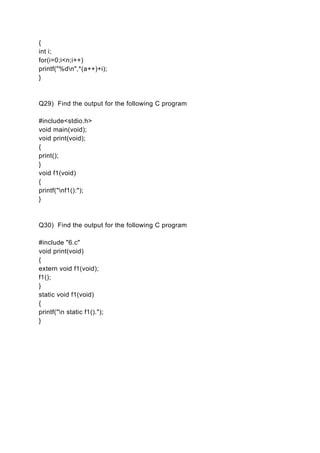
}


Q29) Find the output for the following C program

#include<stdio.h>
void main(void);
void print(void);
{
print();
}
void f1(void)
{
printf("nf1():");
}


Q30) Find the output for the following C program

#include "6.c"
void print(void)
{
extern void f1(void);
f1();
}
static void f1(void)
{
printf("n static f1().");
}

Ramco Sample Paper 2003

  • 1.
    RAMCO SAMPLE PAPER ********************************************************************* 1)A - G are 7 consecutive +ve integers not necessarily in the same order 1) B is the middle number 2) D is 3 less than c 3) the difference between F & A is equal in magnitude and sign to the difference between E & C 4) Neither F nor C lie between E & G a) What is the value of B-F 1 2 -1 -2 cannot be determined b) which is greatest F C A E cannot be determined c) Given both A & B are primes what is the lowest value of E 8 6 9 12 cannot 2) Given that a,b,c,d,e each represent one of the digits between 1-9 and that the following multiplication holds abcde 4 ---------- edcba What digit does e represent a) 4 b) 6 c) 7 d) 8 e) none 1. How many butes does an array A(1:8,-2:2,1:5) require for storage if each element of the array is 24 bits long.
  • 2.
    200 480 600 800 none 2. begin i:=0; j:=0; | block d loop: if(i != 0) i := i-1; else i := i+1; i := i+1; | block a j := j+1; | block b if (j <= 25) goto loop; end | block c a) What is the value of i at [c] 2? b) How many times is the goto executed 25 ? c) How many times is the loop executed if i is initialized to 1 in [d] 26 d) How many times is the loop entered if the block [b] is changed to j=j+1 ? e) What is the value of i at [c] interchanging blocks [a] and [b] ? 2? Follow the instructions given below [ From 1 to 8 ] 1. A cause B or C but not both 2. F occurs only if B occurs
  • 3.
    3. D occursif B or C occurs 4. E occurs if only c occurs 5. J occurs only if E or F occurs 6. H occurs if E occurs 7. D causes G, H or Both. 8. G occurs if F occurs. Questions --------- 1. If A occurs which of the following may occur 1. F & G (ii) E & H (iii) D Ans --- (a) 1 only (b) 2 only (c) 3 only (d) 1,2,3 or 2 & 3 but not 1 (e) 1,2 & 3 2. If B occurs which must occur Ans --- (a) F & G (b) D & G (c) D (d) G & H (e) J 3. If J occurs which must occur Ans --- (a) E (b) Both E & F (c) Either B or C (d) B (e) Both B & c 4. Which may occur as a result by a cause not mentioned. (I) D (II) A (III) F Ans (a) I only (b) II (c) I & II (d) II & III (e) I,II,III
  • 4.
    5. If Eoccurs which cannot occur. (a) F (b) A (c) D (d) C (e) J ================== C Questions 1) Find the output for the following C program main() { char *p1="Name"; char *p2; p2=(char *)malloc(20); while(*p2++=*p1++); printf("%sn",p2); } Ans. An empty string 2) Find the output for the following C program main() { int x=20,y=35; x = y++ + x++; y = ++y + ++x; printf("%d %dn",x,y); } Ans. 57 94 3) Find the output for the following C program main() { int x=5; printf("%d %d %dn",x,x<<2,x>>2); } Ans. 5 20 1
  • 5.
    4) Find theoutput for the following C program #define swap1(a,b) a=a+b;b=a-b;a=a-b; main() { int x=5,y=10; swap1(x,y); printf("%d %dn",x,y); swap2(x,y); printf("%d %dn",x,y); } int swap2(int a,int b) { int temp; temp=a; b=a; a=temp; return; } Ans. 10 5 5) Find the output for the following C program main() { char *ptr = "Ramco Systems"; (*ptr)++; printf("%sn",ptr); ptr++; printf("%sn",ptr); } Ans. Samco Systems 6) Find the output for the following C program #include<stdio.h> main() { char s1[]="Ramco"; char s2[]="Systems"; s1=s2;
  • 6.
    printf("%s",s1); } Ans. Compilation errorgiving it cannot be an modifiable 'lvalue' 7) Find the output for the following C program #include<stdio.h> main() { char *p1; char *p2; p1=(char *) malloc(25); p2=(char *) malloc(25); strcpy(p1,"Ramco"); strcpy(p2,"Systems"); strcat(p1,p2); printf("%s",p1); } Ans. RamcoSystems 8) Find the output for the following C program given that [1]. The following variable is available in file1.c static int average_float; Ans. All the functions in the file1.c can access the variable 9) Find the output for the following C program # define TRUE 0 some code while(TRUE) { some code } Ans. This won't go into the loop as TRUE is defined as 0 10) Find the output for the following C program
  • 7.
    main() { int x=10; x++; change_value(x); x++; Modify_value(); printf("First output:%dn",x); } x++; change_value(x); printf("Second Output : %dn",x); Modify_value(x); printf("Third Output : %dn",x); } Modify_value() { return (x+=10); } change_value() { return(x+=1); } Ans. 12 1 1 11) Find the output for the following C program main() { int x=10,y=15; x=x++; y=++y; printf("%d %dn",x,y); } Ans. 11 16 12) Find the output for the following C program main() { int a=0;
  • 8.
    if(a=0) printf("Ramco Systemsn"); printf("RamcoSystemsn"); } Ans. Ony one time "Ramco Systems" will be printed 13) Find the output for the following C program #include<stdio.h> int SumElement(int *,int); void main(void) { int x[10]; int i=10; for(;i;) { i--; *(x+i)=i; } printf("%d",SumElement(x,10)); } int SumElement(int array[],int size) { int i=0; float sum=0; for(;i<size;i++) sum+=array[i]; return sum; } Q14) Find the output for the following C program #include<stdio.h> void main(void); int printf(const char*,...); void main(void) { int i=100,j=10,k=20; -- int sum; float ave; char myformat[]="ave=%.2f"; sum=i+j+k; ave=sum/3.0;
  • 9.
    printf(myformat,ave); } Q15) Find theoutput for the following C program #include<stdio.h> void main(void); { int a[10]; printf("%d",((a+9) + (a+1))); } Q16) Find the output for the following C program #include<stdio.h> void main(void) { struct s{ int x; float y; }s1={25,45.00}; union u{ int x; float y; } u1; u1=(union u)s1; printf("%d and %f",u1.x,u1.y); } Q17) Find the output for the following C program #include<stdio.h> void main(void) { unsigned int c; unsigned x=0x3; scanf("%u",&c); switch(c&x) { case 3: printf("Hello!t"); case 2: printf("Welcomet"); case 1: printf("To Allt");
  • 10.
    default:printf("n"); } } Q18) Find theoutput for the following C program #include<stdio.h> int fn(void); void print(int,int(*)()); int i=10; void main(void) { int i=20; print(i,fn); } void print(int i,int (*fn1)()) { printf("%dn",(*fn1)()); } int fn(void) { return(i-=5); } Q19) Find the output for the following C program #include<stdio.h> void main(void); { char numbers[5][6]={"Zero","One","Two","Three","Four"}; printf("%s is %c",&numbers[4][0],numbers[0][0]); } Q20) Find the output for the following C program int bags[5]={20,5,20,3,20}; void main(void) { int pos=5,*next(); *next()=pos; printf("%d %d %d",pos,*next(),bags[0]); }
  • 11.
    int *next() { int i; for(i=0;i<5;i++) if(bags[i]==20) return(bags+i); printf("Error!"); exit(0); } Q21) Find the output for the following C program #include<stdio.h> void main(void) { int y,z; int x=y=z=10; int f=x; float ans=0.0; f *=x*y; ans=x/3.0+y/3; printf("%d %.2f",f,ans); } Q22) Find the output for the following C program #include<stdio.h> void main(void); { double dbl=20.4530,d=4.5710,dblvar3; double dbln(void); dblvar3=dbln(); printf("%.2ft%.2ft%.2fn",dbl,d,dblvar3); } double dbln(void) { double dblvar3; dbl=dblvar3=4.5; return(dbl+d+dblvar3); } Q23) Find the output for the following C program
  • 12.
    #include<stdio.h> static int i=5; voidmain(void) { int sum=0; do { sum+=(1/i); }while(0<i--); } Q24) Find the output for the following C program #include<stdio.h> void main(void) { int oldvar=25,newvar=-25; int swap(int,int); swap(oldvar,newvar); printf("Numbers are %dt%d",newvar,oldvar); } int swap(int oldval,int newval) { int tempval=oldval; oldval=newval; newval=tempval; } Q25) Find the output for the following C program #include<stdio.h> void main(void); { int i=100,j=20; i++=j; i*=j; printf("%dt%dn",i,j); } Q26) Find the output for the following C program
  • 13.
    #include<stdio.h> void main(void); int newval(int); voidmain(void) { int ia[]={12,24,45,0}; int i; int sum=0; for(i=0;ia[i];i++) { sum+=newval(ia[i]); } printf("Sum= %d",sum); } int newval(int x) { static int div=1; return(x/div++); } Q27) Find the output for the following C program #include<stdio.h> void main(void); { int var1,var2,var3,minmax; var1=5; var2=5; var3=6; minmax=(var1>var2)?(var1>var3)?var1:var3:(var2>var3)?var2:var3; printf("%dn",minmax); Q28) Find the output for the following C program #include<stdio.h> void main(void); { void pa(int *a,int n); int arr[5]={5,4,3,2,1}; pa(arr,5); } void pa(int *a,int n)
  • 14.
    { int i; for(i=0;i<n;i++) printf("%dn",*(a++)+i); } Q29) Findthe output for the following C program #include<stdio.h> void main(void); void print(void); { print(); } void f1(void) { printf("nf1():"); } Q30) Find the output for the following C program #include "6.c" void print(void) { extern void f1(void); f1(); } static void f1(void) { printf("n static f1()."); }