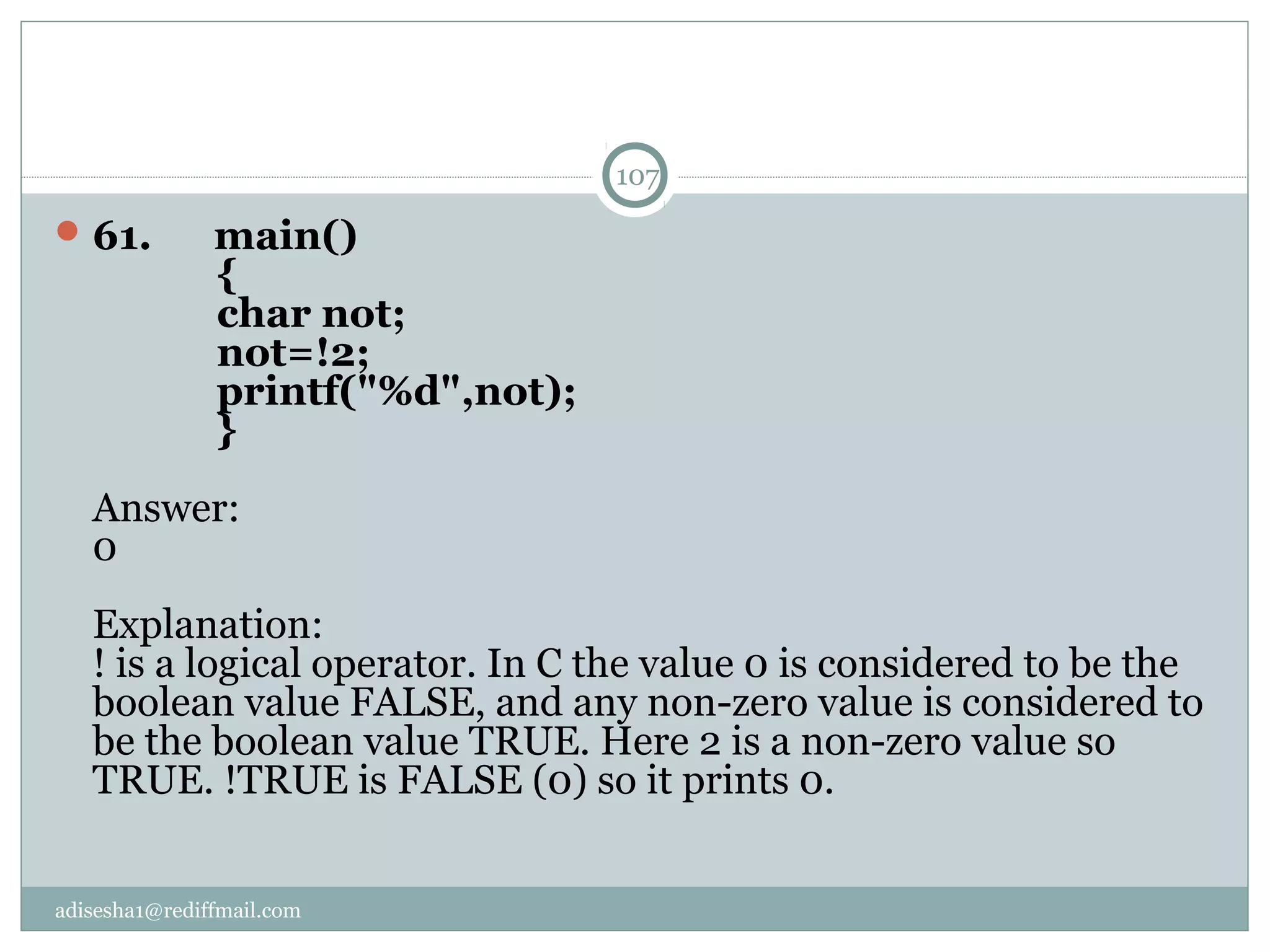
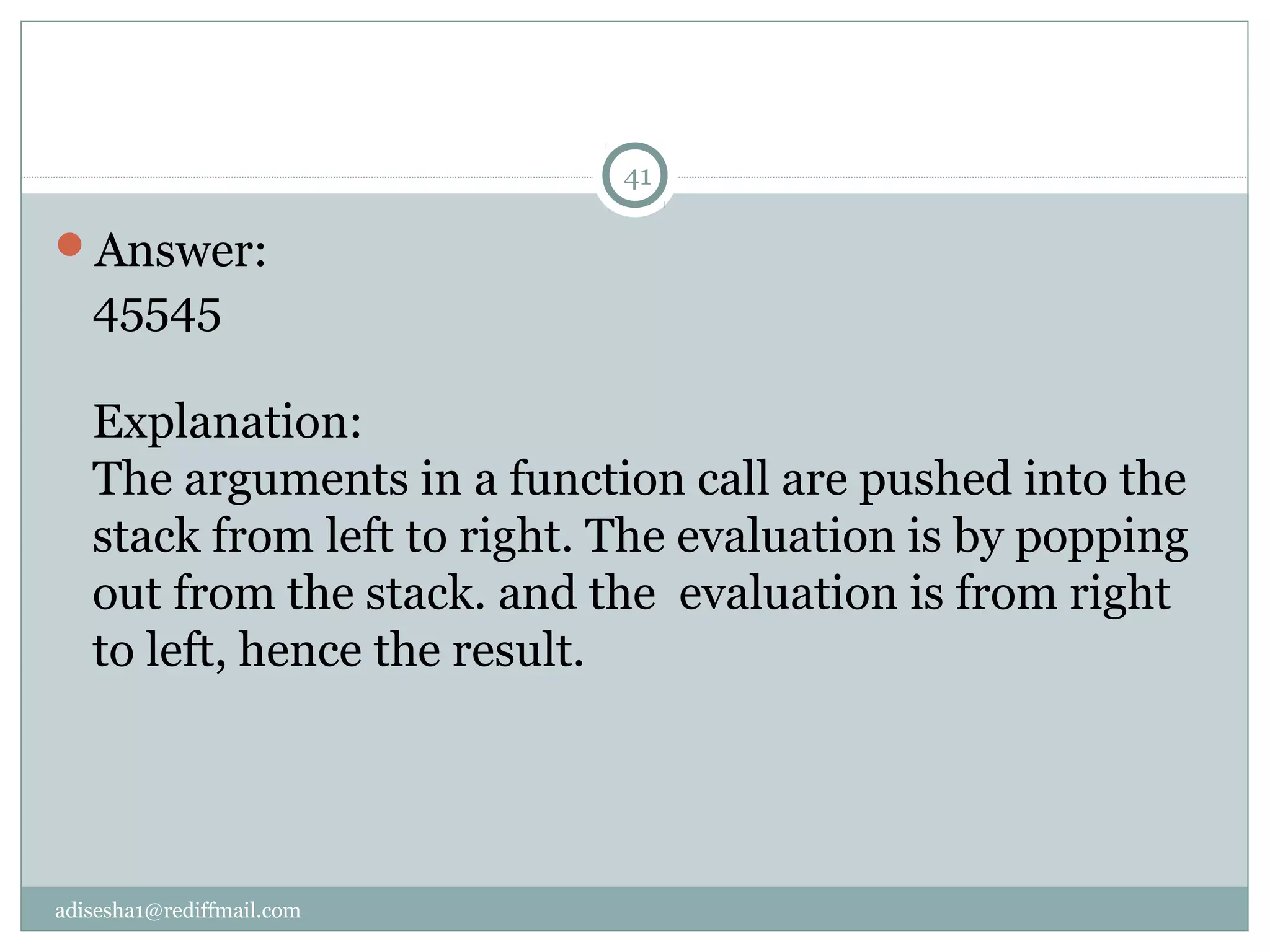
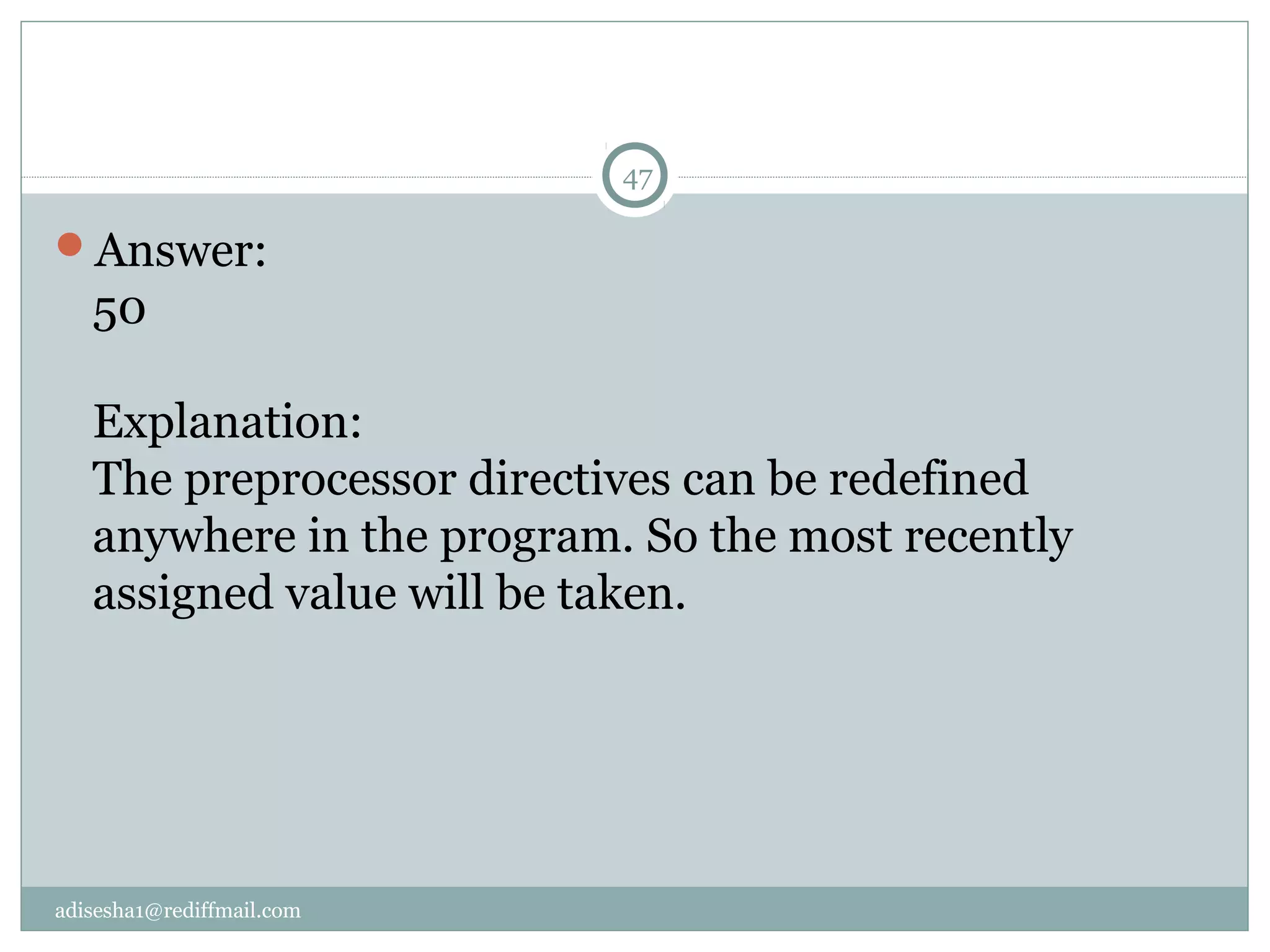
The document contains 22 coding problems and their explanations. Each problem contains 1-2 lines of C code and the expected output. The explanations describe how the code works and the logic behind each output.
adisesha1@rediffmail.com
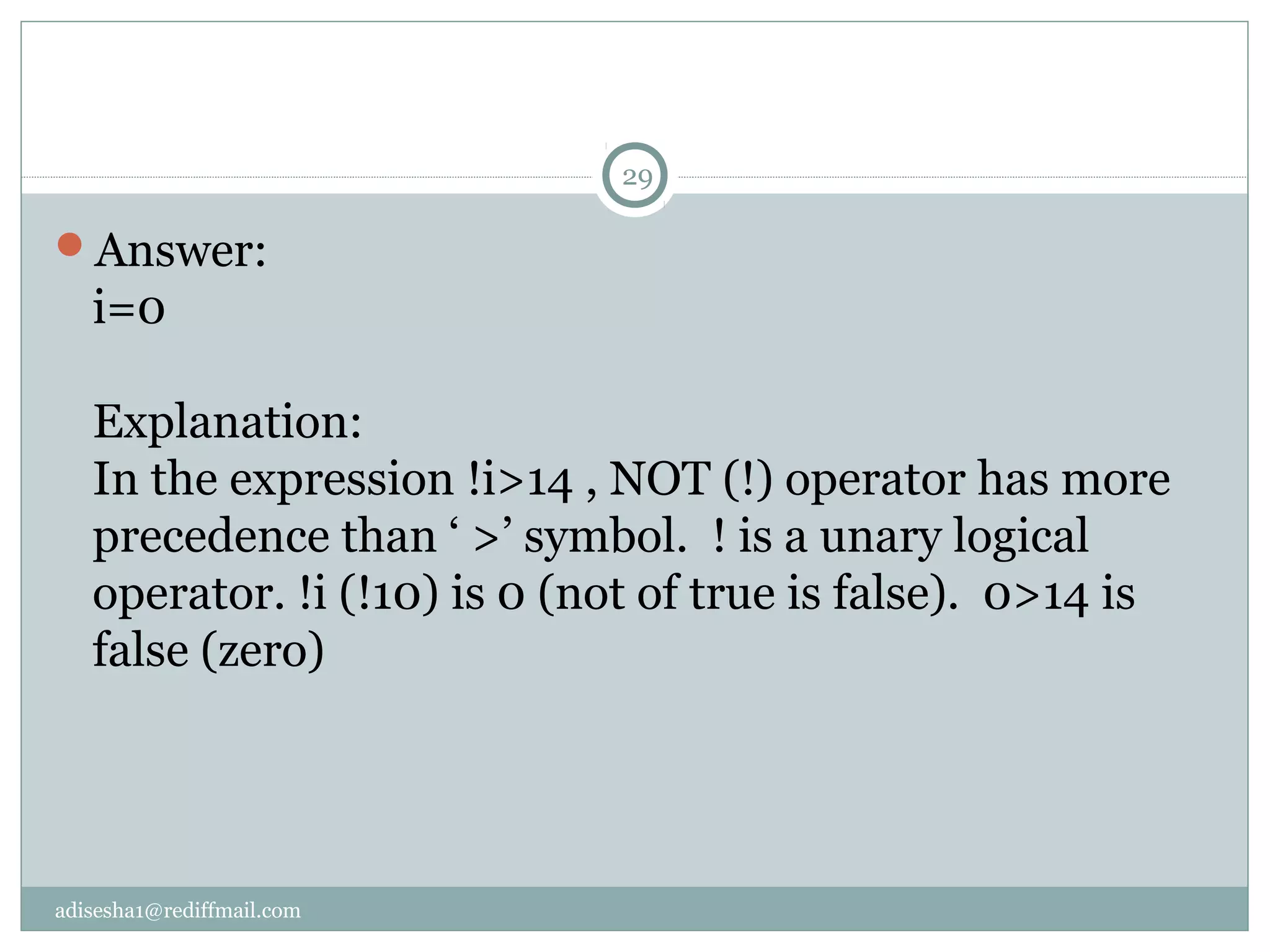
Answer:
mmmm
aaaa
nnnn
Explanation:
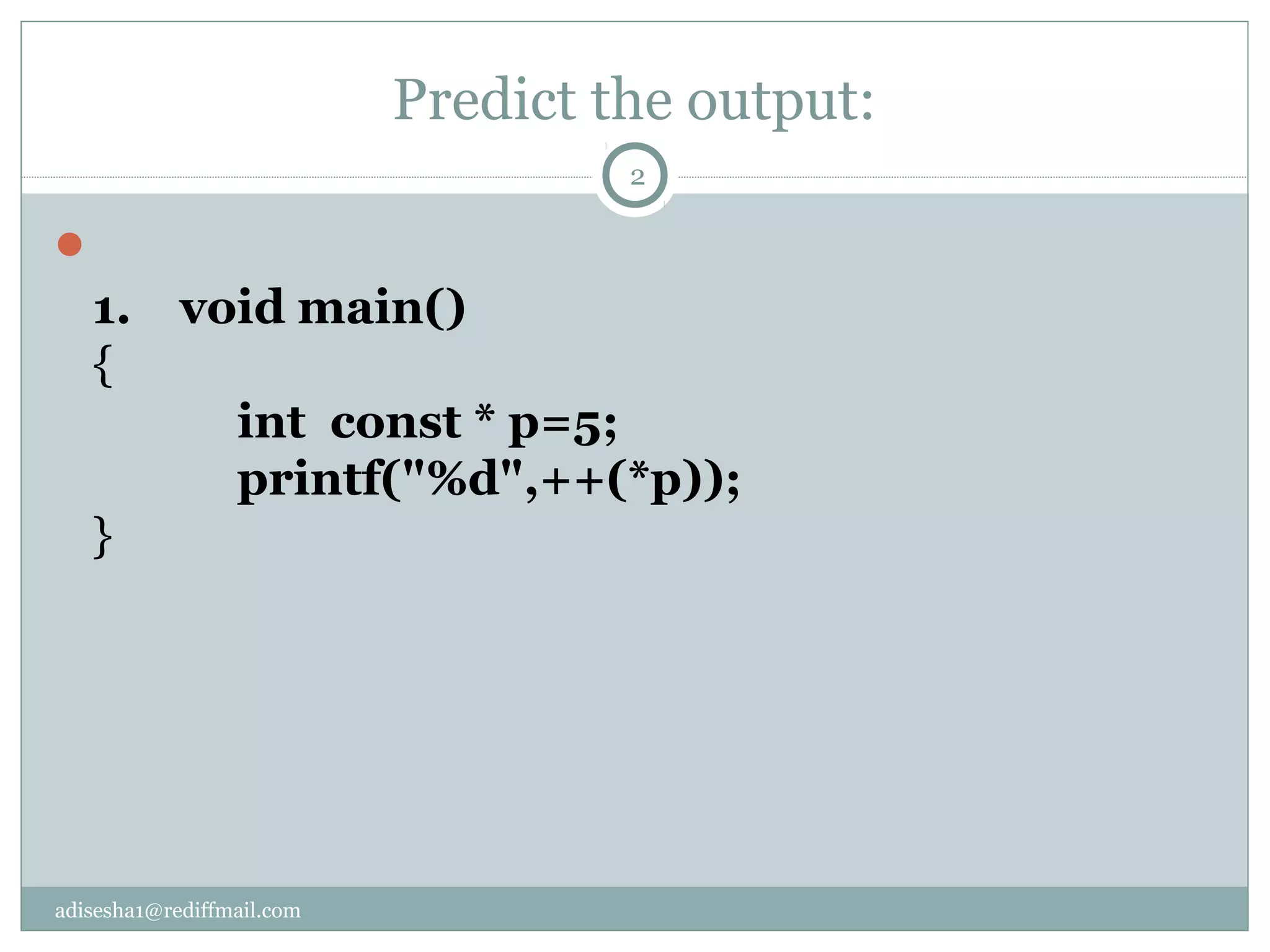
s[i], *(i+s), *(s+i),i[s] are all different ways of
expressing the same idea. Generally array name is
the base address for that array. Here s is the base
address. i is the index number/displacement from
the base address. So, indirecting it with * is same as
s[i]. i[s] may be surprising. But in the case of C it is
same as s[i].
5
adisesha1@rediffmail.com
Answer:
I hate U
Explanation:
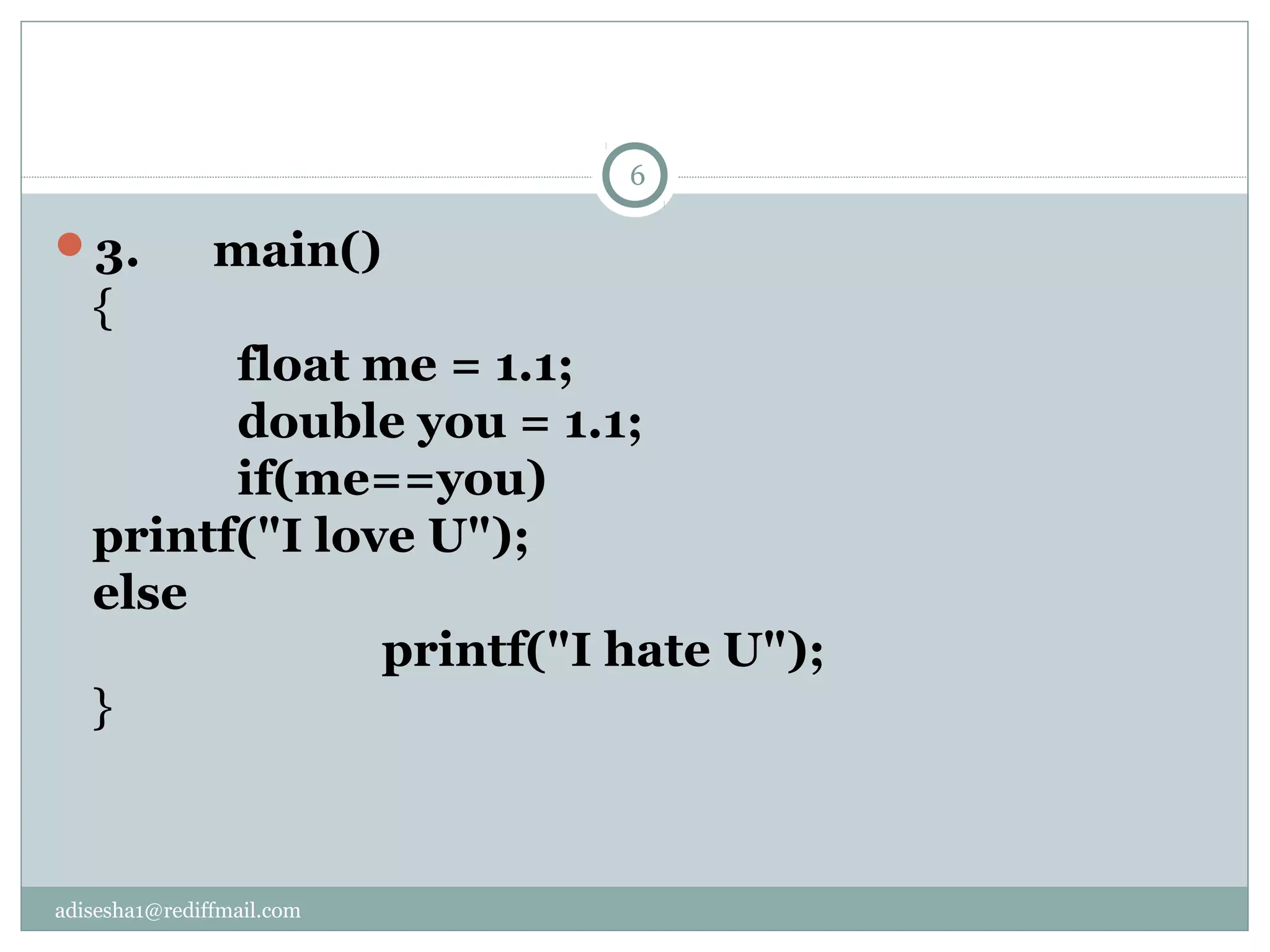
Forfloating point numbers (float, double, long double)
the values cannot be predicted exactly. Depending on the
number of bytes, the precession with of the value
represented varies. Float takes 4 bytes and long double
takes 10 bytes. So float stores 0.9 with less precision than
long double.
Rule of Thumb:
Never compare or at-least be cautious when using
floating point numbers with relational operators (== , >,
<, <=, >=,!= ) .
7
adisesha1@rediffmail.com
Answer:
5 4 32 1
Explanation:
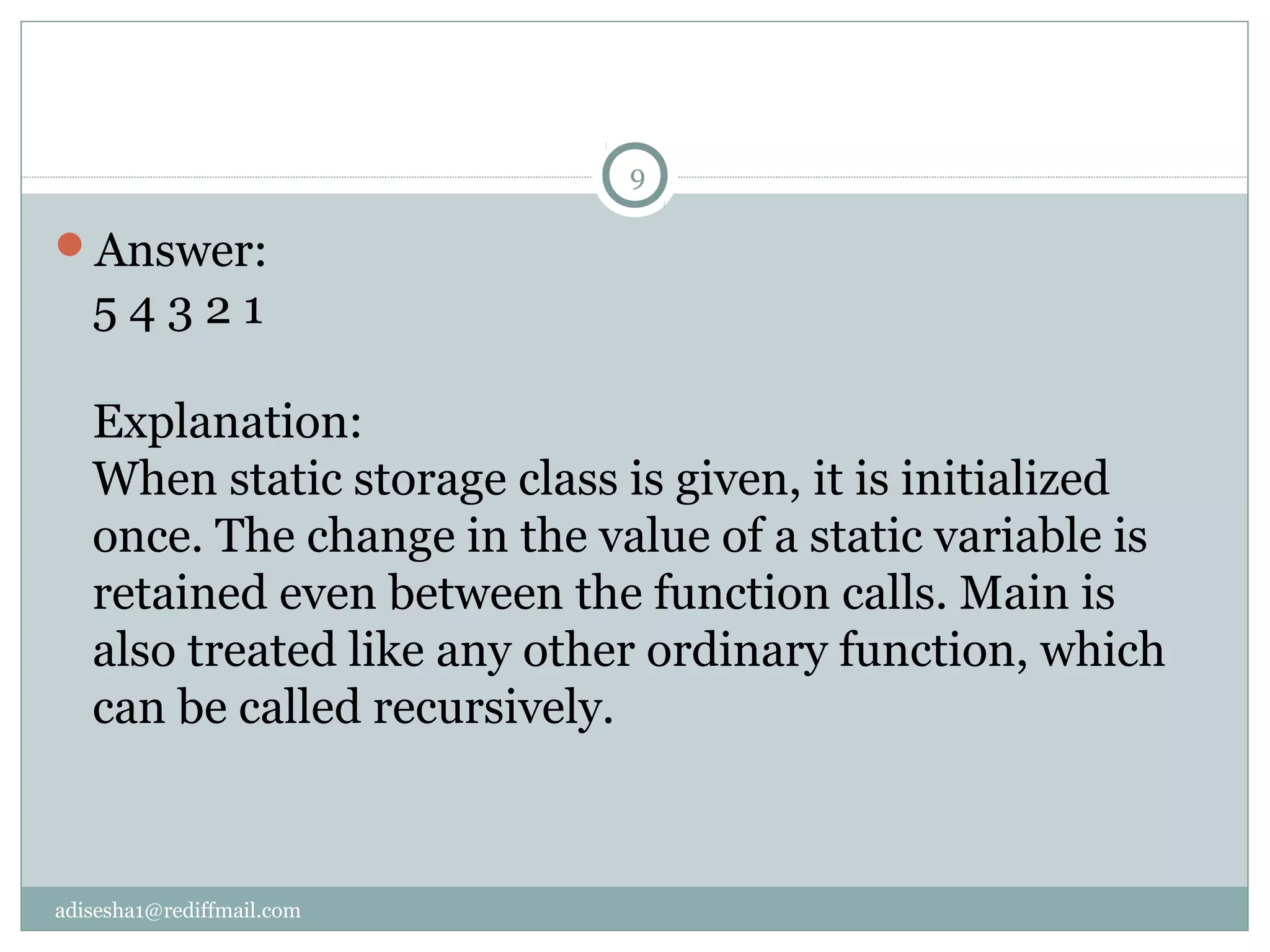
When static storage class is given, it is initialized
once. The change in the value of a static variable is
retained even between the function calls. Main is
also treated like any other ordinary function, which
can be called recursively.
9
adisesha1@rediffmail.com
Answer:
2 2 22 2 2 3 4 6 5
Explanation:
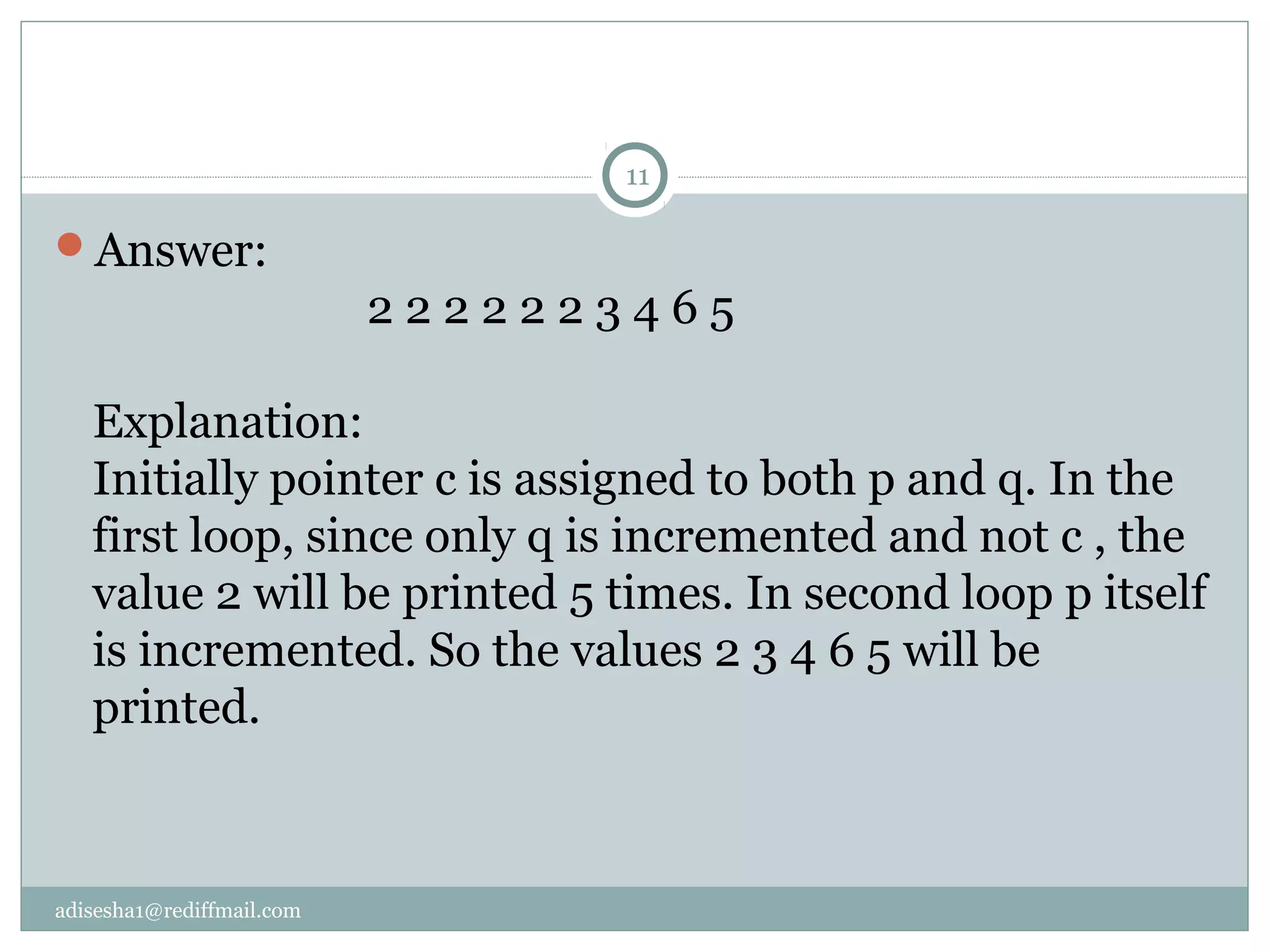
Initially pointer c is assigned to both p and q. In the
first loop, since only q is incremented and not c , the
value 2 will be printed 5 times. In second loop p itself
is incremented. So the values 2 3 4 6 5 will be
printed.
11
adisesha1@rediffmail.com
Answer:
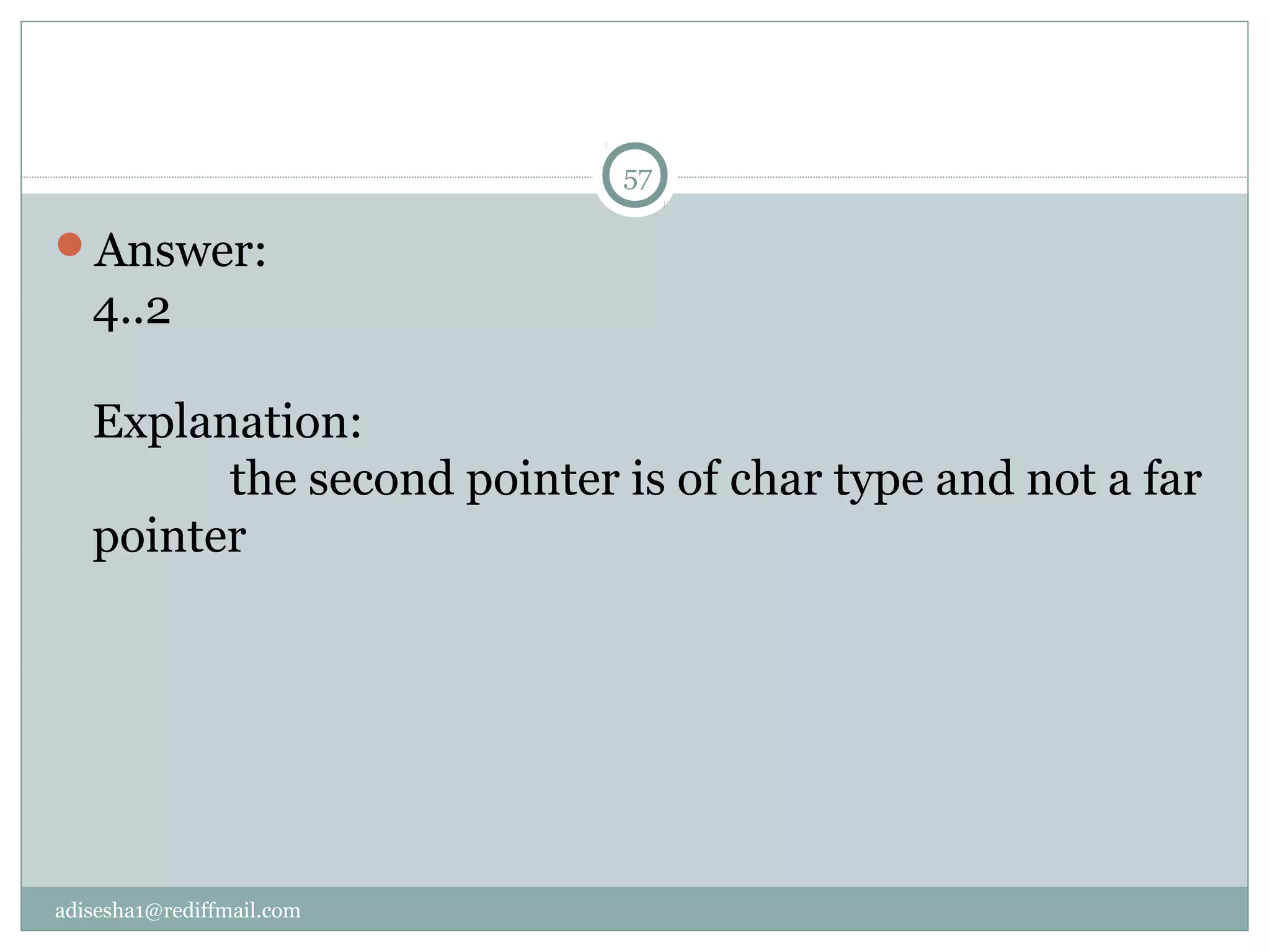
Linker Error :Undefined symbol '_i'
Explanation:
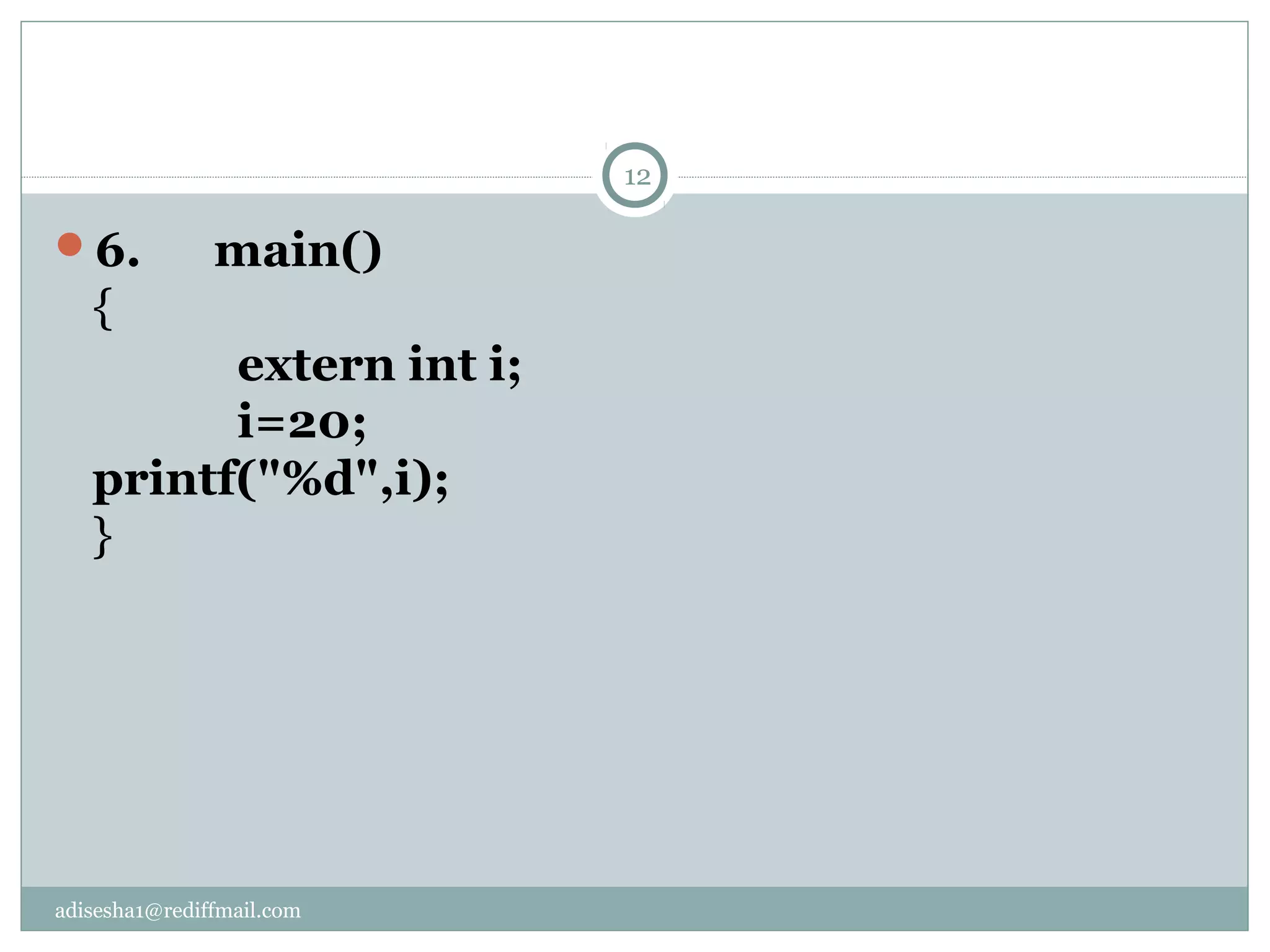
extern storage class in the following
declaration,
extern int i;
specifies to the compiler that the memory for i is
allocated in some other program and that address will be
given to the current program at the time of linking. But
linker finds that no other variable of name i is available
in any other program with memory space allocated for it.
Hence a linker error has occurred .
13
adisesha1@rediffmail.com
Answer:
0 0 13 1
Explanation :
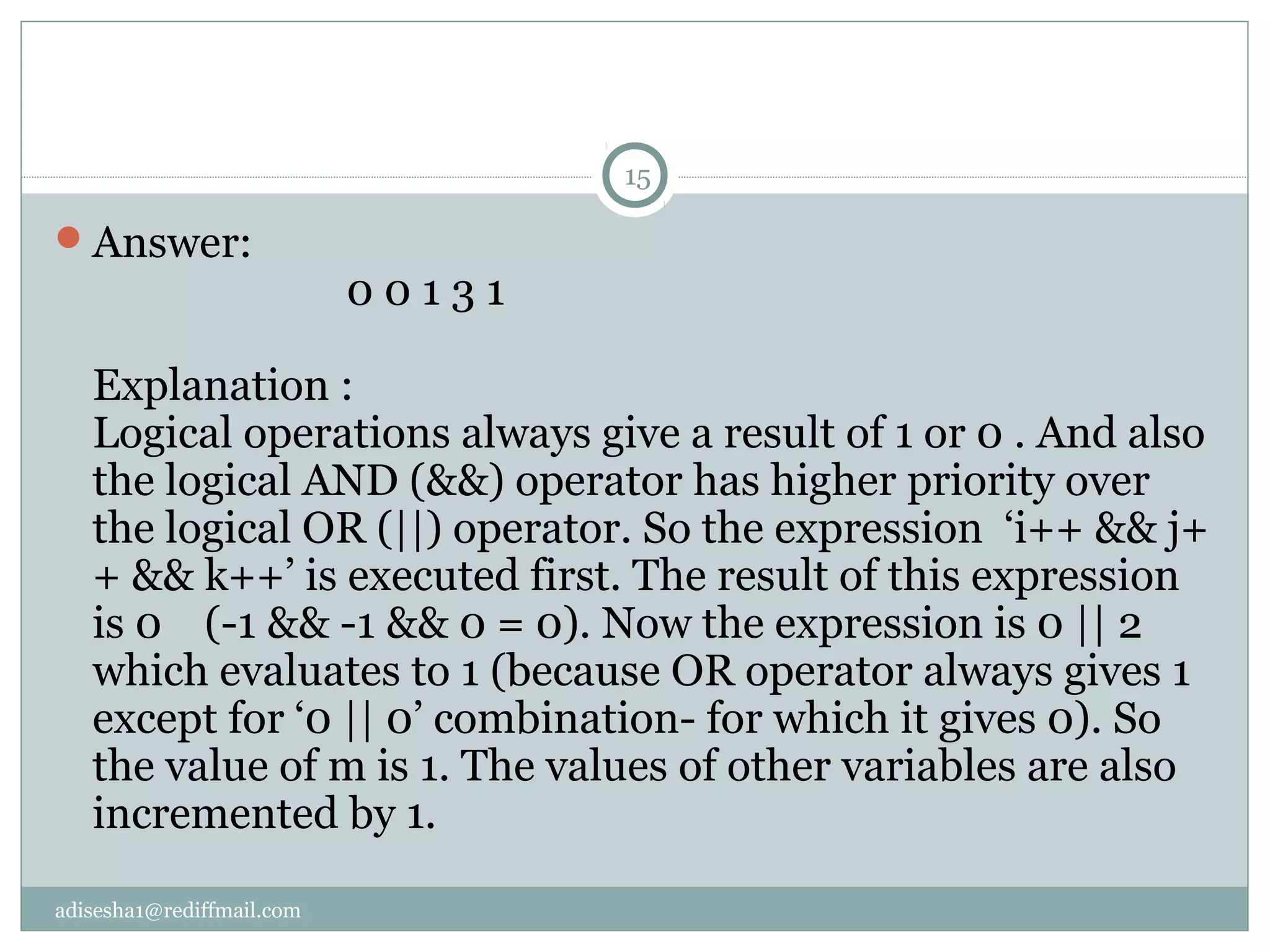
Logical operations always give a result of 1 or 0 . And also
the logical AND (&&) operator has higher priority over
the logical OR (||) operator. So the expression ‘i++ && j+
+ && k++’ is executed first. The result of this expression
is 0 (-1 && -1 && 0 = 0). Now the expression is 0 || 2
which evaluates to 1 (because OR operator always gives 1
except for ‘0 || 0’ combination- for which it gives 0). So
the value of m is 1. The values of other variables are also
incremented by 1.
15
adisesha1@rediffmail.com
Answer:
1 2
Explanation:
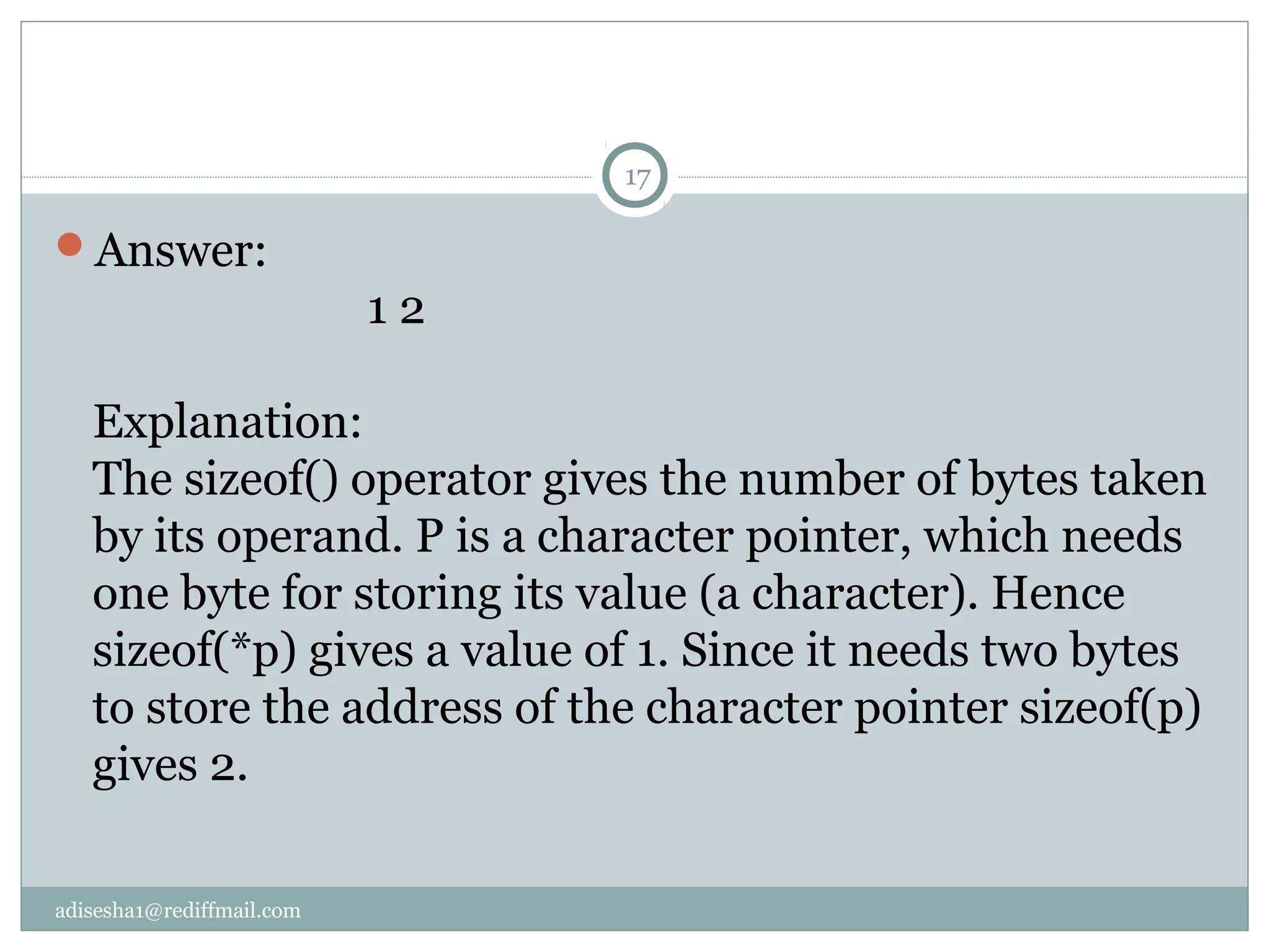
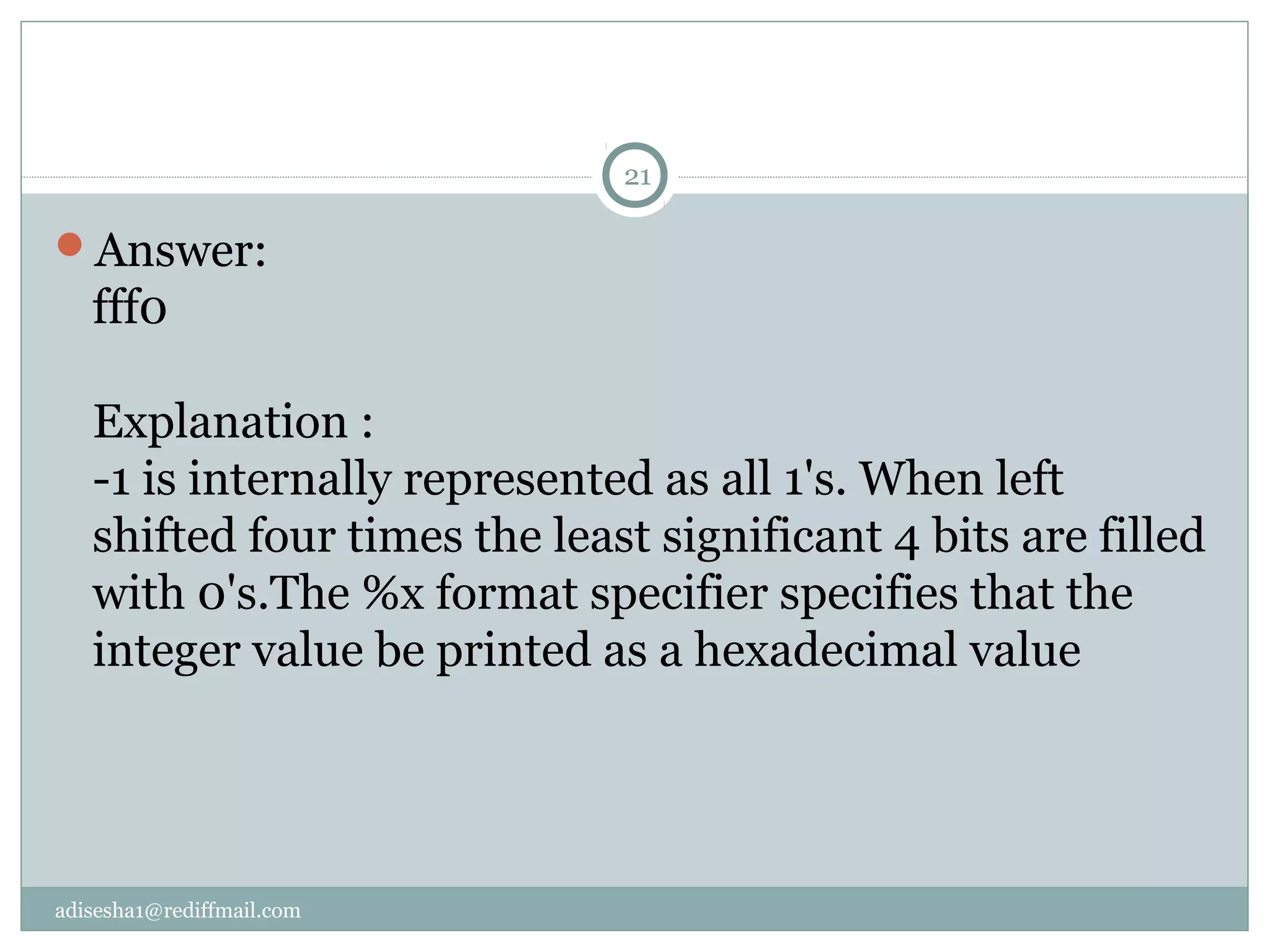
The sizeof()operator gives the number of bytes taken
by its operand. P is a character pointer, which needs
one byte for storing its value (a character). Hence
sizeof(*p) gives a value of 1. Since it needs two bytes
to store the address of the character pointer sizeof(p)
gives 2.
17
adisesha1@rediffmail.com
Answer:
fff0
Explanation :
-1 isinternally represented as all 1's. When left
shifted four times the least significant 4 bits are filled
with 0's.The %x format specifier specifies that the
integer value be printed as a hexadecimal value
21
adisesha1@rediffmail.com
Answer:
Compiler Error :Type mismatch in redeclaration of
function display
Explanation :
In third line, when the function display is encountered,
the compiler doesn't know anything about the function
display. It assumes the arguments and return types to be
integers, (which is the default type). When it sees the
actual function display, the arguments and type
contradicts with what it has assumed previously. Hence a
compile time error occurs.
23
adisesha1@rediffmail.com
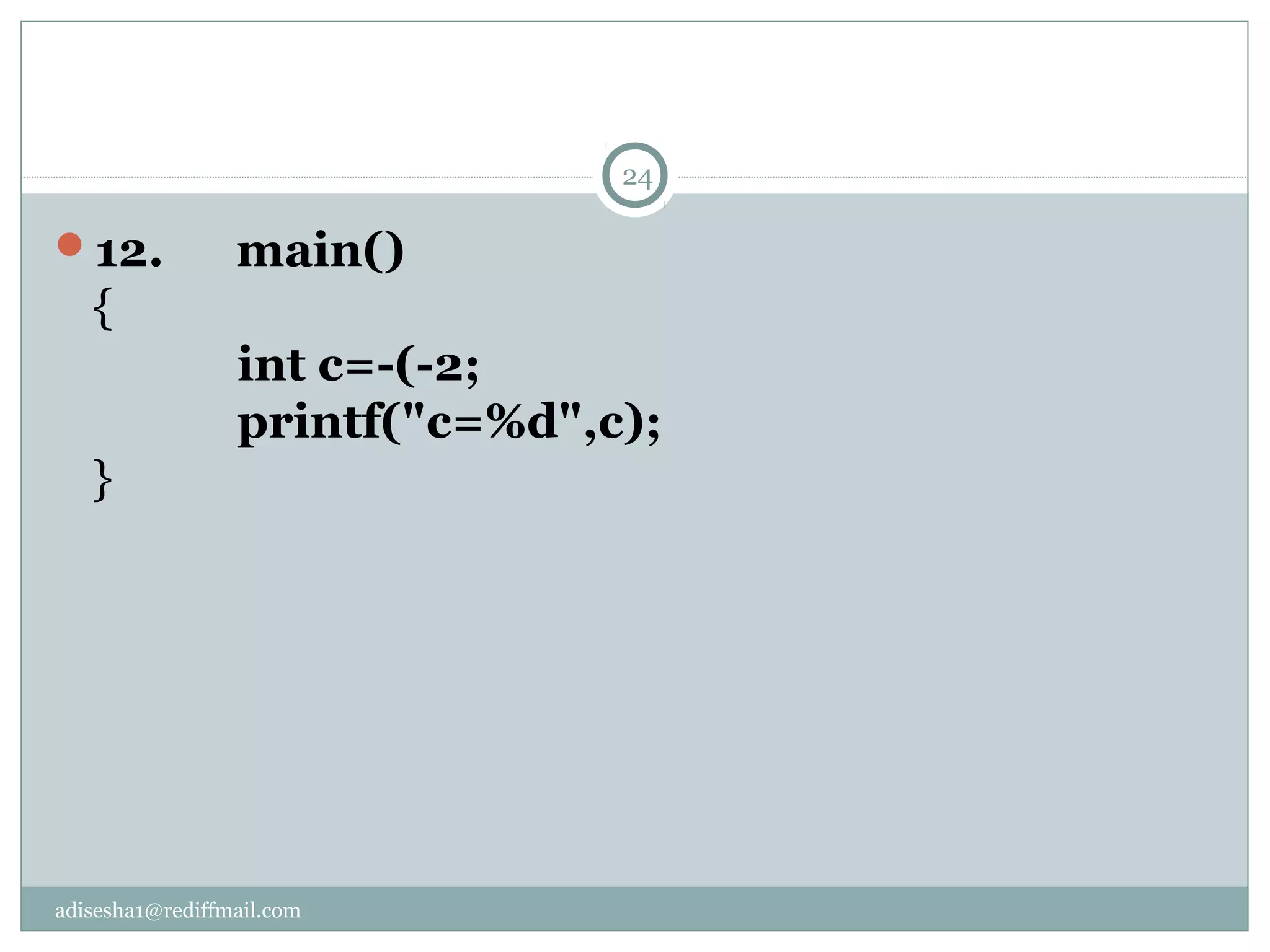
Answer:
c=2;
Explanation:
Here unary minus(or negation) operator is used
twice. Same maths rules applies, ie. minus * minus=
plus.
Note:
However you cannot give like --2. Because --
operator can only be applied to variables as a
decrement operator (eg., i--). 2 is a constant and not
a variable.
25
adisesha1@rediffmail.com
Answer:
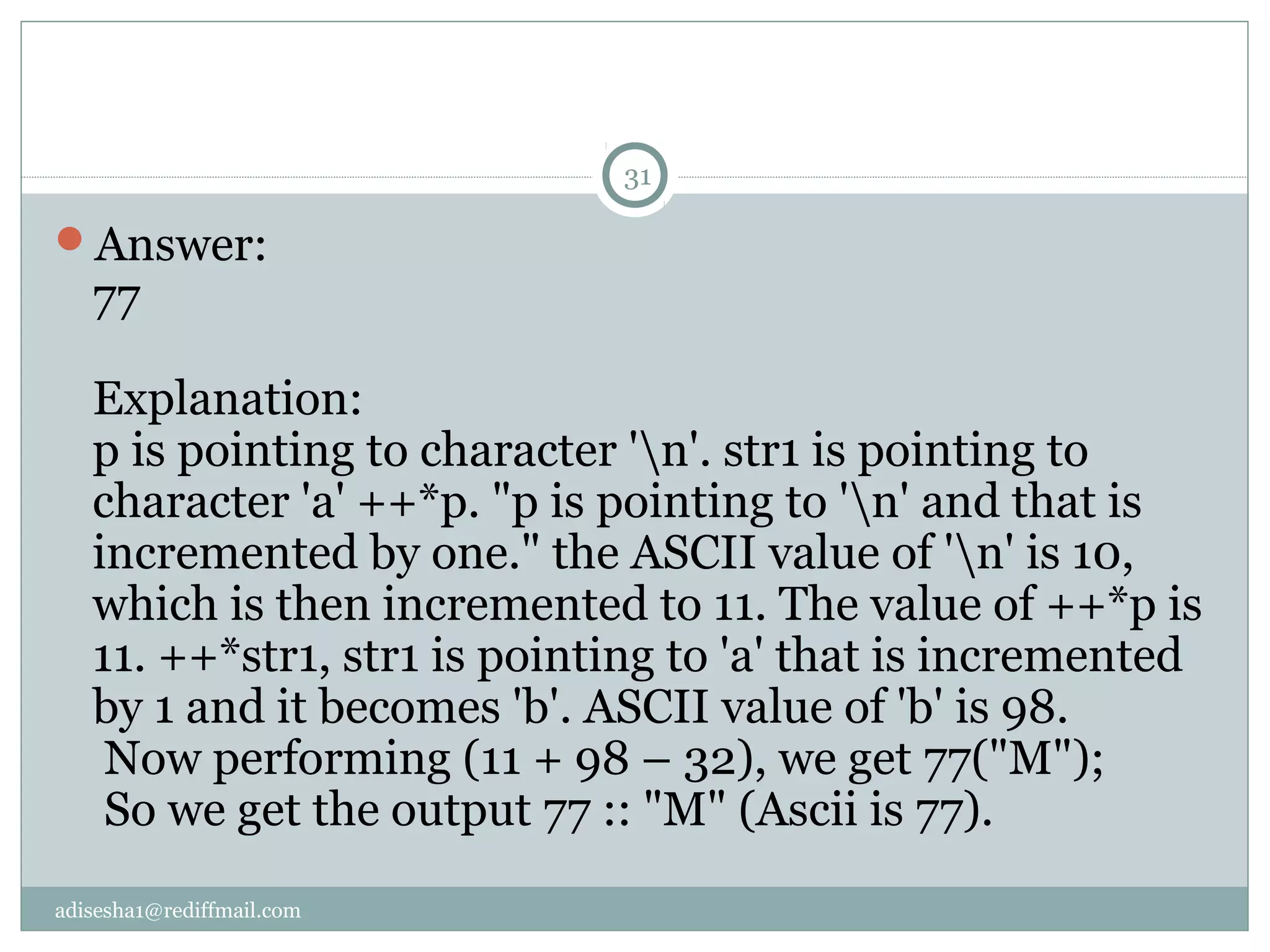
77
Explanation:
p is pointingto character 'n'. str1 is pointing to
character 'a' ++*p. "p is pointing to 'n' and that is
incremented by one." the ASCII value of 'n' is 10,
which is then incremented to 11. The value of ++*p is
11. ++*str1, str1 is pointing to 'a' that is incremented
by 1 and it becomes 'b'. ASCII value of 'b' is 98.
Now performing (11 + 98 – 32), we get 77("M");
So we get the output 77 :: "M" (Ascii is 77).
31
adisesha1@rediffmail.com
Answer:
SomeGarbageValue---1
Explanation:
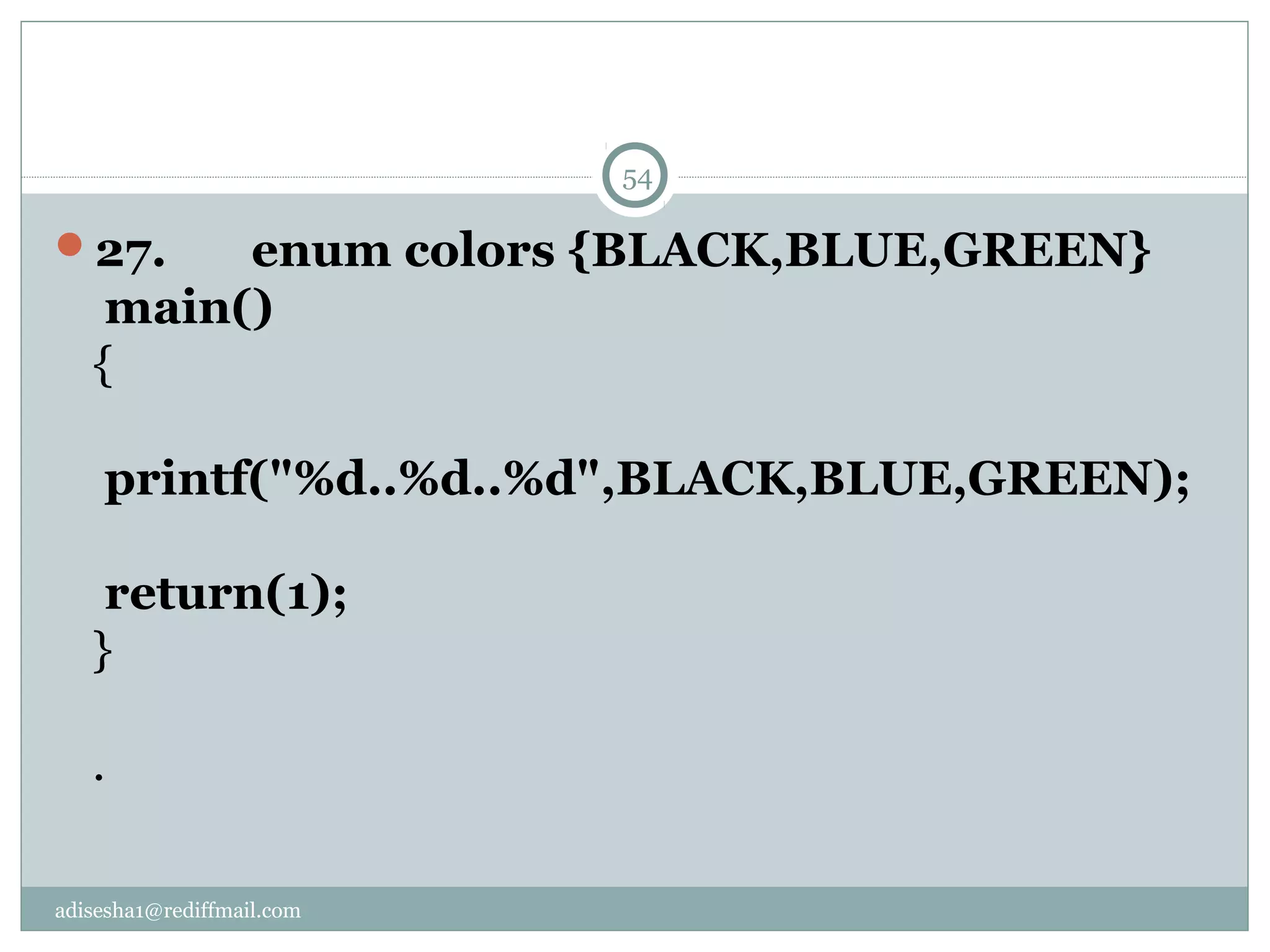
p=&a[2][2][2] you declareonly two 2D arrays, but
you are trying to access the third 2D(which you are
not declared) it will print garbage values. *q=***a
starting address of a is assigned integer pointer. Now
q is pointing to starting address of a. If you print *q,
it will print first element of 3D array.
33
adisesha1@rediffmail.com
Answer:
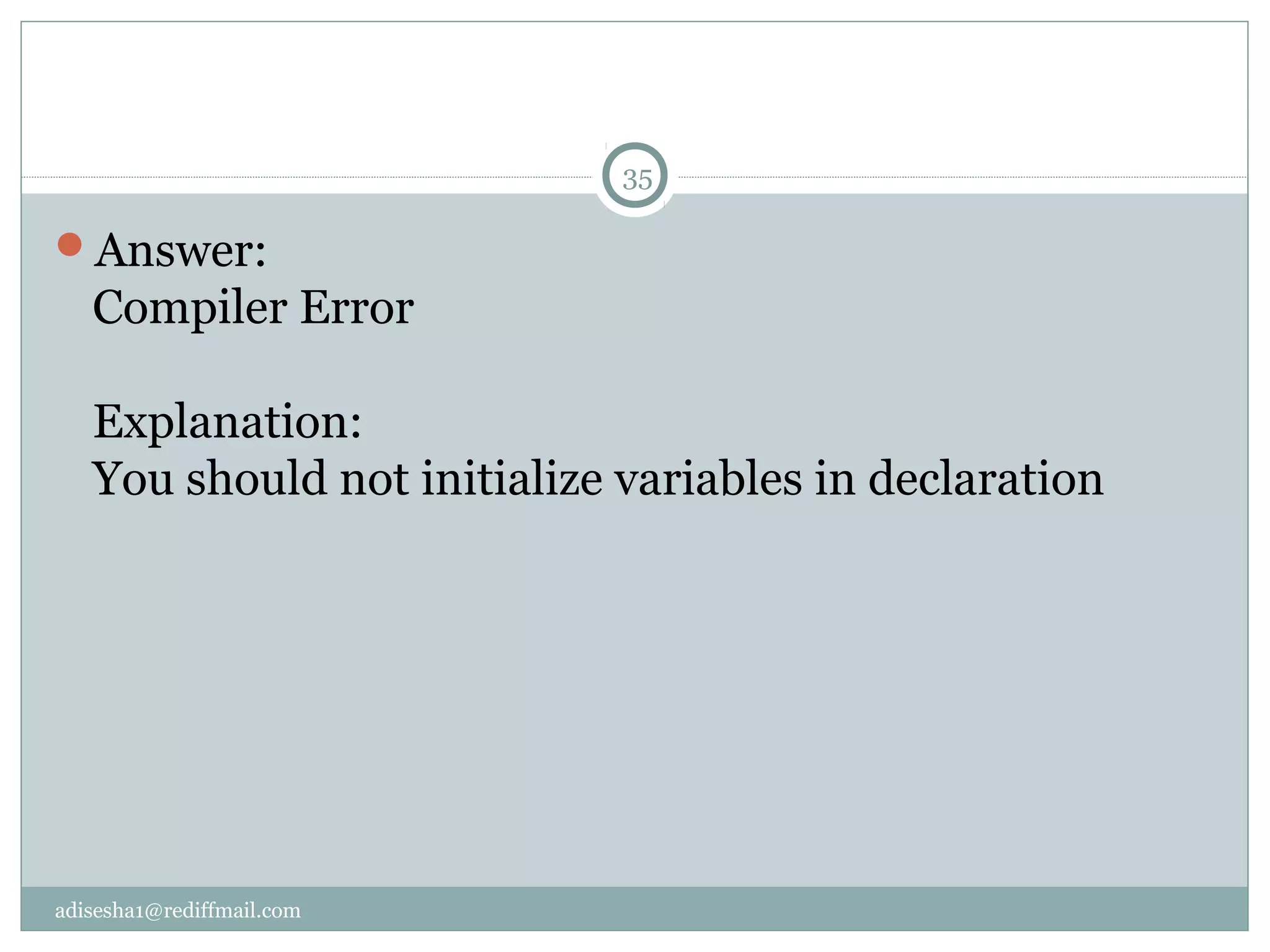
Compiler Error
Explanation:
The structureyy is nested within structure xx.
Hence, the elements are of yy are to be accessed
through the instance of structure xx, which needs an
instance of yy to be known. If the instance is created
after defining the structure the compiler will not
know about the instance relative to xx. Hence for
nested structure yy you have to declare member.
37
adisesha1@rediffmail.com
Answer:
ibj!gsjfoet
Explanation:
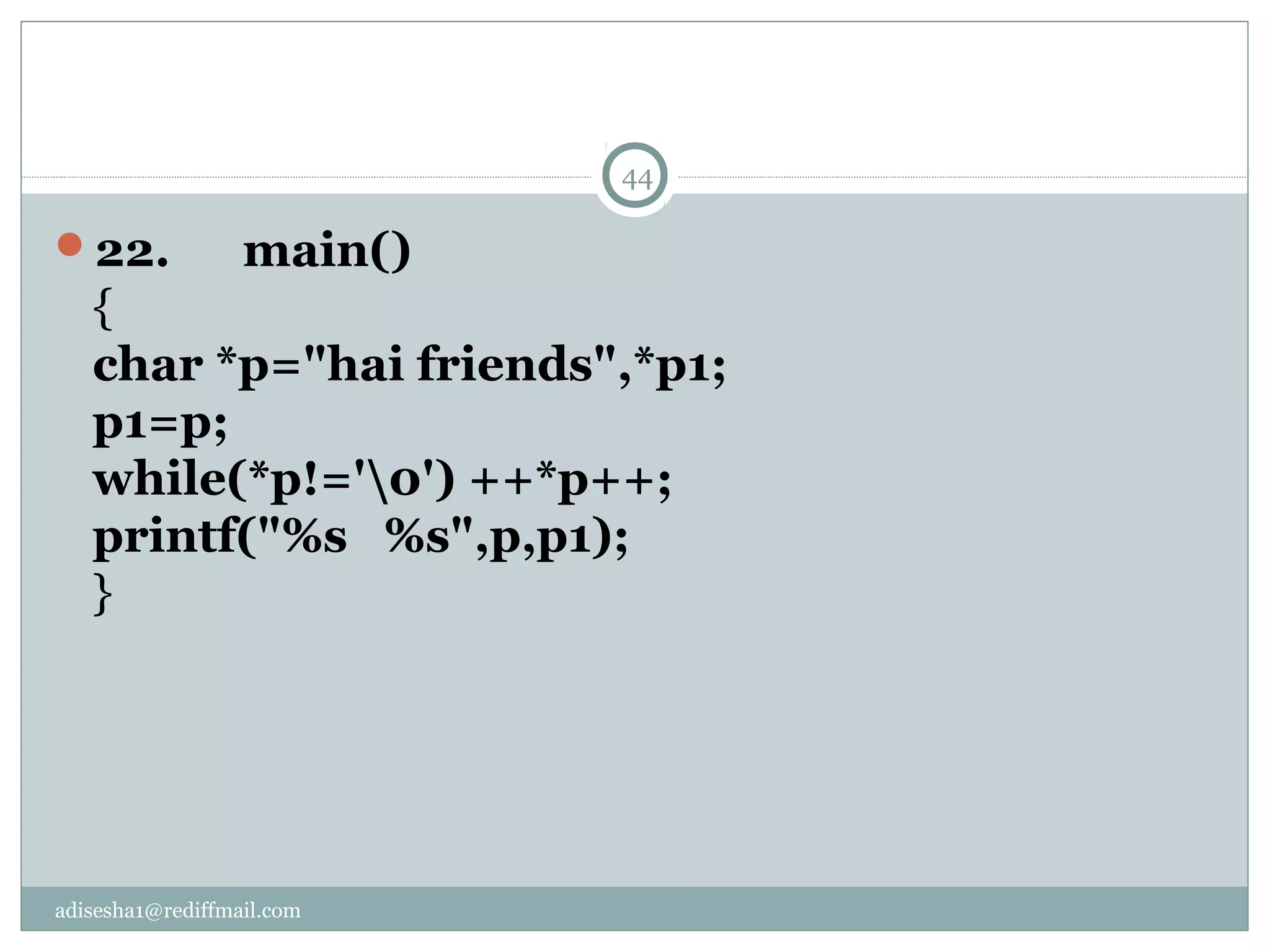
++*p++ willbe parse in the given order
Ø *p that is value at the location currently pointed by p will be
taken
Ø ++*p the retrieved value will be incremented
Ø when ; is encountered the location will be incremented that is p+
+ will be executed
Hence, in the while loop initial value pointed by p is ‘h’, which is
changed to ‘i’ by executing ++*p and pointer moves to point, ‘a’
which is similarly changed to ‘b’ and so on. Similarly blank space is
converted to ‘!’. Thus, we obtain value in p becomes “ibj!gsjfoet” and
since p reaches ‘0’ and p1 points to p thus p1doesnot print
anything.
45
adisesha1@rediffmail.com
Answer:
100
Explanation:
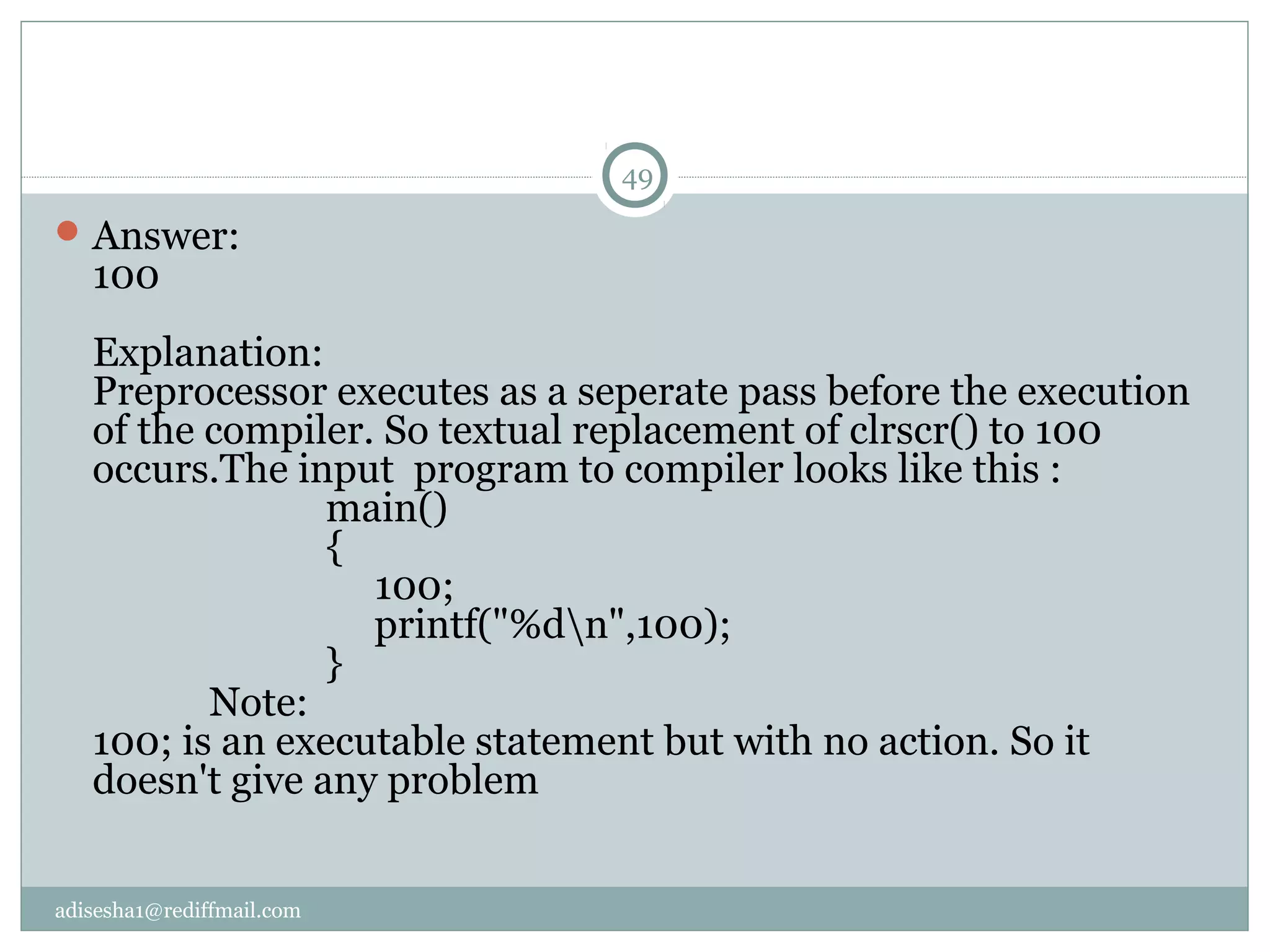
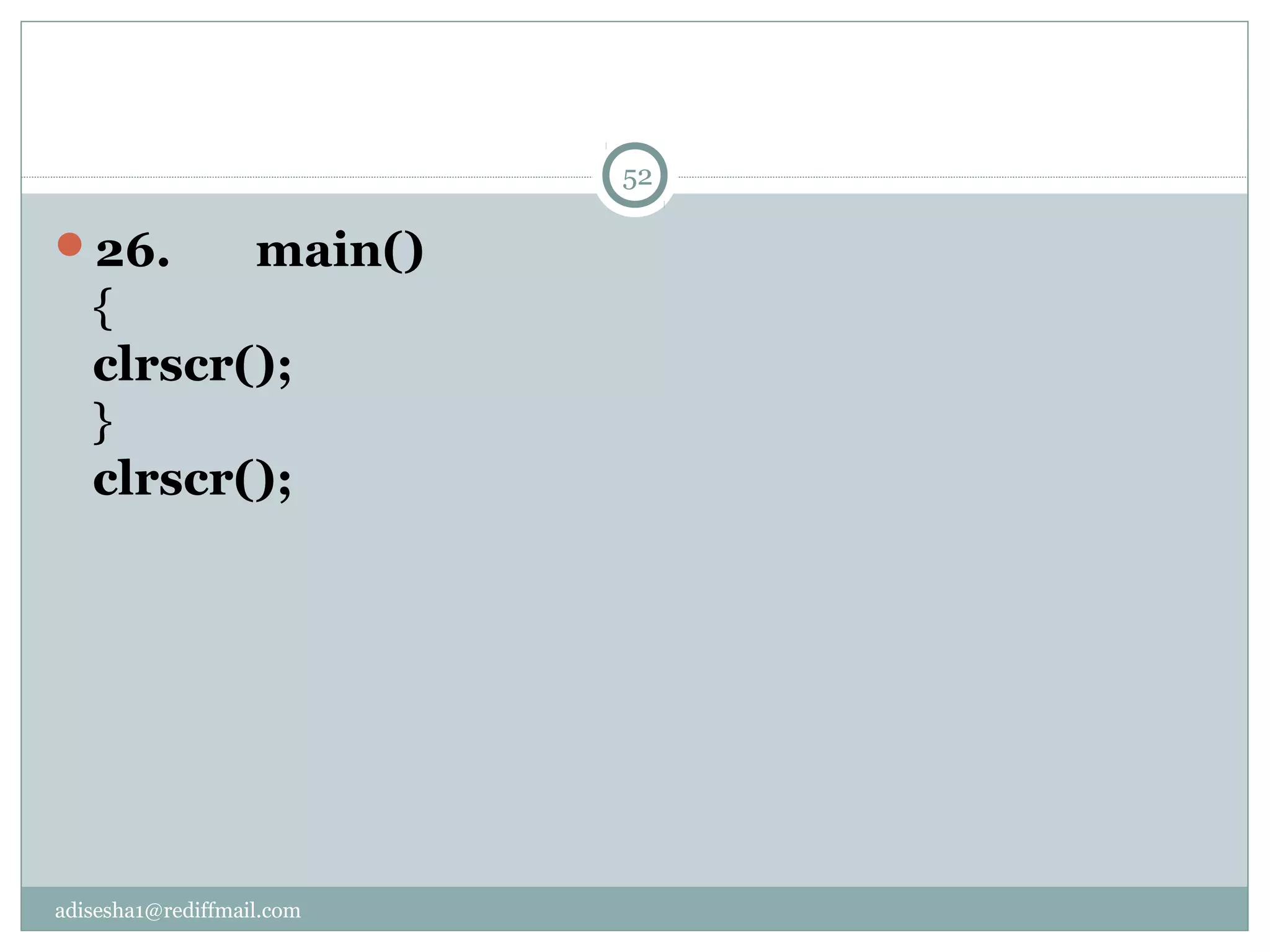
Preprocessor executes asa seperate pass before the execution
of the compiler. So textual replacement of clrscr() to 100
occurs.The input program to compiler looks like this :
main()
{
100;
printf("%dn",100);
}
Note:
100; is an executable statement but with no action. So it
doesn't give any problem
49
adisesha1@rediffmail.com
Answer:
Some address willbe printed.
Explanation:
Function names are just addresses (just like
array names are addresses).
main() is also a function. So the address of function
main will be printed. %p in printf specifies that the
argument is an address. They are printed as
hexadecimal numbers.
51
adisesha1@rediffmail.com
Answer:
400..300
Explanation:
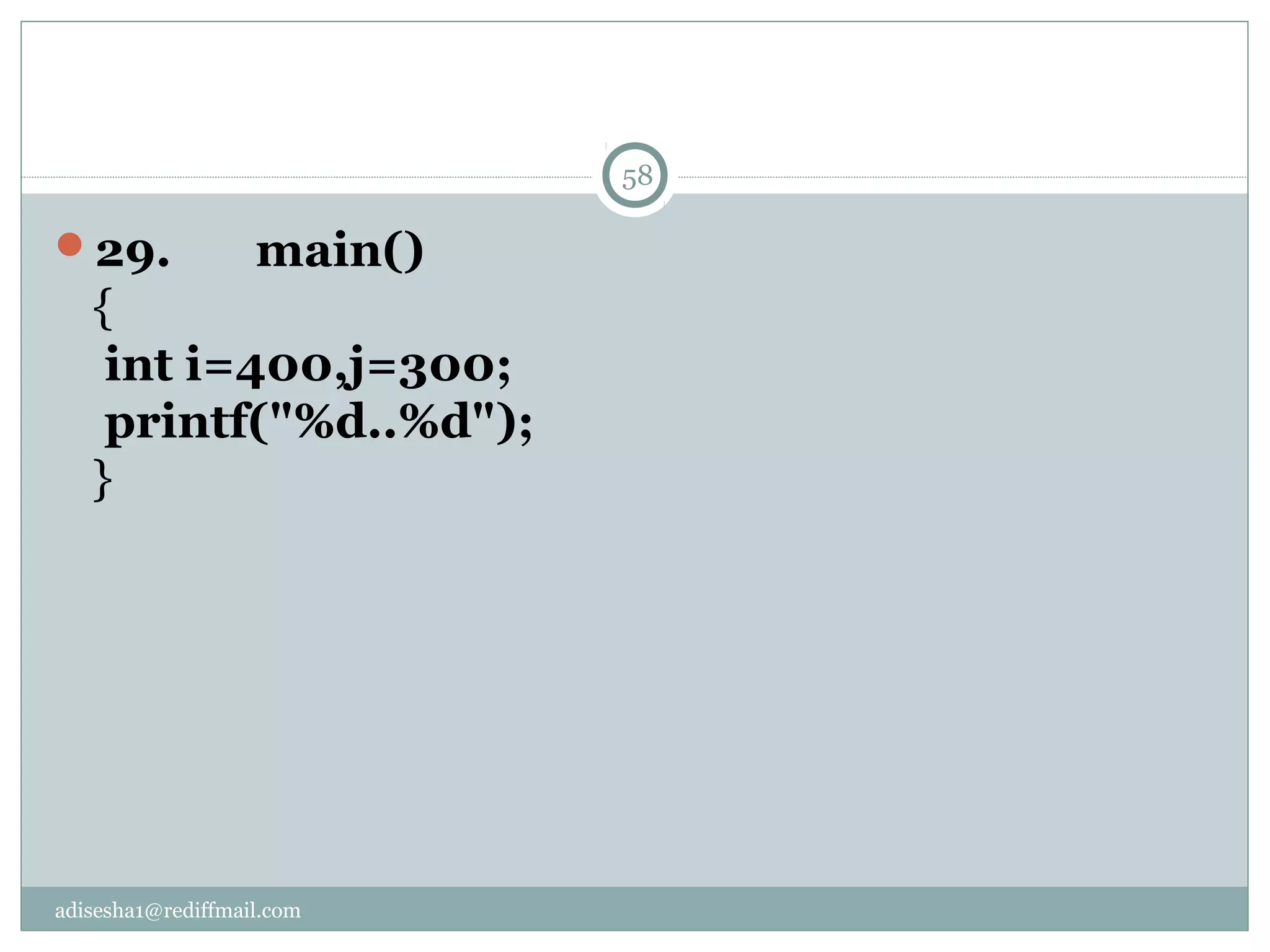
printf takes thevalues of the first two assignments of
the program. Any number of printf's may be given.
All of them take only the first two values. If more
number of assignments given in the program, then
printf will take garbage values.
59
adisesha1@rediffmail.com
Answer:
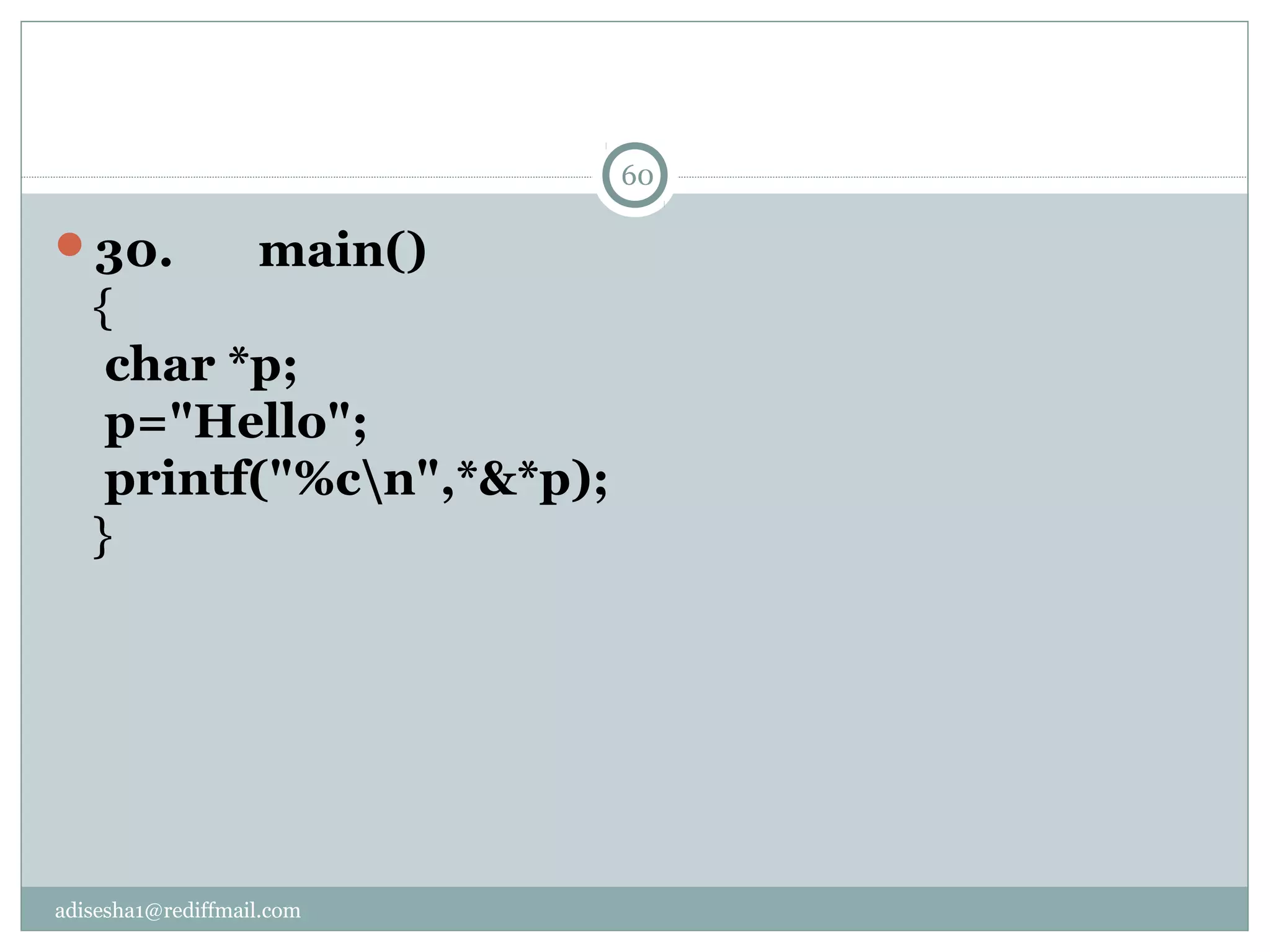
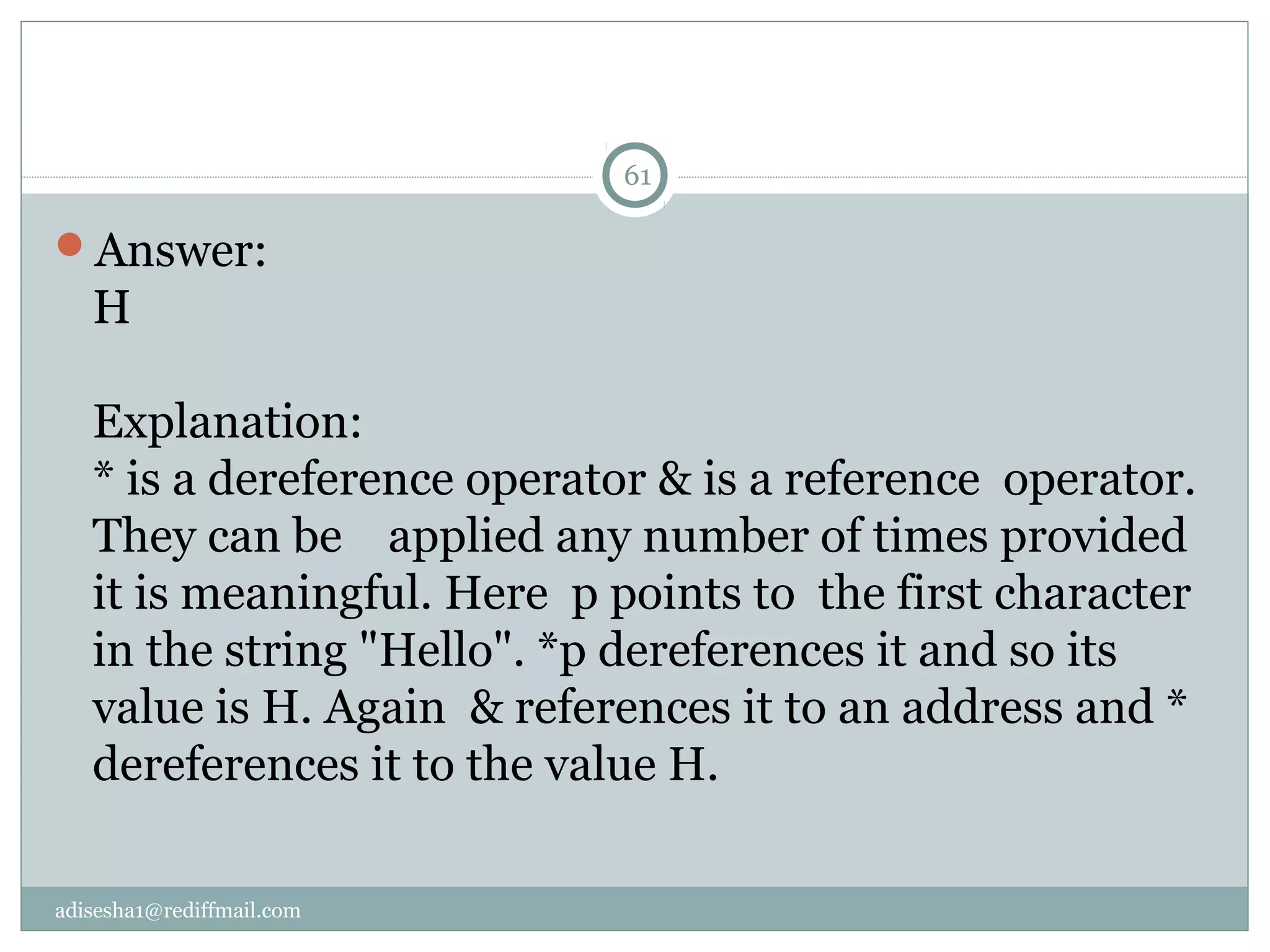
H
Explanation:
* is adereference operator & is a reference operator.
They can be applied any number of times provided
it is meaningful. Here p points to the first character
in the string "Hello". *p dereferences it and so its
value is H. Again & references it to an address and *
dereferences it to the value H.
61
adisesha1@rediffmail.com
Answer:
Compiler error: Undefinedlabel 'here' in function
main
Explanation:
Labels have functions scope, in other words The
scope of the labels is limited to functions . The label
'here' is available in function fun() Hence it is not
visible in function main.
63
adisesha1@rediffmail.com
Answer:
Compiler Error: Constantexpression required in
function main.
Explanation:
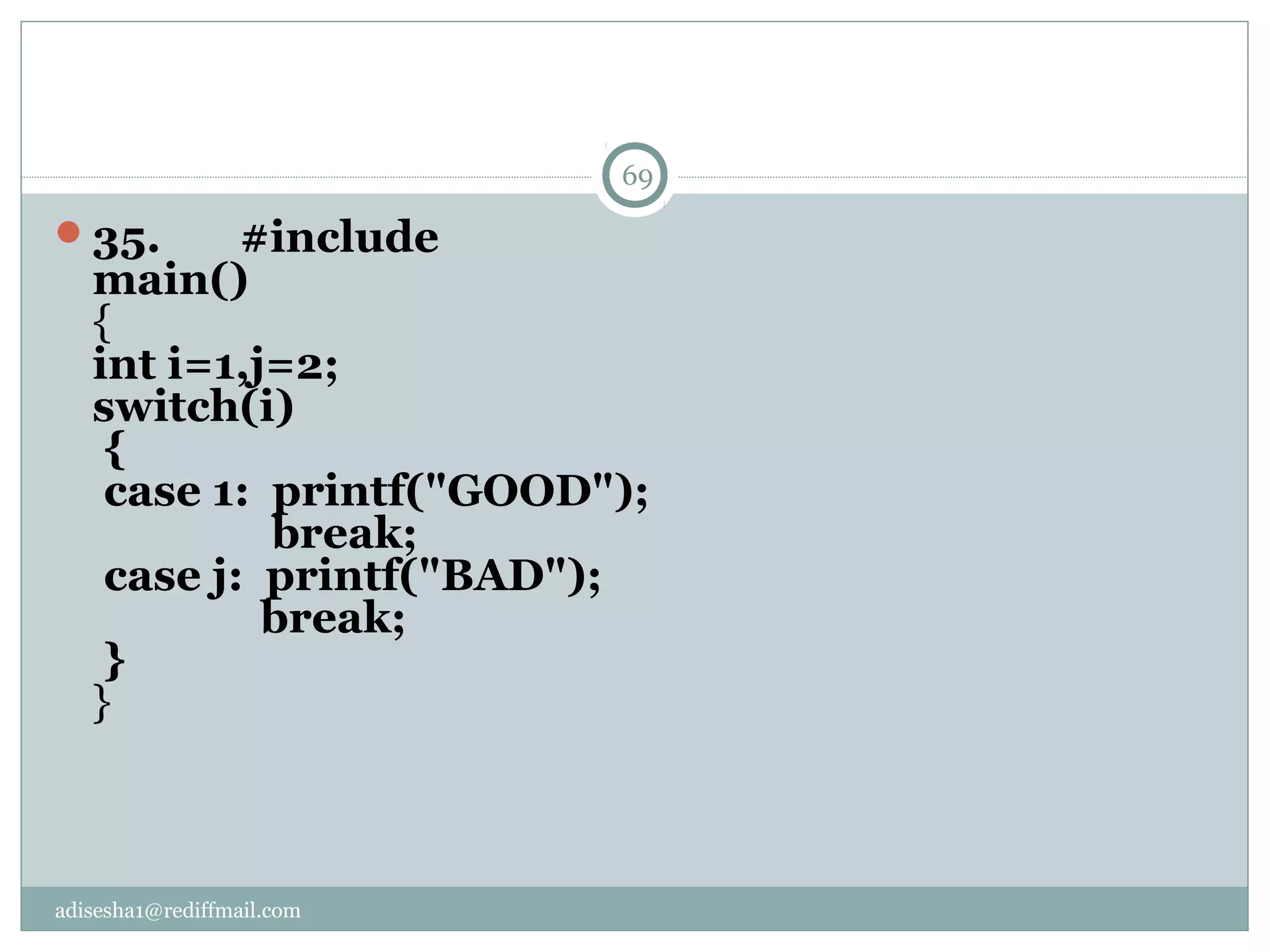
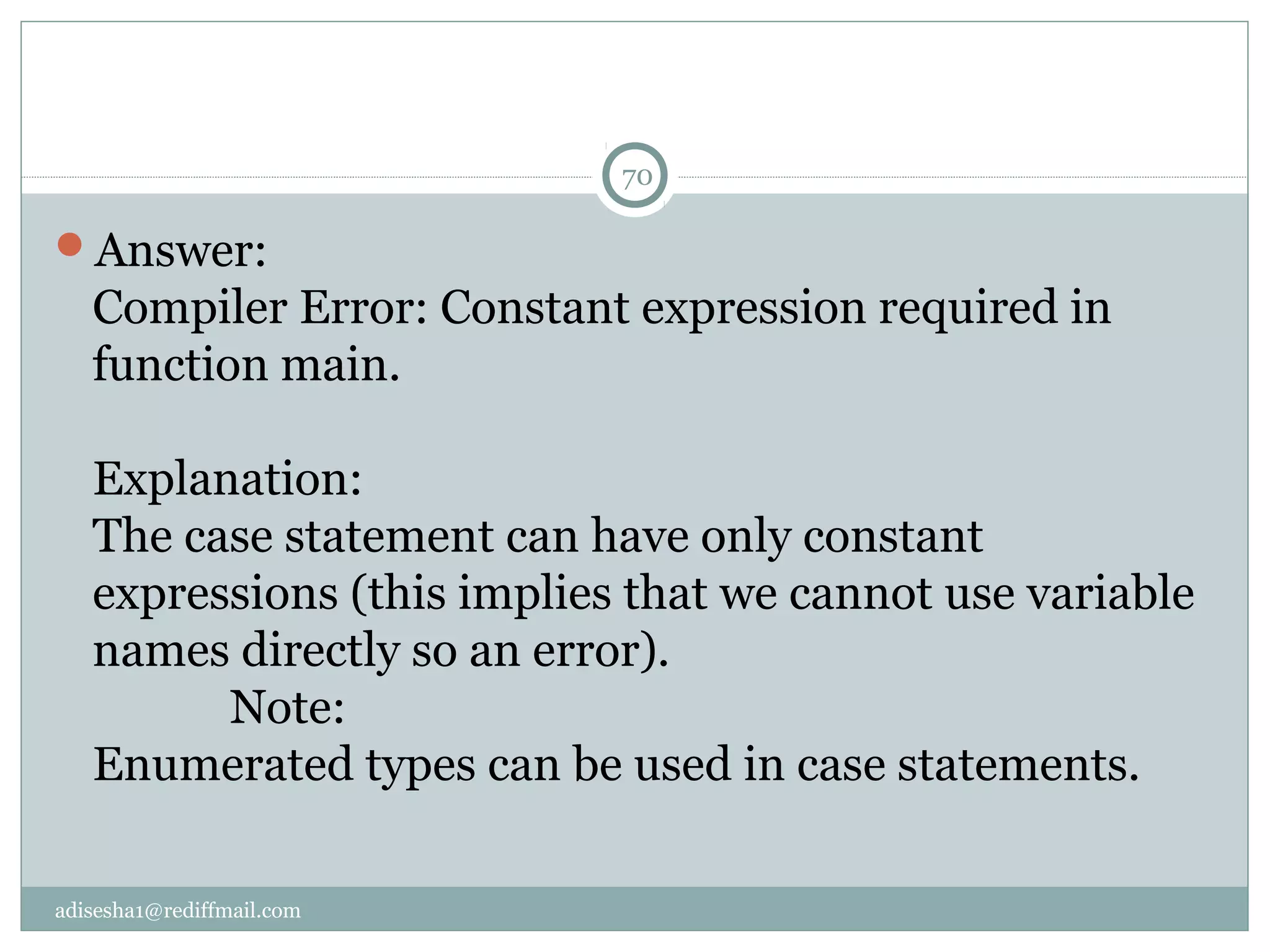
The case statement can have only constant
expressions (this implies that we cannot use variable
names directly so an error).
Note:
Enumerated types can be used in case statements.
70
adisesha1@rediffmail.com
Answer:
M
Explanation:
p is pointingto character 'n'.str1 is pointing to character
'a' ++*p meAnswer:"p is pointing to 'n' and that is
incremented by one." the ASCII value of 'n' is 10. then it
is incremented to 11. the value of ++*p is 11. ++*str1
meAnswer:"str1 is pointing to 'a' that is incremented by 1
and it becomes 'b'. ASCII value of 'b' is 98. both 11 and 98
is added and result is subtracted from 32.
i.e. (11+98-32)=77("M");
77
adisesha1@rediffmail.com
42. main()
{
extern int i;
i=20;
printf("%d",sizeof(i));
}
Answer:
Linker error:undefined symbol '_i'.
Explanation:
extern declaration specifies that the variable i is defined somewhere
else. The compiler passes the external variable to be resolved by the
linker. So compiler doesn't find an error. During linking the linker
searches for the definition of i. Since it is not found the linker flags
an error.
82
adisesha1@rediffmail.com
Answer:
Compier error: Typemismatch in redeclaration of show.
Explanation:
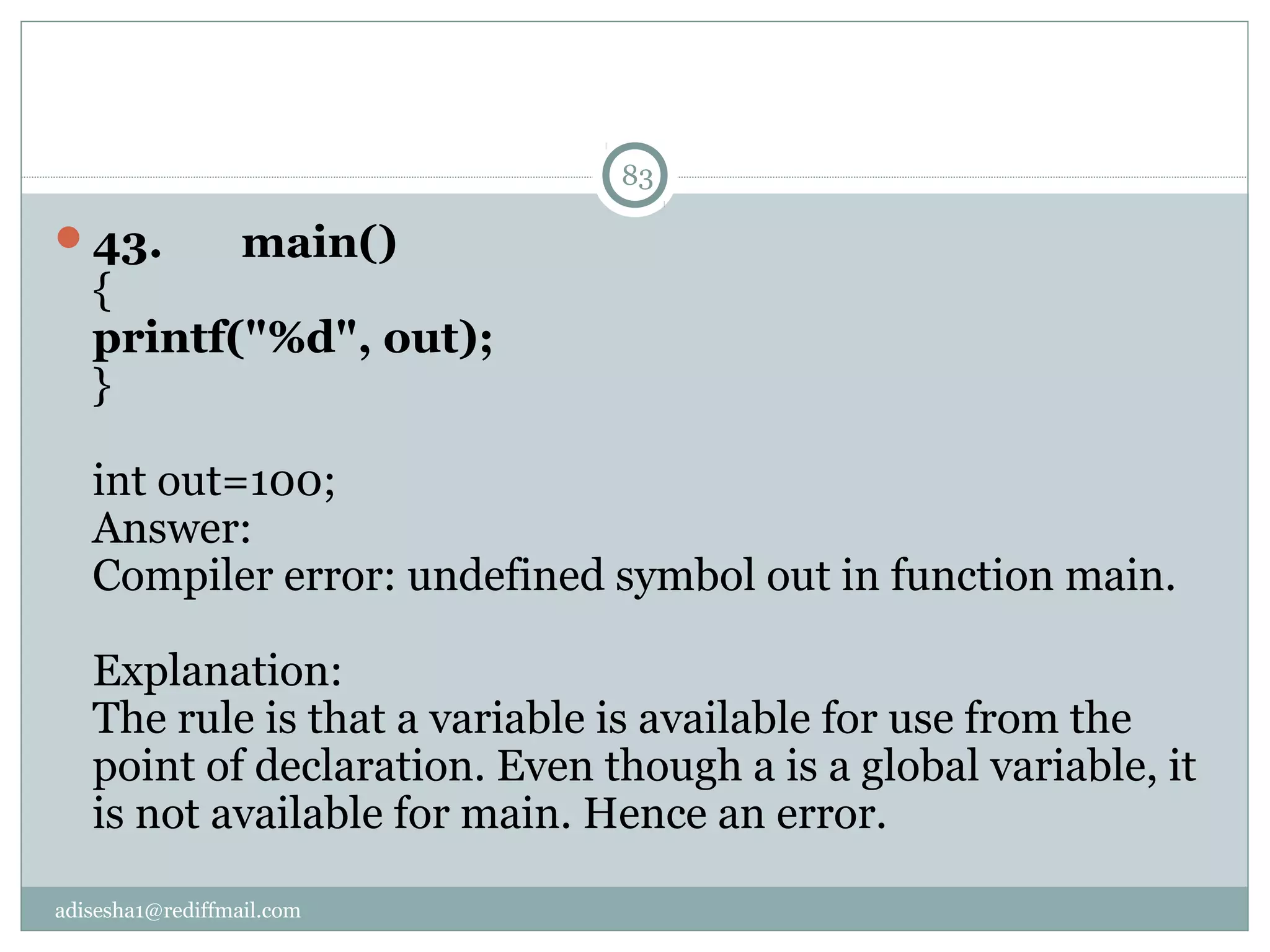
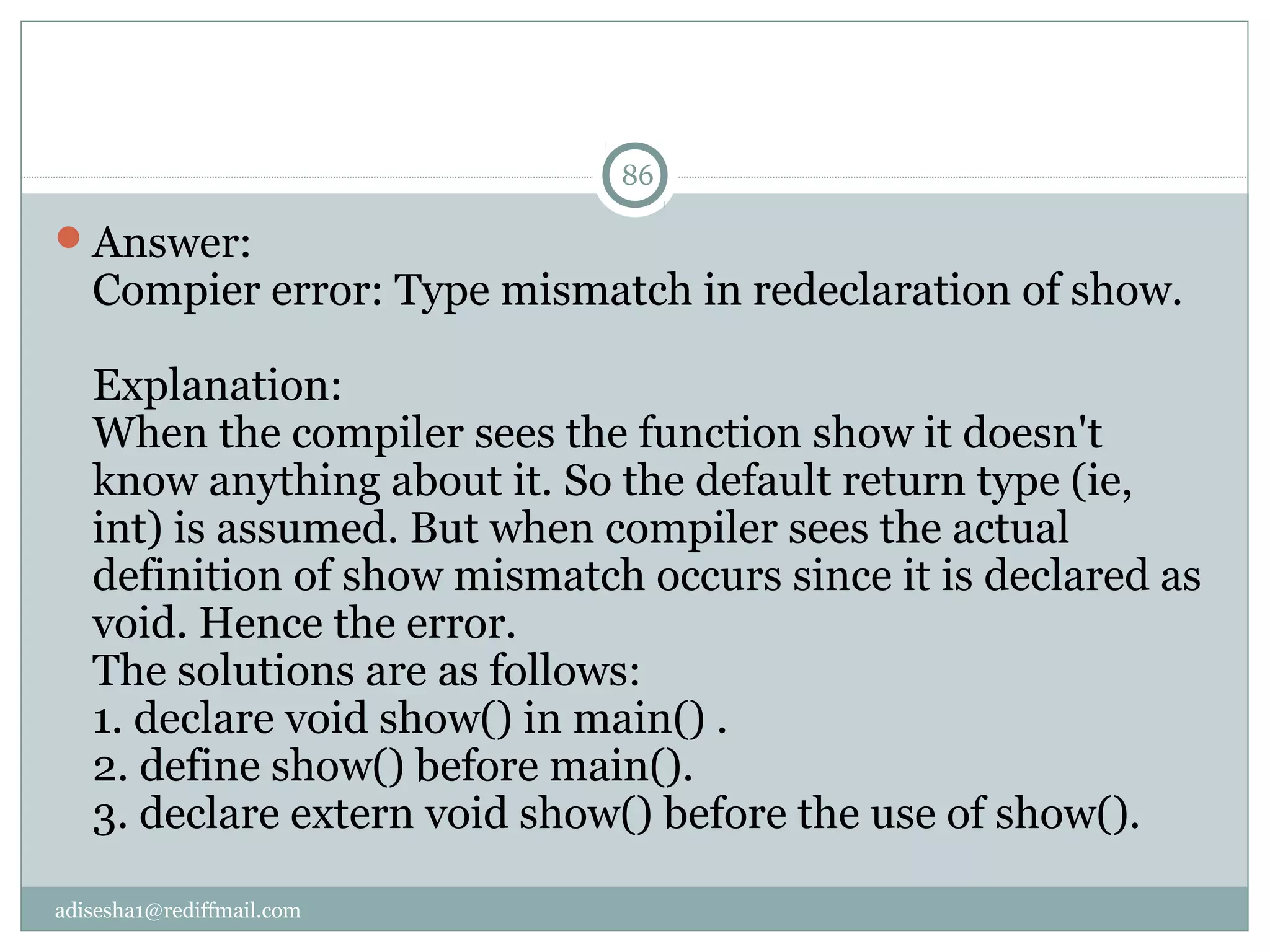
When the compiler sees the function show it doesn't
know anything about it. So the default return type (ie,
int) is assumed. But when compiler sees the actual
definition of show mismatch occurs since it is declared as
void. Hence the error.
The solutions are as follows:
1. declare void show() in main() .
2. define show() before main().
3. declare extern void show() before the use of show().
86
adisesha1@rediffmail.com
Answer:
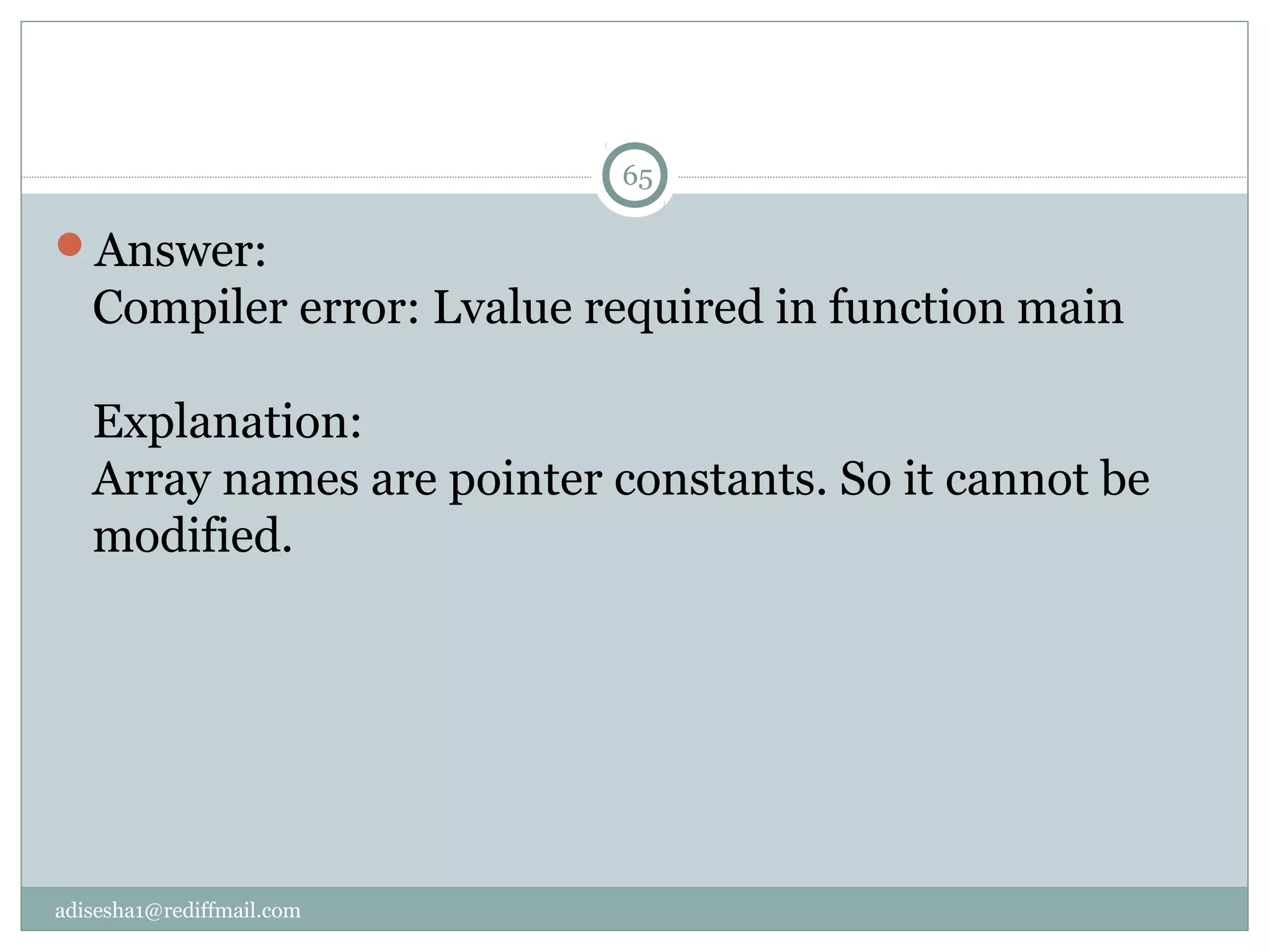
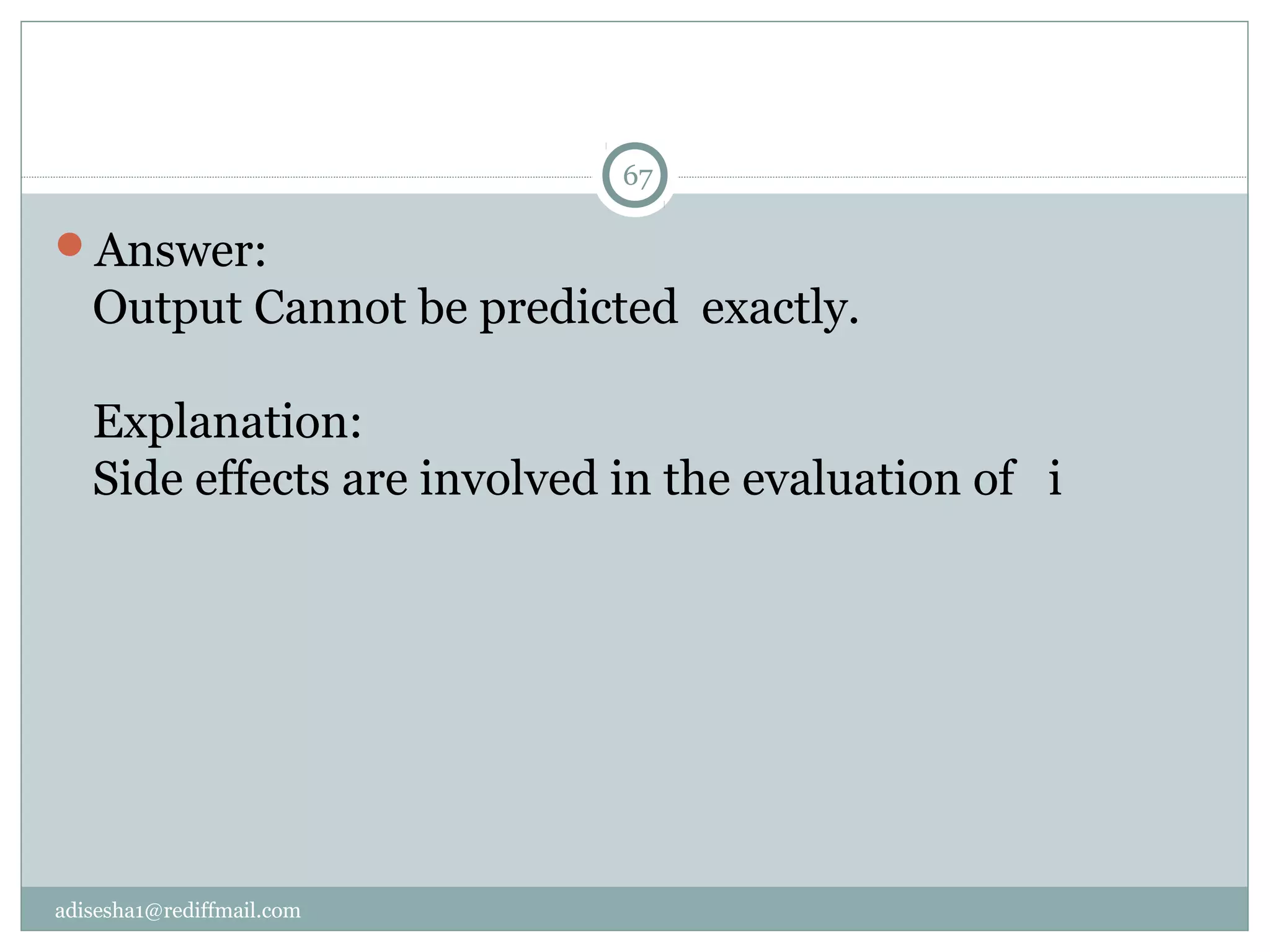
Compiler error: lvaluerequired.
Explanation:
Error is in line with statement a++. The operand
must be an lvalue and may be of any of scalar type
for the any operator, array name only when
subscripted is an lvalue. Simply array name is a non-
modifiable lvalue.
89
adisesha1@rediffmail.com
Answer:
g20fy
Explanation:
Since a voidpointer is used it can be type casted to any
other type pointer. vp = &ch stores address of char ch
and the next statement prints the value stored in vp after
type casting it to the proper data type pointer. the output
is ‘g’. Similarly the output from second printf is ‘20’. The
third printf statement type casts it to print the string
from the 4th value hence the output is ‘fy’.
92
adisesha1@rediffmail.com
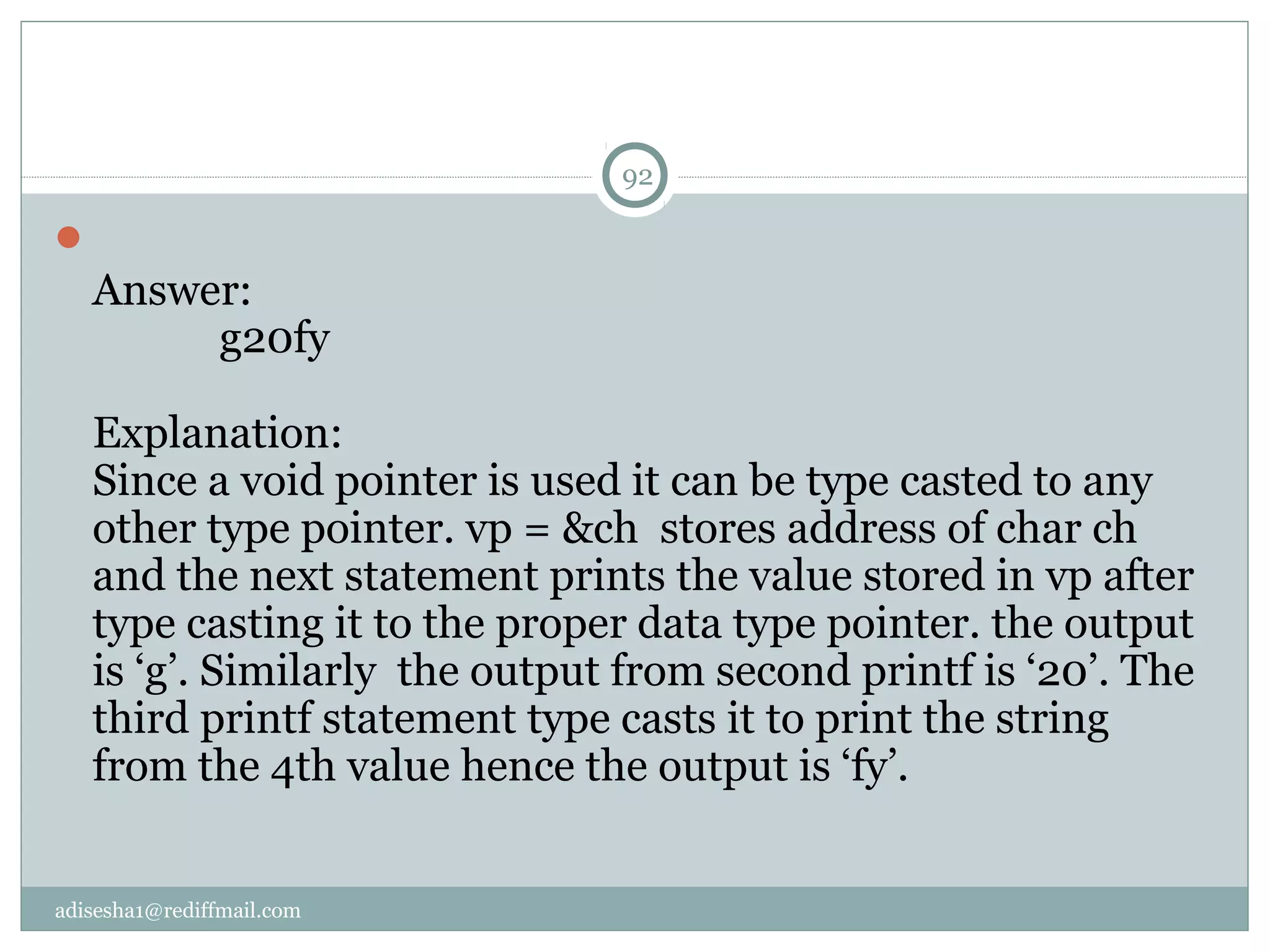
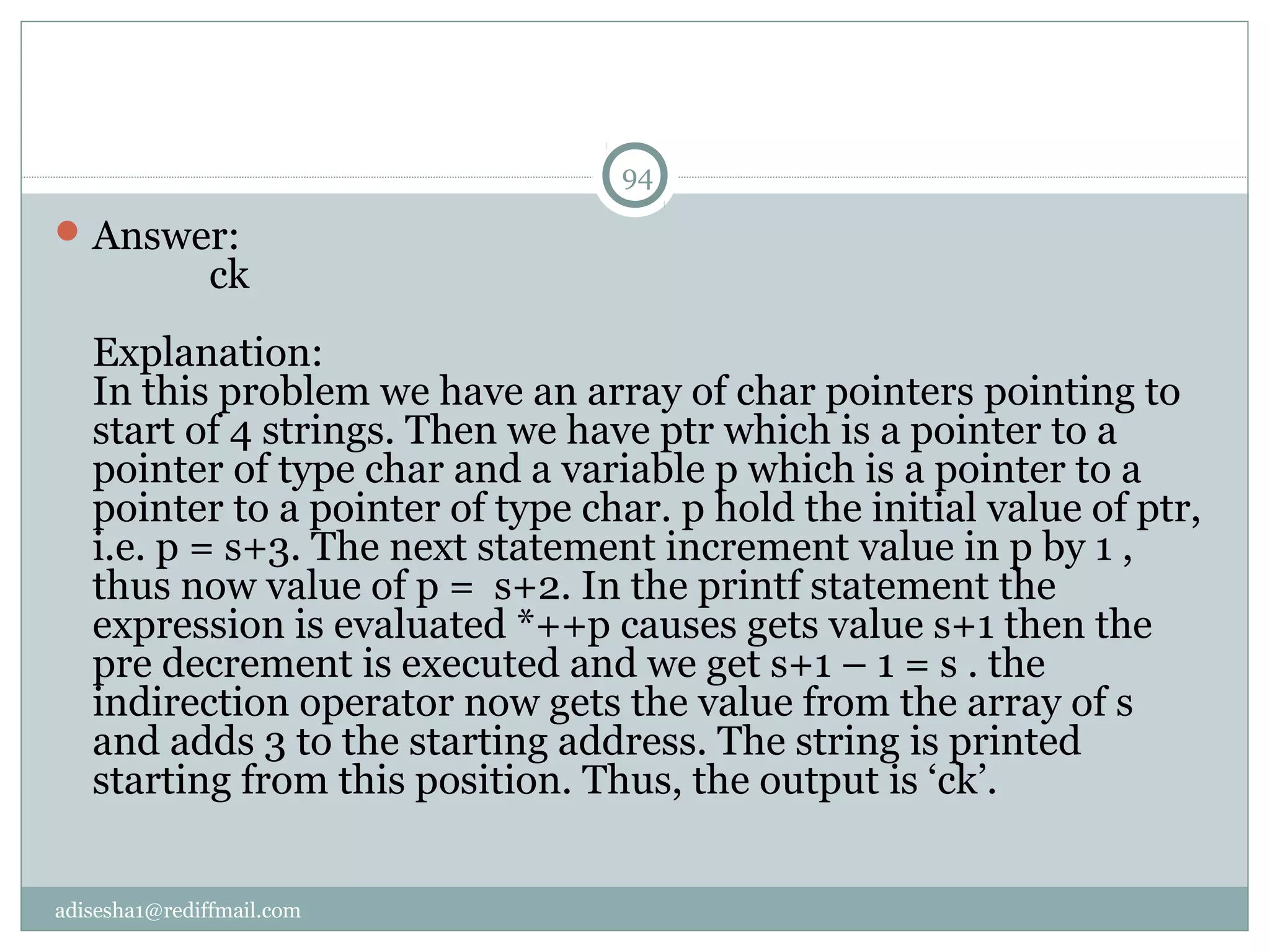
Answer:
ck
Explanation:
In this problemwe have an array of char pointers pointing to
start of 4 strings. Then we have ptr which is a pointer to a
pointer of type char and a variable p which is a pointer to a
pointer to a pointer of type char. p hold the initial value of ptr,
i.e. p = s+3. The next statement increment value in p by 1 ,
thus now value of p = s+2. In the printf statement the
expression is evaluated *++p causes gets value s+1 then the
pre decrement is executed and we get s+1 – 1 = s . the
indirection operator now gets the value from the array of s
and adds 3 to the starting address. The string is printed
starting from this position. Thus, the output is ‘ck’.
94
adisesha1@rediffmail.com
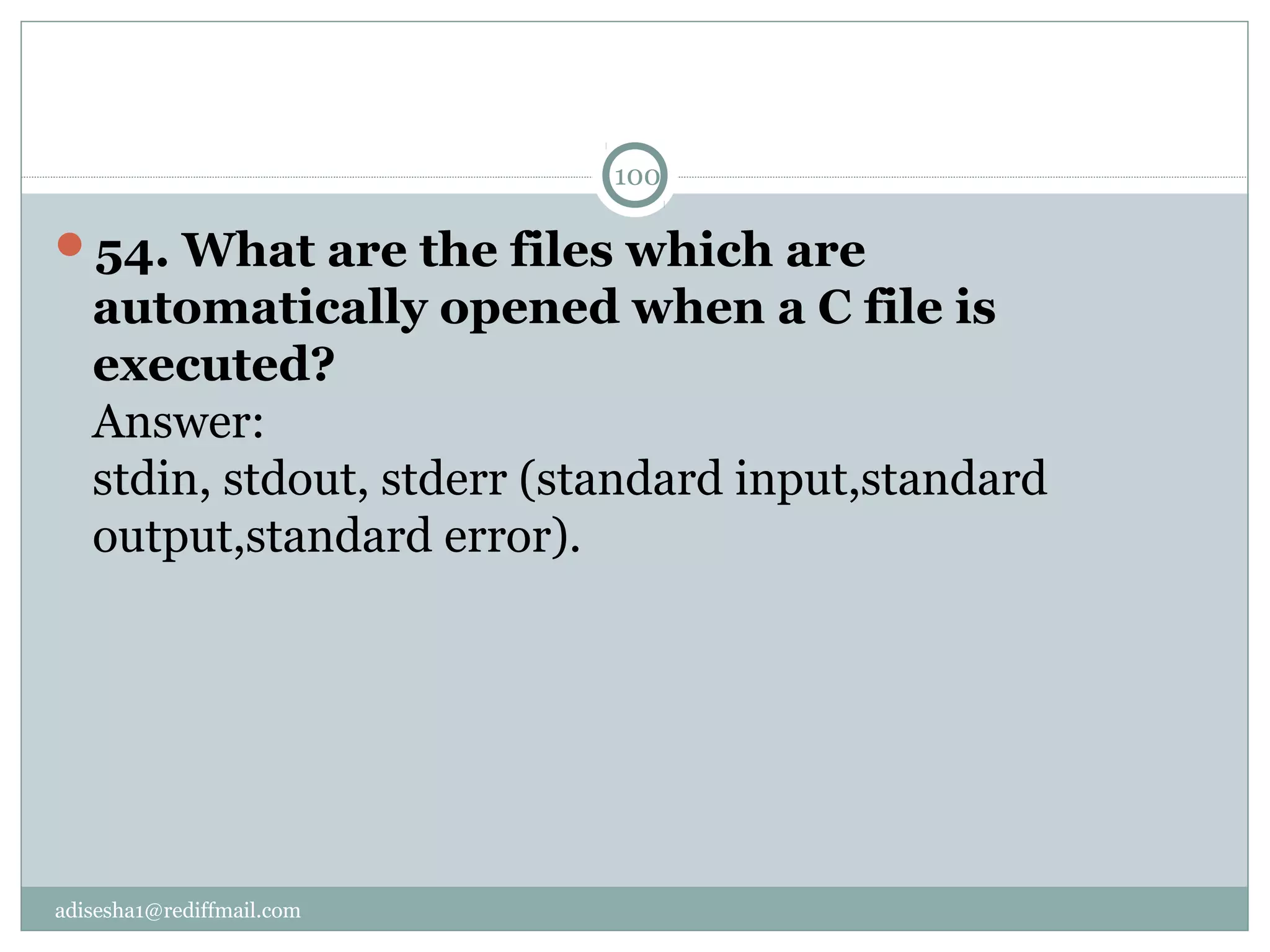
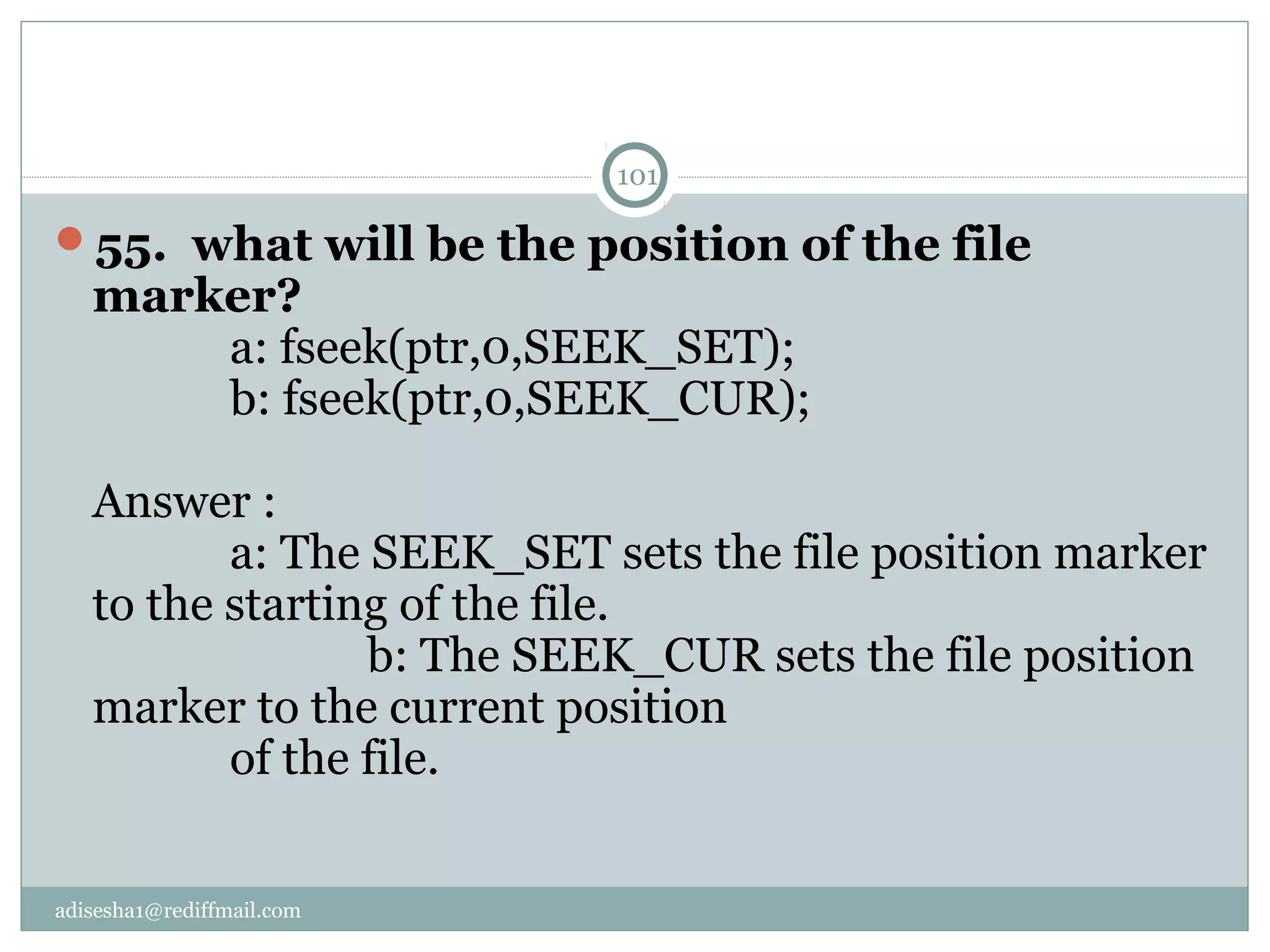
Answer:
(blank space)
irl
rl
l
Explanation:
Herea string (a pointer to char) is initialized with a value “girl”. The
strlen function returns the length of the string, thus n has a value 4.
The next statement assigns value at the nth location (‘0’) to the first
location. Now the string becomes “0irl” . Now the printf statement
prints the string after each iteration it increments it starting
position. Loop starts from 0 to 4. The first time x[0] = ‘0’ hence it
prints nothing and pointer value is incremented. The second time it
prints from x[1] i.e “irl” and the third time it prints “rl” and the last
time it prints “l” and the loop terminates.
96
adisesha1@rediffmail.com
Answer:
Runtime error: Abnormalprogram termination.
assert failed (i<5), ,
Explanation:
asserts are used during debugging to make sure that
certain conditions are satisfied. If assertion fails, the
program will terminate reporting the same. After
debugging use,
#undef NDEBUG
and this will disable all the assertions from the source
code. Assertion
is a good debugging tool to make use of.
98

![adisesha1@rediffmail.com
2. main()
{
char s[ ]="man";
int i;
for(i=0;s[ i ];i++)
printf("n%c%c%c
%c",s[ i ],*(s+i),*(i+s),i[s]);
}
4](https://image.slidesharecdn.com/captitude-160314163249/75/C-aptitude-4-2048.jpg)
![adisesha1@rediffmail.com
Answer:
mmmm
aaaa
nnnn
Explanation:
s[i], *(i+s), *(s+i), i[s] are all different ways of
expressing the same idea. Generally array name is
the base address for that array. Here s is the base
address. i is the index number/displacement from
the base address. So, indirecting it with * is same as
s[i]. i[s] may be surprising. But in the case of C it is
same as s[i].
5](https://image.slidesharecdn.com/captitude-160314163249/75/C-aptitude-5-2048.jpg)


![adisesha1@rediffmail.com
5. main()
{
int c[ ]={2.8,3.4,4,6.7,5};
int j,*p=c,*q=c;
for(j=0;j<5;j++) {
printf(" %d ",*c);
++q; }
for(j=0;j<5;j++){
printf(" %d ",*p);
++p; }
}
10](https://image.slidesharecdn.com/captitude-160314163249/75/C-aptitude-10-2048.jpg)





![adisesha1@rediffmail.com
11. main()
{
char string[]="Hello World";
display(string);
}
void display(char *string)
{
printf("%s",string);
}
22](https://image.slidesharecdn.com/captitude-160314163249/75/C-aptitude-22-2048.jpg)



![adisesha1@rediffmail.com
15. #include
main()
{
char s[]={'a','b','c','n','c','0'};
char *p,*str,*str1;
p=&s[3];
str=p;
str1=s;
printf("%d",++*p + ++*str1-32);
}
30](https://image.slidesharecdn.com/captitude-160314163249/75/C-aptitude-30-2048.jpg)
![adisesha1@rediffmail.com
16. #include
main()
{
int a[2][2][2] = { {10,2,3,4}, {5,6,7,8} };
int *p,*q;
p=&a[2][2][2];
*q=***a;
printf("%d----%d",*p,*q);
}
32](https://image.slidesharecdn.com/captitude-160314163249/75/C-aptitude-32-2048.jpg)
![adisesha1@rediffmail.com
Answer:
SomeGarbageValue---1
Explanation:
p=&a[2][2][2] you declare only two 2D arrays, but
you are trying to access the third 2D(which you are
not declared) it will print garbage values. *q=***a
starting address of a is assigned integer pointer. Now
q is pointing to starting address of a. If you print *q,
it will print first element of 3D array.
33](https://image.slidesharecdn.com/captitude-160314163249/75/C-aptitude-33-2048.jpg)
![adisesha1@rediffmail.com
17. #include
main()
{
struct xx
{
int x=3;
char name[]="hello";
};
struct xx *s;
printf("%d",s->x);
printf("%s",s->name);
}
34](https://image.slidesharecdn.com/captitude-160314163249/75/C-aptitude-34-2048.jpg)

















![adisesha1@rediffmail.com
32. main()
{
static char names[5]
[20]={"pascal","ada","cobol","fortran","perl"};
int i;
char *t;
t=names[3];
names[3]=names[4];
names[4]=t;
for (i=0;i<=4;i++)
printf("%s",names[i]);
}
64](https://image.slidesharecdn.com/captitude-160314163249/75/C-aptitude-64-2048.jpg)




![adisesha1@rediffmail.com
39. #include
main()
{
char s[]={'a','b','c','n','c','0'};
char *p,*str,*str1;
p=&s[3];
str=p;
str1=s;
printf("%d",++*p + ++*str1-32);
}
76](https://image.slidesharecdn.com/captitude-160314163249/75/C-aptitude-76-2048.jpg)

![adisesha1@rediffmail.com
40. #include
main()
{
struct xx
{
int x=3;
char name[]="hello";
};
struct xx *s=malloc(sizeof(struct xx));
printf("%d",s->x);
printf("%s",s->name);
}
78](https://image.slidesharecdn.com/captitude-160314163249/75/C-aptitude-78-2048.jpg)




![adisesha1@rediffmail.com
46. main( )
{
int a[2][3][2] = {{{2,4},{7,8},{3,4}},{{2,2},
{2,3},{3,4}}};
printf(“%u %u %u %d n”,a,*a,**a,***a);
printf(“%u %u %u %d
n”,a+1,*a+1,**a+1,***a+1);
}
Answer:
100, 100, 100, 2
114, 104, 102, 3
87](https://image.slidesharecdn.com/captitude-160314163249/75/C-aptitude-87-2048.jpg)
![adisesha1@rediffmail.com
47. main( )
{
int a[ ] = {10,20,30,40,50},j,*p;
for(j=0; j<5; j++)
{
printf(“%d” ,*a);
a++;
}
p = a;
for(j=0; j<5; j++)
{
printf(“%d ” ,*p);
p++;
}
}
88](https://image.slidesharecdn.com/captitude-160314163249/75/C-aptitude-88-2048.jpg)

![adisesha1@rediffmail.com
48. main( )
{
static int a[ ] = {0,1,2,3,4};
int *p[ ] = {a,a+1,a+2,a+3,a+4};
int **ptr = p;
ptr++;
printf(“n %d %d %d”, ptr-p, *ptr-a, **ptr);
*ptr++;
printf(“n %d %d %d”, ptr-p, *ptr-a, **ptr);
*++ptr;
printf(“n %d %d %d”, ptr-p, *ptr-a, **ptr);
++*ptr;
printf(“n %d %d %d”, ptr-p, *ptr-a, **ptr);
}
Answer:
111
222
333
344
90](https://image.slidesharecdn.com/captitude-160314163249/75/C-aptitude-90-2048.jpg)

![adisesha1@rediffmail.com
50. main ( )
{
static char *s[ ] = {“black”, “white”,
“yellow”, “violet”};
char **ptr[ ] = {s+3, s+2, s+1, s}, ***p;
p = ptr;
**++p;
printf(“%s”,*--*++p + 3);
}
93](https://image.slidesharecdn.com/captitude-160314163249/75/C-aptitude-93-2048.jpg)
![adisesha1@rediffmail.com
51. main()
{
int i, n;
char *x = “girl”;
n = strlen(x);
*x = x[n];
for(i=0; i
{
printf(“%sn”,x);
x++;
}
}
95](https://image.slidesharecdn.com/captitude-160314163249/75/C-aptitude-95-2048.jpg)
![adisesha1@rediffmail.com
Answer:
(blank space)
irl
rl
l
Explanation:
Here a string (a pointer to char) is initialized with a value “girl”. The
strlen function returns the length of the string, thus n has a value 4.
The next statement assigns value at the nth location (‘0’) to the first
location. Now the string becomes “0irl” . Now the printf statement
prints the string after each iteration it increments it starting
position. Loop starts from 0 to 4. The first time x[0] = ‘0’ hence it
prints nothing and pointer value is incremented. The second time it
prints from x[1] i.e “irl” and the third time it prints “rl” and the last
time it prints “l” and the loop terminates.
96](https://image.slidesharecdn.com/captitude-160314163249/75/C-aptitude-96-2048.jpg)


![adisesha1@rediffmail.com
56. main()
{
char name[10],s[12];
scanf(" "%[^"]"",s);
}
How scanf will execute?
Answer:
First it checks for the leading white space and
discards it.Then it matches with a quotation mark
and then it reads all character upto another
quotation mark.
102](https://image.slidesharecdn.com/captitude-160314163249/75/C-aptitude-102-2048.jpg)


![adisesha1@rediffmail.com
60. main()
{
char *str1="abcd";
char str2[]="abcd";
printf("%d %d
%d",sizeof(str1),sizeof(str2),sizeof("abcd"));
}
Answer:
2 5 5
Explanation:
In first sizeof, str1 is a character pointer so it gives you the size of the
pointer variable. In second sizeof the name str2 indicates the name
of the array whose size is 5 (including the '0' termination
character). The third sizeof is similar to the second one.
106](https://image.slidesharecdn.com/captitude-160314163249/75/C-aptitude-106-2048.jpg)