Function Practice Sheet
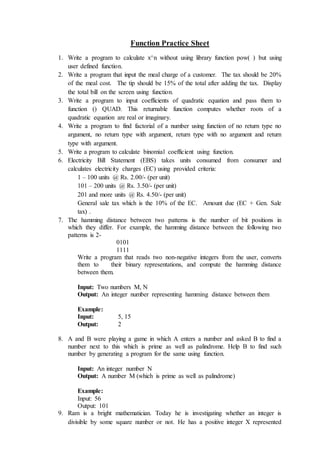
1. Write a program to calculate x^n without using library function pow( ) but using
user defined function.
2. Write a program that input the meal charge of a customer. The tax should be 20%
of the meal cost. The tip should be 15% of the total after adding the tax. Display
the total bill on the screen using function.
3. Write a program to input coefficients of quadratic equation and pass them to
function () QUAD. This returnable function computes whether roots of a
quadratic equation are real or imaginary.
4. Write a program to find factorial of a number using function of no return type no
argument, no return type with argument, return type with no argument and return
type with argument.
5. Write a program to calculate binomial coefficient using function.
6. Electricity Bill Statement (EBS) takes units consumed from consumer and
calculates electricity charges (EC) using provided criteria:
1 – 100 units @ Rs. 2.00/- (per unit)
101 – 200 units @ Rs. 3.50/- (per unit)
201 and more units @ Rs. 4.50/- (per unit)
General sale tax which is the 10% of the EC. Amount due (EC + Gen. Sale
tax) .
7. The hamming distance between two patterns is the number of bit positions in
which they differ. For example, the hamming distance between the following two
patterns is 2-
0101
1111
Write a program that reads two non-negative integers from the user, converts
them to their binary representations, and compute the hamming distance
between them.
Input: Two numbers M, N
Output: An integer number representing hamming distance between them
Example:
Input: 5, 15
Output: 2
8. A and B were playing a game in which A enters a number and asked B to find a
number next to this which is prime as well as palindrome. Help B to find such
number by generating a program for the same using function.
Input: An integer number N
Output: A number M (which is prime as well as palindrome)
Example:
Input: 56
Output: 101
9. Ram is a bright mathematician. Today he is investigating whether an integer is
divisible by some square number or not. He has a positive integer X represented
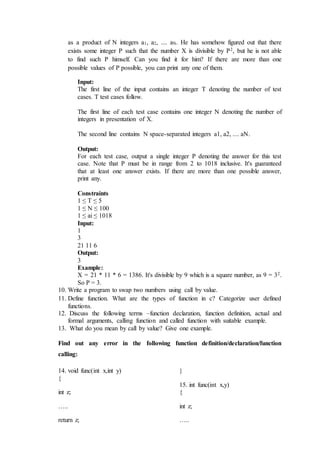
as a product of N integers a1, a2, .... aN. He has somehow figured out that there
exists some integer P such that the number X is divisible by P2, but he is not able
to find such P himself. Can you find it for him? If there are more than one
possible values of P possible, you can print any one of them.
Input:
The first line of the input contains an integer T denoting the number of test
cases. T test cases follow.
The first line of each test case contains one integer N denoting the number of
integers in presentation of X.
The second line contains N space-separated integers a1, a2, .... aN.
Output:
For each test case, output a single integer P denoting the answer for this test
case. Note that P must be in range from 2 to 1018 inclusive. It's guaranteed
that at least one answer exists. If there are more than one possible answer,
print any.
Constraints
1 ≤ T ≤ 5
1 ≤ N ≤ 100
1 ≤ ai ≤ 1018
Input:
1
3
21 11 6
Output:
3
Example:
X = 21 * 11 * 6 = 1386. It's divisible by 9 which is a square number, as 9 = 32.
So P = 3.
10. Write a program to swap two numbers using call by value.
11. Define function. What are the types of function in c? Categorize user defined
functions.
12. Discuss the following terms –function declaration, function definition, actual and
formal arguments, calling function and called function with suitable example.
13. What do you mean by call by value? Give one example.
Find out any error in the following function definition/declaration/function
calling:
14. void func(int x,int y)
{
int z;
…..
return z;
}
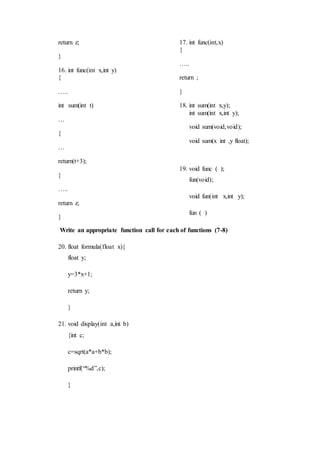
15. int func(int x,y)
{
int z;
…..
return z;
}
16. int func(int x,int y)
{
…..
int sum(int t)
…
{
…
return(t+3);
}
…..
return z;
}
17. int func(int,x)
{
…..
return ;
}
18. int sum(int x,y);
int sum(int x,int y);
void sum(void,void);
void sum(x int ,y float);
19. void func ( );
fun(void);
void fun(int x,int y);
fun ( )
Write an appropriate function call for each of functions (7-8)
20. float formula(float x){
float y;
y=3*x+1;
return y;
}
21. void display(int a,int b)
{int c;
c=sqrt(a*a+b*b);
printf(“%d”,c);
}
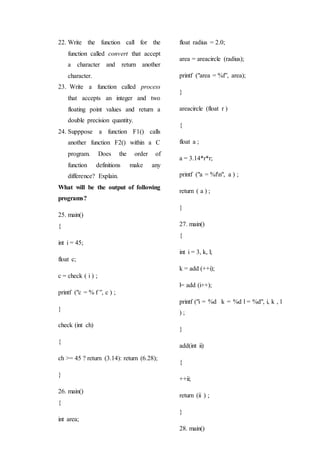
22. Write the function call for the
function called convert that accept
a character and return another
character.
23. Write a function called process
that accepts an integer and two
floating point values and return a
double precision quantity.
24. Supppose a function F1() calls
another function F2() within a C
program. Does the order of
function definitions make any
difference? Explain.
What will be the output of following
programs?
25. main()
{
int i = 45;
float c;
c = check ( i ) ;
printf ("c = % f ”, c ) ;
}
check (int ch)
{
ch >= 45 ? return (3.14): return (6.28);
}
26. main()
{
int area;
float radius = 2.0;
area = areacircle (radius);
printf ("area = %f”, area);
}
areacircle (float r )
{
float a ;
a = 3.14*r*r;
printf ("a = %fn", a ) ;
return ( a ) ;
}
27. main()
{
int i = 3, k, l;
k = add (++i);
l= add (i++);
printf ("i = %d k = %d l = %d", i, k , l
) ;
}
add(int ii)
{
++ii;
return (ii ) ;
}
28. main()
{
int k = 35, z ;
k = fund (k = fund (k = fund ( k ) ) ) ;
printf ("k = %d",k);
}
fund (k)
int k;
{
k++;
return ( k ) ;
}
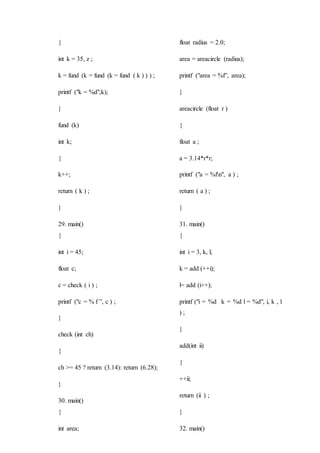
29. main()
{
int i = 45;
float c;
c = check ( i ) ;
printf ("c = % f ”, c ) ;
}
check (int ch)
{
ch >= 45 ? return (3.14): return (6.28);
}
30. main()
{
int area;
float radius = 2.0;
area = areacircle (radius);
printf ("area = %f”, area);
}
areacircle (float r )
{
float a ;
a = 3.14*r*r;
printf ("a = %fn", a ) ;
return ( a ) ;
}
31. main()
{
int i = 3, k, l;
k = add (++i);
l= add (i++);
printf ("i = %d k = %d l = %d", i, k , l
) ;
}
add(int ii)
{
++ii;
return (ii ) ;
}
32. main()
{
int k = 35, z ;
k = fund (k = fund (k = fund ( k ) ) ) ;
printf ("k = %d",k);
}
fund (k)
int k;
{
k++;
return ( k ) ;
}
33. main()
{
int k = 35, z ;
z = func ( k ) ;
printf ("z = % d " , z ) ;
}
func (int m)
{
++m;
return (m = fund ( + + m ) ) ;
}
fund (int m)
{
m++;
return ( m ) ;
}
34. main() {
int i = 135, a = 135, k;
k = function (!++i, !a++);
printf ("i = %d a = %d k = %f”, i, a, k
);
}
function (int j, int b)
{
int c;
c = j + b;
return ( c ) ;
}
35. Write any three advantages of using function.
36. Can a function called from more than one place in the program?
37. What will be the output of the following codes?
(a)
int main()
{
int fun(int);
int i = fun(10);
printf("%dn", --i);
return 0;
}
int fun(int i)
{
return (i++);
}
(b)
int addmult(int ii, int jj)
{
int kk, ll;
kk = ii + jj;
ll = ii * jj;
return (kk, ll);
}
int main()
{
int i=3, j=4, k, l;
k = addmult(i, j);
l = addmult(i, j);
printf("%d %dn", k, l);
return 0;
}
(c)
int main()
{
int k=35;
k = func1(k=func1(k=func1(k)));
printf("k=%dn", k);
return 0;
}
int func1(int k)
{
k++;
return k;
}
(d)
int addmult(int ii, int jj)
{
int kk, ll;
kk = ii + jj;
ll = ii * jj;
return (kk, ll);
}
int main()
{
int i=3, j=4, k, l;
k = addmult(i, j);
l = addmult(i, j);
printf("%d, %dn", k, l);
return 0;
}
(e)
int check(int);
int main()
{
int i=45, c;
c = check(i);
printf("%dn", c);
return 0;
}
int check(int ch)
{
if(ch >= 45)
return 100;
(f)
int fun(int i)
{
i++;
return i;
}
int main()
{
int fun(int);
int i=3;
fun(i=fun(fun(i)));
printf("%dn", i);
return 0;
}
(g)
int main()
{
float k=3;
fun(k=fun(fun(k)));
printf("%fn", k);
return 0;
}
int fun(int i)
{
i++;
return i;
}
Functions Practice Sheet.docx

Functions Practice Sheet.docx

  • 1.
    Function Practice Sheet 1.Write a program to calculate x^n without using library function pow( ) but using user defined function. 2. Write a program that input the meal charge of a customer. The tax should be 20% of the meal cost. The tip should be 15% of the total after adding the tax. Display the total bill on the screen using function. 3. Write a program to input coefficients of quadratic equation and pass them to function () QUAD. This returnable function computes whether roots of a quadratic equation are real or imaginary. 4. Write a program to find factorial of a number using function of no return type no argument, no return type with argument, return type with no argument and return type with argument. 5. Write a program to calculate binomial coefficient using function. 6. Electricity Bill Statement (EBS) takes units consumed from consumer and calculates electricity charges (EC) using provided criteria: 1 – 100 units @ Rs. 2.00/- (per unit) 101 – 200 units @ Rs. 3.50/- (per unit) 201 and more units @ Rs. 4.50/- (per unit) General sale tax which is the 10% of the EC. Amount due (EC + Gen. Sale tax) . 7. The hamming distance between two patterns is the number of bit positions in which they differ. For example, the hamming distance between the following two patterns is 2- 0101 1111 Write a program that reads two non-negative integers from the user, converts them to their binary representations, and compute the hamming distance between them. Input: Two numbers M, N Output: An integer number representing hamming distance between them Example: Input: 5, 15 Output: 2 8. A and B were playing a game in which A enters a number and asked B to find a number next to this which is prime as well as palindrome. Help B to find such number by generating a program for the same using function. Input: An integer number N Output: A number M (which is prime as well as palindrome) Example: Input: 56 Output: 101 9. Ram is a bright mathematician. Today he is investigating whether an integer is divisible by some square number or not. He has a positive integer X represented
  • 2.
    as a productof N integers a1, a2, .... aN. He has somehow figured out that there exists some integer P such that the number X is divisible by P2, but he is not able to find such P himself. Can you find it for him? If there are more than one possible values of P possible, you can print any one of them. Input: The first line of the input contains an integer T denoting the number of test cases. T test cases follow. The first line of each test case contains one integer N denoting the number of integers in presentation of X. The second line contains N space-separated integers a1, a2, .... aN. Output: For each test case, output a single integer P denoting the answer for this test case. Note that P must be in range from 2 to 1018 inclusive. It's guaranteed that at least one answer exists. If there are more than one possible answer, print any. Constraints 1 ≤ T ≤ 5 1 ≤ N ≤ 100 1 ≤ ai ≤ 1018 Input: 1 3 21 11 6 Output: 3 Example: X = 21 * 11 * 6 = 1386. It's divisible by 9 which is a square number, as 9 = 32. So P = 3. 10. Write a program to swap two numbers using call by value. 11. Define function. What are the types of function in c? Categorize user defined functions. 12. Discuss the following terms –function declaration, function definition, actual and formal arguments, calling function and called function with suitable example. 13. What do you mean by call by value? Give one example. Find out any error in the following function definition/declaration/function calling: 14. void func(int x,int y) { int z; ….. return z; } 15. int func(int x,y) { int z; …..
  • 3.
    return z; } 16. intfunc(int x,int y) { ….. int sum(int t) … { … return(t+3); } ….. return z; } 17. int func(int,x) { ….. return ; } 18. int sum(int x,y); int sum(int x,int y); void sum(void,void); void sum(x int ,y float); 19. void func ( ); fun(void); void fun(int x,int y); fun ( ) Write an appropriate function call for each of functions (7-8) 20. float formula(float x){ float y; y=3*x+1; return y; } 21. void display(int a,int b) {int c; c=sqrt(a*a+b*b); printf(“%d”,c); }
  • 4.
    22. Write thefunction call for the function called convert that accept a character and return another character. 23. Write a function called process that accepts an integer and two floating point values and return a double precision quantity. 24. Supppose a function F1() calls another function F2() within a C program. Does the order of function definitions make any difference? Explain. What will be the output of following programs? 25. main() { int i = 45; float c; c = check ( i ) ; printf ("c = % f ”, c ) ; } check (int ch) { ch >= 45 ? return (3.14): return (6.28); } 26. main() { int area; float radius = 2.0; area = areacircle (radius); printf ("area = %f”, area); } areacircle (float r ) { float a ; a = 3.14*r*r; printf ("a = %fn", a ) ; return ( a ) ; } 27. main() { int i = 3, k, l; k = add (++i); l= add (i++); printf ("i = %d k = %d l = %d", i, k , l ) ; } add(int ii) { ++ii; return (ii ) ; } 28. main()
  • 5.
    { int k =35, z ; k = fund (k = fund (k = fund ( k ) ) ) ; printf ("k = %d",k); } fund (k) int k; { k++; return ( k ) ; } 29. main() { int i = 45; float c; c = check ( i ) ; printf ("c = % f ”, c ) ; } check (int ch) { ch >= 45 ? return (3.14): return (6.28); } 30. main() { int area; float radius = 2.0; area = areacircle (radius); printf ("area = %f”, area); } areacircle (float r ) { float a ; a = 3.14*r*r; printf ("a = %fn", a ) ; return ( a ) ; } 31. main() { int i = 3, k, l; k = add (++i); l= add (i++); printf ("i = %d k = %d l = %d", i, k , l ) ; } add(int ii) { ++ii; return (ii ) ; } 32. main()
  • 6.
    { int k =35, z ; k = fund (k = fund (k = fund ( k ) ) ) ; printf ("k = %d",k); } fund (k) int k; { k++; return ( k ) ; } 33. main() { int k = 35, z ; z = func ( k ) ; printf ("z = % d " , z ) ; } func (int m) { ++m; return (m = fund ( + + m ) ) ; } fund (int m) { m++; return ( m ) ; } 34. main() { int i = 135, a = 135, k; k = function (!++i, !a++); printf ("i = %d a = %d k = %f”, i, a, k ); } function (int j, int b) { int c; c = j + b; return ( c ) ; }
  • 7.
    35. Write anythree advantages of using function. 36. Can a function called from more than one place in the program? 37. What will be the output of the following codes? (a) int main() { int fun(int); int i = fun(10); printf("%dn", --i); return 0; } int fun(int i) { return (i++); } (b) int addmult(int ii, int jj) { int kk, ll; kk = ii + jj; ll = ii * jj; return (kk, ll); } int main() { int i=3, j=4, k, l; k = addmult(i, j); l = addmult(i, j); printf("%d %dn", k, l); return 0; } (c) int main() { int k=35; k = func1(k=func1(k=func1(k))); printf("k=%dn", k); return 0; } int func1(int k) { k++; return k; }
  • 8.
    (d) int addmult(int ii,int jj) { int kk, ll; kk = ii + jj; ll = ii * jj; return (kk, ll); } int main() { int i=3, j=4, k, l; k = addmult(i, j); l = addmult(i, j); printf("%d, %dn", k, l); return 0; } (e) int check(int); int main() { int i=45, c; c = check(i); printf("%dn", c); return 0; } int check(int ch) { if(ch >= 45) return 100; (f) int fun(int i) { i++; return i; } int main() { int fun(int); int i=3; fun(i=fun(fun(i))); printf("%dn", i); return 0; } (g) int main() { float k=3; fun(k=fun(fun(k))); printf("%fn", k); return 0; } int fun(int i)
  • 9.