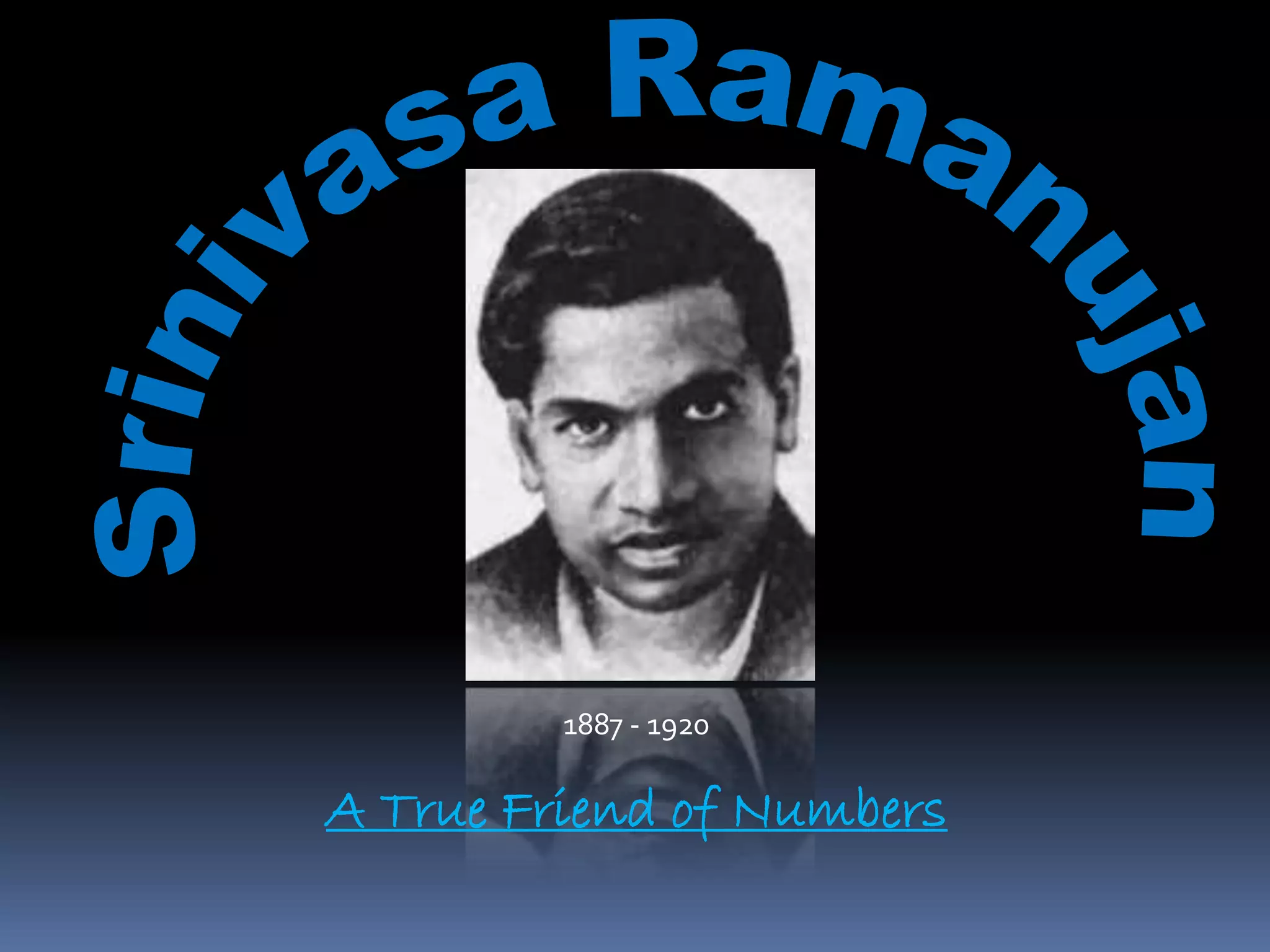
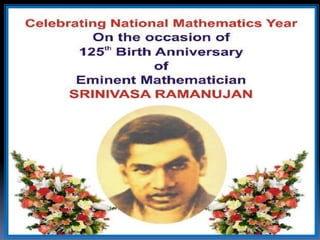
A True Friend of Numbers
1887 - 1920
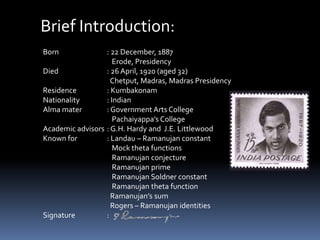
Brief Introduction:
Born : 22 December, 1887
Erode, Presidency
Died : 26 April, 1920 (aged 32)
Chetput, Madras, Madras Presidency
Residence : Kumbakonam
Nationality : Indian
Alma mater : Government Arts College
Pachaiyappa’s College
Academic advisors : G.H. Hardy and J.E. Littlewood
Known for : Landau – Ramanujan constant
Mock theta functions
Ramanujan conjecture
Ramanujan prime
Ramanujan Soldner constant
Ramanujan theta function
Ramanujan’s sum
Rogers – Ramanujan identities
Signature :
In 1887, in the town of Kumbakonam
A baby boy, Ramanujan, was born.
His mom knew in her heart,
From the stars she could chart,
This was no ordinary mind.
The boy grew and played,
While the mother sat and prayed,
Namagiri give us guidance and strength.
With each passing year,
It grew increasingly clear
This was no ordinary mind.
The teachers at school,
Didn’t know what to do
With this young man, so many years ahead.
One gave him a math book by Carr –
5000 equations to explore.
For better or worse, a blessing may be a curse.
He lost interest in everything but math.
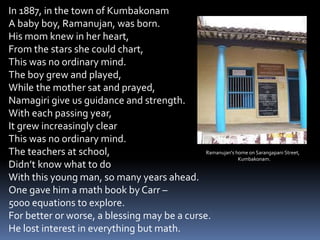
Ramanujan's home on Sarangapani Street,
Kumbakonam.
Early Life:
Ramanujan was born on 22 December 1887 in Erode, Madras Presidency, at the residence of
his maternal grandparents.His father, K. Srinivasa Iyengar, worked as a clerk in a sari shop
and hailed from the district ofThanjavur.His mother, Komalatammal, was a housewife
and also sang at a local temple.They lived in Sarangapani Street in a traditional home in
the town of Kumbakonam.The family home is now a museum.
On 1 October 1892, Ramanujan was enrolled at the local school.In March 1894, he was
moved to aTelugu medium school.After his maternal grandfather lost his job as a court
official in Kanchipuram,Ramanujan and his mother moved back to Kumbakonam and he
was enrolled in the Kangayan Primary School Since Ramanujan's father was at work most of
the day, his mother took care of him as a child. He had a close relationship with her. From her,
he learned about tradition and puranas. He learned to sing religious songs, to attend pujas at
the temple and particular eating habits – all of which are part of Brahmin culture.At the
Kangayan Primary School, Ramanujan performed well.
Just before the age of 10, in November 1897, he passed his primary examinations in English,
Tamil, geography and arithmetic.With his scores, he stood first in the district.That year,
Ramanujan entered Higher Secondary School where he encountered formal mathematics for
the first time.By 11, he had exhausted the mathematical knowledge of two college students
who were lodgers at his home. He was later lent a book on advanced trigonometry
written by S. L. Loney. He completely mastered this book by the age of 13 and
discovered sophisticated theorems on his own. By 14, he was receiving merit certificates
and academic awards which continued throughout his school career .
His notebooks filled with formulas
that no one had conceived;
but his college courses suffered,
so he was asked to leave.
His mother arranged him a marriage
To nine-year old Janaki.
Now he had to beg for a job to feed his new family.
Boarded a train bound for Madras
Leaving his family, his new wife, far behind.
Showed his notebook to Inida’s brightest
Hoping to find, at last, another brilliant mind.
Someone who’d understand… his math…The math was too far above them
And so his spirits sank.
They had no way to determine was he a genius or a crank?
And so he sent out letters
To those who might understand
Twas Hardy who finally recognized
The brilliance of this man.
He’d found someone to understand… his math…
Boarded a ship, bound for Cambridge
Leaving his country, his people, so far behind.
Thus began math’s most famous collaboration,
Between these two extraordinary minds.
Adulthood in India
Attention from mathematicians
Ramanujan received a scholarship to study at Government College
in Kumbakonam, but lost it when he failed his non-mathematical
coursework. He joined another college to pursue independent
mathematical research, working as a clerk in the Accountant-General's
office at the Madras PortTrust Office to support himself.
In 1912–1913, he sent samples of his theorems to three academics
at the University of Cambridge. G. H. Hardy, recognizing the brilliance
of his work, invited Ramanujan to visit and work with him at Cambridge.
He became a Fellow of the Royal Society and a Fellow of
Trinity College, Cambridge.
Srinivasa died of illness, malnutrition, and possibly liver infection
in 1920 at the age of 32.
During his short lifetime, Ramanujan independently
compiled nearly 3900 results (mostly identities and
equations).Most of his claims have now been proven
correct, although a small number of these results were
actually false and some were already known.
He stated results that were both original and highly
unconventional, such as the Ramanujan prime and
the Ramanujan theta function, and these have
inspired a vast amount of further research.
However, the mathematical mainstream has
been rather slow in absorbing some of his major
discoveries.The RamanujanJournal, an international
publication, was launched to publish work in all areas
of mathematics influenced by his work.
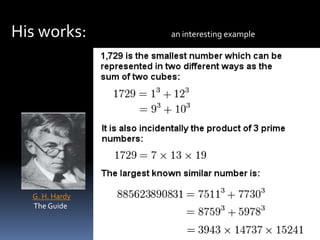
His works: an interesting example
G. H. Hardy
The Guide
In December 2011, in recognition of his
contribution to mathematics,
the Government of India declared that
Ramanujan's birthday (22 December)
should be celebrated every year as
National Mathematics Day,
and also declared 2012 the
National MathematicalYear
A
Project
Made by
ANUJA GUPTA
And
JYOTI RAWAT
Of
VII C
KV OFD Raipur
Dehradun
ACKNOWLEDGEMENTS
We are thankful to
•Wikipedia
•Our learned Sir Arun Kumar
•The Principal, KV, OFD Raipur Dehradun

Srinivasaramanujan ppt-120827092840-phpapp01

  • 1.
    A True Friendof Numbers 1887 - 1920
  • 2.
    Brief Introduction: Born :22 December, 1887 Erode, Presidency Died : 26 April, 1920 (aged 32) Chetput, Madras, Madras Presidency Residence : Kumbakonam Nationality : Indian Alma mater : Government Arts College Pachaiyappa’s College Academic advisors : G.H. Hardy and J.E. Littlewood Known for : Landau – Ramanujan constant Mock theta functions Ramanujan conjecture Ramanujan prime Ramanujan Soldner constant Ramanujan theta function Ramanujan’s sum Rogers – Ramanujan identities Signature :
  • 3.
    In 1887, inthe town of Kumbakonam A baby boy, Ramanujan, was born. His mom knew in her heart, From the stars she could chart, This was no ordinary mind. The boy grew and played, While the mother sat and prayed, Namagiri give us guidance and strength. With each passing year, It grew increasingly clear This was no ordinary mind. The teachers at school, Didn’t know what to do With this young man, so many years ahead. One gave him a math book by Carr – 5000 equations to explore. For better or worse, a blessing may be a curse. He lost interest in everything but math. Ramanujan's home on Sarangapani Street, Kumbakonam.
  • 4.
    Early Life: Ramanujan wasborn on 22 December 1887 in Erode, Madras Presidency, at the residence of his maternal grandparents.His father, K. Srinivasa Iyengar, worked as a clerk in a sari shop and hailed from the district ofThanjavur.His mother, Komalatammal, was a housewife and also sang at a local temple.They lived in Sarangapani Street in a traditional home in the town of Kumbakonam.The family home is now a museum. On 1 October 1892, Ramanujan was enrolled at the local school.In March 1894, he was moved to aTelugu medium school.After his maternal grandfather lost his job as a court official in Kanchipuram,Ramanujan and his mother moved back to Kumbakonam and he was enrolled in the Kangayan Primary School Since Ramanujan's father was at work most of the day, his mother took care of him as a child. He had a close relationship with her. From her, he learned about tradition and puranas. He learned to sing religious songs, to attend pujas at the temple and particular eating habits – all of which are part of Brahmin culture.At the Kangayan Primary School, Ramanujan performed well. Just before the age of 10, in November 1897, he passed his primary examinations in English, Tamil, geography and arithmetic.With his scores, he stood first in the district.That year, Ramanujan entered Higher Secondary School where he encountered formal mathematics for the first time.By 11, he had exhausted the mathematical knowledge of two college students who were lodgers at his home. He was later lent a book on advanced trigonometry written by S. L. Loney. He completely mastered this book by the age of 13 and discovered sophisticated theorems on his own. By 14, he was receiving merit certificates and academic awards which continued throughout his school career .
  • 5.
    His notebooks filledwith formulas that no one had conceived; but his college courses suffered, so he was asked to leave. His mother arranged him a marriage To nine-year old Janaki. Now he had to beg for a job to feed his new family. Boarded a train bound for Madras Leaving his family, his new wife, far behind. Showed his notebook to Inida’s brightest Hoping to find, at last, another brilliant mind. Someone who’d understand… his math…The math was too far above them And so his spirits sank. They had no way to determine was he a genius or a crank? And so he sent out letters To those who might understand Twas Hardy who finally recognized The brilliance of this man. He’d found someone to understand… his math… Boarded a ship, bound for Cambridge Leaving his country, his people, so far behind. Thus began math’s most famous collaboration, Between these two extraordinary minds. Adulthood in India
  • 6.
    Attention from mathematicians Ramanujanreceived a scholarship to study at Government College in Kumbakonam, but lost it when he failed his non-mathematical coursework. He joined another college to pursue independent mathematical research, working as a clerk in the Accountant-General's office at the Madras PortTrust Office to support himself. In 1912–1913, he sent samples of his theorems to three academics at the University of Cambridge. G. H. Hardy, recognizing the brilliance of his work, invited Ramanujan to visit and work with him at Cambridge. He became a Fellow of the Royal Society and a Fellow of Trinity College, Cambridge. Srinivasa died of illness, malnutrition, and possibly liver infection in 1920 at the age of 32.
  • 7.
    During his shortlifetime, Ramanujan independently compiled nearly 3900 results (mostly identities and equations).Most of his claims have now been proven correct, although a small number of these results were actually false and some were already known. He stated results that were both original and highly unconventional, such as the Ramanujan prime and the Ramanujan theta function, and these have inspired a vast amount of further research. However, the mathematical mainstream has been rather slow in absorbing some of his major discoveries.The RamanujanJournal, an international publication, was launched to publish work in all areas of mathematics influenced by his work.
  • 8.
    His works: aninteresting example G. H. Hardy The Guide
  • 9.
    In December 2011,in recognition of his contribution to mathematics, the Government of India declared that Ramanujan's birthday (22 December) should be celebrated every year as National Mathematics Day, and also declared 2012 the National MathematicalYear
  • 11.
    A Project Made by ANUJA GUPTA And JYOTIRAWAT Of VII C KV OFD Raipur Dehradun ACKNOWLEDGEMENTS We are thankful to •Wikipedia •Our learned Sir Arun Kumar •The Principal, KV, OFD Raipur Dehradun