Practical Training
at
Northen-Westren Railway Workshop
VYAS INSTITUTE OF ENGINEERING AND TECHNOLOGY,
Jodhpur (Rajasthan)
Affiliated to
Rajasthan Technical University, Kota
Presented By : Pradeep Vyas
(10EVEEX045)
Contents
 Introduction
– Role of Railway workshop
– Head Quarters
– Basic Training Centre
 Power Shop
 Air Conditioning Shop
 Train Lighting Shop
 Production and Control
 Conclusion
Introduction
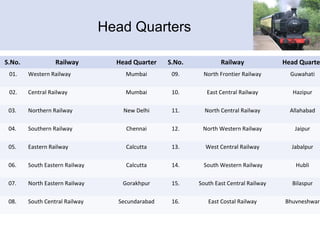
Head Quarters
S.No. Railway Head Quarter S.No. Railway Head Quarte
01. Western Railway Mumbai 09. North Frontier Railway Guwahati
02. Central Railway Mumbai 10. East Central Railway Hazipur
03. Northern Railway New Delhi 11. North Central Railway Allahabad
04. Southern Railway Chennai 12. North Western Railway Jaipur
05. Eastern Railway Calcutta 13. West Central Railway Jabalpur
06. South Eastern Railway Calcutta 14. South Western Railway Hubli
07. North Eastern Railway Gorakhpur 15. South East Central Railway Bilaspur
08. South Central Railway Secundarabad 16. East Costal Railway Bhuvneshwar
Role of Railway Workshop
 Acts as a middle management between the executives and the
technicians.
 Executes the policies and programmers of the administration.
 Plans for the materials, process and production.
 Technical interpretation of the drawings, specifications and
codes/manuals.
 Quality control and Quality assurance to ensure passenger safety.
 Ensures effective utilization of the 3 Ms.
 Motivating staff for higher productivity.
 Training staff for new products, processes, machinery and safety
awareness.
BASIC TRAINING CENTRE
Basic training centre is attached to the railway workshop, where
engineering, graduate / diploma holder / ITI , Defense Personnel
being imparted the training under Apprentice Act.1961.
 2400 Employers
 0150 Supervisors
 0006 Administrative officers
Power Shop
• Introduction
• Substation
• Winding Section
• Specification of Megger
• Vacuum Pressure Insulating Plant
Introduction
Connected Load 4600 KVA
Demand 1360 KVA
Maximum Demand 1400 KVA
Actual Utilization: Day Shift
Night Shift
1100-1500 KVA
400-500 KVA
Average Consumption Per Day/Month 9000 units/ 95300 KWH
Lightning Consumption Per Month 1500 units
Substation
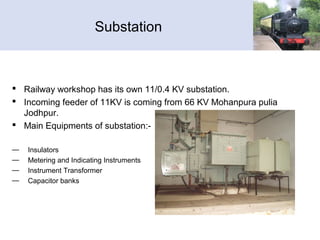
 Railway workshop has its own 11/0.4 KV substation.
 Incoming feeder of 11KV is coming from 66 KV Mohanpura pulia
Jodhpur.
 Main Equipments of substation:-
— Insulators
— Metering and Indicating Instruments
— Instrument Transformer
— Capacitor banks
Winding Section
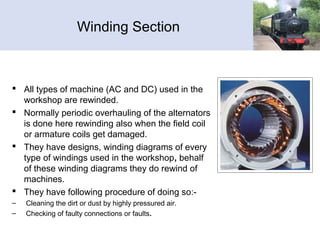
 All types of machine (AC and DC) used in the
workshop are rewinded.
 Normally periodic overhauling of the alternators
is done here rewinding also when the field coil
or armature coils get damaged.
 They have designs, winding diagrams of every
type of windings used in the workshop, behalf
of these winding diagrams they do rewind of
machines.
 They have following procedure of doing so:-
– Cleaning the dirt or dust by highly pressured air.
– Checking of faulty connections or faults.
Specification of Megger
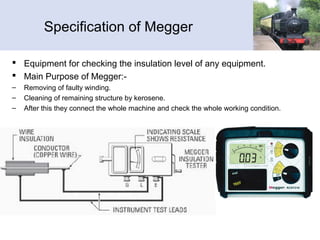
 Equipment for checking the insulation level of any equipment.
 Main Purpose of Megger:-
– Removing of faulty winding.
– Cleaning of remaining structure by kerosene.
– After this they connect the whole machine and check the whole working condition.
Vacuum Insulating Plant
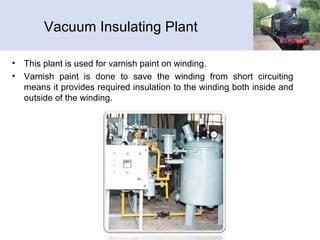
• This plant is used for varnish paint on winding.
• Varnish paint is done to save the winding from short circuiting
means it provides required insulation to the winding both inside and
outside of the winding.
Operation of VPI
 Step1: Open valve 1, 3, 6. Close valve 2, 4, 5, Start vacuum pump
 Step2: Close valve 1, stop vacuum pump.
 Step3: Open valve 4, varnish will start flowing into the VPI, Tank Close valve 4 when the electric
component is completely submerged in the varnish.
 Step4: Release vacuum in VPI tank. Open valve 1, 5.
 Step5: Close valve 3 and 6. Start the compressor build pressure in air tank 3 and 6. Stop air
compressor when pressure gauge shows 3 to 4 kilogram pressure.
 Step6: Open varnish to storage tank. Open valve 1, 2, 4 and keep these valves open till the VPI
tank empties.
 Step7: Close valve 1, 2, 4 in series wait for 15 minutes. Open the top lower take out the
component. Put the component in the oven for curing.
 Step8: Cure the oven for 8 hours at 1200
C and for 4 hours at 1500
C.S
Air Conditioning Shop
• Introduction
• POH Schedule of Air-Conditioning Coaches
• Automatic Pump Down
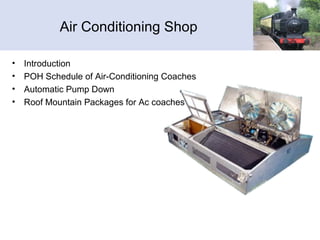
• Roof Mountain Packages for Ac coaches
Introduction
 Air conditioning means to make air fid to promote comfort and effecting or
to ensure proper operation of delicate equipment or to help manufacturing
operation more often it involves following operation:-
– To supply duty clean fresh air to keep low order concentration of carbon dioxide and
smoke with in low limits.
– To cool the air in summer and to heat in winter in order to maintain proper temperature
inside the premises of air conditions.
– To control the humidity of the air conditions.
– To obtain air movement without producing annoying draught.
POH Schedule of Air-conditioned
Coaches
 On arrival a shop first they note down the defects and deficiencies.
 The all equipments like compressor & it’s motors condenser
including liquid receiver cum dehydrator and condenser monitors
evaporator units & its motor ,battery charger cum pre cooling
transformer ,battery ,battery box etc….
 Before overhauling, measure the insulation resistance of all the
electrical equipment such as alternator, motor and wiring to know
the condition of the equipments also after POH also test the writing
of the insulation.
Automatic Pump Down
 The prevention of refrigerant migration back to the compressor and
the isolation of the refrigerant, change in the condenser/receiver had
been automated by the incorporation by an automatic pump down
facility. Thus when the fresh air ambient thermostat stops the
cooling of refrigerant in the system is pumped into the compressor
and receiver with the reenergizing of the liquid line solenoid value
preventing flow of refrigerant back to compressor, the system sucks
down through the low pressure cut out switch. Most of the
refrigerant change is then isolated in the condenser and receiver.
Roof Mountain Packages for AC Coaches
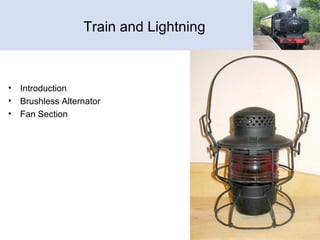
Train and Lightning
• Introduction
• Brushless Alternator
• Fan Section
Introduction
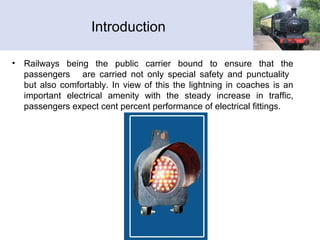
• Railways being the public carrier bound to ensure that the
passengers are carried not only special safety and punctuality
but also comfortably. In view of this the lightning in coaches is an
important electrical amenity with the steady increase in traffic,
passengers expect cent percent performance of electrical fittings.
Brushless Alternator
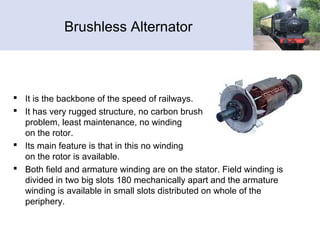
 It is the backbone of the speed of railways.
 It has very rugged structure, no carbon brush
problem, least maintenance, no winding
on the rotor.
 Its main feature is that in this no winding
on the rotor is available.
 Both field and armature winding are on the stator. Field winding is
divided in two big slots 180 mechanically apart and the armature
winding is available in small slots distributed on whole of the
periphery.
Advantages of Brushless Alternator
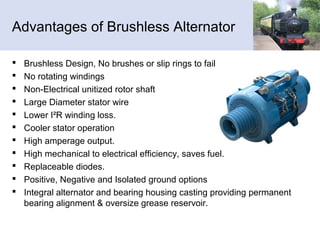
 Brushless Design, No brushes or slip rings to fail
 No rotating windings
 Non-Electrical unitized rotor shaft
 Large Diameter stator wire
 Lower I²R winding loss.
 Cooler stator operation
 High amperage output.
 High mechanical to electrical efficiency, saves fuel.
 Replaceable diodes.
 Positive, Negative and Isolated ground options
 Integral alternator and bearing housing casting providing permanent
bearing alignment & oversize grease reservoir.
Fan Section
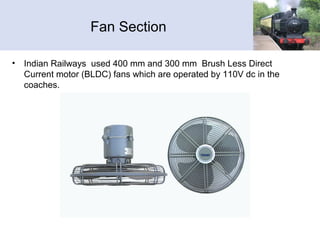
• Indian Railways used 400 mm and 300 mm Brush Less Direct
Current motor (BLDC) fans which are operated by 110V dc in the
coaches.
Fan Section
 Accessories:-
– Regulator
– Fuse Protection
– Gimbal Ring
 Maintenance:- The aim in maintenance is to reduce or compensate for wear and
tear in operation so that the installation continues to function well and give good
service.
 Running Maintenance:-
– Excessive noise and vibrations.
– Excessive sparking/blackening of commutator and excessive wear of carbon brushes.
– Inadequate air delivery.
– Poor insulation.
Production and control

railway workshop jodhpur

  • 1.
    Practical Training at Northen-Westren RailwayWorkshop VYAS INSTITUTE OF ENGINEERING AND TECHNOLOGY, Jodhpur (Rajasthan) Affiliated to Rajasthan Technical University, Kota Presented By : Pradeep Vyas (10EVEEX045)
  • 2.
    Contents  Introduction – Roleof Railway workshop – Head Quarters – Basic Training Centre  Power Shop  Air Conditioning Shop  Train Lighting Shop  Production and Control  Conclusion
  • 3.
  • 4.
    Head Quarters S.No. RailwayHead Quarter S.No. Railway Head Quarte 01. Western Railway Mumbai 09. North Frontier Railway Guwahati 02. Central Railway Mumbai 10. East Central Railway Hazipur 03. Northern Railway New Delhi 11. North Central Railway Allahabad 04. Southern Railway Chennai 12. North Western Railway Jaipur 05. Eastern Railway Calcutta 13. West Central Railway Jabalpur 06. South Eastern Railway Calcutta 14. South Western Railway Hubli 07. North Eastern Railway Gorakhpur 15. South East Central Railway Bilaspur 08. South Central Railway Secundarabad 16. East Costal Railway Bhuvneshwar
  • 5.
    Role of RailwayWorkshop  Acts as a middle management between the executives and the technicians.  Executes the policies and programmers of the administration.  Plans for the materials, process and production.  Technical interpretation of the drawings, specifications and codes/manuals.  Quality control and Quality assurance to ensure passenger safety.  Ensures effective utilization of the 3 Ms.  Motivating staff for higher productivity.  Training staff for new products, processes, machinery and safety awareness.
  • 6.
    BASIC TRAINING CENTRE Basictraining centre is attached to the railway workshop, where engineering, graduate / diploma holder / ITI , Defense Personnel being imparted the training under Apprentice Act.1961.  2400 Employers  0150 Supervisors  0006 Administrative officers
  • 7.
    Power Shop • Introduction •Substation • Winding Section • Specification of Megger • Vacuum Pressure Insulating Plant
  • 8.
    Introduction Connected Load 4600KVA Connected Load 4600 KVA Demand 1360 KVA Maximum Demand 1400 KVA Actual Utilization: Day Shift Night Shift 1100-1500 KVA 400-500 KVA Average Consumption Per Day/Month 9000 units/ 95300 KWH Lightning Consumption Per Month 1500 units
  • 9.
    Substation  Railway workshophas its own 11/0.4 KV substation.  Incoming feeder of 11KV is coming from 66 KV Mohanpura pulia Jodhpur.  Main Equipments of substation:- — Insulators — Metering and Indicating Instruments — Instrument Transformer — Capacitor banks
  • 10.
    Winding Section  Alltypes of machine (AC and DC) used in the workshop are rewinded.  Normally periodic overhauling of the alternators is done here rewinding also when the field coil or armature coils get damaged.  They have designs, winding diagrams of every type of windings used in the workshop, behalf of these winding diagrams they do rewind of machines.  They have following procedure of doing so:- – Cleaning the dirt or dust by highly pressured air. – Checking of faulty connections or faults.
  • 11.
    Specification of Megger Equipment for checking the insulation level of any equipment.  Main Purpose of Megger:- – Removing of faulty winding. – Cleaning of remaining structure by kerosene. – After this they connect the whole machine and check the whole working condition.
  • 12.
    Vacuum Insulating Plant •This plant is used for varnish paint on winding. • Varnish paint is done to save the winding from short circuiting means it provides required insulation to the winding both inside and outside of the winding.
  • 13.
    Operation of VPI Step1: Open valve 1, 3, 6. Close valve 2, 4, 5, Start vacuum pump  Step2: Close valve 1, stop vacuum pump.  Step3: Open valve 4, varnish will start flowing into the VPI, Tank Close valve 4 when the electric component is completely submerged in the varnish.  Step4: Release vacuum in VPI tank. Open valve 1, 5.  Step5: Close valve 3 and 6. Start the compressor build pressure in air tank 3 and 6. Stop air compressor when pressure gauge shows 3 to 4 kilogram pressure.  Step6: Open varnish to storage tank. Open valve 1, 2, 4 and keep these valves open till the VPI tank empties.  Step7: Close valve 1, 2, 4 in series wait for 15 minutes. Open the top lower take out the component. Put the component in the oven for curing.  Step8: Cure the oven for 8 hours at 1200 C and for 4 hours at 1500 C.S
  • 14.
    Air Conditioning Shop •Introduction • POH Schedule of Air-Conditioning Coaches • Automatic Pump Down • Roof Mountain Packages for Ac coaches
  • 15.
    Introduction  Air conditioningmeans to make air fid to promote comfort and effecting or to ensure proper operation of delicate equipment or to help manufacturing operation more often it involves following operation:- – To supply duty clean fresh air to keep low order concentration of carbon dioxide and smoke with in low limits. – To cool the air in summer and to heat in winter in order to maintain proper temperature inside the premises of air conditions. – To control the humidity of the air conditions. – To obtain air movement without producing annoying draught.
  • 16.
    POH Schedule ofAir-conditioned Coaches  On arrival a shop first they note down the defects and deficiencies.  The all equipments like compressor & it’s motors condenser including liquid receiver cum dehydrator and condenser monitors evaporator units & its motor ,battery charger cum pre cooling transformer ,battery ,battery box etc….  Before overhauling, measure the insulation resistance of all the electrical equipment such as alternator, motor and wiring to know the condition of the equipments also after POH also test the writing of the insulation.
  • 17.
    Automatic Pump Down The prevention of refrigerant migration back to the compressor and the isolation of the refrigerant, change in the condenser/receiver had been automated by the incorporation by an automatic pump down facility. Thus when the fresh air ambient thermostat stops the cooling of refrigerant in the system is pumped into the compressor and receiver with the reenergizing of the liquid line solenoid value preventing flow of refrigerant back to compressor, the system sucks down through the low pressure cut out switch. Most of the refrigerant change is then isolated in the condenser and receiver.
  • 18.
    Roof Mountain Packagesfor AC Coaches
  • 19.
    Train and Lightning •Introduction • Brushless Alternator • Fan Section
  • 20.
    Introduction • Railways beingthe public carrier bound to ensure that the passengers are carried not only special safety and punctuality but also comfortably. In view of this the lightning in coaches is an important electrical amenity with the steady increase in traffic, passengers expect cent percent performance of electrical fittings.
  • 21.
    Brushless Alternator  Itis the backbone of the speed of railways.  It has very rugged structure, no carbon brush problem, least maintenance, no winding on the rotor.  Its main feature is that in this no winding on the rotor is available.  Both field and armature winding are on the stator. Field winding is divided in two big slots 180 mechanically apart and the armature winding is available in small slots distributed on whole of the periphery.
  • 22.
    Advantages of BrushlessAlternator  Brushless Design, No brushes or slip rings to fail  No rotating windings  Non-Electrical unitized rotor shaft  Large Diameter stator wire  Lower I²R winding loss.  Cooler stator operation  High amperage output.  High mechanical to electrical efficiency, saves fuel.  Replaceable diodes.  Positive, Negative and Isolated ground options  Integral alternator and bearing housing casting providing permanent bearing alignment & oversize grease reservoir.
  • 23.
    Fan Section • IndianRailways used 400 mm and 300 mm Brush Less Direct Current motor (BLDC) fans which are operated by 110V dc in the coaches.
  • 24.
    Fan Section  Accessories:- –Regulator – Fuse Protection – Gimbal Ring  Maintenance:- The aim in maintenance is to reduce or compensate for wear and tear in operation so that the installation continues to function well and give good service.  Running Maintenance:- – Excessive noise and vibrations. – Excessive sparking/blackening of commutator and excessive wear of carbon brushes. – Inadequate air delivery. – Poor insulation.
  • 25.