Railroad Planning & Optimization


             Private & Confidential
Table of Contents


•   Industrial Requirement

•   Our Approach

•   Understanding Flow Network


                                 Private & Confidential   2
Industrial Requirements – Operating At A Large Scale

•    Privatization of container rail operations in India, has created an overall freight
     market (size of ~3bn tonnes) by trying to shift volumes from road to rail
•    With 500 rakes expected to be operational in FY12/13, around 16 players are
     offering integrated, value-added logistics solutions with last mile connectivity. This
     includes few key players like Concor, Arshiya, Gateway Distriparks, etc.

 Source of above: IDFC SSKI Sector Report, December 2009


 •   Given the capital investment in this segment is high, logistics players need to
     operate with minimum resources yielding maximum capacity utilization
 •   Routes will overlap with each other, and under dynamic loading situation at each
     nodes, forms a classic “Time and Capacity Constrained Routing Problem”
 •   Minimizing the empty run will be a tough nut to crack
 •   Practical conditions such as – customized containerization, maintenance cycle adds
     to the planning difficulties
 •   Traditionally, railroad planning is being done using more than one methodologies
     – MILP, Heuristics, NP-Hard. This requires solid conceptual understanding & real-
     time tested algorithm
                                               Private & Confidential                         3
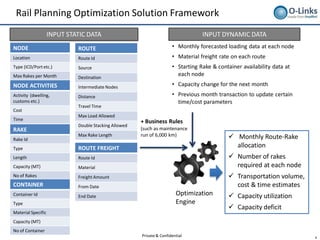
Rail Planning Optimization Solution Framework
                    INPUT STATIC DATA                                              INPUT DYNAMIC DATA
NODE                         ROUTE                                     • Monthly forecasted loading data at each node
Location                     Route Id                                  • Material freight rate on each route
Type (ICD/Port etc.)         Source                                    • Starting Rake & container availability data at
Max Rakes per Month          Destination
                                                                         each node
NODE ACTIVITIES              Intermediate Nodes
                                                                       • Capacity change for the next month
Activity (dwelling,          Distance                                  • Previous month transaction to update certain
customs etc.)                                                            time/cost parameters
                             Travel Time
Cost
                             Max Load Allowed
Time                                                   + Business Rules
                             Double Stacking Allowed
RAKE                                                   (such as maintenance

Rake Id
                             Max Rake Length           run of 6,000 km)                       Monthly Route-Rake
Type                         ROUTE FREIGHT                                                     allocation
Length                       Route Id                                                         Number of rakes
Capacity (MT)                Material                                                          required at each node
No of Rakes                  Freight Amount                                                   Transportation volume,
CONTAINER                    From Date                                                         cost & time estimates
Container Id                 End Date
                                                                         Optimization         Capacity utilization
Type                                                                     Engine
                                                                                              Capacity deficit
Material Specific
Capacity (MT)
No of Container
                                                       Private & Confidential                                             4
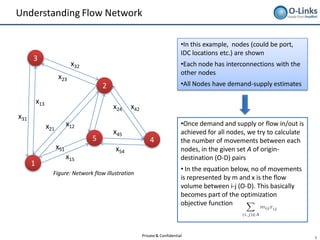
Understanding Flow Network

                                                                            •In this example, nodes (could be port,
                                                                            IDC locations etc.) are shown
      3
                             x32                                            •Each node has interconnections with the
                                                                            other nodes
                      x23
                                       2                                    •All Nodes have demand-supply estimates

          x13
                                           x24   x42
x31
                x21         x12                                             •Once demand and supply or flow in/out is
                                           x45                              achieved for all nodes, we try to calculate
                                   5                       4                the number of movements between each
                      x51                  x54                              nodes, in the given set A of origin-
                            x15                                             destination (O-D) pairs
      1
                                                                            • In the equation below, no of movements
                  Figure: Network flow illustration
                                                                            is represented by m and x is the flow
                                                                            volume between i-j (O-D). This basically
                                                                            becomes part of the optimization
                                                                            objective function


                                                       Private & Confidential                                             5

Railroad planning & optimization

  • 1.
    Railroad Planning &Optimization Private & Confidential
  • 2.
    Table of Contents • Industrial Requirement • Our Approach • Understanding Flow Network Private & Confidential 2
  • 3.
    Industrial Requirements –Operating At A Large Scale • Privatization of container rail operations in India, has created an overall freight market (size of ~3bn tonnes) by trying to shift volumes from road to rail • With 500 rakes expected to be operational in FY12/13, around 16 players are offering integrated, value-added logistics solutions with last mile connectivity. This includes few key players like Concor, Arshiya, Gateway Distriparks, etc. Source of above: IDFC SSKI Sector Report, December 2009 • Given the capital investment in this segment is high, logistics players need to operate with minimum resources yielding maximum capacity utilization • Routes will overlap with each other, and under dynamic loading situation at each nodes, forms a classic “Time and Capacity Constrained Routing Problem” • Minimizing the empty run will be a tough nut to crack • Practical conditions such as – customized containerization, maintenance cycle adds to the planning difficulties • Traditionally, railroad planning is being done using more than one methodologies – MILP, Heuristics, NP-Hard. This requires solid conceptual understanding & real- time tested algorithm Private & Confidential 3
  • 4.
    Rail Planning OptimizationSolution Framework INPUT STATIC DATA INPUT DYNAMIC DATA NODE ROUTE • Monthly forecasted loading data at each node Location Route Id • Material freight rate on each route Type (ICD/Port etc.) Source • Starting Rake & container availability data at Max Rakes per Month Destination each node NODE ACTIVITIES Intermediate Nodes • Capacity change for the next month Activity (dwelling, Distance • Previous month transaction to update certain customs etc.) time/cost parameters Travel Time Cost Max Load Allowed Time + Business Rules Double Stacking Allowed RAKE (such as maintenance Rake Id Max Rake Length run of 6,000 km)  Monthly Route-Rake Type ROUTE FREIGHT allocation Length Route Id  Number of rakes Capacity (MT) Material required at each node No of Rakes Freight Amount  Transportation volume, CONTAINER From Date cost & time estimates Container Id End Date Optimization  Capacity utilization Type Engine  Capacity deficit Material Specific Capacity (MT) No of Container Private & Confidential 4
  • 5.
    Understanding Flow Network •In this example, nodes (could be port, IDC locations etc.) are shown 3 x32 •Each node has interconnections with the other nodes x23 2 •All Nodes have demand-supply estimates x13 x24 x42 x31 x21 x12 •Once demand and supply or flow in/out is x45 achieved for all nodes, we try to calculate 5 4 the number of movements between each x51 x54 nodes, in the given set A of origin- x15 destination (O-D) pairs 1 • In the equation below, no of movements Figure: Network flow illustration is represented by m and x is the flow volume between i-j (O-D). This basically becomes part of the optimization objective function Private & Confidential 5