Visualizing X3D Radar
Beam Model Dynamics
Sungmin Kwon lucidaim@gmail.com
Don Brutzman Brutzman@nps.edu
27 JUL 2018
1/15
• Motivation
• Explore various 3D visualization techniques for presenting
dynamic radar characteristics.
• “The purpose of computing is insight, not numbers.” by
Richard. W. Hamming, 3rd winner of the Turing Award.
• Goal
• Improve understanding of radar through meaningful,
dynamic, physics-based presentations.
• We will not find one single technique - it doesn’t exist!
Visualization is exploration using multiple approaches.
• Purpose of this briefing: we seek expert feedback on
radar and 3D visualization to improve further.
Motivation and Goals
2/15
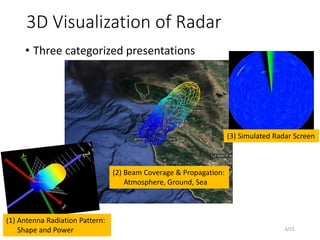
3D Visualization of Radar
(2) Beam Coverage & Propagation:
Atmosphere, Ground, Sea
(1) Antenna Radiation Pattern:
Shape and Power
• Three categorized presentations
(3) Simulated Radar Screen
3/15
• Useful techniques
• Fixed color map for surfaces: for easy comparison and beam consistency
• Explicitly presentation of max gain: for easy comparison
• Z axis beam propagation in logarithmic scales: for easy comparison
• Line properties also can be mapped to characteristics.
 X3D visualizations using beam pattern examples from 4nec2.exe [1]
Main Lobe
Side Lobe
Side Lobe
Main Lobe
<Helical Antenna> <Spider Quad Antenna> <3-Element Yagi Antenna>
(1) Antenna Radiation Pattern
Main Lobe
[1] Arie Voors, http://www.qsl.net/4nec2/
4/15
Examples continued for various antenna
<NecBowtieXg91a.x3d> <NecTvUhf.x3d> <NecParabola50x50.x3d>
<NecVerticalYagi3Element.x3d> <NecGridYagiWireFence.x3d> <Nec5ElementTwinDeltaLoop2m.x3d>
5/15
• Weather Effects
• Thick precipitation cloud [2] to the North
• Additional parameters possible
• Objects and Radar Cross Section (RCS)
• Airplane (RCS : 1.6)
• Cruise ship (RCS : 2.2)
• Long Range Antenna
• Spanagel Hall, NPS, Monterey
• 1 revolution per 12 sec.
• 1 revolution for Cruise ship
and 1 resolution for Airplane
(2) Beam Coverage & Propagation
- Scenario for proposed techniques
[2] Yeonsoo Yang, http://examples.x3dom.org/example/RadarVolumeStyle
6/15
Useful techniques
• 3D coverage envelop over the map
• To present 3D range that radar can detect
• Variant color on objects
• To present power level to be delivered
• Intuitive way to visualize power inside radar beam
• Bent radar beam
• To show effects of weather condition (attenuation
and refractive)
• Goal : Effective Visualization to show ‘how much power
is delivered to some point?’
 Need more study to calculate accurate power
• Simple calculations are used to show visualization concept.
• Ongoing study using AREPS 3.0[3]
3D Coverage
[3] W.L.Patterson, “Advanced refractive effects prediction system (AREPS),” Conf. 2007 IEEE Radar, pp. 891–895, 2007.
7/15
Power
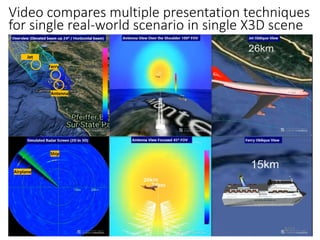
Video compares multiple presentation techniques
for single real-world scenario in single X3D scene
Airplane
Ship
Jet
Ferry
Antenna
8/15
• Simulated Radar Screen
• 3D as 2D presentation
• Until now calculated by Matlab example [4].
• Need digital radar data to validate
Simulated Radar Screen
Consideration
[4] www.mathworks.com/help/phased/examples/scan-radar-using-a-uniform-rectangular-array.html
9/15
• All research products are published as open source.
• These models, imagery and video are all online at
• https://savage.nps.edu/Savage/CommunicationsAndSensors/Radar
10/15
Media assets availability
Reference
11/15
[1] 4nec2.exe Program
• NEC-2 based antenna modeler and optimizer
• Arie Voors encapsulates NEC2 code with windows-based
GUI and provides good environment to use NEC2 code.
• You can get this program free. (ver 5.8.16)
• http://www.qsl.net/4nec2/
• NEC (Numerical Electromagnetics Code)
• Popular antenna modeling system for wire and surface
antennas
• It was originally written in FORTRAN in the 1970s by
Gerald Burke and Andrew Poggio of the Lawrence
Livermore National Laboratory.
• By far the most common version is NEC-2, the last to be
released in fully public form
https://en.wikipedia.org/wiki/Numerical_Electromagnetic
s_Code
12/15
4nec2.exe Output for Antenna Examples
• Input/output files are ascii text files and easy to read.
• 4nec2.exe is good software for a beginner of Antenna beam
pattern to understand.
13/15
• https://examples.x3dom.org/example/RadarVolumeStyle
• with a fog of kansai_pawr_20120726175907.png
• https://dl.acm.org/citation.cfm?id=2775323
• https://vimeo.com/103145827
[2] Cloud data from Weather radar
14/15
[3] AREPS 3.0 example
• W. L. Patterson, “Advanced refractive effects prediction
system (AREPS),” Conf. 2007 IEEE Radar, pp. 891–895, 2007.
15/15
• www.mathworks.com/help/phased/examples/scan-radar-
using-a-uniform-rectangular-array.html
[4] Scan Radar Matlab Example
16/15

RadarBeamX3dVisualizationPresentation.pptx

  • 1.
    Visualizing X3D Radar BeamModel Dynamics Sungmin Kwon lucidaim@gmail.com Don Brutzman Brutzman@nps.edu 27 JUL 2018 1/15
  • 2.
    • Motivation • Explorevarious 3D visualization techniques for presenting dynamic radar characteristics. • “The purpose of computing is insight, not numbers.” by Richard. W. Hamming, 3rd winner of the Turing Award. • Goal • Improve understanding of radar through meaningful, dynamic, physics-based presentations. • We will not find one single technique - it doesn’t exist! Visualization is exploration using multiple approaches. • Purpose of this briefing: we seek expert feedback on radar and 3D visualization to improve further. Motivation and Goals 2/15
  • 3.
    3D Visualization ofRadar (2) Beam Coverage & Propagation: Atmosphere, Ground, Sea (1) Antenna Radiation Pattern: Shape and Power • Three categorized presentations (3) Simulated Radar Screen 3/15
  • 4.
    • Useful techniques •Fixed color map for surfaces: for easy comparison and beam consistency • Explicitly presentation of max gain: for easy comparison • Z axis beam propagation in logarithmic scales: for easy comparison • Line properties also can be mapped to characteristics.  X3D visualizations using beam pattern examples from 4nec2.exe [1] Main Lobe Side Lobe Side Lobe Main Lobe <Helical Antenna> <Spider Quad Antenna> <3-Element Yagi Antenna> (1) Antenna Radiation Pattern Main Lobe [1] Arie Voors, http://www.qsl.net/4nec2/ 4/15
  • 5.
    Examples continued forvarious antenna <NecBowtieXg91a.x3d> <NecTvUhf.x3d> <NecParabola50x50.x3d> <NecVerticalYagi3Element.x3d> <NecGridYagiWireFence.x3d> <Nec5ElementTwinDeltaLoop2m.x3d> 5/15
  • 6.
    • Weather Effects •Thick precipitation cloud [2] to the North • Additional parameters possible • Objects and Radar Cross Section (RCS) • Airplane (RCS : 1.6) • Cruise ship (RCS : 2.2) • Long Range Antenna • Spanagel Hall, NPS, Monterey • 1 revolution per 12 sec. • 1 revolution for Cruise ship and 1 resolution for Airplane (2) Beam Coverage & Propagation - Scenario for proposed techniques [2] Yeonsoo Yang, http://examples.x3dom.org/example/RadarVolumeStyle 6/15
  • 7.
    Useful techniques • 3Dcoverage envelop over the map • To present 3D range that radar can detect • Variant color on objects • To present power level to be delivered • Intuitive way to visualize power inside radar beam • Bent radar beam • To show effects of weather condition (attenuation and refractive) • Goal : Effective Visualization to show ‘how much power is delivered to some point?’  Need more study to calculate accurate power • Simple calculations are used to show visualization concept. • Ongoing study using AREPS 3.0[3] 3D Coverage [3] W.L.Patterson, “Advanced refractive effects prediction system (AREPS),” Conf. 2007 IEEE Radar, pp. 891–895, 2007. 7/15 Power
  • 8.
    Video compares multiplepresentation techniques for single real-world scenario in single X3D scene Airplane Ship Jet Ferry Antenna 8/15
  • 9.
    • Simulated RadarScreen • 3D as 2D presentation • Until now calculated by Matlab example [4]. • Need digital radar data to validate Simulated Radar Screen Consideration [4] www.mathworks.com/help/phased/examples/scan-radar-using-a-uniform-rectangular-array.html 9/15
  • 10.
    • All researchproducts are published as open source. • These models, imagery and video are all online at • https://savage.nps.edu/Savage/CommunicationsAndSensors/Radar 10/15 Media assets availability
  • 11.
  • 12.
    [1] 4nec2.exe Program •NEC-2 based antenna modeler and optimizer • Arie Voors encapsulates NEC2 code with windows-based GUI and provides good environment to use NEC2 code. • You can get this program free. (ver 5.8.16) • http://www.qsl.net/4nec2/ • NEC (Numerical Electromagnetics Code) • Popular antenna modeling system for wire and surface antennas • It was originally written in FORTRAN in the 1970s by Gerald Burke and Andrew Poggio of the Lawrence Livermore National Laboratory. • By far the most common version is NEC-2, the last to be released in fully public form https://en.wikipedia.org/wiki/Numerical_Electromagnetic s_Code 12/15
  • 13.
    4nec2.exe Output forAntenna Examples • Input/output files are ascii text files and easy to read. • 4nec2.exe is good software for a beginner of Antenna beam pattern to understand. 13/15
  • 14.
    • https://examples.x3dom.org/example/RadarVolumeStyle • witha fog of kansai_pawr_20120726175907.png • https://dl.acm.org/citation.cfm?id=2775323 • https://vimeo.com/103145827 [2] Cloud data from Weather radar 14/15
  • 15.
    [3] AREPS 3.0example • W. L. Patterson, “Advanced refractive effects prediction system (AREPS),” Conf. 2007 IEEE Radar, pp. 891–895, 2007. 15/15
  • 16.

Editor's Notes

  • #3 Audience – Radar experts and 3D visualization experts – We want a dialog. Motivation – Explore various 3D visualization techniques for presenting dynamic radar characteristic. Not a Goal – find one single technique – it doesn’t exist Goal – Improve understating of radar through better presentation
  • #4 3 common presentation (2) References can be on slide comments (3) Page (4) Better yet : can you just use your images in this index slide?
  • #5 Title + ‘Examples’ Beam Propagation + ‘power -3dB Iso-surfaces.’ for and + ‘and beam consistency’ Figure name : Helical Antenna, Spider Quad Antenna, 3-Element Yagi Antenna
  • #6 Title : using (various antenna types and ) beam pattern ~~~ Can we make antennas more noticeable?
  • #7 Switch order of bullets to untangle arrows. Weather -> Weather Effects - Additional parameters possible (3) Object -> Object, Radar Cross Section - Align for readability
  • #8 De-confliction and selection are important Assist discussion : include slide numbers
  • #9 Video comparing multiple presentation techniques for single scenario Discuss with me Cloud volume data Show ship and aircraft here 3D as 2D
  • #10 (1) 3D as 2D presentation
  • #14 Output File -> Output for Antenna Examples
  • #15 Need to show progressive slices Also add to video