Racism is the assignment of a direct relationship between biological
characteristics and moral, intellectual or behavioral qualities, resulting
always in a hierarchy that assume the existence of superior and inferior
races. Factors such as skin color or skull shape are related to a series of
random qualities, like intelligence or ability to command. racist speeches
have historically served to legitimize relations of domination,
naturalizing inequalities of all kinds and justifying atrocities and
genocides.
Jean Pimentel
Wesley Tavares
D1IMIN1
RACIST THEORIES
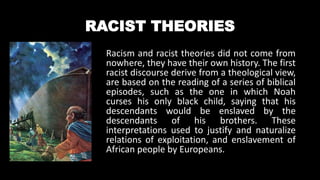
Racism and racist theories did not come from
nowhere, they have their own history. The first
racist discourse derive from a theological view,
are based on the reading of a series of biblical
episodes, such as the one in which Noah
curses his only black child, saying that his
descendants would be enslaved by the
descendants of his brothers. These
interpretations used to justify and naturalize
relations of exploitation, and enslavement of
African people by Europeans.
RACIST THEORIES
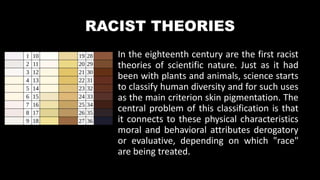
In the eighteenth century are the first racist
theories of scientific nature. Just as it had
been with plants and animals, science starts
to classify human diversity and for such uses
as the main criterion skin pigmentation. The
central problem of this classification is that
it connects to these physical characteristics
moral and behavioral attributes derogatory
or evaluative, depending on which "race"
are being treated.
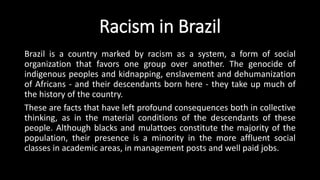
Racism in Brazil
Brazil is a country marked by racism as a system, a form of social
organization that favors one group over another. The genocide of
indigenous peoples and kidnapping, enslavement and dehumanization
of Africans - and their descendants born here - they take up much of
the history of the country.
These are facts that have left profound consequences both in collective
thinking, as in the material conditions of the descendants of these
people. Although blacks and mulattoes constitute the majority of the
population, their presence is a minority in the more affluent social
classes in academic areas, in management posts and well paid jobs.
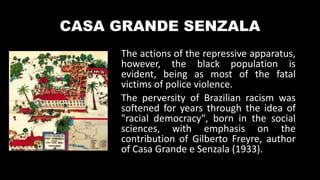
CASA GRANDE SENZALA
The actions of the repressive apparatus,
however, the black population is
evident, being as most of the fatal
victims of police violence.
The perversity of Brazilian racism was
softened for years through the idea of
"racial democracy", born in the social
sciences, with emphasis on the
contribution of Gilberto Freyre, author
of Casa Grande e Senzala (1933).
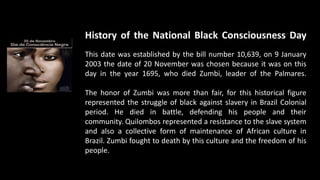
History of the National Black Consciousness Day
This date was established by the bill number 10,639, on 9 January
2003 the date of 20 November was chosen because it was on this
day in the year 1695, who died Zumbi, leader of the Palmares.
The honor of Zumbi was more than fair, for this historical figure
represented the struggle of black against slavery in Brazil Colonial
period. He died in battle, defending his people and their
community. Quilombos represented a resistance to the slave system
and also a collective form of maintenance of African culture in
Brazil. Zumbi fought to death by this culture and the freedom of his
people.
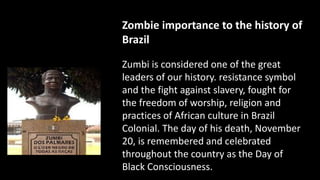
Zombie importance to the history of
Brazil
Zumbi is considered one of the great
leaders of our history. resistance symbol
and the fight against slavery, fought for
the freedom of worship, religion and
practices of African culture in Brazil
Colonial. The day of his death, November
20, is remembered and celebrated
throughout the country as the Day of
Black Consciousness.

Racismo(ingles)

  • 1.
    Racism is theassignment of a direct relationship between biological characteristics and moral, intellectual or behavioral qualities, resulting always in a hierarchy that assume the existence of superior and inferior races. Factors such as skin color or skull shape are related to a series of random qualities, like intelligence or ability to command. racist speeches have historically served to legitimize relations of domination, naturalizing inequalities of all kinds and justifying atrocities and genocides. Jean Pimentel Wesley Tavares D1IMIN1
  • 2.
    RACIST THEORIES Racism andracist theories did not come from nowhere, they have their own history. The first racist discourse derive from a theological view, are based on the reading of a series of biblical episodes, such as the one in which Noah curses his only black child, saying that his descendants would be enslaved by the descendants of his brothers. These interpretations used to justify and naturalize relations of exploitation, and enslavement of African people by Europeans.
  • 3.
    RACIST THEORIES In theeighteenth century are the first racist theories of scientific nature. Just as it had been with plants and animals, science starts to classify human diversity and for such uses as the main criterion skin pigmentation. The central problem of this classification is that it connects to these physical characteristics moral and behavioral attributes derogatory or evaluative, depending on which "race" are being treated.
  • 4.
    Racism in Brazil Brazilis a country marked by racism as a system, a form of social organization that favors one group over another. The genocide of indigenous peoples and kidnapping, enslavement and dehumanization of Africans - and their descendants born here - they take up much of the history of the country. These are facts that have left profound consequences both in collective thinking, as in the material conditions of the descendants of these people. Although blacks and mulattoes constitute the majority of the population, their presence is a minority in the more affluent social classes in academic areas, in management posts and well paid jobs.
  • 5.
    CASA GRANDE SENZALA Theactions of the repressive apparatus, however, the black population is evident, being as most of the fatal victims of police violence. The perversity of Brazilian racism was softened for years through the idea of "racial democracy", born in the social sciences, with emphasis on the contribution of Gilberto Freyre, author of Casa Grande e Senzala (1933).
  • 6.
    History of theNational Black Consciousness Day This date was established by the bill number 10,639, on 9 January 2003 the date of 20 November was chosen because it was on this day in the year 1695, who died Zumbi, leader of the Palmares. The honor of Zumbi was more than fair, for this historical figure represented the struggle of black against slavery in Brazil Colonial period. He died in battle, defending his people and their community. Quilombos represented a resistance to the slave system and also a collective form of maintenance of African culture in Brazil. Zumbi fought to death by this culture and the freedom of his people.
  • 7.
    Zombie importance tothe history of Brazil Zumbi is considered one of the great leaders of our history. resistance symbol and the fight against slavery, fought for the freedom of worship, religion and practices of African culture in Brazil Colonial. The day of his death, November 20, is remembered and celebrated throughout the country as the Day of Black Consciousness.