RA 9292
Jan-Jan Ibanez
RA 9292
• Otherwise as “Electronics Engineering Law of
2004”
• Took effect on 27 May 2004
• Repealed RA 5734 (Electronics and
Communications Engineering Act of the
Philippines) under Sec. 42
• Article I Sec. 4: Classification of licensed
electronics engineers: EcT, EcE and PEcE
Professional Regulatory Commission
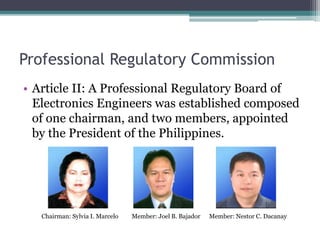
• Article II: A Professional Regulatory Board of
Electronics Engineers was established composed
of one chairman, and two members, appointed
by the President of the Philippines.
Chairman: Sylvia I. Marcelo Member: Joel B. Bajador Member: Nestor C. Dacanay
Professional Regulatory Commission
• Some notable functions:
▫ Grant registration without examination
▫ Review curricula for institutions teaching EcE and
related courses
▫ Adopt and administer the Code of Ethics and a
Code of Technical Standards of Practice for PEcE,
EcE and EcT.
Qualifications
• For EcE:
▫ Scope of the licensure examination includes Math, Applied
Sciences, Engineering Economics, Laws and Ethics,
Electronics, Communications, Computers, and ICT
▫ A passing grade of at least 70% in each subject is required.
Requirement for removal examination is at least 60%.
▫ Release of exam results is 15 days after the exam.
• For PEcE
▫ Long experience as an EcE with certifications and
documentations
▫ Three certifications by three PEcE
▫ Oral interview with the Board sitting en banc
Proper Use of Title
• Article IV Sec. 27: No person shall offer
himself/herself as PECE, ECE or ECTto convey
or to advertise that he/she is qualified to
perform the work of such without holding a valid
Certificate of Registration and a valid
Professional Identification“
• Penal provisions (Sec. 35): Fine of P100,000-
P1M or imprisonment of 6 mos. - 6 yrs.
Foreign Reciprocity
• Under Article III Sec. 26 (5): For every foreign
professional granted special permit here in the
Philippines, there shall be at least two Filipinos
employed in the country of the foreign
professional with the duration of tenure at least
the same.
• Article V Sec. 33: Foreign reciprocity
Other Provisions
• Sec. 30 sets the adoption of a Code of Ethics and
Code of Technical Standards of Practice
• Article V Sec. 32: Establishment of a single
Accredited Professional Organization which is
the Institute of Electronics and Communication
Engineers of the Philippines (IECEP).
▫ Upon registration with the Commission, a licensed
professional shall ipso facto become a member of
this Accredited Professional Organization.
Quiz!
Question 1:
• What are the three classifications of licensed
electronics engineers?
Question 2:
• True or False. The Board is composed of three
members, consisting of one Chair, one Deputy
and one Member.
Question 3:
• Give at least three subjects included in the
licensure exam for electronics engineers.
Question 4:
• What is the passing grade for a subject in the
licensure exam?
Question 5:
• True or False. The Board may grant registration
as a licensed engineer without examination.

Ra9292

  • 1.
  • 2.
    RA 9292 • Otherwiseas “Electronics Engineering Law of 2004” • Took effect on 27 May 2004 • Repealed RA 5734 (Electronics and Communications Engineering Act of the Philippines) under Sec. 42 • Article I Sec. 4: Classification of licensed electronics engineers: EcT, EcE and PEcE
  • 3.
    Professional Regulatory Commission •Article II: A Professional Regulatory Board of Electronics Engineers was established composed of one chairman, and two members, appointed by the President of the Philippines. Chairman: Sylvia I. Marcelo Member: Joel B. Bajador Member: Nestor C. Dacanay
  • 4.
    Professional Regulatory Commission •Some notable functions: ▫ Grant registration without examination ▫ Review curricula for institutions teaching EcE and related courses ▫ Adopt and administer the Code of Ethics and a Code of Technical Standards of Practice for PEcE, EcE and EcT.
  • 5.
    Qualifications • For EcE: ▫Scope of the licensure examination includes Math, Applied Sciences, Engineering Economics, Laws and Ethics, Electronics, Communications, Computers, and ICT ▫ A passing grade of at least 70% in each subject is required. Requirement for removal examination is at least 60%. ▫ Release of exam results is 15 days after the exam. • For PEcE ▫ Long experience as an EcE with certifications and documentations ▫ Three certifications by three PEcE ▫ Oral interview with the Board sitting en banc
  • 6.
    Proper Use ofTitle • Article IV Sec. 27: No person shall offer himself/herself as PECE, ECE or ECTto convey or to advertise that he/she is qualified to perform the work of such without holding a valid Certificate of Registration and a valid Professional Identification“ • Penal provisions (Sec. 35): Fine of P100,000- P1M or imprisonment of 6 mos. - 6 yrs.
  • 7.
    Foreign Reciprocity • UnderArticle III Sec. 26 (5): For every foreign professional granted special permit here in the Philippines, there shall be at least two Filipinos employed in the country of the foreign professional with the duration of tenure at least the same. • Article V Sec. 33: Foreign reciprocity
  • 8.
    Other Provisions • Sec.30 sets the adoption of a Code of Ethics and Code of Technical Standards of Practice • Article V Sec. 32: Establishment of a single Accredited Professional Organization which is the Institute of Electronics and Communication Engineers of the Philippines (IECEP). ▫ Upon registration with the Commission, a licensed professional shall ipso facto become a member of this Accredited Professional Organization.
  • 9.
  • 10.
    Question 1: • Whatare the three classifications of licensed electronics engineers?
  • 11.
    Question 2: • Trueor False. The Board is composed of three members, consisting of one Chair, one Deputy and one Member.
  • 12.
    Question 3: • Giveat least three subjects included in the licensure exam for electronics engineers.
  • 13.
    Question 4: • Whatis the passing grade for a subject in the licensure exam?
  • 14.
    Question 5: • Trueor False. The Board may grant registration as a licensed engineer without examination.