American International Journal of Business Management (AIJBM)
ISSN- 2379-106X, www.aijbm.com Volume 3, Issue 8 (August 2020), PP 168-177
*Corresponding Author: 1
FRANK OWUSU SEKYERE www.aijbm.com 168 | Page
Knowledge, Attitude and Practices of Caregivers towards
Disabled Children under- Five Years and It’s
Influence on Clinical Outcome
1
FRANK OWUSU SEKYERE, 2
CHARLES KWAME R. GYAMFI, 3
GODWIN
NTIAMOAH POKU
1
(Dept.of interdisciplinary studies UEW)
2
(Dept. of special education UEW)
3
(Dept. of child health- kath)
*Corresponding Author: 1
Frank Owusu Sekyere
ABSTRACT:- Delays in seeking appropriate medical care is one of the major factors contributing to severe
disease among children presenting to hospitals with severe forms of malaria, pneumonia and diarrhoea (UNDP,
2015). This study therefore explored the knowledge, attitude and practice of caregivers towards sick disable
children under- five years in a local indigenous setting of Bawku. A cross-sectional descriptive study design
which was quantitative in nature was used and a convenient sampling technique was used to sample 200
caregivers seeking health care for their sick-disabled children at health facilities at the Bawku township of
which they responded to questionnaires which were analyzed using the Statistical Package for Social Sciences
(SPSS) version 21. A Pearson’s correlation test was done to test variables with a significance of p value of ≤0.05
being considered statistically significant. There is a significant relationship between age (p=0.03), educational
status (p=0.001), marital status (p=0.05) as well as religious affiliation (p=0.003) and the three variables.
Findings of the study also showed that all respondents were aware that their children were sick and they have
been sick for some days but thought their children’s illness to be mild/moderate due to the combined symptoms
that was exhibited (78%) and hence 80% did not stop their daily routine to take care of their children and sought
treatment after the father made the decision. Economic factors such as low income levels, lack of transport
during illness, high cost of medical care and high cost of transport whilst socio-cultural factors such as low level
of education, lack of adequate health information, lack of support from partner and cultural barriers/beliefs all
influenced caregivers’ choice of care and practices for their sick children under five years. The study
recommends that there is the need to have an effective and functioning referral system in the health care
delivery system to ensure children are attended to promptly in health facilities at the onset of any illness.
Key Words: disability, children, caregivers
I. INTRODUCTION
Despite the significant progress that has been made in reducing mortality in children under-five years
of age, about 6.9 million children of under-five years died in 2011 worldwide (World Health Organisation
[WHO], 2012). Children in Sub-Saharan Africa (SSA) are about 16.5 times more likely to die before the age of
five years than children in developed region (WHO, 2011). About half of under-five deaths occurs only in
China, Democratic Republic of the Congo, India, Nigeria and Pakistan. More than a third of all under-five
deaths accounted by India (21%) and Nigeria (13%) (WHO, 2013).
The practice of appropriate health care seeking has a great potential to reduce the occurrence of severe
and life-threatening childhood illnesses. However, varieties of factors have been identified as the leading causes
of poor utilization of primary health care services by caregivers. Poor socio-economic status, lack of physical
accessibility, attitude to modern treatment, low literacy level of the caregivers, large family size, number of
symptoms, previous experience of child death, and perceived severity of illness have been the predictors of care
seeking behaviour as well as lack of health insurance coverage especially among the low-economic status
families (Abdulraheem, 2009; Assefa et al., 20008).
Acheampong (2013) noted that in Ghana, most caregivers are not well informed about the risk factors
and prevention of childhood illnesses, its home management, good feeding practices and seeking of early
medical attention. Acheampong noted that most cases that are presented for treatment at the hospitals are poorly
managed at home. Hence she concluded that generally, there was a perception that most of the caregivers who
lack knowledge in the causes and the associated danger signs of childhood illness as well as their management
practices have low level of education.
Knowledge, Attitude and Practices of Caregivers towards Disabled Children under- Five Years...
*Corresponding Author: 1
FRANK OWUSU SEKYERE www.aijbm.com 169 | Page
This study therefore intends to assess the knowledge, attitude and practice of caregivers towards sick-
disabled children under- five years and how these factors can be addressed to reduce childhood illness which
results in disabilities, morbidity and mortality among children under five.
THE DISABILTY CONCEPT
The UNICEF in 2007 estimated that, overall, between 500 and 650 million people worldwide live with
a significant impairment. They further quoted that with respect to the World Health Organization (WHO),
around 10% of the world’s children and young people, some 200 million, have sensory, intellectual or mental
health impairment. Around 80 per cent of them live in developing countries (UNICEF, 2007). Statistics such as
these demonstrate that to be born with or acquire impairment is far from unusual or abnormal. The reported
incidence and prevalence of impairment in the population vary significantly from one country to another.
Specialists, however, agree on a working approximation giving a minimum benchmark of 2.5% of children aged
0-14 with self-evident moderate to severe levels of sensory, physical and intellectual impairments. An additional
8 can be expected to have learning or behavioural difficulties, or both. These estimates were found to be useful
in the detailed analysis of statistics on incidence and prevalence of childhood disability in the UNICEF study on
Children and Disability in Transition in CEE/CIS and Baltic States (UNICEF, 2005). They are based on
research and data gathered over years in countries with the highest human development rankings.
ATTITUDES TOWARDS SICK -DISABLED CHILDREN
It is important to note that culture plays an important role on how children and adults with disabilities
are identified and served in a country.
For instance in Tanzania, they believe that the basis of life lies on the values and norms of the society,
where every person regardless of the differences has dignity, equal opportunity to education and respect. A
study done in Tanzania by Polat (2011) stresses that, inclusive education aims to build a society that promotes
equal opportunities for all citizens to take part in and play their role in development of the nation. Based on
principles of indigenous customary education and traditional African socialism, everybody was included and
was assigned roles according to their abilities. Those principles and values have been emphasized in Tanzania’s
“Development Vision 2025 (1-3)” where the goal is to build a society that promotes the same chance for all
residents to participate in and contribute to the improvement of the nation. Special attention is directed to
women, children, the youth and disabled persons (Polat, 2011).
Durand (2010) also reported that in Tanzania, children with disabilities were thrown away, killed or
being locked inside the house cages because of being associated with bad luck in the family. Most of the
children with disabilities in Tanzania and in developing countries like Ghana are still out of school because of
social and cultural reasons attached to them. Such cultural beliefs have largely affected disabled children’s
rights to education, social living and justice. But it was not until the transitional period when new understanding
and knowledge raised concerns about persons with disabilities in the communities where humanity resulted into
the attempt to serve these children (Skojorten, 2001)
PRACTICES OF CAREGIVERS
In responding to their children’s illness, caregivers institute presumptive treatment which may occur at
all levels of the healthcare system, but is most common within the informal sector, which includes self-treatment
at home or at a local drug shop (Chibwana et al., 2009). At home, caretakers typically diagnose their children
based on the presence of fever, and self-treat with medicines stored in the house (Assefa et al., 2008). In local
drug shops, caretakers purchase any available drug of their choice without a prescription (WHO, 2010).
Presumptive treatment may also occur at local health facilities when diagnostic capabilities are not available, but
there is a professional health worker present to make a more informed diagnosis (WHO, 2010).
PERCEPTION OF CAREGIVERS TOWARDS CHILDHOOD ILLNESS
Cultural beliefs and attitudes especially affect how a family perceives a child’s illness as well the
healthcare and treatments options available to them (Ogunrinde et al., 2012). It also affects what they decide
about, where and when to seek help. Many societies have their own beliefs and classification for illnesses.
Diarrhoea for example, may not always be described as a single disease. Different types of diarrhoea can have
local names and there may be local beliefs about symptoms, causes and treatment. Families may seek treatment
for some types of childhood diarrhoea depending on how they think the illness is. When a child becomes ill, a
family may seek advice from several sources and try a variety of treatments. The first is usually home
medication based on local beliefs about the illness and the advice from family, friends and neighbours. Only
later will they visit a traditional healer, a pharmacist or a physician (Hoan et al., 2009).
Knowledge, Attitude and Practices of Caregivers towards Disabled Children under- Five Years...
*Corresponding Author: 1
FRANK OWUSU SEKYERE www.aijbm.com 170 | Page
METHODS
This study was a quantitative research design which was descriptive in nature. This study utilised the
convenient sampling technique. As such, in this study, the caregivers who were met first were sampled till the
target sampling size of 200 was met and this took from August to September of 2019.
A set of questionnaire was used to collect data. The questions on the questionnaire consisted of both
closed and open-ended questions.
Data analysis was carried out using the Statistical Package for Social Sciences (SPSS) software version 21.
Descriptive analysis was performed and the results expressed as means and percentages. The Pearson’s test was
used to test the difference between two independent groups.
RESULTS PRESENTATION AND DISCUSSIONS
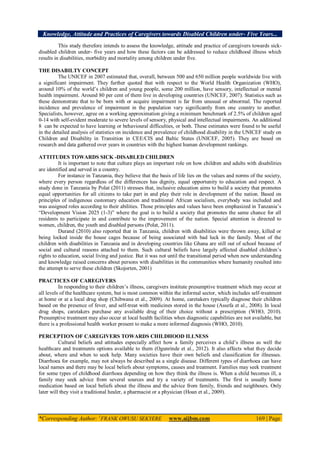
Table 4.1 shows the demographic characteristics of the respondents, 57% were females. This supports
the Ghana Statistical Report in 2014 which revealed that the within the Bawku Municipality females are more
than males. Also, 8% had primary level education, 15% had middle school education whilst 12% had no formal
education As a native area with indigenes, the Statistical Report indicated that the populates are less educated
and this is in line with this study. Also, 49% been Muslims. Likewise, the Ghana Housing and Population
Census in 2010 revealed a Muslim dominant society but with less to no education rates.
Table 4.1: Socio-Demographic characteristics of the respondents
Socio-Demographics Freq (N=200) Percent (%)
Level of Education
Primary 16 8.0
JHS 30 15.0
Secondary 62 31.0
Tertiary 68 34.0
None 24 12.0
Gender
Male 86 43
Female 114 57
Religion
Christian 82 41.0
Muslim 98 49.0
Traditional 20 10.0
Source: Field Survey, (2019)
Recognizing and responding to childhood illness should be evaluated and treated by a trained health
care provider is very important to averting death (WHO, 2013). Likewise in this study, all respondents were
aware that their children were sick and they have been sick for some days. Caregivers according to the World
Health Organisation should recognize when children displays signs of severe disease. Similarly, the first sign
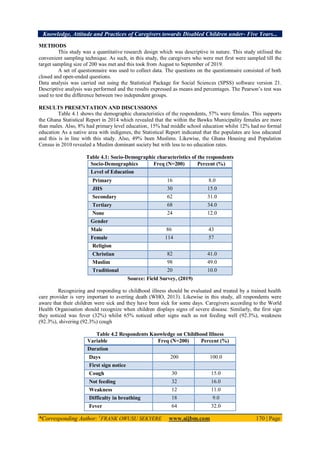
they noticed was fever (32%) whilst 65% noticed other signs such as not feeding well (92.3%), weakness
(92.3%), shivering (92.3%) cough
Table 4.2 Respondents Knowledge on Childhood Illness
Variable Freq (N=200) Percent (%)
Duration
Days 200 100.0
First sign notice
Cough 30 15.0
Not feeding 32 16.0
Weakness 12 11.0
Difficulty in breathing 18 9.0
Fever 64 32.0
Knowledge, Attitude and Practices of Caregivers towards Disabled Children under- Five Years...
*Corresponding Author: 1
FRANK OWUSU SEKYERE www.aijbm.com 171 | Page
Vomiting 18 9.0
Diarrhoea 8 4.0
Shivering 4 2.0
Convulsing 4 2.0
Any other sign
Yes 130 65.0
No 70 35.0
What other signs
Cough 60 46.2
Not feeding 120 92.3
Weakness 120 92.3
Difficulty in breathing 60 46.2
Fever 14 10.8
Vomiting 100 76.9
Diarrhoea 100 76.9
Shivering 120 92.3
Convulsing 110 84.6
Cause of the illness
Germ/microorganism 121 60.5
Spiritual 4 2.0
Wrong medication 28 14.0
Poor feeding 10 5.0
Dirty water 37 18.5
Severity of illness
Severe 55 27.5
Moderate 78 39.0
Mild 67 33.5
Identify severity of illness
Combined symptoms 156 78.0
Illness continues for long
time
44 22.0
Source: field Survey, (2019)
and difficulty breathing (46.2%), vomiting and diarrhoea (76.9%). Likewise, 72.5% of respondents thought their
children’s illness to be mild/moderate due to the combined symptoms that was exhibited (78%). This is in line
with a WHO sponsored survey in which they reported that most mothers saw the child’s behaviour which
interfered with household activities such as crying or restlessness. Only a few that took notice about signs
associated with eyes and changes in the appearance of stools as some of the vital signs to serious ailment.
Webair & Bin-Gouth (2013) and Assefa et al. (2014) revealed similar findings.
Knowledge, Attitude and Practices of Caregivers towards Disabled Children under- Five Years...
*Corresponding Author: 1
FRANK OWUSU SEKYERE www.aijbm.com 172 | Page
Source: field Survey, (2019)
Figure 1: Stratification of Respondents Age against Knowledge about Child Illness.
Figure 1 gives a stratification of respondents’ age against knowledge about child’s illness. All age groups knew
their child was sick.
Studies by Mwenesi et al. (2005), Nyamongo (2002) and Thind & Cruz (2003) as well as Beegle et al. (2011)
found results which corroborates with this study. They found that understanding the signs and symptoms of the
child results in prompt medical treatment.
Table 4.3 Respondents’ Perception on Causes of Illness
Variable Frequency
(N=200)
Percent
(%)
Child’s illness is due to
Witchcraft 8 4.0
Sorcery 16 8.0
Curse 12 6.0
Cultural practices 18 9.0
Orthodox medication 22 11.0
Herbal medication 114 57.0
Incurable disease 8 4.0
Partner conflict 27 13.5
Complimentary feeding 24 12.0
Poor maternal hygiene 30 15.0
Source: field Survey, (2019)
Cultural beliefs and attitudes especially affect how a family perceives a child’s illness as well the
healthcare and treatments options available to them (Ogunrinde et al., 2012). This assertion supports this study
in that from table 4.3, respondents perceived that their children’s illness was due to herbal medications (57%),
complimentary feeding (11.0%), partner conflict (13.5%), orthodox medication bought from vendor (12%),
cultural practices (9%) and sorcery (8%).
In responding to their children’s illness, caregivers institute presumptive treatment which may occur at
all levels of the healthcare system, but is most common within the informal sector, which includes self-treatment
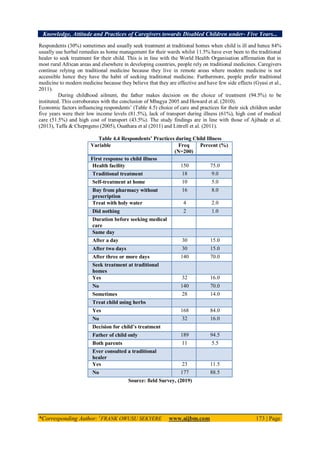
at home or at a local drug shop (Chibwana et al., 2009). This is in line with this study since 75% sent their ward
to a health facility after three days of illness (70%) when presumptive treatments have failed.
Knowledge, Attitude and Practices of Caregivers towards Disabled Children under- Five Years...
*Corresponding Author: 1
FRANK OWUSU SEKYERE www.aijbm.com 173 | Page
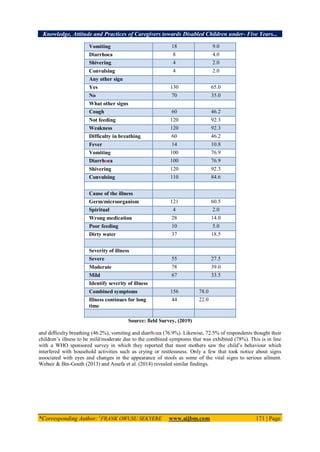
Respondents (30%) sometimes and usually seek treatment at traditional homes when child is ill and hence 84%
usually use herbal remedies as home management for their wards whilst 11.5% have ever been to the traditional
healer to seek treatment for their child. This is in line with the World Health Organisation affirmation that in
most rural African areas and elsewhere in developing countries, people rely on traditional medicines. Caregivers
continue relying on traditional medicine because they live in remote areas where modern medicine is not
accessible hence they have the habit of seeking traditional medicine. Furthermore, people prefer traditional
medicine to modern medicine because they believe that they are effective and have few side effects (Gyasi et al.,
2011).
During childhood ailment, the father makes decision on the choice of treatment (94.5%) to be
instituted. This corroborates with the conclusion of Mbagya 2005 and Howard et al. (2010).
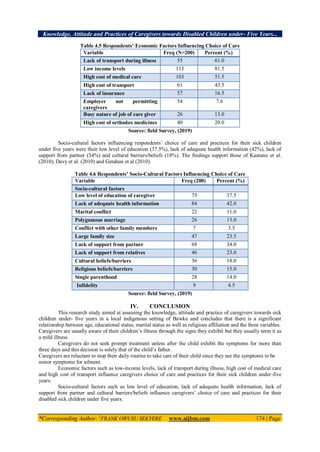
Economic factors influencing respondents’ (Table 4.5) choice of care and practices for their sick children under
five years were their low income levels (81.5%), lack of transport during illness (61%), high cost of medical
care (51.5%) and high cost of transport (43.5%). The study findings are in line with those of Ajibade et al.
(2013), Taffa & Chepngeno (2005), Ouathara et al (2011) and Littrell et al. (2011).
Table 4.4 Respondents’ Practices during Child Illness
Variable Freq
(N=200)
Percent (%)
First response to child illness
Health facility 150 75.0
Traditional treatment 18 9.0
Self-treatment at home 10 5.0
Buy from pharmacy without
prescription
16 8.0
Treat with holy water 4 2.0
Did nothing 2 1.0
Duration before seeking medical
care
Same day
After a day 30 15.0
After two days 30 15.0
After three or more days 140 70.0
Seek treatment at traditional
homes
Yes 32 16.0
No 140 70.0
Sometimes 28 14.0
Treat child using herbs
Yes 168 84.0
No 32 16.0
Decision for child’s treatment
Father of child only 189 94.5
Both parents 11 5.5
Ever consulted a traditional
healer
Yes 23 11.5
No 177 88.5
Source: field Survey, (2019)
Knowledge, Attitude and Practices of Caregivers towards Disabled Children under- Five Years...
*Corresponding Author: 1
FRANK OWUSU SEKYERE www.aijbm.com 174 | Page
Table 4.5 Respondents’ Economic Factors Influencing Choice of Care
Variable Freq (N=200) Percent (%)
Lack of transport during illness 55 61.0
Low income levels 115 81.5
High cost of medical care 103 51.5
High cost of transport 61 43.5
Lack of insurance 57 16.5
Employer not permitting
caregivers
54 7.6
Busy nature of job of care giver 26 13.0
High cost of orthodox medicines 40 20.0
Source: field Survey, (2019)
Socio-cultural factors influencing respondents’ choice of care and practices for their sick children
under five years were their low level of education (37.5%), lack of adequate health information (42%), lack of
support from partner (34%) and cultural barriers/beliefs (18%). The findings support those of Kaatano et al.
(2010), Davy et al. (2010) and Getahun et al (2010).
Table 4.6 Respondents’ Socio-Cultural Factors Influencing Choice of Care
Variable Freq (200) Percent (%)
Socio-cultural factors
Low level of education of caregiver 75 37.5
Lack of adequate health information 84 42.0
Marital conflict 22 11.0
Polygamous marriage 26 13.0
Conflict with other family members 7 3.5
Large family size 47 23.5
Lack of support from partner 68 34.0
Lack of support from relatives 46 23.0
Cultural beliefs/barriers 36 18.0
Religious beliefs/barriers 30 15.0
Single parenthood 28 14.0
Infidelity 9 4.5
Source: field Survey, (2019)
IV. CONCLUSION
This research study aimed at assessing the knowledge, attitude and practice of caregivers towards sick
children under- five years in a local indigenous setting of Bawku and concludes that there is a significant
relationship between age, educational status, marital status as well as religious affiliation and the three variables.
Caregivers are usually aware of their children’s illness through the signs they exhibit but they usually term it as
a mild illness.
Caregivers do not seek prompt treatment unless after the child exhibit the symptoms for more than
three days and this decision is solely that of the child’s father.
Caregivers are reluctant to stop their daily routine to take care of their child since they see the symptoms to be
minor symptoms for ailment.
Economic factors such as low-income levels, lack of transport during illness, high cost of medical care
and high cost of transport influence caregivers choice of care and practices for their sick children under-five
years.
Socio-cultural factors such as low level of education, lack of adequate health information, lack of
support from partner and cultural barriers/beliefs influence caregivers’ choice of care and practices for their
disabled sick children under five years.
Knowledge, Attitude and Practices of Caregivers towards Disabled Children under- Five Years...
*Corresponding Author: 1
FRANK OWUSU SEKYERE www.aijbm.com 175 | Page
5.3 RECOMMENDATIONS
Based on the findings of this study, the following are recommended;
1. There is need to have an effective and functioning referral system in the health care delivery system to
ensure children are attended promptly in health facilities at the onset of any illness.
2. Mass communication and vigorous campaign for the population on seeking treatment early in
recognized health care institutions.
3. Socio-economic development of the rural community through income generating can reduce poverty
levels hence improve healthcare seeking behaviour during the childhood illness.
4. Further studies should be carried out to address access and utilization of health care, water sanitation,
hygiene, use of herbal remedies and their implications.
5. Scope for further longitudinal study design to address specific management of childhood illness.
REFERENCES
[1]. Abdulraheem, I.S. (2009). Factors affecting mothers' healthcare-seeking behaviour for childhood
illnesses in a rural Nigerian setting. Early Child Development and Care; 179(5):671 - 83.
[2]. Adedotun, A.A., Morenikeji, O.A. & Odaibo, A.B. (2010). Knowledge, attitudes and practices about in
an urban community in south-western Nigeria. Journal of Vector Borne disease; 47:155-159.
[3]. Adegboyega, AA & Salawu O. (2014). Care-seeking behaviour of caregivers for common childhood
illnesses in Lagos Island Local Government Area, Nigeria. Unbound MEDLINE; 14: 65-71
[4]. Ajibade, B. L., Amoo, P. O., Adeleke, M. A., Oyadiran G.O, Kolade O.A Olagunju R.O. (2013).
Determinants of Mothers Health Seeking Behaviour for Their Children. Journal of Nursing and Health
Science; 1(6):9-16.
[5]. Arica SG, Arica V, Onur H, Gulbayzar S, Dag H, Obut O. (2012). Knowledge, attitude and response of
mothers about fever in their children. Emerg Med J.; 29(12)
[6]. Assefa, T., Belachew, T., Tegegn, A., Deribew, G. (2008). Mothers’ health care seeking behaviour for
childhood illnesses in Derra District, North Shoa Zone. Ethiopian Journal of Health Science; 18(3):87-
93.
[7]. Assefa, Y., Andargie, A., Addis, K. (2014). Effect of residence on mothers ‟ health care seeking
behaviour for common childhood illness. BMC Research Notes; 7 (705).
[8]. Best, J. W. & Kahn, J. V. (2006). Research in education. Boston: Pearson Education Inc.
[9]. Black, R. E., Morris, S. S., & Bryce, J. (2013). Where and why are 10 million children dying every
year? The Lancet, 361, 2226-2234.
[10]. Chibwana, A. I., Mathanga, D. P., Chinkhumba, J., & Campbell, C. H.,Jr. (2009). Sociocultural
predictors of health-seeking behaviour for febrile under-five children in Mwanza-Neno district,
Malawi. Malaria Journal, 8, 219-225.
[11]. Chirdan, OO, Zoak, AI & Ejembi, CL. (2008). Impact of health education on home treatment and
prevention. The Lancet, 289, 1226-1234.
[12]. Cinar ND, Altun İ, Altınkaynak S, Walsh A. (2014). Turkish parents’ management of childhood fever:
a cross-sectional survey using the PFMS-TR. Australas Emerg Nurs J.;17(1):3–10.
[13]. Davy, CP, Sicuri, E, Ome, M, Lawrence-wood, E, Siba, P, Warvi, GH, Muller, I, & Conteh, L. (2010).
Seeking treatment for symptomatic malaria in Papua New Guinea. Malaria journal; 9(268):1-12.
[14]. Dillip A, Alba S, Mshana C, Hetzel MW, Lengeler C. (2012) Acceptability– a neglected dimension of
access to health care: findings from a study on childhood convulsions in rural Tanzania. BMC Health
Serv Res; 12.
[15]. Edwards H, Walsh A, Courtney M, Monaghan S, Wilson J, Young J. (2007). Improving paediatric
nurses’ knowledge and attitudes in childhood fever management. J Adv Nurs; 57(3):257–69.
[16]. Enarson MC, Ali S, Vandermeer B, Wright RB, Klassen TP, Spiers JA. (2012). Beliefs and
expectations of Canadian parents who bring febrile children for medical care. Pediatrics; 130(4):e905–
12.
[17]. Geldsetzer P, Williams TC, Kirolos A, Mitchell S, Ratcliffe LA, Kohli-Lynch MK. (2014).
Recognition of and Care Seeking Behaviour for Childhood Illness in Developing Countries. PLOS
ONE; 9(4).
[18]. Getahun, A, Deribe, K & Deribew, A. (2010). Determinants of delay in malaria treatment-seeking
behaviour for under-five children in south-west Ethiopia: a case control study. Malaria Journal;
9(320):1-8.
[19]. Ghana Statistical Service [GSS] (2013). 2010 population and housing report: millennium development
goals in Ghana. Ghana: GSS.
[20]. Gupta MS, Rajput U. (2012). Parental knowledge, attitude and practices regarding fever in their
children: a hospital-based prospective study. Australasian Medical J.; 5(1):106.
Knowledge, Attitude and Practices of Caregivers towards Disabled Children under- Five Years...
*Corresponding Author: 1
FRANK OWUSU SEKYERE www.aijbm.com 176 | Page
[21]. Gyasi, RM., Mensar, CM, Adjei, PO & Agyemang, S. (2011). Public perceptions of the role of
traditional medicine in the health care delivery system in Ghana. Global Journal of Health Science
3(2):40-41.
[22]. Hoan, L.T., Chuc, K. N.T., Ottosson, E., & Allebeck, P. (2009). Drug use among children under 5 with
respiratory illness and/or diarrhoea in a rural district of Vietnam. Pharmaco epidemiology and drug
safety; 18: 448–453.
[23]. Holt, TH, Kachur, SP, Marum, LH, Mkanda, C, Chizan, N, Roberts, JM, Macheso, A, & Parise, ME.
(2003). Care seeking behaviour and treatment of febrile illness in children aged less than five years:
Blantyre district, Malawi. Transactions of the Royal Society of Tropical Medicine and Hygiene;
97:491-497
[24]. Howard, N, Shafi, A, Jones, C & Rowland, M. (2010). Malaria control under the Taliban regime:
insecticide-treated net purchasing, coverage, and usage among men and women in eastern Afghanistan.
Malaria Journal 9:7:1-1-12.
[25]. Iwelunmor, J, Idris, O, Adelaku, A & Airhihenbuwa, CO. (2010). Child malaria treatment decisions by
mothers of children less than five years of age attending an outpatient clinic in south-west Nigeria:
application of PEN-3 cultural model. Malaria Journal; 9(354):1-4.
[26]. Jones G, Steketee RW, Black RE, Bhutta ZA, SS M. (2013). How many child deaths can we prevent
this year? Lancet; 362:65-71.
[27]. Kaatano,G.M., Muro, A.I.S., & Medard,M. (2010). Caretaker‘s perceptions, attitudes and practices
regarding childhood febrile illness and diarrhoeal diseases among riparian communities of Lake
Victoria, Tanzania. Tanzania Health Research Bulletin; 8:(3): 155-161
[28]. Littrell, M, Gatakaa, H, Evance, I, Poyer, S, Njogu, J, Solomon, T, Munroe, E, Chapman, S, Goodman,
C, Hanson, K, Zinsou, C, Akulayi, L, Raharinjatovo, J Mathanga,DP, Walker, ED, Wilson, ML, Ali, D,
Taylor, TE & Laufer, MK. 2012. Malaria control in Malawi: current status and directions for the future.
Acta Tropica; 121:212-217.
[29]. Mbagaya, G.M., Odhiambo, M.O. & Oniang’o, R.K. (2005). Mother’s health seeking behaviour
during child illness. African Health Sciences; 5(4): 322 - 7.
[30]. Mesa, LYP. (2012). Patterns of treatment for childhood malaria among caregivers and health care
providers in Turbo, Colombia. IATREIA; 25(2):93-104.
[31]. Negussi, T, & Chepngeno, G. (2005). Determinants of health care seeking for childhood illnesses.
Tropical Medicine and International Health; 10 (3):240-5.
[32]. Ogunrinde, O.G., Raji. T., & Anigo, K.M. (2012). Knowledge, attitude and practice of home
management of childhood diarrhoea among caregivers of under-5 children with diarrhoeal disease in
Northwestern Nigeria. J Trop Pediatr; 58(2):143-6.
[33]. Oguonu, T, Okafor, HU & Obu, HA. (2005). Caregivers knowledge, attitude and practice on childhood
malaria and treatment in urban and rural communities in Enugu, south-east Nigeria. Journal of the
Royal Institute of Public Health; 119:409-414.
[34]. Okeke, TA & Okeibunor, JC. (2010). Rural-urban differences in health-seeking for the treatment of
childhood malaria in south-east Nigeria. Health Policy; 95:62-68.
[35]. Ouathara, AF, Raso, G, Edi, CVA, Utzinger, J, Tanner, M, Dagnogo, M & Koudou, BG. (2011).
Malaria knowledge and long-lasting insecticidal net use in rural communities of central Cote d’voire.
Malaria Journal; 10(288):1-6.
[36]. Purssell, E. (2009). Parental fever phobia and its evolutionary correlates. J Clin Nurs; 18(2):210-8.
[37]. Sharkey, A., Chopra, M., Jackson, D., Winch, P.J.,& Minkovitz, C.S. (2011). Influences on health
cares-seeking during final illness of infants in under resourced south African setting. J Health
Popul Nutr; 378-87.
[38]. Smith, LA, Bruce, J, Gueye, L, Helou, A, Diallo, R, Gueye, B, Jones C & Webster, J. (2010). From
fever to anti-malarial: the treatment seeking process in rural Senegal. Malaria Journal; 9(333):1-8.
[39]. Sreeramareddy CT, Shankar RP, Sreekumaran BV, Subba SH, Joshi HS, U R. (2016). Care seeking
behaviour of child hood illness. BMC international health and human right; 6(7): 1-5.
[40]. Taffa, N., & Chepngeno, G. (2005). Determinants of health care seeking for childhood illnesses in
Nairobi slums. Tropical Medicine and International Health; 10(3), 240-245.
[41]. Tailor, G. R. (Ed.). (2005). Integrating quantitative and qualitative methods in research. Maryland:
University Press of America Inc.
[42]. United Nations Development Programme Ghana (2015). Ghana Millennium Development Goals: 2015
Report. Accra: Republic of Ghana.
[43]. UNDP (2016). Africa’s Millennium Development Goals: 2015 Report. UNDP.
[44]. UNICEF/WHO. (2011). United Nations Levels and Trends in child mortality. New York, USA.
[45]. UNICEF/WHO. (2015). Diarrhea: Why children are still dying and what can be done. Geneva,
Switzerland.
Knowledge, Attitude and Practices of Caregivers towards Disabled Children under- Five Years...
*Corresponding Author: 1
FRANK OWUSU SEKYERE www.aijbm.com 177 | Page
[46]. Vania, D. P., Juliana, C. P., & Débora, F. d. M. (2011). Integrated Management of Childhood Illness
With the Focus on Caregivers: an Integrative Literature Review. Rev. Latino-Am. Enfermagem, 19(1),
203-211.
[47]. Walliman, N. (2011). Research methods: The basics. New York: Routledge.
[48]. Watsierah, C. A., Jura, W. G., Raballah, E., Kaseje, D., Abong'o, B., & Ouma, C. (2011). Knowledge
and behaviour as determinants of anti-malarial drug use in a peri-urban population from malaria
holoendemic region of western Kenya. Malaria Journal, 10, 99-2875-10-99.
[49]. Webair, H. H., Bin-Gouth, S. A. (2013). Factors affecting health seeking behaviour for common
childhood illnesses in Yemen. Patient Preference and Adherence; 7:1129.
[50]. WHO. (2011). World Health Statistics - 2011. Geneva, Switzerland: WHO.
[51]. WHO. (2012). Children: Reducing mortality- 2012. Geneva, Switzerland: WHO.
[52]. World Health Organization. (2013). The world health report 2012: Reducing risks, promoting healthy
life. Geneva: World Health Organization.
*Corresponding Author: 1
Frank Owusu Sekyere
1
(Dept. interdisciplinary studies UEW)

R38168177

  • 1.
    American International Journalof Business Management (AIJBM) ISSN- 2379-106X, www.aijbm.com Volume 3, Issue 8 (August 2020), PP 168-177 *Corresponding Author: 1 FRANK OWUSU SEKYERE www.aijbm.com 168 | Page Knowledge, Attitude and Practices of Caregivers towards Disabled Children under- Five Years and It’s Influence on Clinical Outcome 1 FRANK OWUSU SEKYERE, 2 CHARLES KWAME R. GYAMFI, 3 GODWIN NTIAMOAH POKU 1 (Dept.of interdisciplinary studies UEW) 2 (Dept. of special education UEW) 3 (Dept. of child health- kath) *Corresponding Author: 1 Frank Owusu Sekyere ABSTRACT:- Delays in seeking appropriate medical care is one of the major factors contributing to severe disease among children presenting to hospitals with severe forms of malaria, pneumonia and diarrhoea (UNDP, 2015). This study therefore explored the knowledge, attitude and practice of caregivers towards sick disable children under- five years in a local indigenous setting of Bawku. A cross-sectional descriptive study design which was quantitative in nature was used and a convenient sampling technique was used to sample 200 caregivers seeking health care for their sick-disabled children at health facilities at the Bawku township of which they responded to questionnaires which were analyzed using the Statistical Package for Social Sciences (SPSS) version 21. A Pearson’s correlation test was done to test variables with a significance of p value of ≤0.05 being considered statistically significant. There is a significant relationship between age (p=0.03), educational status (p=0.001), marital status (p=0.05) as well as religious affiliation (p=0.003) and the three variables. Findings of the study also showed that all respondents were aware that their children were sick and they have been sick for some days but thought their children’s illness to be mild/moderate due to the combined symptoms that was exhibited (78%) and hence 80% did not stop their daily routine to take care of their children and sought treatment after the father made the decision. Economic factors such as low income levels, lack of transport during illness, high cost of medical care and high cost of transport whilst socio-cultural factors such as low level of education, lack of adequate health information, lack of support from partner and cultural barriers/beliefs all influenced caregivers’ choice of care and practices for their sick children under five years. The study recommends that there is the need to have an effective and functioning referral system in the health care delivery system to ensure children are attended to promptly in health facilities at the onset of any illness. Key Words: disability, children, caregivers I. INTRODUCTION Despite the significant progress that has been made in reducing mortality in children under-five years of age, about 6.9 million children of under-five years died in 2011 worldwide (World Health Organisation [WHO], 2012). Children in Sub-Saharan Africa (SSA) are about 16.5 times more likely to die before the age of five years than children in developed region (WHO, 2011). About half of under-five deaths occurs only in China, Democratic Republic of the Congo, India, Nigeria and Pakistan. More than a third of all under-five deaths accounted by India (21%) and Nigeria (13%) (WHO, 2013). The practice of appropriate health care seeking has a great potential to reduce the occurrence of severe and life-threatening childhood illnesses. However, varieties of factors have been identified as the leading causes of poor utilization of primary health care services by caregivers. Poor socio-economic status, lack of physical accessibility, attitude to modern treatment, low literacy level of the caregivers, large family size, number of symptoms, previous experience of child death, and perceived severity of illness have been the predictors of care seeking behaviour as well as lack of health insurance coverage especially among the low-economic status families (Abdulraheem, 2009; Assefa et al., 20008). Acheampong (2013) noted that in Ghana, most caregivers are not well informed about the risk factors and prevention of childhood illnesses, its home management, good feeding practices and seeking of early medical attention. Acheampong noted that most cases that are presented for treatment at the hospitals are poorly managed at home. Hence she concluded that generally, there was a perception that most of the caregivers who lack knowledge in the causes and the associated danger signs of childhood illness as well as their management practices have low level of education.
  • 2.
    Knowledge, Attitude andPractices of Caregivers towards Disabled Children under- Five Years... *Corresponding Author: 1 FRANK OWUSU SEKYERE www.aijbm.com 169 | Page This study therefore intends to assess the knowledge, attitude and practice of caregivers towards sick- disabled children under- five years and how these factors can be addressed to reduce childhood illness which results in disabilities, morbidity and mortality among children under five. THE DISABILTY CONCEPT The UNICEF in 2007 estimated that, overall, between 500 and 650 million people worldwide live with a significant impairment. They further quoted that with respect to the World Health Organization (WHO), around 10% of the world’s children and young people, some 200 million, have sensory, intellectual or mental health impairment. Around 80 per cent of them live in developing countries (UNICEF, 2007). Statistics such as these demonstrate that to be born with or acquire impairment is far from unusual or abnormal. The reported incidence and prevalence of impairment in the population vary significantly from one country to another. Specialists, however, agree on a working approximation giving a minimum benchmark of 2.5% of children aged 0-14 with self-evident moderate to severe levels of sensory, physical and intellectual impairments. An additional 8 can be expected to have learning or behavioural difficulties, or both. These estimates were found to be useful in the detailed analysis of statistics on incidence and prevalence of childhood disability in the UNICEF study on Children and Disability in Transition in CEE/CIS and Baltic States (UNICEF, 2005). They are based on research and data gathered over years in countries with the highest human development rankings. ATTITUDES TOWARDS SICK -DISABLED CHILDREN It is important to note that culture plays an important role on how children and adults with disabilities are identified and served in a country. For instance in Tanzania, they believe that the basis of life lies on the values and norms of the society, where every person regardless of the differences has dignity, equal opportunity to education and respect. A study done in Tanzania by Polat (2011) stresses that, inclusive education aims to build a society that promotes equal opportunities for all citizens to take part in and play their role in development of the nation. Based on principles of indigenous customary education and traditional African socialism, everybody was included and was assigned roles according to their abilities. Those principles and values have been emphasized in Tanzania’s “Development Vision 2025 (1-3)” where the goal is to build a society that promotes the same chance for all residents to participate in and contribute to the improvement of the nation. Special attention is directed to women, children, the youth and disabled persons (Polat, 2011). Durand (2010) also reported that in Tanzania, children with disabilities were thrown away, killed or being locked inside the house cages because of being associated with bad luck in the family. Most of the children with disabilities in Tanzania and in developing countries like Ghana are still out of school because of social and cultural reasons attached to them. Such cultural beliefs have largely affected disabled children’s rights to education, social living and justice. But it was not until the transitional period when new understanding and knowledge raised concerns about persons with disabilities in the communities where humanity resulted into the attempt to serve these children (Skojorten, 2001) PRACTICES OF CAREGIVERS In responding to their children’s illness, caregivers institute presumptive treatment which may occur at all levels of the healthcare system, but is most common within the informal sector, which includes self-treatment at home or at a local drug shop (Chibwana et al., 2009). At home, caretakers typically diagnose their children based on the presence of fever, and self-treat with medicines stored in the house (Assefa et al., 2008). In local drug shops, caretakers purchase any available drug of their choice without a prescription (WHO, 2010). Presumptive treatment may also occur at local health facilities when diagnostic capabilities are not available, but there is a professional health worker present to make a more informed diagnosis (WHO, 2010). PERCEPTION OF CAREGIVERS TOWARDS CHILDHOOD ILLNESS Cultural beliefs and attitudes especially affect how a family perceives a child’s illness as well the healthcare and treatments options available to them (Ogunrinde et al., 2012). It also affects what they decide about, where and when to seek help. Many societies have their own beliefs and classification for illnesses. Diarrhoea for example, may not always be described as a single disease. Different types of diarrhoea can have local names and there may be local beliefs about symptoms, causes and treatment. Families may seek treatment for some types of childhood diarrhoea depending on how they think the illness is. When a child becomes ill, a family may seek advice from several sources and try a variety of treatments. The first is usually home medication based on local beliefs about the illness and the advice from family, friends and neighbours. Only later will they visit a traditional healer, a pharmacist or a physician (Hoan et al., 2009).
  • 3.
    Knowledge, Attitude andPractices of Caregivers towards Disabled Children under- Five Years... *Corresponding Author: 1 FRANK OWUSU SEKYERE www.aijbm.com 170 | Page METHODS This study was a quantitative research design which was descriptive in nature. This study utilised the convenient sampling technique. As such, in this study, the caregivers who were met first were sampled till the target sampling size of 200 was met and this took from August to September of 2019. A set of questionnaire was used to collect data. The questions on the questionnaire consisted of both closed and open-ended questions. Data analysis was carried out using the Statistical Package for Social Sciences (SPSS) software version 21. Descriptive analysis was performed and the results expressed as means and percentages. The Pearson’s test was used to test the difference between two independent groups. RESULTS PRESENTATION AND DISCUSSIONS Table 4.1 shows the demographic characteristics of the respondents, 57% were females. This supports the Ghana Statistical Report in 2014 which revealed that the within the Bawku Municipality females are more than males. Also, 8% had primary level education, 15% had middle school education whilst 12% had no formal education As a native area with indigenes, the Statistical Report indicated that the populates are less educated and this is in line with this study. Also, 49% been Muslims. Likewise, the Ghana Housing and Population Census in 2010 revealed a Muslim dominant society but with less to no education rates. Table 4.1: Socio-Demographic characteristics of the respondents Socio-Demographics Freq (N=200) Percent (%) Level of Education Primary 16 8.0 JHS 30 15.0 Secondary 62 31.0 Tertiary 68 34.0 None 24 12.0 Gender Male 86 43 Female 114 57 Religion Christian 82 41.0 Muslim 98 49.0 Traditional 20 10.0 Source: Field Survey, (2019) Recognizing and responding to childhood illness should be evaluated and treated by a trained health care provider is very important to averting death (WHO, 2013). Likewise in this study, all respondents were aware that their children were sick and they have been sick for some days. Caregivers according to the World Health Organisation should recognize when children displays signs of severe disease. Similarly, the first sign they noticed was fever (32%) whilst 65% noticed other signs such as not feeding well (92.3%), weakness (92.3%), shivering (92.3%) cough Table 4.2 Respondents Knowledge on Childhood Illness Variable Freq (N=200) Percent (%) Duration Days 200 100.0 First sign notice Cough 30 15.0 Not feeding 32 16.0 Weakness 12 11.0 Difficulty in breathing 18 9.0 Fever 64 32.0
  • 4.
    Knowledge, Attitude andPractices of Caregivers towards Disabled Children under- Five Years... *Corresponding Author: 1 FRANK OWUSU SEKYERE www.aijbm.com 171 | Page Vomiting 18 9.0 Diarrhoea 8 4.0 Shivering 4 2.0 Convulsing 4 2.0 Any other sign Yes 130 65.0 No 70 35.0 What other signs Cough 60 46.2 Not feeding 120 92.3 Weakness 120 92.3 Difficulty in breathing 60 46.2 Fever 14 10.8 Vomiting 100 76.9 Diarrhoea 100 76.9 Shivering 120 92.3 Convulsing 110 84.6 Cause of the illness Germ/microorganism 121 60.5 Spiritual 4 2.0 Wrong medication 28 14.0 Poor feeding 10 5.0 Dirty water 37 18.5 Severity of illness Severe 55 27.5 Moderate 78 39.0 Mild 67 33.5 Identify severity of illness Combined symptoms 156 78.0 Illness continues for long time 44 22.0 Source: field Survey, (2019) and difficulty breathing (46.2%), vomiting and diarrhoea (76.9%). Likewise, 72.5% of respondents thought their children’s illness to be mild/moderate due to the combined symptoms that was exhibited (78%). This is in line with a WHO sponsored survey in which they reported that most mothers saw the child’s behaviour which interfered with household activities such as crying or restlessness. Only a few that took notice about signs associated with eyes and changes in the appearance of stools as some of the vital signs to serious ailment. Webair & Bin-Gouth (2013) and Assefa et al. (2014) revealed similar findings.
  • 5.
    Knowledge, Attitude andPractices of Caregivers towards Disabled Children under- Five Years... *Corresponding Author: 1 FRANK OWUSU SEKYERE www.aijbm.com 172 | Page Source: field Survey, (2019) Figure 1: Stratification of Respondents Age against Knowledge about Child Illness. Figure 1 gives a stratification of respondents’ age against knowledge about child’s illness. All age groups knew their child was sick. Studies by Mwenesi et al. (2005), Nyamongo (2002) and Thind & Cruz (2003) as well as Beegle et al. (2011) found results which corroborates with this study. They found that understanding the signs and symptoms of the child results in prompt medical treatment. Table 4.3 Respondents’ Perception on Causes of Illness Variable Frequency (N=200) Percent (%) Child’s illness is due to Witchcraft 8 4.0 Sorcery 16 8.0 Curse 12 6.0 Cultural practices 18 9.0 Orthodox medication 22 11.0 Herbal medication 114 57.0 Incurable disease 8 4.0 Partner conflict 27 13.5 Complimentary feeding 24 12.0 Poor maternal hygiene 30 15.0 Source: field Survey, (2019) Cultural beliefs and attitudes especially affect how a family perceives a child’s illness as well the healthcare and treatments options available to them (Ogunrinde et al., 2012). This assertion supports this study in that from table 4.3, respondents perceived that their children’s illness was due to herbal medications (57%), complimentary feeding (11.0%), partner conflict (13.5%), orthodox medication bought from vendor (12%), cultural practices (9%) and sorcery (8%). In responding to their children’s illness, caregivers institute presumptive treatment which may occur at all levels of the healthcare system, but is most common within the informal sector, which includes self-treatment at home or at a local drug shop (Chibwana et al., 2009). This is in line with this study since 75% sent their ward to a health facility after three days of illness (70%) when presumptive treatments have failed.
  • 6.
    Knowledge, Attitude andPractices of Caregivers towards Disabled Children under- Five Years... *Corresponding Author: 1 FRANK OWUSU SEKYERE www.aijbm.com 173 | Page Respondents (30%) sometimes and usually seek treatment at traditional homes when child is ill and hence 84% usually use herbal remedies as home management for their wards whilst 11.5% have ever been to the traditional healer to seek treatment for their child. This is in line with the World Health Organisation affirmation that in most rural African areas and elsewhere in developing countries, people rely on traditional medicines. Caregivers continue relying on traditional medicine because they live in remote areas where modern medicine is not accessible hence they have the habit of seeking traditional medicine. Furthermore, people prefer traditional medicine to modern medicine because they believe that they are effective and have few side effects (Gyasi et al., 2011). During childhood ailment, the father makes decision on the choice of treatment (94.5%) to be instituted. This corroborates with the conclusion of Mbagya 2005 and Howard et al. (2010). Economic factors influencing respondents’ (Table 4.5) choice of care and practices for their sick children under five years were their low income levels (81.5%), lack of transport during illness (61%), high cost of medical care (51.5%) and high cost of transport (43.5%). The study findings are in line with those of Ajibade et al. (2013), Taffa & Chepngeno (2005), Ouathara et al (2011) and Littrell et al. (2011). Table 4.4 Respondents’ Practices during Child Illness Variable Freq (N=200) Percent (%) First response to child illness Health facility 150 75.0 Traditional treatment 18 9.0 Self-treatment at home 10 5.0 Buy from pharmacy without prescription 16 8.0 Treat with holy water 4 2.0 Did nothing 2 1.0 Duration before seeking medical care Same day After a day 30 15.0 After two days 30 15.0 After three or more days 140 70.0 Seek treatment at traditional homes Yes 32 16.0 No 140 70.0 Sometimes 28 14.0 Treat child using herbs Yes 168 84.0 No 32 16.0 Decision for child’s treatment Father of child only 189 94.5 Both parents 11 5.5 Ever consulted a traditional healer Yes 23 11.5 No 177 88.5 Source: field Survey, (2019)
  • 7.
    Knowledge, Attitude andPractices of Caregivers towards Disabled Children under- Five Years... *Corresponding Author: 1 FRANK OWUSU SEKYERE www.aijbm.com 174 | Page Table 4.5 Respondents’ Economic Factors Influencing Choice of Care Variable Freq (N=200) Percent (%) Lack of transport during illness 55 61.0 Low income levels 115 81.5 High cost of medical care 103 51.5 High cost of transport 61 43.5 Lack of insurance 57 16.5 Employer not permitting caregivers 54 7.6 Busy nature of job of care giver 26 13.0 High cost of orthodox medicines 40 20.0 Source: field Survey, (2019) Socio-cultural factors influencing respondents’ choice of care and practices for their sick children under five years were their low level of education (37.5%), lack of adequate health information (42%), lack of support from partner (34%) and cultural barriers/beliefs (18%). The findings support those of Kaatano et al. (2010), Davy et al. (2010) and Getahun et al (2010). Table 4.6 Respondents’ Socio-Cultural Factors Influencing Choice of Care Variable Freq (200) Percent (%) Socio-cultural factors Low level of education of caregiver 75 37.5 Lack of adequate health information 84 42.0 Marital conflict 22 11.0 Polygamous marriage 26 13.0 Conflict with other family members 7 3.5 Large family size 47 23.5 Lack of support from partner 68 34.0 Lack of support from relatives 46 23.0 Cultural beliefs/barriers 36 18.0 Religious beliefs/barriers 30 15.0 Single parenthood 28 14.0 Infidelity 9 4.5 Source: field Survey, (2019) IV. CONCLUSION This research study aimed at assessing the knowledge, attitude and practice of caregivers towards sick children under- five years in a local indigenous setting of Bawku and concludes that there is a significant relationship between age, educational status, marital status as well as religious affiliation and the three variables. Caregivers are usually aware of their children’s illness through the signs they exhibit but they usually term it as a mild illness. Caregivers do not seek prompt treatment unless after the child exhibit the symptoms for more than three days and this decision is solely that of the child’s father. Caregivers are reluctant to stop their daily routine to take care of their child since they see the symptoms to be minor symptoms for ailment. Economic factors such as low-income levels, lack of transport during illness, high cost of medical care and high cost of transport influence caregivers choice of care and practices for their sick children under-five years. Socio-cultural factors such as low level of education, lack of adequate health information, lack of support from partner and cultural barriers/beliefs influence caregivers’ choice of care and practices for their disabled sick children under five years.
  • 8.
    Knowledge, Attitude andPractices of Caregivers towards Disabled Children under- Five Years... *Corresponding Author: 1 FRANK OWUSU SEKYERE www.aijbm.com 175 | Page 5.3 RECOMMENDATIONS Based on the findings of this study, the following are recommended; 1. There is need to have an effective and functioning referral system in the health care delivery system to ensure children are attended promptly in health facilities at the onset of any illness. 2. Mass communication and vigorous campaign for the population on seeking treatment early in recognized health care institutions. 3. Socio-economic development of the rural community through income generating can reduce poverty levels hence improve healthcare seeking behaviour during the childhood illness. 4. Further studies should be carried out to address access and utilization of health care, water sanitation, hygiene, use of herbal remedies and their implications. 5. Scope for further longitudinal study design to address specific management of childhood illness. REFERENCES [1]. Abdulraheem, I.S. (2009). Factors affecting mothers' healthcare-seeking behaviour for childhood illnesses in a rural Nigerian setting. Early Child Development and Care; 179(5):671 - 83. [2]. Adedotun, A.A., Morenikeji, O.A. & Odaibo, A.B. (2010). Knowledge, attitudes and practices about in an urban community in south-western Nigeria. Journal of Vector Borne disease; 47:155-159. [3]. Adegboyega, AA & Salawu O. (2014). Care-seeking behaviour of caregivers for common childhood illnesses in Lagos Island Local Government Area, Nigeria. Unbound MEDLINE; 14: 65-71 [4]. Ajibade, B. L., Amoo, P. O., Adeleke, M. A., Oyadiran G.O, Kolade O.A Olagunju R.O. (2013). Determinants of Mothers Health Seeking Behaviour for Their Children. Journal of Nursing and Health Science; 1(6):9-16. [5]. Arica SG, Arica V, Onur H, Gulbayzar S, Dag H, Obut O. (2012). Knowledge, attitude and response of mothers about fever in their children. Emerg Med J.; 29(12) [6]. Assefa, T., Belachew, T., Tegegn, A., Deribew, G. (2008). Mothers’ health care seeking behaviour for childhood illnesses in Derra District, North Shoa Zone. Ethiopian Journal of Health Science; 18(3):87- 93. [7]. Assefa, Y., Andargie, A., Addis, K. (2014). Effect of residence on mothers ‟ health care seeking behaviour for common childhood illness. BMC Research Notes; 7 (705). [8]. Best, J. W. & Kahn, J. V. (2006). Research in education. Boston: Pearson Education Inc. [9]. Black, R. E., Morris, S. S., & Bryce, J. (2013). Where and why are 10 million children dying every year? The Lancet, 361, 2226-2234. [10]. Chibwana, A. I., Mathanga, D. P., Chinkhumba, J., & Campbell, C. H.,Jr. (2009). Sociocultural predictors of health-seeking behaviour for febrile under-five children in Mwanza-Neno district, Malawi. Malaria Journal, 8, 219-225. [11]. Chirdan, OO, Zoak, AI & Ejembi, CL. (2008). Impact of health education on home treatment and prevention. The Lancet, 289, 1226-1234. [12]. Cinar ND, Altun İ, Altınkaynak S, Walsh A. (2014). Turkish parents’ management of childhood fever: a cross-sectional survey using the PFMS-TR. Australas Emerg Nurs J.;17(1):3–10. [13]. Davy, CP, Sicuri, E, Ome, M, Lawrence-wood, E, Siba, P, Warvi, GH, Muller, I, & Conteh, L. (2010). Seeking treatment for symptomatic malaria in Papua New Guinea. Malaria journal; 9(268):1-12. [14]. Dillip A, Alba S, Mshana C, Hetzel MW, Lengeler C. (2012) Acceptability– a neglected dimension of access to health care: findings from a study on childhood convulsions in rural Tanzania. BMC Health Serv Res; 12. [15]. Edwards H, Walsh A, Courtney M, Monaghan S, Wilson J, Young J. (2007). Improving paediatric nurses’ knowledge and attitudes in childhood fever management. J Adv Nurs; 57(3):257–69. [16]. Enarson MC, Ali S, Vandermeer B, Wright RB, Klassen TP, Spiers JA. (2012). Beliefs and expectations of Canadian parents who bring febrile children for medical care. Pediatrics; 130(4):e905– 12. [17]. Geldsetzer P, Williams TC, Kirolos A, Mitchell S, Ratcliffe LA, Kohli-Lynch MK. (2014). Recognition of and Care Seeking Behaviour for Childhood Illness in Developing Countries. PLOS ONE; 9(4). [18]. Getahun, A, Deribe, K & Deribew, A. (2010). Determinants of delay in malaria treatment-seeking behaviour for under-five children in south-west Ethiopia: a case control study. Malaria Journal; 9(320):1-8. [19]. Ghana Statistical Service [GSS] (2013). 2010 population and housing report: millennium development goals in Ghana. Ghana: GSS. [20]. Gupta MS, Rajput U. (2012). Parental knowledge, attitude and practices regarding fever in their children: a hospital-based prospective study. Australasian Medical J.; 5(1):106.
  • 9.
    Knowledge, Attitude andPractices of Caregivers towards Disabled Children under- Five Years... *Corresponding Author: 1 FRANK OWUSU SEKYERE www.aijbm.com 176 | Page [21]. Gyasi, RM., Mensar, CM, Adjei, PO & Agyemang, S. (2011). Public perceptions of the role of traditional medicine in the health care delivery system in Ghana. Global Journal of Health Science 3(2):40-41. [22]. Hoan, L.T., Chuc, K. N.T., Ottosson, E., & Allebeck, P. (2009). Drug use among children under 5 with respiratory illness and/or diarrhoea in a rural district of Vietnam. Pharmaco epidemiology and drug safety; 18: 448–453. [23]. Holt, TH, Kachur, SP, Marum, LH, Mkanda, C, Chizan, N, Roberts, JM, Macheso, A, & Parise, ME. (2003). Care seeking behaviour and treatment of febrile illness in children aged less than five years: Blantyre district, Malawi. Transactions of the Royal Society of Tropical Medicine and Hygiene; 97:491-497 [24]. Howard, N, Shafi, A, Jones, C & Rowland, M. (2010). Malaria control under the Taliban regime: insecticide-treated net purchasing, coverage, and usage among men and women in eastern Afghanistan. Malaria Journal 9:7:1-1-12. [25]. Iwelunmor, J, Idris, O, Adelaku, A & Airhihenbuwa, CO. (2010). Child malaria treatment decisions by mothers of children less than five years of age attending an outpatient clinic in south-west Nigeria: application of PEN-3 cultural model. Malaria Journal; 9(354):1-4. [26]. Jones G, Steketee RW, Black RE, Bhutta ZA, SS M. (2013). How many child deaths can we prevent this year? Lancet; 362:65-71. [27]. Kaatano,G.M., Muro, A.I.S., & Medard,M. (2010). Caretaker‘s perceptions, attitudes and practices regarding childhood febrile illness and diarrhoeal diseases among riparian communities of Lake Victoria, Tanzania. Tanzania Health Research Bulletin; 8:(3): 155-161 [28]. Littrell, M, Gatakaa, H, Evance, I, Poyer, S, Njogu, J, Solomon, T, Munroe, E, Chapman, S, Goodman, C, Hanson, K, Zinsou, C, Akulayi, L, Raharinjatovo, J Mathanga,DP, Walker, ED, Wilson, ML, Ali, D, Taylor, TE & Laufer, MK. 2012. Malaria control in Malawi: current status and directions for the future. Acta Tropica; 121:212-217. [29]. Mbagaya, G.M., Odhiambo, M.O. & Oniang’o, R.K. (2005). Mother’s health seeking behaviour during child illness. African Health Sciences; 5(4): 322 - 7. [30]. Mesa, LYP. (2012). Patterns of treatment for childhood malaria among caregivers and health care providers in Turbo, Colombia. IATREIA; 25(2):93-104. [31]. Negussi, T, & Chepngeno, G. (2005). Determinants of health care seeking for childhood illnesses. Tropical Medicine and International Health; 10 (3):240-5. [32]. Ogunrinde, O.G., Raji. T., & Anigo, K.M. (2012). Knowledge, attitude and practice of home management of childhood diarrhoea among caregivers of under-5 children with diarrhoeal disease in Northwestern Nigeria. J Trop Pediatr; 58(2):143-6. [33]. Oguonu, T, Okafor, HU & Obu, HA. (2005). Caregivers knowledge, attitude and practice on childhood malaria and treatment in urban and rural communities in Enugu, south-east Nigeria. Journal of the Royal Institute of Public Health; 119:409-414. [34]. Okeke, TA & Okeibunor, JC. (2010). Rural-urban differences in health-seeking for the treatment of childhood malaria in south-east Nigeria. Health Policy; 95:62-68. [35]. Ouathara, AF, Raso, G, Edi, CVA, Utzinger, J, Tanner, M, Dagnogo, M & Koudou, BG. (2011). Malaria knowledge and long-lasting insecticidal net use in rural communities of central Cote d’voire. Malaria Journal; 10(288):1-6. [36]. Purssell, E. (2009). Parental fever phobia and its evolutionary correlates. J Clin Nurs; 18(2):210-8. [37]. Sharkey, A., Chopra, M., Jackson, D., Winch, P.J.,& Minkovitz, C.S. (2011). Influences on health cares-seeking during final illness of infants in under resourced south African setting. J Health Popul Nutr; 378-87. [38]. Smith, LA, Bruce, J, Gueye, L, Helou, A, Diallo, R, Gueye, B, Jones C & Webster, J. (2010). From fever to anti-malarial: the treatment seeking process in rural Senegal. Malaria Journal; 9(333):1-8. [39]. Sreeramareddy CT, Shankar RP, Sreekumaran BV, Subba SH, Joshi HS, U R. (2016). Care seeking behaviour of child hood illness. BMC international health and human right; 6(7): 1-5. [40]. Taffa, N., & Chepngeno, G. (2005). Determinants of health care seeking for childhood illnesses in Nairobi slums. Tropical Medicine and International Health; 10(3), 240-245. [41]. Tailor, G. R. (Ed.). (2005). Integrating quantitative and qualitative methods in research. Maryland: University Press of America Inc. [42]. United Nations Development Programme Ghana (2015). Ghana Millennium Development Goals: 2015 Report. Accra: Republic of Ghana. [43]. UNDP (2016). Africa’s Millennium Development Goals: 2015 Report. UNDP. [44]. UNICEF/WHO. (2011). United Nations Levels and Trends in child mortality. New York, USA. [45]. UNICEF/WHO. (2015). Diarrhea: Why children are still dying and what can be done. Geneva, Switzerland.
  • 10.
    Knowledge, Attitude andPractices of Caregivers towards Disabled Children under- Five Years... *Corresponding Author: 1 FRANK OWUSU SEKYERE www.aijbm.com 177 | Page [46]. Vania, D. P., Juliana, C. P., & Débora, F. d. M. (2011). Integrated Management of Childhood Illness With the Focus on Caregivers: an Integrative Literature Review. Rev. Latino-Am. Enfermagem, 19(1), 203-211. [47]. Walliman, N. (2011). Research methods: The basics. New York: Routledge. [48]. Watsierah, C. A., Jura, W. G., Raballah, E., Kaseje, D., Abong'o, B., & Ouma, C. (2011). Knowledge and behaviour as determinants of anti-malarial drug use in a peri-urban population from malaria holoendemic region of western Kenya. Malaria Journal, 10, 99-2875-10-99. [49]. Webair, H. H., Bin-Gouth, S. A. (2013). Factors affecting health seeking behaviour for common childhood illnesses in Yemen. Patient Preference and Adherence; 7:1129. [50]. WHO. (2011). World Health Statistics - 2011. Geneva, Switzerland: WHO. [51]. WHO. (2012). Children: Reducing mortality- 2012. Geneva, Switzerland: WHO. [52]. World Health Organization. (2013). The world health report 2012: Reducing risks, promoting healthy life. Geneva: World Health Organization. *Corresponding Author: 1 Frank Owusu Sekyere 1 (Dept. interdisciplinary studies UEW)