Oracle EBS R12 features Analysis
Agenda Overall R12 features at high level R12 financials features at high level AP – Suppliers AP – Invoices AP – Banks GL and Cash Management AR iProcurement and PO HRMS features at high level Q & A
Overall R12 features at high level Improved user experience Trading Community Architecture (TCA) while defining suppliers, banks, customers etc., preventing duplication of data entry across Operating Units First complete release on Fusion middleware Current version of 11i is going to be de-supported soon
R12 Financials features at high level A single responsibility to access and transact on multiple organizations (called as MOAC –  M ultiple  O rganization  AC cess) A single ledger to manage multiple currencies  Centralized trading partners (suppliers, banks, first party legal entities)  Subledger accounting and ledger sets to manage accounting processes across ledgers  Centralized rules engine for tax, accounting and inter company  A separate and simple payment creation and delivery solution  New module called eBusiness tax to provide tax information for all transactions New Standard Reports New product family called ‘Oracle Channel Revenue Management’ consisting of  Accounts Receivable Deduction Settlement  Advanced Rebates and Point of Sale Management  Price Protection Supplier Ship and Debit
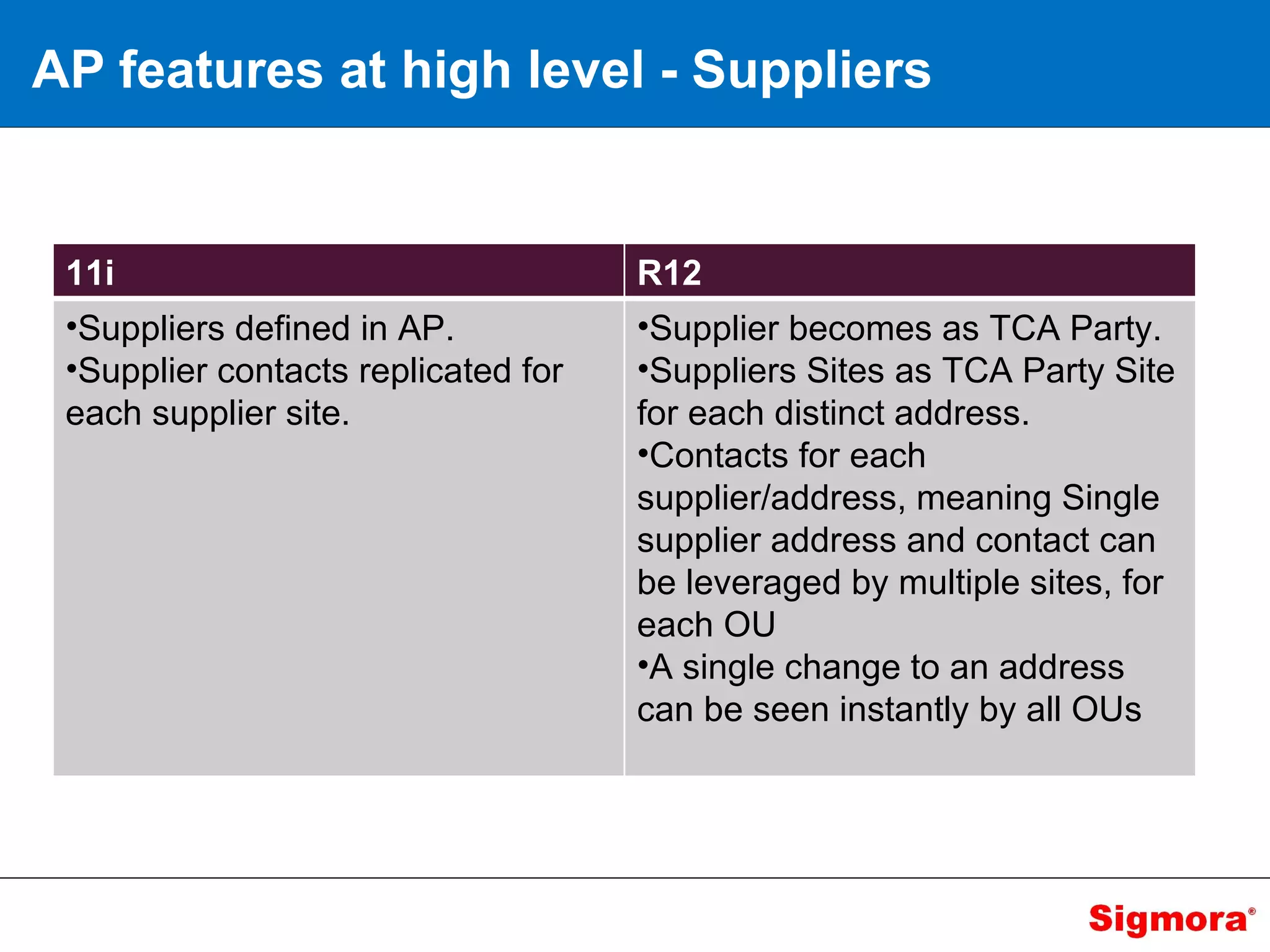
AP features at high level - Suppliers 11i R12 Suppliers defined in AP.  Supplier contacts replicated for each supplier site.  Supplier becomes as TCA Party.  Suppliers Sites as TCA Party Site for each distinct address.  Contacts for each supplier/address, meaning Single supplier address and contact can be leveraged by multiple sites, for each OU  A single change to an address can be seen instantly by all OUs
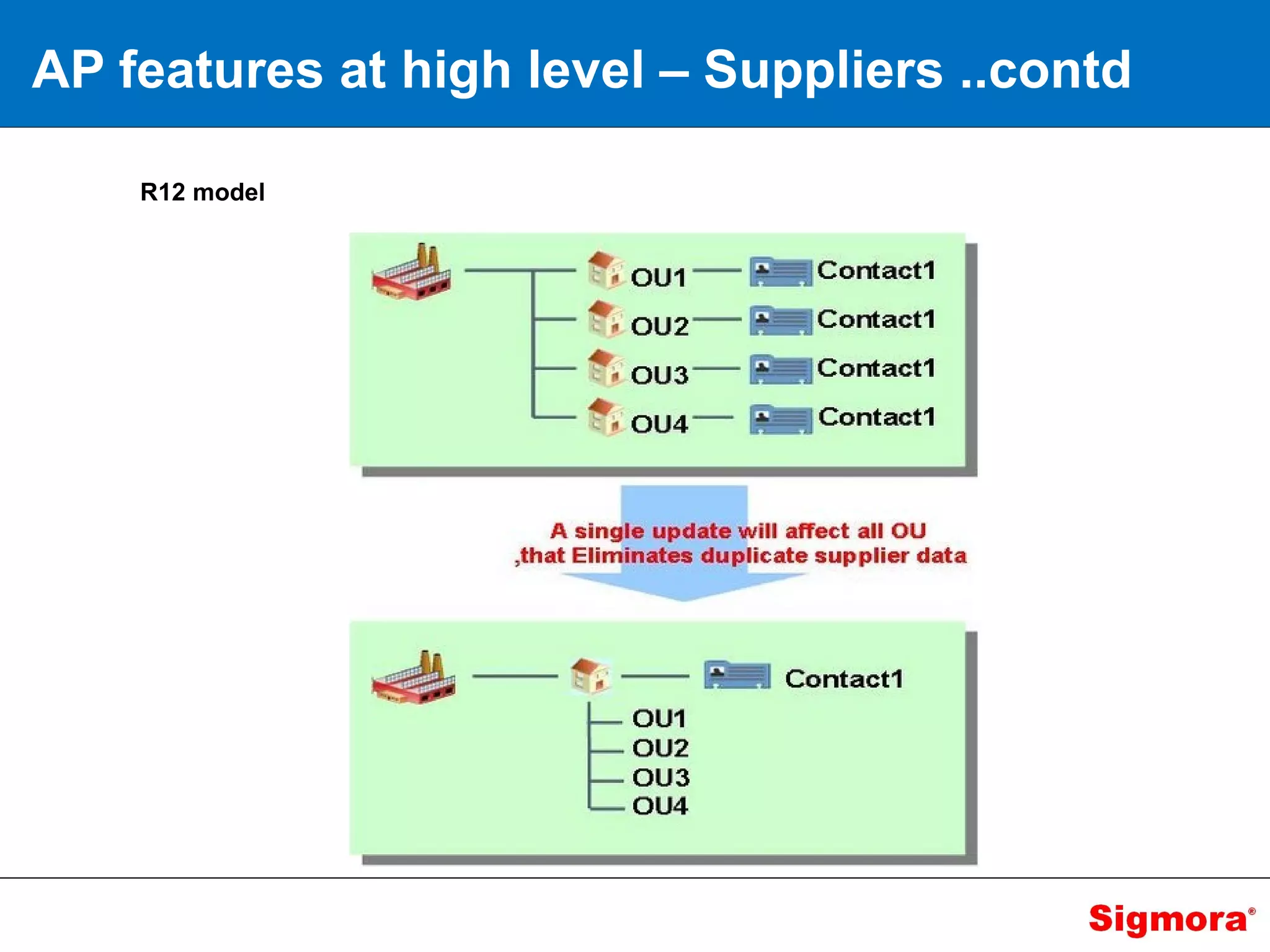
AP features at high level – Suppliers ..contd R12 model
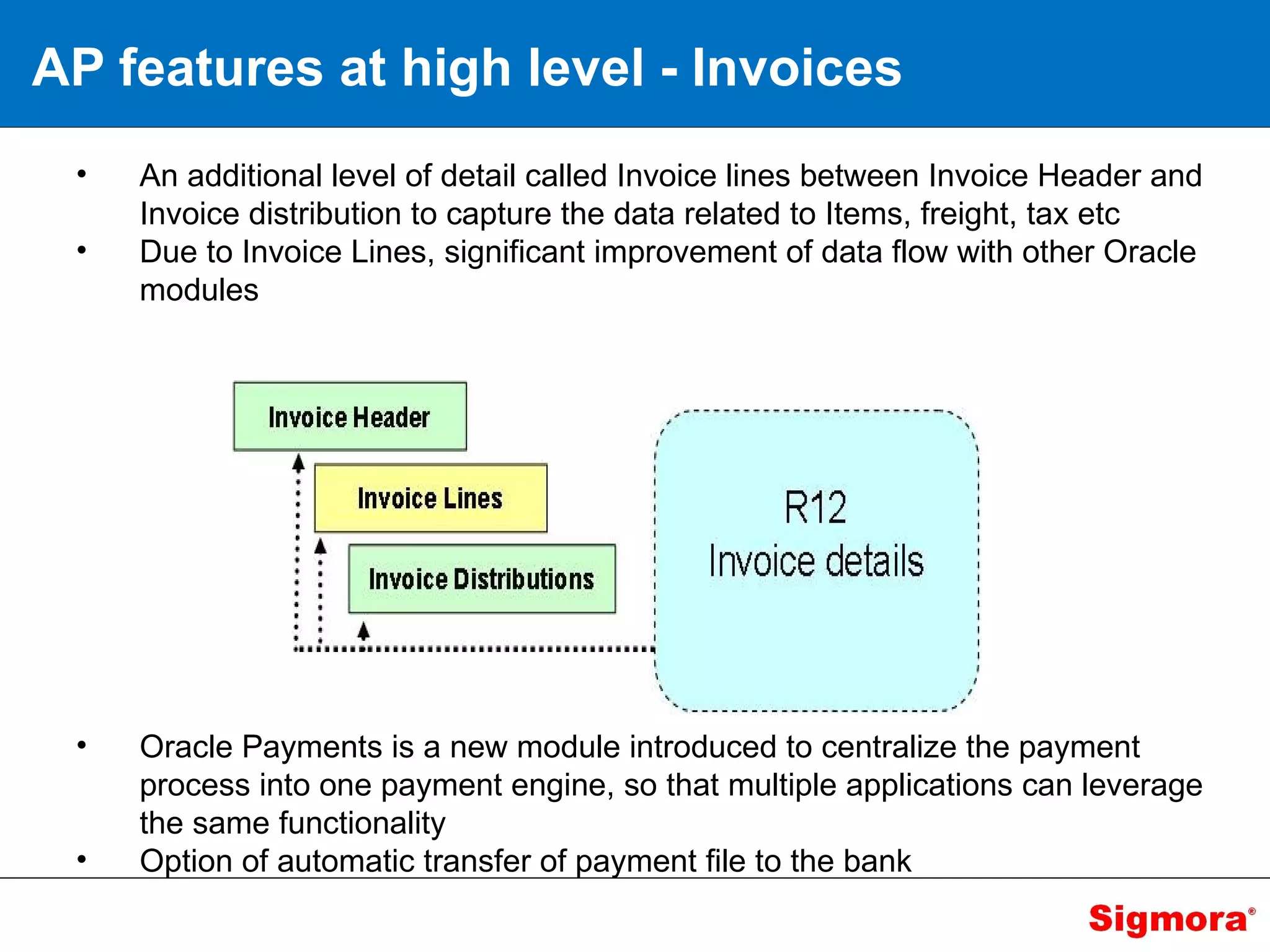
AP features at high level - Invoices An additional level of detail called Invoice lines between Invoice Header and Invoice distribution to capture the data related to Items, freight, tax etc Due to Invoice Lines, significant improvement of data flow with other Oracle modules Oracle Payments is a new module introduced to centralize the payment process into one payment engine, so that multiple applications can leverage the same functionality Option of automatic transfer of payment file to the bank
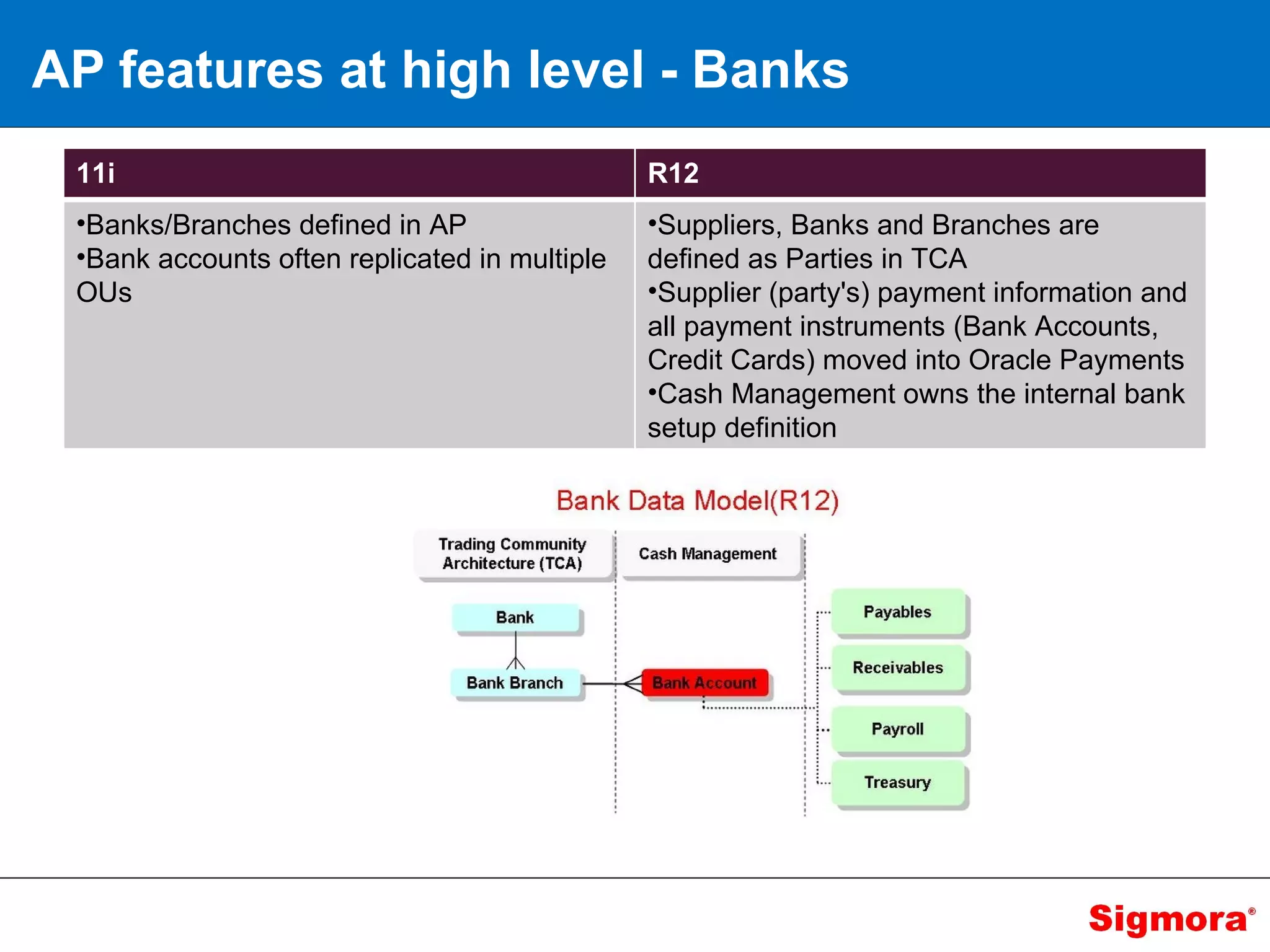
AP features at high level - Banks 11i R12 Banks/Branches defined in AP  Bank accounts often replicated in multiple OUs Suppliers, Banks and Branches are defined as Parties in TCA  Supplier (party's) payment information and all payment instruments (Bank Accounts, Credit Cards) moved into Oracle Payments Cash Management owns the internal bank setup definition
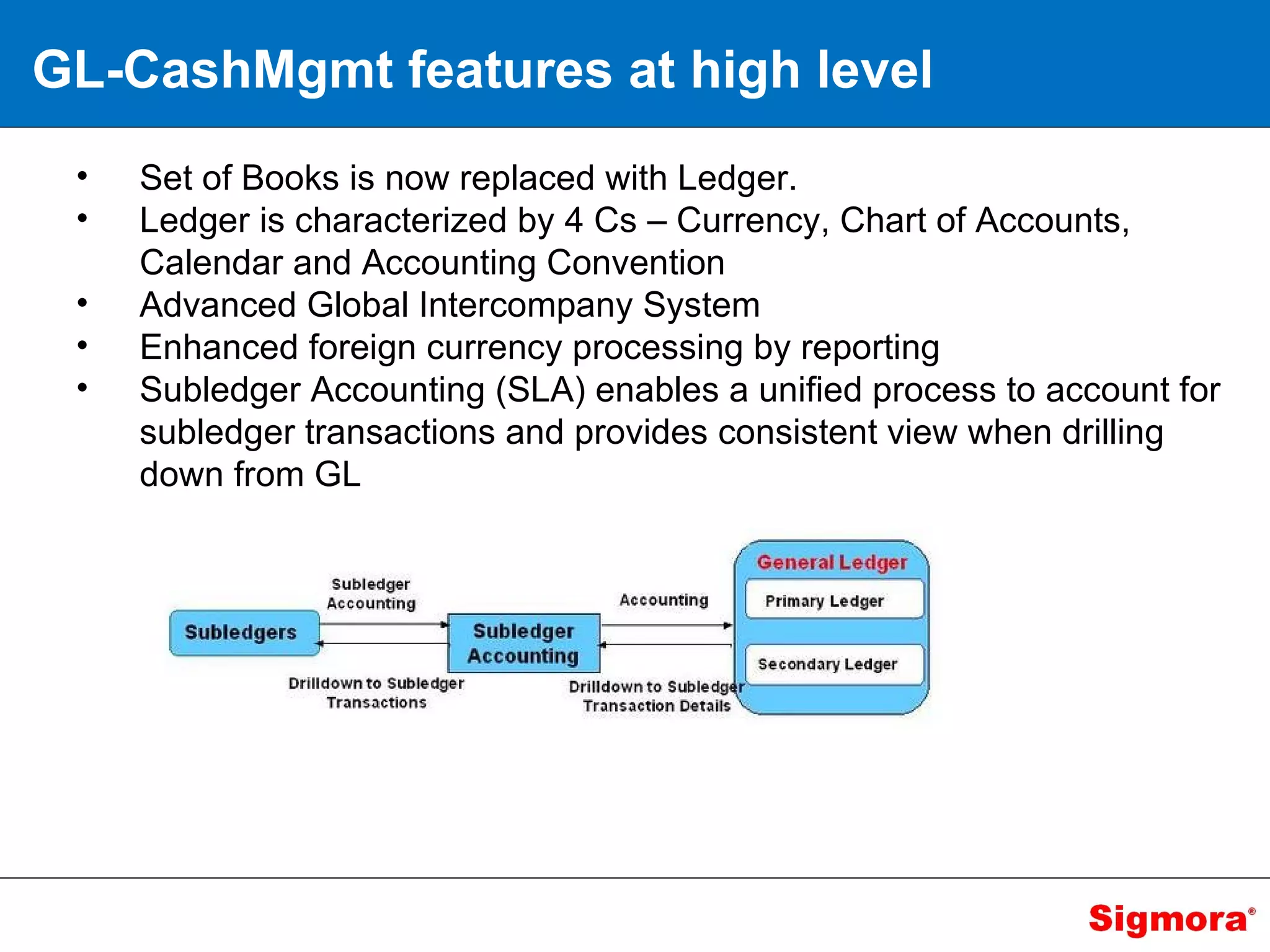
GL-CashMgmt features at high level Set of Books is now replaced with Ledger. Ledger is characterized by 4 Cs – Currency, Chart of Accounts, Calendar and Accounting Convention Advanced Global Intercompany System Enhanced foreign currency processing by reporting Subledger Accounting (SLA) enables a unified process to account for subledger transactions and provides consistent view when drilling down from GL
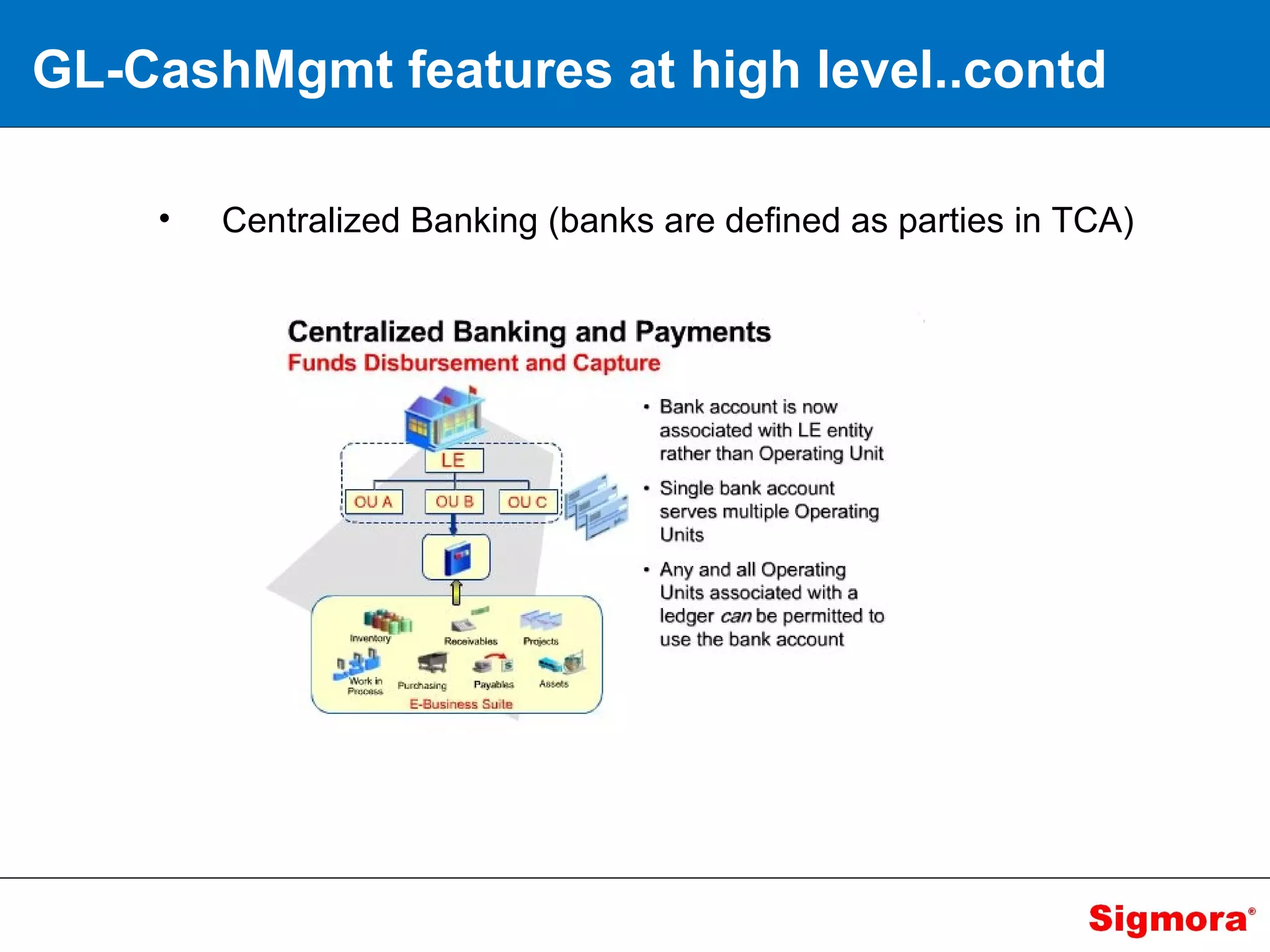
GL-CashMgmt features at high level..contd Centralized Banking (banks are defined as parties in TCA)
AR features at high level Revenue Recognition is based on rules and events Line level cash application feature enables application of receipts to specific transaction items like individual lines, tax or freight buckets Enhanced Customer Screen Matching of open receivables and open payables is automated
iProcurement and PO features at high level Country field is required when entering one time ship-to address in create requuisitions page New feature called Internal Reqs and Internal Sales Orders : Some attributes when changed on the approved internal req (eg. quantity or need-by date) is automatically reflected in Internal Sales Order  and vice versa. Realms are replaced by Content Security Management : gives more flexibility in controlling what is available to the users to procure Sales and use tax are calculated not based on the tax code entered but by the ship-to location and the business rules
HRMS features at high level Salary Administration : Vastly improved user interface for salary information, including high-interactivity embedded analytics Absence Management : Updated business flows and improved look and feel Check lists : Ability to link an HR action to a life event and generate a to-do/check list  when the life event is initiated Compensation Work Bench : Manage budget awards across multiple currencies, business groups and compensation types in a single worksheet with a new task oriented interface and worksheet that can be personalized. iRecruitment : Completely re-designed candidate registration.
Q & A Thanks for your attention! Sigmora Technologies www.sigmora.com [email_address] Page

R12 feature analysis_sigmora

  • 1.
    Oracle EBS R12features Analysis
  • 2.
    Agenda Overall R12features at high level R12 financials features at high level AP – Suppliers AP – Invoices AP – Banks GL and Cash Management AR iProcurement and PO HRMS features at high level Q & A
  • 3.
    Overall R12 featuresat high level Improved user experience Trading Community Architecture (TCA) while defining suppliers, banks, customers etc., preventing duplication of data entry across Operating Units First complete release on Fusion middleware Current version of 11i is going to be de-supported soon
  • 4.
    R12 Financials featuresat high level A single responsibility to access and transact on multiple organizations (called as MOAC – M ultiple O rganization AC cess) A single ledger to manage multiple currencies Centralized trading partners (suppliers, banks, first party legal entities) Subledger accounting and ledger sets to manage accounting processes across ledgers Centralized rules engine for tax, accounting and inter company A separate and simple payment creation and delivery solution New module called eBusiness tax to provide tax information for all transactions New Standard Reports New product family called ‘Oracle Channel Revenue Management’ consisting of Accounts Receivable Deduction Settlement Advanced Rebates and Point of Sale Management Price Protection Supplier Ship and Debit
  • 5.
    AP features athigh level - Suppliers 11i R12 Suppliers defined in AP. Supplier contacts replicated for each supplier site. Supplier becomes as TCA Party. Suppliers Sites as TCA Party Site for each distinct address. Contacts for each supplier/address, meaning Single supplier address and contact can be leveraged by multiple sites, for each OU A single change to an address can be seen instantly by all OUs
  • 6.
    AP features athigh level – Suppliers ..contd R12 model
  • 7.
    AP features athigh level - Invoices An additional level of detail called Invoice lines between Invoice Header and Invoice distribution to capture the data related to Items, freight, tax etc Due to Invoice Lines, significant improvement of data flow with other Oracle modules Oracle Payments is a new module introduced to centralize the payment process into one payment engine, so that multiple applications can leverage the same functionality Option of automatic transfer of payment file to the bank
  • 8.
    AP features athigh level - Banks 11i R12 Banks/Branches defined in AP Bank accounts often replicated in multiple OUs Suppliers, Banks and Branches are defined as Parties in TCA Supplier (party's) payment information and all payment instruments (Bank Accounts, Credit Cards) moved into Oracle Payments Cash Management owns the internal bank setup definition
  • 9.
    GL-CashMgmt features athigh level Set of Books is now replaced with Ledger. Ledger is characterized by 4 Cs – Currency, Chart of Accounts, Calendar and Accounting Convention Advanced Global Intercompany System Enhanced foreign currency processing by reporting Subledger Accounting (SLA) enables a unified process to account for subledger transactions and provides consistent view when drilling down from GL
  • 10.
    GL-CashMgmt features athigh level..contd Centralized Banking (banks are defined as parties in TCA)
  • 11.
    AR features athigh level Revenue Recognition is based on rules and events Line level cash application feature enables application of receipts to specific transaction items like individual lines, tax or freight buckets Enhanced Customer Screen Matching of open receivables and open payables is automated
  • 12.
    iProcurement and POfeatures at high level Country field is required when entering one time ship-to address in create requuisitions page New feature called Internal Reqs and Internal Sales Orders : Some attributes when changed on the approved internal req (eg. quantity or need-by date) is automatically reflected in Internal Sales Order and vice versa. Realms are replaced by Content Security Management : gives more flexibility in controlling what is available to the users to procure Sales and use tax are calculated not based on the tax code entered but by the ship-to location and the business rules
  • 13.
    HRMS features athigh level Salary Administration : Vastly improved user interface for salary information, including high-interactivity embedded analytics Absence Management : Updated business flows and improved look and feel Check lists : Ability to link an HR action to a life event and generate a to-do/check list when the life event is initiated Compensation Work Bench : Manage budget awards across multiple currencies, business groups and compensation types in a single worksheet with a new task oriented interface and worksheet that can be personalized. iRecruitment : Completely re-designed candidate registration.
  • 14.
    Q & AThanks for your attention! Sigmora Technologies www.sigmora.com [email_address] Page

Editor's Notes

  • #2 September 7, 2011
  • #15 September 7, 2011 Project Objective Statement: This should be a 25 word or less statement of the project objective, including scope, schedule and resources. Example: Implement a disaster recovery site for critical financial systems and processes by 6/1/04 for $500k. Note that at this point (New project) the details of schedule and cost/resources may not be known. Give an estimate from the Business case or use approximations, for example “Implement a disaster recovery site for critical financial systems and processes by summer 2004 for less than $1M”. Scope Statement: give a several sentence long statement of the scope of this project What is NOT Included: if there are specific things that are excluded from this project, point those out here. For example: “This project will provide functionality for EMEA only, rollout to the US and APAC will occur at a later time.”