Engineering Mechanics-II
Project
 To study the motion analysis of
Quick Return Mechanism
through Cam Follower.
Components of Projects
 Cam
 Follower
 Bearings
 Shafts
 Spring
Theory
Cam-follower mechanism:
The slider or roller in contact with the cam that
transmits the movement dictated by the cam
profile.
Cams:
Cam is a machine element which is used in cam
and follower mechanism to transmit the rotatory
motion into linear motion with help of follower
Types of cam :
1. Radial or Disc cam
2. Cylindrical cam
3. Translation or wedge cam
4. Spherical cam
Cam and Follower
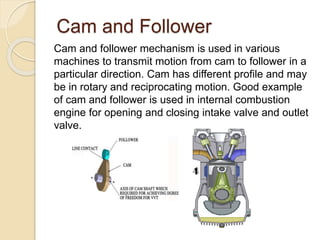
Cam and follower mechanism is used in various
machines to transmit motion from cam to follower in a
particular direction. Cam has different profile and may
be in rotary and reciprocating motion. Good example
of cam and follower is used in internal combustion
engine for opening and closing intake valve and outlet
valve.
Quick Return Mechanism
The Whitworth quick return mechanism converts
rotary motion into reciprocating motion, but unlike the
crank and slider, the forward reciprocating motion is
at a different rate than the backward stroke. This
mechanism is used in shaping machines and
presses.
Cams and Followers
Cam :
Cam is rotating machine element which provides
reciprocating or oscillating motion to the follower.
Follower :
Follower converts the rotary motion of cam into
reciprocating or oscillating motion.
Classification of followers
Based on surface of contact
All these types of followers are
reciprocating followers:
1. Knife edge follower
2. Roller follower
3. Flat-faced follower
4. Spherical follower
Knife Edge Follower
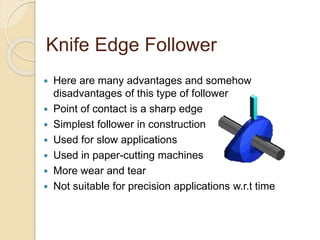
 Here are many advantages and somehow
disadvantages of this type of follower
 Point of contact is a sharp edge
 Simplest follower in construction
 Used for slow applications
 Used in paper-cutting machines
 More wear and tear
 Not suitable for precision applications w.r.t time
Roller Follower
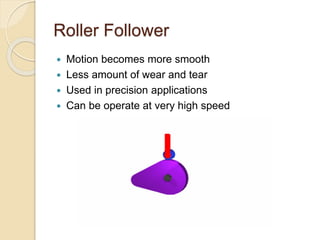
 Motion becomes more smooth
 Less amount of wear and tear
 Used in precision applications
 Can be operate at very high speed
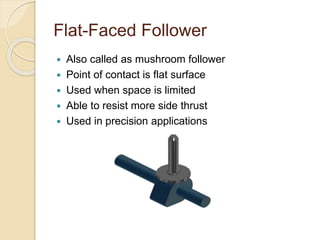
Flat-Faced Follower
 Also called as mushroom follower
 Point of contact is flat surface
 Used when space is limited
 Able to resist more side thrust
 Used in precision applications
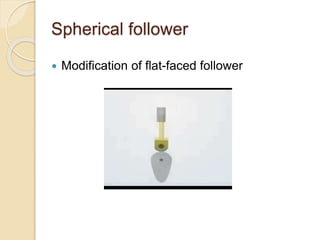
Spherical follower
 Modification of flat-faced follower
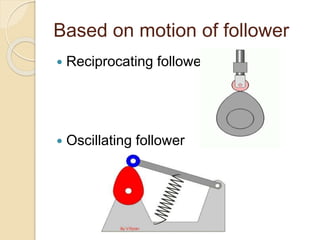
Based on motion of follower
 Reciprocating follower
 Oscillating follower
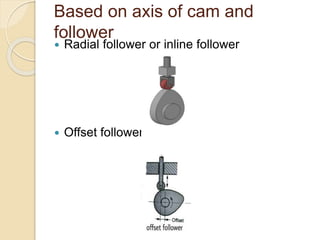
Based on axis of cam and
follower
 Radial follower or inline follower
 Offset follower
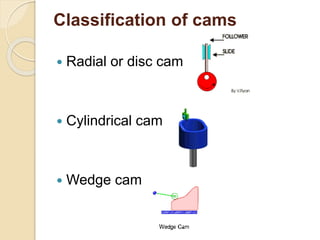
Classification of cams
 Radial or disc cam
 Cylindrical cam
 Wedge cam
How to design cam follower
apparatus?
 What should be the length of follower?
 What should be the max displacement by
follower?
 How can we increase or decrease the
displacement of follower?
 What should be the length of the lobe lift?
 What a new design as compare to the
conventional cam?
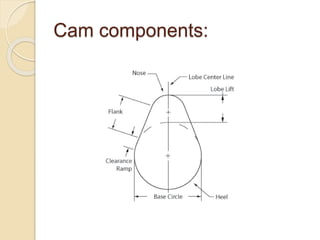
Cam components:
Cam design information
 Cam hole through which shaft has inserted
diameter 23mm (around which cam rotate ).
 As the dia of shaft is too small. So 360º
degrees cannot be mentioned as it has a
cause it will be difficult to see as 360 lines
will be marked and they will overlap.
 So we created a scale of 1 small line = 4º
degrees.
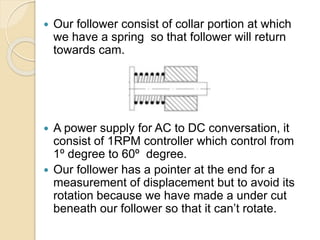
 Our follower consist of collar portion at which
we have a spring so that follower will return
towards cam.
 A power supply for AC to DC conversation, it
consist of 1RPM controller which control from
1º degree to 60º degree.
 Our follower has a pointer at the end for a
measurement of displacement but to avoid its
rotation because we have made a under cut
beneath our follower so that it can’t rotate.
 We also attached a gear motor to
develop automatic continues rotation.
Manufacturing:
 We can cut the cam through CNC wire
cutting machine.
 Follower and block manufacture through
casting and then machining.

Quik return mechanism_through_cam_follower_mechanism

  • 1.
  • 2.
    Project  To studythe motion analysis of Quick Return Mechanism through Cam Follower.
  • 3.
    Components of Projects Cam  Follower  Bearings  Shafts  Spring
  • 4.
    Theory Cam-follower mechanism: The slideror roller in contact with the cam that transmits the movement dictated by the cam profile. Cams: Cam is a machine element which is used in cam and follower mechanism to transmit the rotatory motion into linear motion with help of follower Types of cam : 1. Radial or Disc cam 2. Cylindrical cam 3. Translation or wedge cam 4. Spherical cam
  • 5.
    Cam and Follower Camand follower mechanism is used in various machines to transmit motion from cam to follower in a particular direction. Cam has different profile and may be in rotary and reciprocating motion. Good example of cam and follower is used in internal combustion engine for opening and closing intake valve and outlet valve.
  • 6.
    Quick Return Mechanism TheWhitworth quick return mechanism converts rotary motion into reciprocating motion, but unlike the crank and slider, the forward reciprocating motion is at a different rate than the backward stroke. This mechanism is used in shaping machines and presses.
  • 7.
    Cams and Followers Cam: Cam is rotating machine element which provides reciprocating or oscillating motion to the follower. Follower : Follower converts the rotary motion of cam into reciprocating or oscillating motion.
  • 8.
    Classification of followers Basedon surface of contact All these types of followers are reciprocating followers: 1. Knife edge follower 2. Roller follower 3. Flat-faced follower 4. Spherical follower
  • 9.
    Knife Edge Follower Here are many advantages and somehow disadvantages of this type of follower  Point of contact is a sharp edge  Simplest follower in construction  Used for slow applications  Used in paper-cutting machines  More wear and tear  Not suitable for precision applications w.r.t time
  • 10.
    Roller Follower  Motionbecomes more smooth  Less amount of wear and tear  Used in precision applications  Can be operate at very high speed
  • 11.
    Flat-Faced Follower  Alsocalled as mushroom follower  Point of contact is flat surface  Used when space is limited  Able to resist more side thrust  Used in precision applications
  • 12.
  • 13.
    Based on motionof follower  Reciprocating follower  Oscillating follower
  • 14.
    Based on axisof cam and follower  Radial follower or inline follower  Offset follower
  • 15.
    Classification of cams Radial or disc cam  Cylindrical cam  Wedge cam
  • 16.
    How to designcam follower apparatus?  What should be the length of follower?  What should be the max displacement by follower?  How can we increase or decrease the displacement of follower?  What should be the length of the lobe lift?  What a new design as compare to the conventional cam?
  • 17.
  • 18.
    Cam design information Cam hole through which shaft has inserted diameter 23mm (around which cam rotate ).  As the dia of shaft is too small. So 360º degrees cannot be mentioned as it has a cause it will be difficult to see as 360 lines will be marked and they will overlap.  So we created a scale of 1 small line = 4º degrees.
  • 19.
     Our followerconsist of collar portion at which we have a spring so that follower will return towards cam.  A power supply for AC to DC conversation, it consist of 1RPM controller which control from 1º degree to 60º degree.  Our follower has a pointer at the end for a measurement of displacement but to avoid its rotation because we have made a under cut beneath our follower so that it can’t rotate.
  • 20.
     We alsoattached a gear motor to develop automatic continues rotation. Manufacturing:  We can cut the cam through CNC wire cutting machine.  Follower and block manufacture through casting and then machining.