Module 2
Queuing Models
• The service times of successive arrivals are denoted by S1, S2, S3, . . . They may be constant or of random
duration.
• In the latter case, {S1, S2, S3, . . . } is usually characterized as a sequence of independent and identically
distributed random variables.
• The exponential, Weibull, gamma, lognormal and truncated normal distributions have all been used
successfully as models of service times in different situations.
• Sometimes services are identically distributed for all customers of a given type or class or priority,
whereas customers of different types might have completely different service-time distributions.
• In addition, in some systems, service times depend upon the time of day or upon the length of the
waiting line.
• For example, servers might work faster than usual when the waiting line is long, thus effectively reducing
the service times.
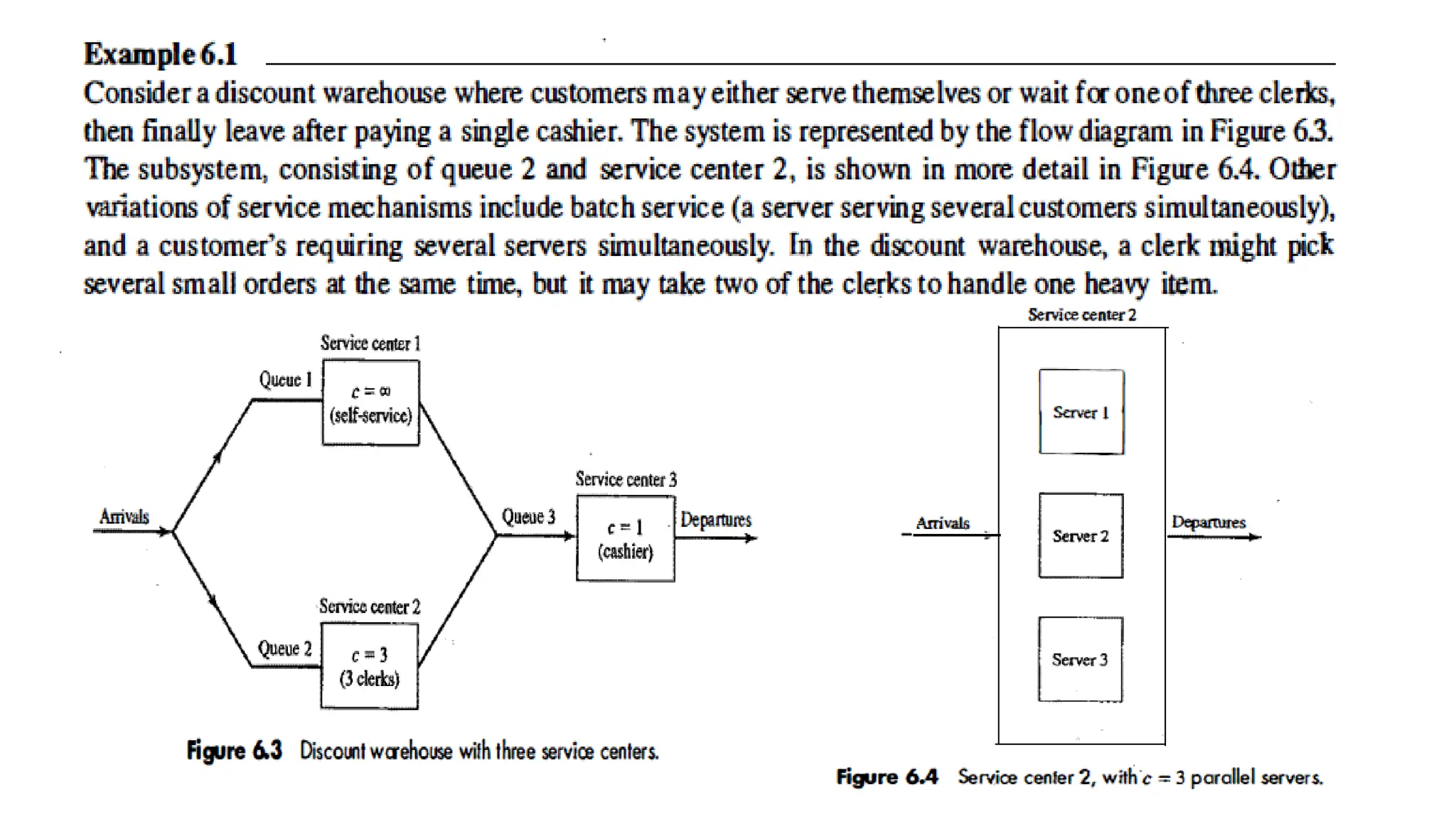
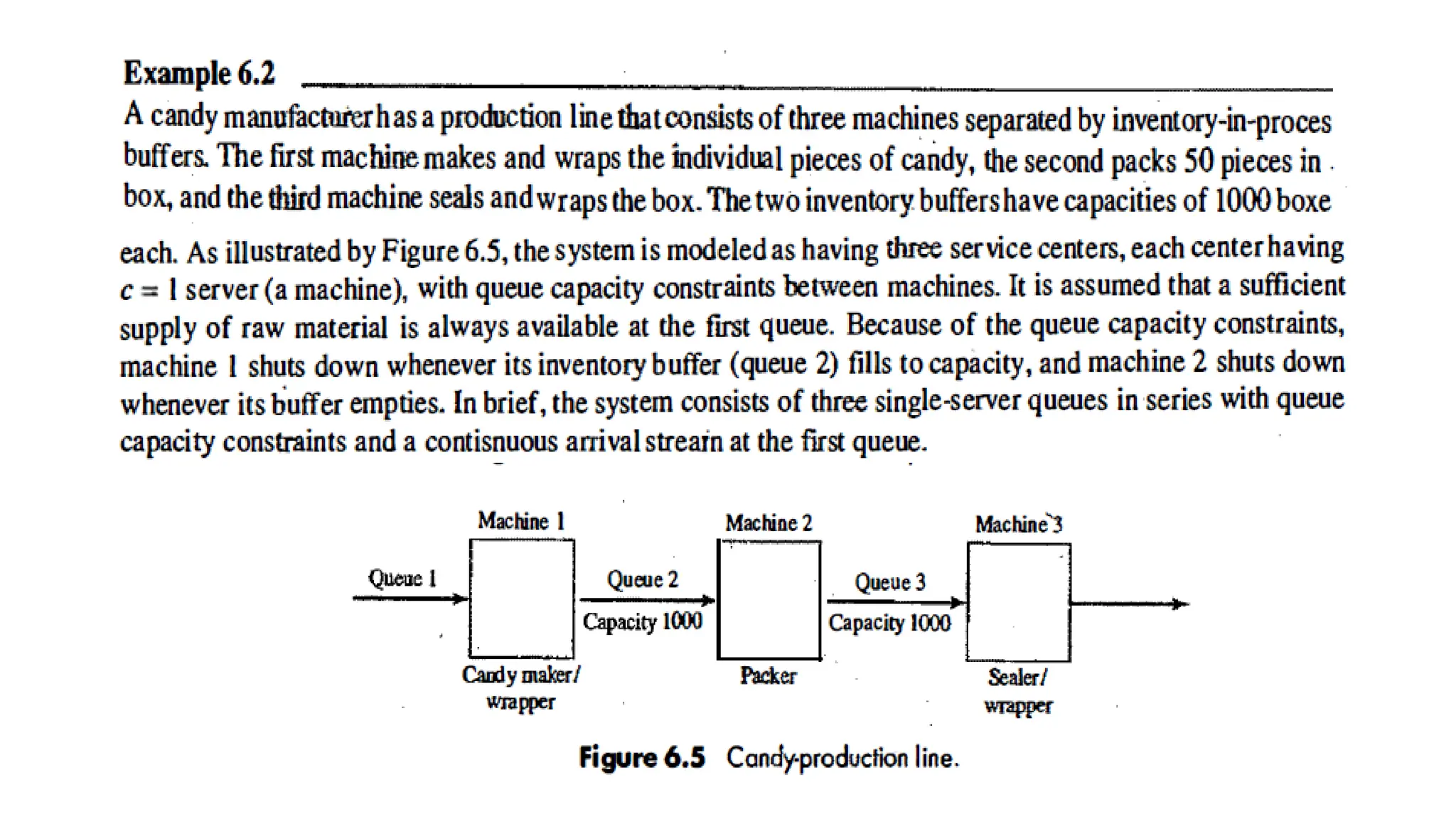
• A queueing system consists of a number of service centers and interconnecting queues.
• Each service center consists of some number of servers, c, working in parallel;
that is, upon getting to the head of the line, a customer takes, the first available server.
• Parallel service mechanisms are either single server (c = 1), multiple server (1 < c < ∞ ), or unlimited
servers (c = ∞ ).
• A self-service facility is usually characterized as having an unlimited number of servers.
Service Times and Service Mechanism
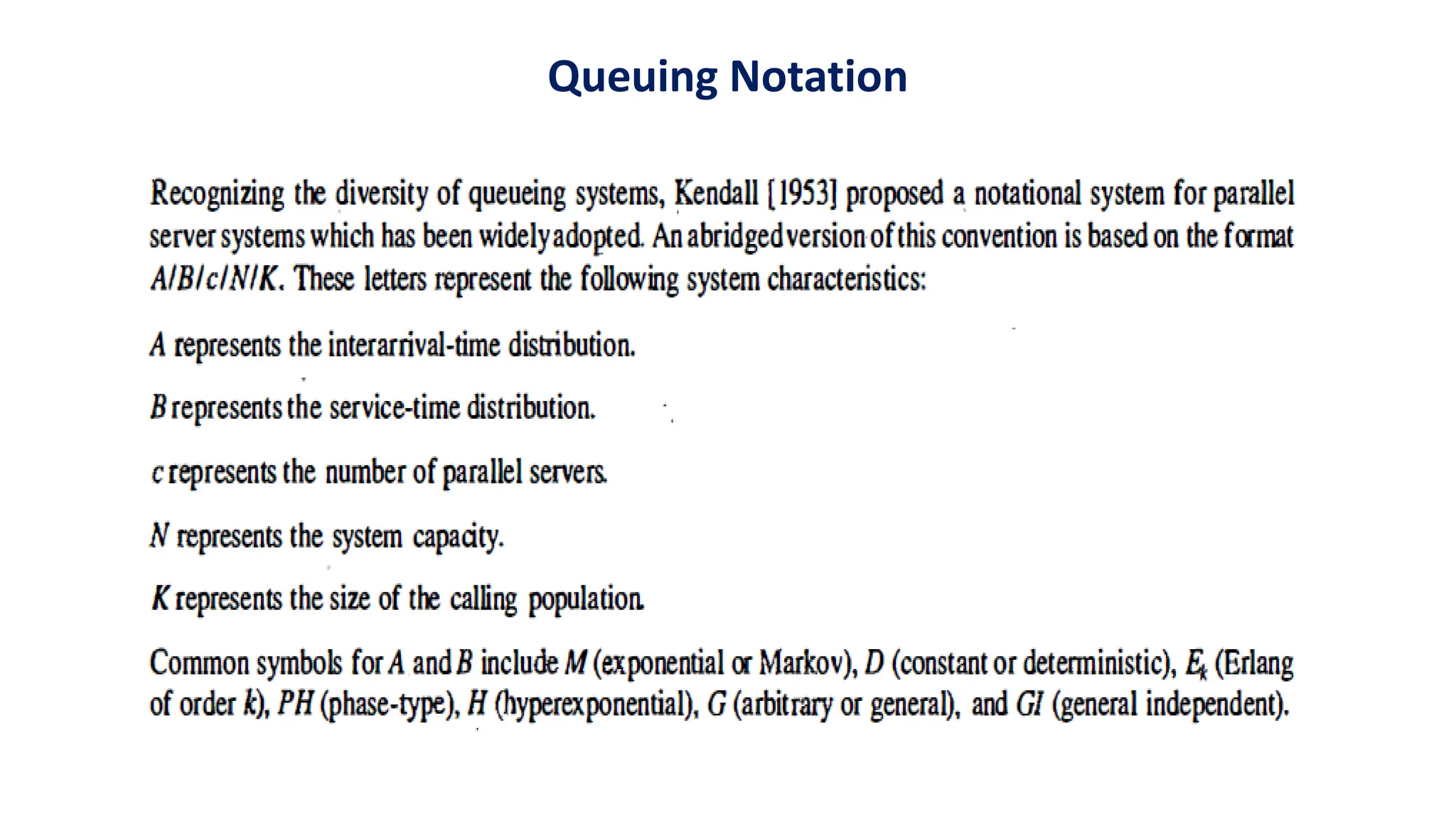
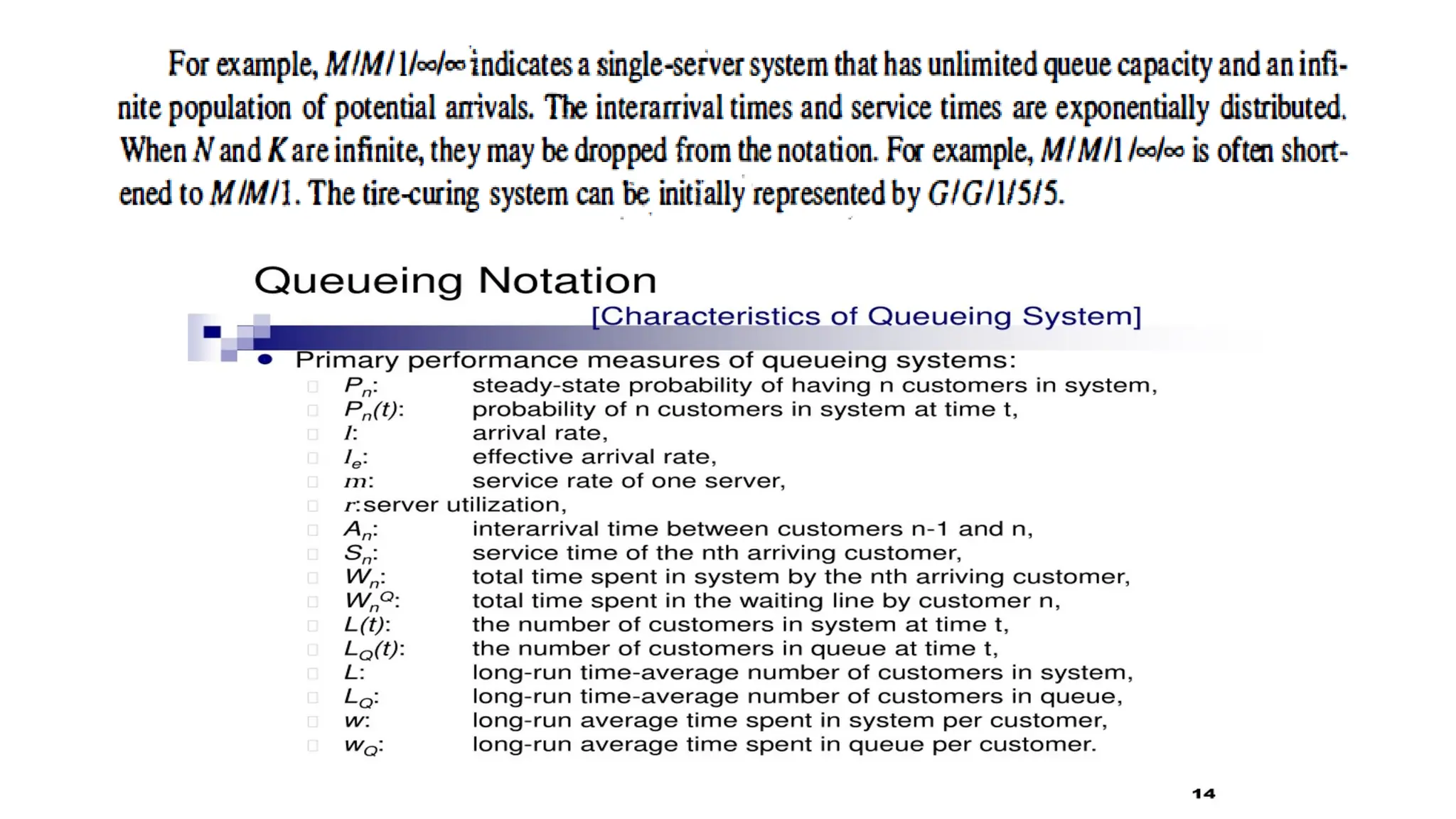
Queuing Notation
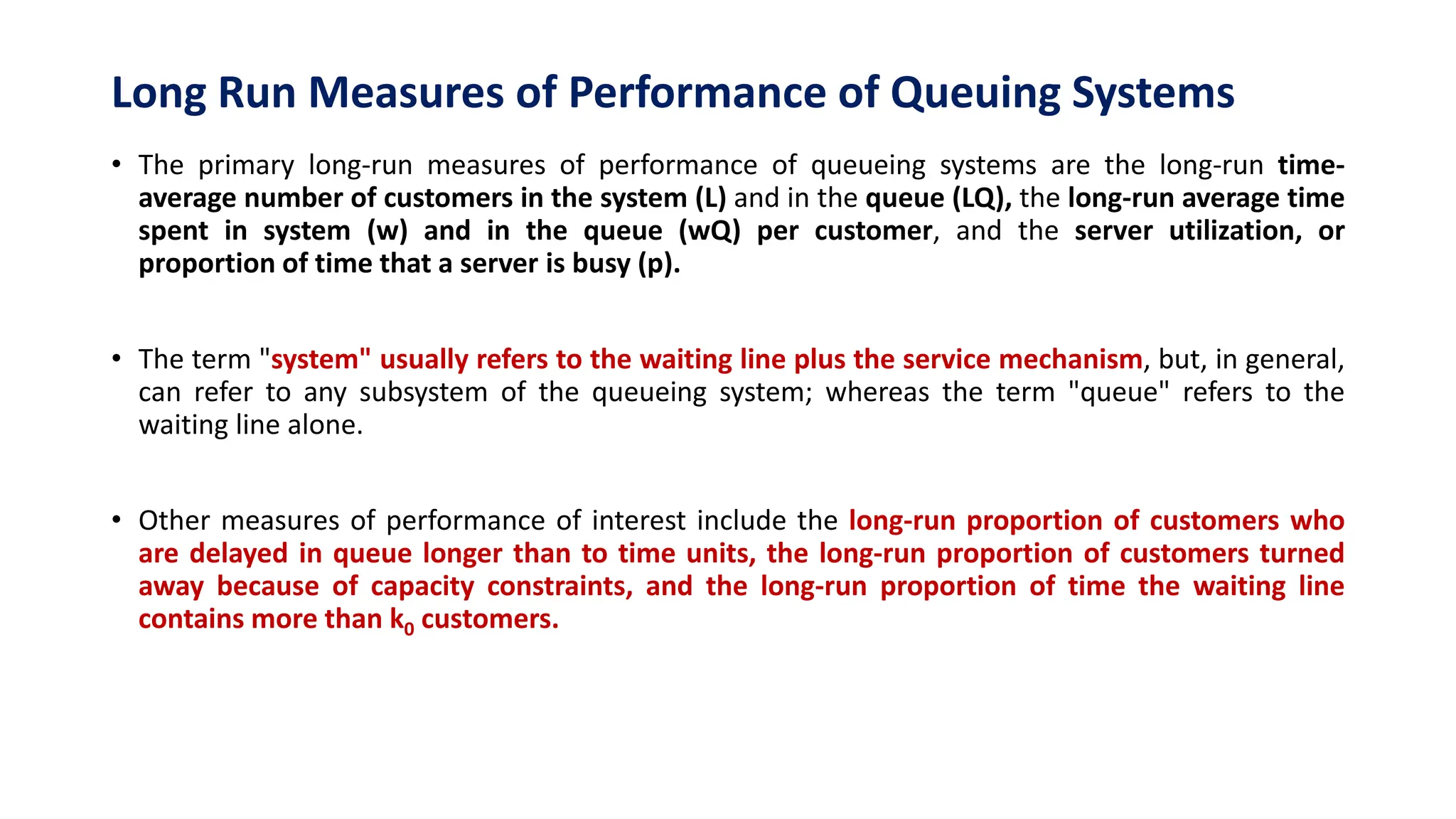
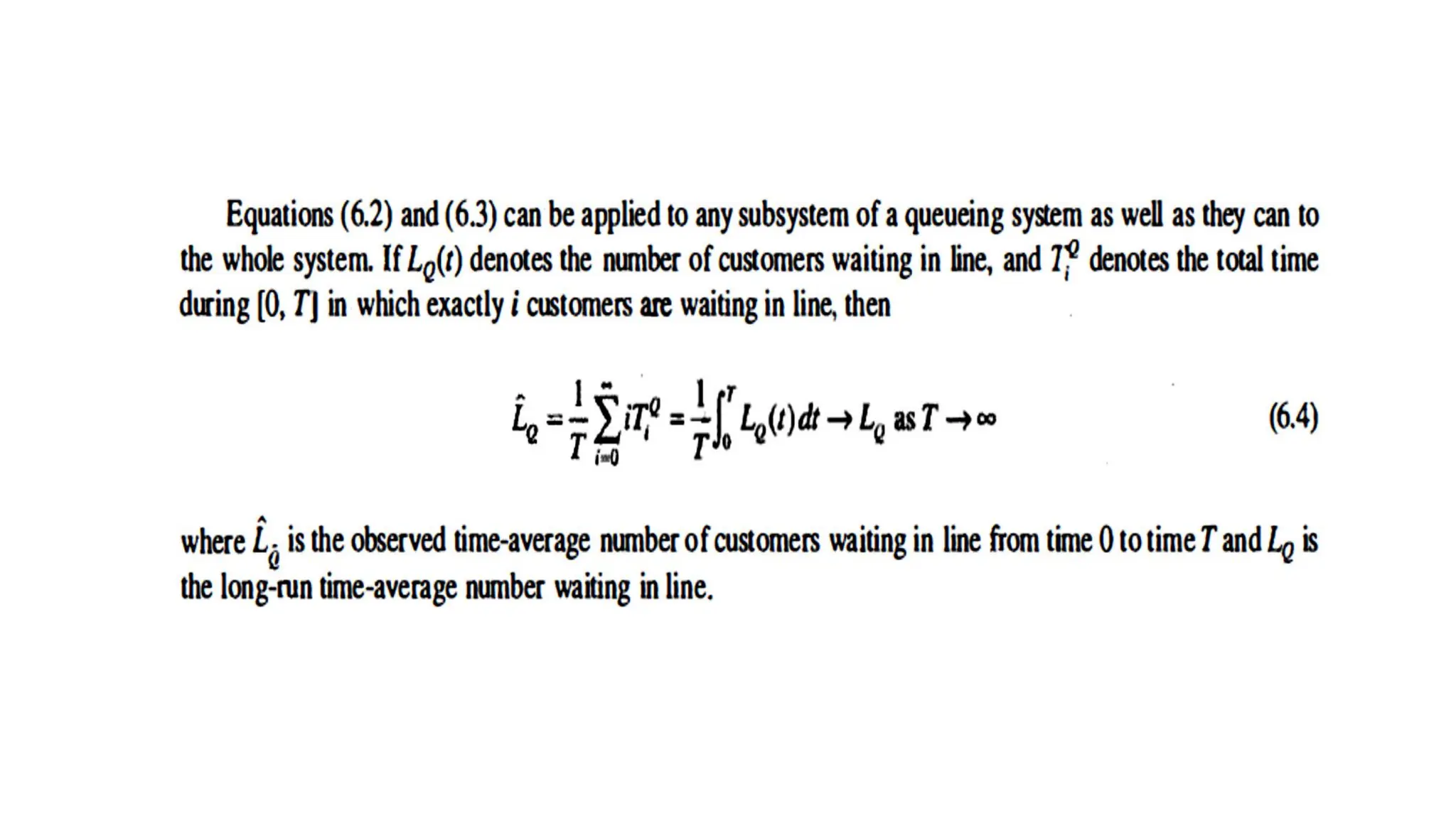
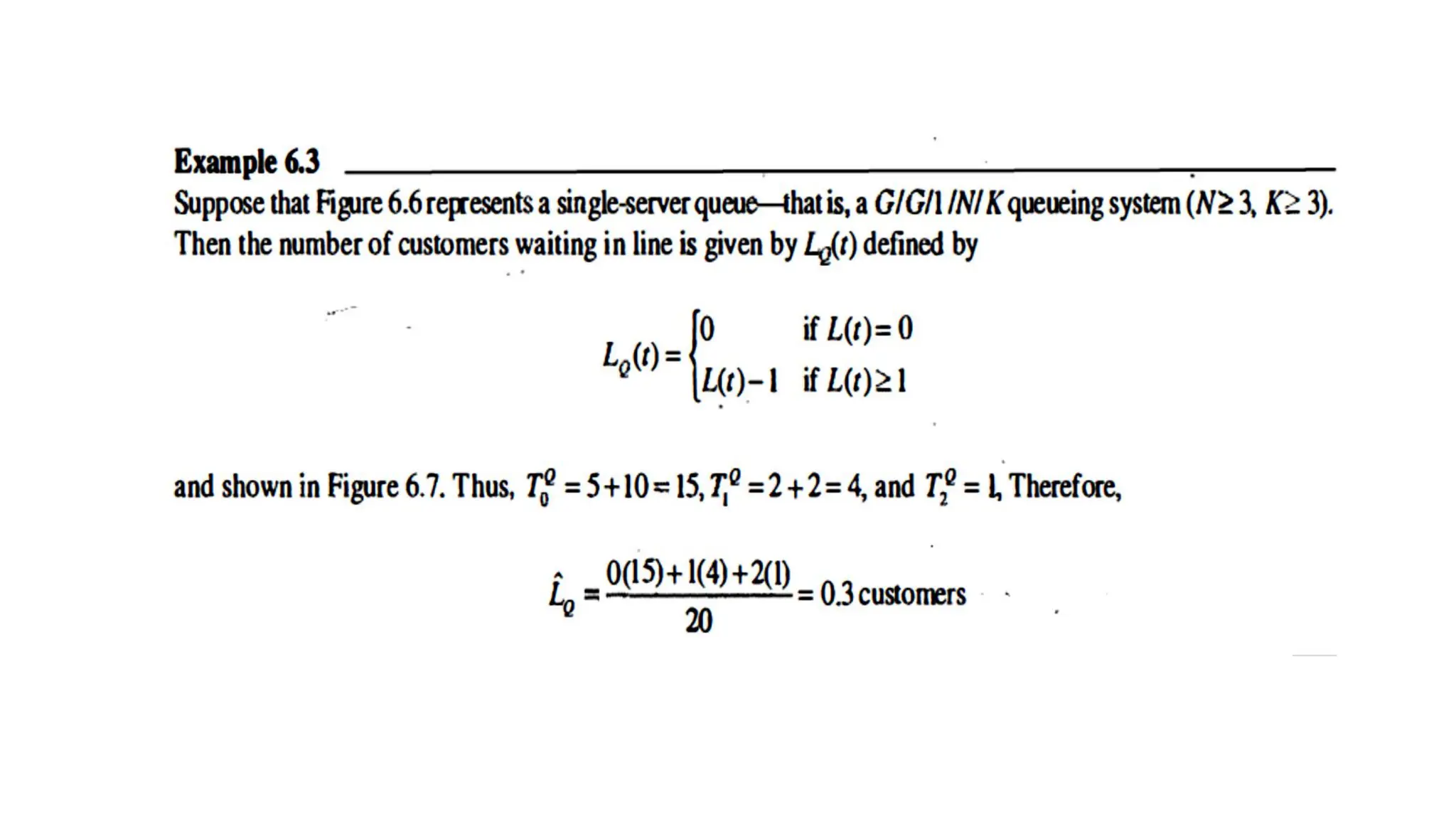
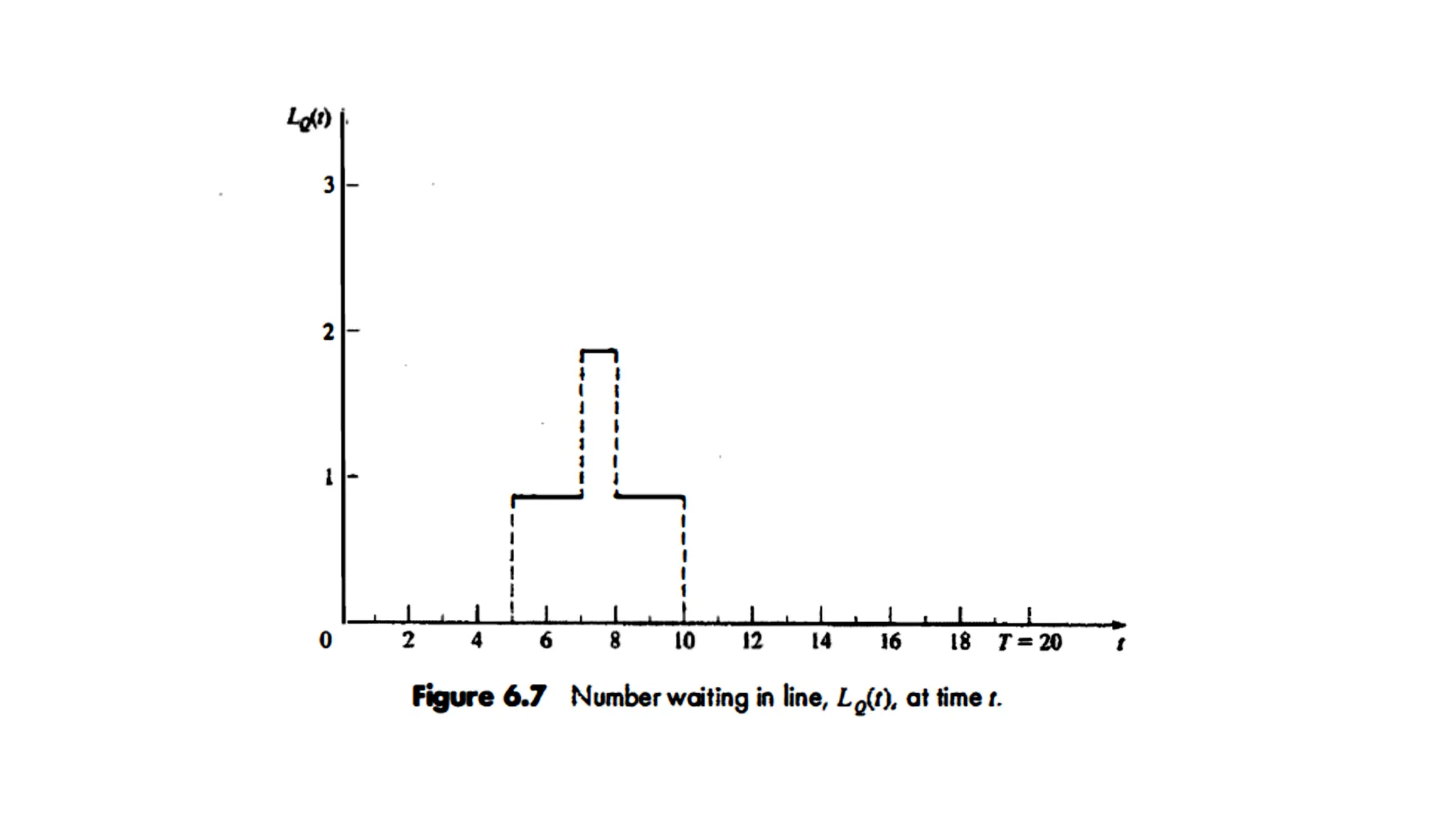
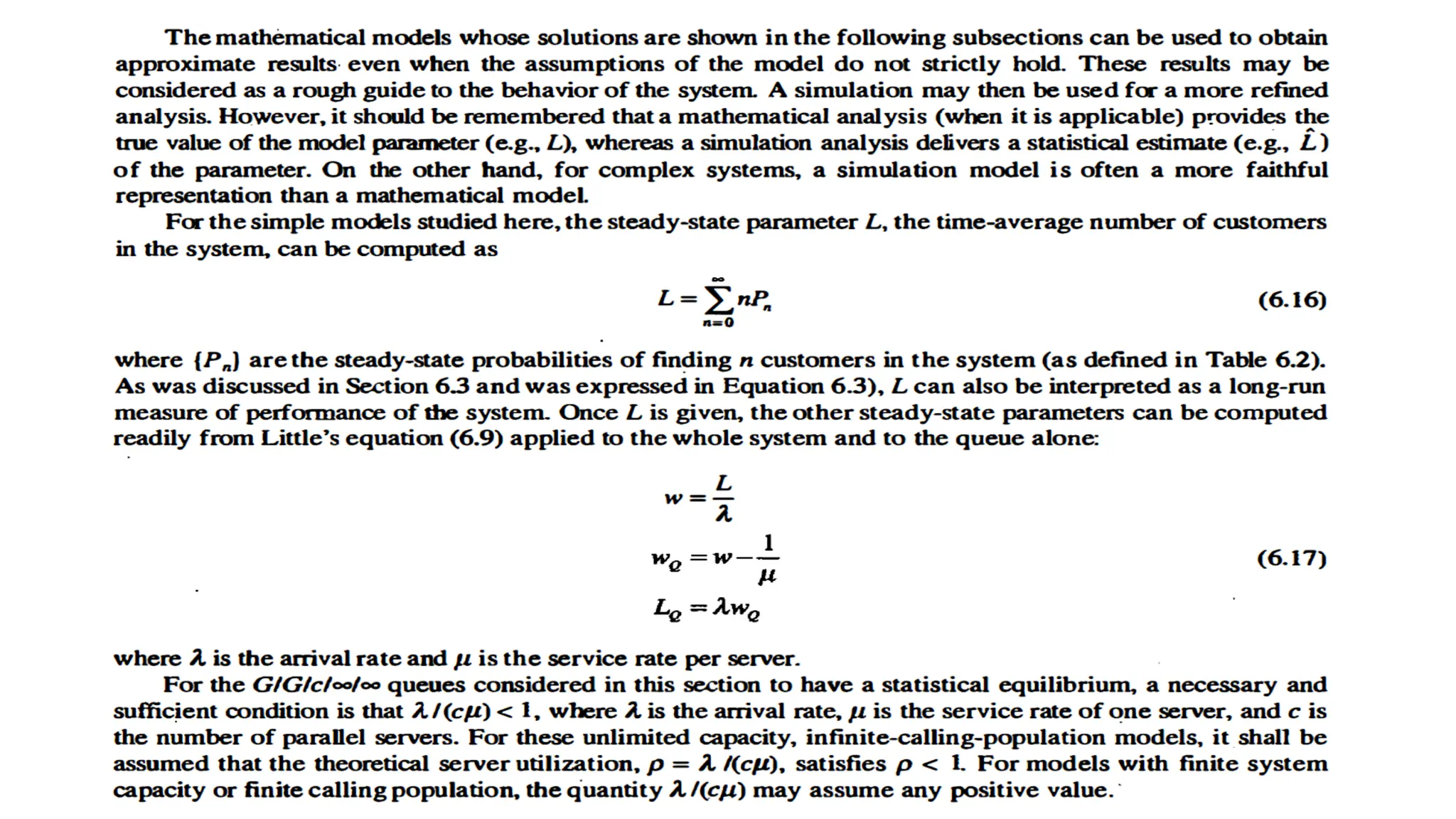
Long Run Measures of Performance of Queuing Systems
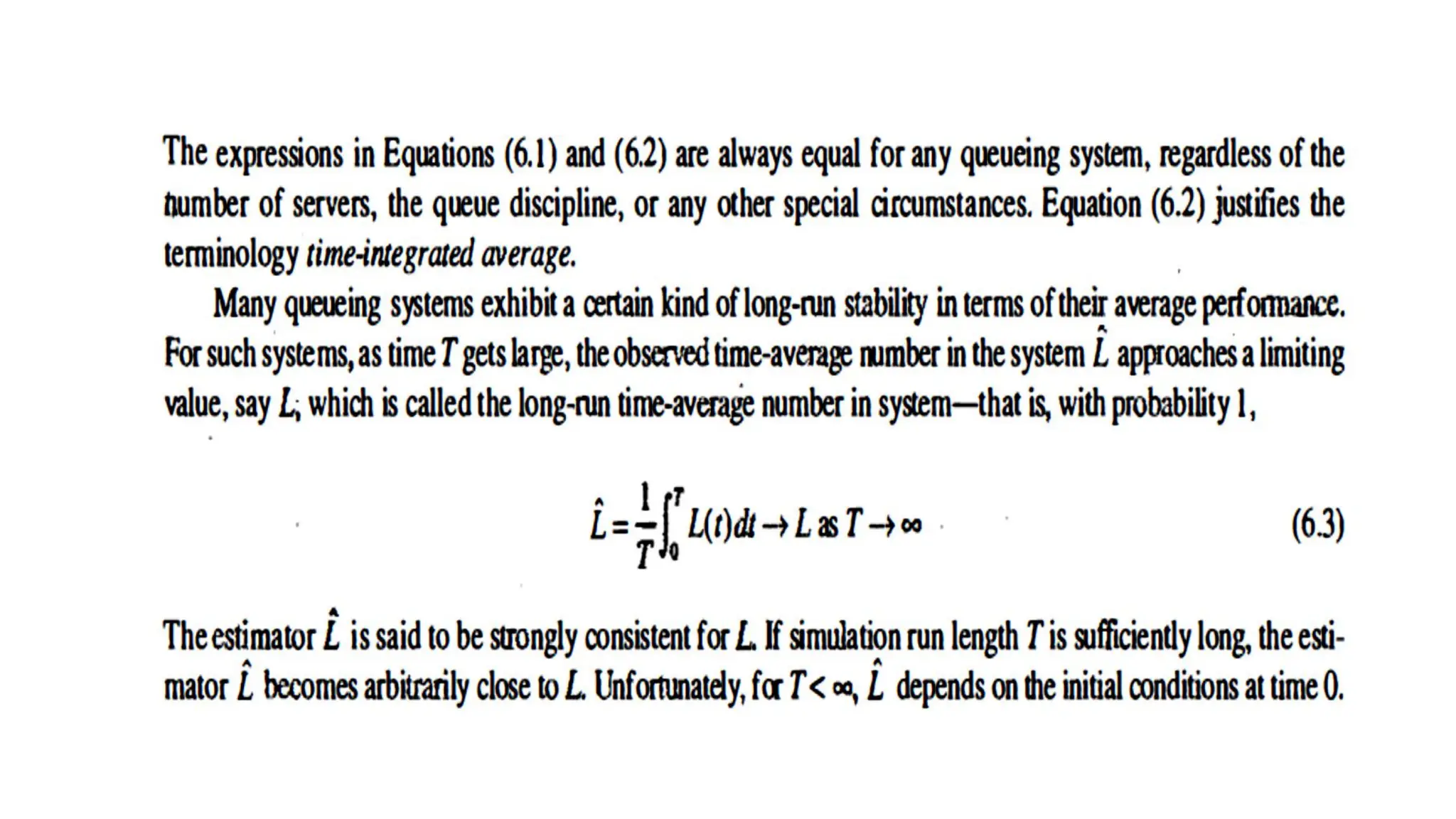
• The primary long-run measures of performance of queueing systems are the long-run time-
average number of customers in the system (L) and in the queue (LQ), the long-run average time
spent in system (w) and in the queue (wQ) per customer, and the server utilization, or
proportion of time that a server is busy (p).
• The term "system" usually refers to the waiting line plus the service mechanism, but, in general,
can refer to any subsystem of the queueing system; whereas the term "queue" refers to the
waiting line alone.
• Other measures of performance of interest include the long-run proportion of customers who
are delayed in queue longer than to time units, the long-run proportion of customers turned
away because of capacity constraints, and the long-run proportion of time the waiting line
contains more than k0 customers.
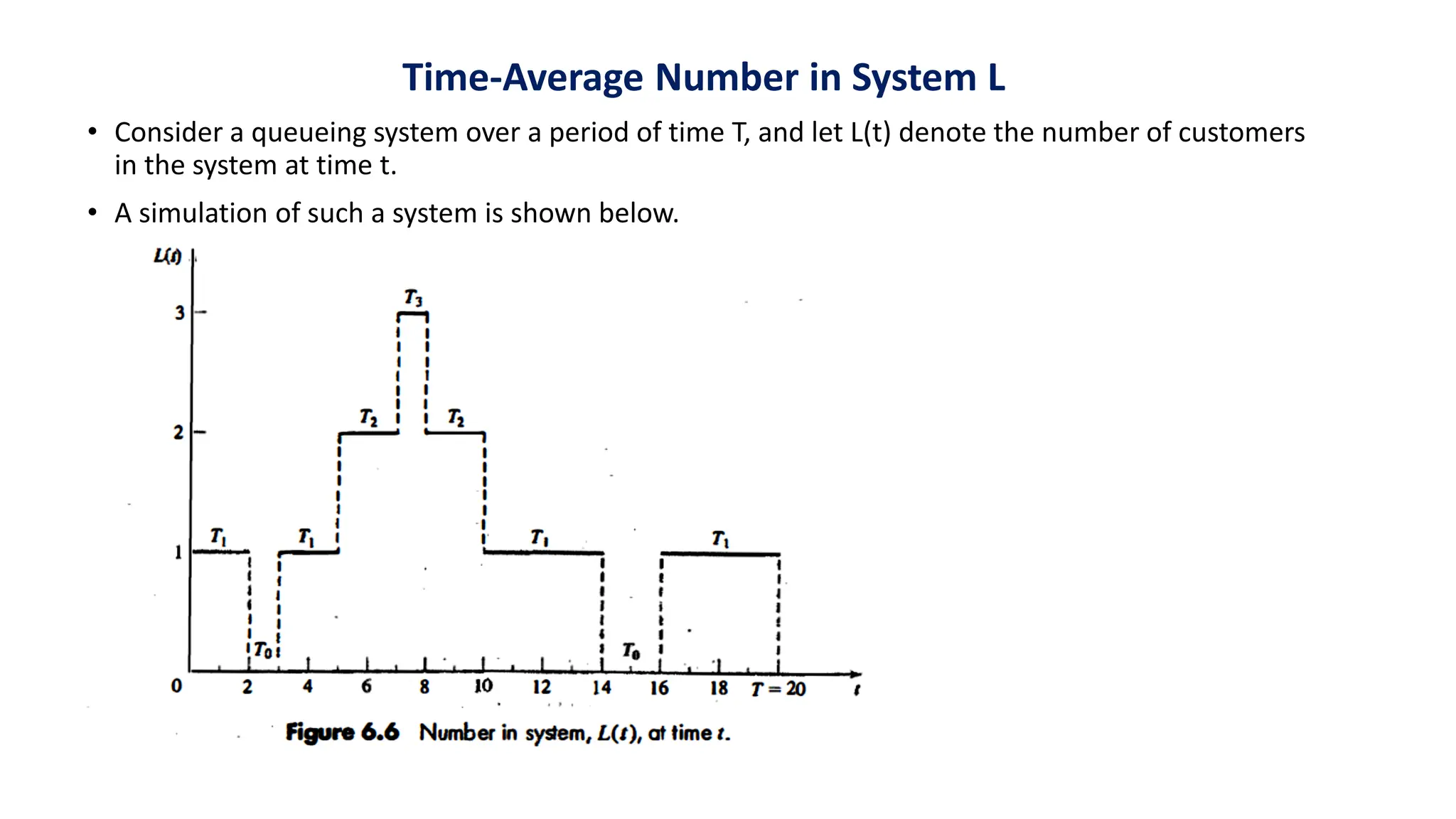
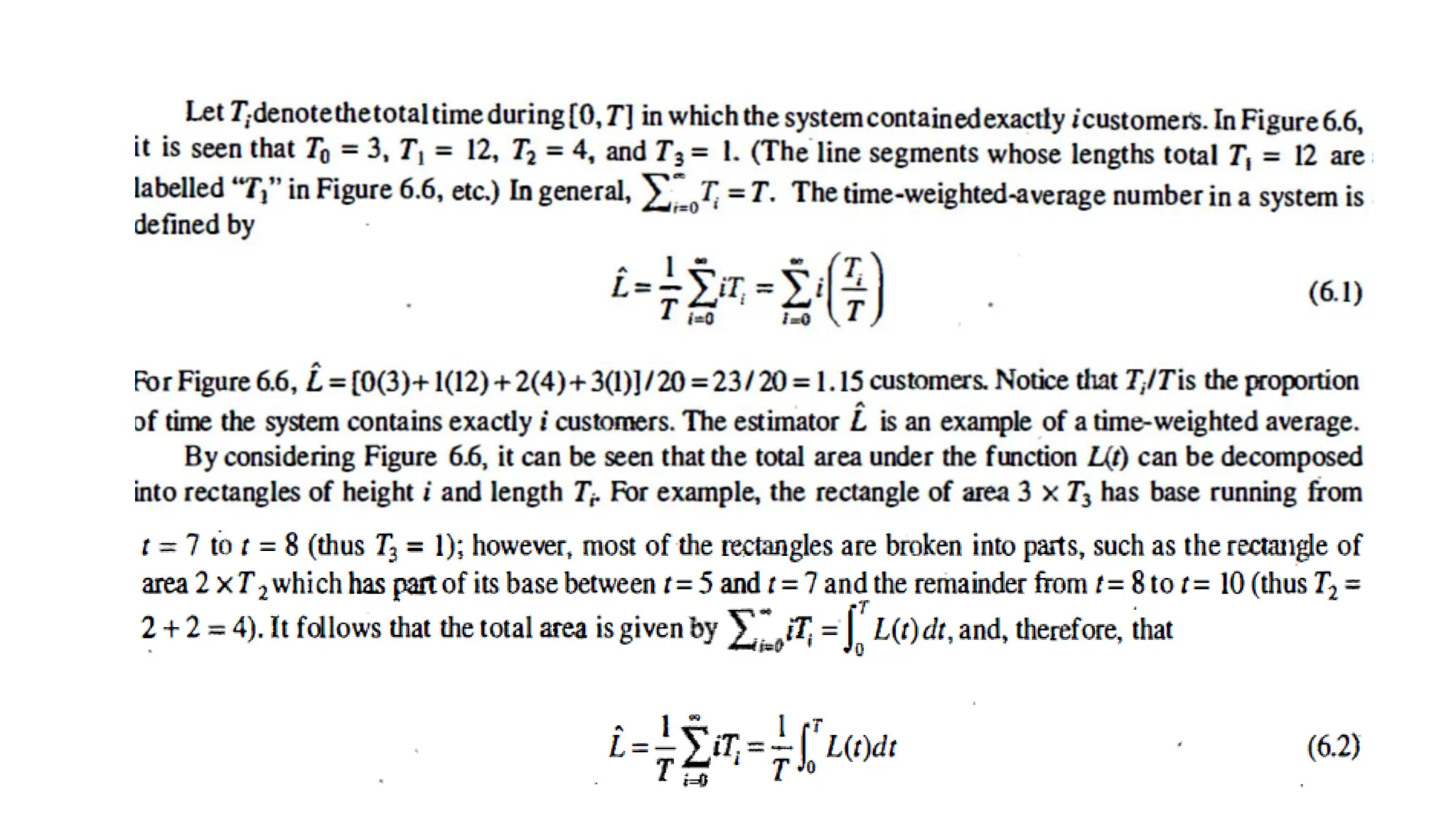
Time-Average Number in System L
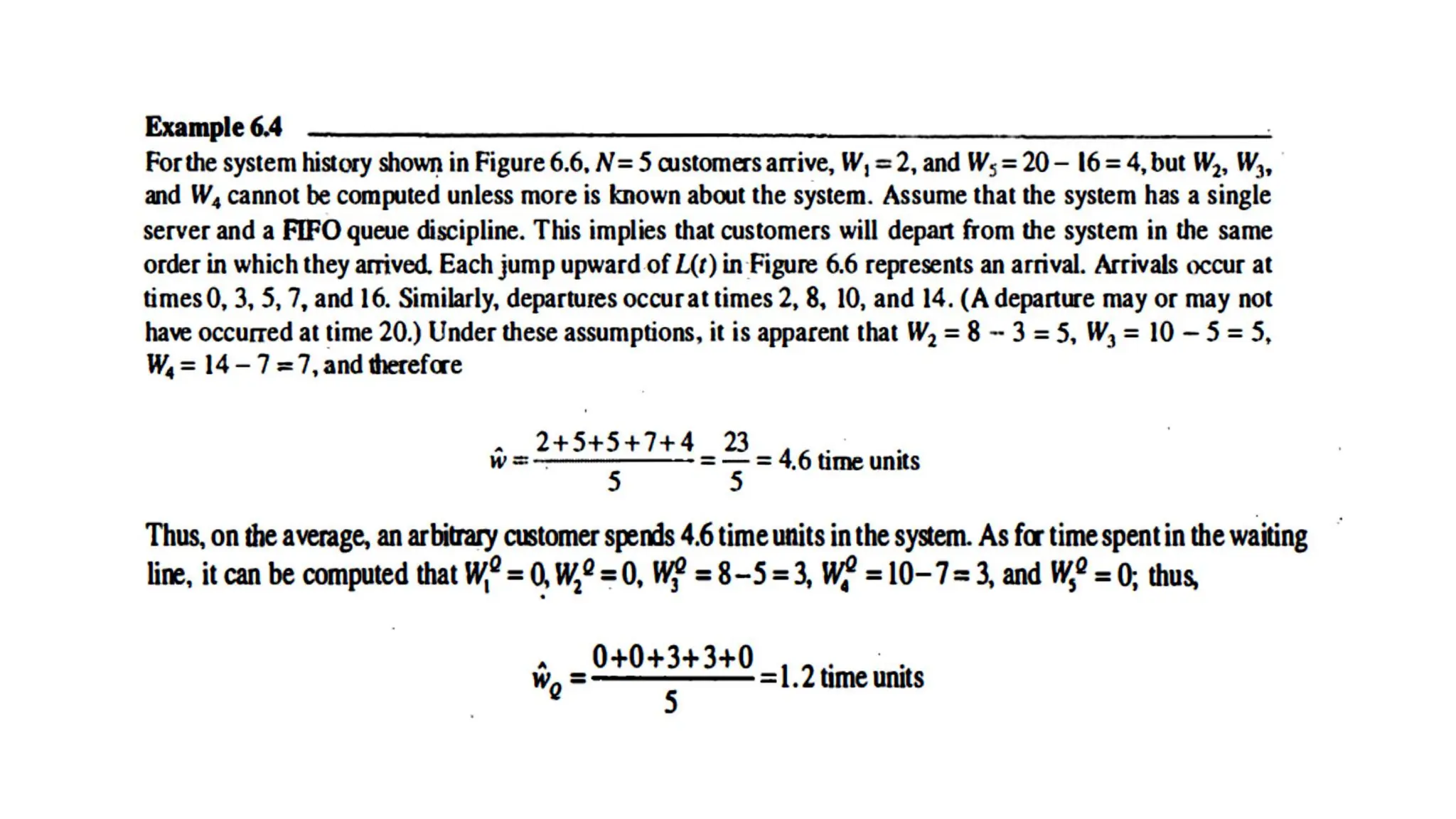
• Consider a queueing system over a period of time T, and let L(t) denote the number of customers
in the system at time t.
• A simulation of such a system is shown below.
Average Time Spent in System Per Customer w
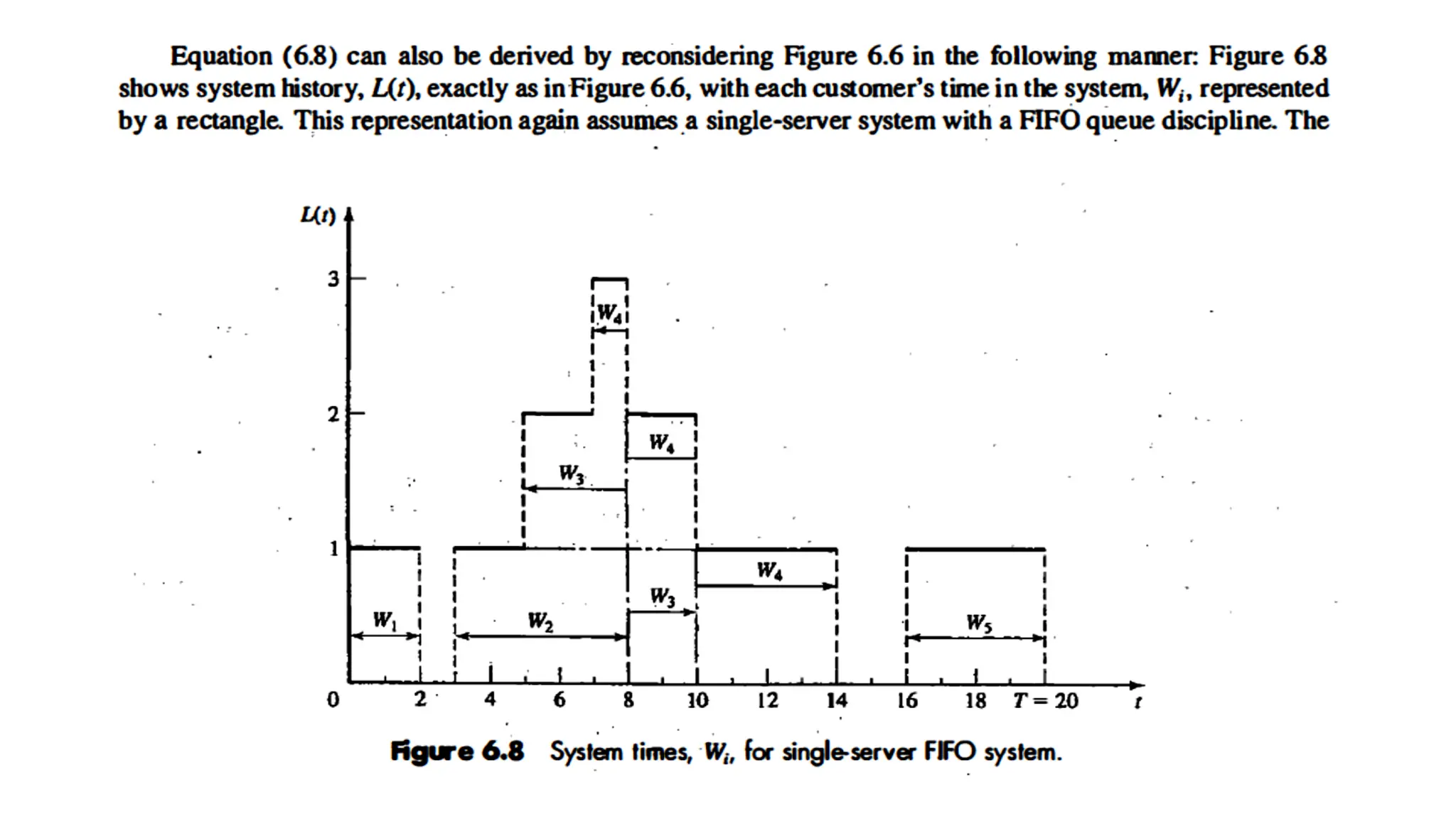
• If we simulate a queueing system for some period of time, say T, then we can record the time
each customer spends in the system during [0, T], say W1, W2, . . ., WN> where N is the number
of arrivals during [0, T].
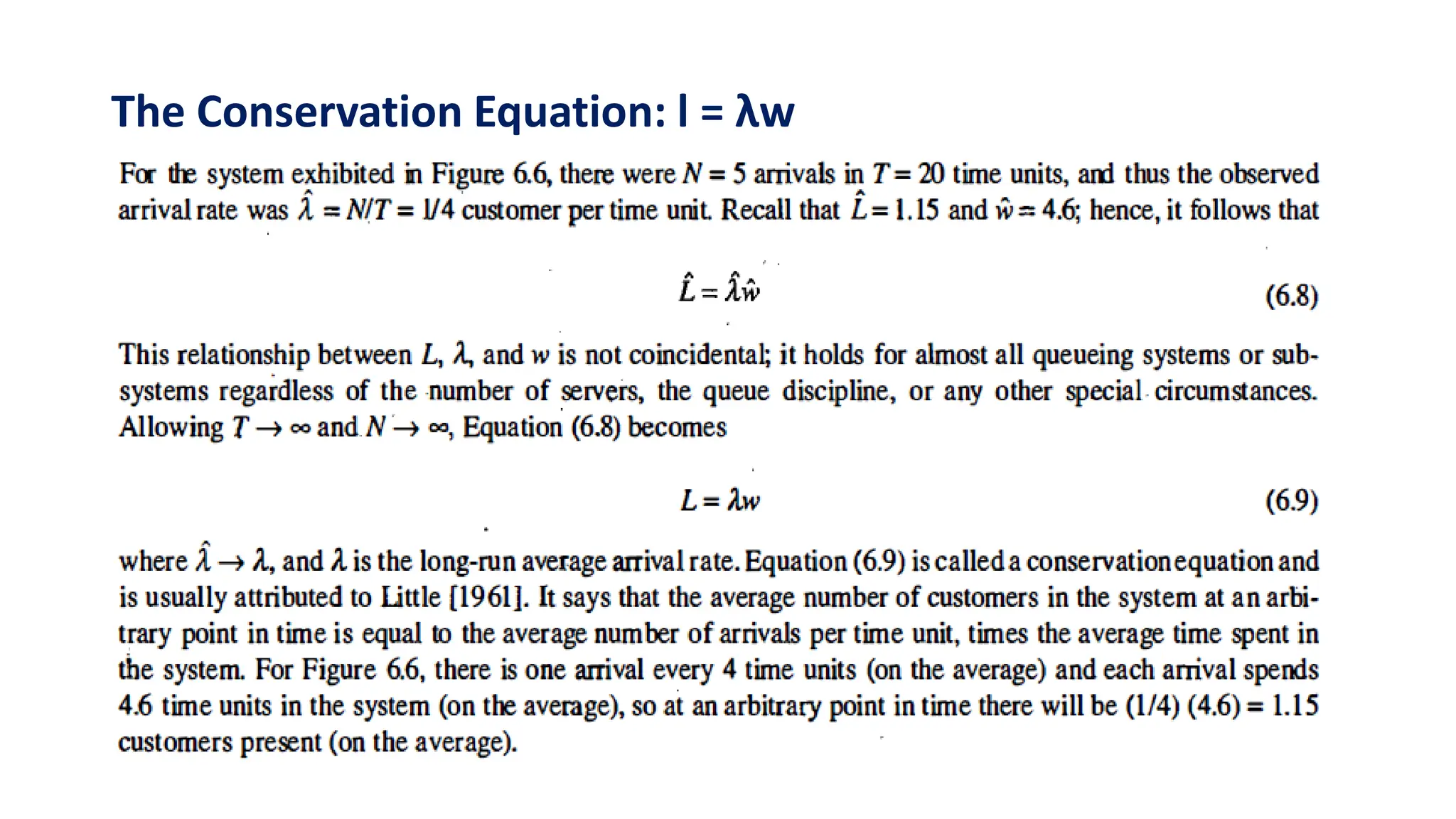
• The average time spent in system per customer, called the average system time, is given by the
ordinary sample average,
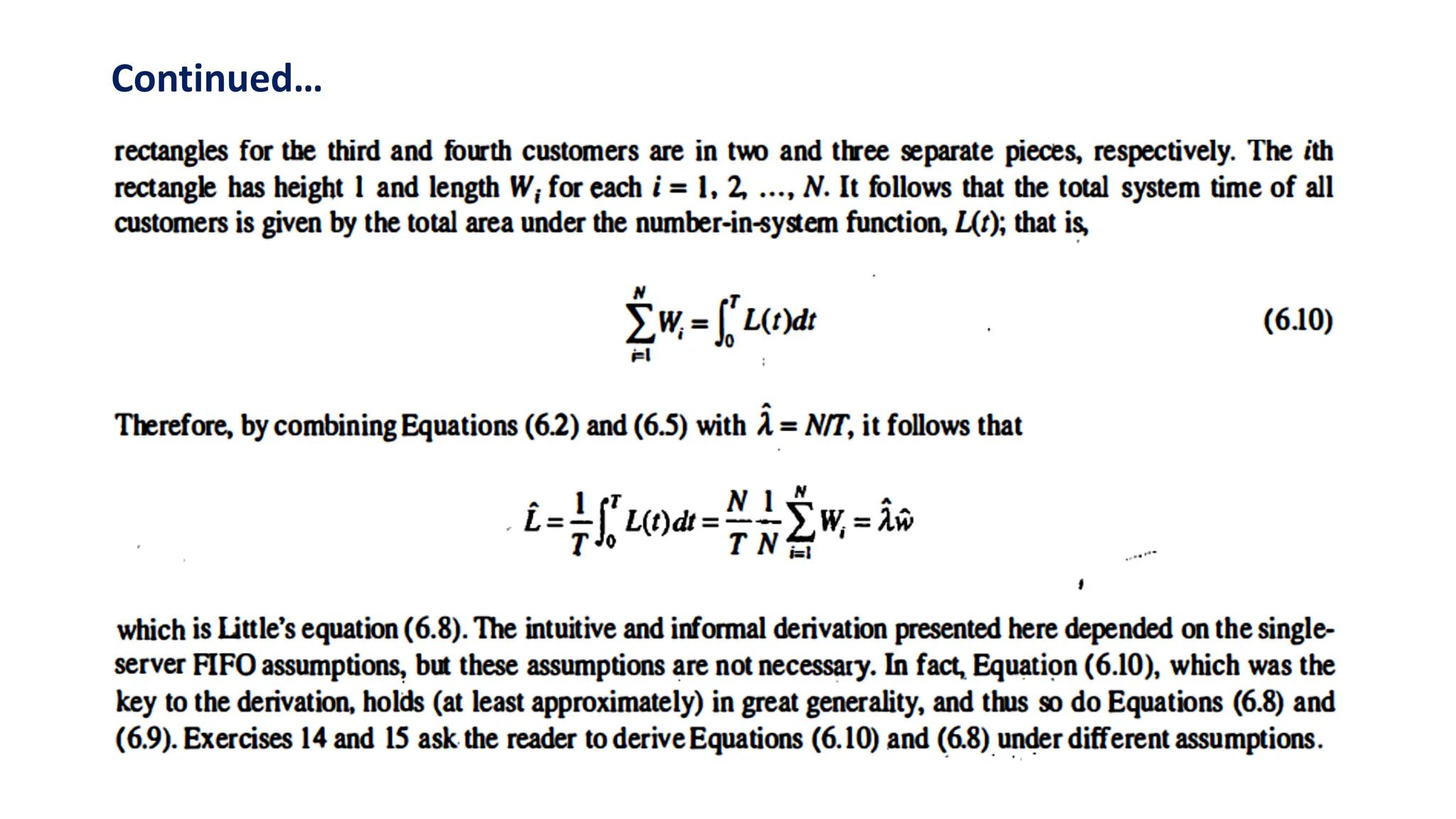
The Conservation Equation: l = λw
Continued…
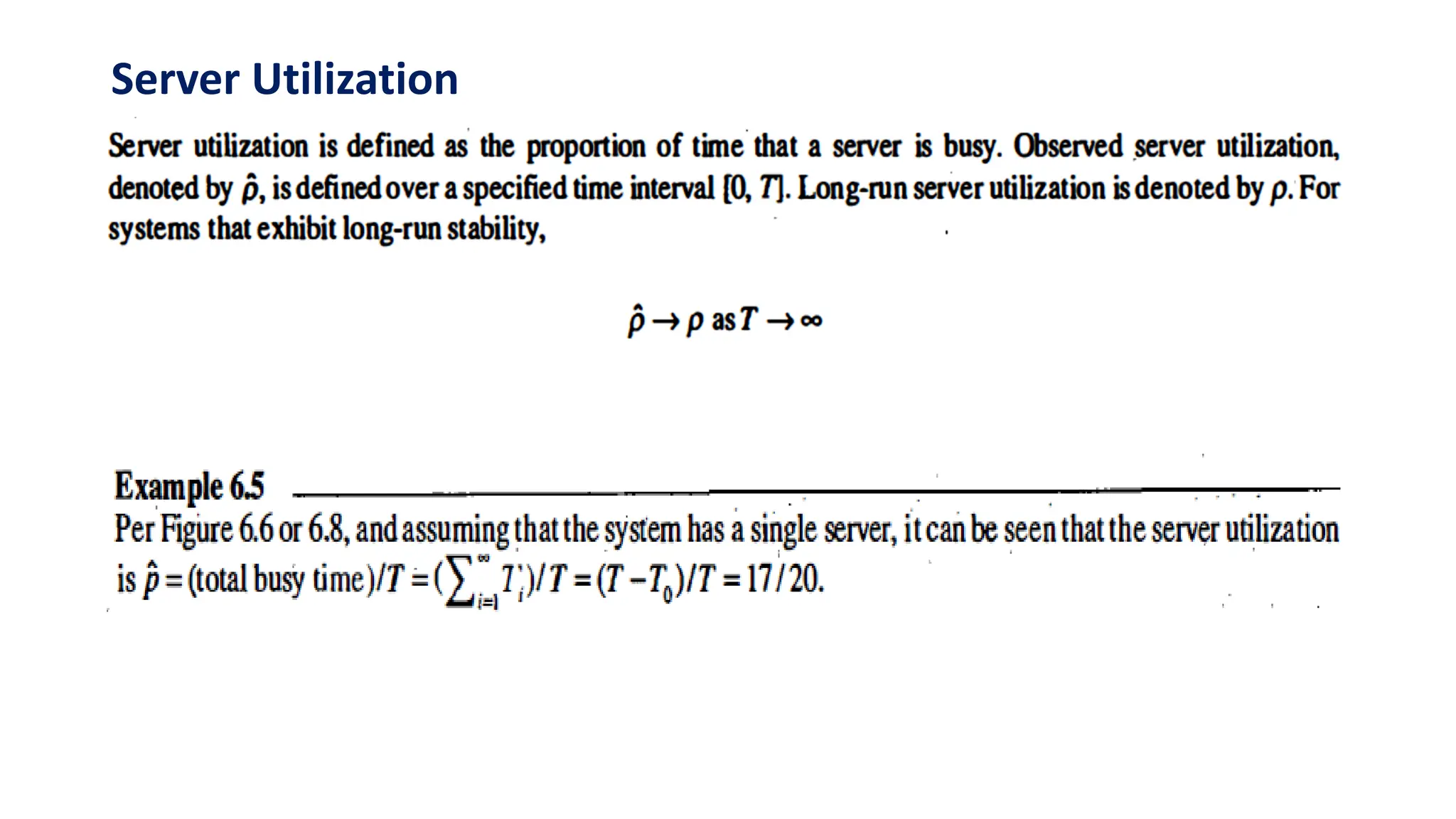
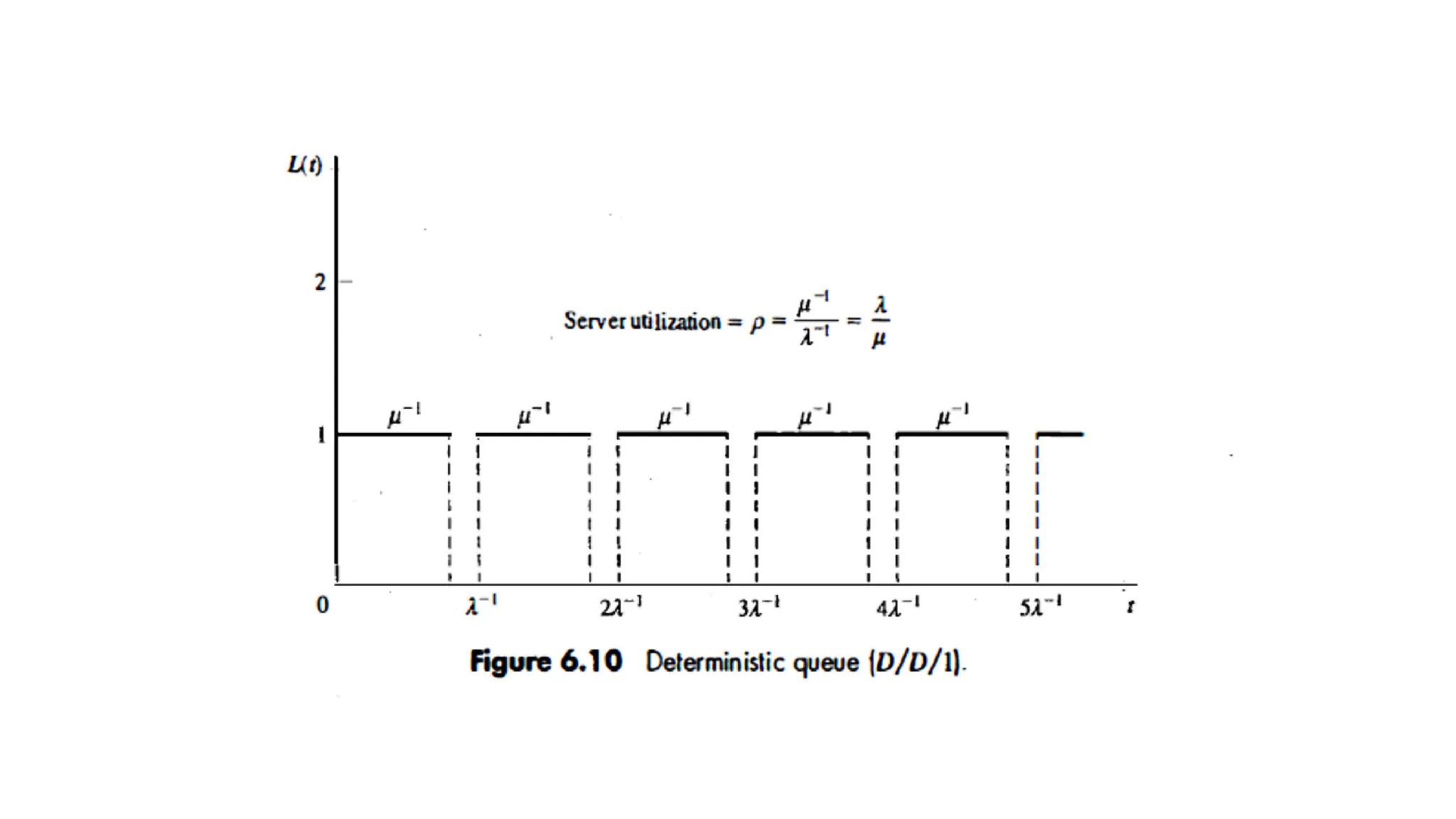
Server Utilization
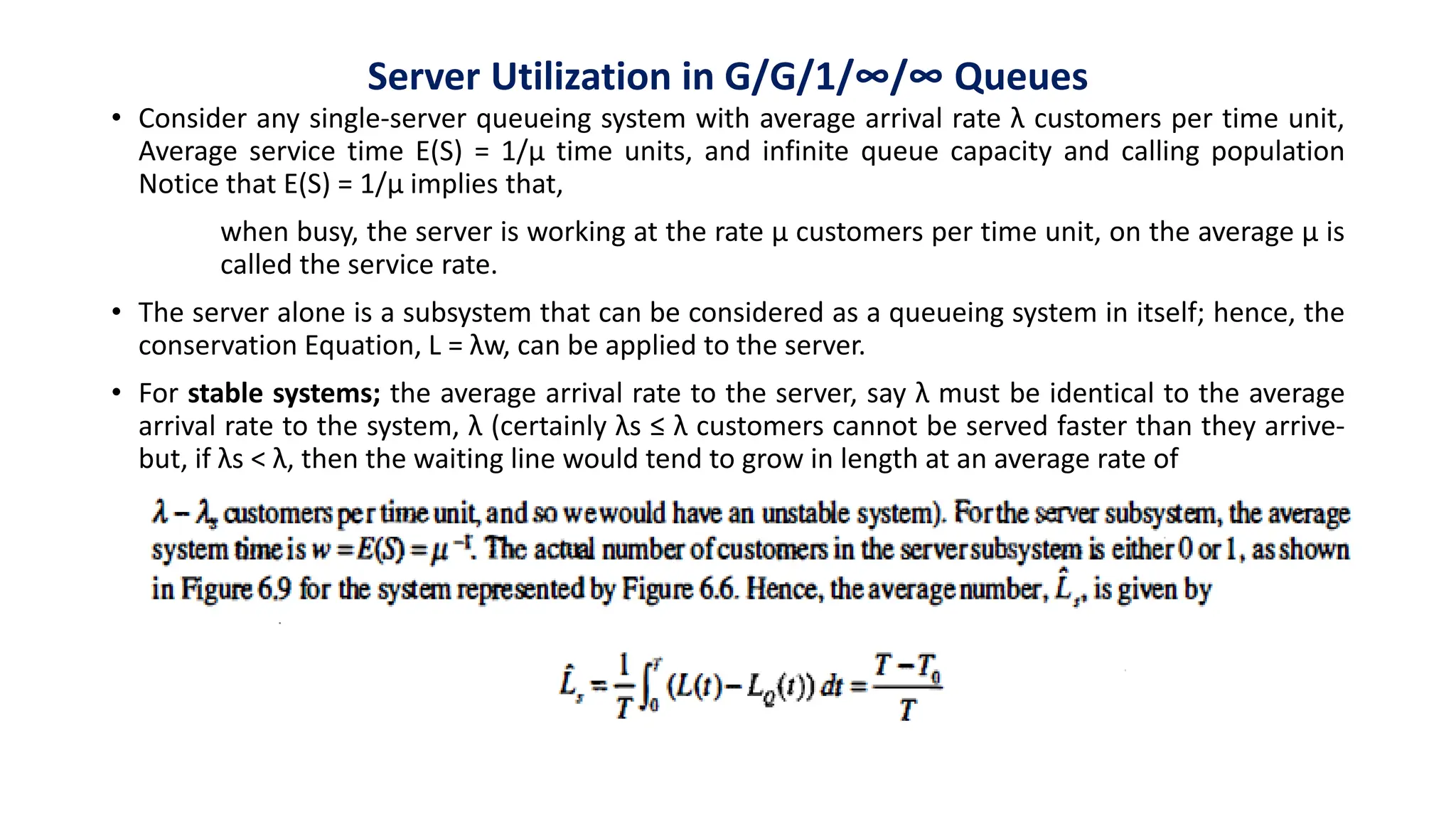
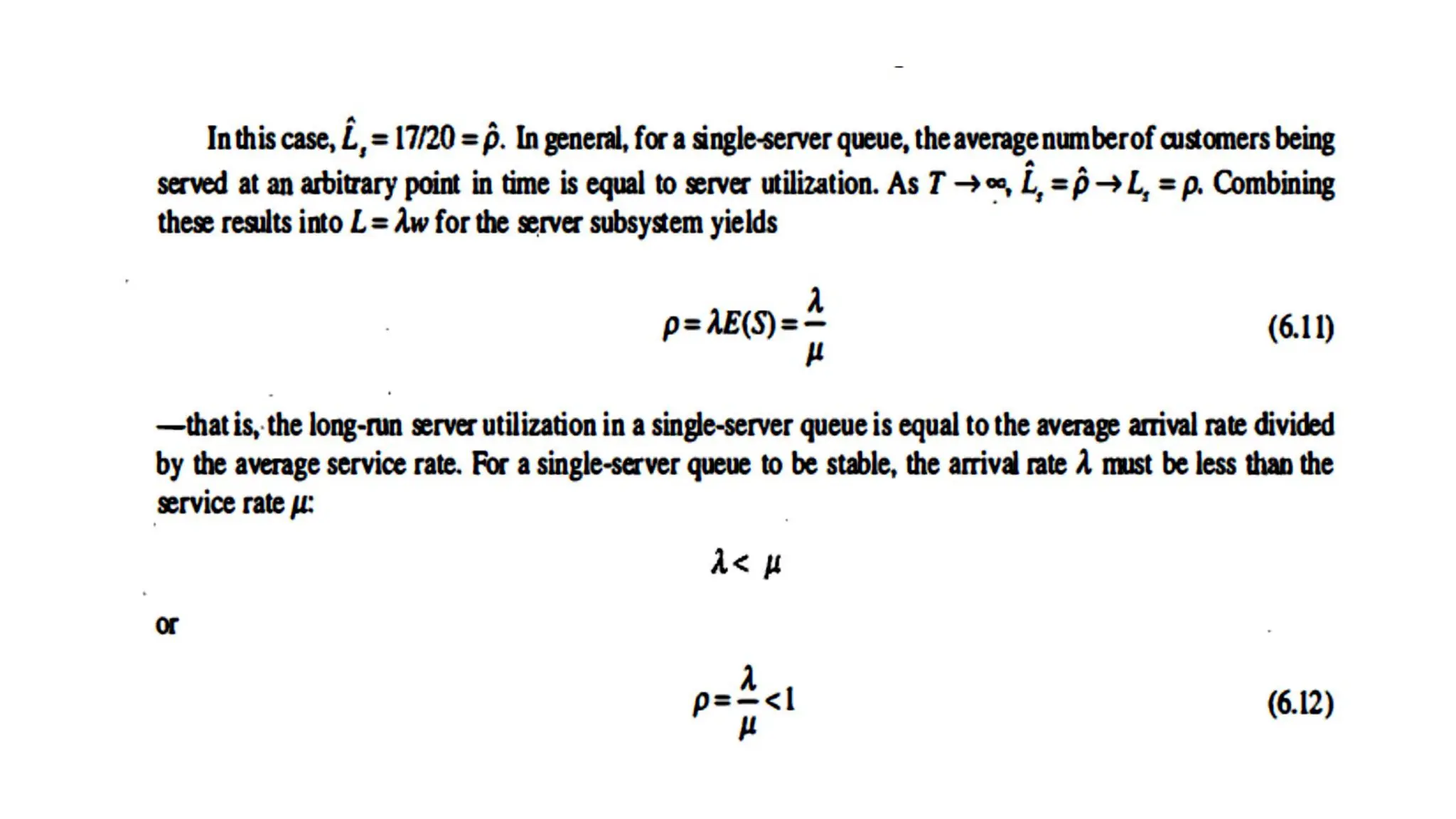
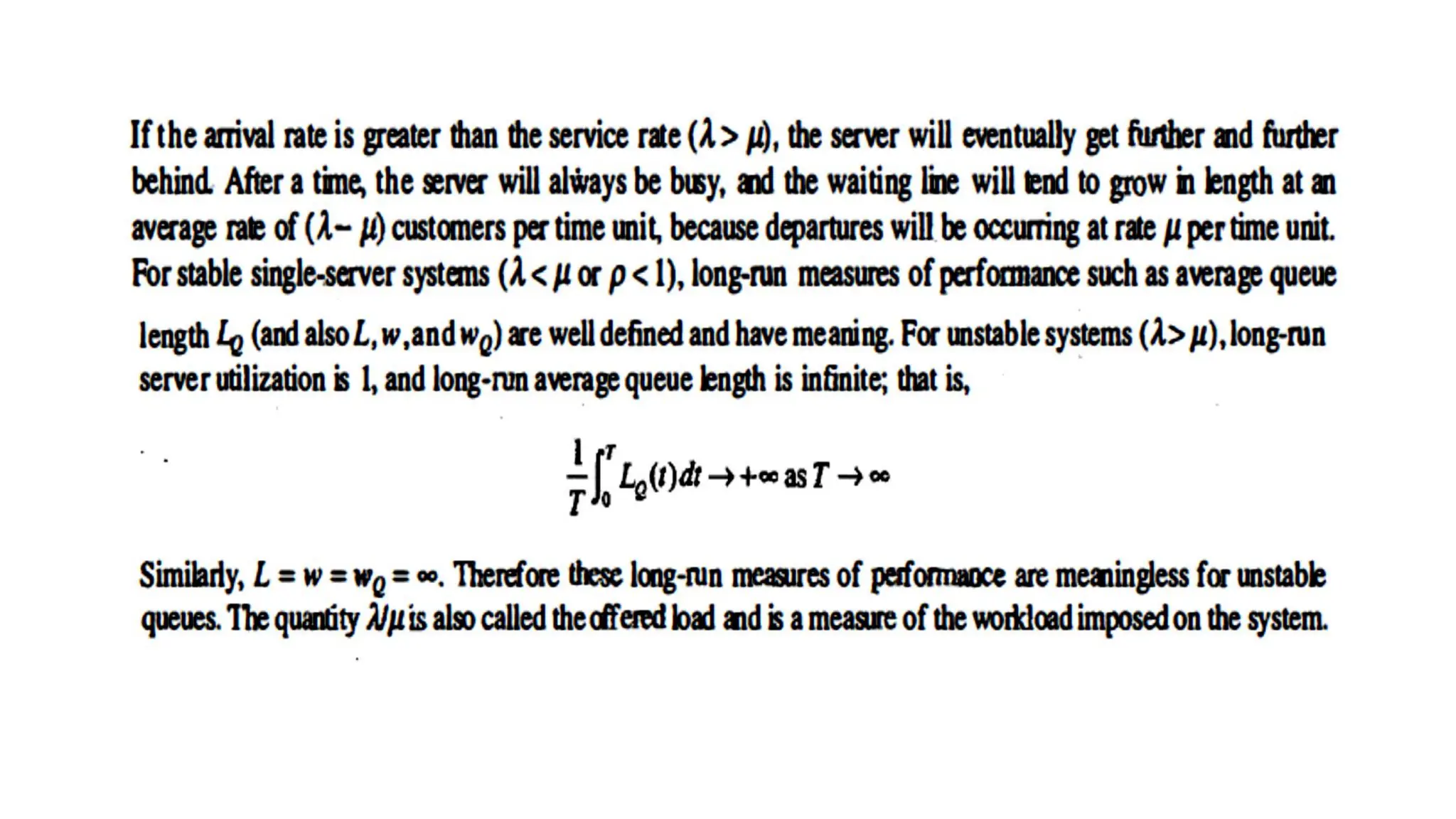
Server Utilization in G/G/1/∞/∞ Queues
• Consider any single-server queueing system with average arrival rate λ customers per time unit,
Average service time E(S) = 1/µ time units, and infinite queue capacity and calling population
Notice that E(S) = 1/µ implies that,
when busy, the server is working at the rate µ customers per time unit, on the average µ is
called the service rate.
• The server alone is a subsystem that can be considered as a queueing system in itself; hence, the
conservation Equation, L = λw, can be applied to the server.
• For stable systems; the average arrival rate to the server, say λ must be identical to the average
arrival rate to the system, λ (certainly λs ≤ λ customers cannot be served faster than they arrive-
but, if λs < λ, then the waiting line would tend to grow in length at an average rate of
Server Utilization in G/G/c/∞/∞ Queues
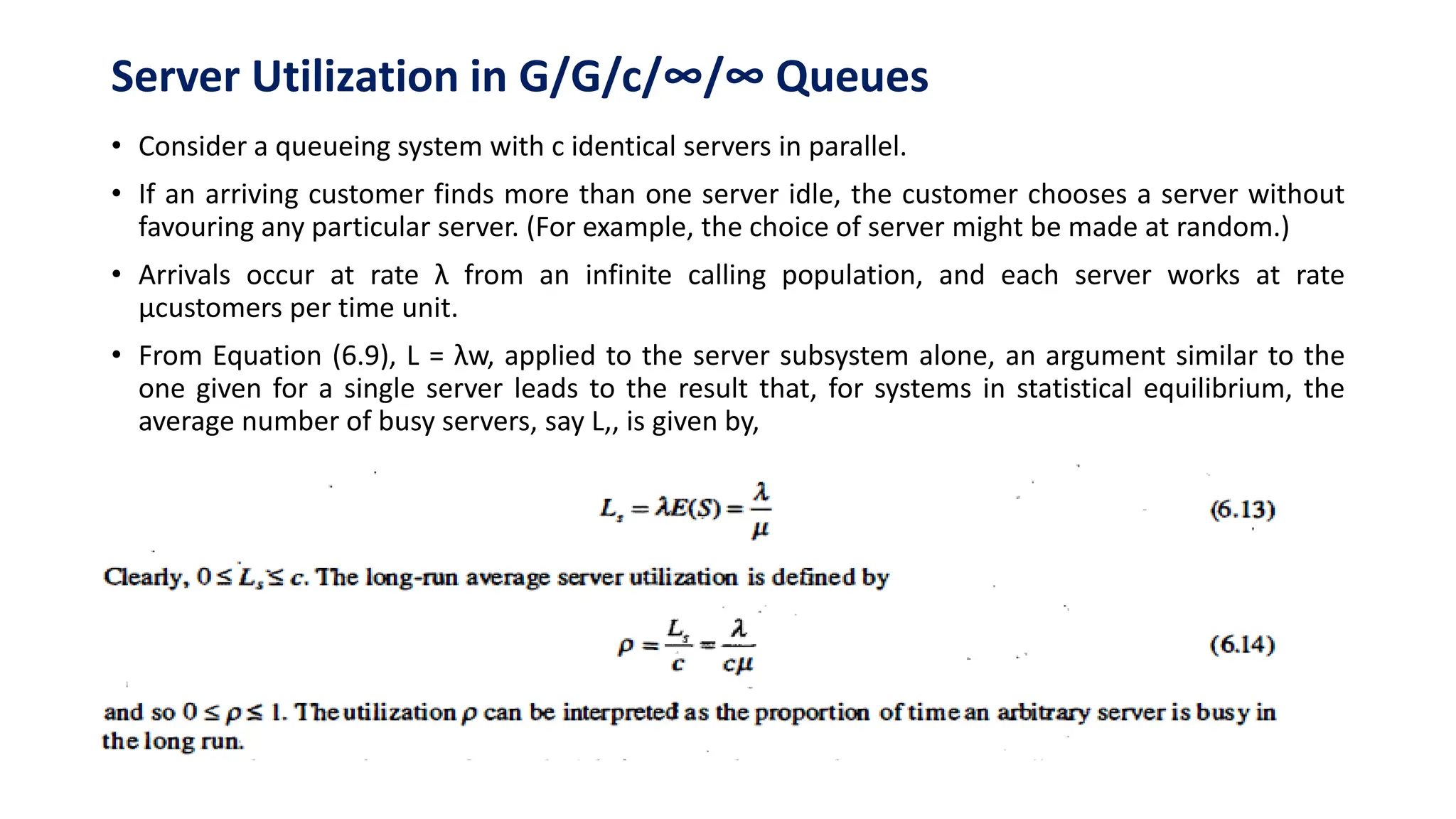
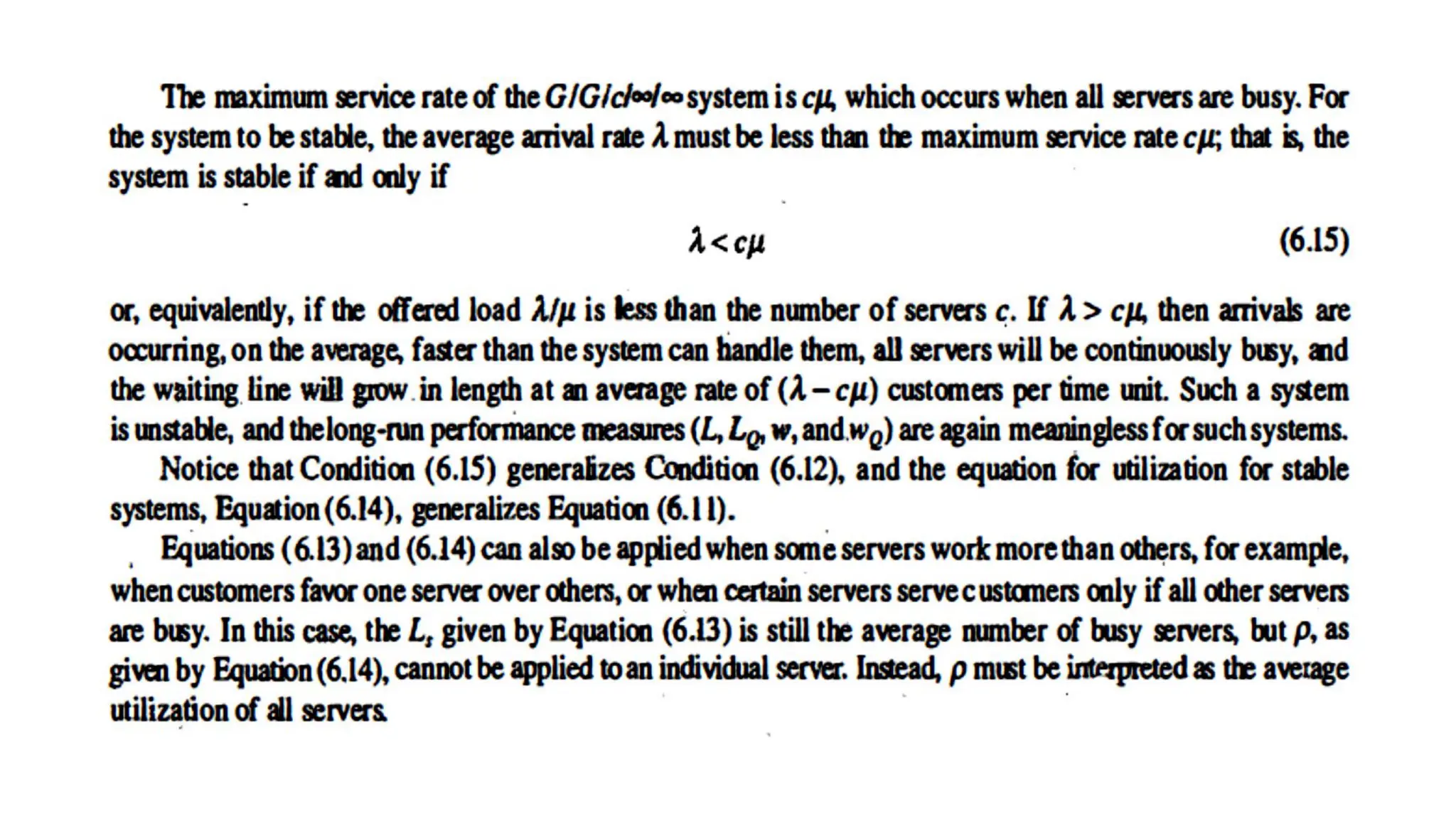
• Consider a queueing system with c identical servers in parallel.
• If an arriving customer finds more than one server idle, the customer chooses a server without
favouring any particular server. (For example, the choice of server might be made at random.)
• Arrivals occur at rate λ from an infinite calling population, and each server works at rate
µcustomers per time unit.
• From Equation (6.9), L = λw, applied to the server subsystem alone, an argument similar to the
one given for a single server leads to the result that, for systems in statistical equilibrium, the
average number of busy servers, say L,, is given by,
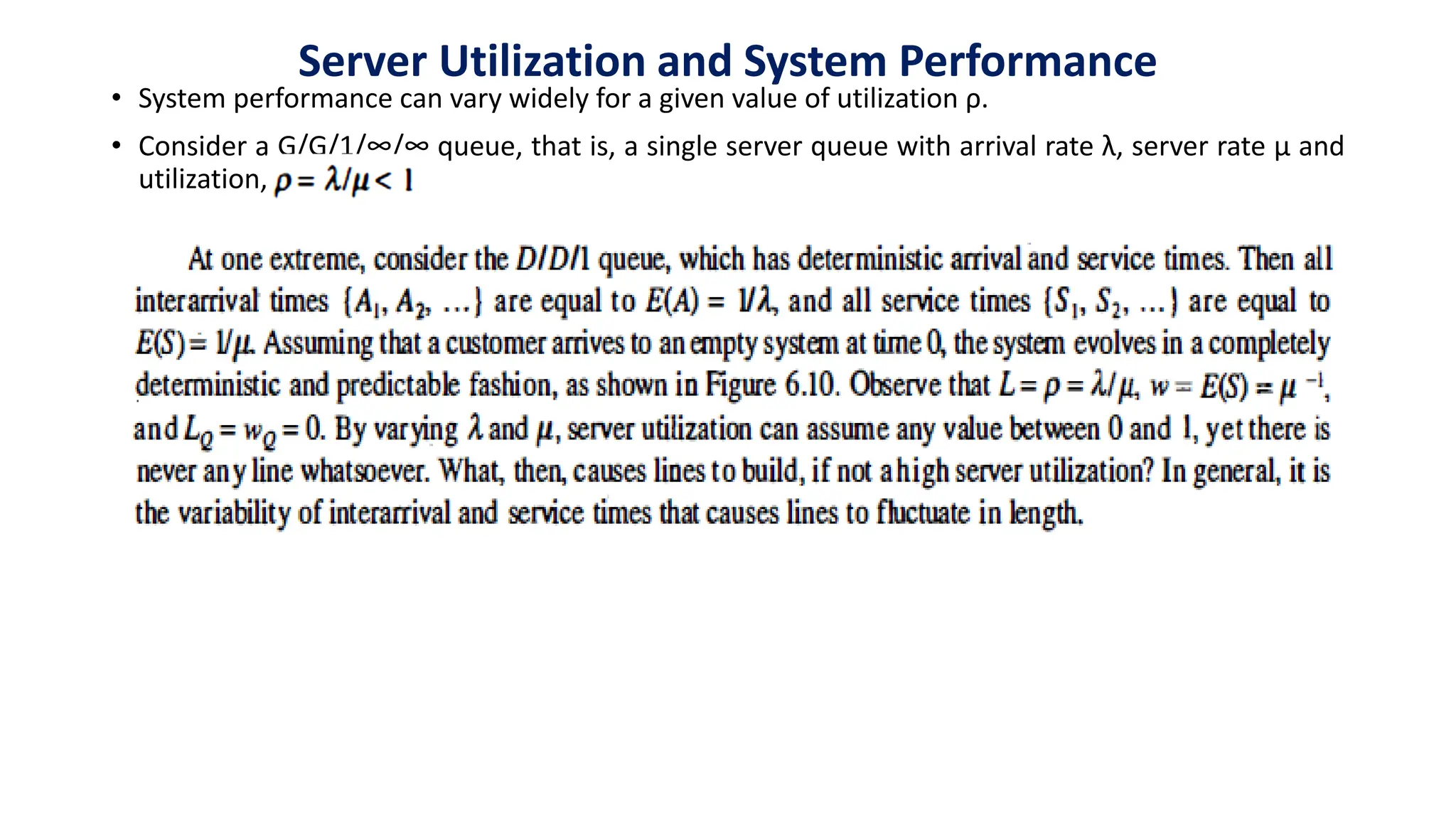
Server Utilization and System Performance
• System performance can vary widely for a given value of utilization ρ.
• Consider a G/G/1/∞/∞ queue, that is, a single server queue with arrival rate λ, server rate µ and
utilization,
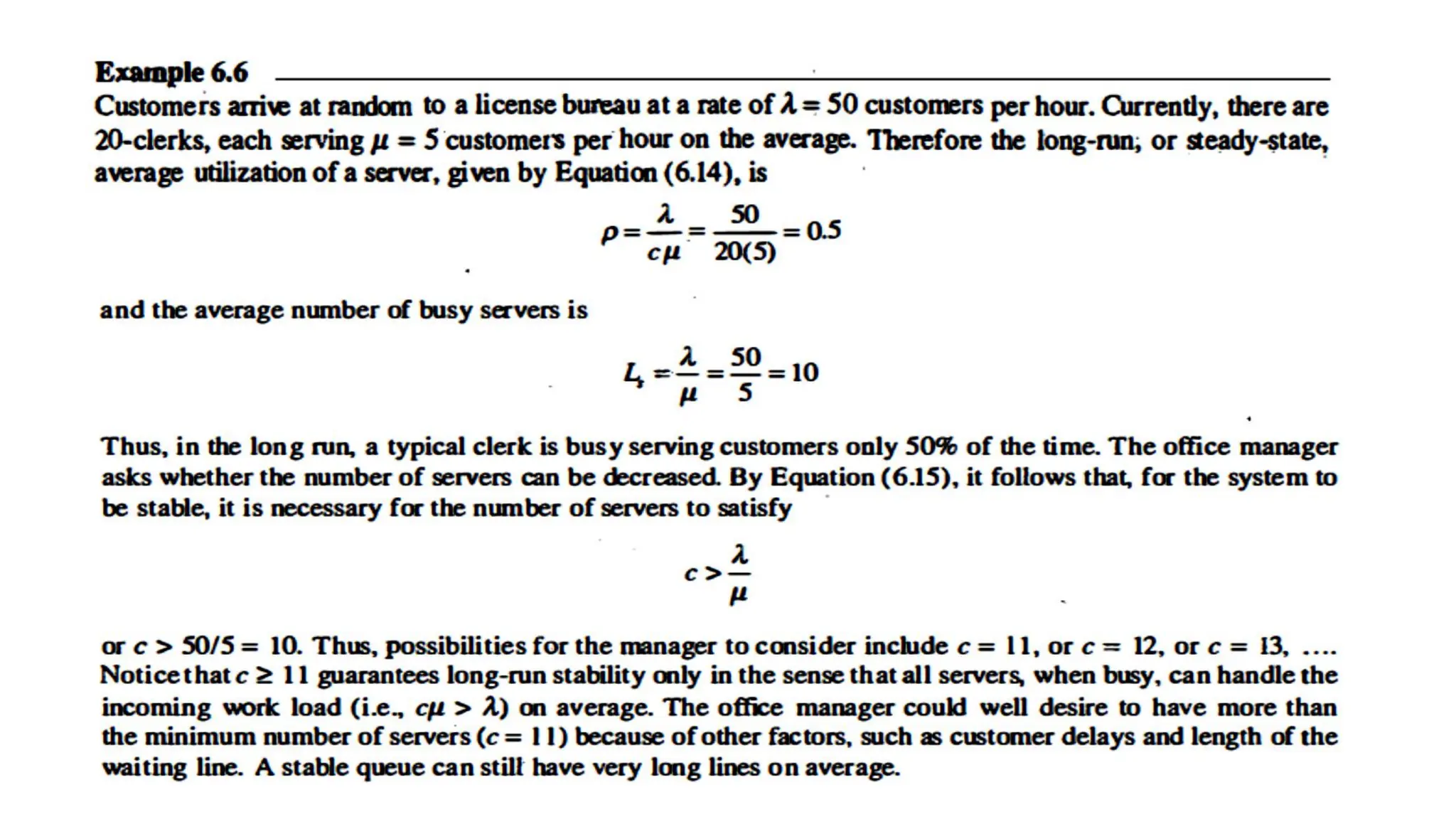
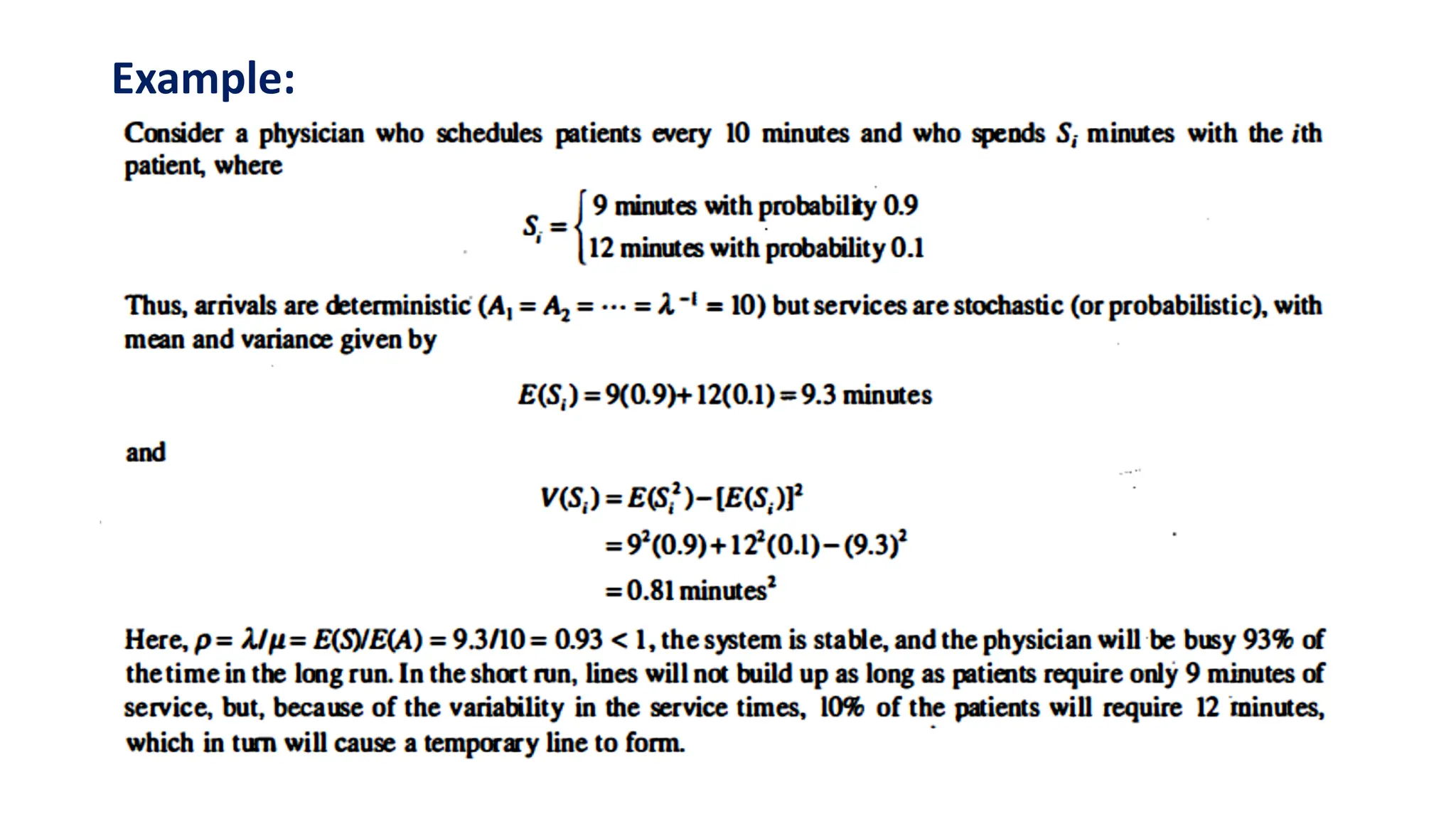
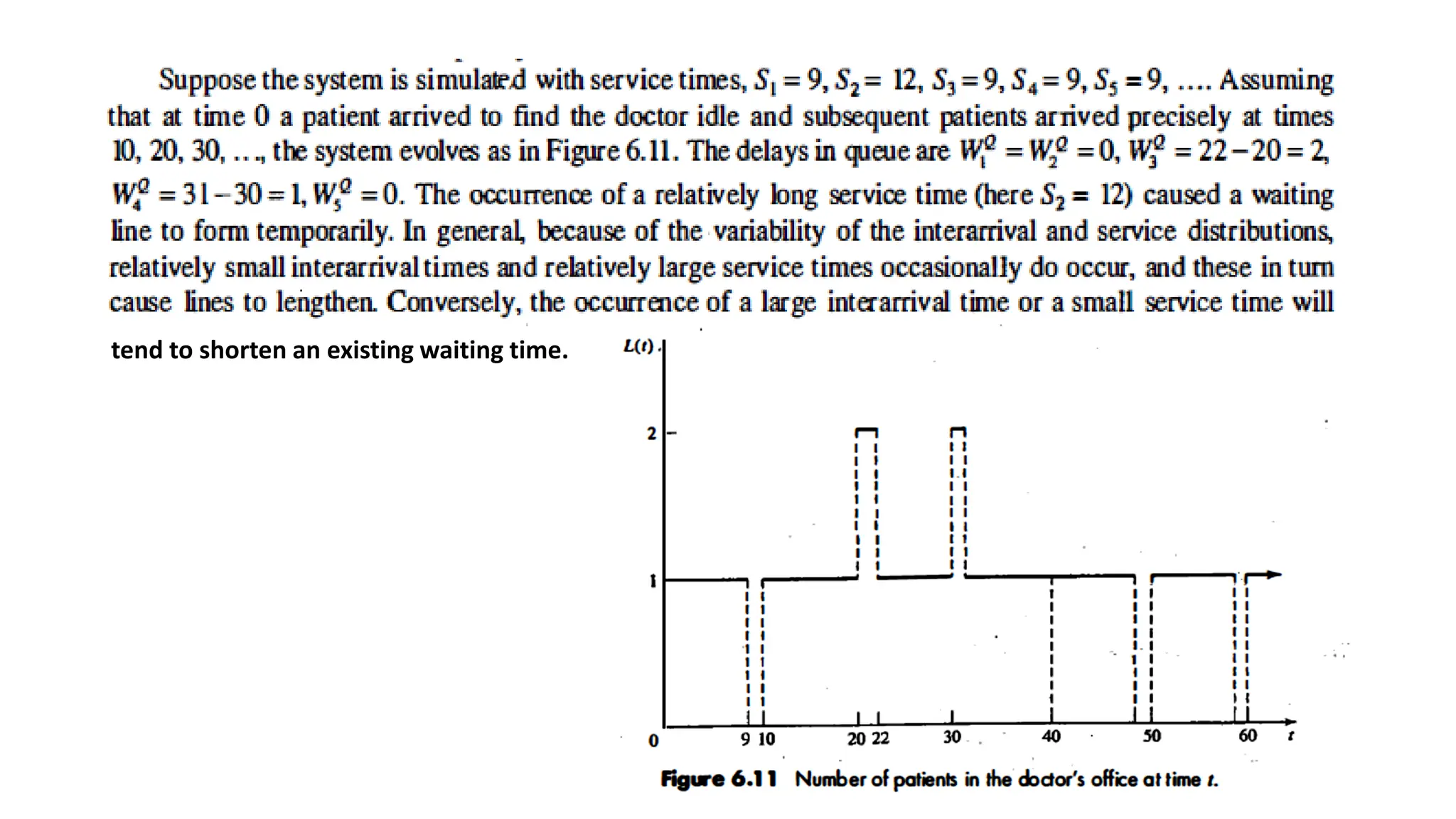
Example:
tend to shorten an existing waiting time.
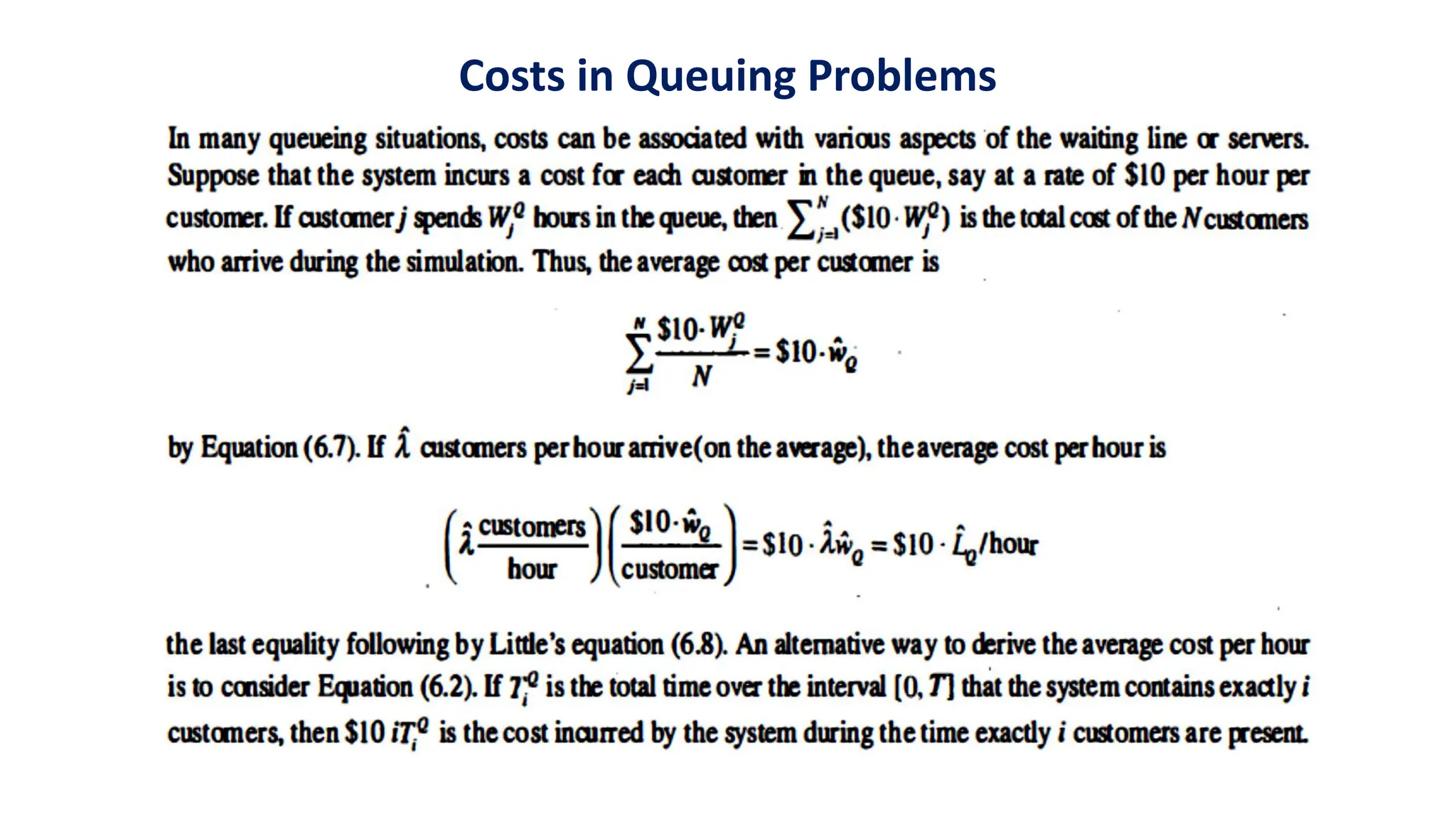
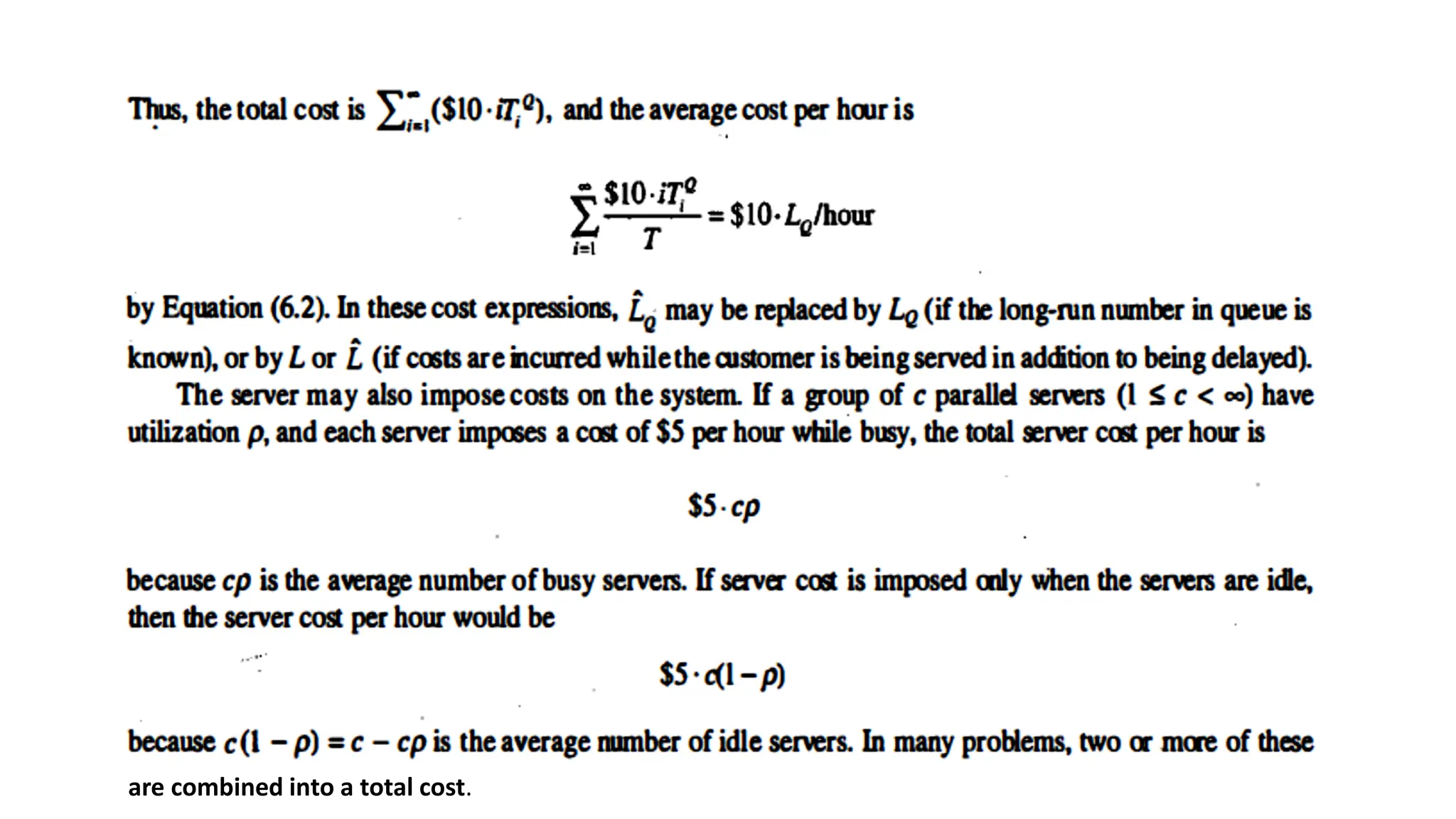
Costs in Queuing Problems
are combined into a total cost.
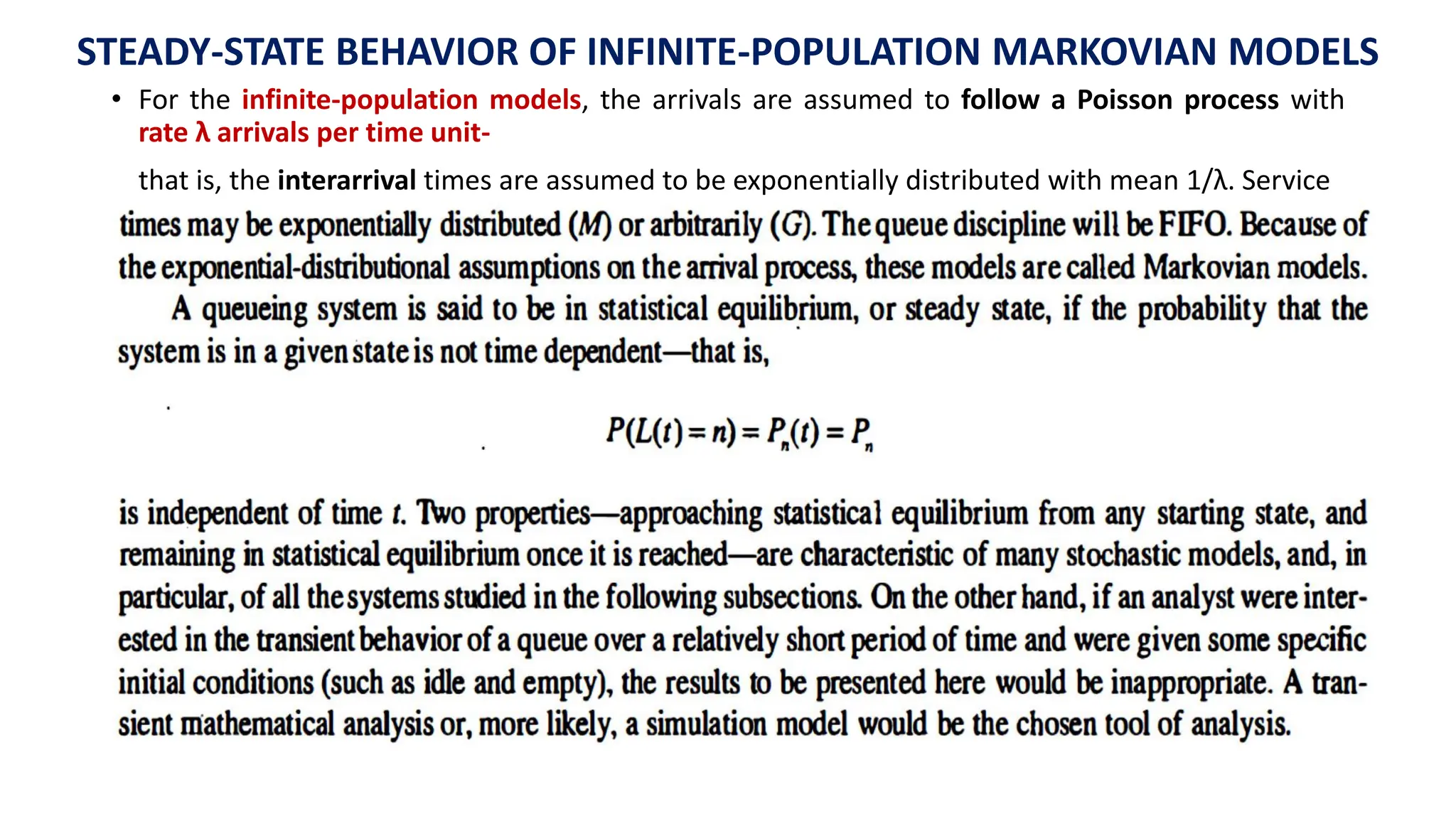
STEADY-STATE BEHAVIOR OF INFINITE-POPULATION MARKOVIAN MODELS
• For the infinite-population models, the arrivals are assumed to follow a Poisson process with
rate λ arrivals per time unit-
that is, the interarrival times are assumed to be exponentially distributed with mean 1/λ. Service
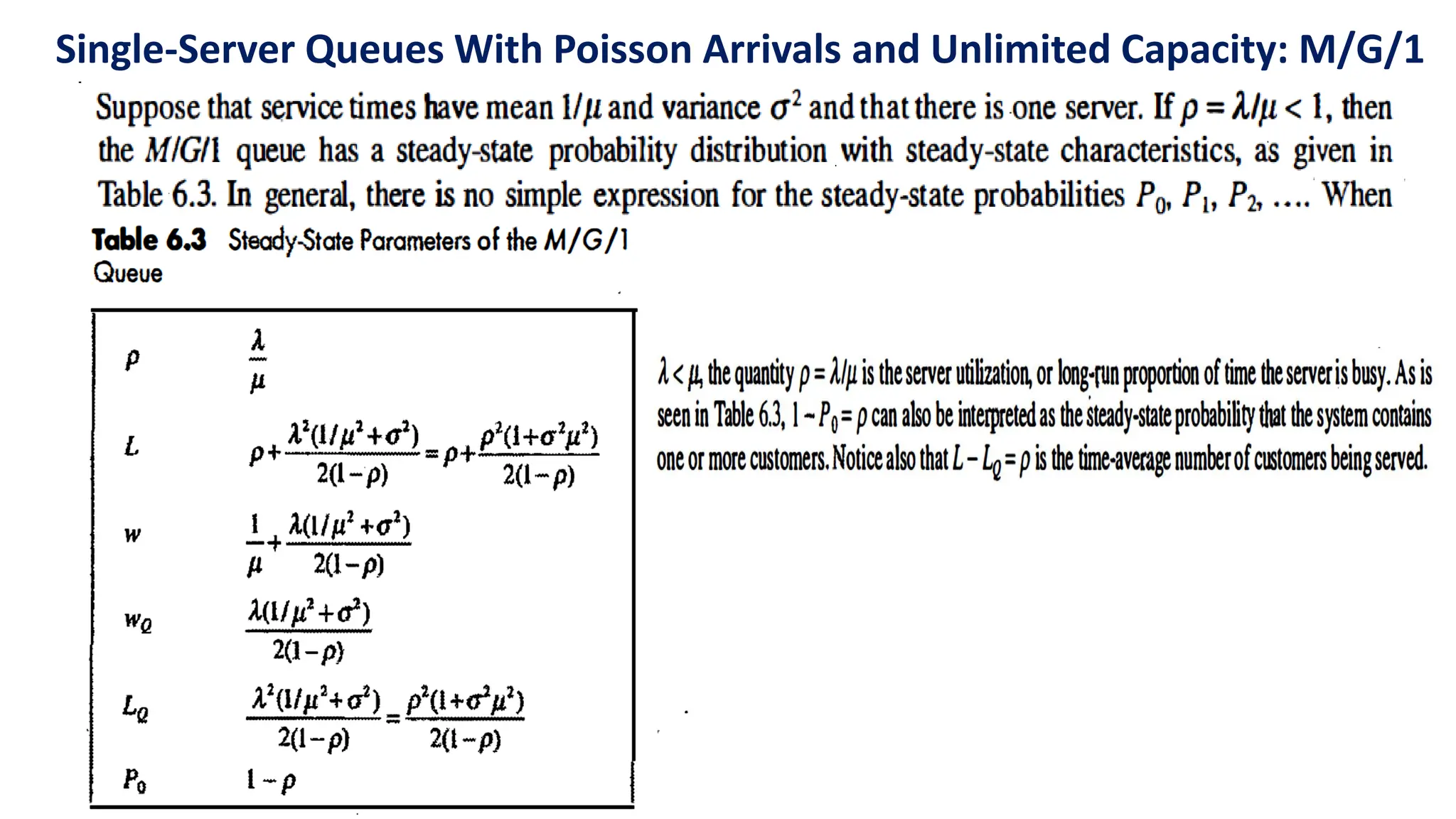
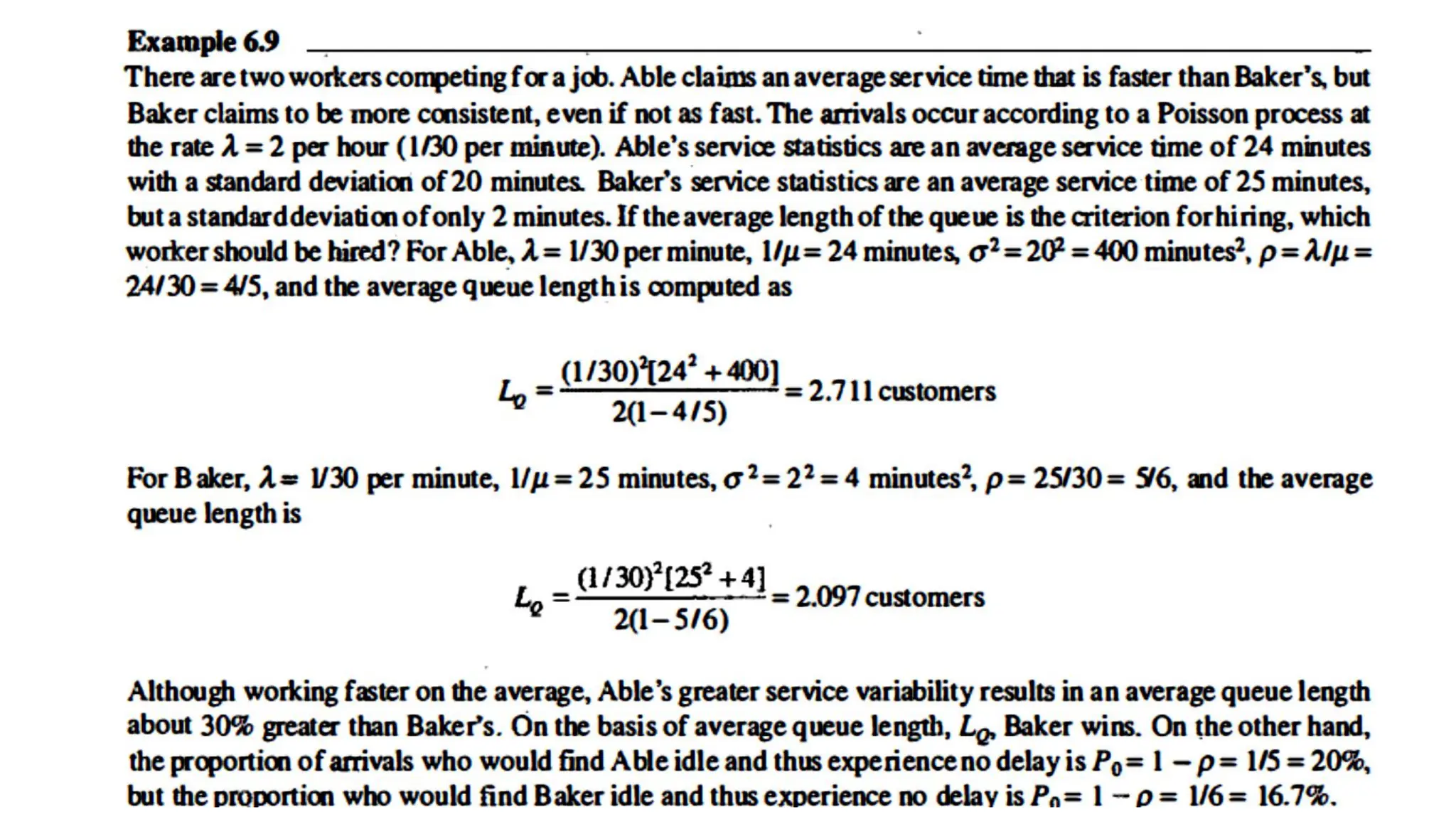
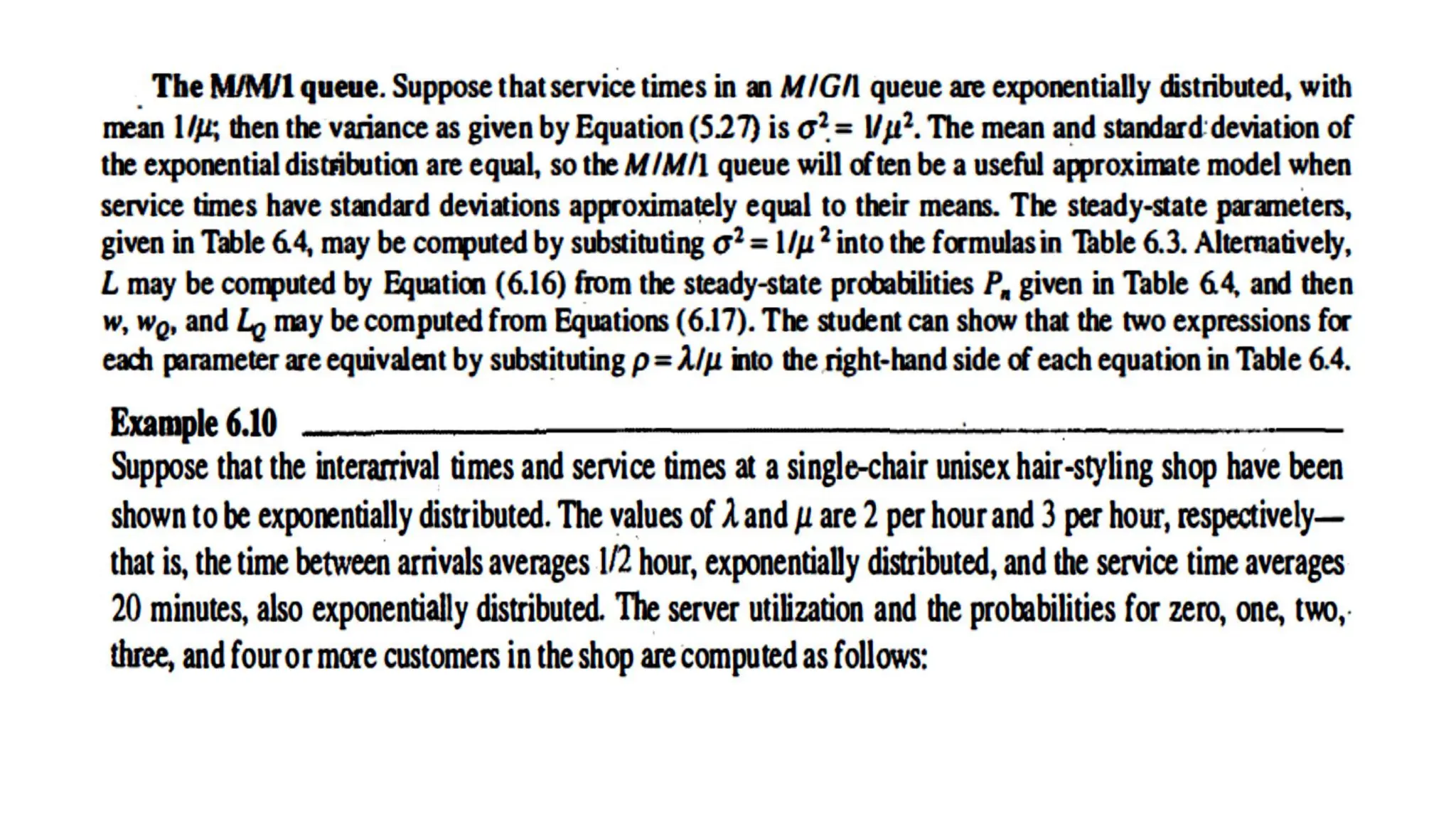
Single-Server Queues With Poisson Arrivals and Unlimited Capacity: M/G/1
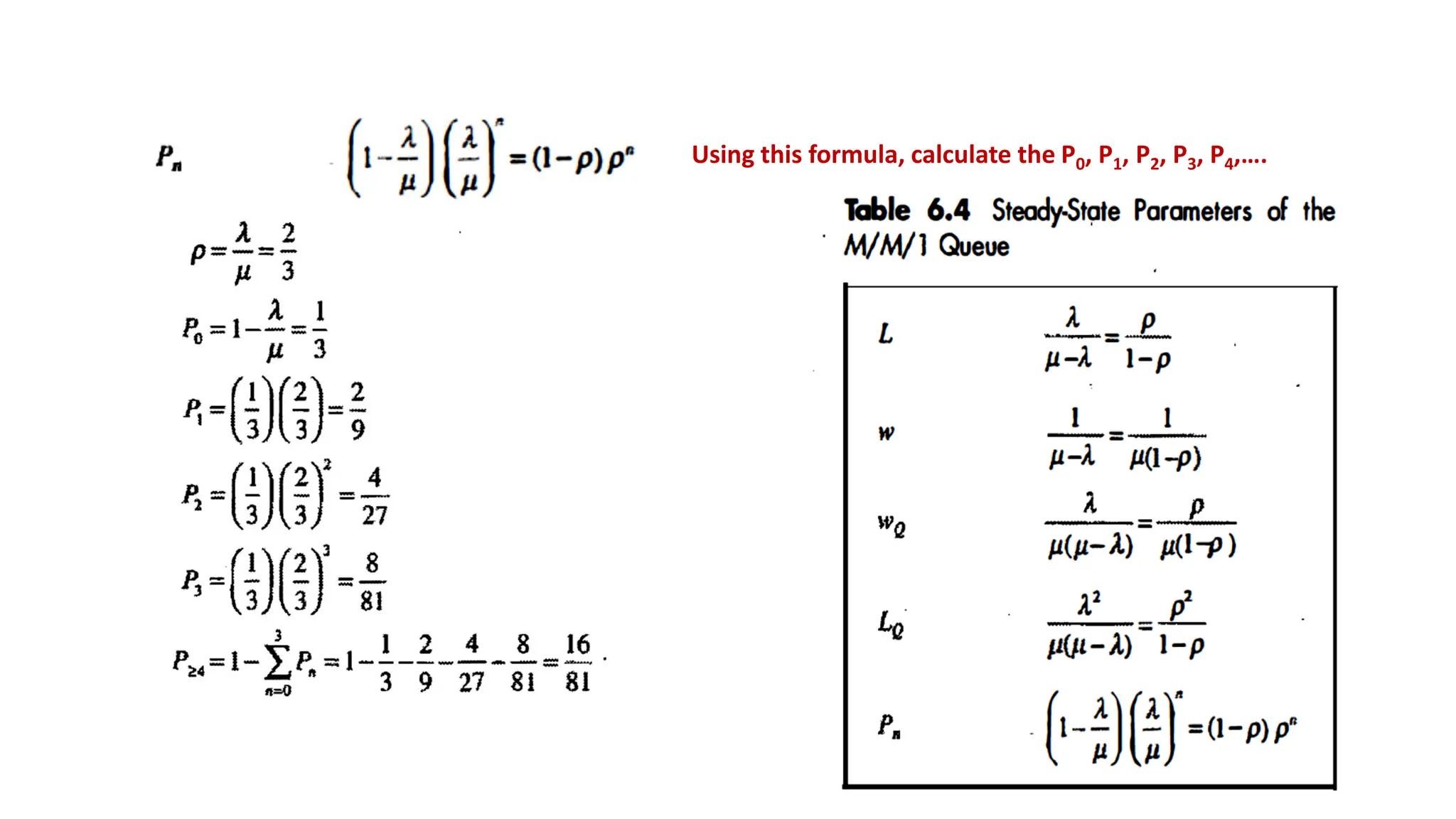
Using this formula, calculate the P0, P1, P2, P3, P4,….
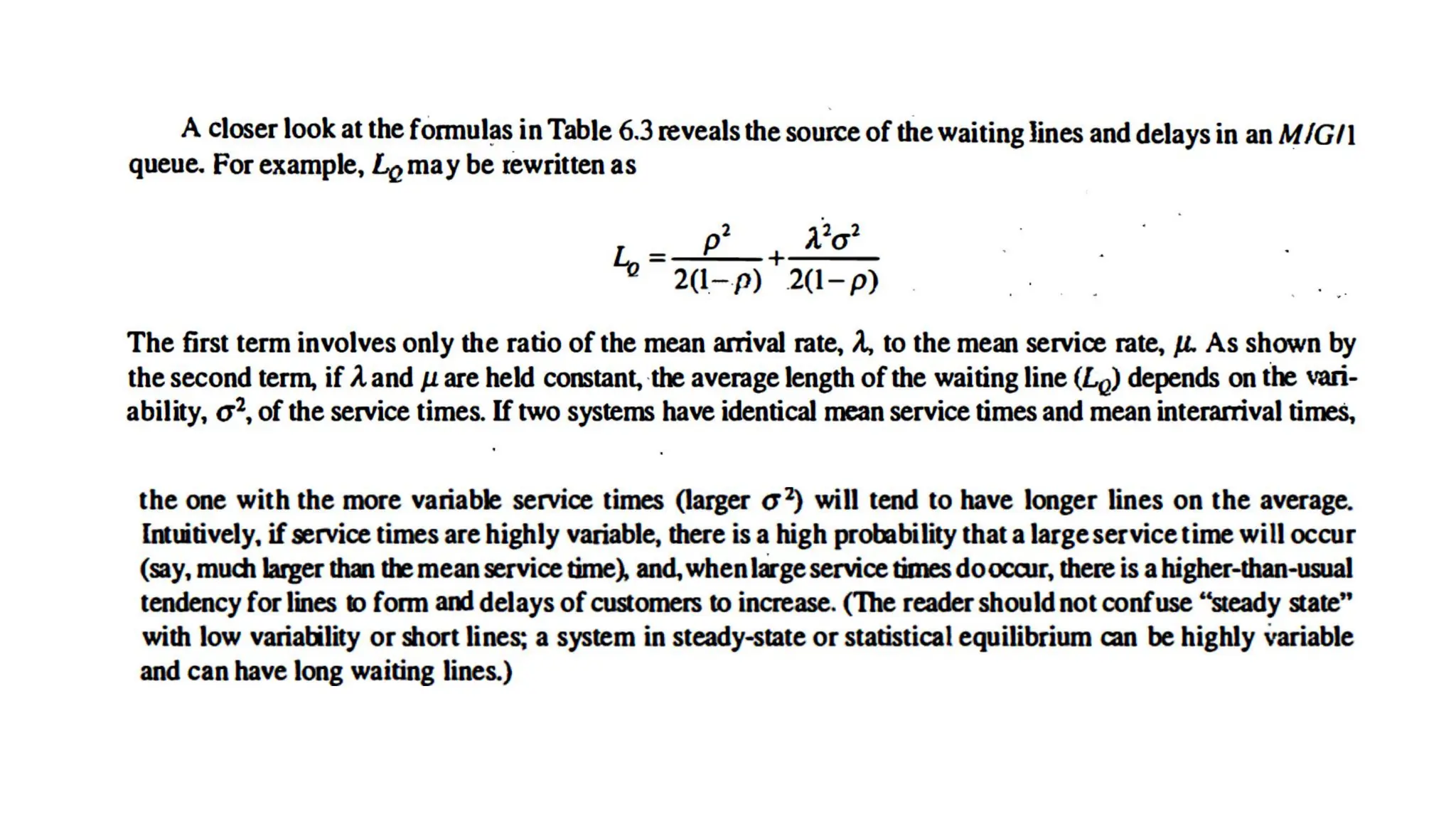
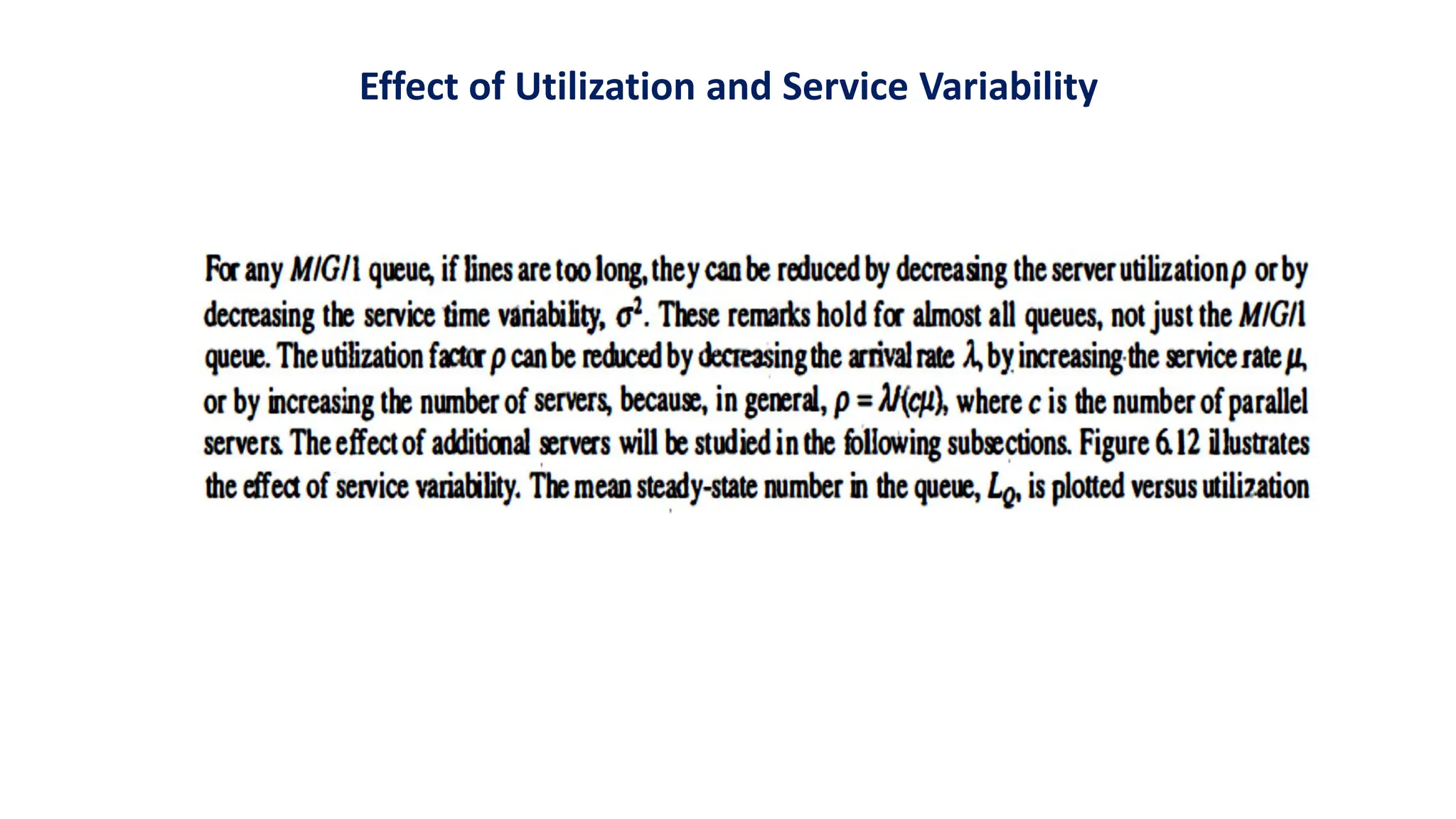
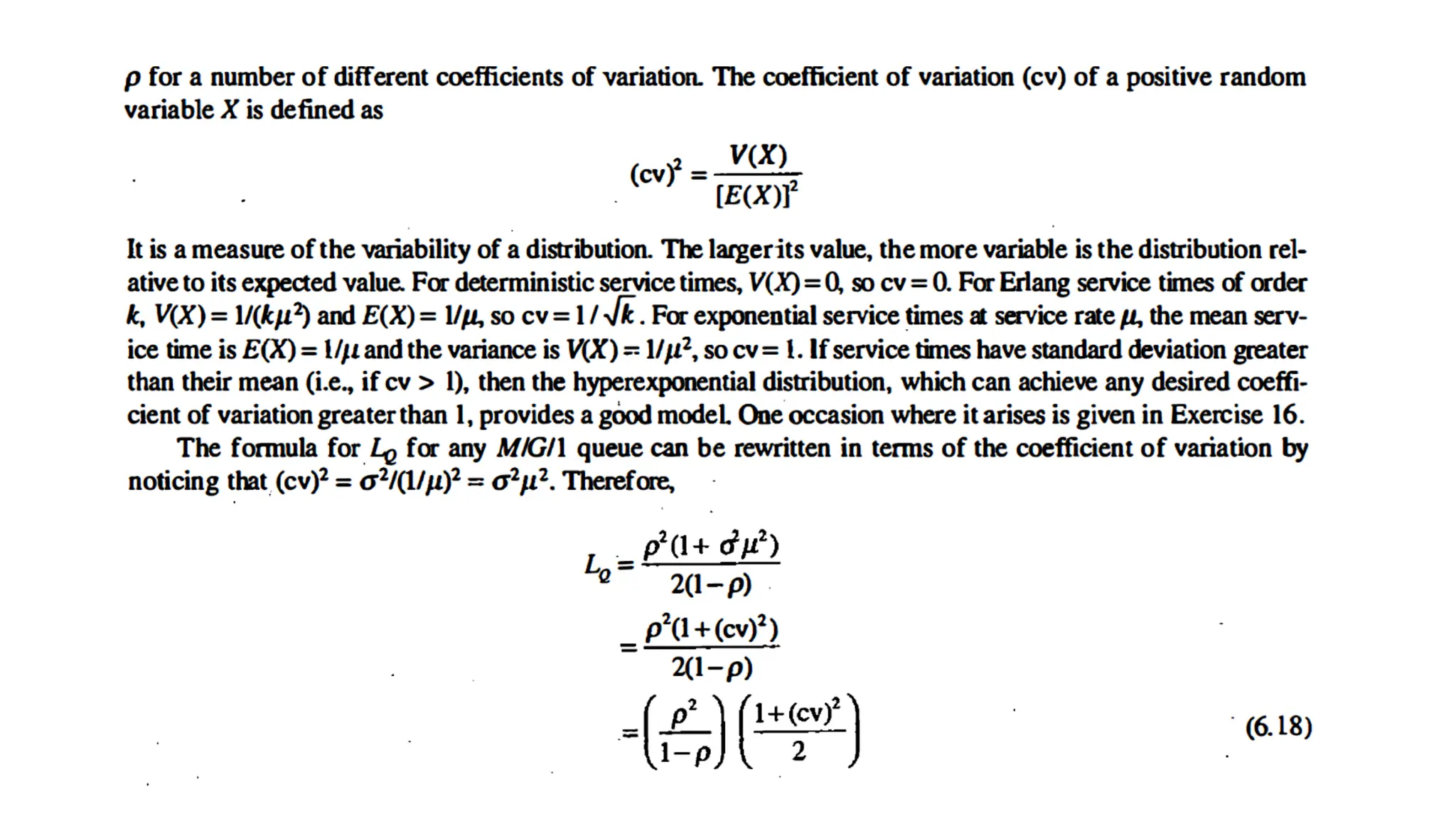
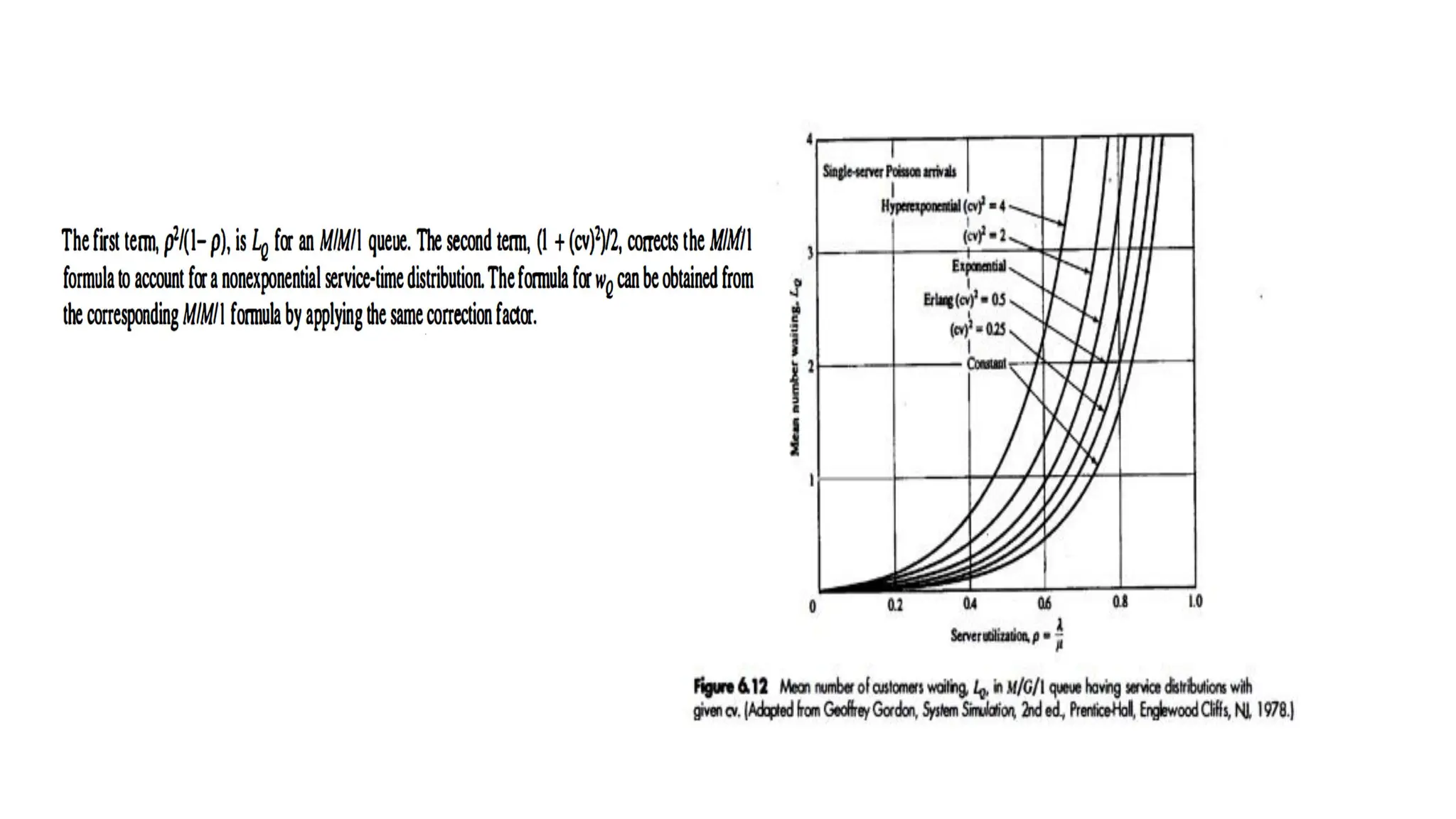
Effect of Utilization and Service Variability
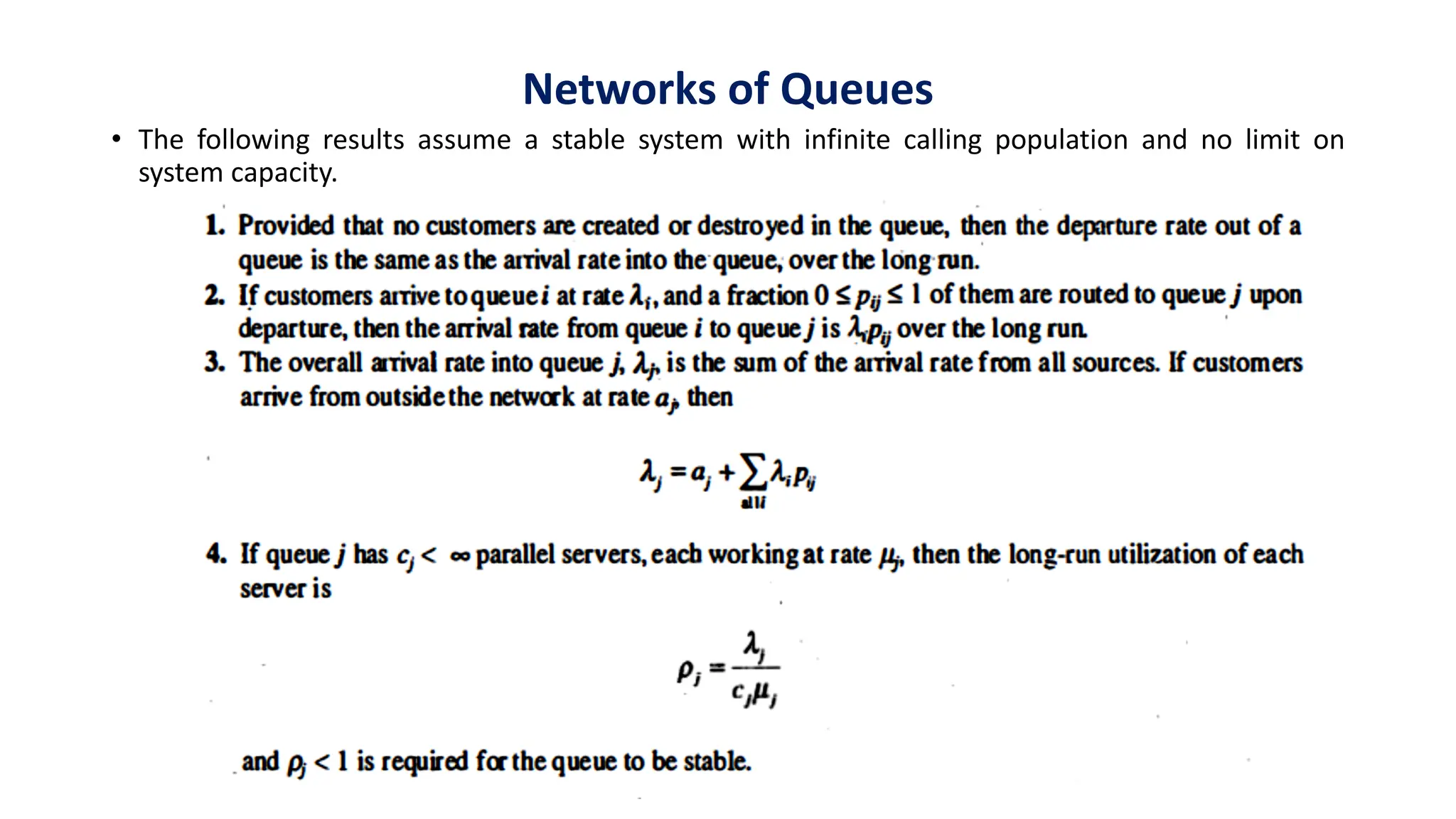
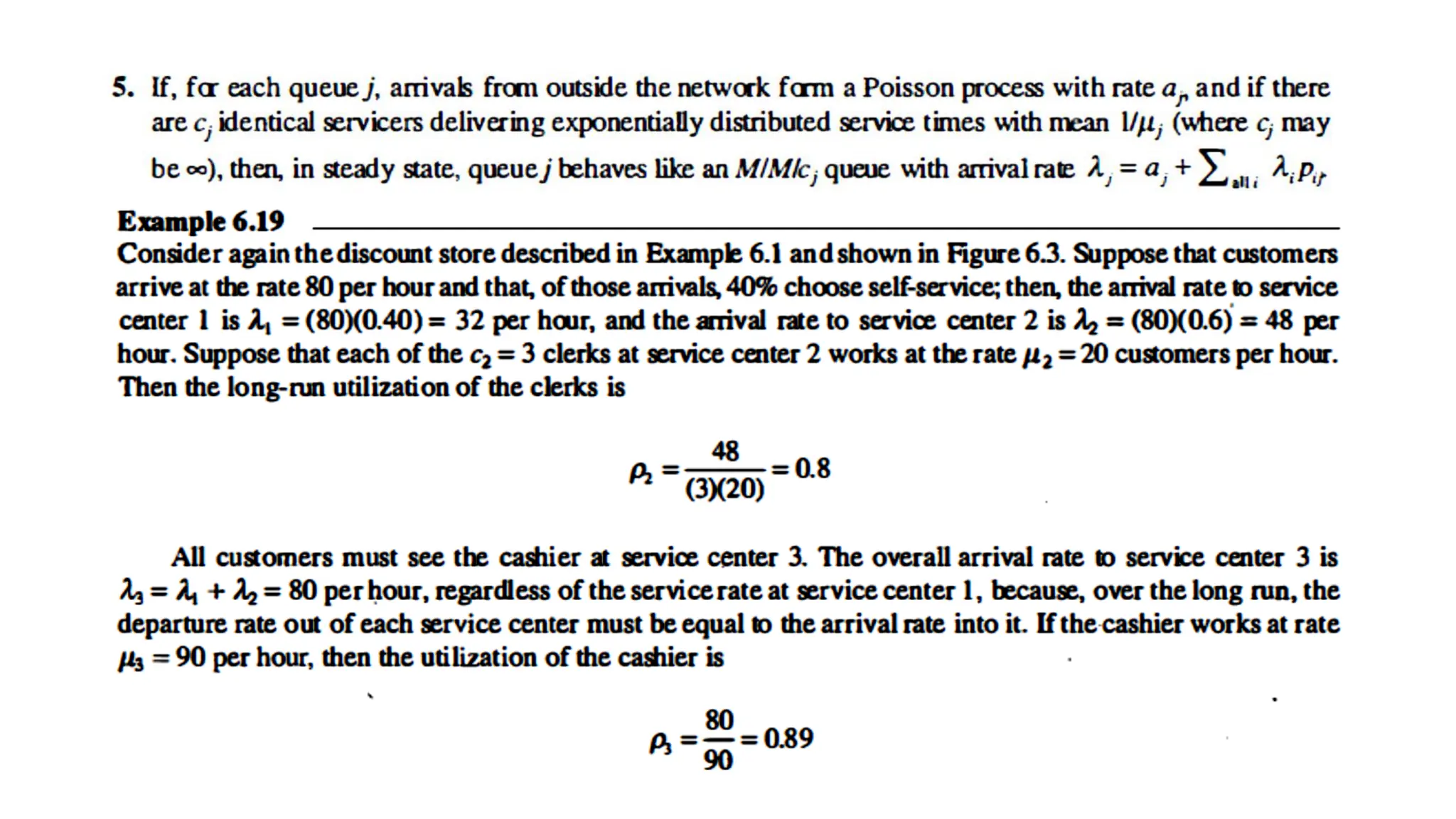
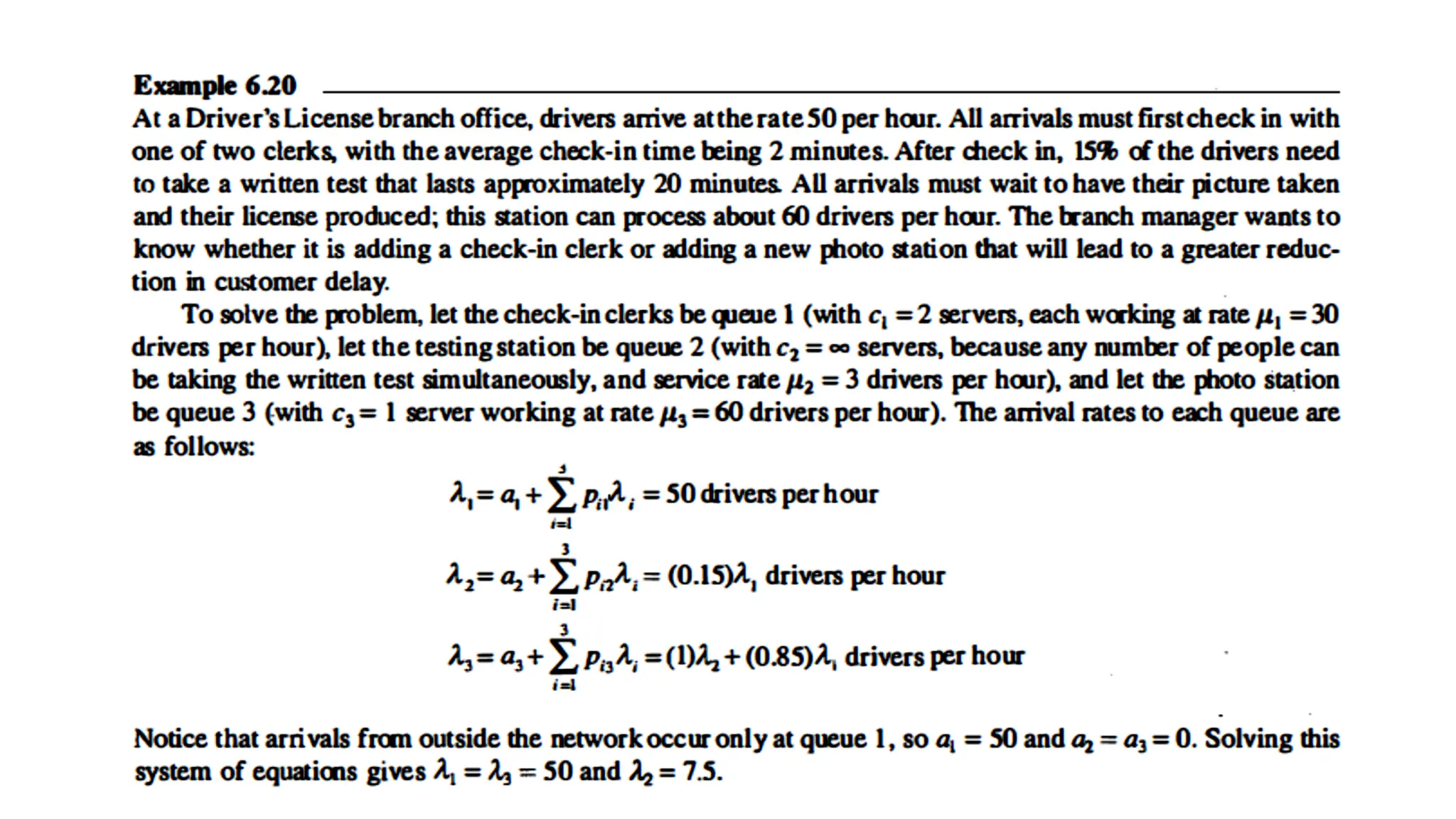
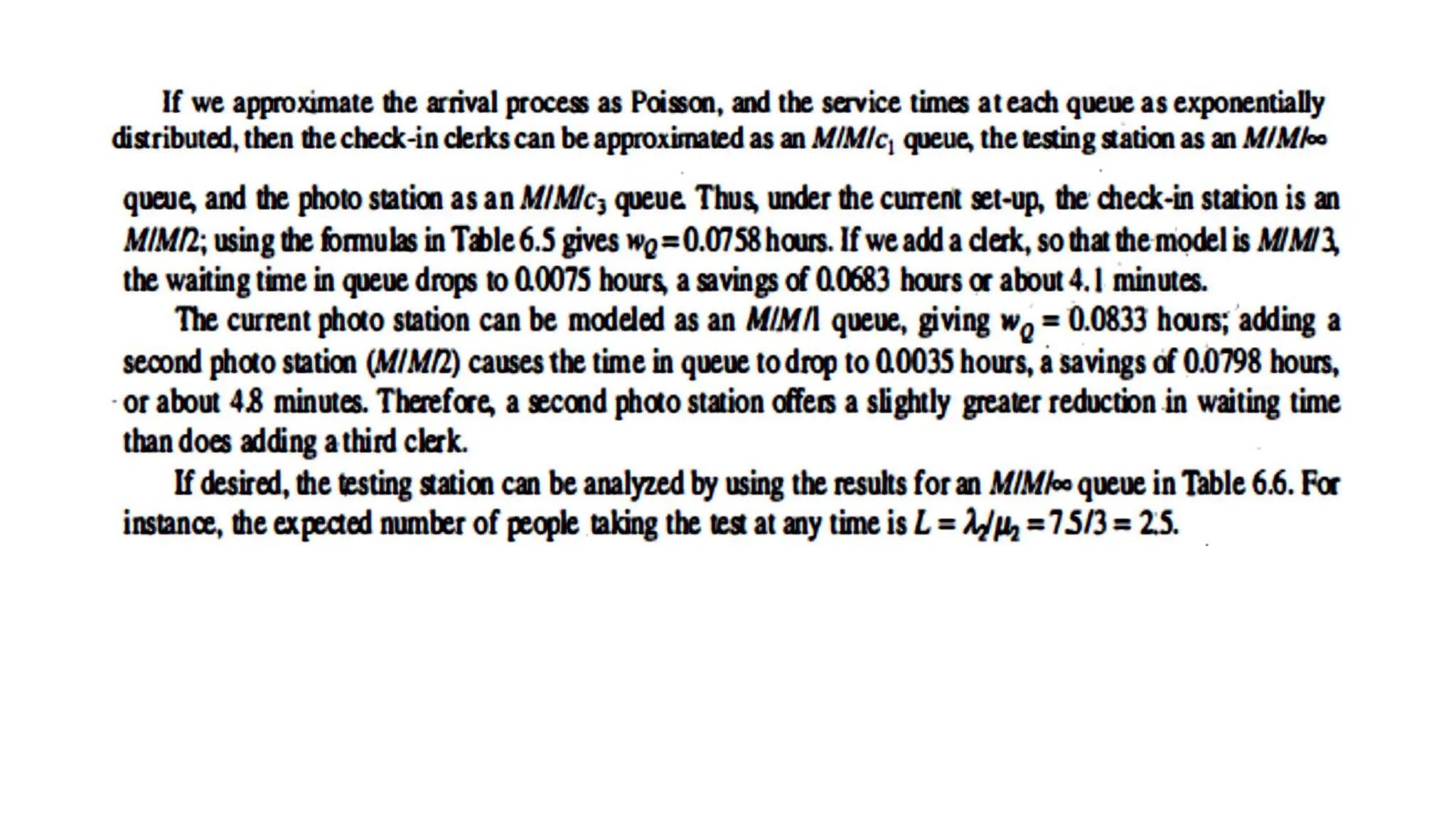
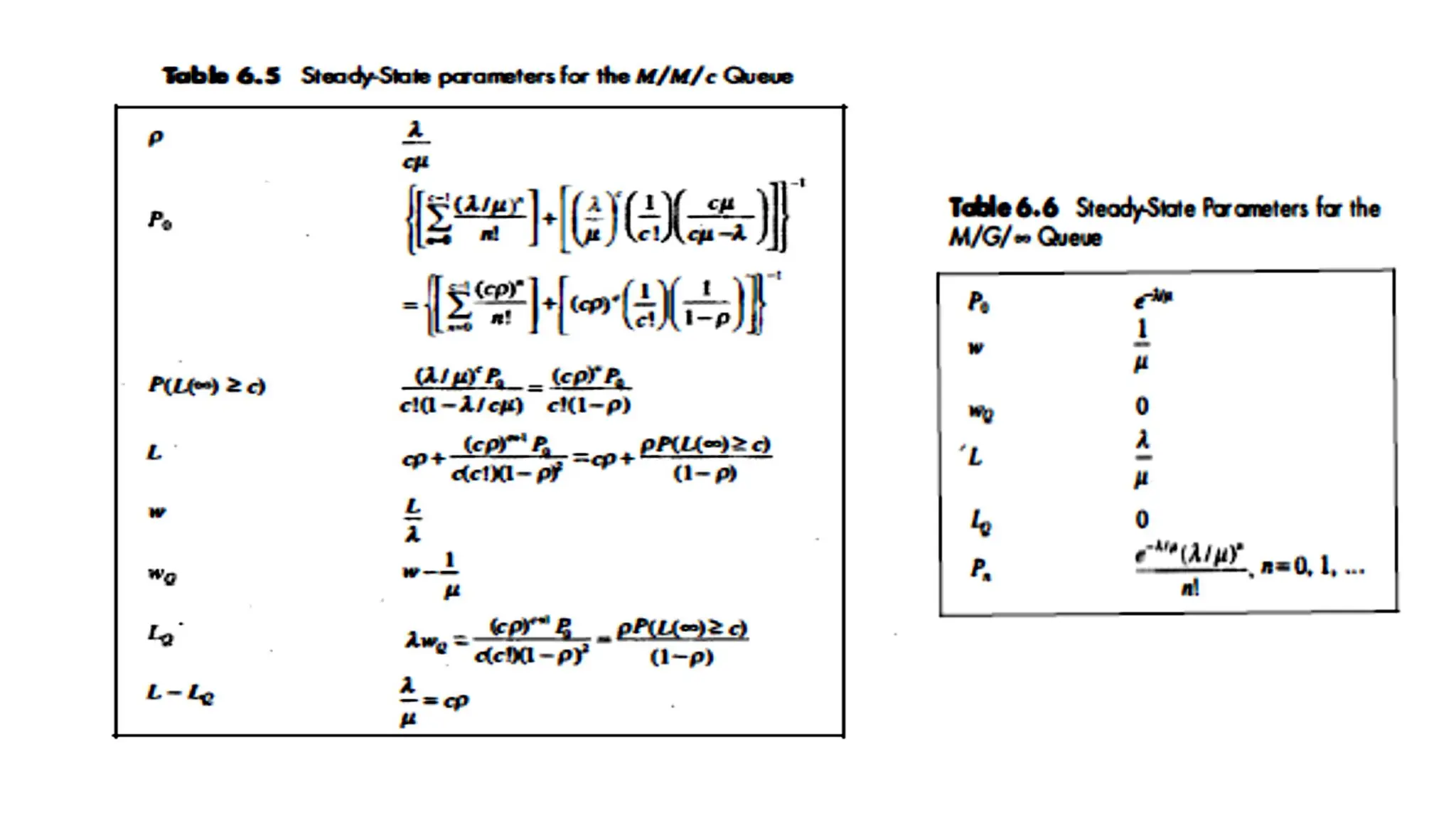
Networks of Queues
• The following results assume a stable system with infinite calling population and no limit on
system capacity.
Module 2 - Queuing Models and notations.pdf

Module 2 - Queuing Models and notations.pdf

  • 1.
  • 9.
    • The servicetimes of successive arrivals are denoted by S1, S2, S3, . . . They may be constant or of random duration. • In the latter case, {S1, S2, S3, . . . } is usually characterized as a sequence of independent and identically distributed random variables. • The exponential, Weibull, gamma, lognormal and truncated normal distributions have all been used successfully as models of service times in different situations. • Sometimes services are identically distributed for all customers of a given type or class or priority, whereas customers of different types might have completely different service-time distributions. • In addition, in some systems, service times depend upon the time of day or upon the length of the waiting line. • For example, servers might work faster than usual when the waiting line is long, thus effectively reducing the service times. • A queueing system consists of a number of service centers and interconnecting queues. • Each service center consists of some number of servers, c, working in parallel; that is, upon getting to the head of the line, a customer takes, the first available server. • Parallel service mechanisms are either single server (c = 1), multiple server (1 < c < ∞ ), or unlimited servers (c = ∞ ). • A self-service facility is usually characterized as having an unlimited number of servers. Service Times and Service Mechanism
  • 12.
  • 14.
    Long Run Measuresof Performance of Queuing Systems • The primary long-run measures of performance of queueing systems are the long-run time- average number of customers in the system (L) and in the queue (LQ), the long-run average time spent in system (w) and in the queue (wQ) per customer, and the server utilization, or proportion of time that a server is busy (p). • The term "system" usually refers to the waiting line plus the service mechanism, but, in general, can refer to any subsystem of the queueing system; whereas the term "queue" refers to the waiting line alone. • Other measures of performance of interest include the long-run proportion of customers who are delayed in queue longer than to time units, the long-run proportion of customers turned away because of capacity constraints, and the long-run proportion of time the waiting line contains more than k0 customers.
  • 15.
    Time-Average Number inSystem L • Consider a queueing system over a period of time T, and let L(t) denote the number of customers in the system at time t. • A simulation of such a system is shown below.
  • 20.
    Average Time Spentin System Per Customer w • If we simulate a queueing system for some period of time, say T, then we can record the time each customer spends in the system during [0, T], say W1, W2, . . ., WN> where N is the number of arrivals during [0, T]. • The average time spent in system per customer, called the average system time, is given by the ordinary sample average,
  • 23.
  • 25.
  • 26.
  • 27.
    Server Utilization inG/G/1/∞/∞ Queues • Consider any single-server queueing system with average arrival rate λ customers per time unit, Average service time E(S) = 1/µ time units, and infinite queue capacity and calling population Notice that E(S) = 1/µ implies that, when busy, the server is working at the rate µ customers per time unit, on the average µ is called the service rate. • The server alone is a subsystem that can be considered as a queueing system in itself; hence, the conservation Equation, L = λw, can be applied to the server. • For stable systems; the average arrival rate to the server, say λ must be identical to the average arrival rate to the system, λ (certainly λs ≤ λ customers cannot be served faster than they arrive- but, if λs < λ, then the waiting line would tend to grow in length at an average rate of
  • 31.
    Server Utilization inG/G/c/∞/∞ Queues • Consider a queueing system with c identical servers in parallel. • If an arriving customer finds more than one server idle, the customer chooses a server without favouring any particular server. (For example, the choice of server might be made at random.) • Arrivals occur at rate λ from an infinite calling population, and each server works at rate µcustomers per time unit. • From Equation (6.9), L = λw, applied to the server subsystem alone, an argument similar to the one given for a single server leads to the result that, for systems in statistical equilibrium, the average number of busy servers, say L,, is given by,
  • 34.
    Server Utilization andSystem Performance • System performance can vary widely for a given value of utilization ρ. • Consider a G/G/1/∞/∞ queue, that is, a single server queue with arrival rate λ, server rate µ and utilization,
  • 36.
  • 37.
    tend to shortenan existing waiting time.
  • 38.
  • 39.
    are combined intoa total cost.
  • 40.
    STEADY-STATE BEHAVIOR OFINFINITE-POPULATION MARKOVIAN MODELS • For the infinite-population models, the arrivals are assumed to follow a Poisson process with rate λ arrivals per time unit- that is, the interarrival times are assumed to be exponentially distributed with mean 1/λ. Service
  • 42.
    Single-Server Queues WithPoisson Arrivals and Unlimited Capacity: M/G/1
  • 47.
    Using this formula,calculate the P0, P1, P2, P3, P4,….
  • 52.
    Effect of Utilizationand Service Variability
  • 55.
    Networks of Queues •The following results assume a stable system with infinite calling population and no limit on system capacity.