Questioning the Value of
Mathematics
Paul Ernest
University of Exeter
p.ernest@ex.ac.uk
Valuing of Mathematics
As mathematics professionals we greatly esteem
and value mathematics
Mathematics is valuable in several ways
Mathematics has:
1. Intrinsic value
2. Extrinsic and social value
3. Personal value
Questioning the Value of Maths
• But is mathematics an untramelled good?
• Does promoting mathematics lead to solely
beneficial outcomes?
• What are the actual, including unintended,
outcomes and costs of privileging
mathematics in education and society?
• Dare we question the unquestionable and ask:
• Does mathematics cause harm?
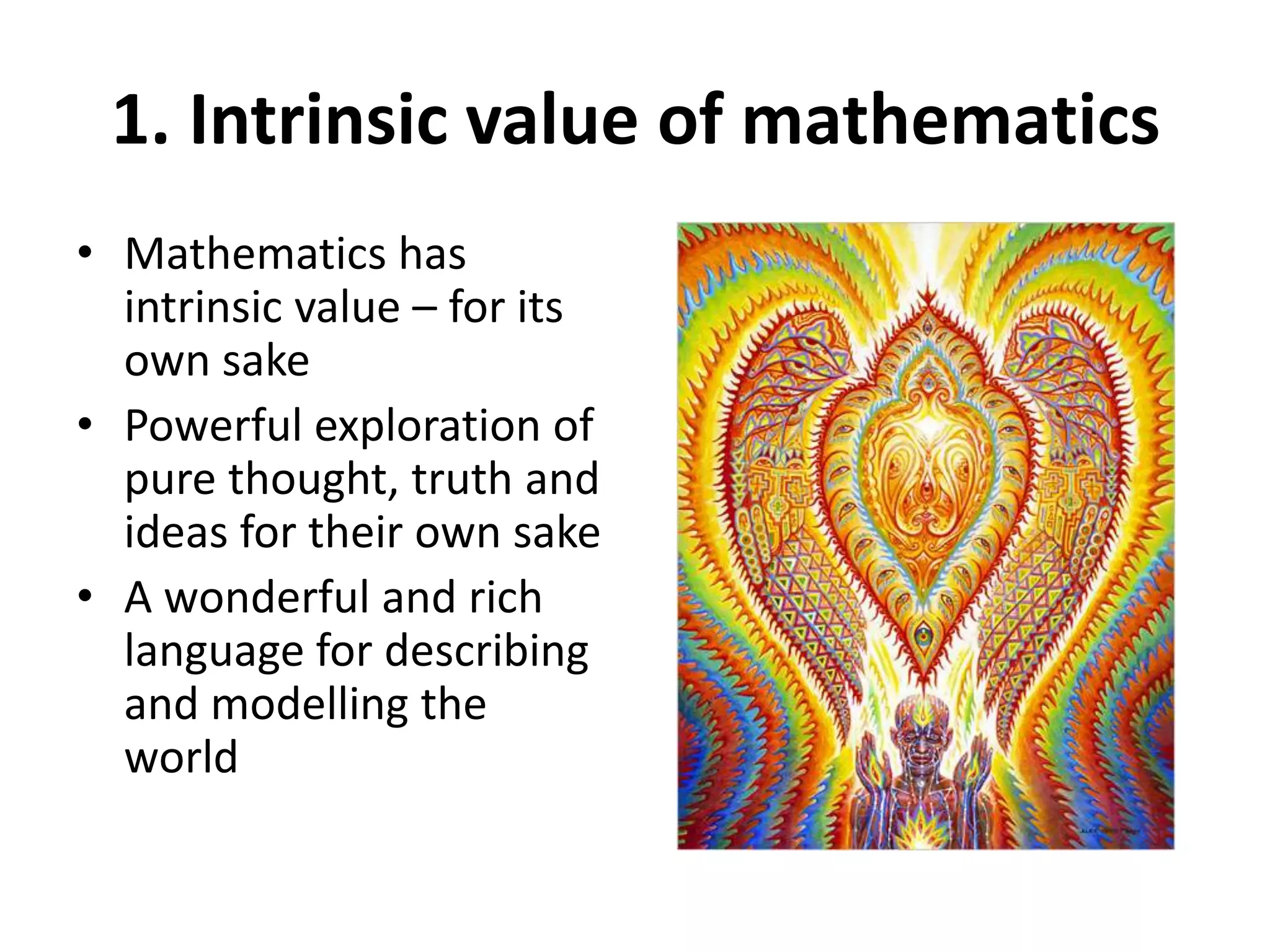
1. Intrinsic value of mathematics
• Mathematics has
intrinsic value – for its
own sake
• Powerful exploration of
pure thought, truth and
ideas for their own sake
• A wonderful and rich
language for describing
and modelling the
world
The beauty of pure mathematics
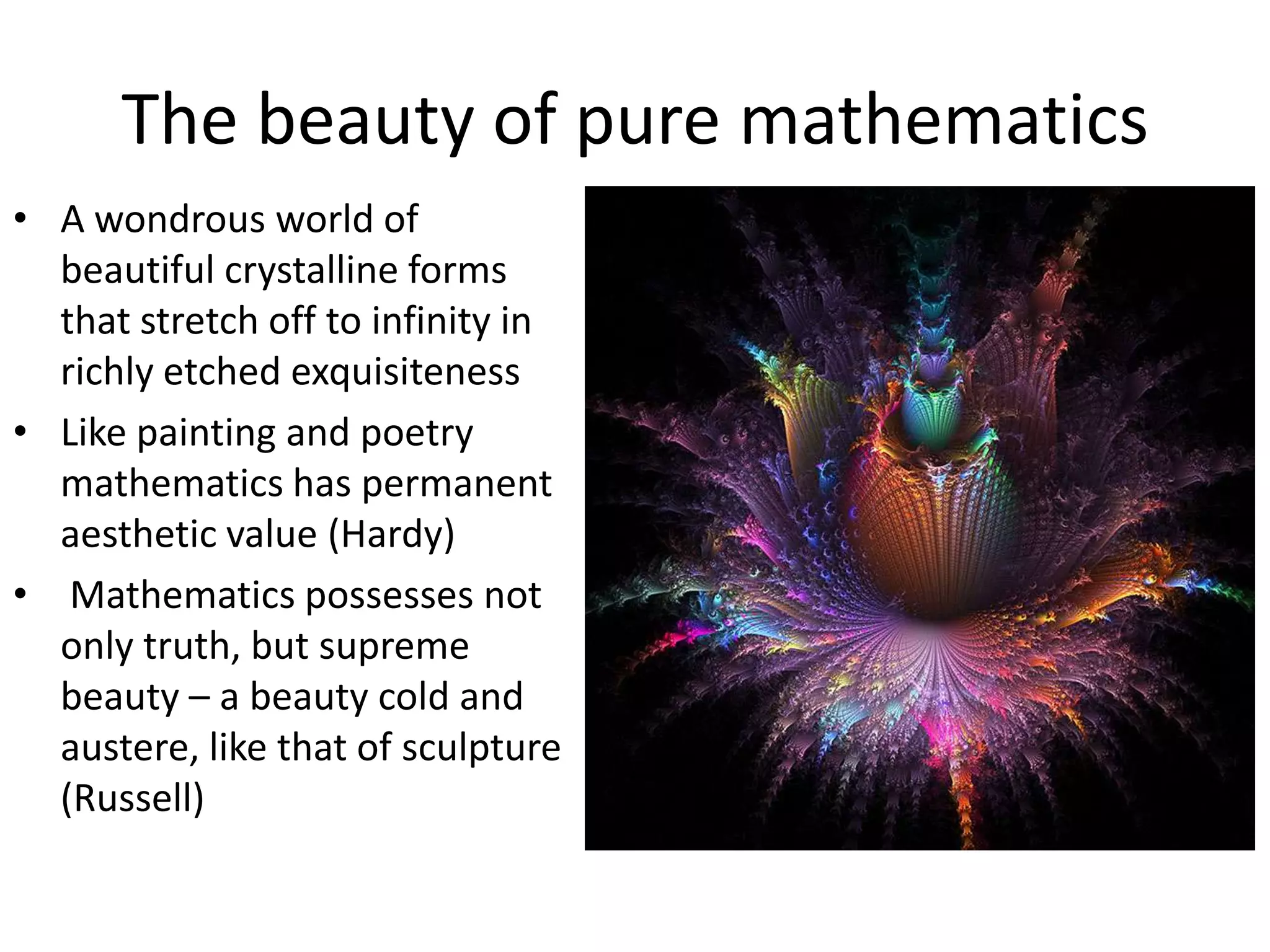
• A wondrous world of
beautiful crystalline forms
that stretch off to infinity in
richly etched exquisiteness
• Like painting and poetry
mathematics has permanent
aesthetic value (Hardy)
• Mathematics possesses not
only truth, but supreme
beauty – a beauty cold and
austere, like that of sculpture
(Russell)
The Characteristics of Mathematics
Calculation is central – it dominates history and
schooling
• Rule based procedures in which meaning is
ignored
Algebra is central – the language of mathematics
• Variable based – specific meanings are detached
(noted by Berkeley 1710)
Unique linguistic move from meanings to rules
• This enables the miracle of electronic computing
• But has costs too
Costs of mathematics
The mathematical way of thinking promotes
• Detachment of meaning
• Ethical neutrality
• Separated values
• Dehumanizing outlook
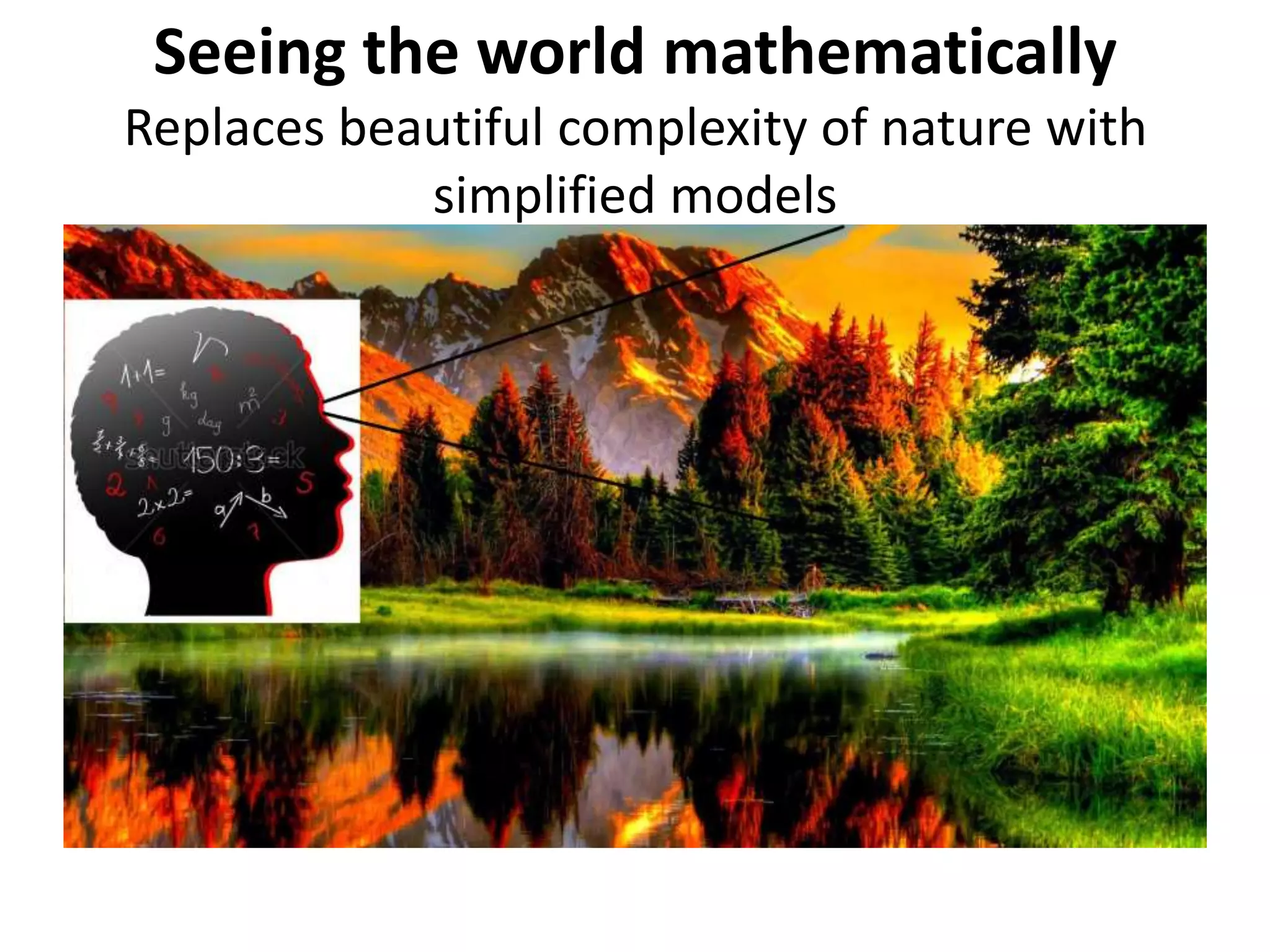
Seeing the world mathematically
Replaces beautiful complexity of nature with
simplified models
Separated Values of Mathematics
Separated values (Gilligan 1982) promote:
• Rules,
• Abstraction,
• Objectification,
• Reason,
• Dispassionate analysis,
• Impersonality
These values intrinsic to mathematics
But inculcating these values fosters a dehumanized
outlook
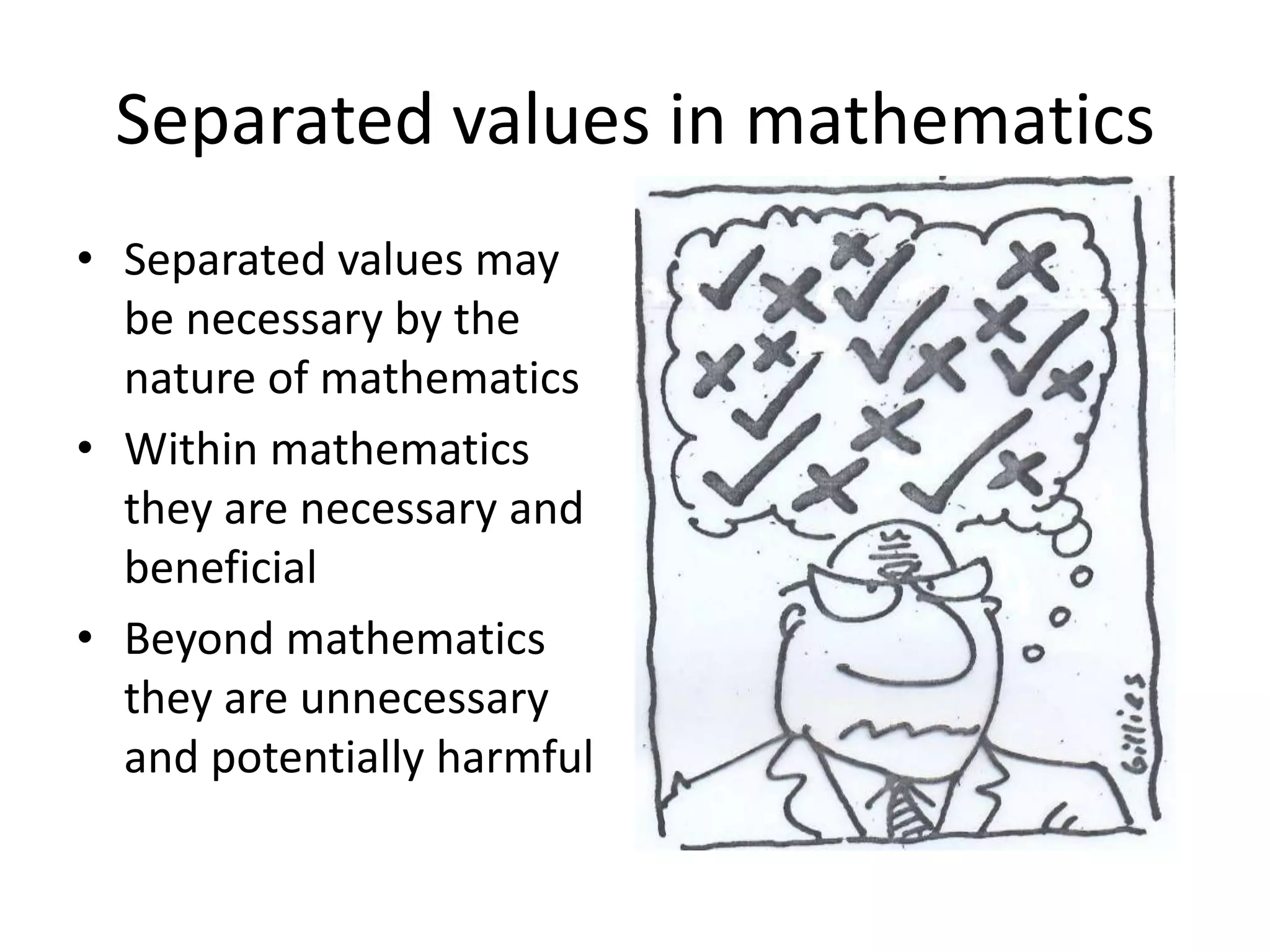
Separated values in mathematics
• Separated values may
be necessary by the
nature of mathematics
• Within mathematics
they are necessary and
beneficial
• Beyond mathematics
they are unnecessary
and potentially harmful
2. Extrinsic / Social Value of Maths
MATHEMATICS ESSENTIAL FOUNDATION FOR
• Much of knowledge – especially science
• Information and communication technology –
computing wholly based on maths
• Applications in engineering, technology and
throughout society
• Economic, fiscal and commercial basis of modern
society
• Work, study and everyday life
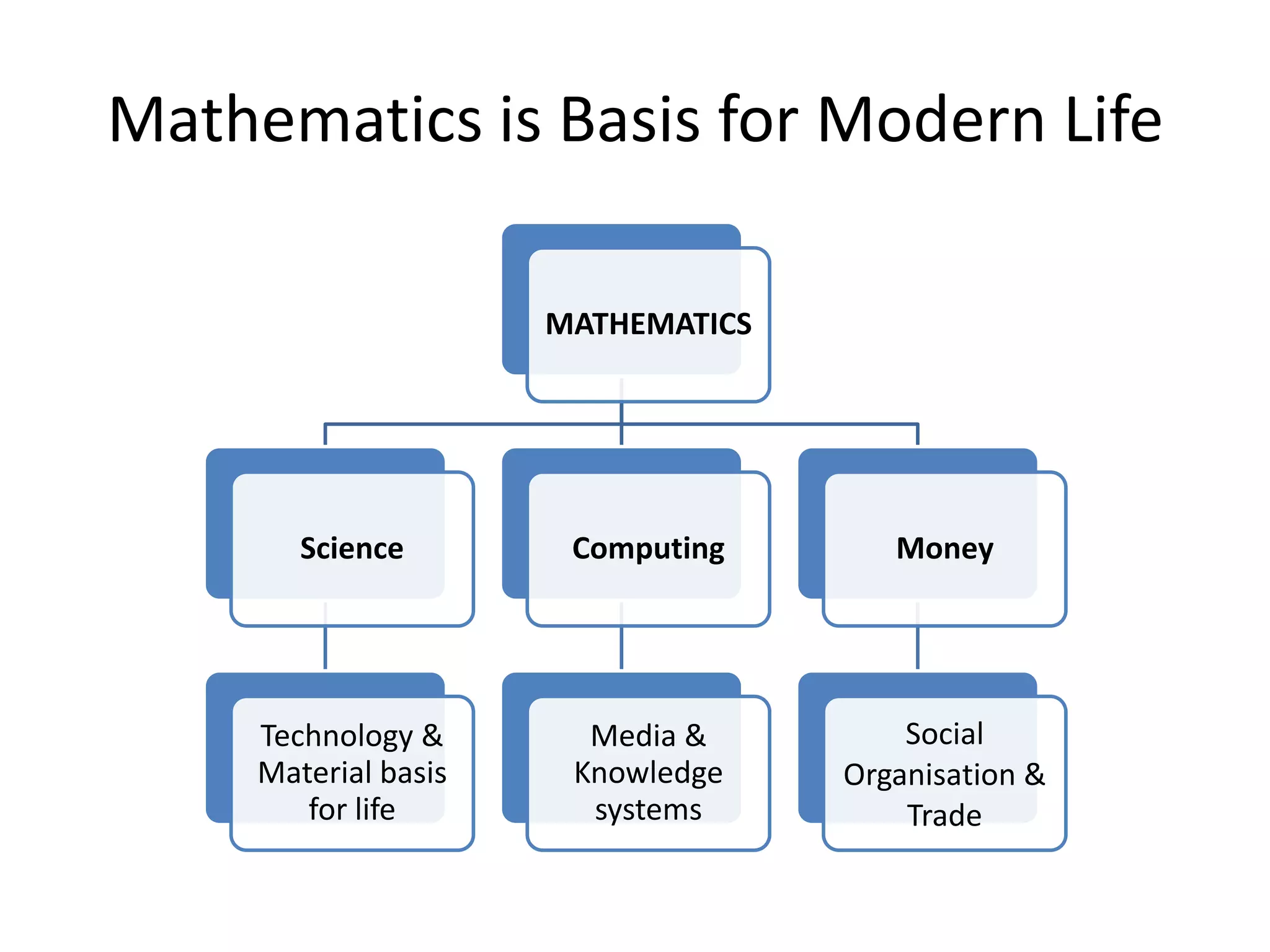
Mathematics is Basis for Modern Life
MATHEMATICS
Science
Technology &
Material basis
for life
Computing
Media &
Knowledge
systems
Money
Social
Organisation &
Trade
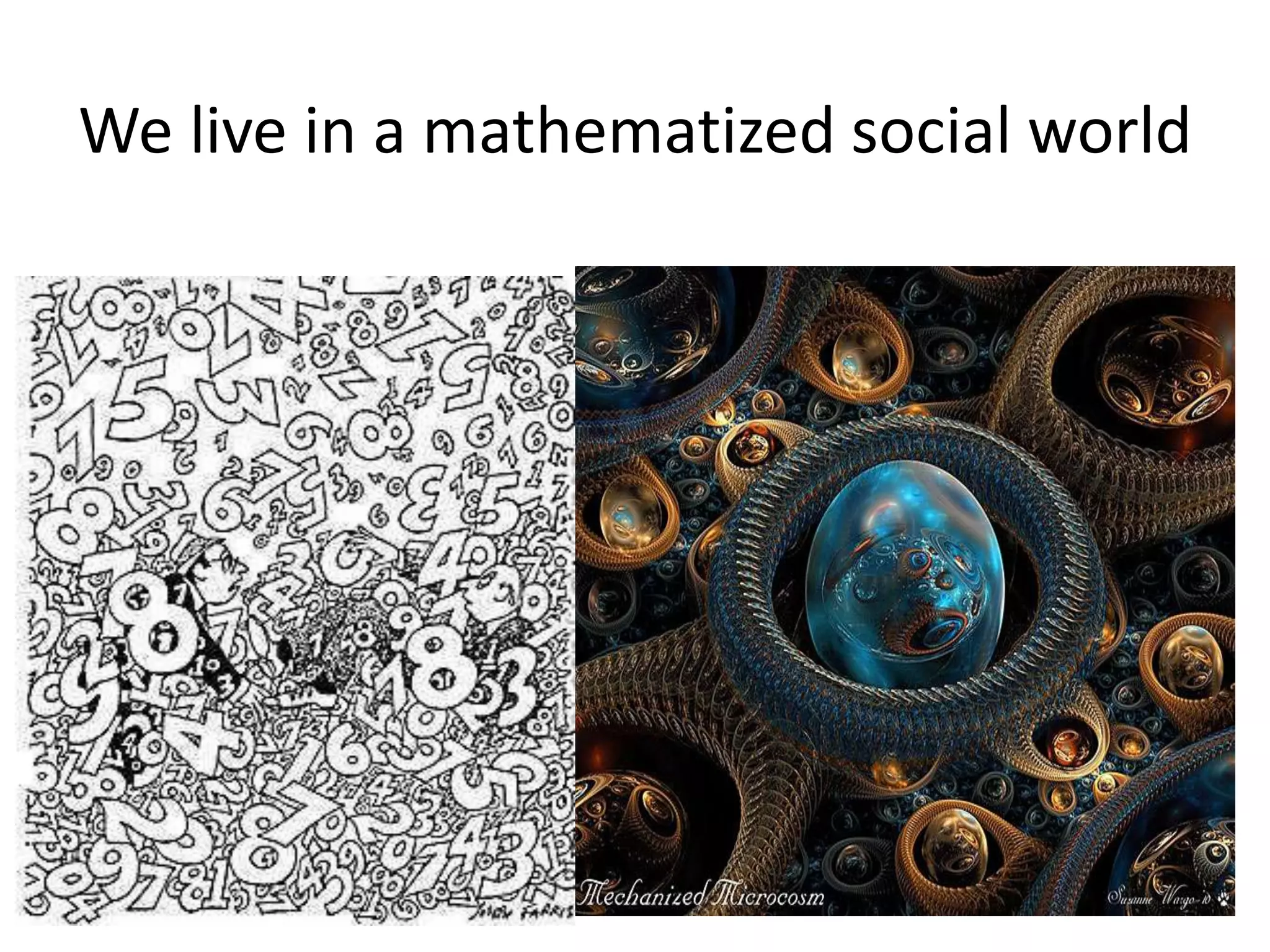
We live in a mathematized social world
Characteristics of Mathematics
School, university and research mathematics presented
in sentences where predominant verb form is imperative
(Rotman)
Imperatives instruct or direct actions - either inclusively
(Let us …, Consider…) or exclusively (Add, Count, Solve,
Prove, etc)
Operating mathematically is to follow imperatives, follow
orders, to carry out instructed procedures following rules
unquestioningly
Many procedures on signs carried out with deferred
meaning
Good training for calculative or instrumental reasoning
(Frankfurt School) – conducting procedures with no
thought of external impact or ethical considerations
Negative Outcomes of Maths in Society
• Objectivism and simplistic epistemology
• Instrumental reasoning in management and
governmental thinking – ethics free thought
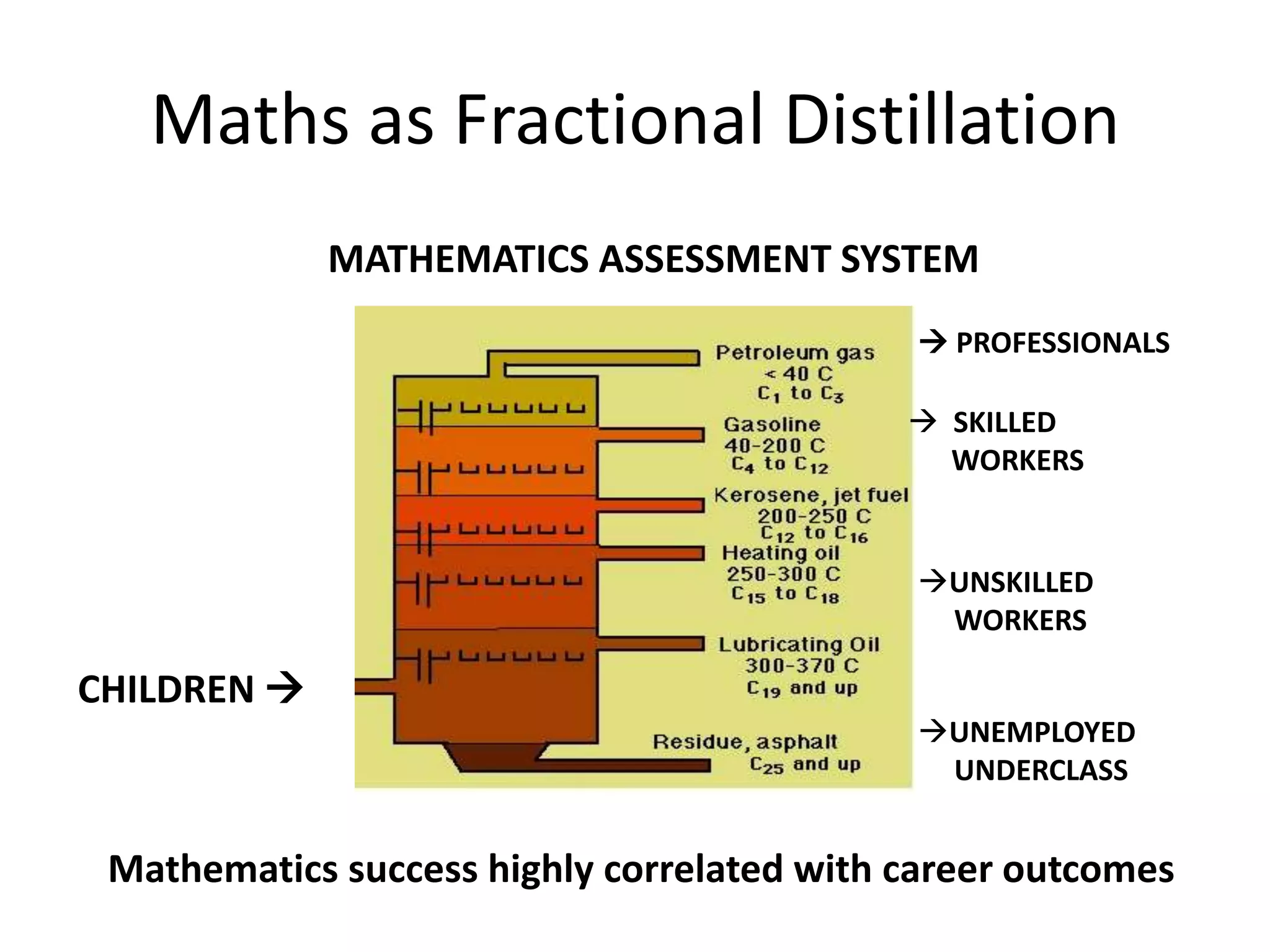
• Mathematics examinations a sifting / filtration
device – fractional distillation of population
via school – class reproductive
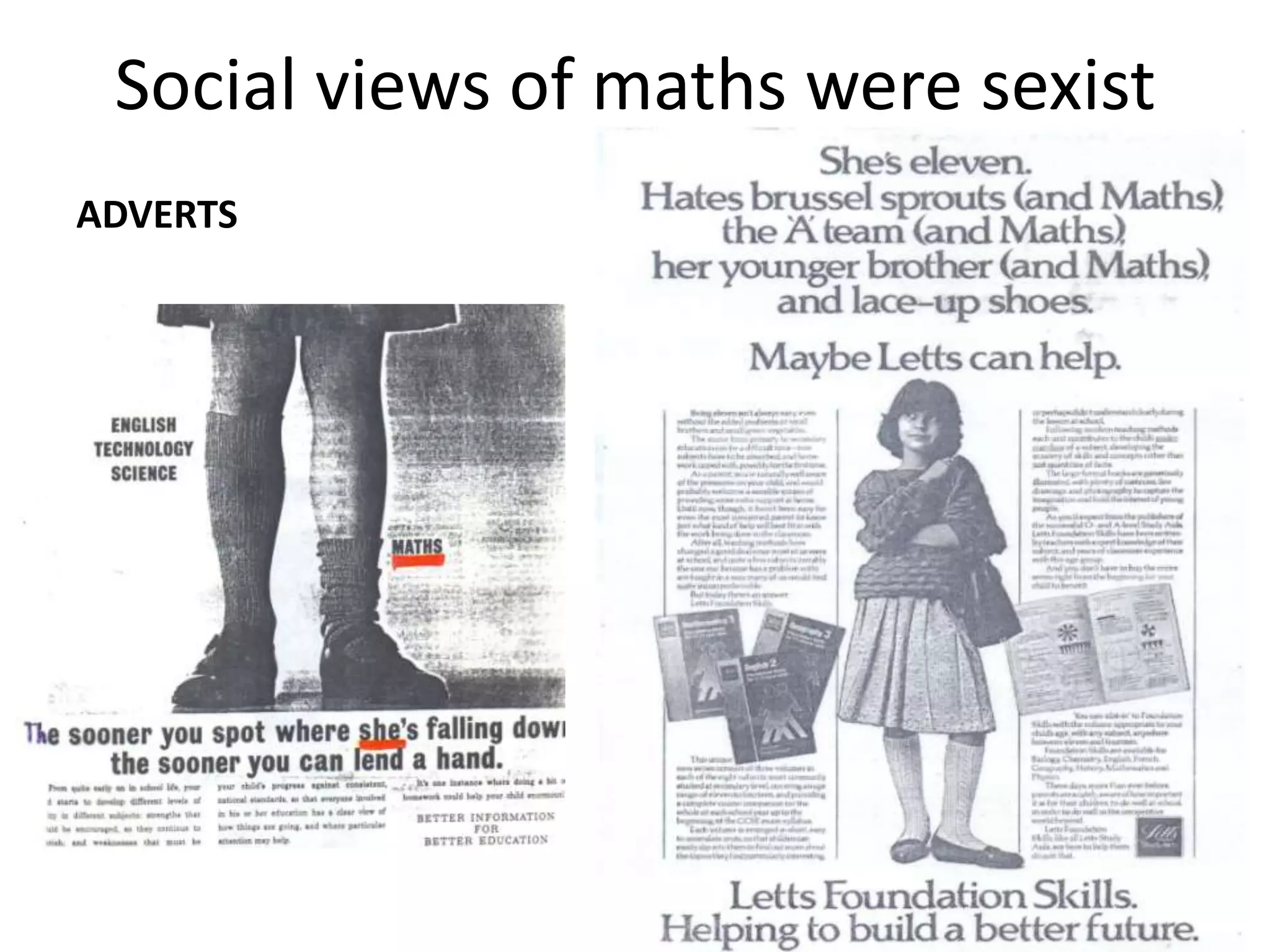
• Sexism supported by maths (diminishing)
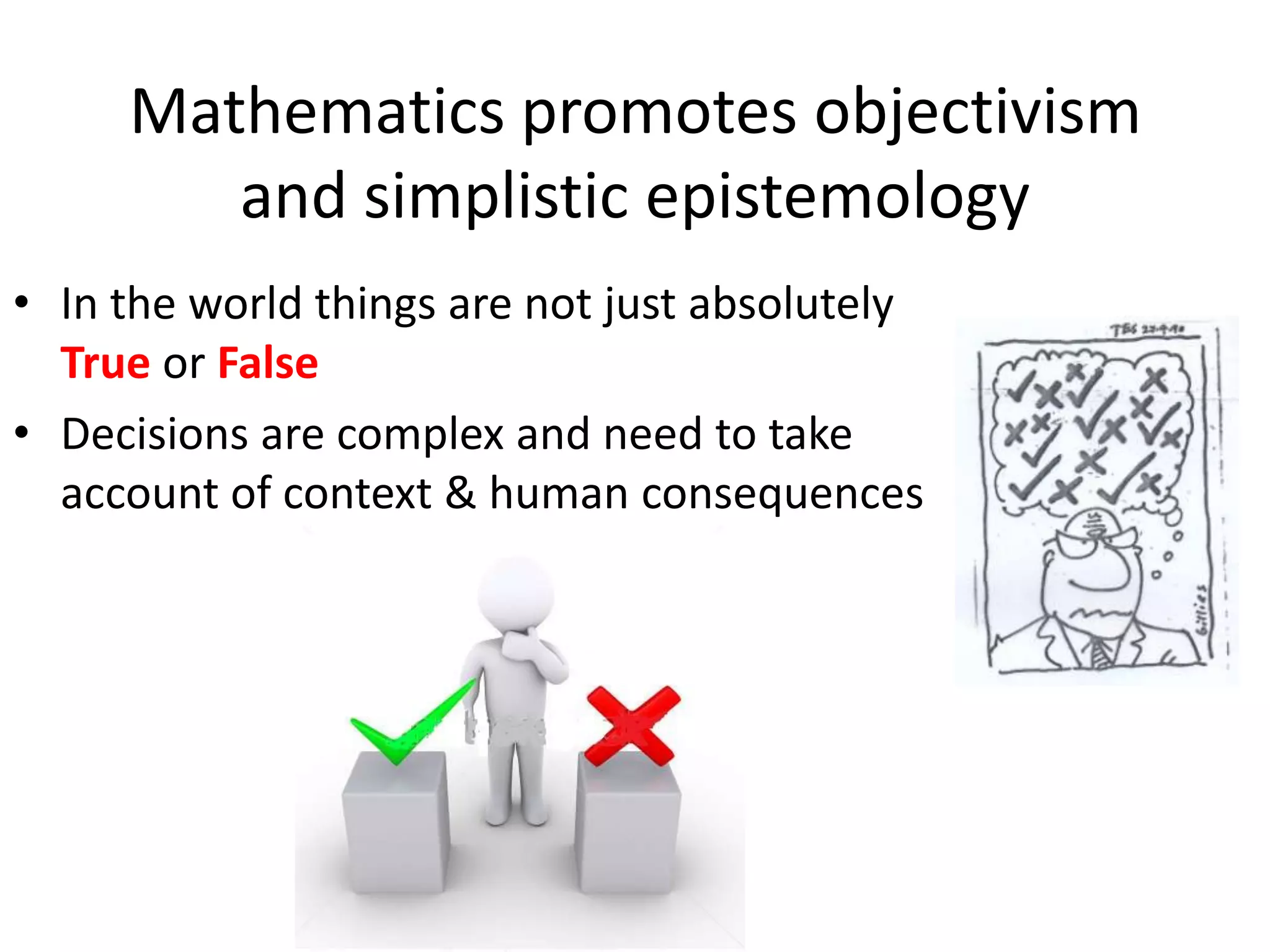
Mathematics promotes objectivism
and simplistic epistemology
• In the world things are not just absolutely
True or False
• Decisions are complex and need to take
account of context & human consequences
Instrumental reasoning
Mathematics provides training in instrumental
reasoning for management, business and
governmental thinking
• Convergent rule following thought
• Inculcating separated values
• Training in ethics-free and value-free thinking
Instrumental reasoning
• Mathematics is essence
of instrumental reason -
focus on means to ends
and not on underlying
values (Frankfurt School
critique)
• Instrumental reasoning
underpins management,
corporate and
governmental thinking
• Standardization,
routinization, and
dehumanization lead to
unethical treatment of
persons (Kelman 1973)
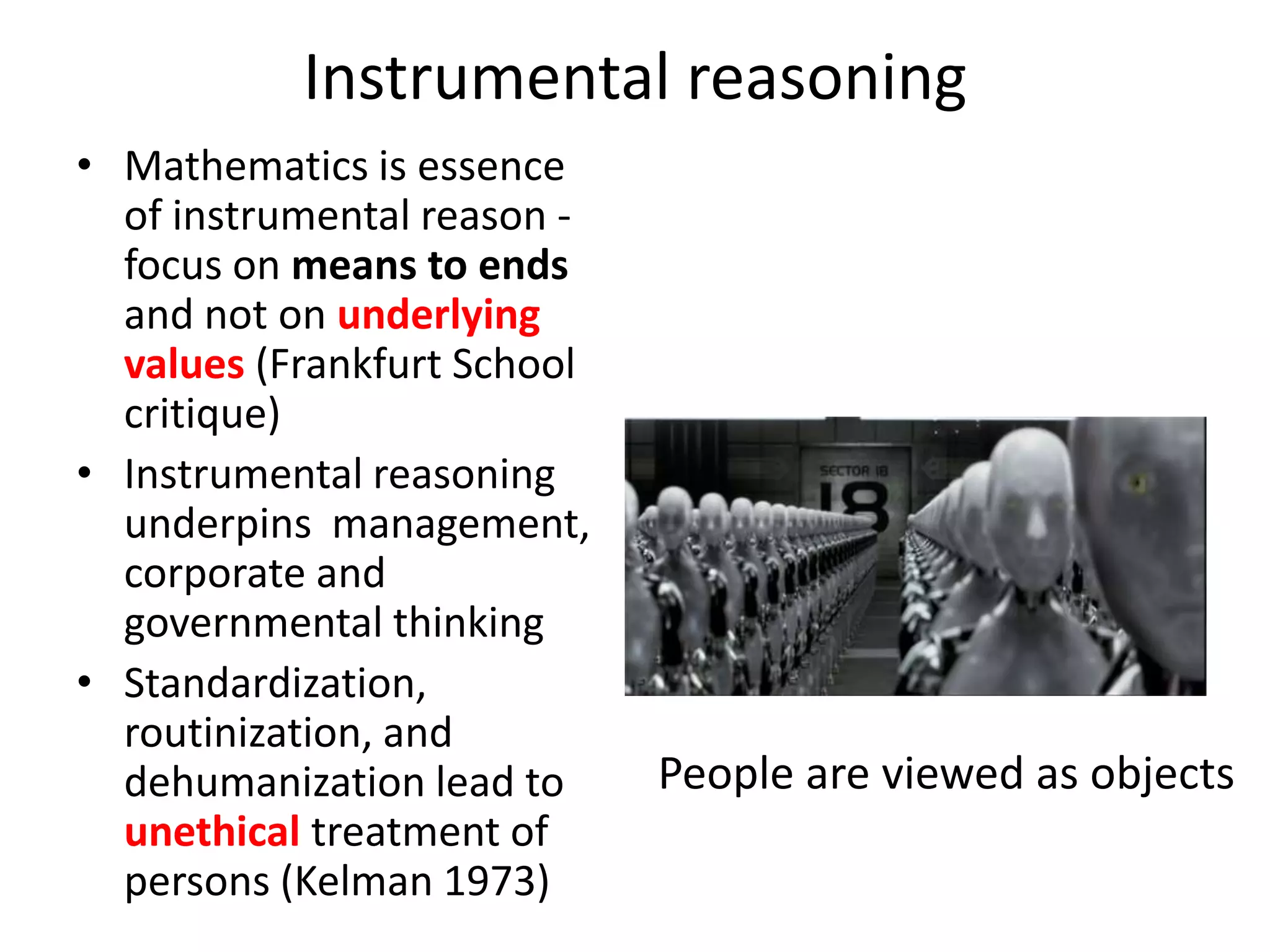
People are viewed as objects
Maths as Fractional Distillation
 PROFESSIONALS
 SKILLED
WORKERS
UNEMPLOYED
UNDERCLASS
UNSKILLED
WORKERS
CHILDREN 
MATHEMATICS ASSESSMENT SYSTEM
Mathematics success highly correlated with career outcomes
Social views of maths were sexist
ADVERTS
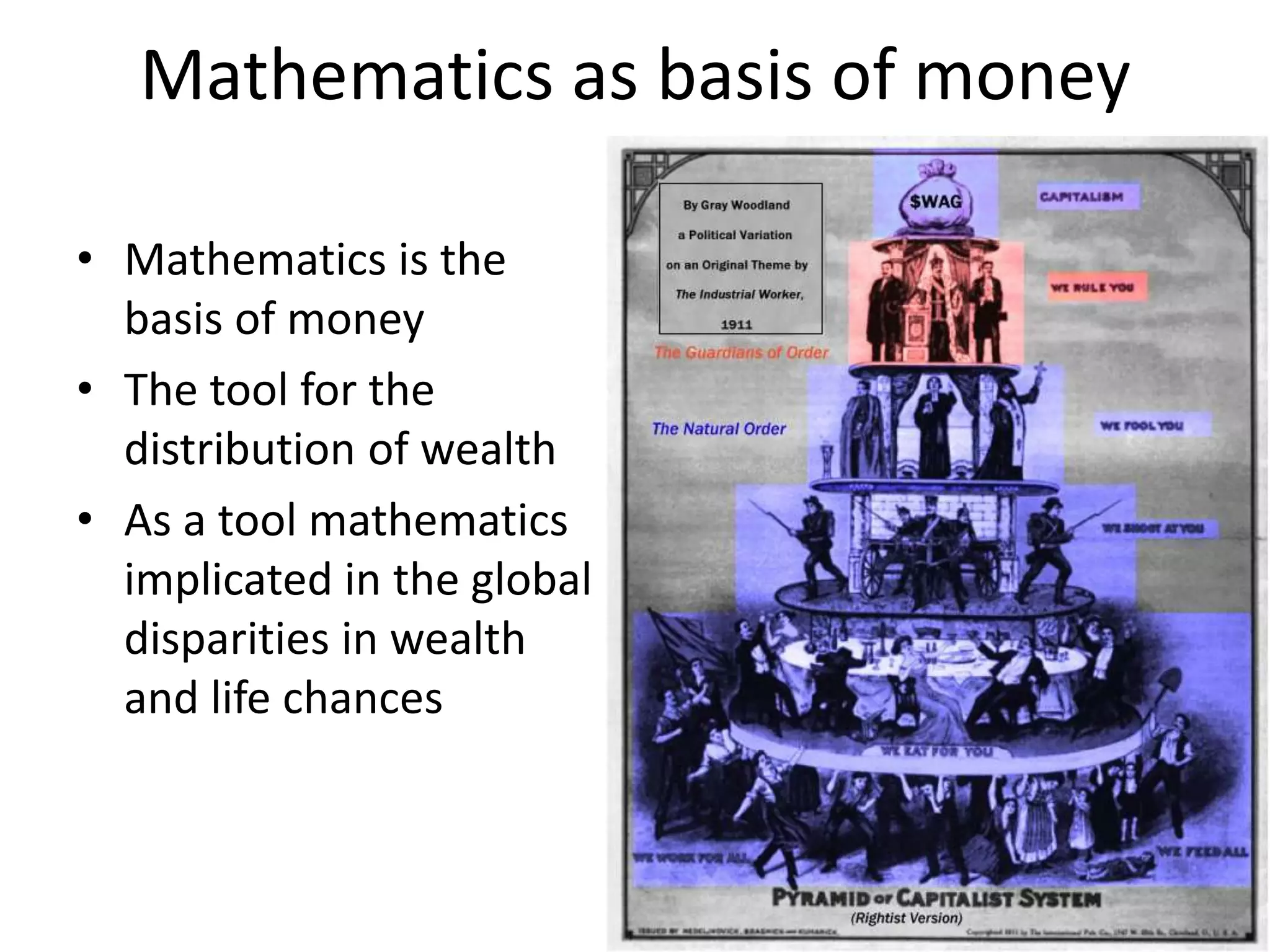
Mathematics as basis of money
• Mathematics is the
basis of money
• The tool for the
distribution of wealth
• As a tool mathematics
implicated in the global
disparities in wealth
and life chances
3. Personal value of mathematics
There are great benefits: Mathematical
knowledge empowers individuals to
• Gain understanding, skills, reasoning and
problem solving abilities
• Gain qualifications for employment
• Be able to use mathematics in life and work
• Express creativity through mathematics
• Gain foundation for further study
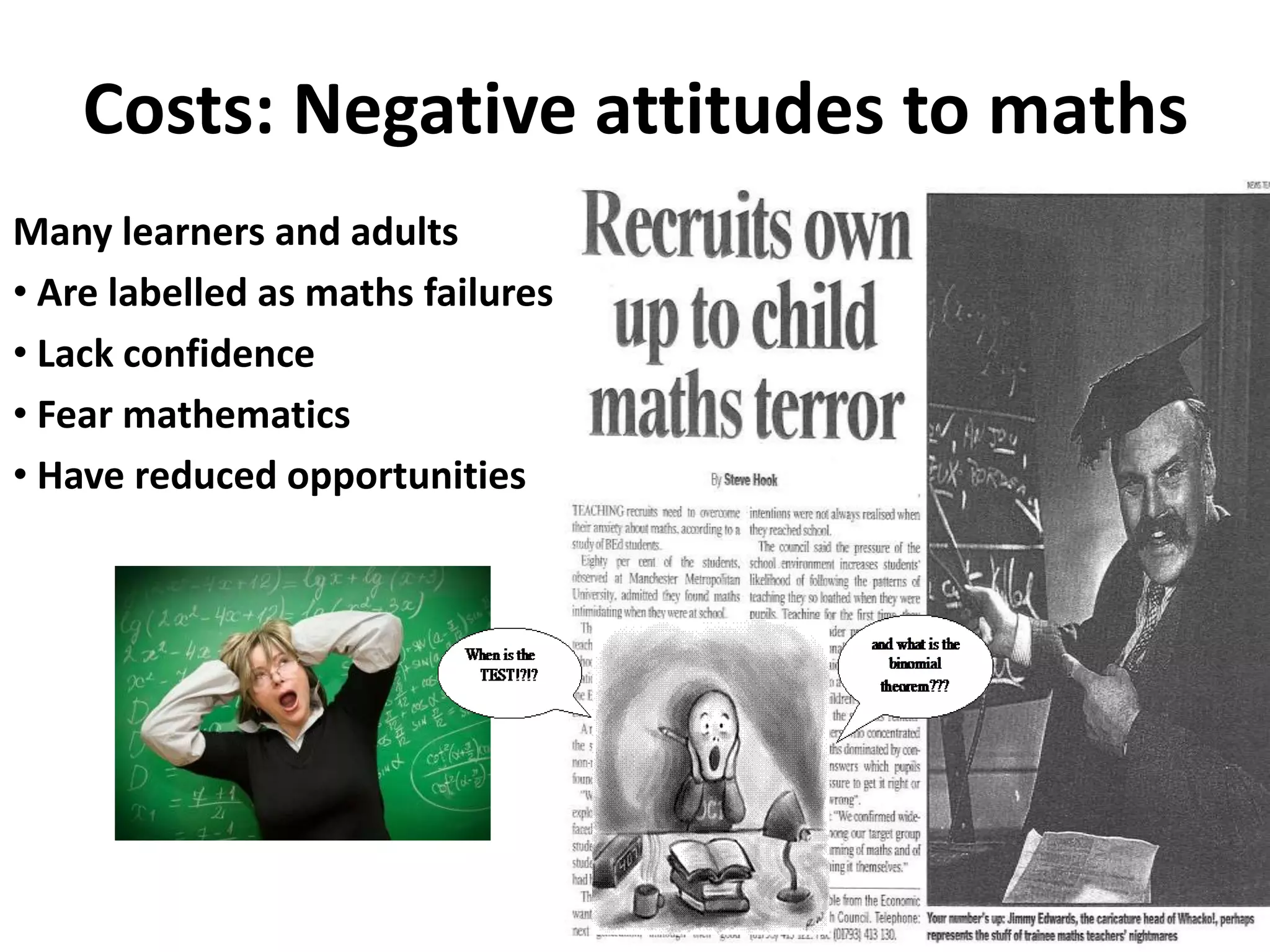
Costs: Negative attitudes to maths
Many learners and adults
• Are labelled as maths failures
• Lack confidence
• Fear mathematics
• Have reduced opportunities
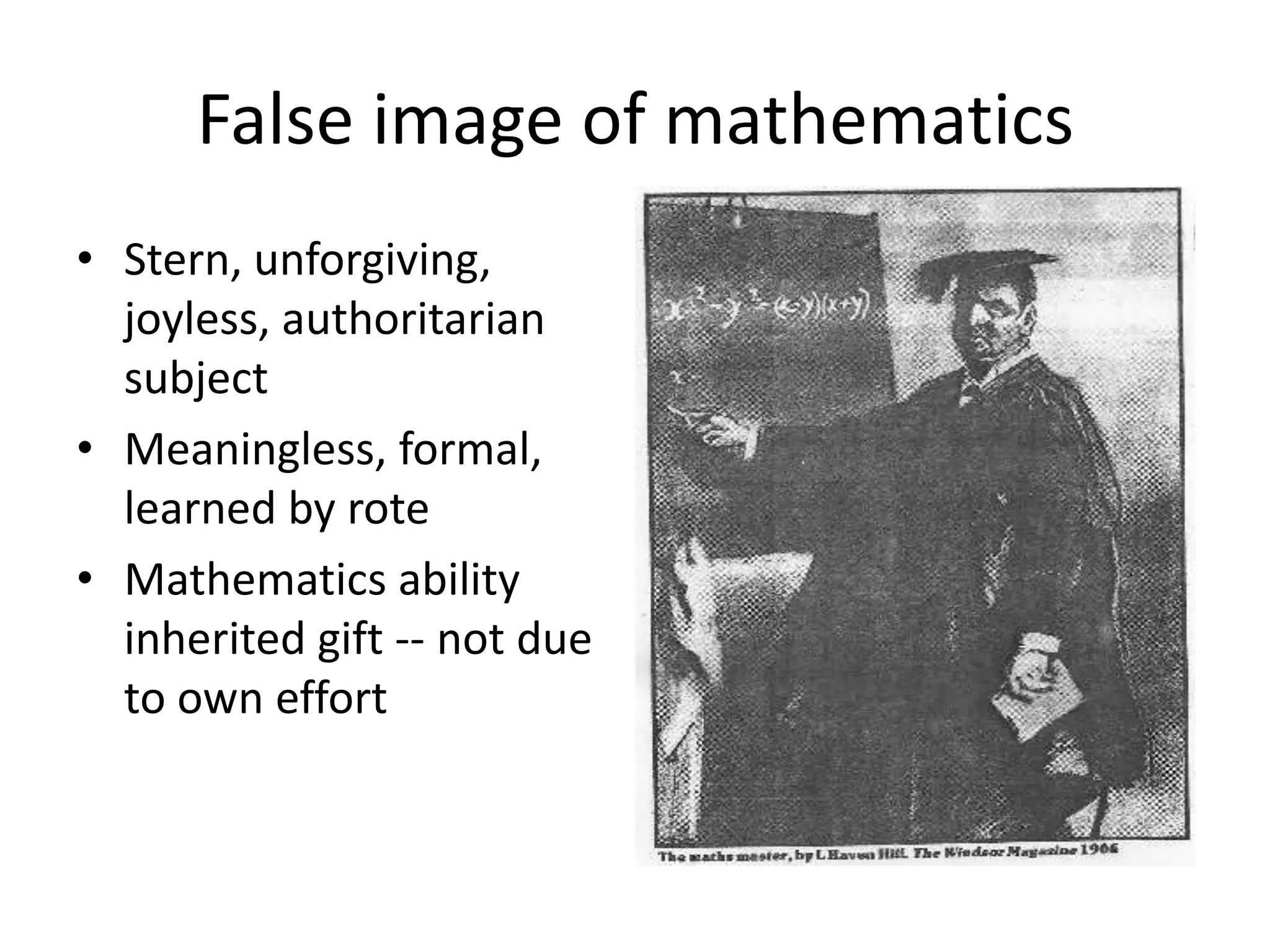
False image of mathematics
• Stern, unforgiving,
joyless, authoritarian
subject
• Meaningless, formal,
learned by rote
• Mathematics ability
inherited gift -- not due
to own effort
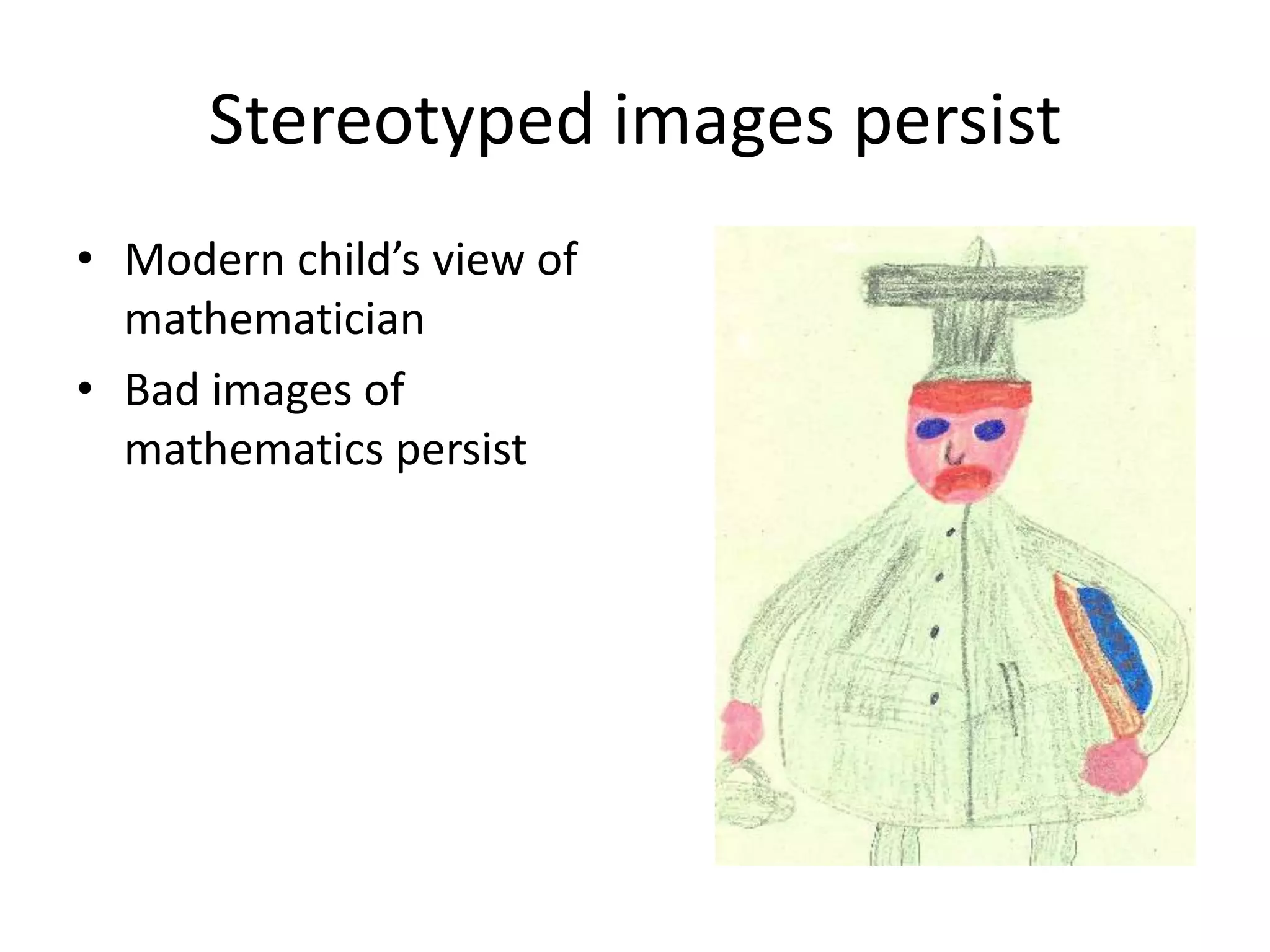
Stereotyped images persist
• Modern child’s view of
mathematician
• Bad images of
mathematics persist
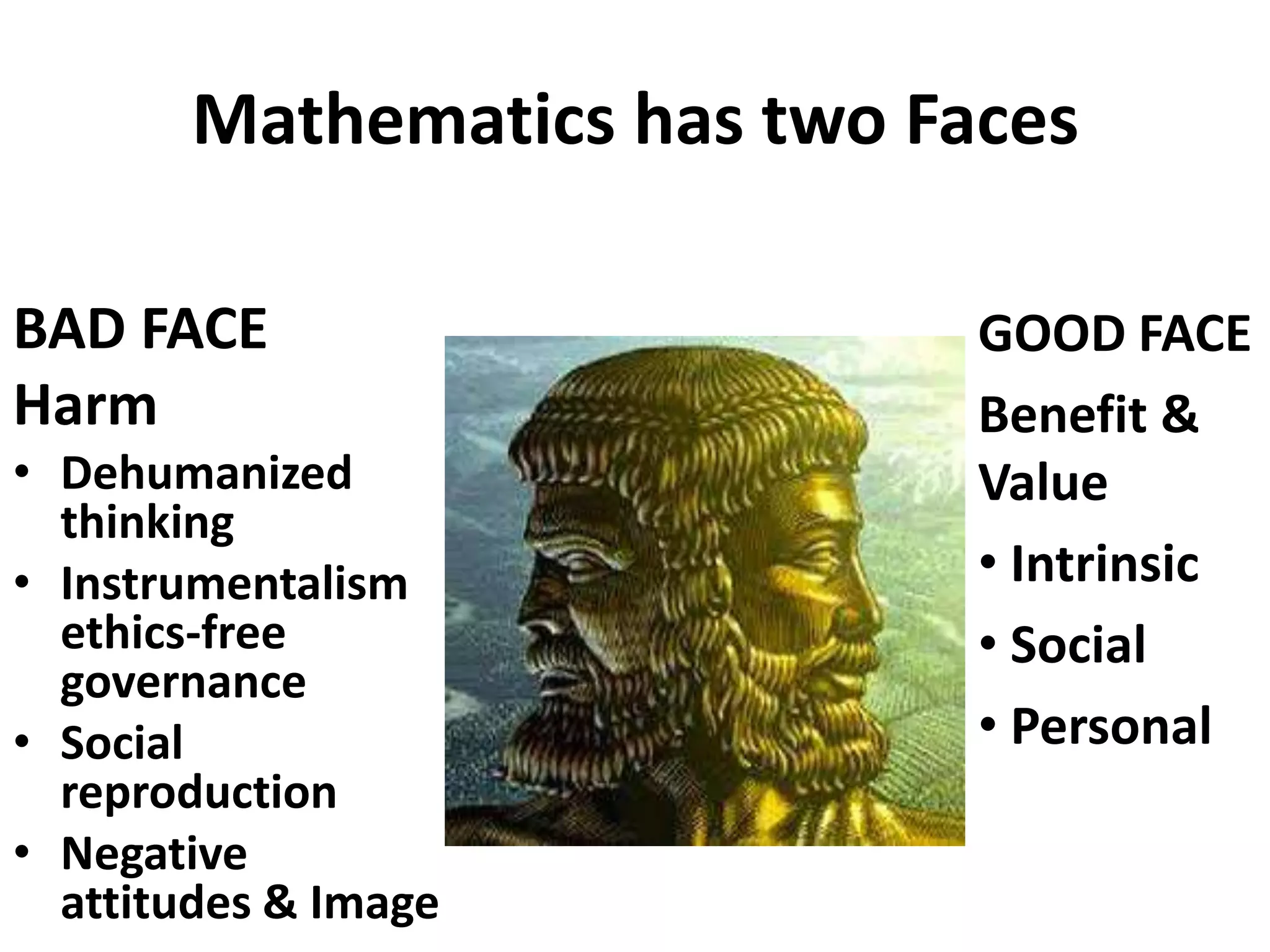
Mathematics has two Faces
BAD FACE
Harm
• Dehumanized
thinking
• Instrumentalism
ethics-free
governance
• Social
reproduction
• Negative
attitudes & Image
GOOD FACE
Benefit &
Value
• Intrinsic
• Social
• Personal
Harm comes from mis-application
Mathematics not intrinsically harmful
But its applications can be detrimental to many
How can we rectify this?
• Include philosophy of mathematics with
mathematics
• Add the ethics of mathematics
• Reform school mathematics teaching,
curriculum and assessment
Teach philosophy of mathematics
Include philosophy of mathematics in
mathematics degree courses
• Teach the limits of mathematical knowledge -
its certainties do not apply to the world –
there is always a margin of error
• Teach limits of mathematical thinking –
true/false dichotomies do not apply to the
world
Teach the ethics of mathematics
Add the ethics of mathematics to mathematics
degree courses
• Teach the limits and dangers of instrumental
thinking – it dehumanization of people and
institutions
• Mathematics must be applied responsibly– it
is wrong to ignore ‘incidental’ outcomes or
‘collateral damage’ in social impacts
Reform mathematics teaching
• Humanize mathematics teaching - duty of care
for learners: their maths attitudes and images
matter
• Don’t demonize errors – they are inevitable steps
in learning – not sins or failures
• Teach critical thinking – look critically at social
applications and mathematics-based claims
• Add mathematical appreciation (10%) to
mathematical capability i.e. ‘doing maths’ (90%)
Teach Appreciation of Maths
Maths more than calculating, solving and proving
School maths needs a broader appreciation of
• Maths in culture, art and social life
• History of mathematics and maths in history
• Mathematics as a unique discipline
• Proof and how maths knowledge validated
• Controversies in philosophy of maths
• Introduce big ideas of mathematics
pattern, modelling, symmetry, structure, equivalence,
invariance, proof, paradox, recursion, randomness, chaos,
infinity, etc
End of Talk

Questioning the value of mathematics: Is mathematics harmful?

  • 1.
    Questioning the Valueof Mathematics Paul Ernest University of Exeter p.ernest@ex.ac.uk
  • 2.
    Valuing of Mathematics Asmathematics professionals we greatly esteem and value mathematics Mathematics is valuable in several ways Mathematics has: 1. Intrinsic value 2. Extrinsic and social value 3. Personal value
  • 3.
    Questioning the Valueof Maths • But is mathematics an untramelled good? • Does promoting mathematics lead to solely beneficial outcomes? • What are the actual, including unintended, outcomes and costs of privileging mathematics in education and society? • Dare we question the unquestionable and ask: • Does mathematics cause harm?
  • 4.
    1. Intrinsic valueof mathematics • Mathematics has intrinsic value – for its own sake • Powerful exploration of pure thought, truth and ideas for their own sake • A wonderful and rich language for describing and modelling the world
  • 5.
    The beauty ofpure mathematics • A wondrous world of beautiful crystalline forms that stretch off to infinity in richly etched exquisiteness • Like painting and poetry mathematics has permanent aesthetic value (Hardy) • Mathematics possesses not only truth, but supreme beauty – a beauty cold and austere, like that of sculpture (Russell)
  • 6.
    The Characteristics ofMathematics Calculation is central – it dominates history and schooling • Rule based procedures in which meaning is ignored Algebra is central – the language of mathematics • Variable based – specific meanings are detached (noted by Berkeley 1710) Unique linguistic move from meanings to rules • This enables the miracle of electronic computing • But has costs too
  • 7.
    Costs of mathematics Themathematical way of thinking promotes • Detachment of meaning • Ethical neutrality • Separated values • Dehumanizing outlook
  • 8.
    Seeing the worldmathematically Replaces beautiful complexity of nature with simplified models
  • 9.
    Separated Values ofMathematics Separated values (Gilligan 1982) promote: • Rules, • Abstraction, • Objectification, • Reason, • Dispassionate analysis, • Impersonality These values intrinsic to mathematics But inculcating these values fosters a dehumanized outlook
  • 10.
    Separated values inmathematics • Separated values may be necessary by the nature of mathematics • Within mathematics they are necessary and beneficial • Beyond mathematics they are unnecessary and potentially harmful
  • 11.
    2. Extrinsic /Social Value of Maths MATHEMATICS ESSENTIAL FOUNDATION FOR • Much of knowledge – especially science • Information and communication technology – computing wholly based on maths • Applications in engineering, technology and throughout society • Economic, fiscal and commercial basis of modern society • Work, study and everyday life
  • 12.
    Mathematics is Basisfor Modern Life MATHEMATICS Science Technology & Material basis for life Computing Media & Knowledge systems Money Social Organisation & Trade
  • 13.
    We live ina mathematized social world
  • 14.
    Characteristics of Mathematics School,university and research mathematics presented in sentences where predominant verb form is imperative (Rotman) Imperatives instruct or direct actions - either inclusively (Let us …, Consider…) or exclusively (Add, Count, Solve, Prove, etc) Operating mathematically is to follow imperatives, follow orders, to carry out instructed procedures following rules unquestioningly Many procedures on signs carried out with deferred meaning Good training for calculative or instrumental reasoning (Frankfurt School) – conducting procedures with no thought of external impact or ethical considerations
  • 15.
    Negative Outcomes ofMaths in Society • Objectivism and simplistic epistemology • Instrumental reasoning in management and governmental thinking – ethics free thought • Mathematics examinations a sifting / filtration device – fractional distillation of population via school – class reproductive • Sexism supported by maths (diminishing)
  • 16.
    Mathematics promotes objectivism andsimplistic epistemology • In the world things are not just absolutely True or False • Decisions are complex and need to take account of context & human consequences
  • 17.
    Instrumental reasoning Mathematics providestraining in instrumental reasoning for management, business and governmental thinking • Convergent rule following thought • Inculcating separated values • Training in ethics-free and value-free thinking
  • 18.
    Instrumental reasoning • Mathematicsis essence of instrumental reason - focus on means to ends and not on underlying values (Frankfurt School critique) • Instrumental reasoning underpins management, corporate and governmental thinking • Standardization, routinization, and dehumanization lead to unethical treatment of persons (Kelman 1973) People are viewed as objects
  • 19.
    Maths as FractionalDistillation  PROFESSIONALS  SKILLED WORKERS UNEMPLOYED UNDERCLASS UNSKILLED WORKERS CHILDREN  MATHEMATICS ASSESSMENT SYSTEM Mathematics success highly correlated with career outcomes
  • 20.
    Social views ofmaths were sexist ADVERTS
  • 21.
    Mathematics as basisof money • Mathematics is the basis of money • The tool for the distribution of wealth • As a tool mathematics implicated in the global disparities in wealth and life chances
  • 22.
    3. Personal valueof mathematics There are great benefits: Mathematical knowledge empowers individuals to • Gain understanding, skills, reasoning and problem solving abilities • Gain qualifications for employment • Be able to use mathematics in life and work • Express creativity through mathematics • Gain foundation for further study
  • 23.
    Costs: Negative attitudesto maths Many learners and adults • Are labelled as maths failures • Lack confidence • Fear mathematics • Have reduced opportunities
  • 24.
    False image ofmathematics • Stern, unforgiving, joyless, authoritarian subject • Meaningless, formal, learned by rote • Mathematics ability inherited gift -- not due to own effort
  • 25.
    Stereotyped images persist •Modern child’s view of mathematician • Bad images of mathematics persist
  • 26.
    Mathematics has twoFaces BAD FACE Harm • Dehumanized thinking • Instrumentalism ethics-free governance • Social reproduction • Negative attitudes & Image GOOD FACE Benefit & Value • Intrinsic • Social • Personal
  • 27.
    Harm comes frommis-application Mathematics not intrinsically harmful But its applications can be detrimental to many How can we rectify this? • Include philosophy of mathematics with mathematics • Add the ethics of mathematics • Reform school mathematics teaching, curriculum and assessment
  • 28.
    Teach philosophy ofmathematics Include philosophy of mathematics in mathematics degree courses • Teach the limits of mathematical knowledge - its certainties do not apply to the world – there is always a margin of error • Teach limits of mathematical thinking – true/false dichotomies do not apply to the world
  • 29.
    Teach the ethicsof mathematics Add the ethics of mathematics to mathematics degree courses • Teach the limits and dangers of instrumental thinking – it dehumanization of people and institutions • Mathematics must be applied responsibly– it is wrong to ignore ‘incidental’ outcomes or ‘collateral damage’ in social impacts
  • 30.
    Reform mathematics teaching •Humanize mathematics teaching - duty of care for learners: their maths attitudes and images matter • Don’t demonize errors – they are inevitable steps in learning – not sins or failures • Teach critical thinking – look critically at social applications and mathematics-based claims • Add mathematical appreciation (10%) to mathematical capability i.e. ‘doing maths’ (90%)
  • 31.
    Teach Appreciation ofMaths Maths more than calculating, solving and proving School maths needs a broader appreciation of • Maths in culture, art and social life • History of mathematics and maths in history • Mathematics as a unique discipline • Proof and how maths knowledge validated • Controversies in philosophy of maths • Introduce big ideas of mathematics pattern, modelling, symmetry, structure, equivalence, invariance, proof, paradox, recursion, randomness, chaos, infinity, etc
  • 32.