OPTICAL COMMUNICATION AND NETWORKS
QUESTION BANK
UNIT I
PART B
1. Discuss the mode theory of circular waveguide. (Nov 2004,June 2006,Nov 2008)
2. Discuss the theory of graded index fibers. Derive the expression for the numerical
aperture of the graded index fiber .(Nov 2004)
3. What are the fiber modes? Explain the mode theory for optical fibers in detail.(Apr
2005,June2007)
4. Compare single mode fiber and graded index fibers. Explain the requirements for the
fiber materials. (Apr 2007)
5. a. Discuss the structure of graded index fiber. (April 2005)
b. Discuss the propagation modes in single mode fiber. (April 2005)
6. a. List the advantages of optical fiber communications. (April 2006)
b. Draw the elements of optical fiber optical transmission link and explain
(Apr2006,Dec 2006)
7. a. Briefly explain the evolution of fiber optic communication. (Dec 2005,07)
b. Compare the configurations of different types of fibers. (Apr 2005)
8. a. List the advantages of an optical fiber communication. (April 2006,Nov 08)
b. Explain in detail the mode field diameter. (April 06)
9. Derive an expression for number of modes propagating in a graded index fibre from the
first principles. [Apr 2008]
10. a. Derive an expression for numerical aperture of step index fibre [10]
b. Relative refractive index ,difference between the core axis, and cladding of graded
index fibre is 0.7 % when the refractive index at the core axis is 1.45. Estimate the
value of numerical aperture of the fibre along the axis, when the index profile is
assumed to be a triangle. [Apr 2008]
11. a. Explain a neat block diagram of fundamentals of optical fibre communication.[8]
b. Discuss the mode theory of circular waveguides. [Nov 2008]
12. a. Discuss briefly about linearly polarized modes. [6]
b. Draw the structure of single and multi mode step index fibres and graded index fibres
with typical dimensions. [6]
c. Mention the advantage of optical fibre system [4]. [Nov
2008]
13. Explain mode propagation in circular waveguides. Obtain its wave equation and modal
equations for step index fibers. [Nov-2009]
14.A typical refractive index difference for an optical fiber designated for long distance
transmission is 1% .Determine the NA and the solid acceptance angle in air for the fiber
when the core index is 1.46.calculate the critical angle at the core-cladding interface
with in the fiber [Nov2009]
15.Draw and explain the working principle of single mode and multimode fiber(Nov 2010)
16.What is numerical aperture.Deduce the expression for the same
17. Calculate NA of silics fiber with its core refractive index(n1) of 1.48 and cladding
refractive index of1.46.What should be the new value of n1 in order to change the NA
to 0.23 (Nov 2011)
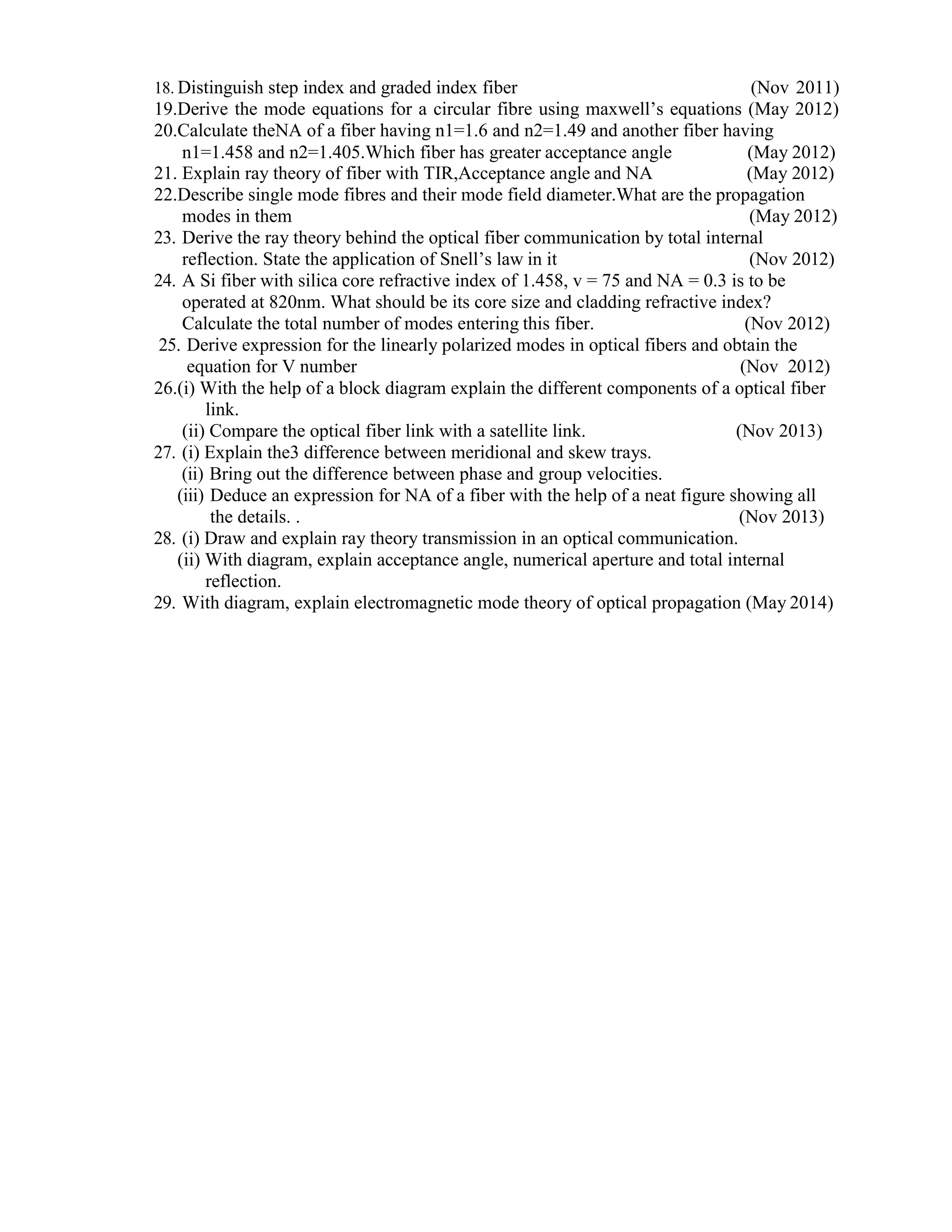
18. Distinguish step index and graded index fiber (Nov 2011)
19.Derive the mode equations for a circular fibre using maxwell’s equations (May 2012)
20.Calculate theNA of a fiber having n1=1.6 and n2=1.49 and another fiber having
n1=1.458 and n2=1.405.Which fiber has greater acceptance angle (May 2012)
21. Explain ray theory of fiber with TIR,Acceptance angle and NA (May 2012)
22.Describe single mode fibres and their mode field diameter.What are the propagation
modes in them (May 2012)
23. Derive the ray theory behind the optical fiber communication by total internal
reflection. State the application of Snell’s law in it (Nov 2012)
24. A Si fiber with silica core refractive index of 1.458, v = 75 and NA = 0.3 is to be
operated at 820nm. What should be its core size and cladding refractive index?
Calculate the total number of modes entering this fiber. (Nov 2012)
25. Derive expression for the linearly polarized modes in optical fibers and obtain the
equation for V number (Nov 2012)
26.(i) With the help of a block diagram explain the different components of a optical fiber
link.
(ii) Compare the optical fiber link with a satellite link. (Nov 2013)
27. (i) Explain the3 difference between meridional and skew trays.
(ii) Bring out the difference between phase and group velocities.
(iii) Deduce an expression for NA of a fiber with the help of a neat figure showing all
the details. . (Nov 2013)
28. (i) Draw and explain ray theory transmission in an optical communication.
(ii) With diagram, explain acceptance angle, numerical aperture and total internal
reflection.
29. With diagram, explain electromagnetic mode theory of optical propagation (May 2014)
UNIT II
PART- B
1. a. What is meant by material dispersion ?
b. Derive the expression of material dispersion.
c. Derive the expression for wave guide dispersion ( Apr 2005 )
2. Discuss the pulse broadening in graded index fiber (April 2005,Nov 08 )
3. Discuss the various kinds of losses that an optical signal might suffer while
propagating through a fiber. Which is most important one ? What is the effect of these
losses on light power and pulse shape ? ( June 2007,April 08,May 09 )
4. What is ode coupling ? Discuss pulse broadening in GI fiber ? (June2007 )
5. a. What is meant by waveguide dispersion ? Derive the expression for the same.
( Nov 2004 )
b. Derive the expression for pulse broadening due to material dispersion.
6. What is meant by waveguide dispersion ? Derive the expression for the same
( Nov 2006 )
7. Discuss the signal distortion in single mode fiber. ( Nov 2006 )
8. Explain the attenuation mechanisms in Optical fibers. (Dec 2007)
9. A 6 km optical link consisting of multimode step index fibre, with a core refractive
index of 1.5 and the relative refractive index difference of 1%. Estimate the delay
difference between the slowest and fastest modes at the fibre output, and the RMS
pulse broadening due to intermodal dispersion on the link. Also derive the expression
involved in it. [Apr 2008]
10. Explain briefly the three key principles involved in the Laser Action. Describe for a
fabry-perot resonator laser diode, modes, and threshold condition. Obtain its rate
equation for steady state output. [Apr 2008]
11. Explain bending losses and type of dispersion (Nov 2010)
12. What is meant by fiber splicing,Explain fusion splicing of optical fibers
13. Explain expanded beam connectors with neat diagram (Nov 2011)
14. Explain nonlinear scattering ,fiber bend loss and material dispersion in optical fiber
15. Explain mechanical splices with neat diagram (May 2012)
16. Write brief note on fiber alignment and joint loss (May 2012)
17. Describe the linear and non-linear scattering losses in optical fibers (Nov 2012)
18. An LED operating at 850nm has a spectral width of 45mm. What is the pulse
spreading in ns/km due to material dispersion? What is the pulse spreading when a
laser diode having a 2nm spectral width is used?
(Nov 2012)
19. Write notes on fiber splices and connectors (Nov 2012)
20. (i)Discuss the attenuation encountered in optical fiber communication due to:
1. Bending 2. Scattering 3. Absorption.
(ii) Calculate the maximum transmission distance for a fiber link with an attenuation
of 0.2 dB/km if the power launched in 1 mw and the receiver sensitivity is 50 µW.
Calculate the attenuation for another link with same parameters and the distance of
26 Kms. (Nov 2013)
21. (i) Clearly bringout the difference between intra and inter modal dispersion.
(ii) Find the maximum bit rate for the fiber link of 5 Kms.The numerical aperture is
0.25 and the refractive index is 1.48 (Nov 2013)
22. Explain the attenuation and losses in fiber. (May 2014)
23. With diagram, explain intra and inter modal dispersion. (May 2014)

Question Bank Unit 1 and 2 OCN presentation

  • 1.
    OPTICAL COMMUNICATION ANDNETWORKS QUESTION BANK UNIT I PART B 1. Discuss the mode theory of circular waveguide. (Nov 2004,June 2006,Nov 2008) 2. Discuss the theory of graded index fibers. Derive the expression for the numerical aperture of the graded index fiber .(Nov 2004) 3. What are the fiber modes? Explain the mode theory for optical fibers in detail.(Apr 2005,June2007) 4. Compare single mode fiber and graded index fibers. Explain the requirements for the fiber materials. (Apr 2007) 5. a. Discuss the structure of graded index fiber. (April 2005) b. Discuss the propagation modes in single mode fiber. (April 2005) 6. a. List the advantages of optical fiber communications. (April 2006) b. Draw the elements of optical fiber optical transmission link and explain (Apr2006,Dec 2006) 7. a. Briefly explain the evolution of fiber optic communication. (Dec 2005,07) b. Compare the configurations of different types of fibers. (Apr 2005) 8. a. List the advantages of an optical fiber communication. (April 2006,Nov 08) b. Explain in detail the mode field diameter. (April 06) 9. Derive an expression for number of modes propagating in a graded index fibre from the first principles. [Apr 2008] 10. a. Derive an expression for numerical aperture of step index fibre [10] b. Relative refractive index ,difference between the core axis, and cladding of graded index fibre is 0.7 % when the refractive index at the core axis is 1.45. Estimate the value of numerical aperture of the fibre along the axis, when the index profile is assumed to be a triangle. [Apr 2008] 11. a. Explain a neat block diagram of fundamentals of optical fibre communication.[8] b. Discuss the mode theory of circular waveguides. [Nov 2008] 12. a. Discuss briefly about linearly polarized modes. [6] b. Draw the structure of single and multi mode step index fibres and graded index fibres with typical dimensions. [6] c. Mention the advantage of optical fibre system [4]. [Nov 2008] 13. Explain mode propagation in circular waveguides. Obtain its wave equation and modal equations for step index fibers. [Nov-2009] 14.A typical refractive index difference for an optical fiber designated for long distance transmission is 1% .Determine the NA and the solid acceptance angle in air for the fiber when the core index is 1.46.calculate the critical angle at the core-cladding interface with in the fiber [Nov2009] 15.Draw and explain the working principle of single mode and multimode fiber(Nov 2010) 16.What is numerical aperture.Deduce the expression for the same 17. Calculate NA of silics fiber with its core refractive index(n1) of 1.48 and cladding refractive index of1.46.What should be the new value of n1 in order to change the NA to 0.23 (Nov 2011)
  • 2.
    18. Distinguish stepindex and graded index fiber (Nov 2011) 19.Derive the mode equations for a circular fibre using maxwell’s equations (May 2012) 20.Calculate theNA of a fiber having n1=1.6 and n2=1.49 and another fiber having n1=1.458 and n2=1.405.Which fiber has greater acceptance angle (May 2012) 21. Explain ray theory of fiber with TIR,Acceptance angle and NA (May 2012) 22.Describe single mode fibres and their mode field diameter.What are the propagation modes in them (May 2012) 23. Derive the ray theory behind the optical fiber communication by total internal reflection. State the application of Snell’s law in it (Nov 2012) 24. A Si fiber with silica core refractive index of 1.458, v = 75 and NA = 0.3 is to be operated at 820nm. What should be its core size and cladding refractive index? Calculate the total number of modes entering this fiber. (Nov 2012) 25. Derive expression for the linearly polarized modes in optical fibers and obtain the equation for V number (Nov 2012) 26.(i) With the help of a block diagram explain the different components of a optical fiber link. (ii) Compare the optical fiber link with a satellite link. (Nov 2013) 27. (i) Explain the3 difference between meridional and skew trays. (ii) Bring out the difference between phase and group velocities. (iii) Deduce an expression for NA of a fiber with the help of a neat figure showing all the details. . (Nov 2013) 28. (i) Draw and explain ray theory transmission in an optical communication. (ii) With diagram, explain acceptance angle, numerical aperture and total internal reflection. 29. With diagram, explain electromagnetic mode theory of optical propagation (May 2014)
  • 3.
    UNIT II PART- B 1.a. What is meant by material dispersion ? b. Derive the expression of material dispersion. c. Derive the expression for wave guide dispersion ( Apr 2005 ) 2. Discuss the pulse broadening in graded index fiber (April 2005,Nov 08 ) 3. Discuss the various kinds of losses that an optical signal might suffer while propagating through a fiber. Which is most important one ? What is the effect of these losses on light power and pulse shape ? ( June 2007,April 08,May 09 ) 4. What is ode coupling ? Discuss pulse broadening in GI fiber ? (June2007 ) 5. a. What is meant by waveguide dispersion ? Derive the expression for the same. ( Nov 2004 ) b. Derive the expression for pulse broadening due to material dispersion. 6. What is meant by waveguide dispersion ? Derive the expression for the same ( Nov 2006 ) 7. Discuss the signal distortion in single mode fiber. ( Nov 2006 ) 8. Explain the attenuation mechanisms in Optical fibers. (Dec 2007) 9. A 6 km optical link consisting of multimode step index fibre, with a core refractive index of 1.5 and the relative refractive index difference of 1%. Estimate the delay difference between the slowest and fastest modes at the fibre output, and the RMS pulse broadening due to intermodal dispersion on the link. Also derive the expression involved in it. [Apr 2008] 10. Explain briefly the three key principles involved in the Laser Action. Describe for a fabry-perot resonator laser diode, modes, and threshold condition. Obtain its rate equation for steady state output. [Apr 2008] 11. Explain bending losses and type of dispersion (Nov 2010) 12. What is meant by fiber splicing,Explain fusion splicing of optical fibers 13. Explain expanded beam connectors with neat diagram (Nov 2011) 14. Explain nonlinear scattering ,fiber bend loss and material dispersion in optical fiber 15. Explain mechanical splices with neat diagram (May 2012) 16. Write brief note on fiber alignment and joint loss (May 2012) 17. Describe the linear and non-linear scattering losses in optical fibers (Nov 2012) 18. An LED operating at 850nm has a spectral width of 45mm. What is the pulse spreading in ns/km due to material dispersion? What is the pulse spreading when a laser diode having a 2nm spectral width is used? (Nov 2012) 19. Write notes on fiber splices and connectors (Nov 2012) 20. (i)Discuss the attenuation encountered in optical fiber communication due to: 1. Bending 2. Scattering 3. Absorption. (ii) Calculate the maximum transmission distance for a fiber link with an attenuation of 0.2 dB/km if the power launched in 1 mw and the receiver sensitivity is 50 µW. Calculate the attenuation for another link with same parameters and the distance of 26 Kms. (Nov 2013) 21. (i) Clearly bringout the difference between intra and inter modal dispersion. (ii) Find the maximum bit rate for the fiber link of 5 Kms.The numerical aperture is 0.25 and the refractive index is 1.48 (Nov 2013) 22. Explain the attenuation and losses in fiber. (May 2014) 23. With diagram, explain intra and inter modal dispersion. (May 2014)