‘Looking back at your preliminary
task(the continuity editing task), what
do you feel you have learnt in the
progression from it to full product?’
Q U E S T I O N 7
Our preliminary tasks involved using basic continuity
skills such as the 180 degree rule, matches on action and
cuts to create free­flowing action and dialogue. We filmed
and edited our preliminary task in November, since then
we have learnt a lot and applied it to our thriller opening
accordingly.
The experience of filming over multiple days and also for
extensive amounts of time allowed us to realise how
important time management and planning was. Ensuring
that we had planned out each filming day was vital in
finishing our project on time. In order to do that we
created a shoot schedule to keep track of what needed to
get done, and a production log to document what had
been done so far on what day. Using these tools we were
able be efficient in our filmmaking.
1. Planning 2. Codes and
Conventions
Secondly, our filming and production skills
have greatly improved since the creation of
the preliminary task. Before filming the
opening,we made a shot list to make sure
there were a variety of shots being utilised to
make certain shots more effective or have a
greater meaning. We also made a costume
and prop list to prepare how we would
manipulate mise en scene for atmospheric
effect. Unlike with the preliminary task, our
thriller opening had a storyboard and script
which were redrafted multiple times, this
resulted in a more refined media product
which on the surface seemed better planned
and well thought out, rather than just thrown
together. The process of redrafting multiple
scripts and storyboards also gave us a better
idea of what is more practical to implement in
film and what would be more effectual for the
intended effect.
When making the preliminary task, we did
not consider the conventions of a thriller,
and it therefore did not have the
atmosphere of feeling of a thriller film. It
also did not contain themes that required
and rather made a mockery of the style,
which would not come off as professional.
However, when filming the final project we
ensured to use the conventions of a thriller
such as frequent use of the enigma code to
create a mystery, low key lighting and an
interesting narrative. The use of low­key
lighting throughout the opening gives a
professional look and sets the sinister
atmosphere for the thriller opening we were
trying to create.
4. Sound3. Lighting
For our preliminary task, we only made
use of natural light as we did not have the
equipment and did not think it necessary
to use extra lights. We did not realise the
usefulness of lighting and how it can be
used for effect other than just to make a
scene visible. For the final project, we
made use of more focused lighting, even
spotlighting the hostage, simply to outline
his importance in the film and the
information he might have. The lighting
has also noticeably been used to black out
the environment which we did effectively
and creates a sense of mystery about their
whereabouts.
In our preliminary task, it required us to
have a conversation with two people, this
means we had to work with sound to
produce a professional sounding
conversation. However the ambient sound
in the shots we used was very poor and
made the footage seem unprofessional as
the dialogue was not completely clear. Our
preliminary task also lacked background
music which is usually essential in setting
the atmosphere of a film. Our final project
included dialogue however, it is notable
there is less ambient sound as we were
able to control sound conditions and it
therefore sounds more professional. We
also utilised very eerie background music
which gave the film a more mysterious feel,
yet professional which was our intended
effect.
5. Camera Angles 6. Editing
The preliminary task only required that
we make use of basic camera angles
and the 180 degree rule for
conversation and did not contain any
complex camera angles. We did use
one low angle shot to show the
protagonist’s dominance. However, our
project made use of a plethora of
camera angles such as point of view,
high angles, close ups and over the
shoulder shots to demonstrate where
the focal point of the shot was, and to
display superiority with certain
characters.
The editing process for our preliminary task
was very problematic as we did not realise
when shooting that we would need multiple
shot options to choose from when editing
and had to edit down the cli to only 30
seconds. We also did not make use of any
transitions, which resulted in our task
having less style and some choppy cuts.
Our editing skills when making our final
thriller opening are also notably more
impressive, making use of dissolve
transitions, title cards and production logos.
Editing in a muzzle flash and gunshot
sound for the gun also made the scene look
more realistic and in turn more professional.
We also had an easier time discriminating
which shots would make the cut and which
would due to a clearer goal of the end
product.
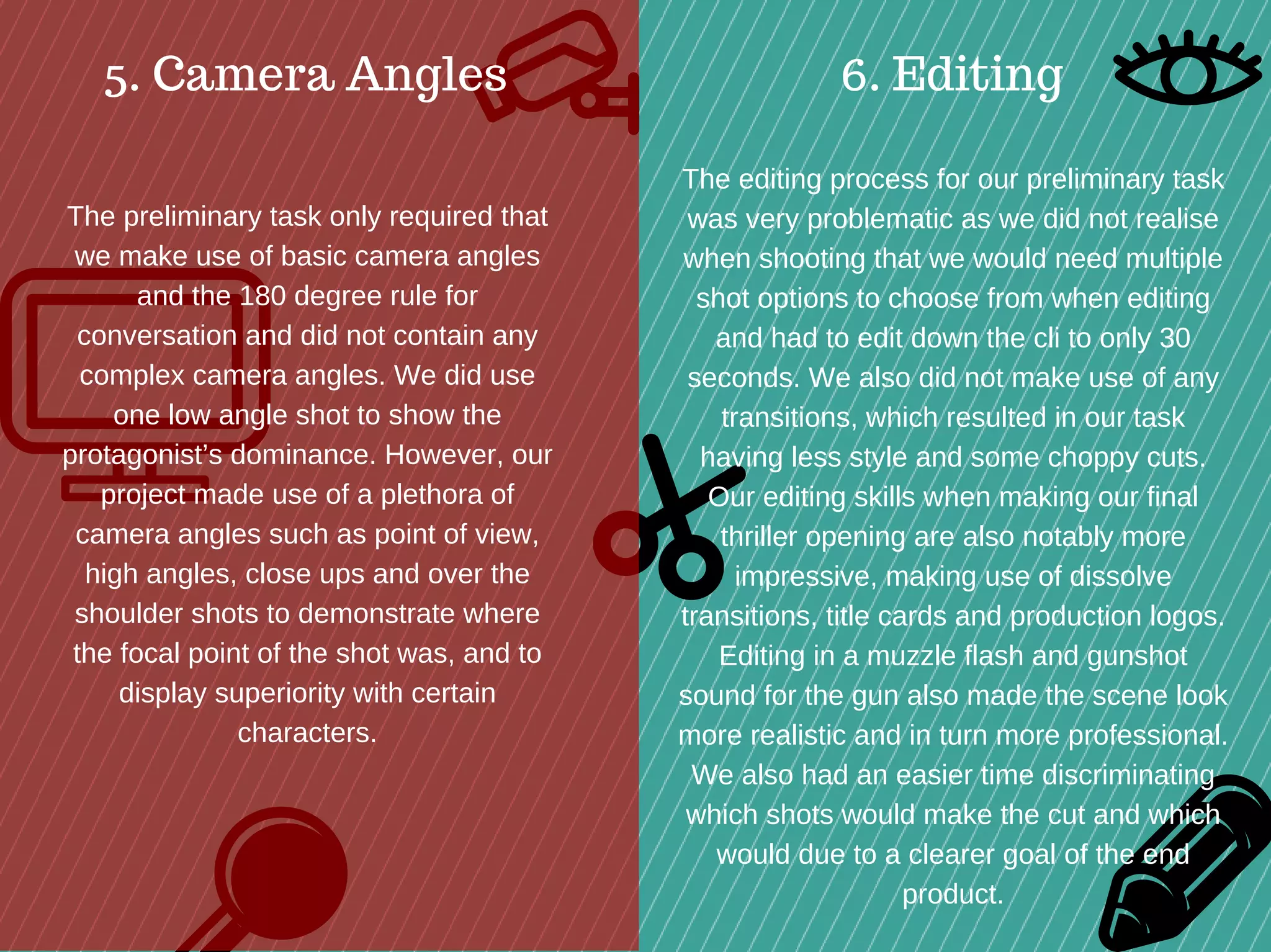
In the preliminary task, we included a
moving follow shot, which due to our lack of
experience was not well focused. It is also
notable here that we were not well practised
in how to plan for lighting and it is had to
see the shot properly because we shot
facing the natural light.
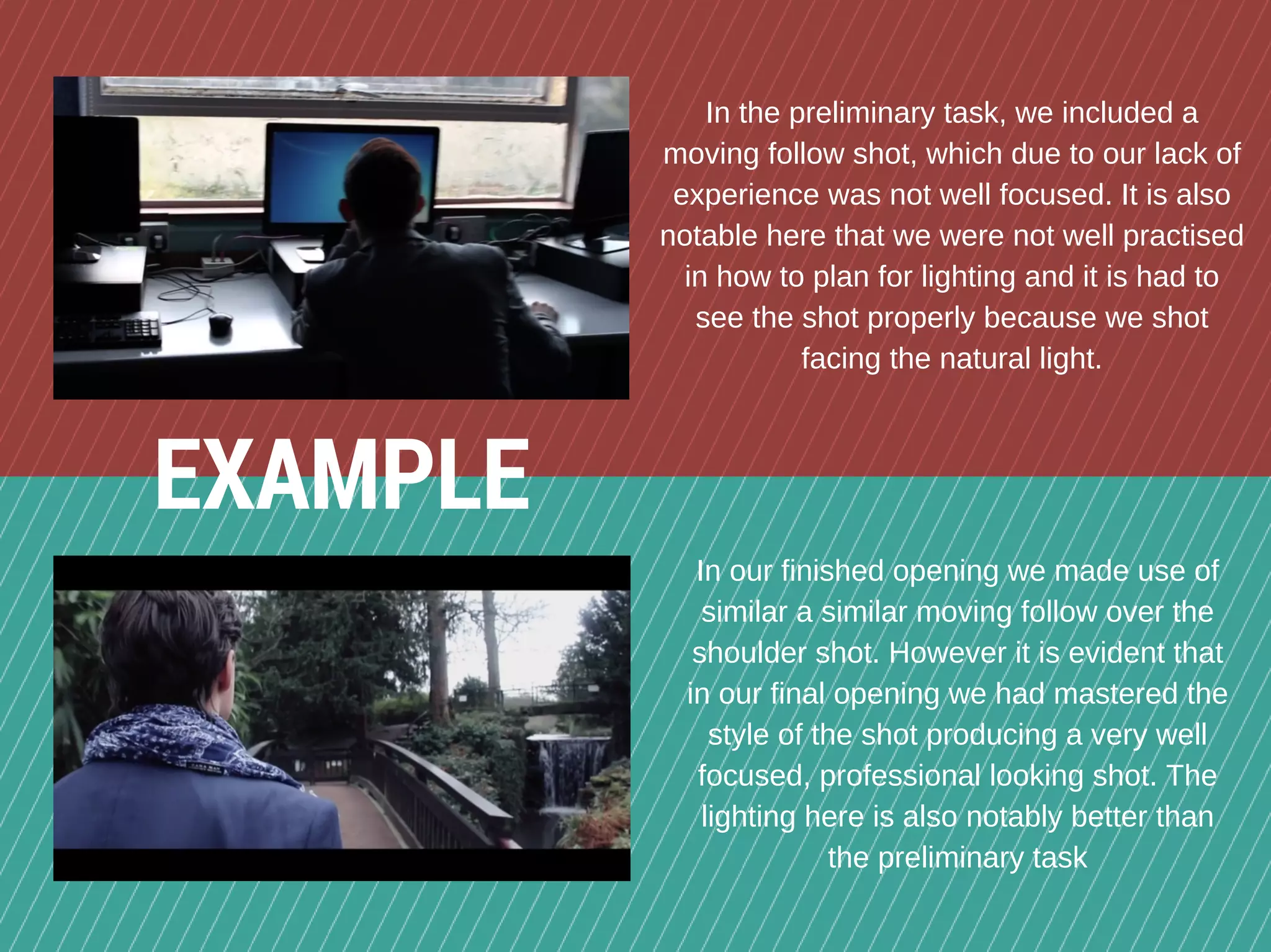
In our finished opening we made use of
similar a similar moving follow over the
shoulder shot. However it is evident that
in our final opening we had mastered the
style of the shot producing a very well
focused, professional looking shot. The
lighting here is also notably better than
the preliminary task
EXAMPLE

Question 7