OSSAP – a Situational Method
for Defining Open Source
Software Adoption Processes
2
Outline
Outline
• OSS Adoption
• OSSAP method goals
• Situational Method Engineering Process
• OSSAP method overview
• Conclusions and future work
3
OSS Adoption
• Many commercial software products adopt
OSS components
• Many organizations are becoming OSS
adopters
• Which business processes for OSS adoption
does an organization need according to its
strategic goals?
4
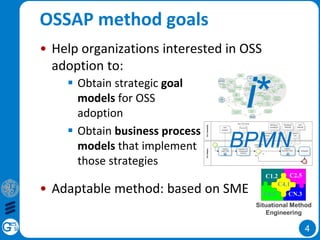
• Help organizations interested in OSS
adoption to:
• Adaptable method: based on SME
OSSAP method goals
 Obtain strategic goal
models for OSS
adoption
 Obtain business process
models that implement
those strategies
i*
BPMN
Situational Method
Engineering
C1.2
CN.3
C2.5
C6.2
C4.1
5
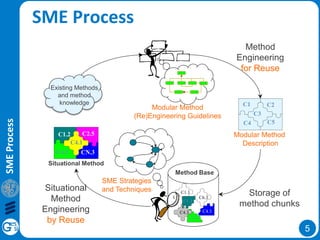
SME Process
Modular Method
Description
C1 C2
C3
C4 C5
Method Base
C6.3
C1.1
CN.5
C4.3
C1.3
C4.3
Situational Method
C1.2
CN.3
C2.5
C6.2
C4.1
SME Strategies
and Techniques
Modular Method
(Re)Engineering Guidelines
Method
Engineering
for Reuse
Situational
Method
Engineering
by Reuse
Existing Methods
and method
knowledge
Storage of
method chunks
SMEProcess
6
SME Process
Modular Method
Description
C1 C2
C3
C4 C5
Method Base
C6.3
C1.1
CN.5
C4.3
C1.3
C4.3
Situational Method
C1.2
CN.3
C2.5
C6.2
C4.1
SME Strategies
and Techniques
Modular Method
(Re)Engineering Guidelines
Method
Engineering
for Reuse
Situational
Method
Engineering
by Reuse
Existing Methods
and method
knowledge
Storage of
method chunks
SMEProcess
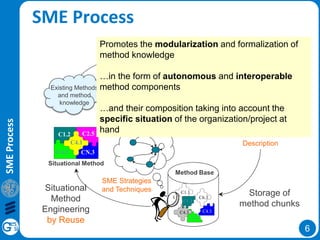
Promotes the modularization and formalization of
method knowledge
…in the form of autonomous and interoperable
method components
…and their composition taking into account the
specific situation of the organization/project at
hand
7
OSSAPmethodoverview
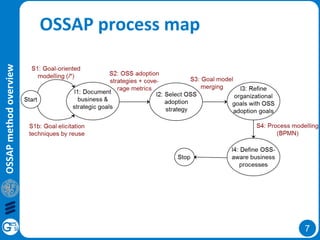
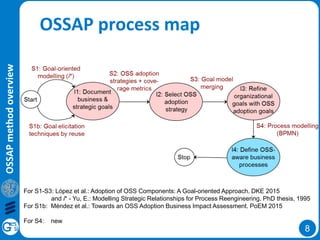
OSSAP process map
8
OSSAPmethodoverview
OSSAP process map
For S1-S3: López et al.: Adoption of OSS Components: A Goal-oriented Approach. DKE 2015
and i* - Yu, E.: Modelling Strategic Relationships for Process Reengineering. PhD thesis, 1995
For S1b: Méndez et al.: Towards an OSS Adoption Business Impact Assessment. PoEM 2015
For S4: new
9
OSSAPmethodoverview
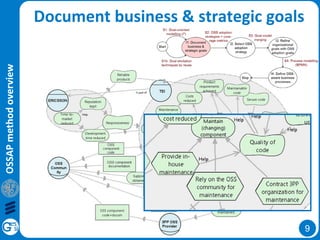
Document business & strategic goals
10
OSSAPmethodoverview
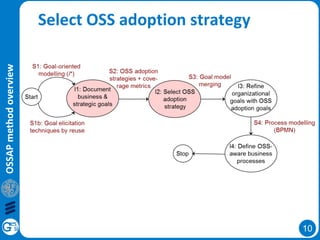
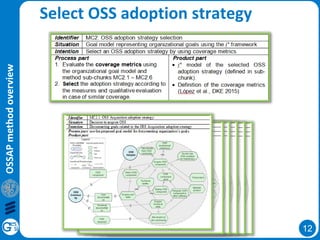
Select OSS adoption strategy
11
OSSAPmethodoverview
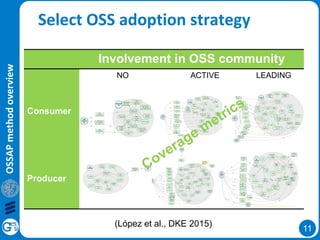
Select OSS adoption strategy
Involvement in OSS community
NO ACTIVE LEADING
Consumer
Producer
(López et al., DKE 2015)
12
OSSAPmethodoverview
Select OSS adoption strategy
13
OSSAPmethodoverview
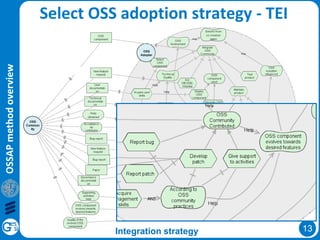
Select OSS adoption strategy - TEI
Integration strategy
14
OSSAPmethodoverview
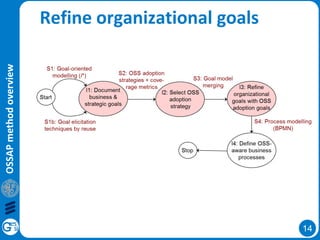
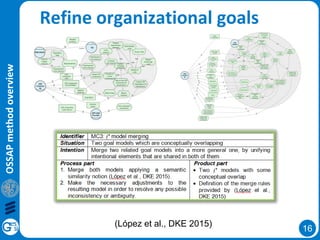
Refine organizational goals
15
OSSAPmethodoverview
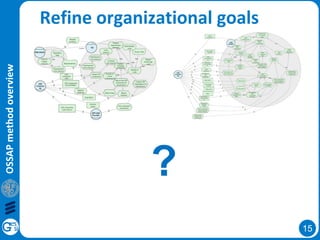
Refine organizational goals
?
16
OSSAPmethodoverview
Refine organizational goals
(López et al., DKE 2015)
17
OSSAPmethodoverview
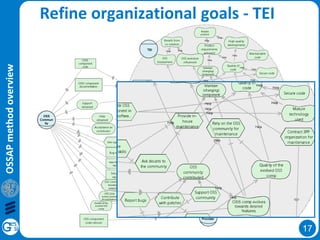
Refine organizational goals - TEI
18
OSSAPmethodoverview
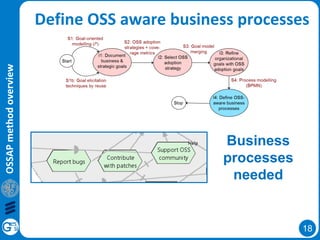
Define OSS aware business processes
Business
processes
needed
19
OSSAPmethodoverview
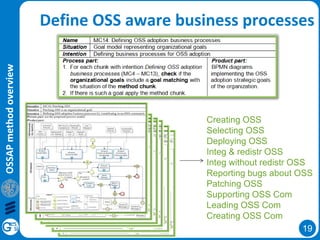
Define OSS aware business processes
Creating OSS
Selecting OSS
Deploying OSS
Integ & redistr OSS
Integ without redistr OSS
Reporting bugs about OSS
Patching OSS
Supporting OSS Com
Leading OSS Com
Creating OSS Com
20
OSSAPmethodoverview
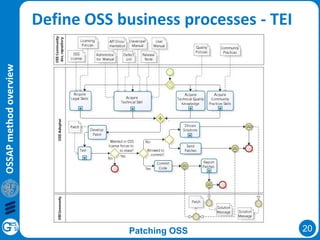
Define OSS business processes - TEI
Patching OSS
21
OSSAPmethodoverview
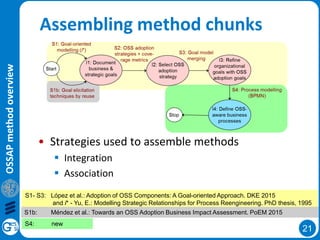
Assembling method chunks
• Strategies used to assemble methods
 Integration
 Association
S1- S3: López et al.: Adoption of OSS Components: A Goal-oriented Approach. DKE 2015
and i* - Yu, E.: Modelling Strategic Relationships for Process Reengineering. PhD thesis, 1995
S1b: Méndez et al.: Towards an OSS Adoption Business Impact Assessment. PoEM 2015
S4: new
22
Conclusions
• OSSAP is a method for defining OSS adoption
business processes
• Using SME to build OSSAP:
 Modular method description, all in terms of
method chunks, that can be reused
 Facilitates the future extension to adapt OSSAP to
new situations
• New emerging OSS adoption strategies
• New kinds of objectives (other than OSS adoption) e.g.
quality assurance
23
Future work
• OSSAP extension
 New emerging adoption strategies
 New kinds of objectives
 Integration of the BPMN processes to the business
processes already existing in the organization
• Analyze other possible strategies to
implement OSSAP intentions: KAOS, GBRAM,
SPEM
• Validation of OSSAP in adopter organizations
Thank you!

Ossap final