Six Easy Pieces (of Quantitatively Analyzing Open Source Software) ‏ Dirk Riehle SAP Research, SAP Labs LLC dirk@riehle.org, www.riehle.org, twitter.com/driehle
Open Source Software Definition of open source software Software that is  provided under an approved OSI license General properties of open source software Software that  is available in source code form Software that you  can modify and redistribute Further important (not always present) properties The project has gathered a thriving community Feedback and ideas about the software are public and abundant Projects are egalitarian, meritocratic, and self-organizing
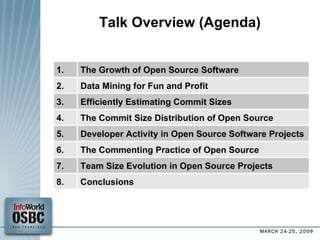
Talk Overview (Agenda) ‏ The Growth of Open Source Software Data Mining for Fun and Profit Efficiently Estimating Commit Sizes Developer Activity in Open Source Software Projects 1. 2. 3. 5. The Commit Size Distribution of Open Source 4. The Commenting Practice of Open Source 6. Team Size Evolution in Open Source Projects 7. Conclusions 8.
The Growth of Open Source Software Amit Deshpande, Dirk Riehle. “The Total Growth of Open Source.” In  Proceedings of the Fourth Conference on Open Source Systems  (OSS 2008). Springer Verlag, 2008. Page 197-209.   http://www.riehle.org/2008/03/14/the-total-growth-of-open-source/
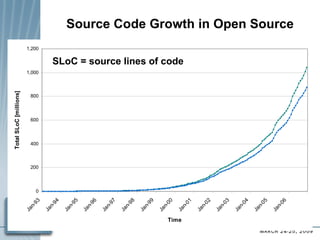
Source Code Growth in Open Source SLoC = source lines of code
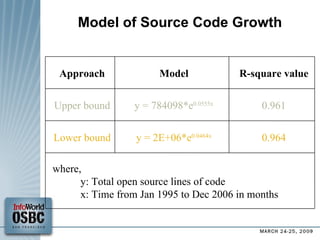
Model of Source Code Growth where, y: Total open source lines of code x: Time from Jan 1995 to Dec 2006 in months 0.964 y = 2E+06*e 0.0464x Lower bound 0.961 y = 784098*e 0.0555x Upper bound R-square value Model Approach
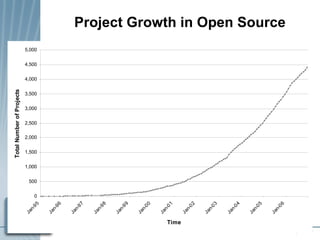
Project Growth in Open Source
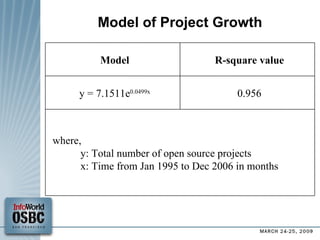
Model of Project Growth where, y: Total number of open source projects x: Time from Jan 1995 to Dec 2006 in months 0.956 y = 7.1511e 0.0499x R-square value Model
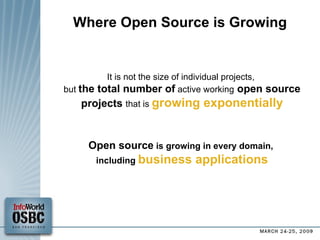
Where Open Source is Growing It is not the size of individual projects,  but  the total number of  active working  open source projects   that is  growing exponentially Open source  is growing in every domain,  including  business applications
Data Mining for Fun and Profit Oliver Arafat, Amit Deshpande, Philipp Hofmann, Dirk Riehle. http://www.riehle.org/publications/
Motivation and Approach Gain insight into how open source software development works Review processes unique to open source (or transferable)‏ Possibly improve corporate software development Possibly build novel tools  Post-facto detailed quantitative analysis of actual behavior Analyzing what people do rather than what they say they do Open source is publicly developed software so there is lots of data
Data Source, Data Quality Using the Ohloh.net repository of open source project information Detailed information on a large number of projects (>9000 in 2008 snapshot)‏ Includes project structure and members but also detailed code information Ohloh captures every commit down to diff sections (>8M commits)‏ See http://www.ohloh.net for more information To be useful, data needs to be cleaned and filtered Depends on the question at hand Developed a variety of easily applicable filters
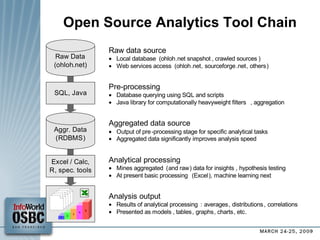
Open Source Analytics Tool Chain
Efficiently Estimating Commit Sizes Philipp Hofmann, Dirk Riehle. “Estimating Commit Sizes Efficiently.” In  Proceedings of the 5th International Conference on Open Source Systems  (OSS 2009). Springer Verlag, 2009. Forthcoming.  http://www.riehle.org/2009/02/11/estimating-commit-sizes-efficiently/
Definition of Commit Size Commit consists of Diffs which consist of Sections One commit may affect multiple files, each file diff can have multiple sections Commit Size = sum(Diff Sizes) where Diff Size = sum(Section Sizes)‏
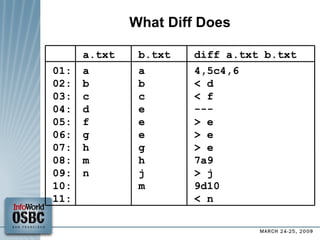
What Diff Does 4,5c4,6 < d < f --- > e > e > e 7a9 > j 9d10 < n a b c e e e g h j m a b c d f g h m n 01: 02: 03: 04: 05: 06: 07: 08: 09: 10: 11: diff a.txt b.txt b.txt a.txt
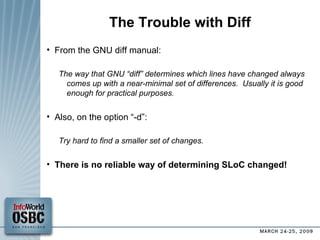
The Trouble with Diff From the GNU diff manual: The way that GNU “diff” determines which lines have changed always comes up with a near-minimal set of differences.  Usually it is good enough for practical purposes. Also, on the option “-d”: Try hard to find a smaller set of changes. There is no reliable way of determining SLoC changed!
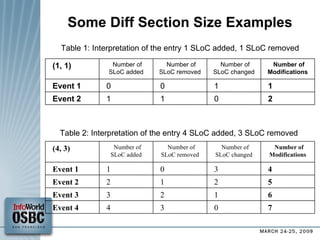
Some Diff Section Size Examples Table 1: Interpretation of the entry 1 SLoC added, 1 SLoC removed Table 2: Interpretation of the entry 4 SLoC added, 3 SLoC removed  2 0 1 1 Event 2 1 1 0 0 Event 1 Number of  Modifications Number of  SLoC changed Number of  SLoC removed Number of  SLoC added (1, 1)‏ 7 0 3 4 Event 4 6 1 2 3 Event 3 5 2 1 2 Event 2 4 3 0 1 Event 1 Number of  Modifications Number of  SLoC changed Number of  SLoC removed Number of  SLoC added (4, 3)‏
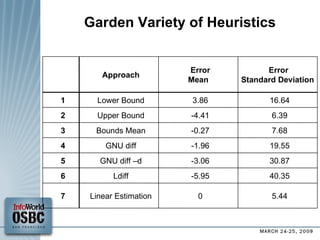
Garden Variety of Heuristics 5.44 0 Linear Estimation 7 40.35 -5.95 Ldiff 6 30.87 -3.06 GNU diff –d 5 19.55 -1.96 GNU diff 4 7.68 -0.27 Bounds Mean 3 6.39 -4.41 Upper Bound 2 16.64 3.86 Lower Bound 1 Error  Standard Deviation Error Mean Approach
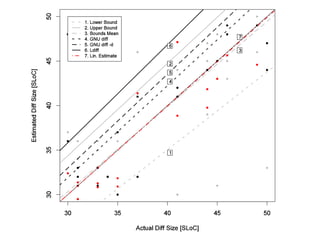
Visual Comparison of Heuristics
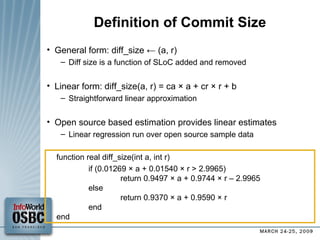
Definition of Commit Size General form: diff_size ← (a, r)  Diff size is a function of SLoC added and removed Linear form: diff_size(a, r) = ca × a + cr × r + b  Straightforward linear approximation Open source based estimation provides linear estimates Linear regression run over open source sample data function real diff_size(int a, int r)‏ if (0.01269 × a + 0.01540 × r > 2.9965) return 0.9497 × a + 0.9744 × r – 2.9965 else return 0.9370 × a + 0.9590 × r end end
The Commit Size Distribution of Open Source Oliver Arafat, Dirk Riehle. “The Commit Size Distribution of Open Source Software.”  In  Proceedings of the 42nd Hawaiian International Conference on System Science   (HICSS-42). IEEE Press: 2009. Page 1-8. http://www.riehle.org/2008/09/23/ the-commit-size-distribution-of-open-source-software/
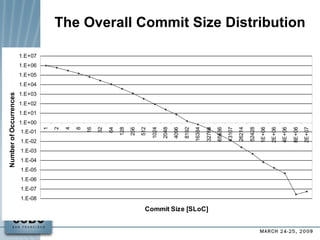
The Overall Commit Size Distribution
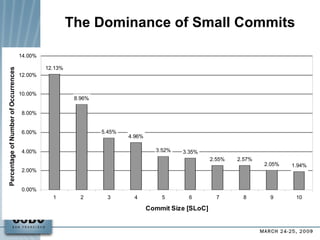
The Dominance of Small Commits
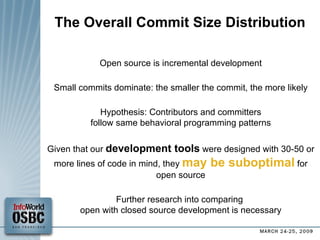
The Overall Commit Size Distribution Open source is incremental development Small commits dominate: the smaller the commit, the more likely Hypothesis: Contributors and committers follow same behavioral programming patterns Given that our  development tools  were designed with 30-50 or more lines of code in mind, they  may be suboptimal  for open source Further research into comparing  open with closed source development is necessary
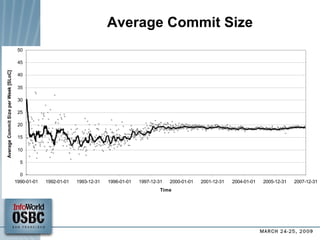
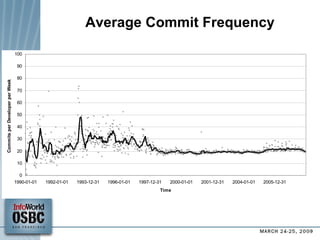
Developer Activity in Open Source Software Projects Dirk Riehle, Oliver Arafat, Amit Deshpande. “Developer Activity in Open Source Software Projects.” In  preparation. Amit Deshpande, Dirk Riehle. “Continuous Integration in Open Source Software Development.” In  Proceedings of the Fourth Conference on Open Source Systems  (OSS 2008). Springer Verlag, 2008. Page 273-280. http://www.riehle.org/2008/03/08/ continuous-integration-in-open-source-software-development/
Average Commit Size
Average Commit Frequency
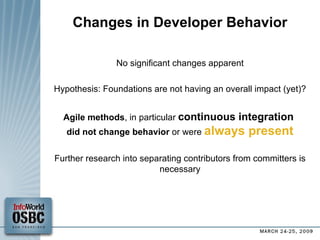
Changes in Developer Behavior No significant changes apparent Hypothesis: Foundations are not having an overall impact (yet)? Agile methods , in particular  continuous integration  did not change behavior  or were  always present Further research into separating contributors from committers is necessary
The Commenting Practice of Open Source Oliver Arafat, Dirk Riehle. “The Comment Density of Open Source Software Code.” In  Companion to Proceedings of the 31st International Conference on Software Engineering  (ICSE 2009). IEEE Press, 2009: Forthcoming.  http://www.riehle.org/2009/02/04/ the-comment-density-of-open-source-software-code/
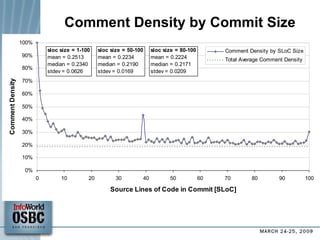
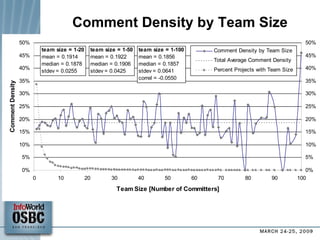
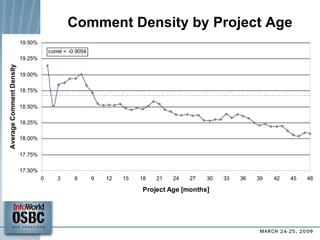
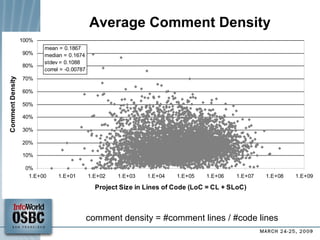
Average Comment Density comment density = #comment lines / #code lines
Comment Density by Programming Language 273 7% 10% Perl 6. 534 8% 11% Python 5. 276 9% 16% Javascript 4. 1621 8% 18% C/C++ 3. 559 12% 22% php 2. 1085 11% 26% Java 1. Population Size Stddev [%] Average [%] Language #
Comment Density by Commit Size
Comment Density by Team Size
Comment Density by Project Age
Commenting in Open Source A continuous on-going practice Surprisingly high comment density, clearly  no belief in self-documenting code Hypothesis:  Comment density  of  open source represents  the sweet spot  of commenting code For any specific conclusions, watch the parameters Further research into project types is necessary
Team Size Evolution in Open Source Projects Philipp Hofmann, Dirk Riehle. “Team Size Evolution in Open Source Software Projects.” In  preparation.
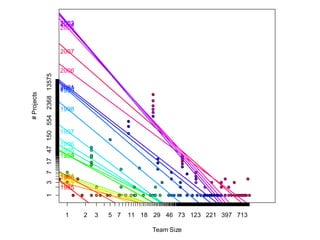
Teams Size Evolution Figure
Is Open Source Scale-Free? Definition of scale-free distribution Follows power-law (straight line on log-log graph)‏ Very common in nature, technology, and society Implies same principles govern every level of scale Examples of scale-free graphs in open source Commit size distribution Team size distribution If open source was scale-free then We would know how to scale to ever larger project sizes By basically applying the same principles across the board
Conclusions Lots of interesting insights to be gained from analyzing open source We have the chance now to fix misconceptions by looking at data Lots of that insight may apply to closed source development as well Open source may show the most resource-efficient sweet spots New research agenda: Is open source scale-free?
Thank you! dirk@riehle.org, www.riehle.org, twitter.com/driehle Comments are welcome! ‏

Six Easy Pieces of Quantitatively Analyzing Open Source

  • 1.
    Six Easy Pieces(of Quantitatively Analyzing Open Source Software) ‏ Dirk Riehle SAP Research, SAP Labs LLC dirk@riehle.org, www.riehle.org, twitter.com/driehle
  • 2.
    Open Source SoftwareDefinition of open source software Software that is provided under an approved OSI license General properties of open source software Software that is available in source code form Software that you can modify and redistribute Further important (not always present) properties The project has gathered a thriving community Feedback and ideas about the software are public and abundant Projects are egalitarian, meritocratic, and self-organizing
  • 3.
    Talk Overview (Agenda)‏ The Growth of Open Source Software Data Mining for Fun and Profit Efficiently Estimating Commit Sizes Developer Activity in Open Source Software Projects 1. 2. 3. 5. The Commit Size Distribution of Open Source 4. The Commenting Practice of Open Source 6. Team Size Evolution in Open Source Projects 7. Conclusions 8.
  • 4.
    The Growth ofOpen Source Software Amit Deshpande, Dirk Riehle. “The Total Growth of Open Source.” In Proceedings of the Fourth Conference on Open Source Systems (OSS 2008). Springer Verlag, 2008. Page 197-209. http://www.riehle.org/2008/03/14/the-total-growth-of-open-source/
  • 5.
    Source Code Growthin Open Source SLoC = source lines of code
  • 6.
    Model of SourceCode Growth where, y: Total open source lines of code x: Time from Jan 1995 to Dec 2006 in months 0.964 y = 2E+06*e 0.0464x Lower bound 0.961 y = 784098*e 0.0555x Upper bound R-square value Model Approach
  • 7.
    Project Growth inOpen Source
  • 8.
    Model of ProjectGrowth where, y: Total number of open source projects x: Time from Jan 1995 to Dec 2006 in months 0.956 y = 7.1511e 0.0499x R-square value Model
  • 9.
    Where Open Sourceis Growing It is not the size of individual projects, but the total number of active working open source projects that is growing exponentially Open source is growing in every domain, including business applications
  • 10.
    Data Mining forFun and Profit Oliver Arafat, Amit Deshpande, Philipp Hofmann, Dirk Riehle. http://www.riehle.org/publications/
  • 11.
    Motivation and ApproachGain insight into how open source software development works Review processes unique to open source (or transferable)‏ Possibly improve corporate software development Possibly build novel tools Post-facto detailed quantitative analysis of actual behavior Analyzing what people do rather than what they say they do Open source is publicly developed software so there is lots of data
  • 12.
    Data Source, DataQuality Using the Ohloh.net repository of open source project information Detailed information on a large number of projects (>9000 in 2008 snapshot)‏ Includes project structure and members but also detailed code information Ohloh captures every commit down to diff sections (>8M commits)‏ See http://www.ohloh.net for more information To be useful, data needs to be cleaned and filtered Depends on the question at hand Developed a variety of easily applicable filters
  • 13.
  • 14.
    Efficiently Estimating CommitSizes Philipp Hofmann, Dirk Riehle. “Estimating Commit Sizes Efficiently.” In Proceedings of the 5th International Conference on Open Source Systems (OSS 2009). Springer Verlag, 2009. Forthcoming. http://www.riehle.org/2009/02/11/estimating-commit-sizes-efficiently/
  • 15.
    Definition of CommitSize Commit consists of Diffs which consist of Sections One commit may affect multiple files, each file diff can have multiple sections Commit Size = sum(Diff Sizes) where Diff Size = sum(Section Sizes)‏
  • 16.
    What Diff Does4,5c4,6 < d < f --- > e > e > e 7a9 > j 9d10 < n a b c e e e g h j m a b c d f g h m n 01: 02: 03: 04: 05: 06: 07: 08: 09: 10: 11: diff a.txt b.txt b.txt a.txt
  • 17.
    The Trouble withDiff From the GNU diff manual: The way that GNU “diff” determines which lines have changed always comes up with a near-minimal set of differences. Usually it is good enough for practical purposes. Also, on the option “-d”: Try hard to find a smaller set of changes. There is no reliable way of determining SLoC changed!
  • 18.
    Some Diff SectionSize Examples Table 1: Interpretation of the entry 1 SLoC added, 1 SLoC removed Table 2: Interpretation of the entry 4 SLoC added, 3 SLoC removed 2 0 1 1 Event 2 1 1 0 0 Event 1 Number of Modifications Number of SLoC changed Number of SLoC removed Number of SLoC added (1, 1)‏ 7 0 3 4 Event 4 6 1 2 3 Event 3 5 2 1 2 Event 2 4 3 0 1 Event 1 Number of Modifications Number of SLoC changed Number of SLoC removed Number of SLoC added (4, 3)‏
  • 19.
    Garden Variety ofHeuristics 5.44 0 Linear Estimation 7 40.35 -5.95 Ldiff 6 30.87 -3.06 GNU diff –d 5 19.55 -1.96 GNU diff 4 7.68 -0.27 Bounds Mean 3 6.39 -4.41 Upper Bound 2 16.64 3.86 Lower Bound 1 Error Standard Deviation Error Mean Approach
  • 20.
  • 21.
    Definition of CommitSize General form: diff_size ← (a, r) Diff size is a function of SLoC added and removed Linear form: diff_size(a, r) = ca × a + cr × r + b Straightforward linear approximation Open source based estimation provides linear estimates Linear regression run over open source sample data function real diff_size(int a, int r)‏ if (0.01269 × a + 0.01540 × r > 2.9965) return 0.9497 × a + 0.9744 × r – 2.9965 else return 0.9370 × a + 0.9590 × r end end
  • 22.
    The Commit SizeDistribution of Open Source Oliver Arafat, Dirk Riehle. “The Commit Size Distribution of Open Source Software.” In Proceedings of the 42nd Hawaiian International Conference on System Science (HICSS-42). IEEE Press: 2009. Page 1-8. http://www.riehle.org/2008/09/23/ the-commit-size-distribution-of-open-source-software/
  • 23.
    The Overall CommitSize Distribution
  • 24.
    The Dominance ofSmall Commits
  • 25.
    The Overall CommitSize Distribution Open source is incremental development Small commits dominate: the smaller the commit, the more likely Hypothesis: Contributors and committers follow same behavioral programming patterns Given that our development tools were designed with 30-50 or more lines of code in mind, they may be suboptimal for open source Further research into comparing open with closed source development is necessary
  • 26.
    Developer Activity inOpen Source Software Projects Dirk Riehle, Oliver Arafat, Amit Deshpande. “Developer Activity in Open Source Software Projects.” In preparation. Amit Deshpande, Dirk Riehle. “Continuous Integration in Open Source Software Development.” In  Proceedings of the Fourth Conference on Open Source Systems  (OSS 2008). Springer Verlag, 2008. Page 273-280. http://www.riehle.org/2008/03/08/ continuous-integration-in-open-source-software-development/
  • 27.
  • 28.
  • 29.
    Changes in DeveloperBehavior No significant changes apparent Hypothesis: Foundations are not having an overall impact (yet)? Agile methods , in particular continuous integration did not change behavior or were always present Further research into separating contributors from committers is necessary
  • 30.
    The Commenting Practiceof Open Source Oliver Arafat, Dirk Riehle. “The Comment Density of Open Source Software Code.” In  Companion to Proceedings of the 31st International Conference on Software Engineering  (ICSE 2009). IEEE Press, 2009: Forthcoming. http://www.riehle.org/2009/02/04/ the-comment-density-of-open-source-software-code/
  • 31.
    Average Comment Densitycomment density = #comment lines / #code lines
  • 32.
    Comment Density byProgramming Language 273 7% 10% Perl 6. 534 8% 11% Python 5. 276 9% 16% Javascript 4. 1621 8% 18% C/C++ 3. 559 12% 22% php 2. 1085 11% 26% Java 1. Population Size Stddev [%] Average [%] Language #
  • 33.
    Comment Density byCommit Size
  • 34.
  • 35.
    Comment Density byProject Age
  • 36.
    Commenting in OpenSource A continuous on-going practice Surprisingly high comment density, clearly no belief in self-documenting code Hypothesis: Comment density of open source represents the sweet spot of commenting code For any specific conclusions, watch the parameters Further research into project types is necessary
  • 37.
    Team Size Evolutionin Open Source Projects Philipp Hofmann, Dirk Riehle. “Team Size Evolution in Open Source Software Projects.” In preparation.
  • 38.
  • 39.
    Is Open SourceScale-Free? Definition of scale-free distribution Follows power-law (straight line on log-log graph)‏ Very common in nature, technology, and society Implies same principles govern every level of scale Examples of scale-free graphs in open source Commit size distribution Team size distribution If open source was scale-free then We would know how to scale to ever larger project sizes By basically applying the same principles across the board
  • 40.
    Conclusions Lots ofinteresting insights to be gained from analyzing open source We have the chance now to fix misconceptions by looking at data Lots of that insight may apply to closed source development as well Open source may show the most resource-efficient sweet spots New research agenda: Is open source scale-free?
  • 41.
    Thank you! dirk@riehle.org,www.riehle.org, twitter.com/driehle Comments are welcome! ‏