Modelling and Applying OSS Adoption 
Strategies 
Lidia López, Dolors Costal, Claudia P. Ayala, 
Xavier Franch, Ruediger Glott, Kirsten Haaland
Agenda 
 Introduction 
 OSS Adoption Strategies Ontology 
 OSS Adoption Strategies Models 
 OSS Adoption Strategies applied to Organizations 
 Conclusions and Future Work 
2 
Applying Business Strategy Models in Organizations. 
ER 2014, 27-29th October 2014
Motivation 
 Business Model 
– Way to create value and achieve revenues according to a 
Business Strategy 
– It aims at achieving organizational goals 
 Many factors impact the Business Model 
– IT is one of them 
 OSS has become a driver for business in various 
sectors 
– At 2016, 95% all commercial software will include OSS 
3 
Applying Business Strategy Models in Organizations. 
ER 2014, 27-29th October 2014
Motivation 
 OSS adoption impacts in fact far beyond technology 
 It is necessary to support organizations that want to 
adopt OSS 
– by analyzing the influences of such adoption 
4 
Modelling and Applying OSS 
Adoption Strategies 
Applying Business Strategy Models in Organizations. 
ER 2014, 27-29th October 2014
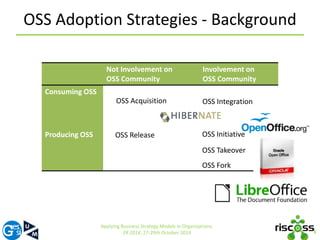
OSS Adoption Strategies - Background 
5 
Not Involvement on 
OSS Community 
OSS Integration 
Applying Business Strategy Models in Organizations. 
ER 2014, 27-29th October 2014 
Involvement on 
OSS Community 
Consuming OSS 
Producing OSS 
OSS Acquisition 
OSS Initiative 
OSS Takeover 
OSS Fork 
OSS Release
Context 
6 
Applying Business Strategy Models in Organizations. 
ER 2014, 27-29th October 2014
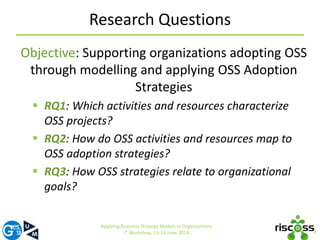
Research Questions 
Objective: Supporting organizations adopting OSS 
through modelling and applying OSS Adoption 
Strategies 
 RQ1: Which activities and resources characterize 
OSS projects? 
 RQ2: How do OSS activities and resources map to 
OSS adoption strategies? 
 RQ3: How OSS strategies relate to organizational 
goals? 
7 
Applying Business Strategy Models in Organizations. 
i* Workshop, 15-16 June 2014.
RQ1: Which activities and resources characterize OSS projects? 
AN ONTOLOGY FOR OSS ADOPTION 
STRATEGIES
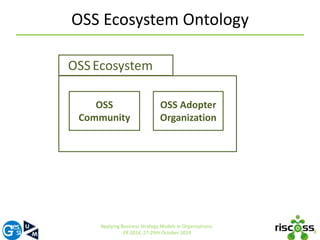
OSS Ecosystem Ontology 
9 
Applying Business Strategy Models in Organizations. 
ER 2014, 27-29th October 2014 
OSS 
Community 
OSS Adopter 
Organization 
OSS Ecosystem
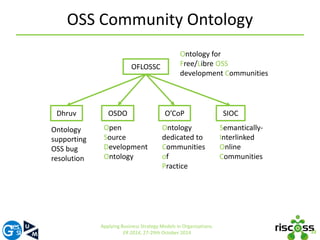
OSS Community Ontology 
10 
OFLOSSC 
Ontology for 
Free/Libre OSS 
development Communities 
Dhruv SIOC 
OSDO O’CoP 
Open 
Source 
Development 
Ontology 
Ontology 
dedicated to 
Communities 
of 
Practice 
Applying Business Strategy Models in Organizations. 
ER 2014, 27-29th October 2014 
Semantically- 
Interlinked 
Online 
Communities 
Ontology 
supporting 
OSS bug 
resolution
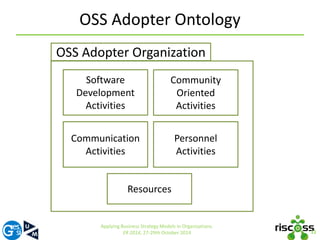
OSS Adopter Ontology 
11 
OSS Adopter Organization 
Software 
Development 
Activities 
Community 
Oriented 
Activities 
Communication 
Activities 
Personnel 
Activities 
Resources 
Applying Business Strategy Models in Organizations. 
ER 2014, 27-29th October 2014
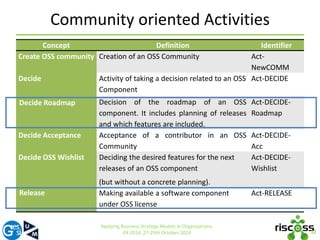
Community oriented Activities 
12 
Concept Definition Identifier 
Create OSS community Creation of an OSS Community Act- 
Release Act-RELEASE 
Applying Business Strategy Models in Organizations. 
ER 2014, 27-29th October 2014 
NewCOMM 
Decide Activity of taking a decision related to an OSS 
Component 
Act-DECIDE 
Decision of the roadmap of an OSS 
component. It includes planning of releases 
and which features are included. 
Act-DECIDE-Roadmap 
Decide Acceptance Acceptance of a contributor in an OSS 
Community 
Act-DECIDE-Acc 
Decide OSS Wishlist Deciding the desired features for the next 
releases of an OSS component 
(but without a concrete planning). 
Act-DECIDE-Wishlist 
Making available a software component 
under OSS license 
Decide Roadmap
RQ2: How do OSS activities and resources map to OSS adoption 
strategies? 
OSS ADOPTION STRATEGIES 
MODELS
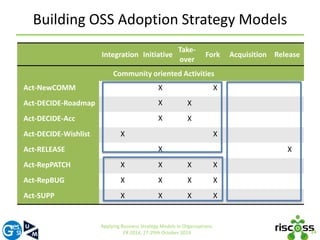
Building OSS Adoption Strategy Models 
14 
Integration Initiative 
Take-over 
Applying Business Strategy Models in Organizations. 
ER 2014, 27-29th October 2014 
Fork Acquisition Release 
Community oriented Activities 
Act-NewCOMM X X 
Act-DECIDE-Roadmap X X 
Act-DECIDE-Acc X X 
Act-DECIDE-Wishlist X X 
Act-RELEASE X X 
Act-RepPATCH X X X X 
Act-RepBUG X X X X 
Act-SUPP X X X X
OSS Adoption Strategy Models 
15 
 Activities and resources describing strategies 
 Evaluate the impact on the organizational 
goals 
Applying Business Strategy Models in Organizations. 
ER 2014, 27-29th October 2014
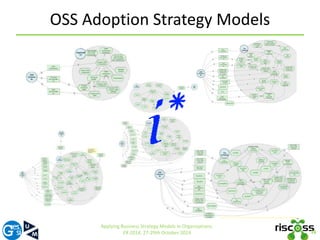
OSS Adoption Strategy Models 
16 
Applying Business Strategy Models in Organizations. 
ER 2014, 27-29th October 2014
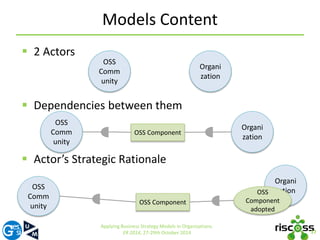
Models Content 
 2 Actors 
 Dependencies between them 
 Actor’s Strategic Rationale 
17 
Applying Business Strategy Models in Organizations. 
ER 2014, 27-29th October 2014 
OSS 
Comm 
unity 
Organi 
zation 
OSS 
Comm 
unity 
Organi 
zation 
OSS Component 
Organi 
OSS OSS 
zation 
Comm 
unity OSS Component 
Component 
adopted
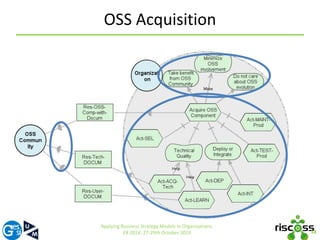
OSS Acquisition 
18 
Applying Business Strategy Models in Organizations. 
ER 2014, 27-29th October 2014
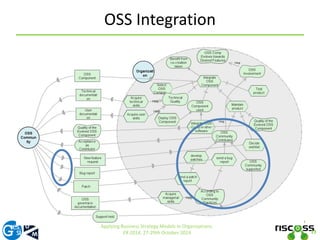
OSS Integration 
19 
Applying Business Strategy Models in Organizations. 
ER 2014, 27-29th October 2014
RQ3: How OSS strategies relate to organizational goals? 
APPLYING OSS ADOPTION 
STRATEGY MODELS
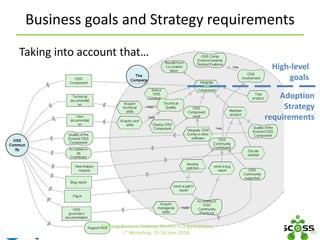
Business goals and Strategy requirements 
High-level 
goals 
Adoption 
Strategy 
requirements 
21 
Taking into account that… 
Applying Business Strategy Models in Organizations. 
i* Workshop, 15-16 June 2014.
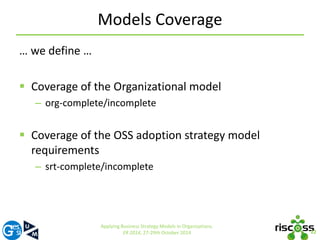
Models Coverage 
… we define … 
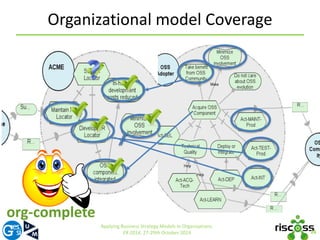
 Coverage of the Organizational model 
– org-complete/incomplete 
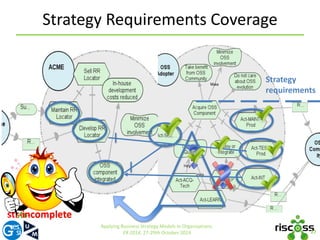
 Coverage of the OSS adoption strategy model 
requirements 
– srt-complete/incomplete 
22 
Applying Business Strategy Models in Organizations. 
ER 2014, 27-29th October 2014
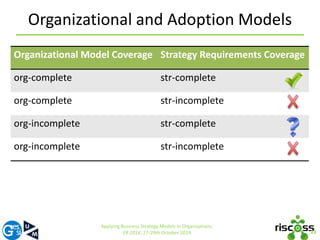
Organizational and Adoption Models 
23 
Organizational Model Coverage Strategy Requirements Coverage 
org-complete str-complete 
org-complete str-incomplete 
org-incomplete str-complete 
org-incomplete str-incomplete 
Applying Business Strategy Models in Organizations. 
ER 2014, 27-29th October 2014
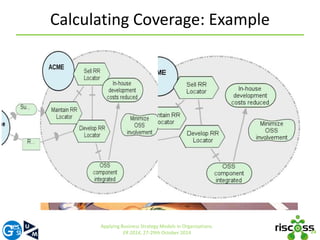
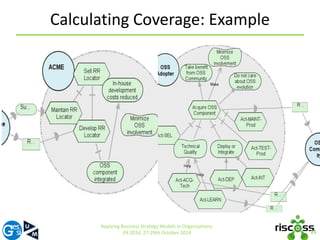
Calculating Coverage: Example 
24 
Applying Business Strategy Models in Organizations. 
ER 2014, 27-29th October 2014
Calculating Coverage: Example 
25 
Applying Business Strategy Models in Organizations. 
ER 2014, 27-29th October 2014
Organizational model Coverage 
26 
Applying Business Strategy Models in Organizations. 
ER 2014, 27-29th October 2014 
org-complete
Strategy Requirements Coverage 
27 
Applying Business Strategy Models in Organizations. 
ER 2014, 27-29th October 2014 
Strategy 
requirements 
strs-tirn-complete
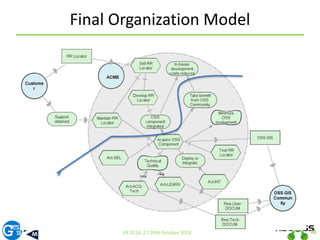
Final Organization Model 
28 
Applying Business Strategy Models in Organizations. 
ER 2014, 27-29th October 2014
CONCLUSIONS FUTURE WORK
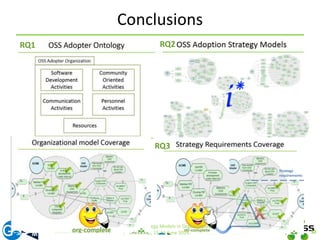
Conclusions 
30 
RQ1 RQ2 
RQ3 
Applying Business Strategy Models in Organizations. 
i* Workshop, 15-16 June 2014.
Future Work 
 Links between business models and OSS Adoption 
Strategies 
 Explore levels of coverage 
 Using i* roles in order to refine the OSS Community 
actor 
 Combining OSS Adoption Strategies 
31 
Applying Business Strategy Models in Organizations. 
i* Workshop, 15-16 June 2014.
Thank you 
Lidia López – llopez@essi.upc.edu 
www.essi.upc.edu/~gessi 
@gessi_upc

Er14

  • 1.
    Modelling and ApplyingOSS Adoption Strategies Lidia López, Dolors Costal, Claudia P. Ayala, Xavier Franch, Ruediger Glott, Kirsten Haaland
  • 2.
    Agenda  Introduction  OSS Adoption Strategies Ontology  OSS Adoption Strategies Models  OSS Adoption Strategies applied to Organizations  Conclusions and Future Work 2 Applying Business Strategy Models in Organizations. ER 2014, 27-29th October 2014
  • 3.
    Motivation  BusinessModel – Way to create value and achieve revenues according to a Business Strategy – It aims at achieving organizational goals  Many factors impact the Business Model – IT is one of them  OSS has become a driver for business in various sectors – At 2016, 95% all commercial software will include OSS 3 Applying Business Strategy Models in Organizations. ER 2014, 27-29th October 2014
  • 4.
    Motivation  OSSadoption impacts in fact far beyond technology  It is necessary to support organizations that want to adopt OSS – by analyzing the influences of such adoption 4 Modelling and Applying OSS Adoption Strategies Applying Business Strategy Models in Organizations. ER 2014, 27-29th October 2014
  • 5.
    OSS Adoption Strategies- Background 5 Not Involvement on OSS Community OSS Integration Applying Business Strategy Models in Organizations. ER 2014, 27-29th October 2014 Involvement on OSS Community Consuming OSS Producing OSS OSS Acquisition OSS Initiative OSS Takeover OSS Fork OSS Release
  • 6.
    Context 6 ApplyingBusiness Strategy Models in Organizations. ER 2014, 27-29th October 2014
  • 7.
    Research Questions Objective:Supporting organizations adopting OSS through modelling and applying OSS Adoption Strategies  RQ1: Which activities and resources characterize OSS projects?  RQ2: How do OSS activities and resources map to OSS adoption strategies?  RQ3: How OSS strategies relate to organizational goals? 7 Applying Business Strategy Models in Organizations. i* Workshop, 15-16 June 2014.
  • 8.
    RQ1: Which activitiesand resources characterize OSS projects? AN ONTOLOGY FOR OSS ADOPTION STRATEGIES
  • 9.
    OSS Ecosystem Ontology 9 Applying Business Strategy Models in Organizations. ER 2014, 27-29th October 2014 OSS Community OSS Adopter Organization OSS Ecosystem
  • 10.
    OSS Community Ontology 10 OFLOSSC Ontology for Free/Libre OSS development Communities Dhruv SIOC OSDO O’CoP Open Source Development Ontology Ontology dedicated to Communities of Practice Applying Business Strategy Models in Organizations. ER 2014, 27-29th October 2014 Semantically- Interlinked Online Communities Ontology supporting OSS bug resolution
  • 11.
    OSS Adopter Ontology 11 OSS Adopter Organization Software Development Activities Community Oriented Activities Communication Activities Personnel Activities Resources Applying Business Strategy Models in Organizations. ER 2014, 27-29th October 2014
  • 12.
    Community oriented Activities 12 Concept Definition Identifier Create OSS community Creation of an OSS Community Act- Release Act-RELEASE Applying Business Strategy Models in Organizations. ER 2014, 27-29th October 2014 NewCOMM Decide Activity of taking a decision related to an OSS Component Act-DECIDE Decision of the roadmap of an OSS component. It includes planning of releases and which features are included. Act-DECIDE-Roadmap Decide Acceptance Acceptance of a contributor in an OSS Community Act-DECIDE-Acc Decide OSS Wishlist Deciding the desired features for the next releases of an OSS component (but without a concrete planning). Act-DECIDE-Wishlist Making available a software component under OSS license Decide Roadmap
  • 13.
    RQ2: How doOSS activities and resources map to OSS adoption strategies? OSS ADOPTION STRATEGIES MODELS
  • 14.
    Building OSS AdoptionStrategy Models 14 Integration Initiative Take-over Applying Business Strategy Models in Organizations. ER 2014, 27-29th October 2014 Fork Acquisition Release Community oriented Activities Act-NewCOMM X X Act-DECIDE-Roadmap X X Act-DECIDE-Acc X X Act-DECIDE-Wishlist X X Act-RELEASE X X Act-RepPATCH X X X X Act-RepBUG X X X X Act-SUPP X X X X
  • 15.
    OSS Adoption StrategyModels 15  Activities and resources describing strategies  Evaluate the impact on the organizational goals Applying Business Strategy Models in Organizations. ER 2014, 27-29th October 2014
  • 16.
    OSS Adoption StrategyModels 16 Applying Business Strategy Models in Organizations. ER 2014, 27-29th October 2014
  • 17.
    Models Content 2 Actors  Dependencies between them  Actor’s Strategic Rationale 17 Applying Business Strategy Models in Organizations. ER 2014, 27-29th October 2014 OSS Comm unity Organi zation OSS Comm unity Organi zation OSS Component Organi OSS OSS zation Comm unity OSS Component Component adopted
  • 18.
    OSS Acquisition 18 Applying Business Strategy Models in Organizations. ER 2014, 27-29th October 2014
  • 19.
    OSS Integration 19 Applying Business Strategy Models in Organizations. ER 2014, 27-29th October 2014
  • 20.
    RQ3: How OSSstrategies relate to organizational goals? APPLYING OSS ADOPTION STRATEGY MODELS
  • 21.
    Business goals andStrategy requirements High-level goals Adoption Strategy requirements 21 Taking into account that… Applying Business Strategy Models in Organizations. i* Workshop, 15-16 June 2014.
  • 22.
    Models Coverage …we define …  Coverage of the Organizational model – org-complete/incomplete  Coverage of the OSS adoption strategy model requirements – srt-complete/incomplete 22 Applying Business Strategy Models in Organizations. ER 2014, 27-29th October 2014
  • 23.
    Organizational and AdoptionModels 23 Organizational Model Coverage Strategy Requirements Coverage org-complete str-complete org-complete str-incomplete org-incomplete str-complete org-incomplete str-incomplete Applying Business Strategy Models in Organizations. ER 2014, 27-29th October 2014
  • 24.
    Calculating Coverage: Example 24 Applying Business Strategy Models in Organizations. ER 2014, 27-29th October 2014
  • 25.
    Calculating Coverage: Example 25 Applying Business Strategy Models in Organizations. ER 2014, 27-29th October 2014
  • 26.
    Organizational model Coverage 26 Applying Business Strategy Models in Organizations. ER 2014, 27-29th October 2014 org-complete
  • 27.
    Strategy Requirements Coverage 27 Applying Business Strategy Models in Organizations. ER 2014, 27-29th October 2014 Strategy requirements strs-tirn-complete
  • 28.
    Final Organization Model 28 Applying Business Strategy Models in Organizations. ER 2014, 27-29th October 2014
  • 29.
  • 30.
    Conclusions 30 RQ1RQ2 RQ3 Applying Business Strategy Models in Organizations. i* Workshop, 15-16 June 2014.
  • 31.
    Future Work Links between business models and OSS Adoption Strategies  Explore levels of coverage  Using i* roles in order to refine the OSS Community actor  Combining OSS Adoption Strategies 31 Applying Business Strategy Models in Organizations. i* Workshop, 15-16 June 2014.
  • 32.
    Thank you LidiaLópez – llopez@essi.upc.edu www.essi.upc.edu/~gessi @gessi_upc

Editor's Notes

  • #6  The OSS can play different roles in a business model, depending on this roles and how is it used there are 6 different adoption strategies. - In this slide, these strategies are categorized depending on the involvement of the organization with the community arround OSS and if this organization is consuming or providing it. - Providing in the sense that they control the evolution of the product. - Taking as an example a Company using hibernate library for mapping an object-oriented domain model to a relational database, it could be Integration or Acquisition depending if the company is contributing or not the community. - Companies providing OSS can release a product under an Open Source License, embracing Release strategy, if they are not interested in creating a community around the product or one of the three in the right bottom cell if the organization do want to be involved - Let me use Open Office to illustrate the last 3 strategies: Sun Microsystems INITIATE the Open Office project. This OSS Project was took over by Oracle when it bought Sun Microsystems, changing the name to Oracle Open Office. After Oracle took the control over this Project, part of the community decided to FORK it creating Libre Office