UNDERSTANDING CHECK!
Prepare ¼ sheet of
paper
WRITE THE LETTER OF YOUR CHOICE
1. Why do scientists use models?
a. To make their work easier
b. Because reality is too simple to study
directly
c. To study complex systems that are difficult
to observe directly
d. Only for educational purposes
2. What is a key reason for using models in scientific
research?
a. Models are always 100% accurate
b. Models allow for simultaneous consideration of all
factors
c. Models help in analyzing and making predictions
about complex systems
d. Models are only used for visual representation
3. Which of the following is NOT a type of
scientific model mentioned?
a. Physical models
b. Conceptual models
c. Mathematical models
d. Verbal models
4. What is an example of a physical
model?
a. A written description of Earth's climate
b. A globe or a map
c. A mathematical equation
d. A theory about climate change
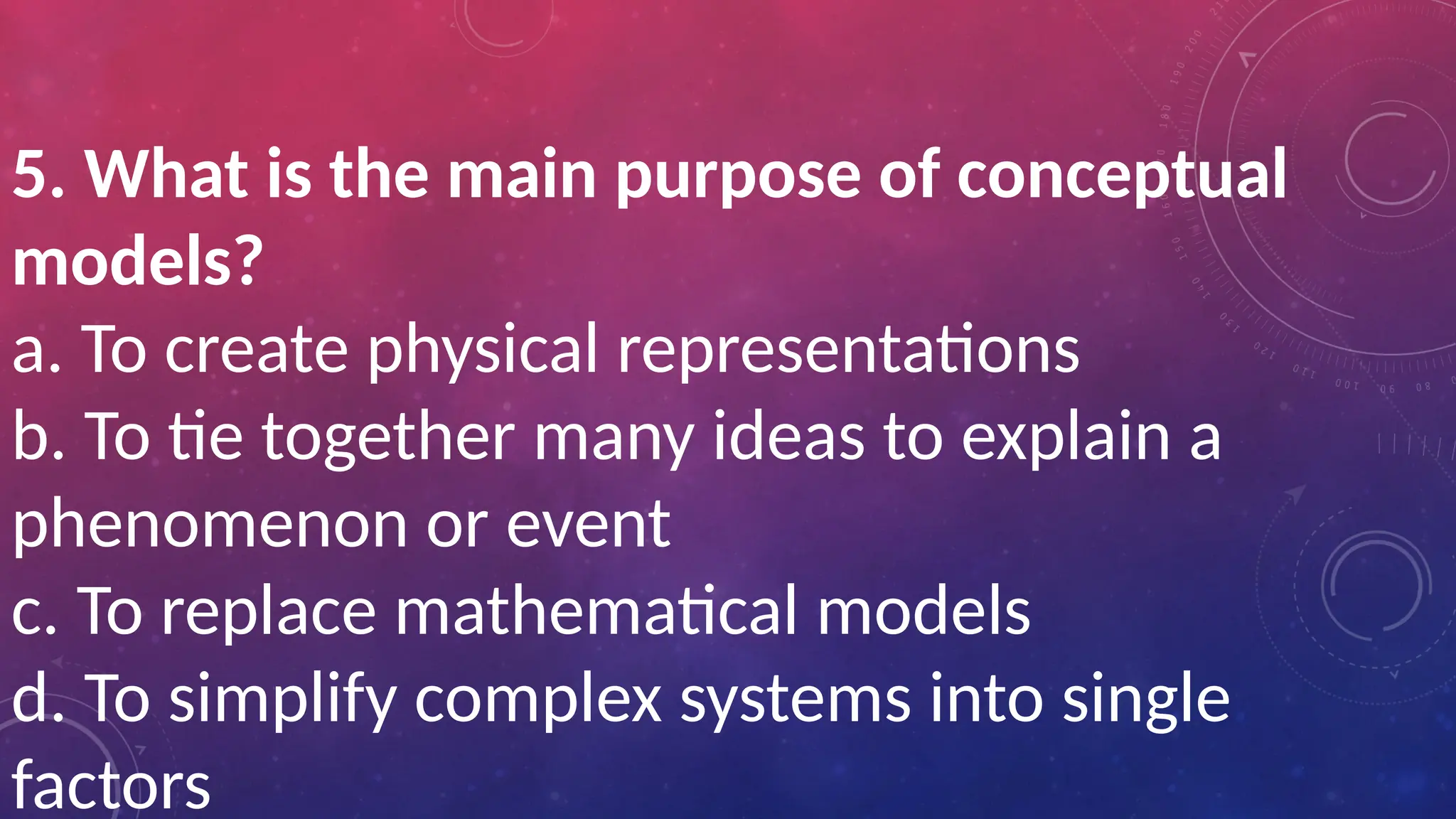
5. What is the main purpose of conceptual
models?
a. To create physical representations
b. To tie together many ideas to explain a
phenomenon or event
c. To replace mathematical models
d. To simplify complex systems into single
factors
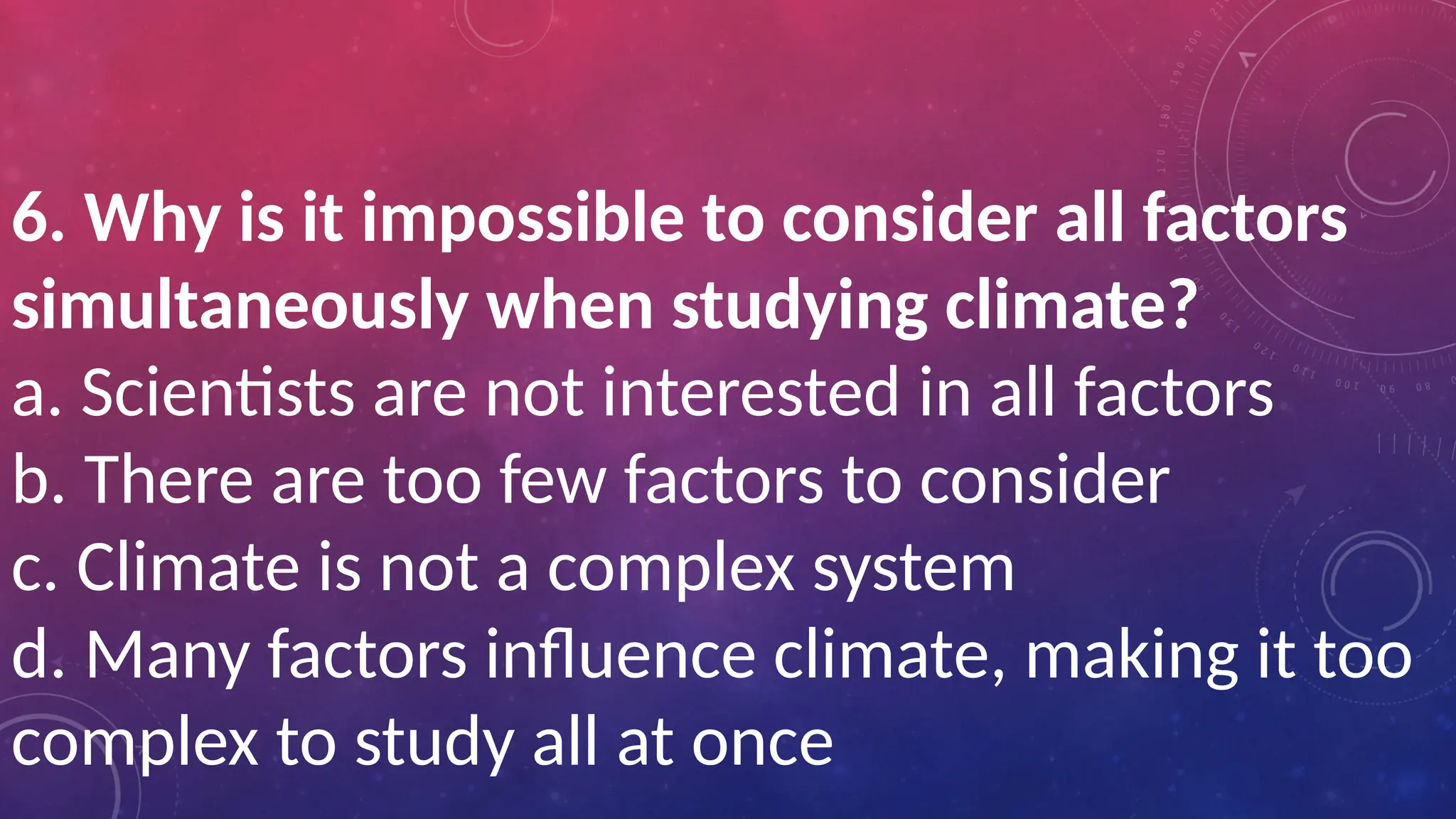
6. Why is it impossible to consider all factors
simultaneously when studying climate?
a. Scientists are not interested in all factors
b. There are too few factors to consider
c. Climate is not a complex system
d. Many factors influence climate, making it too
complex to study all at once
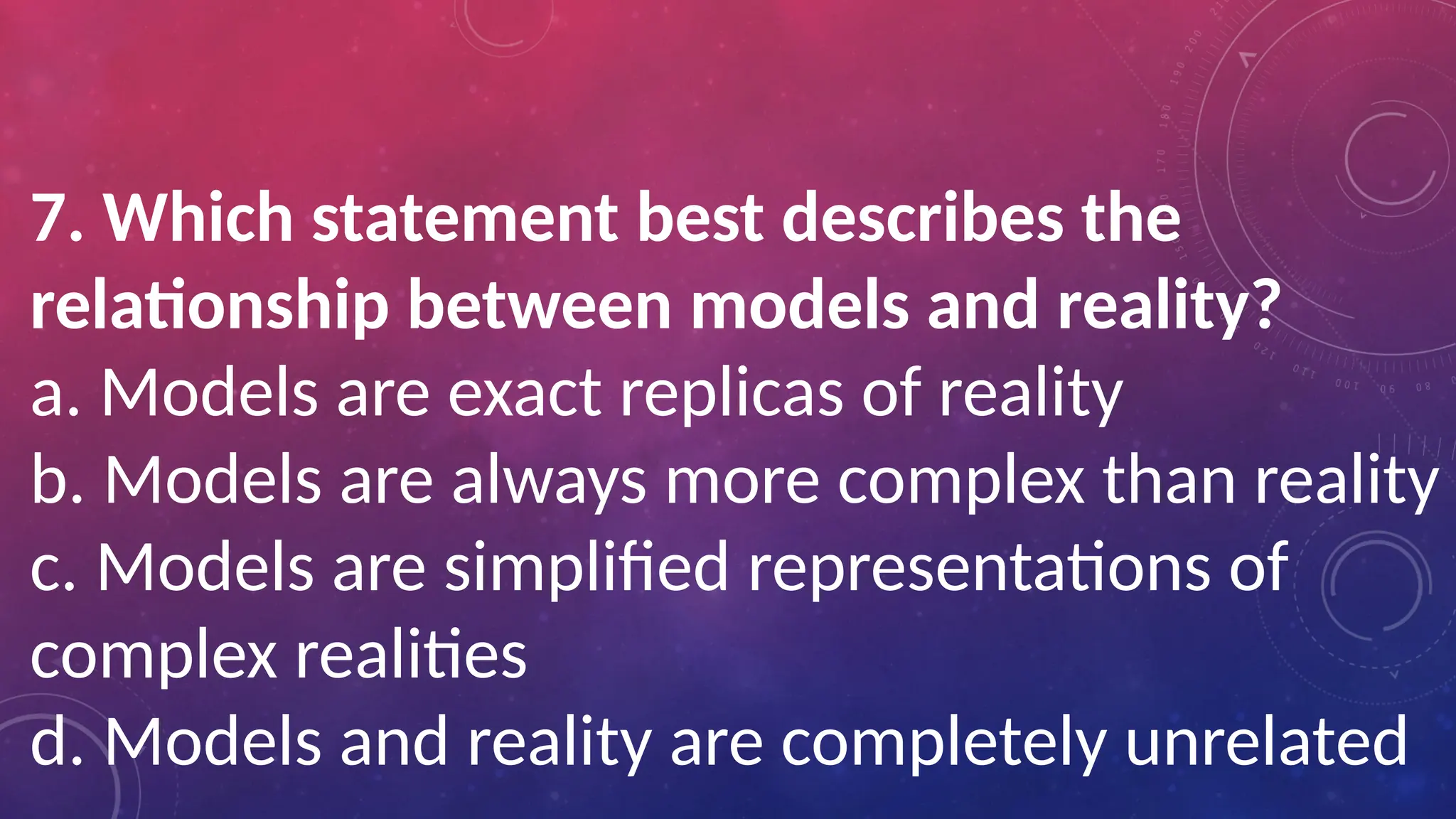
7. Which statement best describes the
relationship between models and reality?
a. Models are exact replicas of reality
b. Models are always more complex than reality
c. Models are simplified representations of
complex realities
d. Models and reality are completely unrelated
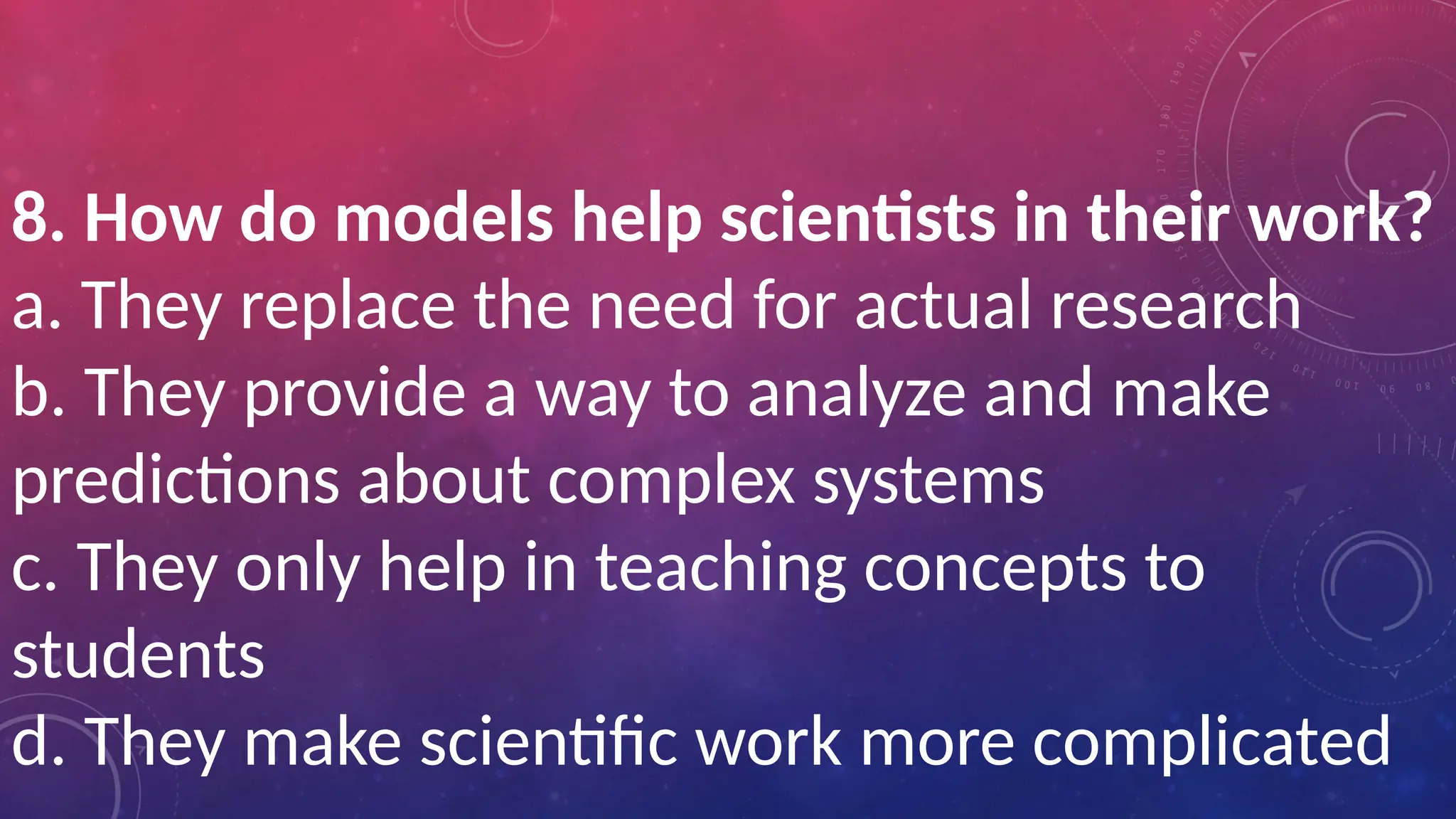
8. How do models help scientists in their work?
a. They replace the need for actual research
b. They provide a way to analyze and make
predictions about complex systems
c. They only help in teaching concepts to
students
d. They make scientific work more complicated
9. What is a key characteristic of Earth's climate
system?
a. It is simple and easy to study directly
b. It can be fully represented by a single model
c. It is complex and influenced by many factors
d. It is not suitable for scientific modeling
10. Which of the following best describes the
purpose of using different types of models?
a. To confuse other scientists
b. To make scientific papers longer
c. To approach complex systems from various
perspectives
d. To avoid mathematical calculations
11-15. Enumerate the 5
models of atom
ANSWER KEY
1. c. To study complex systems that are difficult to observe directly
2. c. Models help in analyzing and making predictions about complex systems
3. d. Verbal models
4. b. A globe or a map
5. b. To tie together many ideas to explain a phenomenon or event
6. d. Many factors influence climate, making it too complex to study all at once
7. c. Models are simplified representations of complex realities
8. b. They provide a way to analyze and make predictions about complex
systems
9. c. It is complex and influenced by many factors
10. c. To approach complex systems from various perspectives
ANSWER KEY
Solid Sphere model
Plum pudding model
Nuclear model
Planetary model
Quantum model
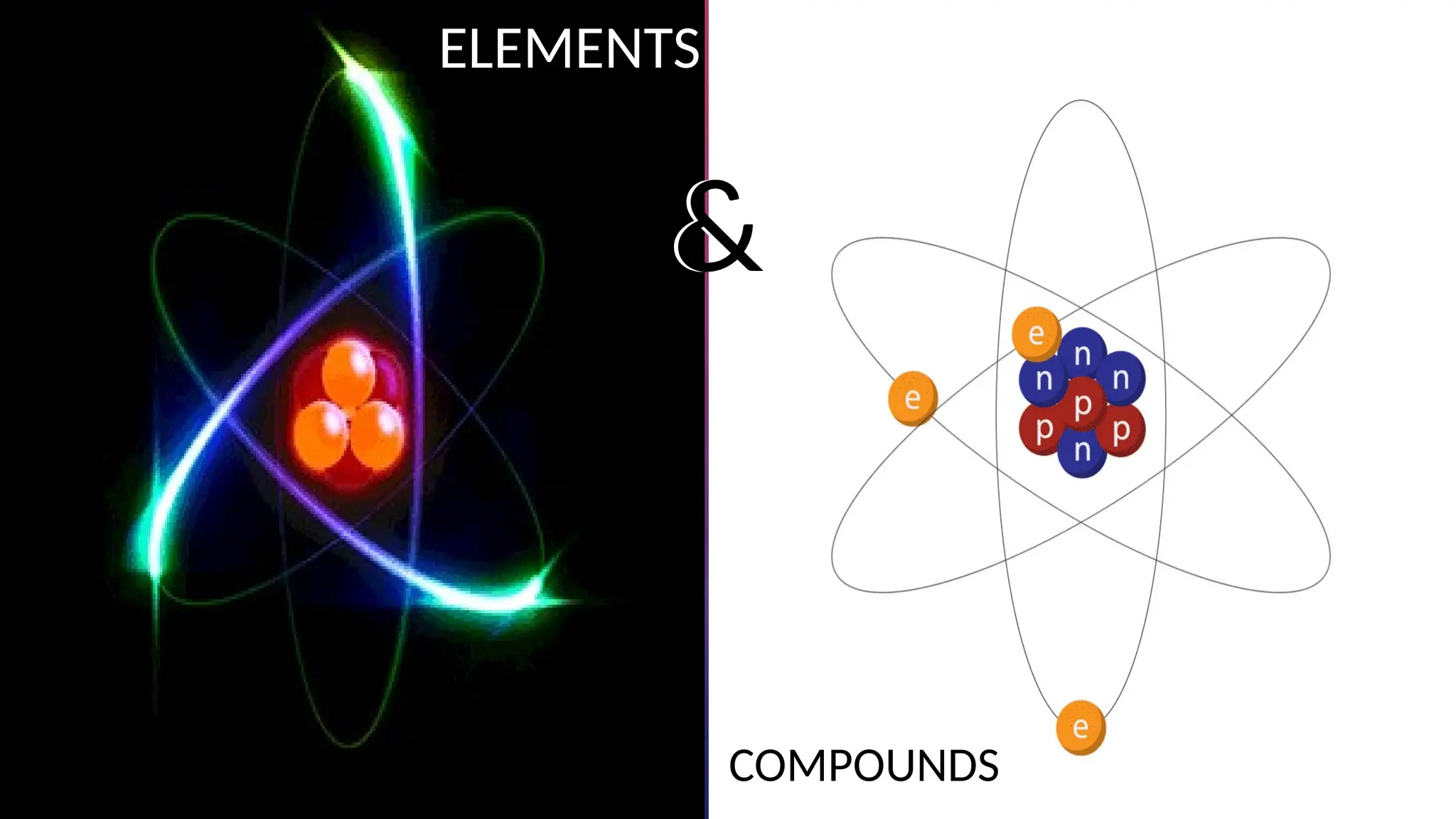
ELEMENTS
&
&
COMPOUNDS
SHORT REVIEW
• What was the discussion last
week all about?
• What is an atom?
• What is the composition of
atom?
• What are the three states of
matter?
• What is the name of the
representation of the molecules
of solid liquid and gas?
• The discussion was about the states
of matter, models of matter, and
history of atom
• Atoms are the fundamental building
blocks of elements, while molecules
consist of two or more atoms
chemically bonded together
• Proton and neutron surrounded by an
electron
• Solid, liquid and gas
• Models of matter
PURE SUBSTANCES
ELEMENTS & COMPOUNDS
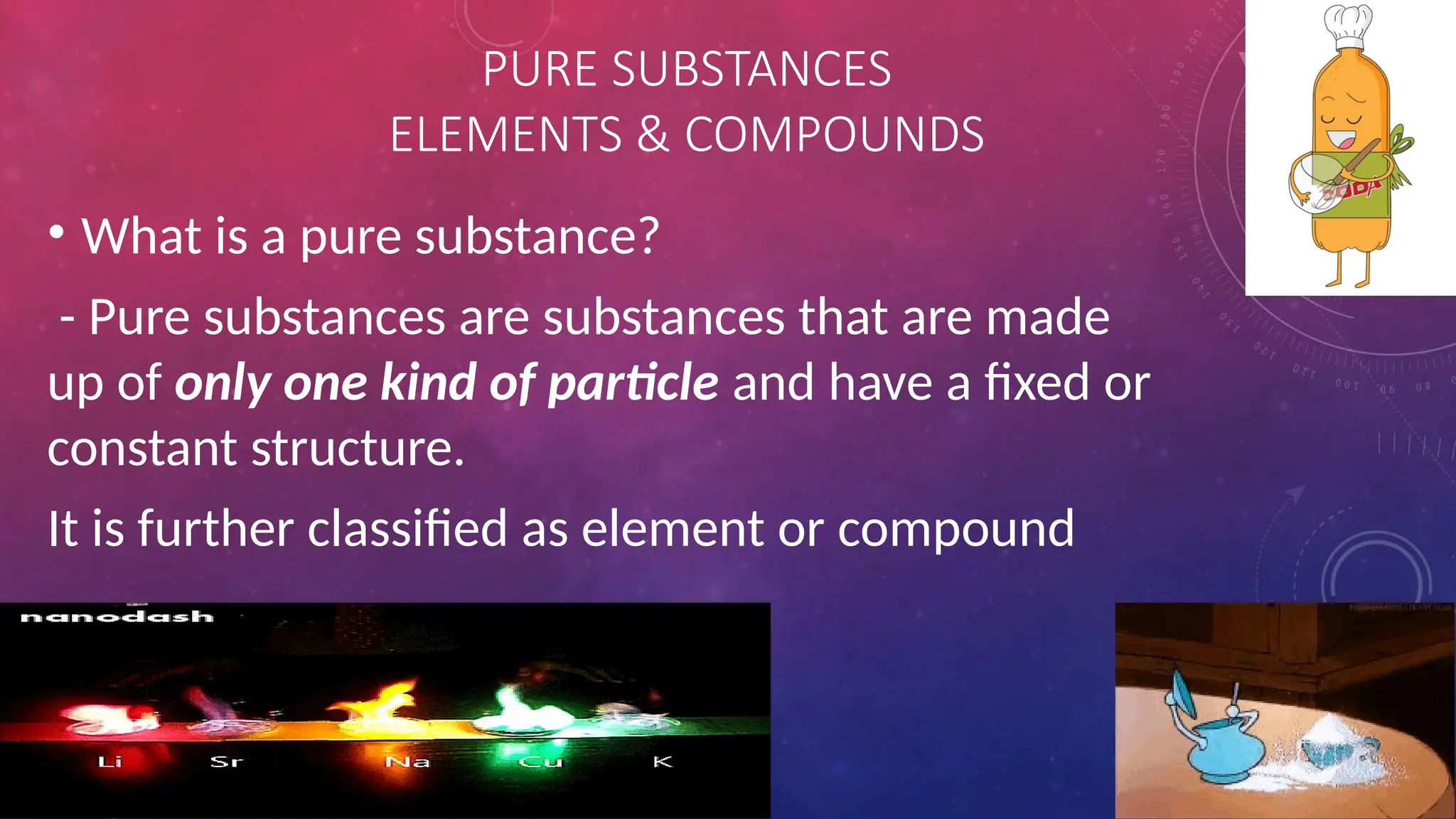
• What is a pure substance?
- Pure substances are substances that are made
up of only one kind of particle and have a fixed or
constant structure.
It is further classified as element or compound
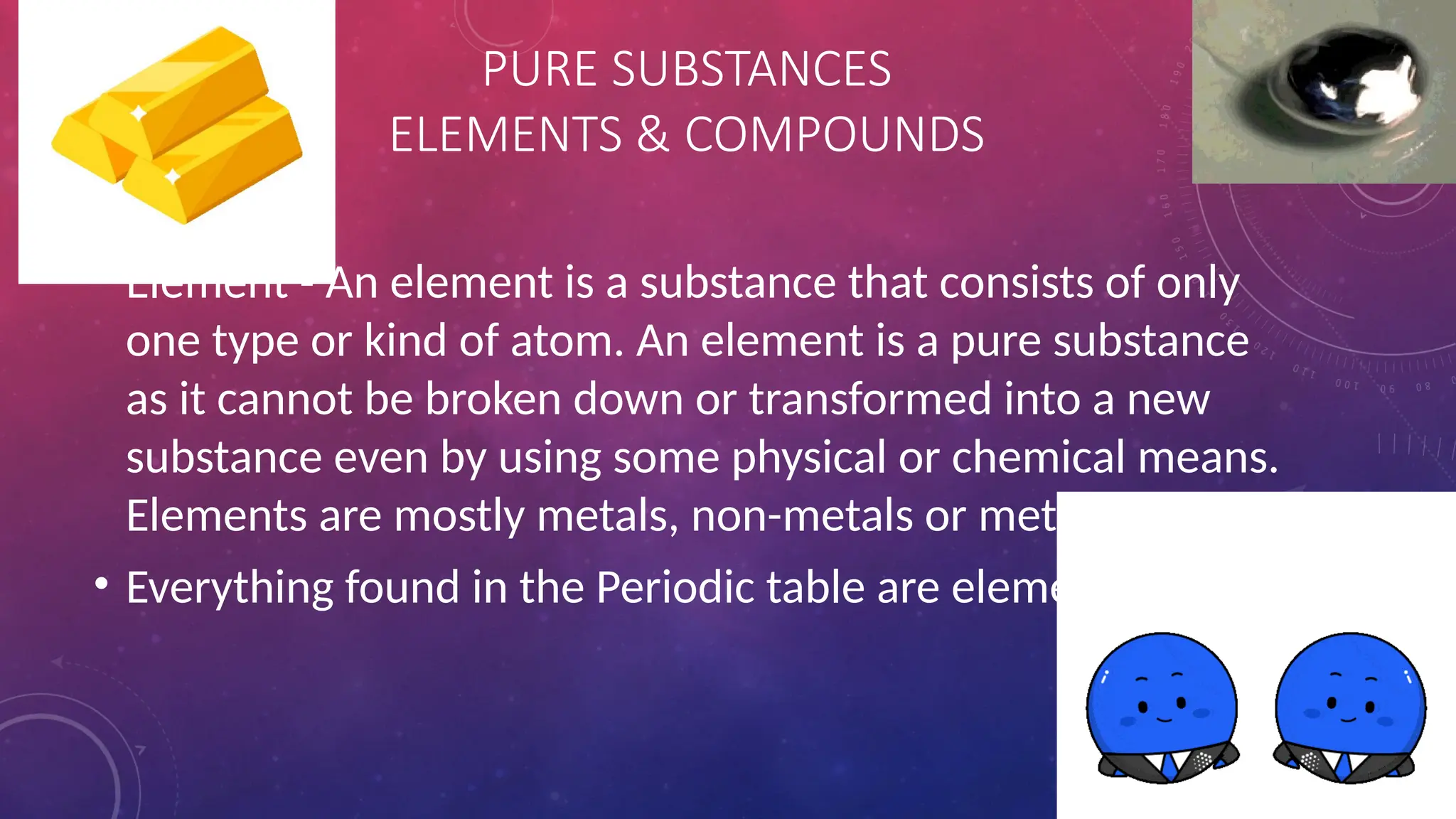
• Element - An element is a substance that consists of only
one type or kind of atom. An element is a pure substance
as it cannot be broken down or transformed into a new
substance even by using some physical or chemical means.
Elements are mostly metals, non-metals or metalloids.
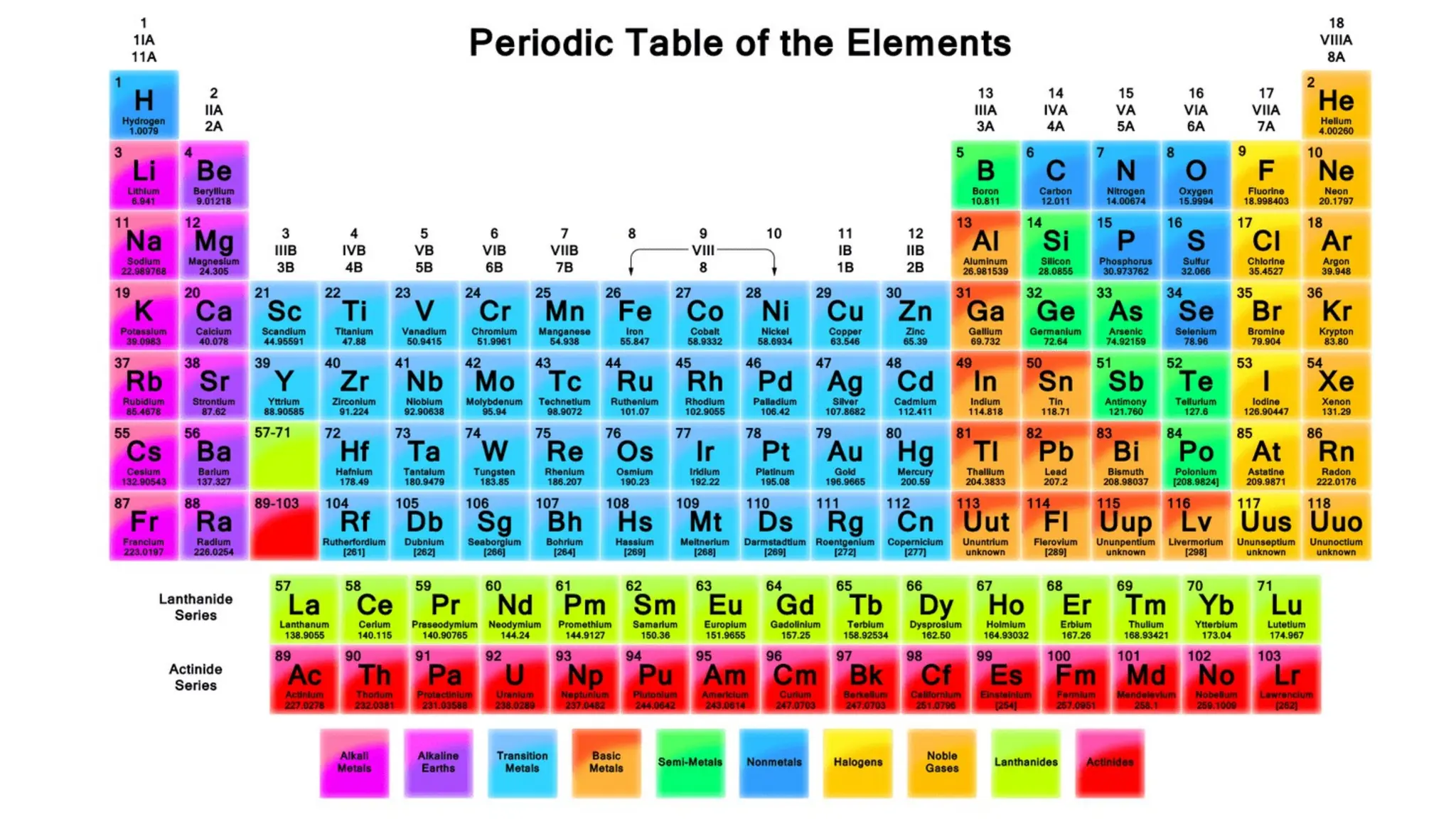
• Everything found in the Periodic table are elements
PURE SUBSTANCES
ELEMENTS & COMPOUNDS
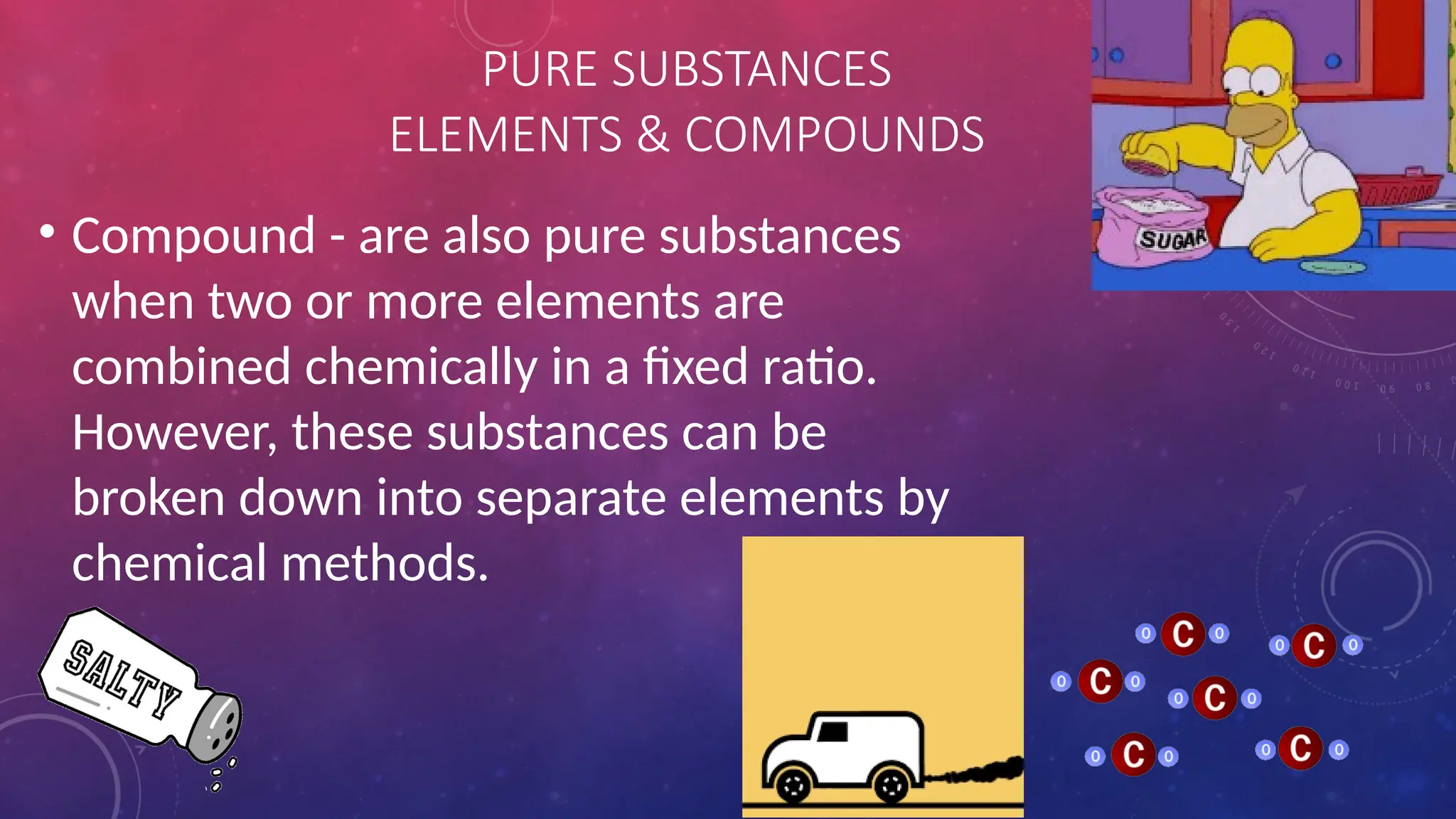
• Compound - are also pure substances
when two or more elements are
combined chemically in a fixed ratio.
However, these substances can be
broken down into separate elements by
chemical methods.
PURE SUBSTANCES
ELEMENTS & COMPOUNDS
CHECKPOINT
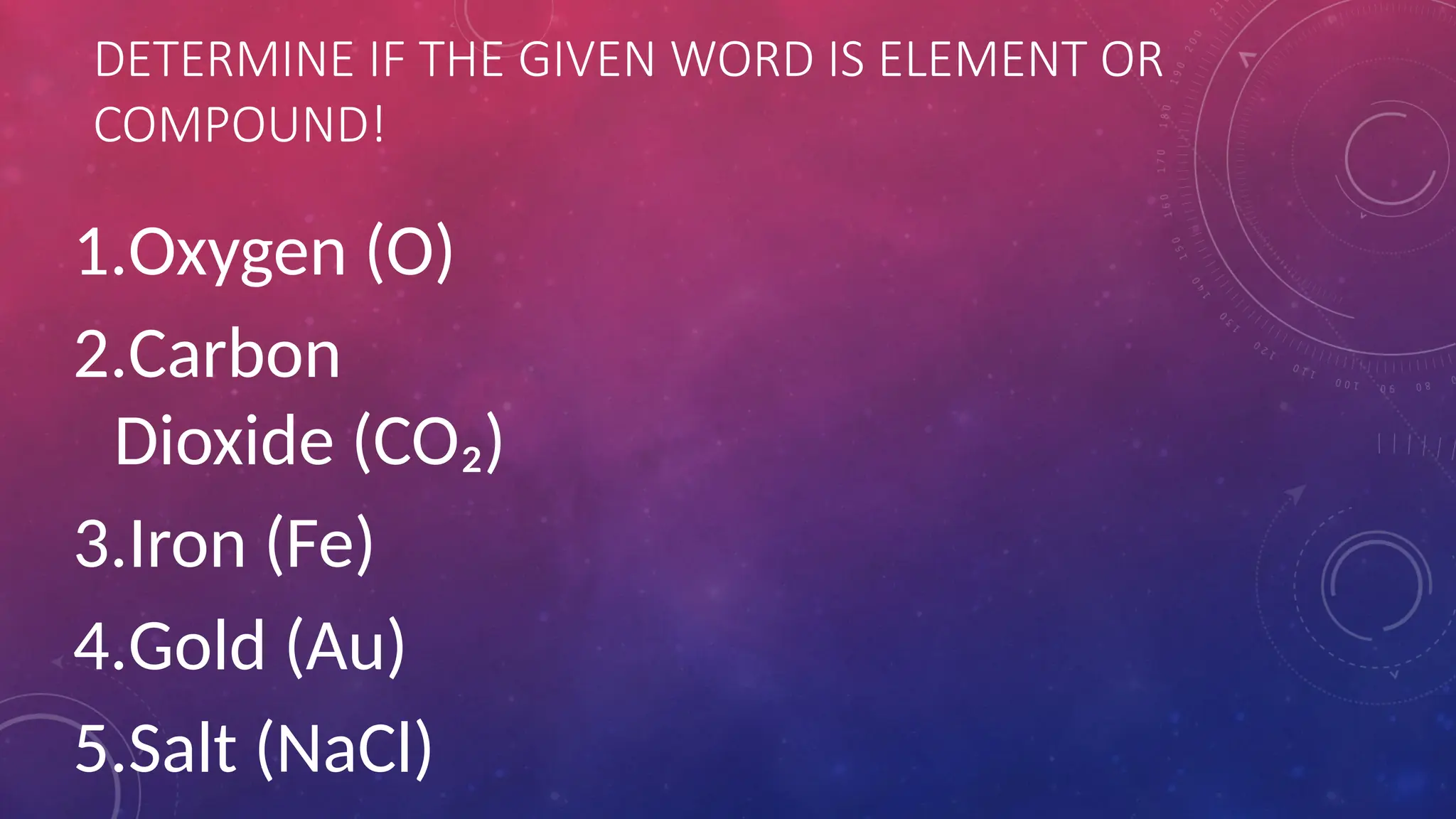
DETERMINE IF THE GIVEN WORD IS ELEMENT OR
COMPOUND!
1.Oxygen (O)
2.Carbon
Dioxide (CO₂)
3.Iron (Fe)
4.Gold (Au)
5.Salt (NaCl)
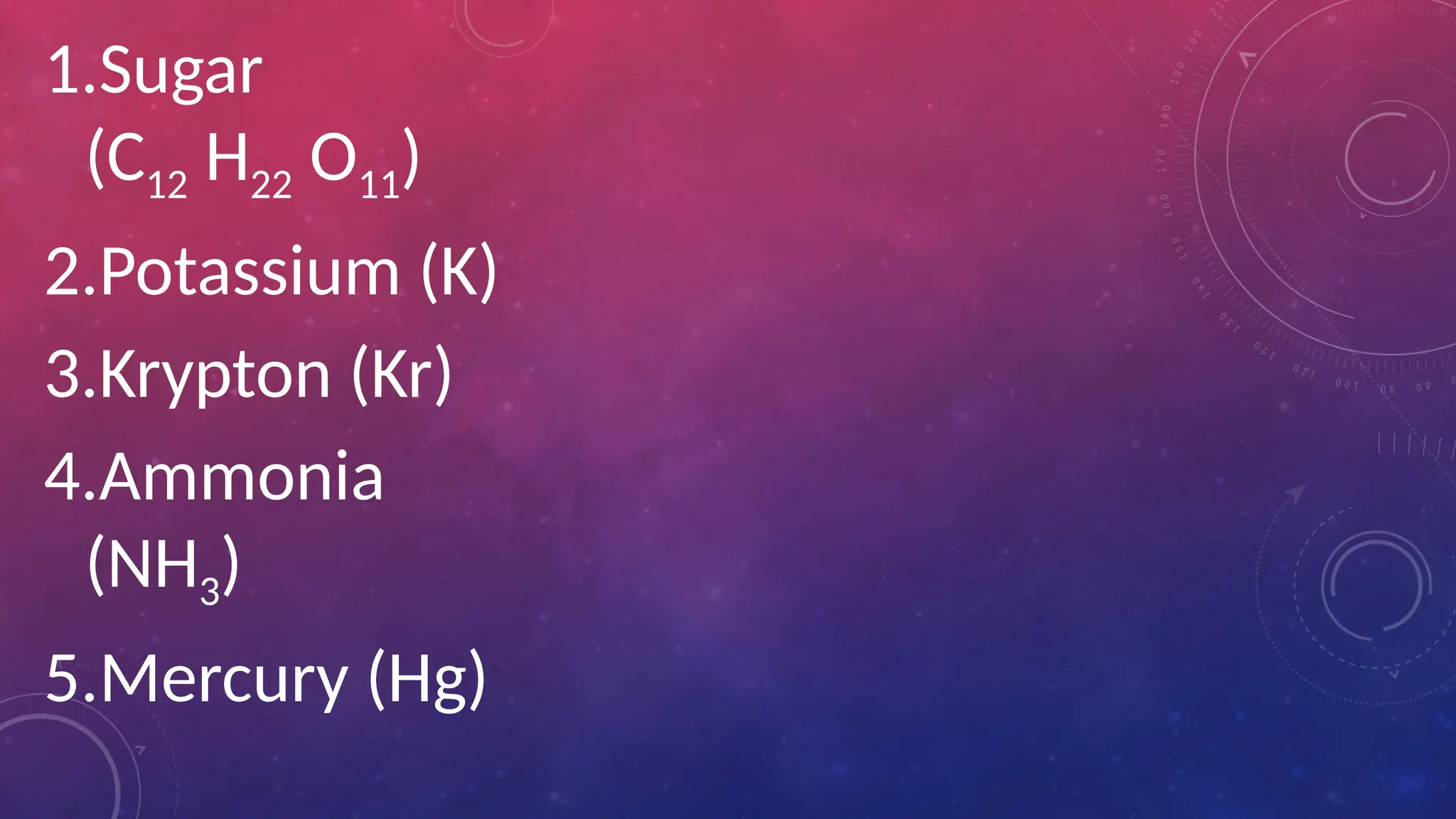
1.Sugar
(C12 H22 O11)
2.Potassium (K)
3.Krypton (Kr)
4.Ammonia
(NH3)
5.Mercury (Hg)
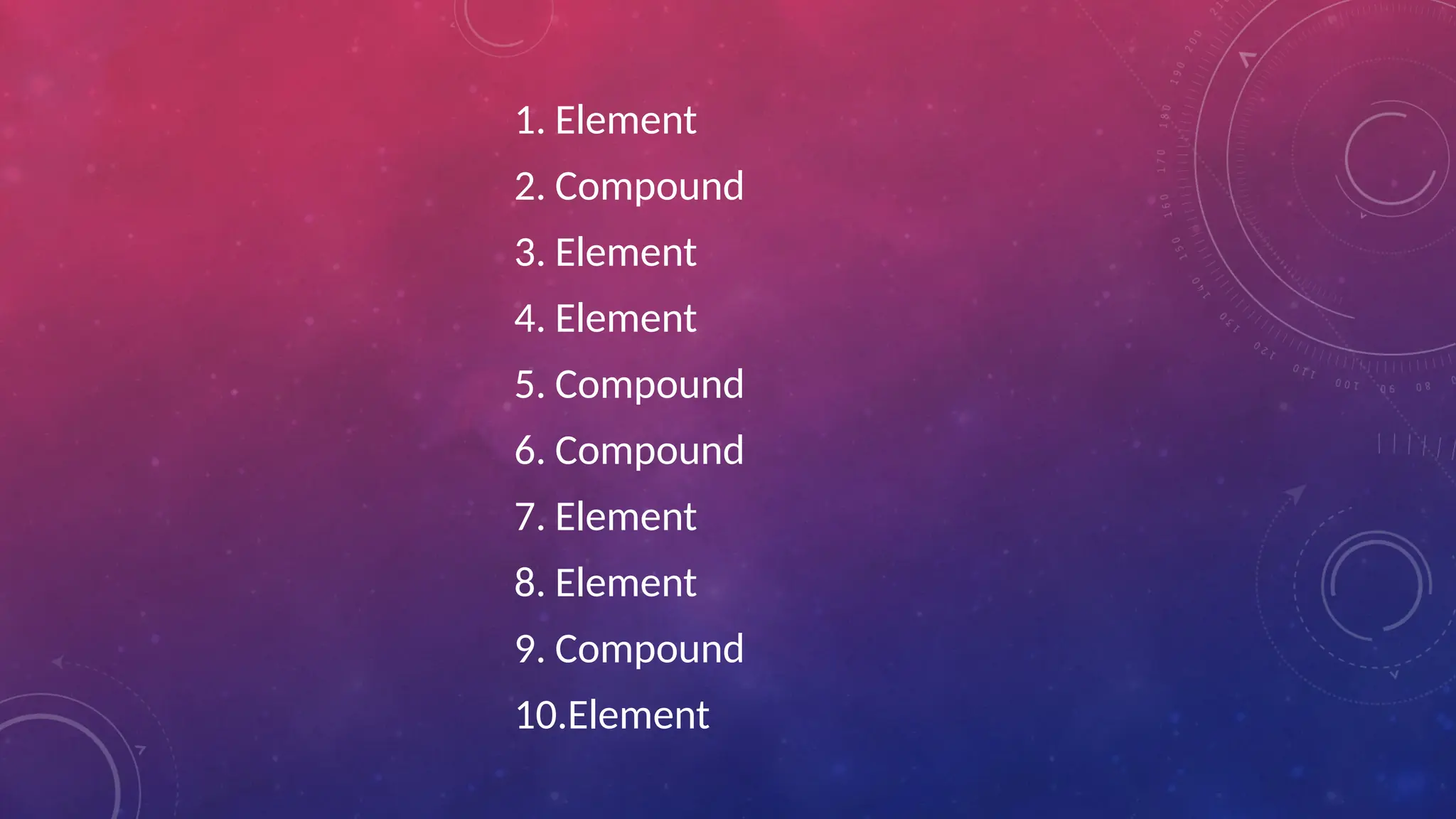
1. Element
2. Compound
3. Element
4. Element
5. Compound
6. Compound
7. Element
8. Element
9. Compound
10.Element
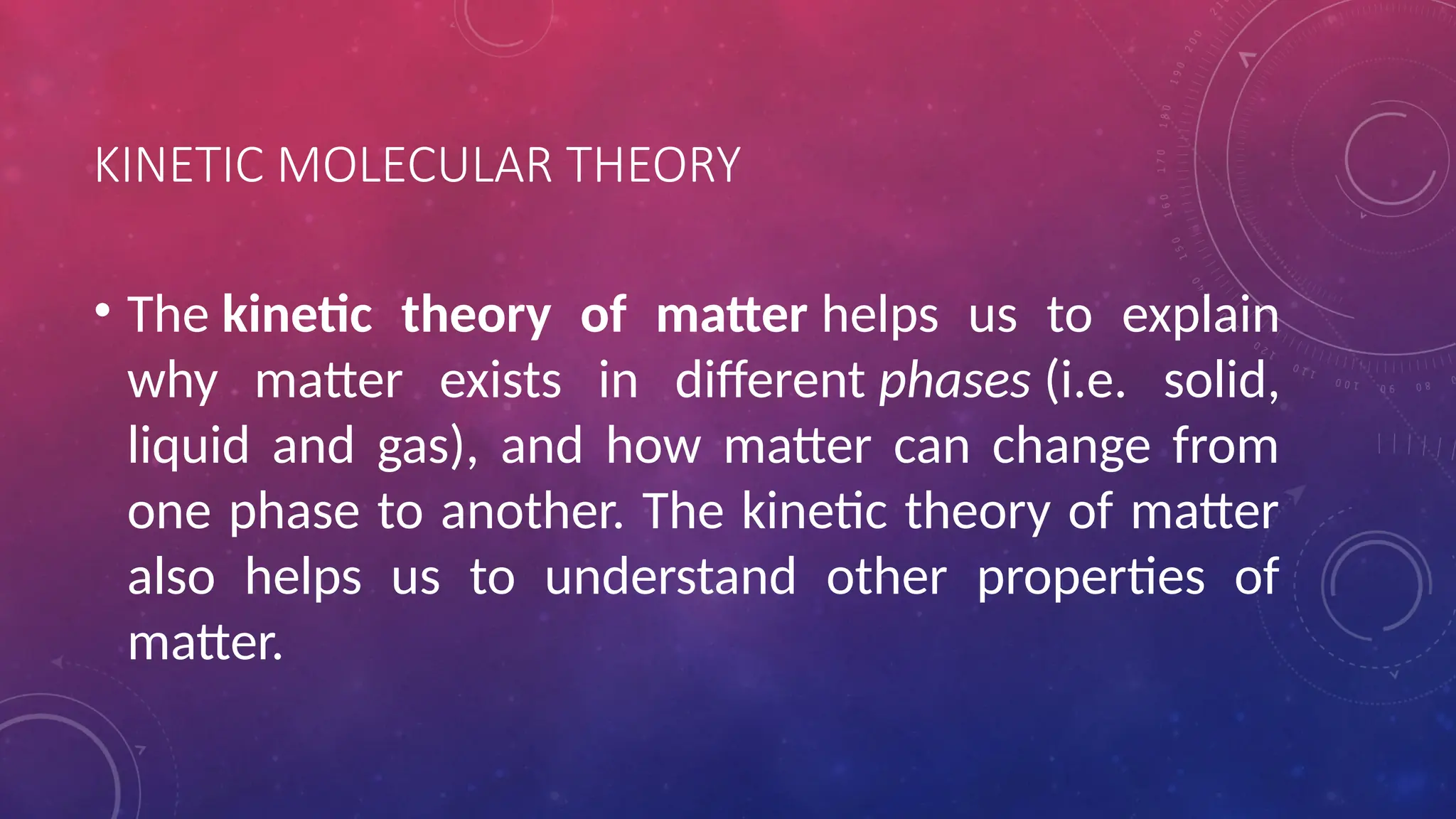
KINETIC MOLECULAR THEORY
• The kinetic theory of matter helps us to explain
why matter exists in different phases (i.e. solid,
liquid and gas), and how matter can change from
one phase to another. The kinetic theory of matter
also helps us to understand other properties of
matter.
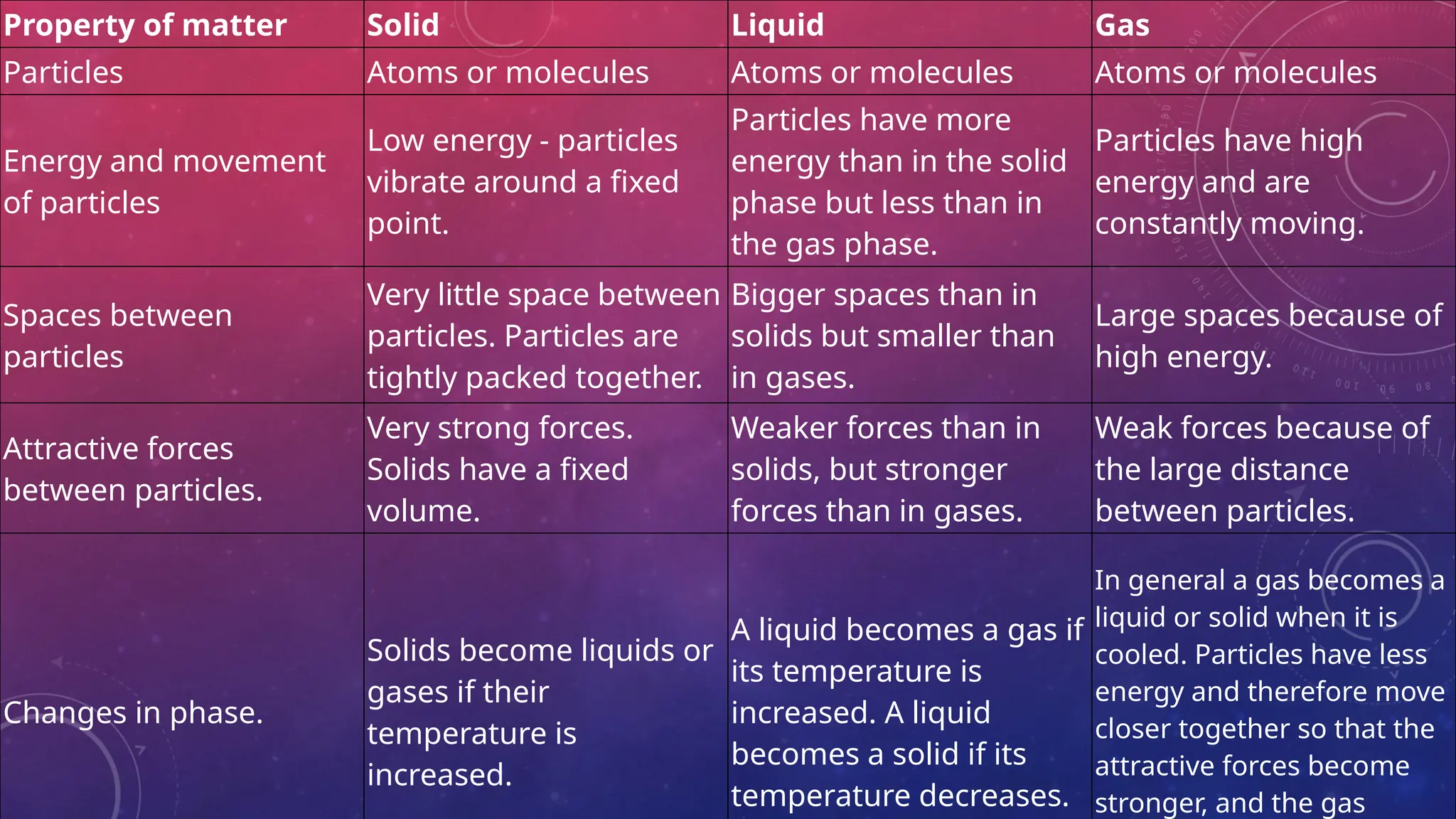
Property of matter Solid Liquid Gas
Particles Atoms or molecules Atoms or molecules Atoms or molecules
Energy and movement
of particles
Low energy - particles
vibrate around a fixed
point.
Particles have more
energy than in the solid
phase but less than in
the gas phase.
Particles have high
energy and are
constantly moving.
Spaces between
particles
Very little space between
particles. Particles are
tightly packed together.
Bigger spaces than in
solids but smaller than
in gases.
Large spaces because of
high energy.
Attractive forces
between particles.
Very strong forces.
Solids have a fixed
volume.
Weaker forces than in
solids, but stronger
forces than in gases.
Weak forces because of
the large distance
between particles.
Changes in phase.
Solids become liquids or
gases if their
temperature is
increased.
A liquid becomes a gas if
its temperature is
increased. A liquid
becomes a solid if its
temperature decreases.
In general a gas becomes a
liquid or solid when it is
cooled. Particles have less
energy and therefore move
closer together so that the
attractive forces become
stronger, and the gas
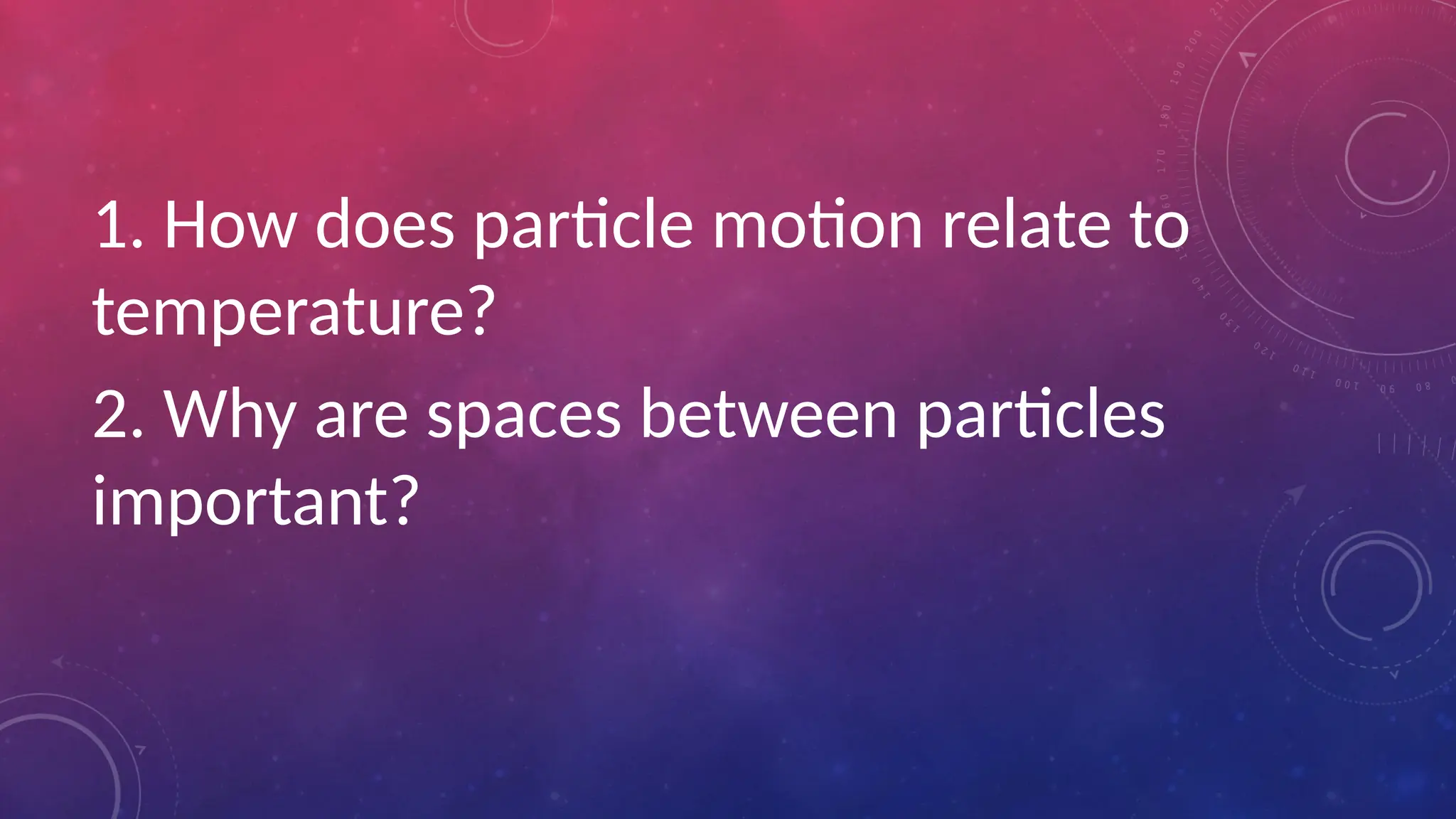
1. How does particle motion relate to
temperature?
2. Why are spaces between particles
important?
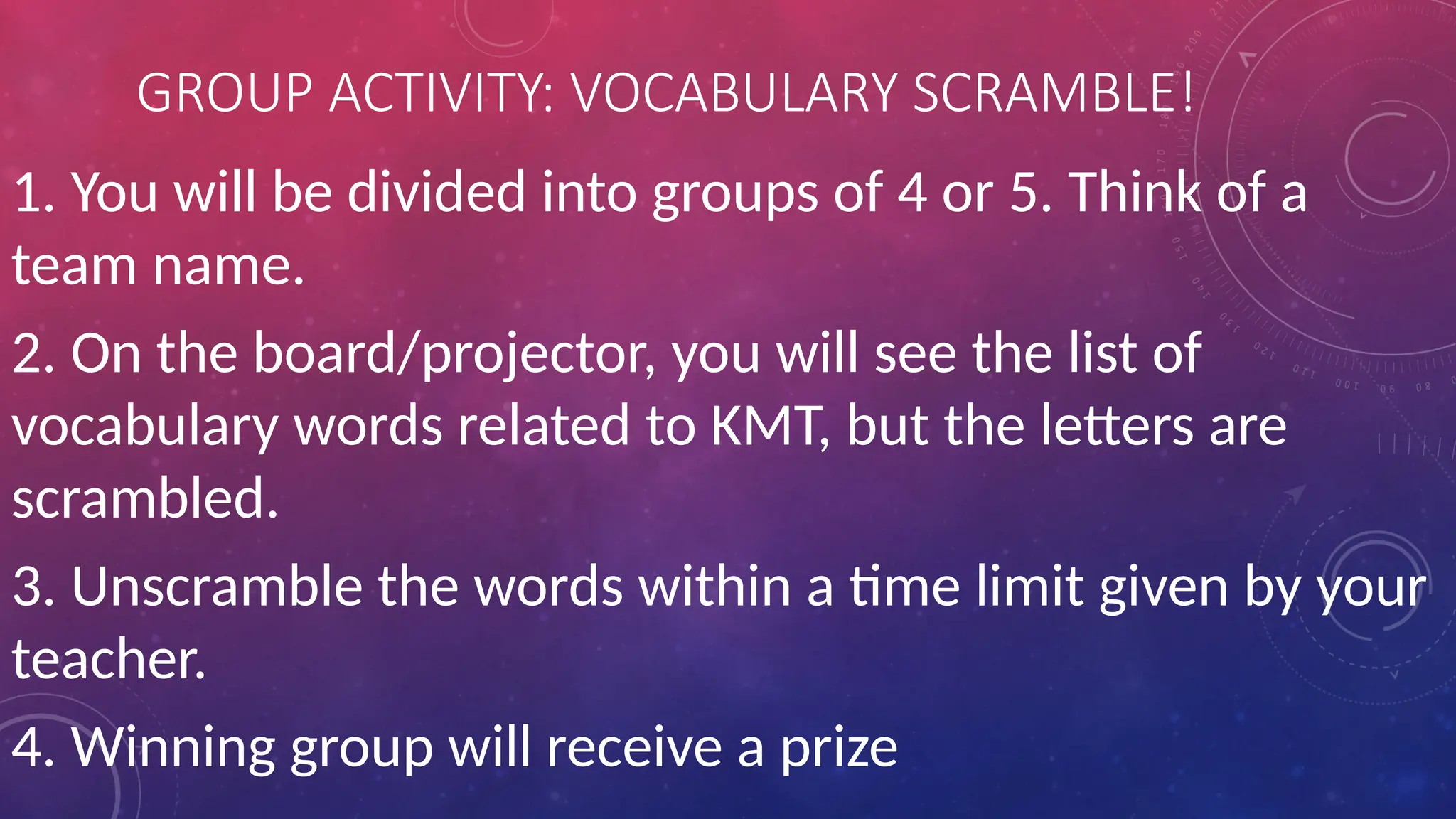
GROUP ACTIVITY: VOCABULARY SCRAMBLE!
1. You will be divided into groups of 4 or 5. Think of a
team name.
2. On the board/projector, you will see the list of
vocabulary words related to KMT, but the letters are
scrambled.
3. Unscramble the words within a time limit given by your
teacher.
4. Winning group will receive a prize
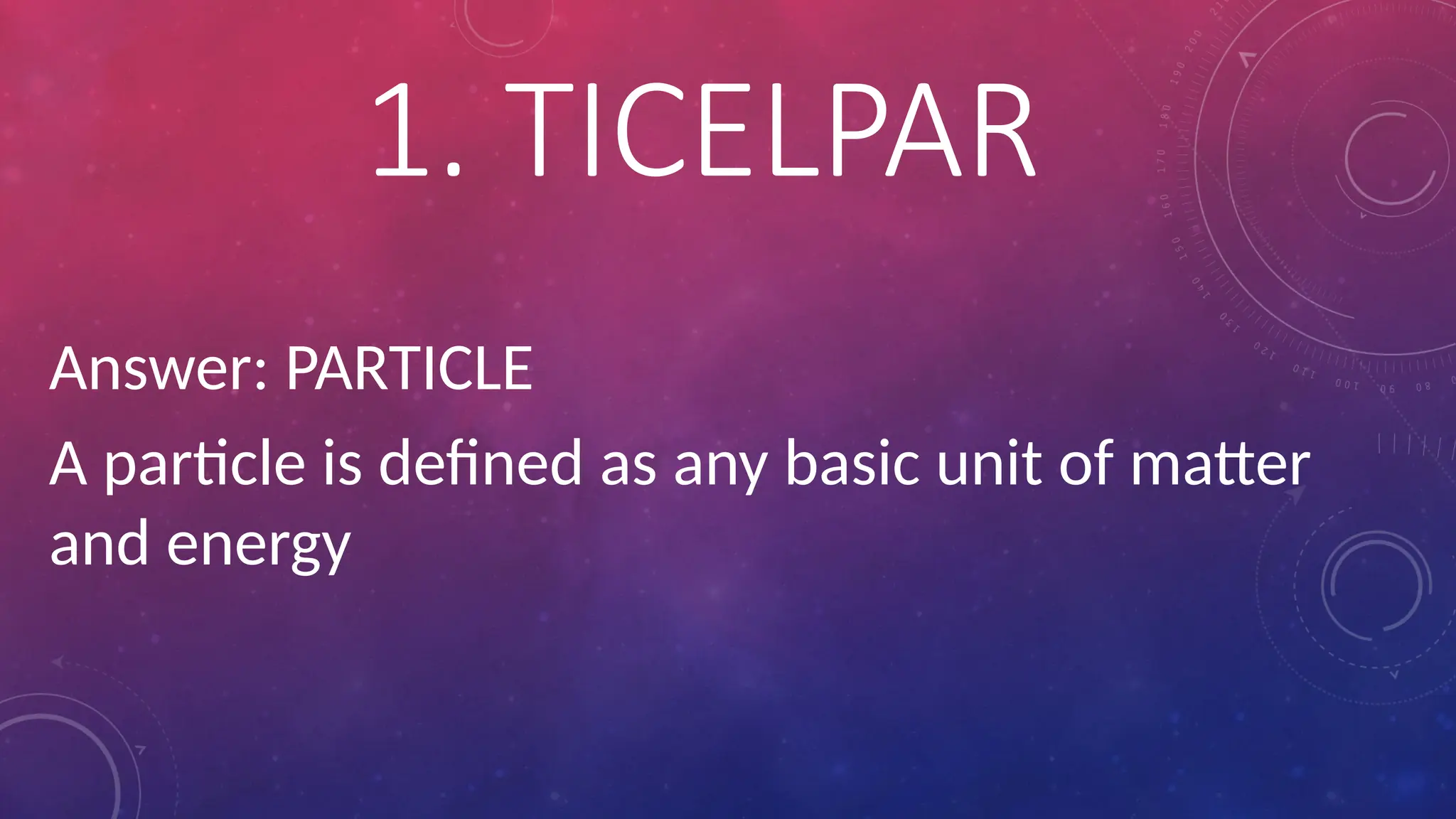
Answer: PARTICLE
A particle is defined as any basic unit of matter
and energy
1. TICELPAR
Answer: MOTION
The action or process of moving or being
moved
2.ONITMO
Answer: TEMPERATURE
the degree or intensity of heat present in a
substance or object
3.PERATREMTEU
Answer: PHASE
a distinct period or stage in a series of events or
a process of change or development
4. SEHPA
Answer: PARTICLE
A substance that flows freely but is of constant
volume, having a consistency like that of water
or oil
5. ILUQID
Answer: SPACE
A continuous area or expanse which is free,
available, or unoccupied
6. CAEPS
Answer: SOLID
Firm and stable in shape; not liquid or fluid.
7. DLIOS
Answer: MOLECULE
A group of atoms bonded together, representing
the smallest fundamental unit of a chemical
compound that can take part in a chemical
reaction
8. OELEUCLM

Quarter one Lesson One Week two Science Seven

  • 1.
  • 2.
    WRITE THE LETTEROF YOUR CHOICE 1. Why do scientists use models? a. To make their work easier b. Because reality is too simple to study directly c. To study complex systems that are difficult to observe directly d. Only for educational purposes
  • 3.
    2. What isa key reason for using models in scientific research? a. Models are always 100% accurate b. Models allow for simultaneous consideration of all factors c. Models help in analyzing and making predictions about complex systems d. Models are only used for visual representation
  • 4.
    3. Which ofthe following is NOT a type of scientific model mentioned? a. Physical models b. Conceptual models c. Mathematical models d. Verbal models
  • 5.
    4. What isan example of a physical model? a. A written description of Earth's climate b. A globe or a map c. A mathematical equation d. A theory about climate change
  • 6.
    5. What isthe main purpose of conceptual models? a. To create physical representations b. To tie together many ideas to explain a phenomenon or event c. To replace mathematical models d. To simplify complex systems into single factors
  • 7.
    6. Why isit impossible to consider all factors simultaneously when studying climate? a. Scientists are not interested in all factors b. There are too few factors to consider c. Climate is not a complex system d. Many factors influence climate, making it too complex to study all at once
  • 8.
    7. Which statementbest describes the relationship between models and reality? a. Models are exact replicas of reality b. Models are always more complex than reality c. Models are simplified representations of complex realities d. Models and reality are completely unrelated
  • 9.
    8. How domodels help scientists in their work? a. They replace the need for actual research b. They provide a way to analyze and make predictions about complex systems c. They only help in teaching concepts to students d. They make scientific work more complicated
  • 10.
    9. What isa key characteristic of Earth's climate system? a. It is simple and easy to study directly b. It can be fully represented by a single model c. It is complex and influenced by many factors d. It is not suitable for scientific modeling
  • 11.
    10. Which ofthe following best describes the purpose of using different types of models? a. To confuse other scientists b. To make scientific papers longer c. To approach complex systems from various perspectives d. To avoid mathematical calculations
  • 12.
    11-15. Enumerate the5 models of atom
  • 13.
    ANSWER KEY 1. c.To study complex systems that are difficult to observe directly 2. c. Models help in analyzing and making predictions about complex systems 3. d. Verbal models 4. b. A globe or a map 5. b. To tie together many ideas to explain a phenomenon or event 6. d. Many factors influence climate, making it too complex to study all at once 7. c. Models are simplified representations of complex realities 8. b. They provide a way to analyze and make predictions about complex systems 9. c. It is complex and influenced by many factors 10. c. To approach complex systems from various perspectives
  • 14.
    ANSWER KEY Solid Spheremodel Plum pudding model Nuclear model Planetary model Quantum model
  • 15.
  • 16.
    SHORT REVIEW • Whatwas the discussion last week all about? • What is an atom? • What is the composition of atom? • What are the three states of matter? • What is the name of the representation of the molecules of solid liquid and gas? • The discussion was about the states of matter, models of matter, and history of atom • Atoms are the fundamental building blocks of elements, while molecules consist of two or more atoms chemically bonded together • Proton and neutron surrounded by an electron • Solid, liquid and gas • Models of matter
  • 18.
    PURE SUBSTANCES ELEMENTS &COMPOUNDS • What is a pure substance? - Pure substances are substances that are made up of only one kind of particle and have a fixed or constant structure. It is further classified as element or compound
  • 19.
    • Element -An element is a substance that consists of only one type or kind of atom. An element is a pure substance as it cannot be broken down or transformed into a new substance even by using some physical or chemical means. Elements are mostly metals, non-metals or metalloids. • Everything found in the Periodic table are elements PURE SUBSTANCES ELEMENTS & COMPOUNDS
  • 21.
    • Compound -are also pure substances when two or more elements are combined chemically in a fixed ratio. However, these substances can be broken down into separate elements by chemical methods. PURE SUBSTANCES ELEMENTS & COMPOUNDS
  • 22.
  • 23.
    DETERMINE IF THEGIVEN WORD IS ELEMENT OR COMPOUND! 1.Oxygen (O) 2.Carbon Dioxide (CO₂) 3.Iron (Fe) 4.Gold (Au) 5.Salt (NaCl)
  • 24.
    1.Sugar (C12 H22 O11) 2.Potassium(K) 3.Krypton (Kr) 4.Ammonia (NH3) 5.Mercury (Hg)
  • 25.
    1. Element 2. Compound 3.Element 4. Element 5. Compound 6. Compound 7. Element 8. Element 9. Compound 10.Element
  • 26.
    KINETIC MOLECULAR THEORY •The kinetic theory of matter helps us to explain why matter exists in different phases (i.e. solid, liquid and gas), and how matter can change from one phase to another. The kinetic theory of matter also helps us to understand other properties of matter.
  • 27.
    Property of matterSolid Liquid Gas Particles Atoms or molecules Atoms or molecules Atoms or molecules Energy and movement of particles Low energy - particles vibrate around a fixed point. Particles have more energy than in the solid phase but less than in the gas phase. Particles have high energy and are constantly moving. Spaces between particles Very little space between particles. Particles are tightly packed together. Bigger spaces than in solids but smaller than in gases. Large spaces because of high energy. Attractive forces between particles. Very strong forces. Solids have a fixed volume. Weaker forces than in solids, but stronger forces than in gases. Weak forces because of the large distance between particles. Changes in phase. Solids become liquids or gases if their temperature is increased. A liquid becomes a gas if its temperature is increased. A liquid becomes a solid if its temperature decreases. In general a gas becomes a liquid or solid when it is cooled. Particles have less energy and therefore move closer together so that the attractive forces become stronger, and the gas
  • 28.
    1. How doesparticle motion relate to temperature? 2. Why are spaces between particles important?
  • 29.
    GROUP ACTIVITY: VOCABULARYSCRAMBLE! 1. You will be divided into groups of 4 or 5. Think of a team name. 2. On the board/projector, you will see the list of vocabulary words related to KMT, but the letters are scrambled. 3. Unscramble the words within a time limit given by your teacher. 4. Winning group will receive a prize
  • 30.
    Answer: PARTICLE A particleis defined as any basic unit of matter and energy 1. TICELPAR
  • 31.
    Answer: MOTION The actionor process of moving or being moved 2.ONITMO
  • 32.
    Answer: TEMPERATURE the degreeor intensity of heat present in a substance or object 3.PERATREMTEU
  • 33.
    Answer: PHASE a distinctperiod or stage in a series of events or a process of change or development 4. SEHPA
  • 34.
    Answer: PARTICLE A substancethat flows freely but is of constant volume, having a consistency like that of water or oil 5. ILUQID
  • 35.
    Answer: SPACE A continuousarea or expanse which is free, available, or unoccupied 6. CAEPS
  • 36.
    Answer: SOLID Firm andstable in shape; not liquid or fluid. 7. DLIOS
  • 37.
    Answer: MOLECULE A groupof atoms bonded together, representing the smallest fundamental unit of a chemical compound that can take part in a chemical reaction 8. OELEUCLM