MATHEMATICS
QUARTER 3 WEEK 3
D
A
Y
1
Visualizing, Identifying
and Describing Polygons
with 5 or More Sides
Review:
Answers:
1. The base is 6,000
2. The rate is 10%
3. The percentage is 600.
Look at the different FIGURES and name
what FIGURE it is:
What did you observed to those
shapes being presented?
Open or closed figures?
Close figures.
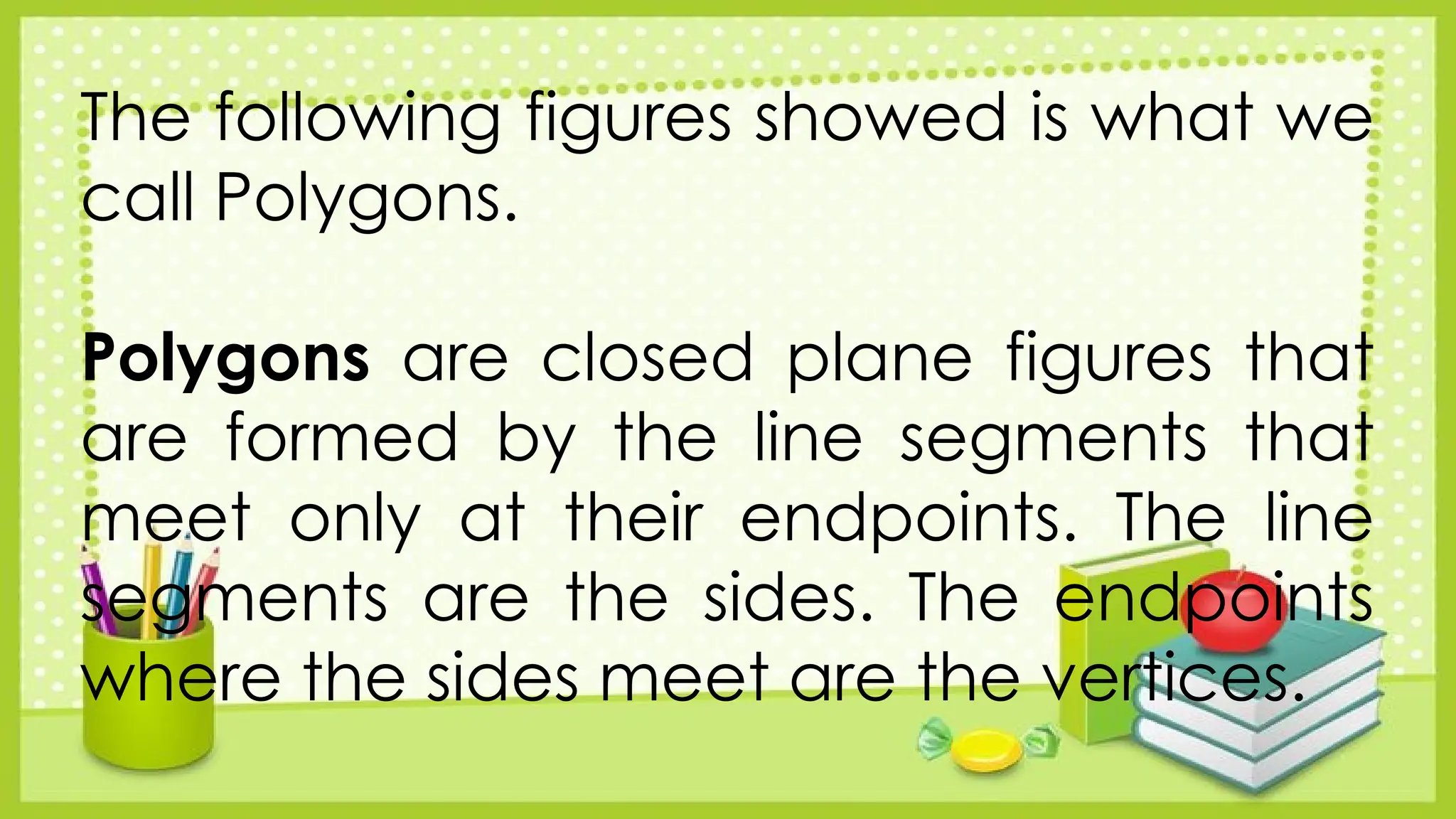
The following figures showed is what we
call Polygons.
Polygons are closed plane figures that
are formed by the line segments that
meet only at their endpoints. The line
segments are the sides. The endpoints
where the sides meet are the vertices.
Everyday, we encounter representations of
polygons in many different forms, colors and
sizes, even in the streets or inside our homes.
Thus, knowing and identifying shapes and
angles are not enough. It is also important to
master the skills in visualizing, naming and
describing polygons with 5 sides or more, so
that we can easily recognize them wherever
we go, in whatever form and shape they are
having.
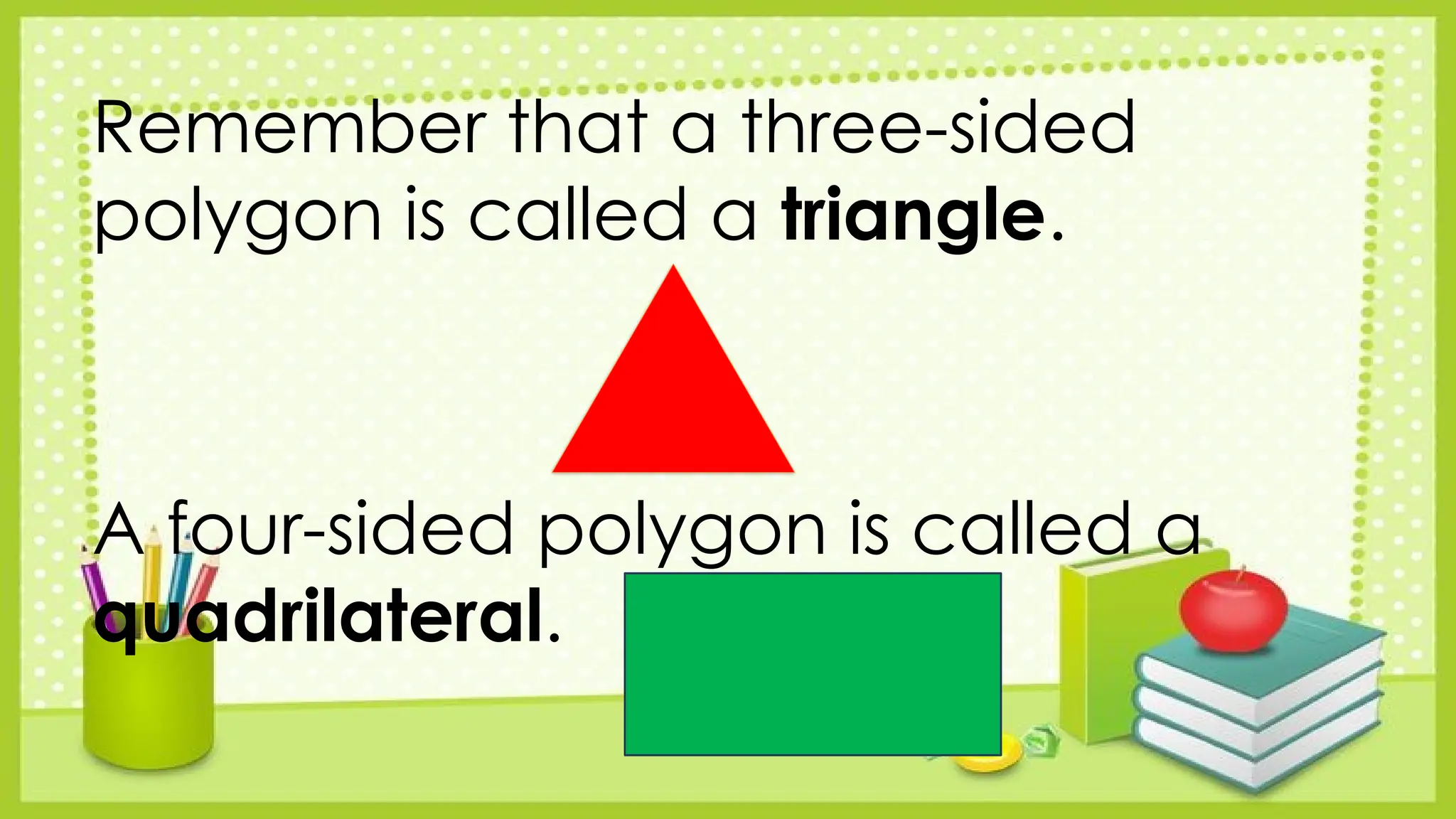
Remember that a three-sided
polygon is called a triangle.
A four-sided polygon is called a
quadrilateral.
A five-sided polygon is called
a pentagon.
A six-sided polygon is called a
hexagon.
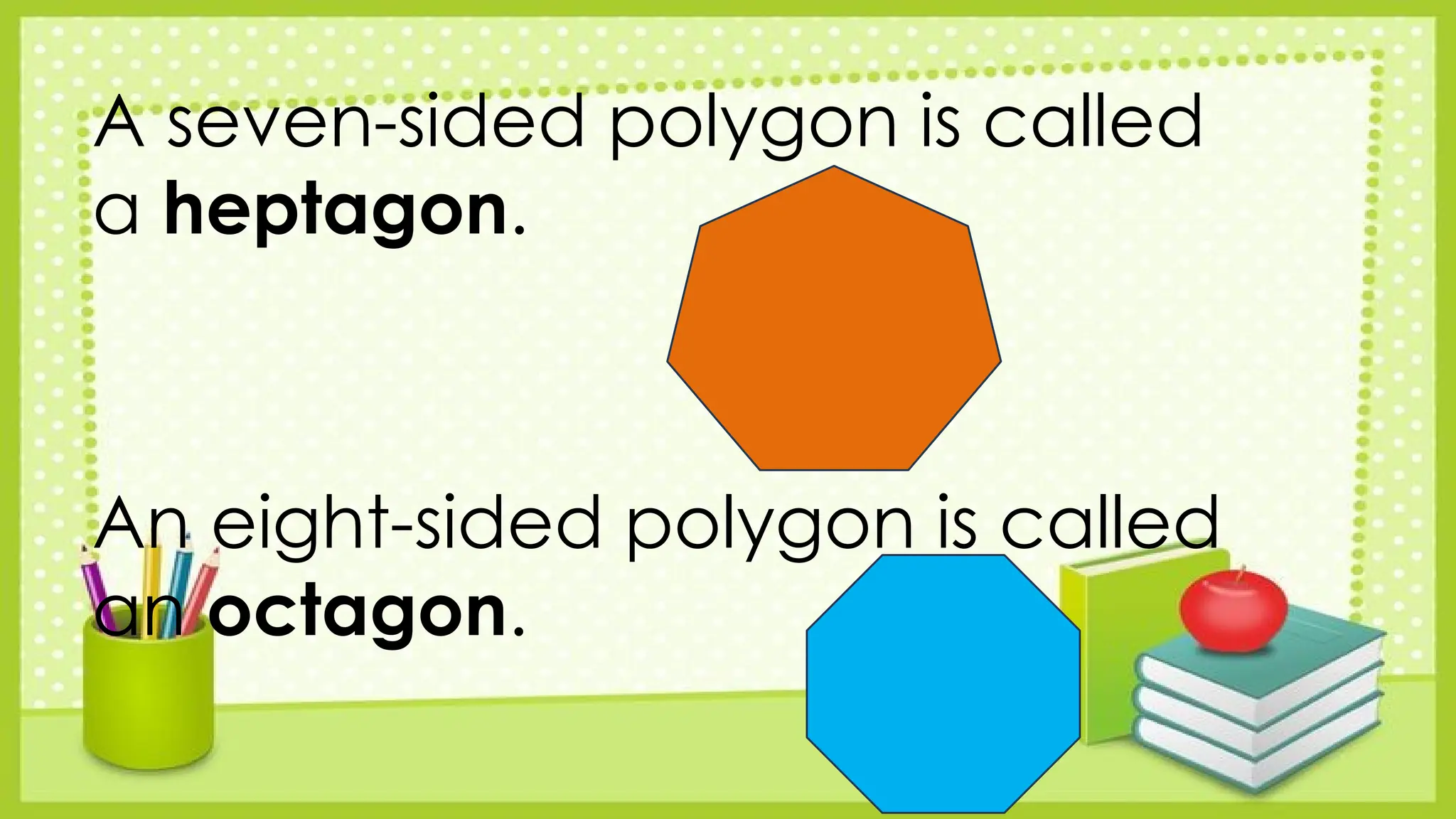
A seven-sided polygon is called
a heptagon.
An eight-sided polygon is called
an octagon.
A nine-sided polygon
is called a nonagon.
A ten-sided polygon
is called a decagon.
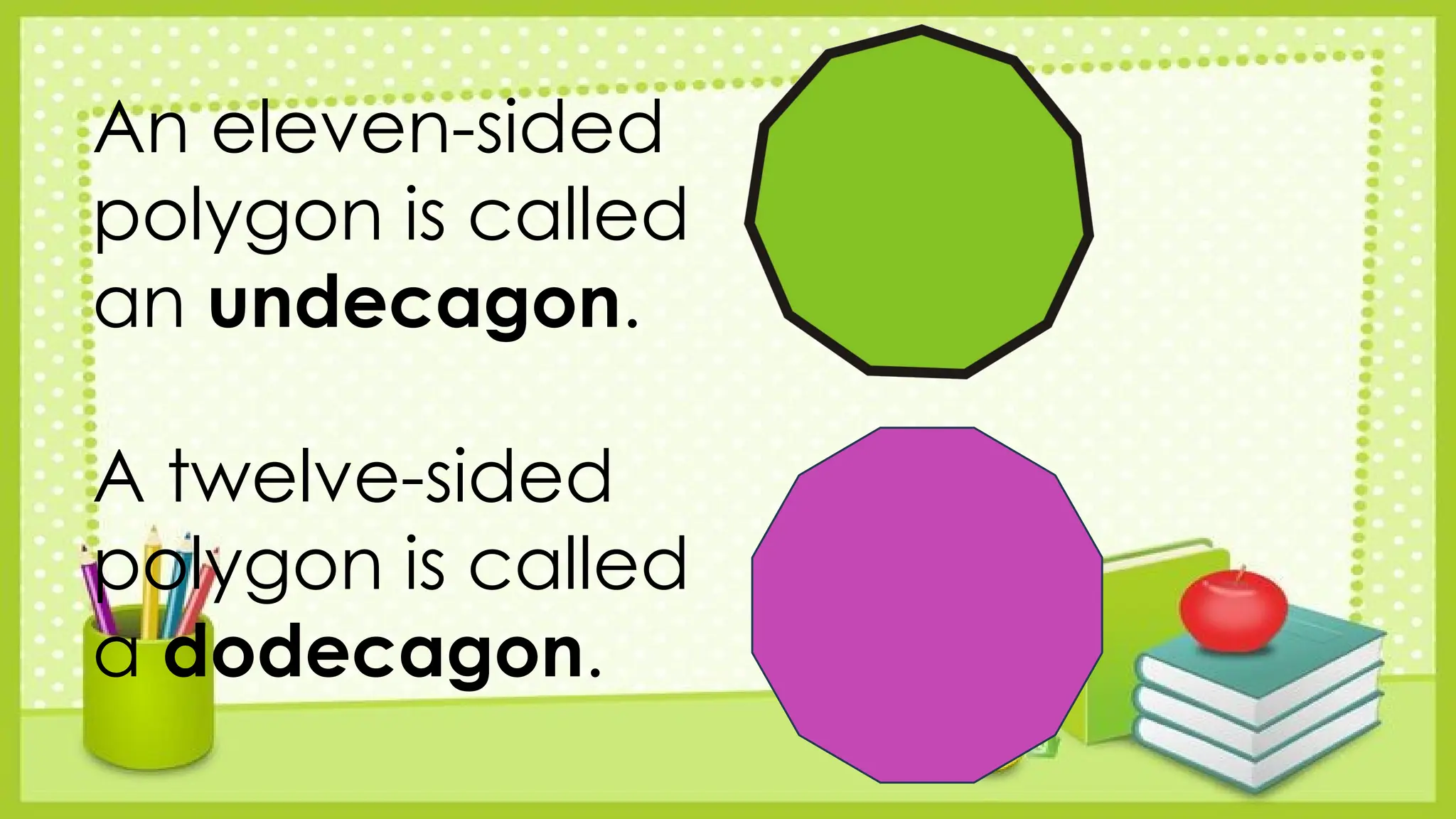
An eleven-sided
polygon is called
an undecagon.
A twelve-sided
polygon is called
a dodecagon.
An n-sided polygon
can be called
n-gon.
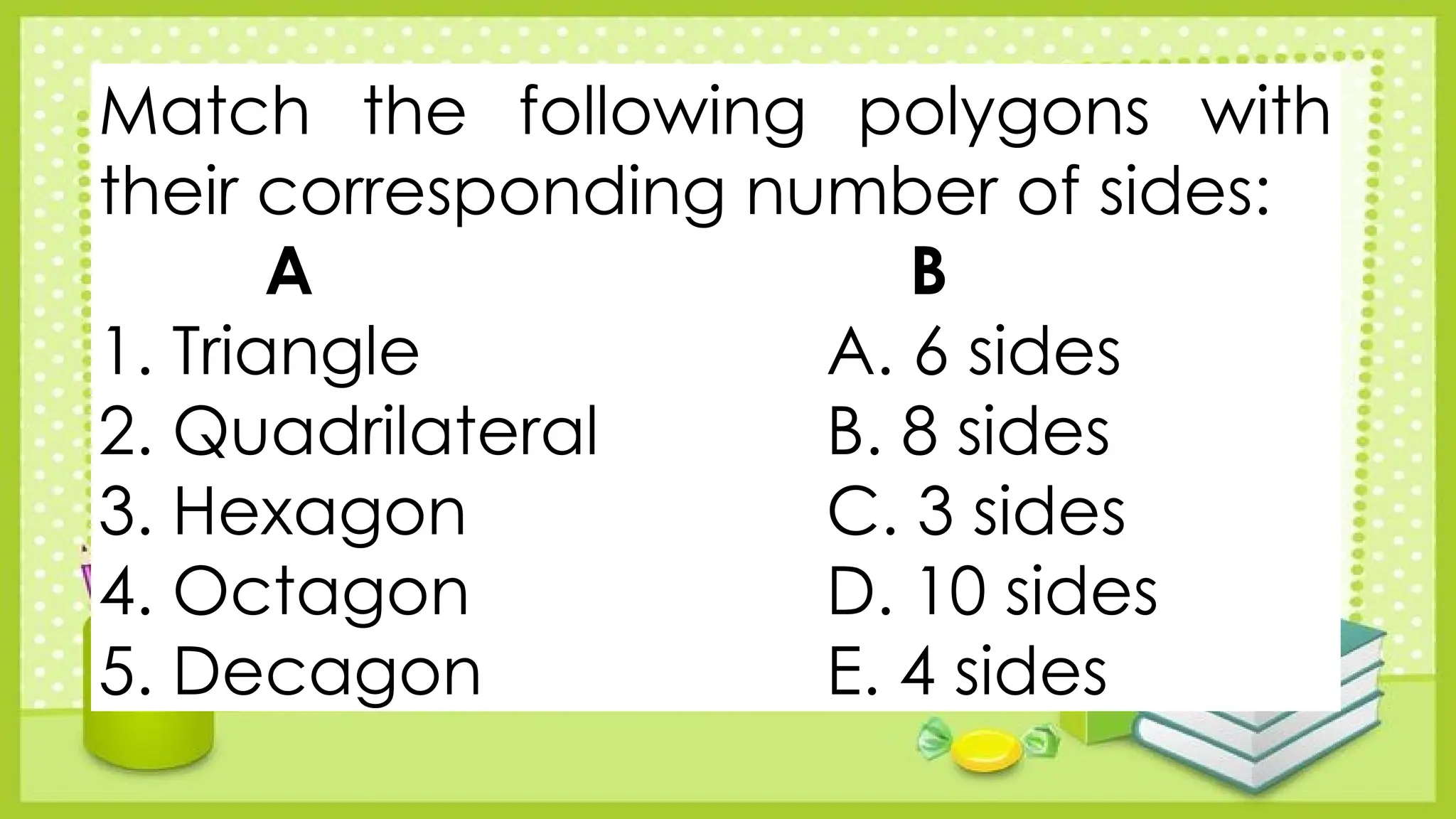
Match the following polygons with
their corresponding number of sides:
A B
1. Triangle A. 6 sides
2. Quadrilateral B. 8 sides
3. Hexagon C. 3 sides
4. Octagon D. 10 sides
5. Decagon E. 4 sides
Cite some
examples of an
objects that show
Polygons.
What are the different
types of polygons?
What is the meaning of
polygon?
Visualize the following polygons
though drawing.
1. undecagon
2. heptagon
3. nonagon
4. pentagon
5. quadrilateral
MATHEMATICS
QUARTER 3 WEEK 3
D
A
Y
2
Visualizing, Identifying
and Describing Polygons
with 5 or More Sides
Review:
Match the following polygons with
their corresponding number of sides:
A B
1. Triangle A. 6 sides
2. Quadrilateral B. 8 sides
3. Hexagon C. 3 sides
4. Octagon D. 10 sides
5. Decagon E. 4 sides
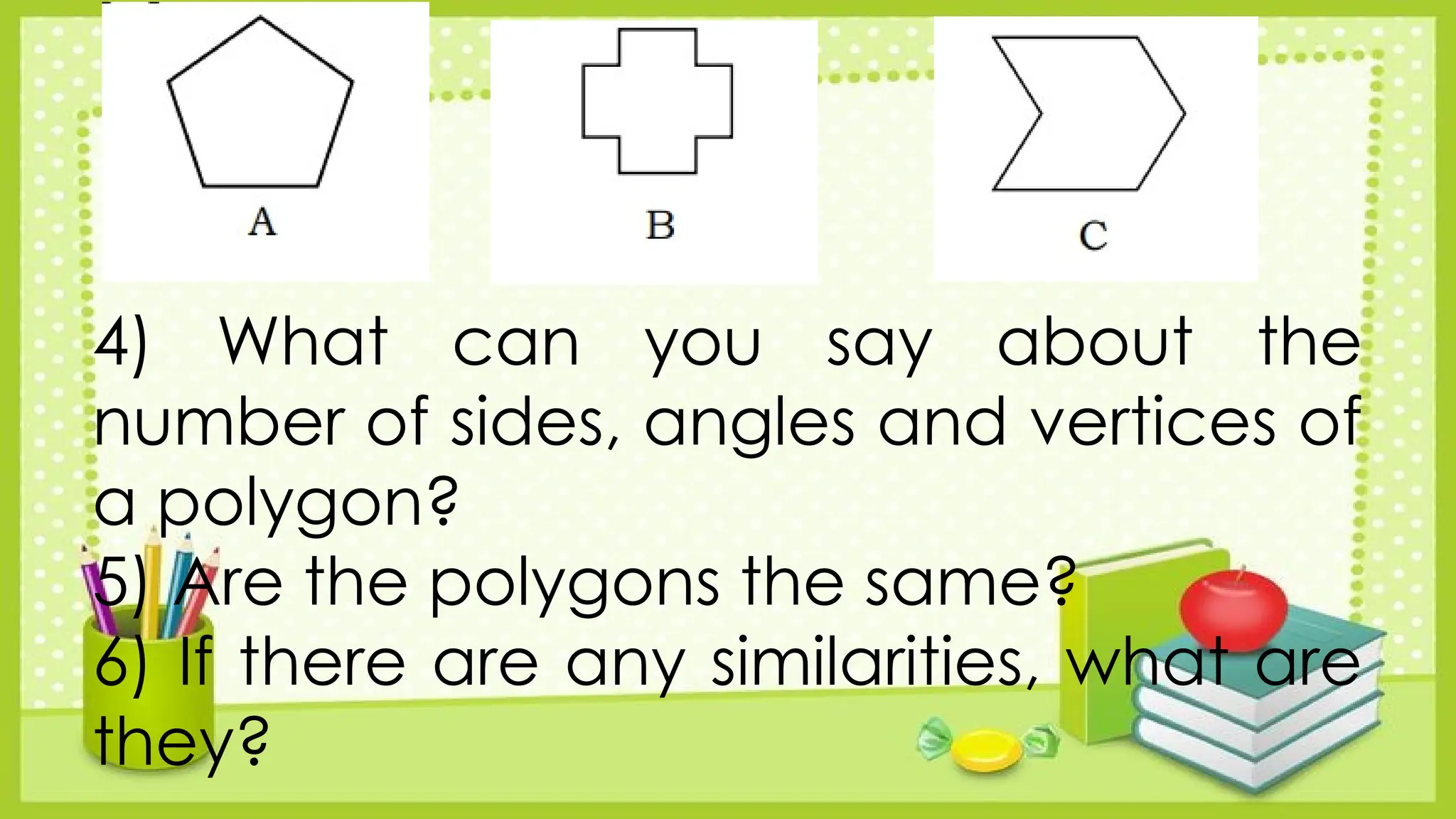
Let us consider the following polygons.
1) How many sides are there in each
polygon?
2) How many angles are there in each
polygon?
3) How many vertices are there in each
polygon?
4) What can you say about the
number of sides, angles and vertices of
a polygon?
5) Are the polygons the same?
6) If there are any similarities, what are
they?
7) If there are any differences, what
are they?
8) How are polygons identified?
9) In each polygon, how many sides
are there in each vertex?
10) Using your own words,
describe polygon.
Show Me Game!
Directions: The teacher will tell the name of
polygons and visualize it using your show me
board, or on the board.
1. Triangle
2. Quadrilateral
3. Pentagon
4. Heptagon
5. Octagon
6. Decagon
7. Nonagon
8. Undecagon
9. Dodecagon
10.Hexagon
Can You Recognize Me!
Directions: Name each polygon by
the number of its sides. Write your
answer on a separate sheet of
paper.
Describe the following polygons
according to the number of sides.
Write your answer on a separate sheet
of paper.
1. dodecagon
2. hexagon
3. decagon
4. nonagon
5. octagon
Look at the picture below;
Where can you
find the sign?
What type of
polygon?
What is the importance of following
the traffic sign?
Using your own
words, describe a
polygon.
Directions: On a separate sheet of paper, copy the table below.
Count the number of sides in each polygon. Name the polygon.
The first item is already answered for you as a guide.
MATHEMATICS
QUARTER 3 WEEK 3
D
A
Y
3
Describing and Comparing
Properties of Regular and
Irregular Polygons
Review:
Describe the following polygons according
to the number of sides.
1. dodecagon
2. hexagon
3. decagon
4. nonagon
5. octagon
Observe the following figures below;
What can you say
about the figures?
Can you consider those figures as
Polygons?
The following figures are non-polygons.
Can you tell, why?
Let’s Discuss it!
It is said that Polygons are identified
according to the number of sides that
they have.
And polygon is a closed plane figure
that is formed by the line segments that
meet only at their endpoints.
The following figures are examples of
polygons around us. Can you determine
what these are and where you typically see
them?
When working with
polygons the properties are
the number of sides of the
shape, the angles in the
shape, and the length of
the sides of the shape.
Observe the following sets of figures;
Can you see the difference
between the sets of figures?
The following are examples of regular
polygons;
A polygon which has all its
sides of equal length and
all its angles of equal
measures is called a
regular polygon.
The marks on the sides of the
polygons indicate equal length.
A polygon which sides are
not equal in length and all
its angles are not equal is
called a regular polygon.
Let’s Compare!
Compare the two figures
and tell whether regular or
irregular polygons
Which figure is regular
polygon?
Which is irregular polygon?
Know Me Well!
Write RP if ethe figure described regular
polygon and IP if irregular Polygon.
Give some examples of
objects that you always
use every day that shows
Irregular Polygons.
When can you say
that a polygon is
irregular and regular?
Directions: Read for each figure, count the
number of sides, name the polygon and describe
if it is regular or irregular.
MATHEMATICS
QUARTER 3 WEEK 3
D
A
Y
4
Visualizing Congruent
Polygons
Review:
Are the set of figures the same?
For Set A the figures are the
same while set B are not the
same.
For Mathematical Term we can
say it as Congruent or Not
congruent.
Always remember that the word
“congruent” is defined as
“identical in form; coinciding
exactly when superimposed.” The
origin of the word “congruent” is
from the Latin to “agree” or “to
meet together”.
Congruent polygons are
exactly the same size and
exactly the same shape. All
of their sides have the same
length and all of their angles
have the same measure.
Polygons are congruent if they
are equal in all respects: same
number of sides; all
corresponding sides have the
same length; and all
corresponding interior angles
have the same measure.
It is possible to turn, flip and/or slide one
figure so it will fit exactly on the other
figure.
The areas of congruent figures are equal.
The perimeters of congruent figures are
equal. The corresponding angles of
congruent figures are equal in measure.
The corresponding line segments of
congruent figures are equal in length.
Congruent Figures
 These are pairs of figures which have
exactly the same size and shape.
 These figures have equal measures
for all the sides and angles.
Congruent Polygons
 Two polygons are congruent
if their corresponding sides
and angles are congruent.
Identify whether the following are
congruent polygons or not.
The two triangles have equal
measures of angles. However,
notice that the measures of their
sides are not equal. This means
that the two triangles are not
congruent.
Identify whether the following are
congruent polygons or not.
The tick marks indicate that
the corresponding sides of the
two triangles are congruent.
The second triangle is just a
rotated version of the first
triangle. Therefore, the
triangles are congruent.
Find My Pair!
Directions: Identify the figures that appear to
be congruent. Write your answer on a
separate sheet of paper.
On a sheet of paper, draw
a congruent polygon that
you can see on your
surroundings.
When can you say
that polygons are
congruent?
Directions: Choose the figure that is likely
to be congruent to the given figure. Write
your answer on a separate sheet of paper.
MATHEMATICS
QUARTER 3 WEEK 3
D
A
Y
5
Catch-Up Friday

MATHEMATICS 5 Quarter 3 Week 3 The Official

  • 1.
    MATHEMATICS QUARTER 3 WEEK3 D A Y 1 Visualizing, Identifying and Describing Polygons with 5 or More Sides
  • 2.
    Review: Answers: 1. The baseis 6,000 2. The rate is 10% 3. The percentage is 600.
  • 3.
    Look at thedifferent FIGURES and name what FIGURE it is:
  • 4.
    What did youobserved to those shapes being presented? Open or closed figures? Close figures.
  • 5.
    The following figuresshowed is what we call Polygons. Polygons are closed plane figures that are formed by the line segments that meet only at their endpoints. The line segments are the sides. The endpoints where the sides meet are the vertices.
  • 7.
    Everyday, we encounterrepresentations of polygons in many different forms, colors and sizes, even in the streets or inside our homes. Thus, knowing and identifying shapes and angles are not enough. It is also important to master the skills in visualizing, naming and describing polygons with 5 sides or more, so that we can easily recognize them wherever we go, in whatever form and shape they are having.
  • 8.
    Remember that athree-sided polygon is called a triangle. A four-sided polygon is called a quadrilateral.
  • 9.
    A five-sided polygonis called a pentagon. A six-sided polygon is called a hexagon.
  • 10.
    A seven-sided polygonis called a heptagon. An eight-sided polygon is called an octagon.
  • 11.
    A nine-sided polygon iscalled a nonagon. A ten-sided polygon is called a decagon.
  • 12.
    An eleven-sided polygon iscalled an undecagon. A twelve-sided polygon is called a dodecagon.
  • 13.
    An n-sided polygon canbe called n-gon.
  • 14.
    Match the followingpolygons with their corresponding number of sides: A B 1. Triangle A. 6 sides 2. Quadrilateral B. 8 sides 3. Hexagon C. 3 sides 4. Octagon D. 10 sides 5. Decagon E. 4 sides
  • 15.
    Cite some examples ofan objects that show Polygons.
  • 16.
    What are thedifferent types of polygons? What is the meaning of polygon?
  • 17.
    Visualize the followingpolygons though drawing. 1. undecagon 2. heptagon 3. nonagon 4. pentagon 5. quadrilateral
  • 18.
    MATHEMATICS QUARTER 3 WEEK3 D A Y 2 Visualizing, Identifying and Describing Polygons with 5 or More Sides
  • 19.
    Review: Match the followingpolygons with their corresponding number of sides: A B 1. Triangle A. 6 sides 2. Quadrilateral B. 8 sides 3. Hexagon C. 3 sides 4. Octagon D. 10 sides 5. Decagon E. 4 sides
  • 20.
    Let us considerthe following polygons.
  • 21.
    1) How manysides are there in each polygon? 2) How many angles are there in each polygon? 3) How many vertices are there in each polygon?
  • 22.
    4) What canyou say about the number of sides, angles and vertices of a polygon? 5) Are the polygons the same? 6) If there are any similarities, what are they?
  • 23.
    7) If thereare any differences, what are they? 8) How are polygons identified? 9) In each polygon, how many sides are there in each vertex?
  • 24.
    10) Using yourown words, describe polygon.
  • 25.
    Show Me Game! Directions:The teacher will tell the name of polygons and visualize it using your show me board, or on the board. 1. Triangle 2. Quadrilateral 3. Pentagon 4. Heptagon 5. Octagon 6. Decagon 7. Nonagon 8. Undecagon 9. Dodecagon 10.Hexagon
  • 26.
    Can You RecognizeMe! Directions: Name each polygon by the number of its sides. Write your answer on a separate sheet of paper.
  • 28.
    Describe the followingpolygons according to the number of sides. Write your answer on a separate sheet of paper. 1. dodecagon 2. hexagon 3. decagon 4. nonagon 5. octagon
  • 29.
    Look at thepicture below; Where can you find the sign? What type of polygon? What is the importance of following the traffic sign?
  • 30.
    Using your own words,describe a polygon.
  • 31.
    Directions: On aseparate sheet of paper, copy the table below. Count the number of sides in each polygon. Name the polygon. The first item is already answered for you as a guide.
  • 33.
    MATHEMATICS QUARTER 3 WEEK3 D A Y 3 Describing and Comparing Properties of Regular and Irregular Polygons
  • 34.
    Review: Describe the followingpolygons according to the number of sides. 1. dodecagon 2. hexagon 3. decagon 4. nonagon 5. octagon
  • 35.
    Observe the followingfigures below; What can you say about the figures?
  • 36.
    Can you considerthose figures as Polygons? The following figures are non-polygons. Can you tell, why? Let’s Discuss it!
  • 37.
    It is saidthat Polygons are identified according to the number of sides that they have. And polygon is a closed plane figure that is formed by the line segments that meet only at their endpoints.
  • 38.
    The following figuresare examples of polygons around us. Can you determine what these are and where you typically see them?
  • 39.
    When working with polygonsthe properties are the number of sides of the shape, the angles in the shape, and the length of the sides of the shape.
  • 40.
    Observe the followingsets of figures;
  • 41.
    Can you seethe difference between the sets of figures?
  • 42.
    The following areexamples of regular polygons;
  • 43.
    A polygon whichhas all its sides of equal length and all its angles of equal measures is called a regular polygon.
  • 44.
    The marks onthe sides of the polygons indicate equal length.
  • 47.
    A polygon whichsides are not equal in length and all its angles are not equal is called a regular polygon.
  • 48.
    Let’s Compare! Compare thetwo figures and tell whether regular or irregular polygons
  • 49.
    Which figure isregular polygon? Which is irregular polygon?
  • 50.
    Know Me Well! WriteRP if ethe figure described regular polygon and IP if irregular Polygon.
  • 51.
    Give some examplesof objects that you always use every day that shows Irregular Polygons.
  • 52.
    When can yousay that a polygon is irregular and regular?
  • 53.
    Directions: Read foreach figure, count the number of sides, name the polygon and describe if it is regular or irregular.
  • 55.
    MATHEMATICS QUARTER 3 WEEK3 D A Y 4 Visualizing Congruent Polygons
  • 56.
  • 57.
    Are the setof figures the same?
  • 58.
    For Set Athe figures are the same while set B are not the same. For Mathematical Term we can say it as Congruent or Not congruent.
  • 59.
    Always remember thatthe word “congruent” is defined as “identical in form; coinciding exactly when superimposed.” The origin of the word “congruent” is from the Latin to “agree” or “to meet together”.
  • 60.
    Congruent polygons are exactlythe same size and exactly the same shape. All of their sides have the same length and all of their angles have the same measure.
  • 62.
    Polygons are congruentif they are equal in all respects: same number of sides; all corresponding sides have the same length; and all corresponding interior angles have the same measure.
  • 63.
    It is possibleto turn, flip and/or slide one figure so it will fit exactly on the other figure. The areas of congruent figures are equal. The perimeters of congruent figures are equal. The corresponding angles of congruent figures are equal in measure.
  • 64.
    The corresponding linesegments of congruent figures are equal in length. Congruent Figures  These are pairs of figures which have exactly the same size and shape.  These figures have equal measures for all the sides and angles.
  • 65.
    Congruent Polygons  Twopolygons are congruent if their corresponding sides and angles are congruent.
  • 66.
    Identify whether thefollowing are congruent polygons or not.
  • 67.
    The two triangleshave equal measures of angles. However, notice that the measures of their sides are not equal. This means that the two triangles are not congruent.
  • 68.
    Identify whether thefollowing are congruent polygons or not.
  • 69.
    The tick marksindicate that the corresponding sides of the two triangles are congruent. The second triangle is just a rotated version of the first triangle. Therefore, the triangles are congruent.
  • 70.
    Find My Pair! Directions:Identify the figures that appear to be congruent. Write your answer on a separate sheet of paper.
  • 72.
    On a sheetof paper, draw a congruent polygon that you can see on your surroundings.
  • 73.
    When can yousay that polygons are congruent?
  • 74.
    Directions: Choose thefigure that is likely to be congruent to the given figure. Write your answer on a separate sheet of paper.
  • 76.
    MATHEMATICS QUARTER 3 WEEK3 D A Y 5 Catch-Up Friday