
The Strange World of Quantum MechanicsDESIGNED BY CHARLES HENDERSON 2004
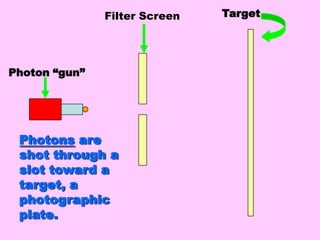
TargetFilter ScreenPhoton “gun”Photons are shot through a slot toward a target, a photographic plate.
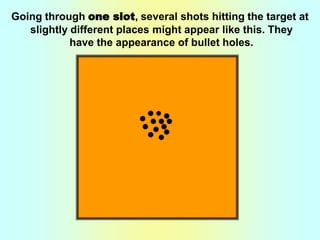
Going through one slot, several shots hitting the target at slightly different places might appear like this. Theyhave the appearance of bullet holes.
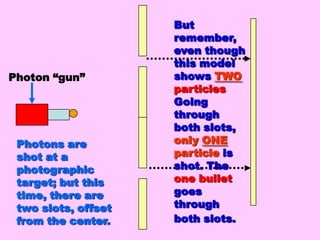
But remember,even thoughthis model shows TWOparticlesGoingthroughboth slots,only ONEparticle isshot. Theone bulletgoesthroughboth slots.Photon “gun”Photons are shot at a photographic target; but this time, there are two slots, offset from the center.
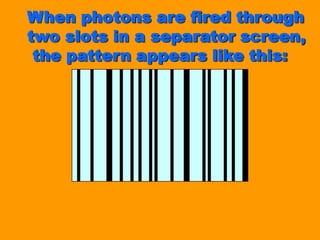
When photons are fired through two slots in a separator screen, the pattern appears like this:
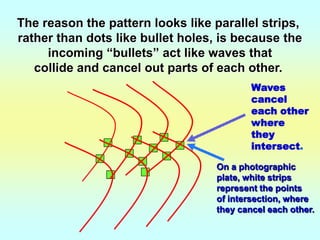
The reason the pattern looks like parallel strips, rather than dots like bullet holes, is because the incoming “bullets” act like waves thatcollide and cancel out parts of each other.Waves cancel each other where they intersect.On a photographicplate, white strips represent the pointsof intersection, where they cancel each other.
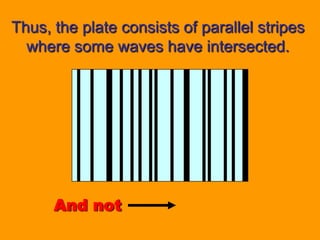
Thus, the plate consists of parallel stripeswhere some waves have intersected.And not
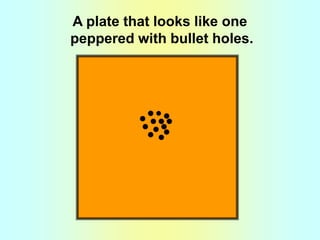
A plate that looks like one peppered with bullet holes.
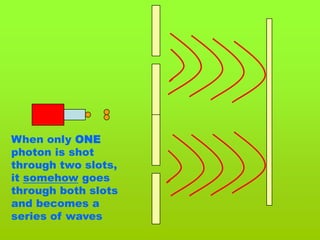
When only ONE photon is shot through two slots, it somehow goes through both slots and becomes a series of waves
Could it be that the particle is not a ball from the outset  but a WAVE from the start?If so, why does it ACT as though it is a ball when there is only ONE slot?
The next slide demonstrateshow it might look if “particles”are really only waves.
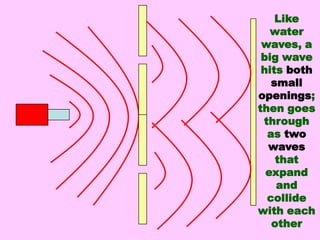
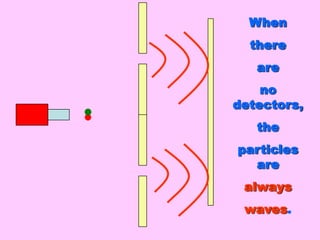
Like water waves, a big wave hits both small openings; then goes through as two waves that expand and collide with each other
What has happened? Does the original particle “KNOW” that there are two slots and separates into two particles in order to go through both slots?If so how does the particle “ KNOW ”there are two slots?
When we consider what a particlecan KNOW in the quantum world thingsget even stranger.Suppose we wanted to know WHICH particle went through a given slot?For example, suppose one particle is green, the other red, and we decide to observe a slot to see which color shows up.In a quantum experiment, we would haveto check, for example, for a green particle at one slot. If it turns out that the particle isNOT GREEN, we could infer that it has to be RED.
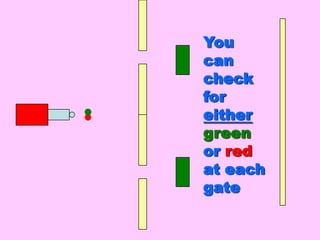
You can check for eithergreen or red at each gate
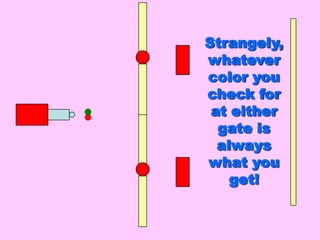
Strangely, whatever color you check for at either gate is always what you get!
Somehow, it seems that the particles (or whatever is behind them) always“know” what color is being checkedfor at any time and always show the observer what they are looking for!Scientists have never been able to “fool”the particles by setting up any type of examination. The particles always knowBEFORE the experiments are set up what the scientists will be checking for!
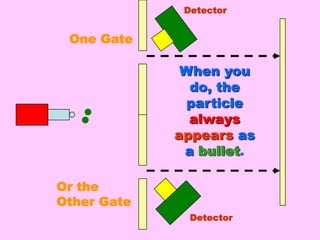
But it gets crazier!Suppose you set up a detector to see WHICH SLOTthe particle goesthrough?
DetectorOne GateWhen you do, the particle always appears as    a bullet.Or theOther GateDetector
When thereareno detectors,theparticles are alwayswaves.
The sub-atomic world is much moredifferent than the macro world we see about us. How can particles exist in both a packet and a wave form?It could be that the smallest units of the universe exist in some form that we cannot, at present, understand or have never seen.What we do know about the atomic structure  is that matter doesn’t really look like the model we use, that of the solar system with a central core (the sun) and planets circling it.
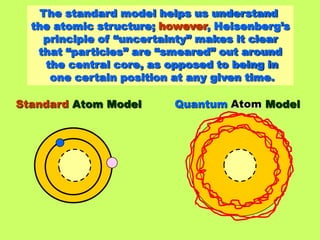
The standard model helps us understand the atomic structure; however, Heisenberg’s principle of “uncertainty” makes it clear that “particles” are “smeared” out around the central core, as opposed to being in one certain position at any given time.Standard Atom ModelQuantum Atom Model
We can then conclude that the individual units that make up the material of the universe exist simultaneously as both particles, like tiny balls, and waves.
The basic idea behind quantum mechanics is that nothing is absolute in the universe, every event is a “probability.”Nothing is really known until someone observes an event.Everything is a PROBABILITY WAVE in which anythingis possible before it happens or is observed.When an event is observed, it is no longer a probability. In physics terms, the probability wave “collapsesinto reality. At that point it is a certainty.Only when an event is observed by a person does the “probability” collapse into reality.The entire universe, then, is an unfolding, a revelation ofwhat “could” be possible into what actually is.To the quantum mechanics physicist, we live in an“all possible universes” existence.
The macro-universe, which is comprised of the elements of the micro-world, is a strange place indeed.What quantum mechanics brings to our understanding of the physical laws of the universeis that they operate differently when dealing withsub-atomic particles; also, those laws often seemto be contradicted.The strangest concept to understand is that sub-atomic elements, whether particle or wave,seem to:Know what we want to do with them before weperform any operations on themThey can convey information to each “other” atspeeds faster than light, a condition Einsteinsays is impossible.
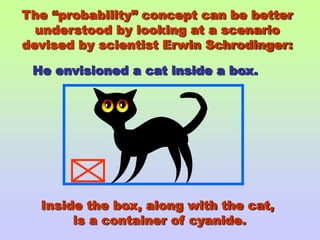
The “probability” concept can be better understood by looking at a scenario devised by scientist Erwin Schrodinger:He envisioned a cat inside a box.Inside the box, along with the cat, is a container of cyanide.
A random hit by a gamma ray from space may hit the containerand activate a release mechanism.If that happens, the cat will be killed.Looking at the box from the outside,one cannot tell whether a gammaray has hit the container.Therefore, the cat is eitherdead or alive.
The “probability” exists that one orthe other of the cases is true.Only by opening the box, can youdetermine what hashappened.When the box is opened, there isno longer a “probability” that the cat is either dead or alive.Mere “probability” collapses into a reality of what has or has not happened.
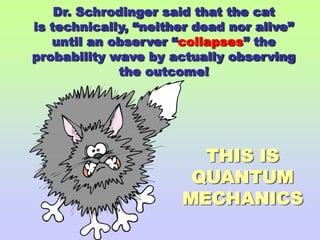
Dr. Schrodinger said that the catis technically, “neither dead nor alive”until an observer “collapses” theprobability wave by actually observingthe outcome!THIS ISQUANTUMMECHANICS
This has been a summary of the weird, weird ways ofQuantum MechanicsPhoto by Charles HendersonBy Charles Henderson2005Missouri

Quantum Experiments

  • 1.
    The Strange Worldof Quantum MechanicsDESIGNED BY CHARLES HENDERSON 2004
  • 2.
    TargetFilter ScreenPhoton “gun”Photonsare shot through a slot toward a target, a photographic plate.
  • 3.
    Going through oneslot, several shots hitting the target at slightly different places might appear like this. Theyhave the appearance of bullet holes.
  • 4.
    But remember,even thoughthismodel shows TWOparticlesGoingthroughboth slots,only ONEparticle isshot. Theone bulletgoesthroughboth slots.Photon “gun”Photons are shot at a photographic target; but this time, there are two slots, offset from the center.
  • 5.
    When photons arefired through two slots in a separator screen, the pattern appears like this:
  • 6.
    The reason thepattern looks like parallel strips, rather than dots like bullet holes, is because the incoming “bullets” act like waves thatcollide and cancel out parts of each other.Waves cancel each other where they intersect.On a photographicplate, white strips represent the pointsof intersection, where they cancel each other.
  • 7.
    Thus, the plateconsists of parallel stripeswhere some waves have intersected.And not
  • 8.
    A plate thatlooks like one peppered with bullet holes.
  • 9.
    When only ONEphoton is shot through two slots, it somehow goes through both slots and becomes a series of waves
  • 10.
    Could it bethat the particle is not a ball from the outset but a WAVE from the start?If so, why does it ACT as though it is a ball when there is only ONE slot?
  • 11.
    The next slidedemonstrateshow it might look if “particles”are really only waves.
  • 12.
    Like water waves,a big wave hits both small openings; then goes through as two waves that expand and collide with each other
  • 13.
    What has happened?Does the original particle “KNOW” that there are two slots and separates into two particles in order to go through both slots?If so how does the particle “ KNOW ”there are two slots?
  • 14.
    When we considerwhat a particlecan KNOW in the quantum world thingsget even stranger.Suppose we wanted to know WHICH particle went through a given slot?For example, suppose one particle is green, the other red, and we decide to observe a slot to see which color shows up.In a quantum experiment, we would haveto check, for example, for a green particle at one slot. If it turns out that the particle isNOT GREEN, we could infer that it has to be RED.
  • 15.
    You can checkfor eithergreen or red at each gate
  • 16.
    Strangely, whatever coloryou check for at either gate is always what you get!
  • 17.
    Somehow, it seemsthat the particles (or whatever is behind them) always“know” what color is being checkedfor at any time and always show the observer what they are looking for!Scientists have never been able to “fool”the particles by setting up any type of examination. The particles always knowBEFORE the experiments are set up what the scientists will be checking for!
  • 18.
    But it getscrazier!Suppose you set up a detector to see WHICH SLOTthe particle goesthrough?
  • 19.
    DetectorOne GateWhen youdo, the particle always appears as a bullet.Or theOther GateDetector
  • 20.
  • 21.
    The sub-atomic worldis much moredifferent than the macro world we see about us. How can particles exist in both a packet and a wave form?It could be that the smallest units of the universe exist in some form that we cannot, at present, understand or have never seen.What we do know about the atomic structure is that matter doesn’t really look like the model we use, that of the solar system with a central core (the sun) and planets circling it.
  • 22.
    The standard modelhelps us understand the atomic structure; however, Heisenberg’s principle of “uncertainty” makes it clear that “particles” are “smeared” out around the central core, as opposed to being in one certain position at any given time.Standard Atom ModelQuantum Atom Model
  • 23.
    We can thenconclude that the individual units that make up the material of the universe exist simultaneously as both particles, like tiny balls, and waves.
  • 24.
    The basic ideabehind quantum mechanics is that nothing is absolute in the universe, every event is a “probability.”Nothing is really known until someone observes an event.Everything is a PROBABILITY WAVE in which anythingis possible before it happens or is observed.When an event is observed, it is no longer a probability. In physics terms, the probability wave “collapsesinto reality. At that point it is a certainty.Only when an event is observed by a person does the “probability” collapse into reality.The entire universe, then, is an unfolding, a revelation ofwhat “could” be possible into what actually is.To the quantum mechanics physicist, we live in an“all possible universes” existence.
  • 25.
    The macro-universe, whichis comprised of the elements of the micro-world, is a strange place indeed.What quantum mechanics brings to our understanding of the physical laws of the universeis that they operate differently when dealing withsub-atomic particles; also, those laws often seemto be contradicted.The strangest concept to understand is that sub-atomic elements, whether particle or wave,seem to:Know what we want to do with them before weperform any operations on themThey can convey information to each “other” atspeeds faster than light, a condition Einsteinsays is impossible.
  • 26.
    The “probability” conceptcan be better understood by looking at a scenario devised by scientist Erwin Schrodinger:He envisioned a cat inside a box.Inside the box, along with the cat, is a container of cyanide.
  • 27.
    A random hitby a gamma ray from space may hit the containerand activate a release mechanism.If that happens, the cat will be killed.Looking at the box from the outside,one cannot tell whether a gammaray has hit the container.Therefore, the cat is eitherdead or alive.
  • 28.
    The “probability” existsthat one orthe other of the cases is true.Only by opening the box, can youdetermine what hashappened.When the box is opened, there isno longer a “probability” that the cat is either dead or alive.Mere “probability” collapses into a reality of what has or has not happened.
  • 29.
    Dr. Schrodinger saidthat the catis technically, “neither dead nor alive”until an observer “collapses” theprobability wave by actually observingthe outcome!THIS ISQUANTUMMECHANICS
  • 30.
    This has beena summary of the weird, weird ways ofQuantum MechanicsPhoto by Charles HendersonBy Charles Henderson2005Missouri