Quantile Based Reliability Analysis 1st Edition N. Unnikrishnan Nair
Quantile Based Reliability Analysis 1st Edition N. Unnikrishnan Nair
Quantile Based Reliability Analysis 1st Edition N. Unnikrishnan Nair
Quantile Based Reliability Analysis 1st Edition N. Unnikrishnan Nair
Quantile Based Reliability Analysis 1st Edition N. Unnikrishnan Nair
1.
Quantile Based ReliabilityAnalysis 1st Edition
N. Unnikrishnan Nair pdf download
https://ebookgate.com/product/quantile-based-reliability-
analysis-1st-edition-n-unnikrishnan-nair/
Get Instant Ebook Downloads – Browse at https://ebookgate.com
2.
Get Your DigitalFiles Instantly: PDF, ePub, MOBI and More
Quick Digital Downloads: PDF, ePub, MOBI and Other Formats
Advances in Reliability 1st Edition N. Balakrishnan
https://ebookgate.com/product/advances-in-reliability-1st-
edition-n-balakrishnan/
Safety Reliability and Risk Analysis Theory Methods and
Applications 3rd Edition 4 Volumes Sebastián Martorell
https://ebookgate.com/product/safety-reliability-and-risk-
analysis-theory-methods-and-applications-3rd-edition-4-volumes-
sebastian-martorell/
Safety Reliability and Risk Analysis Beyond the Horizon
R.D.J.M. Steenbergen
https://ebookgate.com/product/safety-reliability-and-risk-
analysis-beyond-the-horizon-r-d-j-m-steenbergen/
Quantile Regression Theory and Applications 1st Edition
Cristina Davino
https://ebookgate.com/product/quantile-regression-theory-and-
applications-1st-edition-cristina-davino/
3.
Vascular Biology Protocols1st Edition Nair Sreejayan
https://ebookgate.com/product/vascular-biology-protocols-1st-
edition-nair-sreejayan/
Advances in Survival Analysis N. Balakrishnan
https://ebookgate.com/product/advances-in-survival-analysis-n-
balakrishnan/
World Clinics Diabetology Type 2 Diabetes Mellitus 1st
Edition Ranjit Unnikrishnan
https://ebookgate.com/product/world-clinics-diabetology-
type-2-diabetes-mellitus-1st-edition-ranjit-unnikrishnan/
Computer Ethics A Case based Approach 1st Edition
Robert N. Barger
https://ebookgate.com/product/computer-ethics-a-case-based-
approach-1st-edition-robert-n-barger/
Evidence based Management of Lipid Disorders 1st
Edition Maud N. Vissers
https://ebookgate.com/product/evidence-based-management-of-lipid-
disorders-1st-edition-maud-n-vissers/
4.
Statistics for Industryand Technology
Quantile-
Based
Reliability
Analysis
N. Unnikrishnan Nair
P.G. Sankaran
N. Balakrishnan
6.
Statistics for Industryand Technology
Series Editor
N. Balakrishnan
McMaster University
Hamilton, ON
Canada
Editorial Advisory Board
Max Engelhardt
EG&G Idaho, Inc.
Idaho Falls, ID, USA
Harry F. Martz
Los Alamos National Laboratory
Los Alamos, NM, USA
Gary C. McDonald
NAO Research & Development Center
Warren, MI, USA
Kazuyuki Suzuki
University of Electro Communications
Chofu-shi, Tokyo
Japan
For further volumes:
http://www.springer.com/series/4982
7.
N. Unnikrishnan Nair• P.G. Sankaran
N. Balakrishnan
Quantile-Based Reliability
Analysis
To Jamuna, Anoopand Arun
NUN
To Sandhya, Revathi and Nandana
PGS
To Julia, Sarah and Colleen
NB
11.
Foreword
Quantile functions area fundamental, and often the most natural, way of rep-
resenting probability distributions and data samples. In much of environmental
science, finance, and risk management, there is a need to know the event magnitude
corresponding to a given return period or exceedance probability, and the quantile
function provides the most direct expression of the solution. The book Statistical
Modelling with Quantile Functions by Warren Gilchrist provides an extensive
survey of quantile-based methods of inference for complete distributions.
Reliability analysis is another field in which quantile-based methods are partic-
ularly useful. In many applications one must deal with censored data and truncated
distributions, and concepts such as hazard rate and residual life become important.
Quantile-based methods need some extensions to deal with these issues, and the
present book goes beyond Prof. Gilchrist’s and provides a thorough grounding in
the relevant theory and practical methods for reliability analysis.
I have been fortunate in having been able for over 20 years to develop a theory
of L-moments, statistics that are simple and effective inferences about probability
distributions. Although not restricted to quantile-based inference, L-moments lend
themselves well to quantile methods since many of the key results regarding
L-moments are most conveniently expressed in terms of the quantile function.
As with quantile methods generally, an L-moment-based approach to reliability
analysis has not been developed in detail. In this book the authors have made
significant progress, and in particular the development of L-moment methods for
residual life analysis is a major step forward. I congratulate the authors on their
achievements, and I invite the readers of this book to enjoy a survey of material that
is rich in both theoretical depth and practical utility.
Yorktown Heights, NY J.R.M. Hosking
vii
13.
Preface
Reliability theory hastaken rapid strides in the last four decades to become
an independent discipline that influences our daily lives and schedules through
our dependence on good and reliable functioning of devices and systems that
we constantly use. The extensive literature on reliability theory, along with its
applications, is scattered over various disciplines including statistics, engineering,
applied probability, demography, economics, medicine, survival analysis, insurance
and public policy. Life distributions specified by their distribution functions and
various concepts and characteristics derived from it occupy a big portion of
reliability analysis. Although quantile functions also represent life distributions and
would facilitate one to carry out all the principal functions enjoyed by distribution
functions in the existing theory and practice, this feature is neither fully appreciated
nor exploited. The objective of this book is to attempt a systematic study of various
aspects of reliability analysis with the aid of quantile functions, so as to provide
alternative methodologies, new models and inferential results that are sometimes
difficult to accomplish through the conventional approach.
Due to the stated objective, the material presented in this book is loaded with a
quantile flavour. However, all through the discussion, we first present a concept or
methodology in terms of the conventional approach and only introduce the quantile-
based counterpart. This will enable the reader to transfer the methodology from one
form to the other and to choose the one that fits his/her taste and need. Being an
introductory text in quantile-based reliability methods, there is scope for further
improvements and extensions of the results discussed here.
The book is biased towards the mathematical theory, with examples intended to
clarify various notions and applications to real data being limited to demonstrate the
utility of quantile functions. For those with interest in practical aspects of quantile-
based model building, relevant tools and descriptive data analysis, the book by
Gilchrist would provide a valuable guidance.
This book is organized into nine chapters. Chapter 1 deals with the definition,
properties and various descriptive measures based on the quantile functions. Various
reliability concepts like hazard rate, and mean residual life, in the conventional form
as well as their quantile equivalents, are discussed in Chap. 2. This is followed, in
Chap. 3, by a detailed presentation of the distributional and reliability aspects of
ix
14.
x Preface
quantile functionmodels along with some applications to real data. Different ageing
concepts in quantile versions are described in Chap. 4. Total time on test transforms,
an essentially quantile-based notion, is detailed in Chap.5. As alternatives to the
conventional moments, the L-moments and partial moments in relation to residual
life are presented. In Chap. 6, the definitions, properties and characterizations of
these concepts are explained along with their use in inferential methods. Bathtub
hazard models are considered in Chap. 7 along with their quantile counterparts and
some new quantile functions that exhibit nonmonotone hazard quantile functions.
The definitions and properties of various stochastic orders encountered in reliability
theory are described in Chap. 8. Finally, Chap. 9 deals with various methods of
estimation and modelling problems. A more detailed account of the contents of
each chapter is provided in the Abstract at the beginning of each chapter.
Within the space available for this book, it has not been possible to include all
the topics pertinent to reliability analysis. Likewise, the work of many authors who
have contributed to these topics, as well as to those in the text, could not be included
in the book. Our sincere apologies for these shortcomings. Any suggestion for the
improvement in the contents and/or indication of possible errors in the book are
wholeheartedly welcomed.
Finally, we wish to thank Sanjai Varma, Vinesh Kumar and K. P. Sasidharan for
their contributions to the cause of this work. We are grateful to the colleagues in the
Department of Statistics and Administration of the Cochin University of Science
and Technology. Our sincere thanks also go to Ms. Debbie Iscoe for her help with
the final typesetting and production of the volume.
Finally, we would like to state formally that this project was catalysed and
supported by the Department of Science and Technology, Government of India,
under its Utilisation of Scientific Expertise of Retired Scientist Scheme.
Cochin, India N. Unnikrishnan Nair
Cochin, India P.G. Sankaran
Hamilton, ON, Canada N. Balakrishnan
15.
Contents
1 Quantile Functions...........................................................1
1.1 Introduction ............................................................ 1
1.2 Definitions and Properties ............................................. 3
1.3 Quantile Functions of Life Distributions ............................. 9
1.4 Descriptive Quantile Measures........................................ 9
1.5 Order Statistics......................................................... 16
1.6 Moments ............................................................... 20
1.7 Diagrammatic Representations........................................ 26
2 Quantile-Based Reliability Concepts ...................................... 29
2.1 Concepts Based on Distribution Functions ........................... 29
2.1.1 Hazard Rate Function ......................................... 30
2.1.2 Mean Residual Life Function ................................. 32
2.1.3 Variance Residual Life Function.............................. 36
2.1.4 Percentile Residual Life Function ............................ 39
2.2 Reliability Functions in Reversed Time .............................. 41
2.2.1 Reversed Hazard Rate ......................................... 41
2.2.2 Reversed Mean Residual Life................................. 43
2.2.3 Some Other Functions ........................................ 45
2.3 Hazard Quantile Function ............................................. 46
2.4 Mean Residual Quantile Function .................................... 51
2.5 Residual Variance Quantile Function ................................. 54
2.6 Other Quantile Functions.............................................. 56
3 Quantile Function Models .................................................. 59
3.1 Introduction ............................................................ 59
3.2 Lambda Distributions.................................................. 60
3.2.1 Generalized Lambda Distribution ............................ 62
3.2.2 Generalized Tukey Lambda Family .......................... 75
3.2.3 van Staden–Loots Model...................................... 81
3.2.4 Five-Parameter Lambda Family .............................. 85
3.3 Power-Pareto Distribution ............................................. 88
xi
16.
xii Contents
3.4 Govindarajulu’sDistribution .......................................... 93
3.5 Generalized Weibull Family........................................... 98
3.6 Applications to Lifetime Data......................................... 100
4 Ageing Concepts ............................................................. 105
4.1 Introduction ............................................................ 105
4.2 Reliability Operations ................................................. 107
4.2.1 Coherent Systems ............................................. 107
4.2.2 Convolution.................................................... 108
4.2.3 Mixture......................................................... 108
4.2.4 Shock Models ................................................. 109
4.2.5 Equilibrium Distributions ..................................... 110
4.3 Classes Based on Hazard Quantile Function ......................... 113
4.3.1 Monotone Hazard Rate Classes............................... 113
4.3.2 Increasing Hazard Rate(2) .................................... 122
4.3.3 New Better Than Used in Hazard Rate....................... 123
4.3.4 Stochastically Increasing Hazard Rates ...................... 125
4.3.5 Increasing Hazard Rate Average.............................. 126
4.3.6 Decreasing Mean Time to Failure ............................ 128
4.4 Classes Based on Residual Quantile Function ....................... 130
4.4.1 Decreasing Mean Residual Life Class........................ 130
4.4.2 Used Better Than Aged Class................................. 134
4.4.3 Decreasing Variance Residual Life ........................... 136
4.4.4 Decreasing Percentile Residual Life Functions .............. 139
4.5 Concepts Based on Survival Functions ............................... 140
4.5.1 New Better Than Used ........................................ 140
4.5.2 New Better Than Used in Convex Order ..................... 146
4.5.3 New Better Than Used in Expectation ....................... 149
4.5.4 Harmonically New Better Than Used ........................ 151
4.5.5 L and M Classes............................................. 153
4.5.6 Renewal Ageing Notions...................................... 154
4.6 Classes Based on Concepts in Reversed Time ....................... 156
4.7 Applications............................................................ 158
4.7.1 Analysis of Quantile Functions ............................... 158
4.7.2 Relative Ageing ............................................... 163
5 Total Time on Test Transforms ............................................. 167
5.1 Introduction ............................................................ 168
5.2 Definitions and Properties ............................................. 168
5.3 Relationships with Other Curves...................................... 174
5.4 Characterizations of Ageing Concepts................................ 182
5.5 Some Generalizations ................................................. 185
5.6 Characterizations of Distributions .................................... 191
5.7 Some Applications..................................................... 193
17.
Contents xiii
6 L-Momentsof Residual Life and Partial Moments....................... 199
6.1 Introduction ............................................................ 200
6.2 Definition and Properties of L-Moments of Residual Life........... 201
6.3 L-Moments of Reversed Residual Life ............................... 211
6.4 Characterizations ...................................................... 213
6.5 Ageing Properties...................................................... 224
6.6 Partial Moments ....................................................... 225
6.7 Some Applications..................................................... 230
7 Nonmonotone Hazard Quantile Functions................................ 235
7.1 Introduction ............................................................ 236
7.2 Two-Parameter BT and UBT Hazard Functions ..................... 236
7.3 Three-Parameter BT and UBT Models ............................... 248
7.4 More Flexible Hazard Rate Functions ................................ 261
7.5 Some General Methods of Construction.............................. 267
7.6 Quantile Function Models............................................. 269
7.6.1 Bathtub Hazard Quantile Functions Using Total
Time on Test Transforms...................................... 269
7.6.2 Models Using Properties of Score Function ................. 273
8 Stochastic Orders in Reliability ............................................ 281
8.1 Introduction ............................................................ 281
8.2 Usual Stochastic Order ................................................ 283
8.3 Hazard Rate Order ..................................................... 287
8.4 Mean Residual Life Order............................................. 291
8.5 Renewal and Harmonic Renewal Mean Residual Life Orders ...... 298
8.6 Variance Residual Life Order ......................................... 302
8.7 Percentile Residual Life Order ........................................ 303
8.8 Stochastic Order by Functions in Reversed Time .................... 306
8.8.1 Reversed Hazard Rate Order.................................. 306
8.8.2 Other Orders in Reversed Time............................... 308
8.9 Total Time on Test Transform Order.................................. 311
8.10 Stochastic Orders Based on Ageing Criteria ......................... 314
8.11 MTTF Order ........................................................... 320
8.12 Some Applications..................................................... 322
9 Estimation and Modelling................................................... 327
9.1 Introduction ............................................................ 327
9.2 Method of Percentiles ................................................. 328
9.3 Method of Moments ................................................... 334
9.3.1 Conventional Moments ....................................... 334
9.3.2 L-Moments .................................................... 336
9.3.3 Probability Weighted Moments............................... 341
9.4 Method of Maximum Likelihood ..................................... 344
9.5 Estimation of the Quantile Density Function......................... 346
9.6 Estimation of the Hazard Quantile Function ......................... 350
18.
xiv Contents
9.7 Estimationof Percentile Residual Life ............................... 352
9.8 Modelling Failure Time Data ......................................... 355
9.9 Model Identification ................................................... 356
9.10 Model Fitting and Validation.......................................... 358
References......................................................................... 361
Index ............................................................................... 385
Author Index...................................................................... 391
19.
List of Figures
Fig.1.1 Q-Q plot for Example 1.12............................................ 27
Fig. 1.2 Box plot for the data given in Example 1.12 ......................... 28
Fig. 3.1 Density plots of the generalized lambda distribution
(Ramberg and Schmeiser [503] model) for different
choices of (λ1,λ2,λ3,λ4). (a) (1,0.2,0.13,0.13);
(b) (1,0.6,1.5,-1.5); (c) (1,0.6,1.75,1.2); (d)
(1,0.2,0.13,0.013); (e) (1,0.2,0.0013,0.13); (f) (1,1,0.5,4) ........... 65
Fig. 3.2 Density plots of the GLD (Freimer et al. model) for
different choices of (λ1,λ2,λ3,λ4). (a) (2,1,2,0.5);
(b) (2,1,0.5,2); (c) (2,1,0.5,0.5); (d) (3,1,1.5,2.5); (e)
(3,1,1.5,1.6,); (f) (1,1,2,0.1); (g) (5,1,0.1,2) .......................... 77
Fig. 3.3 Density plots of the GLD proposed by van Staden and
Loots [572] for varying (λ1,λ2,λ3,λ4). (a) (1,1,0.5,2);
(b) (2,1,0.5,3); (c) (3,2,0.25,0.5); (d) (1,2,0.1,−1)................... 84
Fig. 3.4 Density plots of the five-parameter GLD for different
choices of (λ1,λ2,λ3,λ4,λ5). (q) (1,1,0,10,10); (b)
(1,1,0,2,2); (c) (1,1,0.5,-0.6,-0.5); (d) (1,1,-0.5,-0.6,
-0.5); (e) (1,1,0.5,0.5,5) ............................................... 86
Fig. 3.5 Density plots of power-Pareto distribution for some
choices of (C,λ1,λ2). (a) (1,0.5,0.01); (b) (1,1,0.2); (c)
(1,0.2,0.1); (d) (1,0.1,1); (e) (1,0.5,0.001); (f) (1,2,0.001) .......... 89
Fig. 3.6 Density plots of Govindarajulu’s distribution for some
choices of β. (a) β = 3; (b) β = 0.5; (c) β = 2...................... 94
Fig. 3.7 Q-Q plot for the data on lifetimes of aluminum coupons............ 101
Fig. 3.8 Q-Q plot for the data on times to first failure of electric carts....... 102
Fig. 3.9 Q-Q plot for the data on failure times of devices using
Govindarajulu’s model ................................................ 102
Fig. 4.1 Implications among different ageing concepts ....................... 157
Fig. 4.2 Plots of hazard quantile function when (1) β = 0.1,
σ = 1 and (2) β = 2, σ = 1 for Govindarajalu’s distribution ....... 160
xv
20.
xvi List ofFigures
Fig. 4.3 Plots of hazard quantile function when (1) C = 0.1,
λ1 = 0.5, λ2 = 0.01; (2) C = 0.5, λ1 = 2, λ2 = 0.01;
(3) C = 0.01, λ1 = 2, λ2 = 0.5; (4) C = 0.01, λ1 = 0.5,
λ2 = 0.5, for the power-Pareto distribution .......................... 160
Fig. 4.4 Plots of hazard quantile function when (1) λ1 = 0,
λ2 = 100, λ3 = −0.5, λ4 = −0.1; (2) λ1 = 0, λ2 = 500,
λ3 = 3, λ4 = 2; (3) λ1 = 0, λ2 = 2, λ3 = 10, λ4 = 5;
(4) λ1 = 0, λ2 = 100, λ3 = 2, λ4 = 0.5; (5) λ1 = 0,
λ2 = 250, λ3 = 2, λ4 = 0.001, for the generalized Tukey
lambda distribution .................................................... 161
Fig. 4.5 Plots of hazard quantile function when (1) λ1 = 1,
λ2 = 100, λ3 = 0.05, λ4 = 0.5; (2) λ1 = 0, λ2 = −1000,
λ3 = 0, λ4 = −2; (3) λ1 = 1, λ2 = 10, λ3 = 2, λ4 = 0;
(4) λ1 = 0, λ2 = −1000, λ3 = −2, λ4 = −1, for the
generalized lambda distribution....................................... 162
Fig. 4.6 Plots of hazard quantile function when (1) λ1 = 0,
λ2 = 0.01, λ3 = 0.5, λ4 = −2; (2) λ1 = 0, λ2 = 100,
λ3 = 0.5, λ4 = 10; (3) λ1 = 0, λ2 = 1, λ3 = 0.6,
λ4 = 0.5; (4) λ1 = 0, λ2 = 0.1, λ3 = 1, λ4 = −5, for the
van Staden–Loots model .............................................. 163
Fig. 6.1 Plot of M(u) and l2(u) for the data on lifetimes of
aluminum coupons .................................................... 207
Fig. 6.2 Plot of M(u) and l2(u) for the data on failure times of a
set of refrigerators ..................................................... 208
Fig. 6.3 Plot of M(u) and l2(u) for the data on failure times of
electric carts............................................................ 209
21.
Acronyms
X,Y,Z Continuous randomvariables
F(x) Distribution function of X
Q(u) Quantile function corresponding to F(x)
f(x) Probability density function of X
q(u) Quantile density function
Xt Residual life at age t
F̄(x) Survival function of X
F̄t(x) Survival function of Xt
M Median
S Galton’s coefficient of skewness
T Moors’ measure of kurtosis
Δ Gini’s mean difference
Xr:n rth order statistic in a sample of size n
Lr rth L-moment
τ2 L-coefficient of variation
τ3 L-coefficient of skewness
τ4 L-coefficient of kurtosis
h(x) Hazard rate of X
H(u) Hazard quantile function of X
m(x) Mean residual life function
M(u) Mean residual quantile function
σ2(x) Variance residual life function
V(u) Variance residual quantile function
pα(x) Percentile residual life function
Pα(u) Percentile residual quantile function
λ(x) Reversed hazard rate function
Λ(u) Reversed hazard quantile function
r(x) Reversed mean residual life
R(u) Reversed mean residual quantile function
v(x) Reversed variance residual life function
xvii
22.
xviii Acronyms
D(u) Reversedvariance quantile function
qα(x) Reversed percentile residual life function
σ2 Variance of X
μr rth central moment of X
lr rth sample Λ-moment
J(u) Score function
τ(·) Total time on test statistic
Fn(x) Empirical distribution function
T(u) Total time on test transform
φ(u) Scaled total time on test transform
L(u) Lorenz curve
G Gini index
B(u) Bonferroni curve
K(u) Leimkuhler curve
Tn(u) Total time on test transform of order n
Lr(t) rth L-moment of X|(X > t)
lr(u) Quantile version of Lr(t)
Br(t) rth L-moment of X|(X ≤ t)
θr(u) Quantile version of Br(t)
Pr(u) Upper partial moment of order r
P∗
r (u) Lower partial moment of order r
Qn(p) Empirical quantile function
ξp Sample quantile
Mp,rs Probability weighted moments
≤st Usual stochastic order
≤hr Hazard rate order
≤mrl Mean residual life order
≤rmrl Renewal mean residual life order
≤hrmrl Harmonic renewal mean residual life order
≤vrl Variance residual life order
≤prl−α Percentile residual life order
≤rh Reversed hazard rate order
≤MIT Mean inactivity time order
≤VIT Variance inactivity time order
≤TTT Total time on test transform order
≤c Convex transform order
≤∗ Star order
≤su Super additive order
≤NBUHR New better than used in hazard rate order
≤DMRL Decreasing mean residual life order
≤NBUE New better than used in expectation order
≤MTTF Mean time to failure order
BT (UBT) Bathtub-shaped hazard rate (upside-down bathtub-shaped hazard
rate)
23.
Acronyms xix
DCSS Decreasingcumulative survival class
DHRA Decreasing hazard rate average
DMERL Decreasing median residual life
DMRL Decreasing mean residual life
DMRLHA Decreasing mean residual life in harmonic average
DMTTF Decreasing mean time to failure
DPRL Decreasing percentile residual life
DRMRL Decreasing renewal mean residual life
DVRL Decreasing variance residual life
GIMRL Generalized increasing mean residual life
HNBUE Harmonically new better than used
HNWUE Harmonically new worse than used
HRNBUE Harmonically renewal new better than used in expectation
HUBAE Harmonically used better than aged
ICSS Increasing cumulative survival class
IHR (2) Increasing hazard rate of order 2
IHR (DHR) Increasing hazard rate (decreasing hazard rate)
IHRA Increasing hazard rate average
IMERL Increasing median residual life
IMIT Increasing mean inactivity time
IMRL Increasing mean residual life
IPRL Increasing percentile residual life
IQR Interquartile range
IRMRL Increasing renewal mean residual life
IVRL Increasing variance residual life
NBRU New better than renewal used
NBU New better than used
NBUC New better than used in convex order
NBUCA New better than used in convex average
NBUE New better than used in expectation
NBUHR New better than used in hazard rate
NBUHRA New better than used in hazard rate average
NBUL New better than used in Laplace order
NDMRL Net decreasing mean residual life
NWRU New worse than renewal used
NWU New worse than used
NWUC New worse than used in convex order
NWUE New worse than used in expectation
NWUHR New worse than used in hazard rate
NWUHRA New worse than used in hazard rate average
NWUL New worse than used in Laplace order
RNBRU Renewal new is better than renewal used
RNBRUE Renewal new is better than renewal used in expectation
RNBU Renewal new is better than used
RNBUE Renewal new is better than used in expectation
24.
xx Acronyms
RNWU Renewalnew is worse than used
SIHR Stochastically increasing hazard rate
SNBU Stochastically new better than used
TTT Total time on test transform
UBA Used better than aged
UBAE Used better than aged in expectation
UWA Used worse than aged
UWAE Used worse than aged in expectation
2 1 QuantileFunctions
an appropriate choice of the domain of observations, a better understanding of a
chance phenomenon can be achieved by the use of quantile functions, is fast gaining
acceptance.
Historically, many facts about the potential of quantiles in data analysis were
known even before the nineteenth century. It appears that the Belgian sociologist
Quetelet [499] initiated the use of quantiles in statistical analysis in the form of the
present day inter-quantile range. A formal representation of a distribution through
a quantile function was introduced by Galton (1822–1911) [206] who also initiated
the ordering of observations along with the concepts of median, quartiles and
interquartile range. Subsequently, the research on quantiles was directed towards
estimation problems with the aid of sample quantiles, their large sample behaviour
and limiting distributions (Galton [207, 208]). A major development in portraying
quantile functions to represent distributions is the work of Hastings et al. [264], who
introduced a family of distributions by a quantile function. This was refined later
by Tukey [568]. The symmetric distribution of Tukey [568] and his articulation
of exploratory data analysis sparked considerable interest in quantile functional
forms that continues till date. Various aspects of the Tukey family and general-
izations thereto were studied by a number of authors including Hogben [273],
Shapiro and Wilk [536], Filliben [197], Joiner and Rosenblatt [304], Ramberg
and Schmeiser [504], Ramberg [501], Ramberg et al. [502], MacGillivray [407],
Freimer et al. [203], Gilchrist [215] and Tarsitano [563]. We will discuss all these
models in Chap. 3. Another turning point in the development of quantile functions
is the seminal paper by Parzen [484], in which he emphasized the description
of a distribution in terms of the quantile function and its role in data modelling.
Parzen [485–487] exhibits a sequential development of the theory and application
of quantile functions in different areas and also as a tool in unification of various
approaches.
Quantile functions have several interesting properties that are not shared by
distributions, which makes it more convenient for analysis. For example, the sum
of two quantile functions is again a quantile function. There are explicit general dis-
tribution forms for the quantile function of order statistics. In Sect. 1.2, we mention
these and some other properties. Moreover, random numbers from any distribution
can be generated using appropriate quantile functions, a purpose for which lambda
distributions were originally conceived. The moments in different forms such as raw,
central, absolute and factorial have been used effectively in specifying the model,
describing the basic characteristics of distributions, and in inferential procedures.
Some of the methods of estimation like least squares, maximum likelihood and
method of moments often provide estimators and/or their standard errors in terms
of moments. Outliers have a significant effect on the estimates so derived. For
example, in the case of samples from the normal distribution, all the above methods
give sample mean as the estimate of the population mean, whose values change
significantly in the presence of an outlying observation. Asymptotic efficiency of the
sample moments is rather poor for heavy tailed distributions since the asymptotic
variances are mainly in terms of higher order moments that tend to be large in this
case. In reliability analysis, a single long-term survivor can have a marked effect
27.
1.2 Definitions andProperties 3
on mean life, especially in the case of heavy tailed models which are commonly
encountered for lifetime data. In such cases, quantile-based estimates are generally
found to be more precise and robust against outliers. Another advantage in choosing
quantiles is that in life testing experiments, one need not wait until the failure of
all the items on test, but just a portion of them for proposing useful estimates.
Thus, there is a case for adopting quantile functions as models of lifetime and base
their analysis with the aid of functions derived from them. Many other facets of
the quantile approach will be more explicit in the sequel in the form of alternative
methodology, new opportunities and unique cases where there are no corresponding
results if one adopts the distribution function approach.
1.2 Definitions and Properties
In this section, we define the quantile function and discuss some of its general
properties. The random variable considered here has the real line as its support, but
the results are valid for lifetime random variables which take on only non-negative
values.
Definition 1.1. Let X be a real valued continuous random variable with distribution
function F(x) which is continuous from the right. Then, the quantile function Q(u)
of X is defined as
Q(u) = F−1
(u) = inf{x : F(x) ≥ u}, 0 ≤ u ≤ 1. (1.1)
For every −∞ < x < ∞ and 0 < u < 1, we have
F(x) ≥ u if and only if Q(u) ≤ x.
Thus, if there exists an x such that F(x) = u, then F(Q(u)) = u and Q(u) is the
smallest value of x satisfying F(x) = u. Further, if F(x) is continuous and strictly
increasing, Q(u) is the unique value x such that F(x) = u, and so by solving the
equation F(x) = u, we can find x in terms of u which is the quantile function of X.
Most of the distributions we consider in this work are of this form and nature.
Definition 1.2. If f(x) is the probability density function of X, then f(Q(u)) is
called the density quantile function. The derivative of Q(u), i.e.,
q(u) = Q
(u),
is known as the quantile density function of X. By differentiating F(Q(u)) = u, we
find
q(u)f(Q(u)) = 1. (1.2)
28.
4 1 QuantileFunctions
Some important properties of quantile functions required in the sequel are as
follows.
1. From the definition of Q(u) for a general distribution function, we see that
(a) Q(u) is non-decreasing on (0,1) with Q(F(x)) ≤ x for all −∞ x ∞ for
which 0 F(x) 1;
(b) F(Q(u)) ≥ u for any 0 u 1;
(c) Q(u) is continuous from the left or Q(u−) = Q(u);
(d) Q(u+) = inf{x : F(x) u} so that Q(u) has limits from above;
(e) Any jumps of F(x) are flat points of Q(u) and flat points of F(x) are jumps
of Q(u).
2. If U is a uniform random variable over [0,1], then X = Q(U) has its distribution
function as F(x). This follows from the fact that
P(Q(U) ≤ x) = P(U ≤ F(x)) = F(x).
This property enables us to conceive a given data set as arising from the uniform
distribution transformed by the quantile function Q(u).
3. If T(x) is a non-decreasing function of x, then T(Q(u)) is a quantile function.
Gilchrist [215] refers to this as the Q-transformation rule. On the other hand, if
T(x) is non-increasing, then T(Q(1 − u)) is also a quantile function.
Example 1.1. Let X be a random variable with Pareto type II (also called Lomax)
distribution with
F(x) = 1 − αc
(x+ α)−c
, x 0; α,c 0.
Since F(x) is strictly increasing, setting F(x) = u and solving for x, we obtain
x = Q(u) = α[(1 − u)− 1
c − 1].
Taking T(X) = Xβ , β 0, we have a non-decreasing transformation which
results in
T(Q(u)) = αβ
[(1 − u)− 1
c − 1]β
.
When T(Q(u)) = y, we obtain, on solving for u,
u = G(y) = 1 −
⎛
⎝1 +
y
1
β
α
⎞
⎠
−c
which is a Burr type XII distribution with T(Q(u)) being the corresponding
quantile function.
29.
1.2 Definitions andProperties 5
Example 1.2. Assume X has Pareto type I distribution with
F(x) = 1 −
x
σ
α
, x σ; α 0, σ 0.
Then, working as in the previous example, we see that
Q(u) = σ(1 − u)− 1
α .
Apply the transformation T(X) = Y = X−1, which is non-increasing, we have
T(Q(1 − u)) = σ−1
u
1
α
and equating this to y and solving, we get
G(y) = (yσ)α
, 0 ≤ y ≤
1
σ
.
G(y) is the distribution function of a power distribution with T(Q(1 − u)) being
the corresponding quantile function.
4. If Q(u) is the quantile function of X with continuous distribution function
F(x) and T(u) is a non-decreasing function satisfying the boundary conditions
T(0) = 0 and T(1) = 1, then Q(T(u)) is a quantile function of a random variable
with the same support as X.
Example 1.3. Consider a non-negative random variable with continuous distri-
bution function F(x) and quantile function Q(u). Taking T(u) = u
1
θ , for θ 0,
we have T(0) = 0 and T(1) = 1. Then,
Q1(u) = Q(T(u)) = Q(u
1
θ ).
Further, if y = Q1(u), u
1
θ = y and so the distribution function corresponding to
Q1(u) is
G(x) = Fθ
(x).
The random variable Y with distribution function G(x) is called the proportional
reversed hazards model of X. There is considerable literature on such models in
reliability and survival analysis. If we take X to be exponential with
F(x) = 1 − e−λx
, x 0; λ 0,
so that
Q(u) = λ−1
(−log(1 − u)),
30.
6 1 QuantileFunctions
then
Q1(u) = λ−1
(−log(1 − u
1
θ ))
provides
G(x) = (1 − e−λx
)θ
,
the generalized or exponentiated exponential law (Gupta and Kundu [250]). In a
similar manner, Mudholkar and Srivastava [429] take the baseline distribution as
Weibull. For some recent results and survey of such models, we refer the readers
to Gupta and Gupta [240]. In Chap. 3, we will come across several quantile
functions that represent families of distributions containing some life distribu-
tions as special cases. They are highly flexible empirical models capable of
approximating many continuous distributions. The above transformation on these
models generates new proportional reversed hazards models of a general form.
The analysis of lifetime data employing such models seems to be an open issue.
Remark 1.1. From the form of G(x) above, it is clear that for positive integral
values of θ, it is simply the distribution function of the maximum of a random
sample of size θ from the exponential population with distribution function F(x)
above. Thus, G(x) may be simply regarded as the distribution function of the
maximum from a random sample of real size θ (instead of an integer). This
viewpoint was discussed by Stigler [547] under the general idea of ‘fractional
order statistics’; see also Rohatgi and Saleh [509].
Remark 1.2. Just as G(x) can be regarded as the distribution function of the
maximum from a random sample of (real) size θ from the population with
distribution function F(x), we can consider G∗(x) = 1 − (1 − F(x))θ as a
generalized form corresponding to the minimum of a random sample of (real)
size θ. The model G∗(x) is, of course, the familiar proportional hazards model.
It is important to mention here that these two models are precisely the ones
introduced by Lehmann [382], as early as in 1953, as stochastically ordered
alternatives for nonparametric tests of equality of distributions.
Remark 1.3. It is useful to bear in mind that for distributions closed under
minima such as exponential and Weibull (i.e., the distributions for which the
minima have the same form of the distribution but with different parameters),
the distribution function G(x) would provide a natural generalization while,
for distributions closed under maxima such as power and inverse Weibull (i.e.,
the distributions for which the maxima have the same form of the distribution
but with different parameters), the distribution function G∗(x) would provide a
natural generalization.
5. The sum of two quantile functions is again a quantile function. Likewise,
two quantile density functions, when added, produce another quantile density
function.
31.
1.2 Definitions andProperties 7
6. The product of two positive quantile functions is a quantile function. In this case,
the condition of positivity cannot be relaxed, as in general, there may be negative
quantile functions that affect the increasing nature of the product. Since we are
dealing primarily with lifetimes, the required condition will be automatically
satisfied.
7. If X has quantile function Q(u), then 1
X has quantile function 1/Q(1 − u).
Remark 1.4. Property 7 is illustrated in Example 1.2. Chapter 3 contains some
examples wherein quantile functions are generated as sums and products of
quantile functions of known distributions. It becomes evident from Properties
3–7 that they can be used to produce new distributions from the existing ones.
Thus, in our approach, a few basic forms are sufficient to begin with since
new forms can always be evolved from them that match our requirements and
specifications. This is in direct contrast to the abundance of probability density
functions built up, each to satisfy a particular data form in the distribution
function approach. In data analysis, the crucial advantage is that if one quantile
function is not an appropriate model, the features that produce lack of fit can
be ascertained and rectification can be made to the original model itself. This
avoids the question of choice of an altogether new model and the repetition of all
inferential procedures for the new one as is done in most conventional analyses.
8. The concept of residual life is of special interest in reliability theory. It represents
the lifetime remaining in a unit after it has attained age t. Thus, if X is the original
lifetime with quantile function Q(u), the associated residual life is the random
variable Xt = (X −t|X t). Using the definition of conditional probability, the
survival function of Xt is
F̄t(x) = P(Xt x) =
F̄(x+t)
F̄(t)
,
where F̄(x) = P(X x) = 1 − F(x) is the survival function. Thus, we have
Ft(x) =
F(x+t)− F(t)
1 − F(t)
. (1.3)
Let F(t) = u0, F(x+t) = v and Ft(x) = u. Then, with
x+t = Q(v), x = Q1(u), say,
we have
Q1(u) = Q(v)− Q(u0)
and consequently from (1.3),
u(1 − u0) = v− u0
32.
8 1 QuantileFunctions
or
v = u0 + (1 − u0)u.
Thus, the quantile function of the residual life Xt becomes
Q1(u) = Q(u0 + (1 − u0)u)− Q(u0). (1.4)
Equation (1.4) will be made use of later in defining mean residual quantile
function in Chap. 2.
9. In some reliability and quality control situations, truncated forms of lifetime
models arise naturally, and the truncation may be on the right or on the left or
on both sides. Suppose F(x) is the underlying distribution function and Q(u) is
the corresponding quantile function. Then, if the distribution is truncated on the
right at x = U (i.e., the observations beyond U cannot be observed), then the
corresponding distribution function is
FRT (x) =
F(x)
F(U)
, 0 ≤ x ≤ U,
and its quantile function is
QRT (x) = Q(uQ−1
(U)).
Similarly, if the distribution is truncated on the left at x = L (i.e., the obser-
vations below L cannot be observed), then the corresponding distribution func-
tion is
FLT (x) =
F(x)− F(L)
1 − F(L)
, x ≥ L,
and its quantile function is
QLT (u) = Q(u + (1 − u)Q−1
(L)).
Finally, if the distribution is truncated on the left at x = L and also on the right at
x = U, then the corresponding distribution function is
FDT (x) =
F(x)− F(L)
F(U)− F(L)
, L ≤ x ≤ U,
and its quantile function is
QDT (u) = Q(uQ−1
(U)+ (1 − u)Q−1
(L)).
33.
1.4 Descriptive QuantileMeasures 9
Example 1.4. Suppose the underlying distribution is logistic with distribution
function F(x) = 1/(1 + e−x) on the whole real line R. It is easily seen that
the corresponding quantile function is Q(u) = log
u
1−u . Further, suppose we
consider the distribution truncated on the left at 0, i.e., L = 0, for proposing a
lifetime model. Then, from the expression above and the fact that Q−1(0) = 1
2 ,
we arrive at the quantile function
QLT (u) = Q u + (1 − u)
1
2
= log
u + 1
2 (1 − u)
1 − u − 1
2 (1 − u)
= log
1 + u
1 − u
corresponding to the half-logistic distribution of Balakrishnan [47, 48]; see
Table 1.1.
1.3 Quantile Functions of Life Distributions
As mentioned earlier, we concentrate here on distributions of non-negative random
variables representing the lifetime of a component or unit. The distribution function
of such random variables is such that F(0−) = 0. Often, it is more convenient to
work with
F̄(x) = 1 − F(x) = P(X x),
which is the probability that the unit survives time (referred to as the age of the unit)
x. It is also called the reliability or survival function since it expresses the probability
that the unit is still reliable at age x.
In the previous section, some examples of quantile functions and a few methods
of obtaining them were explained. We now present in Table 1.1 quantile functions of
many distributions considered in the literature as lifetime models. The properties of
these distributions are discussed in the references cited below each of them. Models
like gamma, lognormal and inverse Gaussian do not find a place in the list as their
quantile functions are not in a tractable form. However, in the next chapter, we will
see quantile forms that provide good approximations to them.
1.4 Descriptive Quantile Measures
The advent of the Pearson family of distributions was a major turning point in
data modelling using distribution functions. The fact that members of the family
can be characterized by the first four moments gave an impetus to the extensive
use of moments in describing the properties of distributions and their fitting to
observed data. A familiar pattern of summary measures took the form of mean
34.
10 1 QuantileFunctions
Table 1.1 Quantile functions of some lifetime distributions
No. Distribution F̄(x) Q(u)
1 Exponential exp[−λx] λ−1(−log(1−u))
(Marshall and Olkin [412]) x 0; λ 0
2 Weibull exp[−( x
σ )λ ] σ(−log(1−u))
1
λ
(Murthy et al. [434], x 0; λ,σ 0
Hahn and Shapiro [257])
3 Pareto II αc(x+α)−c α[(1−u))− 1
c −1]
(Marshall and Olkin [412]) x 0; α,c 0
4 Rescaled beta (1− x
R )c R[1−(1−u))
1
c ]
(Marshall and Olkin [412]) 0 ≤ x ≤ R; c,R 0
5 Half-logistic 2
1+exp
x
σ
−1
σ log
1+u
1−u
(Balakrishnan [47,48], x 0; σ 0
Balakrishnan and Wong [61])
6 Power 1−( x
α )β αu
1
β
(Marshall and Olkin [412]) 0 ≤ x ≤ α; α,β 0
7 Pareto I ( x
σ )−α σ(1−u)− 1
α
(Marshall and Olkin [412]) x σ 0; α,σ 0
8 Burr type XII (1+xc)−k [(1−u)
1
k −1]
1
c
(Zimmer et al. [604], x 0; c,k 0
Fry [204])
9 Gompertz exp[−B(Cx−1)
logC ] 1
logC [1− logClog(1−u)
B ]
(Lai and Xie [368]) x 0; B,C 0
10 Greenwich [225] (1+ x2
b2 )− a
2 b[(1−u)
2
a −1]
1
2
x ≥ 0; a,b 0
11 Kus [364] 1−eλe−βx
1−eλ − 1
β log[λ−1 log{1−(1−u)
x 0; λ,β 0 (1−e−λ )}]
12 Logistic exponential 1+(eλθ −1)k
1+(eλ(x+θ)−1)k
1
λ log[1+{(eλθ −1)k+u
1−u }
1
k ]
(Lan and Leemis [372]) x ≥ 0; λ 0,
k 0, θ ≥ 0
13 Dimitrakopoulou et al. [178] exp[1−(1+λxβ )α ] λ−1[{1−log(1−u)}
1
α −1]
1
β
x 0; α,β,λ 0
14 Log Weibull exp[−(log(1+ρx))k] ρ−1[exp(−log(1−u))
1
k −1]
(Avinadav and Raz [41]) x 0; ρ,k 0
15 Modified Weibull exp[−ασ(e( x
σ )λ
−1)] σ[log(1+ log(1−u)
ασ )]
1
λ
extension (Xie et al. [595]) x 0; α,σ,λ 0
16 Exponential power exp[e−(λt)α
−1] 1
λ [−log(1+log(1−u))]
1
α
(Paranjpe et al. [482]) x 0; λ,α 0
17 Generalized Pareto (1+ ax
b )− a+1
a b
a [(1−u)− a
a+1 −1]
(Lai and Xie [368]) x 0,b 0,a −1
18 Inverse Weibull 1−exp[−(σ
x )λ ] σ(−logu)− 1
λ
(Erto [188]) x 0; σ,λ 0
(continued)
35.
1.4 Descriptive QuantileMeasures 11
Table 1.1 (continued)
No. Distribution F̄(x) Q(u)
19 Extended Weibull
θ exp[−( x
σ )λ ]
1−(1−θ)exp[−( x
σ )λ ]
σ[log θ+(1−θ)(1−u)
1−u ]
1
λ
(Marshall and Olkin [411]) x 0; θ,λ,σ 0
20 Generalized exponential 1−[1−exp(− x
σ )]θ σ[−log(1−u
1
θ )]
(Gupta et al. [239]) x 0; σ,θ 0
21 Exponentiated Weibull 1−[1−exp(− x
σ )λ ]θ σ[−log(1−u
1
θ )]
1
λ
(Mudholkar et al. [427]) x 0; σ,θ,λ 0
22 Generalized Weibull [1−λ( x
β )α ][ 1
λ
]
β[1−(1−u)λ
λ ]
1
α , λ = 0
(Mudholkar and Kollia [426]) x 0 for λ ≤ 0
0 x β
λ
1
α
, λ 0 β[−log(1−u)]
1
α , λ = 0
α,β 0
23 Exponential geometric (1− p)e−λx(1− pe−λx)−1 1
λ log(1−pu
1−u )
(Adamidis and
Loukas [18])
x 0, λ 0, 0 p 1
24 Log logistic (1+(αx)β )−1 α−1( u
1−u )
1
β
(Gupta et al. [237]) x 0, α,β 0
25 Generalized half-logistic 2(1−kx)1/k
1+(1−kx)1/k
1
k
1−
1−u
1+u
k
(Balakrishnan and
Sandhu [59],
0 ≤ x ≤ 1
k , k ≥ 0
Balakrishnan and
Aggarwala [49])
for location, variance for dispersion, and the Pearson’s coefficients β1 =
μ2
3
μ3
2
for
skewness and β2 = μ4
μ2
2
for kurtosis. While the mean and variance claimed universal
acceptance, several limitations of β1 and β2 were subsequently exposed. Some of
the concerns with regard to β1 are: (1) it becomes arbitrarily large or even infinite
making it difficult for comparison and interpretation as relatively small changes in
parameters produce abrupt changes, (2) it does not reflect the sign of the difference
(mean-median) which is a traditional basis for defining skewness, (3) there exist
asymmetric distributions with β1 = 0 and (4) instability of the sample estimate of
β1 while matching with the population value. Similarly, for a standardized variable
X, the relationship
E(X4
) = 1 +V(X2
) (1.5)
would mean that the interpretation of kurtosis depends on the concentration of the
probabilities near μ ± σ as well as in the tails of the distribution.
The specification of a distribution through its quantile function takes away the
need to describe a distribution through its moments. Alternative measures in terms
of quantiles that reduce the shortcomings of the moment-based ones can be thought
of. A measure of location is the median defined by
36.
12 1 QuantileFunctions
M = Q(0.5). (1.6)
Dispersion is measured by the interquartile range
IQR = Q3 − Q1, (1.7)
where Q3 = Q(0.75) and Q1 = Q(0.25).
Skewness is measured by Galton’s coefficient
S =
Q1 + Q3 − 2M
Q3 − Q1
. (1.8)
Note that in the case of extreme positive skewness, Q1 → M while in the case of
extreme negative skewness Q3 → M so that S lies between −1 and +1. When the
distribution is symmetric, M = Q1+Q3
2 and hence S = 0. Due to the relation in (1.5),
kurtosis can be large when the probability mass is concentrated near the mean or in
the tails. For this reason, Moors [421] proposed the measure
T = [Q(0.875)− Q(0.625)+ Q(0.375)−Q(0.125)]/IQR (1.9)
as a measure of kurtosis. As an index, T is justified on the grounds that the
differences Q(0.875) − Q(0.625) and Q(0.375) − Q(0.125) become large (small)
if relatively small (large) probability mass is concentrated around Q3 and Q1
corresponding to large (small) dispersion in the vicinity of μ ± σ.
Given the form of Q(u), the calculations of all the coefficients are very simple,
as we need to only substitute the appropriate fractions for u. On the other hand,
calculation of moments given the distribution function involves integration, which
occasionally may not even yield closed-form expressions.
Example 1.5. Let X follow the Weibull distribution with (see Table 1.1)
Q(u) = σ(−log(1 − u))
1
λ .
Then, we have
M = Q
1
2
= σ(log2)
1
λ ,
S =
(log4)
1
λ + (log 4
3 )
1
λ − 2(log2)
1
λ
(log4)
1
λ −
log 4
3
1
λ
,
IQR = σ
(log4)
1
λ − log
4
3
1
λ
,
37.
1.4 Descriptive QuantileMeasures 13
and
T =
(log8)
1
λ −
log 8
3
1
λ +
log 8
5
1
λ −
log 8
7
1
λ
(log4)
1
λ −
log 4
3
1
λ
.
The effect of a change of origin and scale on Q(u) and the above four measures
are of interest in later studies. Let X and Y be two random variables such that Y =
aX + b. Then,
FY (y) = P(Y ≤ y) = P X ≤
y− b
a
= FX
y− a
b
.
If QX (u) and QY (u) denote the quantile functions of X and Y, respectively,
FX
y− a
b
= u ⇒ QX (u) =
y− b
a
=
QY (u)− b
a
or
QY (u) = aQX (u)+ b.
So, we simply have
MY = QY (0.5) = aQX(0.5)+ b = aMX + b.
Similar calculations using (1.7), (1.8) and (1.9) yield
IQRY = aIQRX , SY = SX and TY = TX .
Other quantile-based measures have also been suggested for quantifying spread,
skewness and kurtosis. One measure of spread, similar to mean deviation in
the distribution function approach, is the median of absolute deviation from the
median, viz.,
A = Med(|X − M|). (1.10)
For further details and justifications for (1.10), we refer to Falk [194]. A second
popular measure that has received wide attention in economics is Gini’s mean
difference defined as
Δ =
∞
−∞
∞
−∞
|x− y|f(x)f(y)dxdy
= 2
∞
−∞
F(x)(1 − F(x))dx, (1.11)
where f(x) is the probability density function of X. Setting F(x) = u in (1.11), we
have
38.
14 1 QuantileFunctions
Δ = 2
1
0
u(1 − u)q(u)du (1.12)
= 2
1
0
(2u − 1)Q(u)du. (1.13)
The expression in (1.13) follows from (1.12) by integration by parts. One
may use (1.12) or (1.13) depending on whether q(u) or Q(u) is specified.
Gini’s mean difference will be further discussed in the context of reliability in
Chap. 4.
Example 1.6. The generalized Pareto distribution with (see Table 1.1)
Q(u) =
b
a
(1 − u)− a
a+1 − 1
has its quantile density function as
q(u) =
b
a + 1
(1 − u)− a
a+1 −1
.
Then, from (1.12), we obtain
Δ =
2b
a + 1
1
0
u(1 − u)− a
a+1 du =
2b
a + 1
B 2,
1
a + 1
,
where B(m,n) =
1
0 tm−1(1−t)n−1dt is the complete beta function. Thus, we obtain
the simplified expression
Δ =
2b(a + 1)
a + 2
.
Hinkley [271] proposed a generalization of Galton’s measure of skewness of the
form
S(u) =
Q(u)+ Q(1 − u)− 2Q(0.5)
Q(u)− Q(1 − u)
. (1.14)
Obviously, (1.14) reduces to Galton’s measure when u = 0.75. Since (1.14)
is a function of u and u is arbitrary, an overall measure of skewness can be
provided as
S2 = sup
1
2 ≤u≤1
S(u).
Groeneveld and Meeden [227] suggested that the numerator and denominator
in (1.14) be integrated with respect to u to arrive at the measure
39.
1.4 Descriptive QuantileMeasures 15
S3 =
1
1
2
{Q(u)+ Q(1 − u)− 2Q(0.5)}du
1
1
2
{Q(u)+ Q(1 − u)}du
.
Now, in terms of expectations, we have
1
1
2
Q(u)du =
x
M
xf(x)dx,
1
1
2
Q(1 − u)du =
1
2
0
Q(u)du =
M
0
xf(x)dx,
1
1
2
Q(0.5)du =
1
2
M,
and thus
S3 =
E(X)− M
∞
M xf(x)dx−
M
0 xf(x)dx
=
μ − M
E(|X − M|)
. (1.15)
The numerator of (1.15) is the traditional term (being the difference between the
mean and the median) indicating skewness and the denominator is a measure of
spread used for standardizing S3. Hence, (1.15) can be thought of as an index of
skewness in the usual sense. If we replace the denominator by the standard deviation
σ of X, the classical measure of skewness will result.
Example 1.7. Consider the half-logistic distribution with (see Table 1.1)
Q(u) = σ log
1 + u
1 − u
,
μ =
1
0
Q(u)du = σ log4,
1
1
2
Q(u)du = σ log16 −
3
2
log3 ,
1
2
0
Q(u)du = σ
3
2
log3 − 2log2 ,
and hence S3 = log(4
3 )/log(64
27 ).
Instead of using quantiles, one can also use percentiles to define skewness.
Galton [206] in fact used the middle 50 % of observations, while Kelly’s measure
takes 90 % of observations to propose the measure
S4 =
Q(0.90)+ Q(0.10)− 2M
Q(0.90)− Q(0.10)
.
40.
16 1 QuantileFunctions
For further discussion of alternative measures of skewness and kurtosis, a review of
the literature and comparative studies, we refer to Balanda and MacGillivray [63],
Tajuddin [559], Joannes and Gill [299], Suleswki [552] and Kotz and Seier [355].
1.5 Order Statistics
In life testing experiments, a number of units, say n, are placed on test and the
quantity of interest is their failure times which are assumed to follow a distribution
F(x). The failure times X1,X2,...,Xn of the n units constitute a random sample
of size n from the population with distribution function F(x), if X1,X2,...,Xn are
independent and identically distributed as F(x). Suppose the realization of Xi in
an experiment is denoted by xi. Then, the order statistics of the random sample
(X1,X2,...,Xn) are the sample values placed in ascending order of magnitude de-
noted by X1:n ≤ X2:n ≤ ··· ≤ Xn:n, so that X1:n = min1≤i≤n Xi and Xn:n = max1≤i≤n Xi.
The sample median, denoted by m, is the value for which approximately 50 % of the
observations are less than m and 50 % are more than m. Thus
m =
⎧
⎨
⎩
Xn+1
2 :n if n is odd
1
2 (Xn
2 :n + Xn
2 +1:n) if n is even.
(1.16)
Generalizing, we have the percentiles. The 100p-th percentile, denoted by xp, in
the sample corresponds to the value for which approximately np observations are
smaller than this value and n(1 − p) observations are larger. In terms of order
statistics we have
xp =
X[np]:n if 1
2n p 0.5
X(n+1)−[n(1−p)] if 0.5 p 1 − 1
2n
, (1.17)
where the symbol [t] is defined as [t] = r whenever r − 0.5 ≤ t r + 0.5, for all
positive integers r. We note that in the above definition, if xp is the ith smallest
observation, then the ith largest observation is x1−p. Obviously, the median m is the
50th percentile and the lower quartile q1 and the upper quartile q3 of the sample are,
respectively, the 25th and 75th percentiles. The sample interquartile range is
iqr = q3 − q1. (1.18)
All the sample descriptive measures are defined in terms of the sample median,
quartiles and percentiles analogous to the population measures introduced in
Sect. 1.4. Thus, iqr in (1.18) describes the spread, while
s =
q3 + q1 − 2m
q3 − q1
(1.19)
41.
1.5 Order Statistics17
and
t =
e7 − e5 + e3 − e1
iqr
, (1.20)
where ei = i
8 , i = 1,3,5,7, describes the skewness and kurtosis.
Parzen [484] introduced the empirical quantile function
Q̄(u) = F−1
n (u) = inf(x : Fn(x) ≥ u),
where Fn(x) is the proportion of X1,X2,...,Xn that is at most x. In other words,
Q̄(u) = Xr:n for
r − 1
n
u
r
n
, r = 1,2,...,n, (1.21)
which is a step function with jump 1
n . For u = 0, Q̄(u) is taken as X1:n or a
natural minimum if one is available. In the case of lifetime variables, this becomes
Q̄(0). When a smooth function is required for Q̄(u), Parzen [484] suggested the
use of
Q̄1(u) = n
r
n
− u
Xr−1:n + n u −
r − 1
n
Xr:n
for r−1
n ≤ u ≤ r
n , r = 1,2,...,n. The corresponding empirical quantile density
function is
q̄1(u) =
d
du
Q̄1(u) = n(Xr:n − Xr−1:n), for
r − 1
n
u
r
n
.
In this set-up, we have qi = Q̄( i
4 ), i = 1,3 and ei = Q̄( i
8 ), i = 1,3,7,8.
It is well known that the distribution of the rth order statistic Xr:n is given by
Arnold et al. [37]
Fr(x) = P(Xr:n ≤ x) =
n
∑
k=r
n
k
Fk
(x)(1 − F(x))n−k
. (1.22)
In particular, Xn:n and X1:n have their distributions as
Fn(x) = Fn
(x) (1.23)
and
F1(x) = 1 − (1 − F(x))n
. (1.24)
42.
18 1 QuantileFunctions
Recalling the definitions of the beta function
B(m,n) =
1
0
tm−1
(1 −t)n−1
dt, m,n 0,
and the incomplete beta function ratio
Ix(m,n) =
Bx(m,n)
B(m,n)
,
where
Bx(m,n) =
x
0
tm−1
(1 −t)n−1
dt,
we have the upper tail of the binomial distribution and the incomplete beta function
ratio to be related as (Abramowitz and Stegun [15])
n
∑
k=r
n
k
pk
(1 − p)n−k
= Ip(r,n − r + 1). (1.25)
Comparing (1.22) and (1.25) we see that, if a sample of n observations from a
distribution with quantile function Q(u) is ordered, then the quantile function of
the rth order statistic is given by
Qr(ur) = Q(I−1
ur
(r,n − r + 1)), (1.26)
where
ur = Iu(r,n − r + 1) (1.27)
and I−1
is the inverse of the beta function ratio I. Thus, the quantile function of
the rth order statistic has an explicit distributional form, unlike the expression for
distribution function in (1.22). However, the expression for Qr(ur) is not explicit
in terms of Q(u). This is not a serious handicap as the Iu(·,·) function is tabulated
for various values of n and r (Pearson [489]) and also available in all statistical
softwares for easy computation. The distributions of Xn:n and X1:n have simple
quantile forms
Qn(un) = Q u
1
n
n
and
Q1(u1) = Q[1 − (1 − u1)
1
n ].
43.
1.5 Order Statistics19
The probability density function of Xr:n becomes
fr(x) =
n!
(r − 1)!(n − r)!
Fr−1
(x)(1 − F(x))n−r
f(x)
and so
μr:n = E(Xr:n) =
xfr(x)dx
=
n!
(r − 1)!(n − 1)!
1
0
ur−1
(1 − u)n−r
Q(u)du. (1.28)
This mean value is referred to as the rth mean rankit of X. For reasons explained
earlier with reference to the use of moments, often the median rankit
Mr:n = Q(I−1
0.5 (r,n − r + 1)), (1.29)
which is robust, is preferred over the mean rankit.
The importance and role of order statistics in the study of quantile function
become clear from the discussions in this section. Added to this, there are several
topics in reliability analysis in which order statistics appear quite naturally. One of
them is system reliability. We consider a system consisting of n components whose
lifetimes X1,X2,...,Xn are independent and identically distributed. The system is
said to have a series structure if it functions only when all the components are func-
tioning, and the lifetime of this system is the smallest among the Xi’s or X1:n. In the
parallel structure, on the other hand, the system functions if and only if at least one
of the components work, so that the system life is Xn:n. These two structures are em-
bedded in what is called a k-out-of-n system, which functions if and only if at least
k of the components function. The lifetime of such a system is obviously Xn−k+1:n.
In life testing experiments, when n identical units are put on test to ascertain
their lengths of life, there are schemes of sampling wherein the experimenter need
not have to wait until all units fail. The experimenter may choose to observe only
a prefixed number of failures of, say, n − r units and terminate the experiment
as soon as the (n − r)th unit fails. Thus, the lifetimes of r units that are still
working get censored. This sampling scheme is known as type II censoring. The
data consists of realizations of X1:n,X2:n,...,Xn−r:n. Another sampling scheme is
to prefix a time T∗ and observe only those failures that occur up to time T∗. This
scheme is known as type I censoring, and in this case the number of failures to
be observed is random. One may refer to Balakrishnan and Cohen [51] and Cohen
[154] for various methods of inference for type I and type II censored samples from
a wide array of lifetime distributions. Yet another sampling scheme is to prefix the
number of failures at n − r and also a time T∗. If (n − r) failures occur before time
T∗, then the experiment is terminated; otherwise, observe all failures until time
T∗. Thus, the time of truncation of the experiment is now min(T,Xn−r:n). This is
referred to as type I hybrid censoring; see Balakrishnan and Kundu [53] for an
overview of various developments on this and many other forms of hybrid censoring
44.
20 1 QuantileFunctions
schemes. A third important application of order statistics is in the construction of
tests regrading the nature of ageing of a device; see Lai and Xie [368]. For an
encyclopedic treatment on the theory, methods and applications of order satistics,
one may refer to Balakrishnan and Rao [56,57].
1.6 Moments
The emphasis given to quantiles in describing the basic properties of a distribution
does not in any way minimize the importance of moments in model specification and
inferential problems. In this section, we look at various types of moments through
quantile functions. The conventional moments
μ
r = E(Xr
) =
∞
0
xr
f(x)dx
are readily expressible in terms of quantile functions, by the substitution x =
Q(u), as
μ
r =
1
0
{Q(u)}r
du. (1.30)
In particular, as already seen, the mean is
μ =
1
0
Q(u)du =
1
0
(1 − u)q(u)du. (1.31)
The central moments and other quantities based on it are obtained through the well-
known relationships they have with the raw moments μ
r in (1.30).
Some of the difficulties experienced while employing the moments in descriptive
measures as well as in inferential problems have been mentioned in the previous
sections. The L-moments to be considered next can provide a competing alternative
to the conventional moments. Firstly, by definition, they are expected values of
linear functions of order statistics. They have generally lower sampling variances
and are also robust against outliers. Like the conventional moments, L-moments can
be used as summary measures (statistics) of probability distributions (samples), to
identify distributions and to fit models to data. The origin of L-moments can be
traced back to the work on linear combination of order statistics in Sillito [537] and
Greenwood et al. [226]. It was Hosking [276] who presented a unified theory on
L-moments and made a systematic study of their properties and role in statistical
analysis. See also Hosking [277, 279, 280] and Hosking and Wallis [282] for more
elaborate details on this topic.
The rth L-moment is defined as
Lr =
1
r
r−1
∑
k=0
(−1)k r − 1
k
E(Xr−k:r), r = 1,2,3,... (1.32)
45.
1.6 Moments 21
Using(1.28), we can write
Lr =
1
r
r−1
∑
k=0
(−1)k r − 1
k
r!
(r − k − 1)!k!
1
0
ur−k−1
(1 − u)k
Q(u)du.
Expanding (1 − u)k in powers of u using binomial theorem and combining powers
of u, we get
Lr =
1
0
r−1
∑
k=0
(−1)r−1−k r − 1
k
r − 1 + k
k
uk
Q(u)du. (1.33)
Jones [306] has given an alternative method of establishing the last relationship. In
particular, we obtain:
L1 =
1
0
Q(u)du = μ, (1.34)
L2 =
1
0
(2u − 1)Q(u)du, (1.35)
L3 =
1
0
(6u2
− 6u + 1)Q(u)du, (1.36)
L4 =
1
0
(20u3
− 30u2
+ 12u − 1)Q(u)du. (1.37)
Sometimes, it is convenient (to avoid integration by parts while computing the
integrals in (1.34)–(1.37)) to work with the equivalent formulas
L1 =
1
0
(1 − u)q(u)du, (1.38)
L2 =
1
0
(u − u2
)q(u)du, (1.39)
L3 =
1
0
(3u2
− 2u3
− u)q(u)du, (1.40)
L4 =
1
0
(u − 6u2
+ 10u3
− 5u4
)q(u)du. (1.41)
Example 1.8. For the exponential distribution with parameter λ, we have
Q(u) = −λ−1
log(1 − u) and q(u) =
1
λ(1 − u)
.
46.
22 1 QuantileFunctions
Hence, using (1.38)–(1.41), we obtain
L1 =
1
0
1
λ
du = λ−1
,
L2 =
1
0
u(1 − u)q(u)du =
1
0
u
λ
du = (2λ)−1
,
L3 =
1
0
u(1 − u)(2u − 1)q(u)du = (6λ)−1
,
L4 =
1
0
u(1 − u)(1 − 5u + 5u2
)q(u)du = (12λ)−1
.
More examples are presented in Chap. 3 when properties of various distributions are
studied.
The L-moments have the following properties that distinguish themselves from
the usual moments:
1. The L-moments exist whenever E(X) is finite, while additional restrictions may
be required for the conventional moments to be finite for many distributions;
2. A distribution whose mean exists is characterized by (Lr : r = 1,2,...). This
result can be compared with the moment problem discussed in probability theory.
However, any set that contains all L-moments except one is not sufficient to
characterize a distribution. For details, see Hosking [279,280];
3. From (1.12), we see that L2 = 1
2 Δ, and so L2 is a measure of spread. Thus,
the first (being the mean) and second L-moments provide measures of location
and spread. In a recent comparative study of the relative merits of the variance
and the mean difference Δ, Yitzhaki [596] noted that the mean difference is
more informative than the variance in deriving properties of distributions that
depart from normality. He also compared the algebraic structure of variance
and Δ and examined the relative superiority of the latter from the stochastic
dominance, exchangability and stratification viewpoints. For further comments
on these aspects and some others in the reliability context, see Chap. 7;
4. Forming the ratios τr = Lr
L2
, r = 3,4,..., for any non-degenerateX with μ ∞, the
result |τr| 1 holds. Hence, the quantities τr’s are dimensionless and bounded;
5. The skewness and kurtosis of a distribution can be ascertained through the
moment ratios. The L-coefficient of skewness is
τ3 =
L3
L2
(1.42)
and the L-coefficient of kurtosis is
τ4 =
L4
L2
. (1.43)
These two measures satisfy the criteria presented for coefficients of skewness
and kurtosis in terms of order relations. The range of τ3 is (−1,1) while that
of τ4 is 1
4 (5τ2
3 − 1) ≤ τ4 1. These results are proved in Hosking [279] and
47.
1.6 Moments 23
Jones[306] using different approaches. It may be observed that both τ3 and τ4
are bounded and do not assume arbitrarily large values as β1 (for example, in the
case of F(x) = 1 − x−3, x 1);
6. The ratio
τ2 =
L2
L1
(1.44)
is called L-coefficient of variation. Since X is non-negative in our case, L1 0,
L2 0 and further
L2 =
1
0
u(1 − u)q(u)du
1
0
(1 − u)q(u)du = L1
so that 0 τ2 1.
The above properties of L-moments have made them popular in diverse applications,
especially in hydrology, civil engineering and meteorology. Several empirical
studies (as the one by Sankarasubramonian and Sreenivasan [517]) comparing L-
moments and the usual moments reveal that estimates based on the former are less
sensitive to outliers. Just as matching the population and sample moments for the
estimation of parameters, the same method (method of L-moments) can be applied
with L-moments as well. Asymptotic approximations to sampling distributions are
better achieved with L-moments. An added advantage is that standard errors of
sample L-moments exist whenever the underlying distribution has a finite variance,
whereas for the usual moments this may not be enough in many cases.
When dealing with the conventional moments, the (β1,β2) plot is used as a
preliminary tool to discriminate between candidate distributions for the data. For
example, if one wishes to choose a distribution from the Pearson family as a model,
(β1,β2) provide exclusive classification of the members of this family. Distributions
with no shape parameters are represented by points in the β1-β2 plane, those with a
single shape parameter have their (β1,β2) values lie on the line 2β2 − 3β1 − 6 = 0,
while two shape parameters in the distribution ensure that for them, (β1,β2) falls in
a region between the lines 2β2 − 3β1 − 6 = 0 and β2 − β1 − 1 = 0. These cases are,
respectively, illustrated by the exponential distribution (which has (β1,β2) = (4,9)
as a point), the gamma family and the beta family; see Johnson et al. [302]
for details. In a similar manner, one can construct (τ2,τ3)-plots or (τ3,τ4)-plots
for distribution functions or quantile functions to give a visual identification of
which distribution can be expected to fit a given set of observations. Vogel and
Fennessey [574] articulate the need for such diagrams and provide several examples
on how to construct them. Some refinements of the L-moments are also studied in
the name of trimmed L-moments (Elamir and Seheult [187], Hosking [281]) and
LQ-moments (Mudholkar and Hutson [424]).
Example 1.9. The L-moments of the exponential distribution were calculated ear-
lier in Example 1.8. Applying the formulas for τ2, τ3 and τ4 in (1.44), (1.42)
and (1.43), we have
48.
24 1 QuantileFunctions
τ2 =
1
2
, τ3 =
1
3
, τ4 =
1
6
.
Thus, (τ2,τ3) = (1
2 , 1
3 ) and (τ3,τ4) = (1
3 , 1
6 ) are points in the τ2-τ3 and τ3-τ4 planes,
respectively.
Example 1.10. The random variable X has generalized Pareto distribution with
Q(u) =
b
a
{(1 − u)− a
a+1 − 1}, a −1, b 0.
Then, straightforward calculations yield
L1 = b, L2 = b(a + 1)(a + 2)−1
,
L3 = b(a + 1)(2a + 1)[(2a +3)(a +2)]−1
,
L4 = b(a + 1)(6a2
+ 7a + 2)[(a + 2)(2a+3)(3a+4)]−1
,
so that
τ2 =
a + 1
a + 2
, τ3 =
2a + 1
2a + 3
and τ4 =
6a2 + 7a + 2
6a2 + 17a + 12
.
Then, eliminating a between τ2 and τ3, we obtain
τ3 =
3τ2 − 1
τ2 + 1
.
Thus, the plot of (τ2,τ3) for all values of a and b lies on the curve
(τ2 + 1)(3 − τ3) = 4. Note that the exponential plot is (1
2 , 1
3 ) which lies on the curve
when a → 0. The estimation and other related inferential problems are discussed
in Chap. 7.
We now present probability weighted moments (PWM) which is a forerunner
to the concept of L-moments. Introduced by Greenwood et al. [226], PWMs are of
considerable interest when the distribution is expressed in quantile form. The PWMs
are defined as
Mp,r,s = E[X p
Fr
(X)F̄s
(X)], (1.45)
where p,r,s are non-negative real numbers and E|X|p
∞. Two special cases
of (1.45) in general use are
βp,r = E(X p
Fr
(X))
=
xp
Fr
(x)f(x)dx
=
1
0
(Q(u))p
ur
du (1.46)
Welcome to OurBookstore - The Ultimate Destination for Book Lovers
Are you passionate about books and eager to explore new worlds of
knowledge? At our website, we offer a vast collection of books that
cater to every interest and age group. From classic literature to
specialized publications, self-help books, and children’s stories, we
have it all! Each book is a gateway to new adventures, helping you
expand your knowledge and nourish your soul
Experience Convenient and Enjoyable Book Shopping Our website is more
than just an online bookstore—it’s a bridge connecting readers to the
timeless values of culture and wisdom. With a sleek and user-friendly
interface and a smart search system, you can find your favorite books
quickly and easily. Enjoy special promotions, fast home delivery, and
a seamless shopping experience that saves you time and enhances your
love for reading.
Let us accompany you on the journey of exploring knowledge and
personal growth!
ebookgate.com










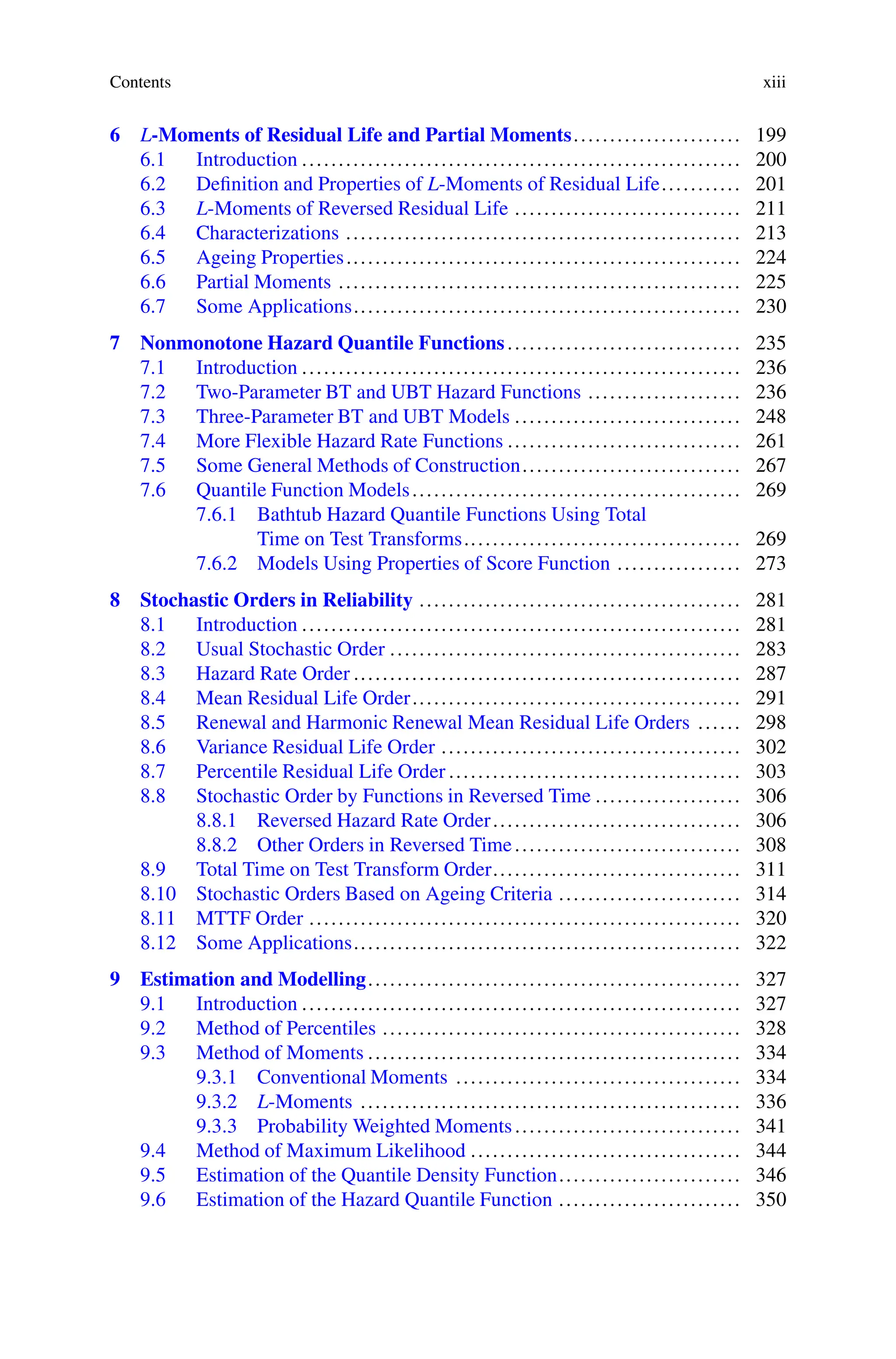

![List of Figures
Fig. 1.1 Q-Q plot for Example 1.12............................................ 27
Fig. 1.2 Box plot for the data given in Example 1.12 ......................... 28
Fig. 3.1 Density plots of the generalized lambda distribution
(Ramberg and Schmeiser [503] model) for different
choices of (λ1,λ2,λ3,λ4). (a) (1,0.2,0.13,0.13);
(b) (1,0.6,1.5,-1.5); (c) (1,0.6,1.75,1.2); (d)
(1,0.2,0.13,0.013); (e) (1,0.2,0.0013,0.13); (f) (1,1,0.5,4) ........... 65
Fig. 3.2 Density plots of the GLD (Freimer et al. model) for
different choices of (λ1,λ2,λ3,λ4). (a) (2,1,2,0.5);
(b) (2,1,0.5,2); (c) (2,1,0.5,0.5); (d) (3,1,1.5,2.5); (e)
(3,1,1.5,1.6,); (f) (1,1,2,0.1); (g) (5,1,0.1,2) .......................... 77
Fig. 3.3 Density plots of the GLD proposed by van Staden and
Loots [572] for varying (λ1,λ2,λ3,λ4). (a) (1,1,0.5,2);
(b) (2,1,0.5,3); (c) (3,2,0.25,0.5); (d) (1,2,0.1,−1)................... 84
Fig. 3.4 Density plots of the five-parameter GLD for different
choices of (λ1,λ2,λ3,λ4,λ5). (q) (1,1,0,10,10); (b)
(1,1,0,2,2); (c) (1,1,0.5,-0.6,-0.5); (d) (1,1,-0.5,-0.6,
-0.5); (e) (1,1,0.5,0.5,5) ............................................... 86
Fig. 3.5 Density plots of power-Pareto distribution for some
choices of (C,λ1,λ2). (a) (1,0.5,0.01); (b) (1,1,0.2); (c)
(1,0.2,0.1); (d) (1,0.1,1); (e) (1,0.5,0.001); (f) (1,2,0.001) .......... 89
Fig. 3.6 Density plots of Govindarajulu’s distribution for some
choices of β. (a) β = 3; (b) β = 0.5; (c) β = 2...................... 94
Fig. 3.7 Q-Q plot for the data on lifetimes of aluminum coupons............ 101
Fig. 3.8 Q-Q plot for the data on times to first failure of electric carts....... 102
Fig. 3.9 Q-Q plot for the data on failure times of devices using
Govindarajulu’s model ................................................ 102
Fig. 4.1 Implications among different ageing concepts ....................... 157
Fig. 4.2 Plots of hazard quantile function when (1) β = 0.1,
σ = 1 and (2) β = 2, σ = 1 for Govindarajalu’s distribution ....... 160
xv](https://image.slidesharecdn.com/43349-250615084344-fa6b34be/75/Quantile-Based-Reliability-Analysis-1st-Edition-N-Unnikrishnan-Nair-19-2048.jpg)


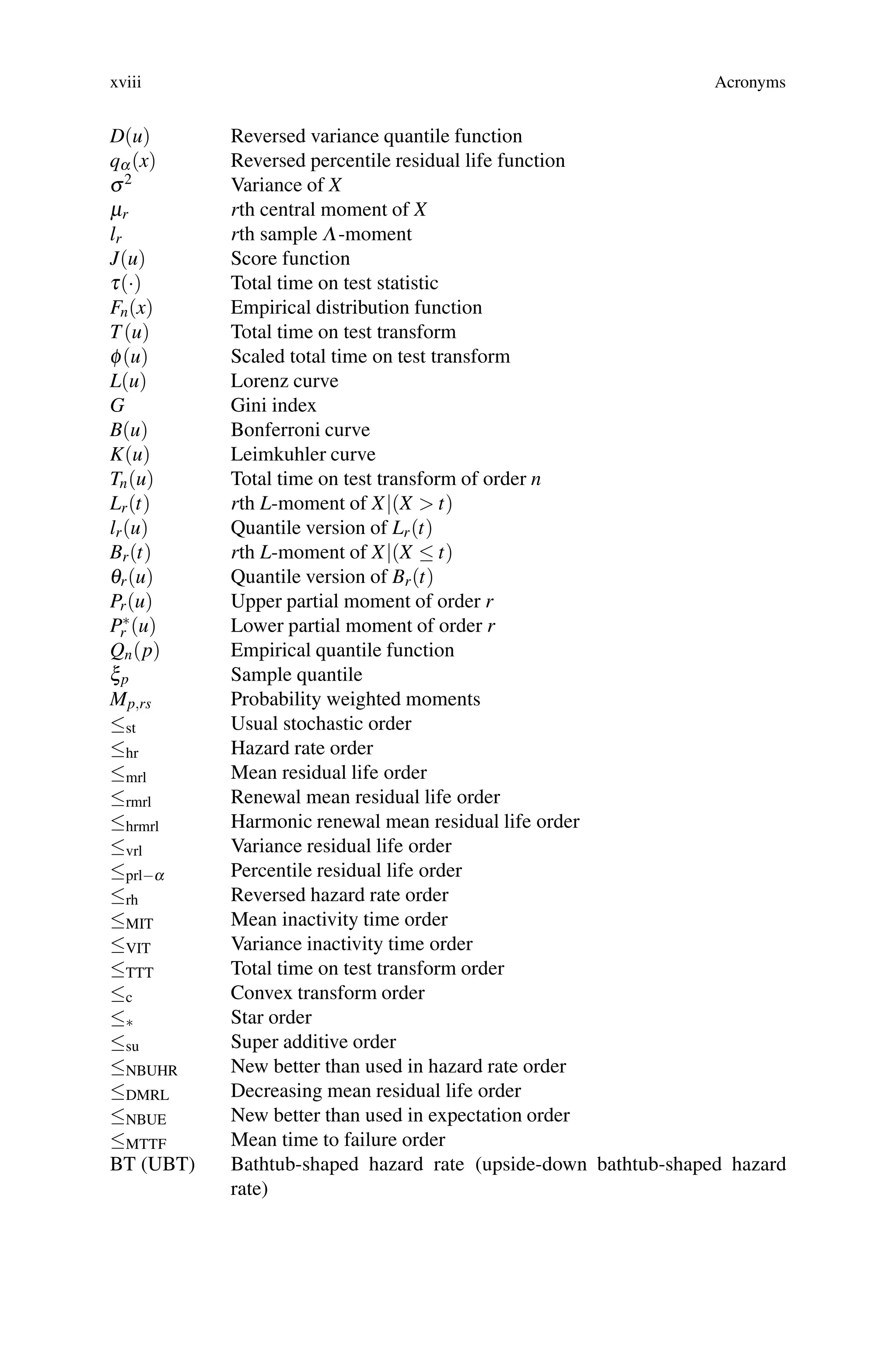


![2 1 Quantile Functions
an appropriate choice of the domain of observations, a better understanding of a
chance phenomenon can be achieved by the use of quantile functions, is fast gaining
acceptance.
Historically, many facts about the potential of quantiles in data analysis were
known even before the nineteenth century. It appears that the Belgian sociologist
Quetelet [499] initiated the use of quantiles in statistical analysis in the form of the
present day inter-quantile range. A formal representation of a distribution through
a quantile function was introduced by Galton (1822–1911) [206] who also initiated
the ordering of observations along with the concepts of median, quartiles and
interquartile range. Subsequently, the research on quantiles was directed towards
estimation problems with the aid of sample quantiles, their large sample behaviour
and limiting distributions (Galton [207, 208]). A major development in portraying
quantile functions to represent distributions is the work of Hastings et al. [264], who
introduced a family of distributions by a quantile function. This was refined later
by Tukey [568]. The symmetric distribution of Tukey [568] and his articulation
of exploratory data analysis sparked considerable interest in quantile functional
forms that continues till date. Various aspects of the Tukey family and general-
izations thereto were studied by a number of authors including Hogben [273],
Shapiro and Wilk [536], Filliben [197], Joiner and Rosenblatt [304], Ramberg
and Schmeiser [504], Ramberg [501], Ramberg et al. [502], MacGillivray [407],
Freimer et al. [203], Gilchrist [215] and Tarsitano [563]. We will discuss all these
models in Chap. 3. Another turning point in the development of quantile functions
is the seminal paper by Parzen [484], in which he emphasized the description
of a distribution in terms of the quantile function and its role in data modelling.
Parzen [485–487] exhibits a sequential development of the theory and application
of quantile functions in different areas and also as a tool in unification of various
approaches.
Quantile functions have several interesting properties that are not shared by
distributions, which makes it more convenient for analysis. For example, the sum
of two quantile functions is again a quantile function. There are explicit general dis-
tribution forms for the quantile function of order statistics. In Sect. 1.2, we mention
these and some other properties. Moreover, random numbers from any distribution
can be generated using appropriate quantile functions, a purpose for which lambda
distributions were originally conceived. The moments in different forms such as raw,
central, absolute and factorial have been used effectively in specifying the model,
describing the basic characteristics of distributions, and in inferential procedures.
Some of the methods of estimation like least squares, maximum likelihood and
method of moments often provide estimators and/or their standard errors in terms
of moments. Outliers have a significant effect on the estimates so derived. For
example, in the case of samples from the normal distribution, all the above methods
give sample mean as the estimate of the population mean, whose values change
significantly in the presence of an outlying observation. Asymptotic efficiency of the
sample moments is rather poor for heavy tailed distributions since the asymptotic
variances are mainly in terms of higher order moments that tend to be large in this
case. In reliability analysis, a single long-term survivor can have a marked effect](https://image.slidesharecdn.com/43349-250615084344-fa6b34be/75/Quantile-Based-Reliability-Analysis-1st-Edition-N-Unnikrishnan-Nair-26-2048.jpg)

![4 1 Quantile Functions
Some important properties of quantile functions required in the sequel are as
follows.
1. From the definition of Q(u) for a general distribution function, we see that
(a) Q(u) is non-decreasing on (0,1) with Q(F(x)) ≤ x for all −∞ x ∞ for
which 0 F(x) 1;
(b) F(Q(u)) ≥ u for any 0 u 1;
(c) Q(u) is continuous from the left or Q(u−) = Q(u);
(d) Q(u+) = inf{x : F(x) u} so that Q(u) has limits from above;
(e) Any jumps of F(x) are flat points of Q(u) and flat points of F(x) are jumps
of Q(u).
2. If U is a uniform random variable over [0,1], then X = Q(U) has its distribution
function as F(x). This follows from the fact that
P(Q(U) ≤ x) = P(U ≤ F(x)) = F(x).
This property enables us to conceive a given data set as arising from the uniform
distribution transformed by the quantile function Q(u).
3. If T(x) is a non-decreasing function of x, then T(Q(u)) is a quantile function.
Gilchrist [215] refers to this as the Q-transformation rule. On the other hand, if
T(x) is non-increasing, then T(Q(1 − u)) is also a quantile function.
Example 1.1. Let X be a random variable with Pareto type II (also called Lomax)
distribution with
F(x) = 1 − αc
(x+ α)−c
, x 0; α,c 0.
Since F(x) is strictly increasing, setting F(x) = u and solving for x, we obtain
x = Q(u) = α[(1 − u)− 1
c − 1].
Taking T(X) = Xβ , β 0, we have a non-decreasing transformation which
results in
T(Q(u)) = αβ
[(1 − u)− 1
c − 1]β
.
When T(Q(u)) = y, we obtain, on solving for u,
u = G(y) = 1 −
⎛
⎝1 +
y
1
β
α
⎞
⎠
−c
which is a Burr type XII distribution with T(Q(u)) being the corresponding
quantile function.](https://image.slidesharecdn.com/43349-250615084344-fa6b34be/75/Quantile-Based-Reliability-Analysis-1st-Edition-N-Unnikrishnan-Nair-28-2048.jpg)

![6 1 Quantile Functions
then
Q1(u) = λ−1
(−log(1 − u
1
θ ))
provides
G(x) = (1 − e−λx
)θ
,
the generalized or exponentiated exponential law (Gupta and Kundu [250]). In a
similar manner, Mudholkar and Srivastava [429] take the baseline distribution as
Weibull. For some recent results and survey of such models, we refer the readers
to Gupta and Gupta [240]. In Chap. 3, we will come across several quantile
functions that represent families of distributions containing some life distribu-
tions as special cases. They are highly flexible empirical models capable of
approximating many continuous distributions. The above transformation on these
models generates new proportional reversed hazards models of a general form.
The analysis of lifetime data employing such models seems to be an open issue.
Remark 1.1. From the form of G(x) above, it is clear that for positive integral
values of θ, it is simply the distribution function of the maximum of a random
sample of size θ from the exponential population with distribution function F(x)
above. Thus, G(x) may be simply regarded as the distribution function of the
maximum from a random sample of real size θ (instead of an integer). This
viewpoint was discussed by Stigler [547] under the general idea of ‘fractional
order statistics’; see also Rohatgi and Saleh [509].
Remark 1.2. Just as G(x) can be regarded as the distribution function of the
maximum from a random sample of (real) size θ from the population with
distribution function F(x), we can consider G∗(x) = 1 − (1 − F(x))θ as a
generalized form corresponding to the minimum of a random sample of (real)
size θ. The model G∗(x) is, of course, the familiar proportional hazards model.
It is important to mention here that these two models are precisely the ones
introduced by Lehmann [382], as early as in 1953, as stochastically ordered
alternatives for nonparametric tests of equality of distributions.
Remark 1.3. It is useful to bear in mind that for distributions closed under
minima such as exponential and Weibull (i.e., the distributions for which the
minima have the same form of the distribution but with different parameters),
the distribution function G(x) would provide a natural generalization while,
for distributions closed under maxima such as power and inverse Weibull (i.e.,
the distributions for which the maxima have the same form of the distribution
but with different parameters), the distribution function G∗(x) would provide a
natural generalization.
5. The sum of two quantile functions is again a quantile function. Likewise,
two quantile density functions, when added, produce another quantile density
function.](https://image.slidesharecdn.com/43349-250615084344-fa6b34be/75/Quantile-Based-Reliability-Analysis-1st-Edition-N-Unnikrishnan-Nair-30-2048.jpg)

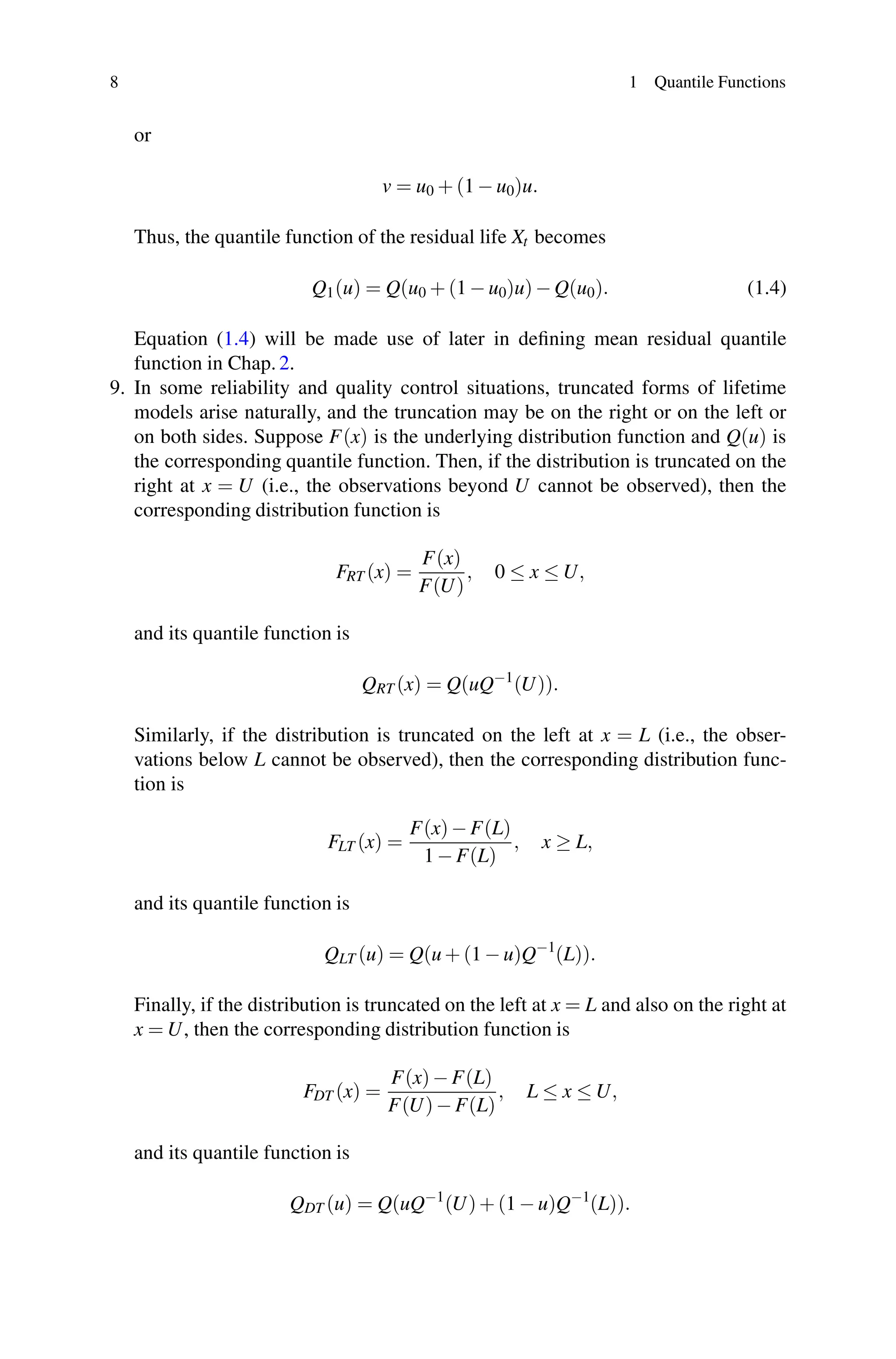
![1.4 Descriptive Quantile Measures 9
Example 1.4. Suppose the underlying distribution is logistic with distribution
function F(x) = 1/(1 + e−x) on the whole real line R. It is easily seen that
the corresponding quantile function is Q(u) = log
u
1−u . Further, suppose we
consider the distribution truncated on the left at 0, i.e., L = 0, for proposing a
lifetime model. Then, from the expression above and the fact that Q−1(0) = 1
2 ,
we arrive at the quantile function
QLT (u) = Q u + (1 − u)
1
2
= log
u + 1
2 (1 − u)
1 − u − 1
2 (1 − u)
= log
1 + u
1 − u
corresponding to the half-logistic distribution of Balakrishnan [47, 48]; see
Table 1.1.
1.3 Quantile Functions of Life Distributions
As mentioned earlier, we concentrate here on distributions of non-negative random
variables representing the lifetime of a component or unit. The distribution function
of such random variables is such that F(0−) = 0. Often, it is more convenient to
work with
F̄(x) = 1 − F(x) = P(X x),
which is the probability that the unit survives time (referred to as the age of the unit)
x. It is also called the reliability or survival function since it expresses the probability
that the unit is still reliable at age x.
In the previous section, some examples of quantile functions and a few methods
of obtaining them were explained. We now present in Table 1.1 quantile functions of
many distributions considered in the literature as lifetime models. The properties of
these distributions are discussed in the references cited below each of them. Models
like gamma, lognormal and inverse Gaussian do not find a place in the list as their
quantile functions are not in a tractable form. However, in the next chapter, we will
see quantile forms that provide good approximations to them.
1.4 Descriptive Quantile Measures
The advent of the Pearson family of distributions was a major turning point in
data modelling using distribution functions. The fact that members of the family
can be characterized by the first four moments gave an impetus to the extensive
use of moments in describing the properties of distributions and their fitting to
observed data. A familiar pattern of summary measures took the form of mean](https://image.slidesharecdn.com/43349-250615084344-fa6b34be/75/Quantile-Based-Reliability-Analysis-1st-Edition-N-Unnikrishnan-Nair-33-2048.jpg)
![10 1 Quantile Functions
Table 1.1 Quantile functions of some lifetime distributions
No. Distribution F̄(x) Q(u)
1 Exponential exp[−λx] λ−1(−log(1−u))
(Marshall and Olkin [412]) x 0; λ 0
2 Weibull exp[−( x
σ )λ ] σ(−log(1−u))
1
λ
(Murthy et al. [434], x 0; λ,σ 0
Hahn and Shapiro [257])
3 Pareto II αc(x+α)−c α[(1−u))− 1
c −1]
(Marshall and Olkin [412]) x 0; α,c 0
4 Rescaled beta (1− x
R )c R[1−(1−u))
1
c ]
(Marshall and Olkin [412]) 0 ≤ x ≤ R; c,R 0
5 Half-logistic 2
1+exp
x
σ
−1
σ log
1+u
1−u
(Balakrishnan [47,48], x 0; σ 0
Balakrishnan and Wong [61])
6 Power 1−( x
α )β αu
1
β
(Marshall and Olkin [412]) 0 ≤ x ≤ α; α,β 0
7 Pareto I ( x
σ )−α σ(1−u)− 1
α
(Marshall and Olkin [412]) x σ 0; α,σ 0
8 Burr type XII (1+xc)−k [(1−u)
1
k −1]
1
c
(Zimmer et al. [604], x 0; c,k 0
Fry [204])
9 Gompertz exp[−B(Cx−1)
logC ] 1
logC [1− logClog(1−u)
B ]
(Lai and Xie [368]) x 0; B,C 0
10 Greenwich [225] (1+ x2
b2 )− a
2 b[(1−u)
2
a −1]
1
2
x ≥ 0; a,b 0
11 Kus [364] 1−eλe−βx
1−eλ − 1
β log[λ−1 log{1−(1−u)
x 0; λ,β 0 (1−e−λ )}]
12 Logistic exponential 1+(eλθ −1)k
1+(eλ(x+θ)−1)k
1
λ log[1+{(eλθ −1)k+u
1−u }
1
k ]
(Lan and Leemis [372]) x ≥ 0; λ 0,
k 0, θ ≥ 0
13 Dimitrakopoulou et al. [178] exp[1−(1+λxβ )α ] λ−1[{1−log(1−u)}
1
α −1]
1
β
x 0; α,β,λ 0
14 Log Weibull exp[−(log(1+ρx))k] ρ−1[exp(−log(1−u))
1
k −1]
(Avinadav and Raz [41]) x 0; ρ,k 0
15 Modified Weibull exp[−ασ(e( x
σ )λ
−1)] σ[log(1+ log(1−u)
ασ )]
1
λ
extension (Xie et al. [595]) x 0; α,σ,λ 0
16 Exponential power exp[e−(λt)α
−1] 1
λ [−log(1+log(1−u))]
1
α
(Paranjpe et al. [482]) x 0; λ,α 0
17 Generalized Pareto (1+ ax
b )− a+1
a b
a [(1−u)− a
a+1 −1]
(Lai and Xie [368]) x 0,b 0,a −1
18 Inverse Weibull 1−exp[−(σ
x )λ ] σ(−logu)− 1
λ
(Erto [188]) x 0; σ,λ 0
(continued)](https://image.slidesharecdn.com/43349-250615084344-fa6b34be/75/Quantile-Based-Reliability-Analysis-1st-Edition-N-Unnikrishnan-Nair-34-2048.jpg)
![1.4 Descriptive Quantile Measures 11
Table 1.1 (continued)
No. Distribution F̄(x) Q(u)
19 Extended Weibull
θ exp[−( x
σ )λ ]
1−(1−θ)exp[−( x
σ )λ ]
σ[log θ+(1−θ)(1−u)
1−u ]
1
λ
(Marshall and Olkin [411]) x 0; θ,λ,σ 0
20 Generalized exponential 1−[1−exp(− x
σ )]θ σ[−log(1−u
1
θ )]
(Gupta et al. [239]) x 0; σ,θ 0
21 Exponentiated Weibull 1−[1−exp(− x
σ )λ ]θ σ[−log(1−u
1
θ )]
1
λ
(Mudholkar et al. [427]) x 0; σ,θ,λ 0
22 Generalized Weibull [1−λ( x
β )α ][ 1
λ
]
β[1−(1−u)λ
λ ]
1
α , λ = 0
(Mudholkar and Kollia [426]) x 0 for λ ≤ 0
0 x β
λ
1
α
, λ 0 β[−log(1−u)]
1
α , λ = 0
α,β 0
23 Exponential geometric (1− p)e−λx(1− pe−λx)−1 1
λ log(1−pu
1−u )
(Adamidis and
Loukas [18])
x 0, λ 0, 0 p 1
24 Log logistic (1+(αx)β )−1 α−1( u
1−u )
1
β
(Gupta et al. [237]) x 0, α,β 0
25 Generalized half-logistic 2(1−kx)1/k
1+(1−kx)1/k
1
k
1−
1−u
1+u
k
(Balakrishnan and
Sandhu [59],
0 ≤ x ≤ 1
k , k ≥ 0
Balakrishnan and
Aggarwala [49])
for location, variance for dispersion, and the Pearson’s coefficients β1 =
μ2
3
μ3
2
for
skewness and β2 = μ4
μ2
2
for kurtosis. While the mean and variance claimed universal
acceptance, several limitations of β1 and β2 were subsequently exposed. Some of
the concerns with regard to β1 are: (1) it becomes arbitrarily large or even infinite
making it difficult for comparison and interpretation as relatively small changes in
parameters produce abrupt changes, (2) it does not reflect the sign of the difference
(mean-median) which is a traditional basis for defining skewness, (3) there exist
asymmetric distributions with β1 = 0 and (4) instability of the sample estimate of
β1 while matching with the population value. Similarly, for a standardized variable
X, the relationship
E(X4
) = 1 +V(X2
) (1.5)
would mean that the interpretation of kurtosis depends on the concentration of the
probabilities near μ ± σ as well as in the tails of the distribution.
The specification of a distribution through its quantile function takes away the
need to describe a distribution through its moments. Alternative measures in terms
of quantiles that reduce the shortcomings of the moment-based ones can be thought
of. A measure of location is the median defined by](https://image.slidesharecdn.com/43349-250615084344-fa6b34be/75/Quantile-Based-Reliability-Analysis-1st-Edition-N-Unnikrishnan-Nair-35-2048.jpg)
![12 1 Quantile Functions
M = Q(0.5). (1.6)
Dispersion is measured by the interquartile range
IQR = Q3 − Q1, (1.7)
where Q3 = Q(0.75) and Q1 = Q(0.25).
Skewness is measured by Galton’s coefficient
S =
Q1 + Q3 − 2M
Q3 − Q1
. (1.8)
Note that in the case of extreme positive skewness, Q1 → M while in the case of
extreme negative skewness Q3 → M so that S lies between −1 and +1. When the
distribution is symmetric, M = Q1+Q3
2 and hence S = 0. Due to the relation in (1.5),
kurtosis can be large when the probability mass is concentrated near the mean or in
the tails. For this reason, Moors [421] proposed the measure
T = [Q(0.875)− Q(0.625)+ Q(0.375)−Q(0.125)]/IQR (1.9)
as a measure of kurtosis. As an index, T is justified on the grounds that the
differences Q(0.875) − Q(0.625) and Q(0.375) − Q(0.125) become large (small)
if relatively small (large) probability mass is concentrated around Q3 and Q1
corresponding to large (small) dispersion in the vicinity of μ ± σ.
Given the form of Q(u), the calculations of all the coefficients are very simple,
as we need to only substitute the appropriate fractions for u. On the other hand,
calculation of moments given the distribution function involves integration, which
occasionally may not even yield closed-form expressions.
Example 1.5. Let X follow the Weibull distribution with (see Table 1.1)
Q(u) = σ(−log(1 − u))
1
λ .
Then, we have
M = Q
1
2
= σ(log2)
1
λ ,
S =
(log4)
1
λ + (log 4
3 )
1
λ − 2(log2)
1
λ
(log4)
1
λ −
log 4
3
1
λ
,
IQR = σ
(log4)
1
λ − log
4
3
1
λ
,](https://image.slidesharecdn.com/43349-250615084344-fa6b34be/75/Quantile-Based-Reliability-Analysis-1st-Edition-N-Unnikrishnan-Nair-36-2048.jpg)
![1.4 Descriptive Quantile Measures 13
and
T =
(log8)
1
λ −
log 8
3
1
λ +
log 8
5
1
λ −
log 8
7
1
λ
(log4)
1
λ −
log 4
3
1
λ
.
The effect of a change of origin and scale on Q(u) and the above four measures
are of interest in later studies. Let X and Y be two random variables such that Y =
aX + b. Then,
FY (y) = P(Y ≤ y) = P X ≤
y− b
a
= FX
y− a
b
.
If QX (u) and QY (u) denote the quantile functions of X and Y, respectively,
FX
y− a
b
= u ⇒ QX (u) =
y− b
a
=
QY (u)− b
a
or
QY (u) = aQX (u)+ b.
So, we simply have
MY = QY (0.5) = aQX(0.5)+ b = aMX + b.
Similar calculations using (1.7), (1.8) and (1.9) yield
IQRY = aIQRX , SY = SX and TY = TX .
Other quantile-based measures have also been suggested for quantifying spread,
skewness and kurtosis. One measure of spread, similar to mean deviation in
the distribution function approach, is the median of absolute deviation from the
median, viz.,
A = Med(|X − M|). (1.10)
For further details and justifications for (1.10), we refer to Falk [194]. A second
popular measure that has received wide attention in economics is Gini’s mean
difference defined as
Δ =
∞
−∞
∞
−∞
|x− y|f(x)f(y)dxdy
= 2
∞
−∞
F(x)(1 − F(x))dx, (1.11)
where f(x) is the probability density function of X. Setting F(x) = u in (1.11), we
have](https://image.slidesharecdn.com/43349-250615084344-fa6b34be/75/Quantile-Based-Reliability-Analysis-1st-Edition-N-Unnikrishnan-Nair-37-2048.jpg)
![14 1 Quantile Functions
Δ = 2
1
0
u(1 − u)q(u)du (1.12)
= 2
1
0
(2u − 1)Q(u)du. (1.13)
The expression in (1.13) follows from (1.12) by integration by parts. One
may use (1.12) or (1.13) depending on whether q(u) or Q(u) is specified.
Gini’s mean difference will be further discussed in the context of reliability in
Chap. 4.
Example 1.6. The generalized Pareto distribution with (see Table 1.1)
Q(u) =
b
a
(1 − u)− a
a+1 − 1
has its quantile density function as
q(u) =
b
a + 1
(1 − u)− a
a+1 −1
.
Then, from (1.12), we obtain
Δ =
2b
a + 1
1
0
u(1 − u)− a
a+1 du =
2b
a + 1
B 2,
1
a + 1
,
where B(m,n) =
1
0 tm−1(1−t)n−1dt is the complete beta function. Thus, we obtain
the simplified expression
Δ =
2b(a + 1)
a + 2
.
Hinkley [271] proposed a generalization of Galton’s measure of skewness of the
form
S(u) =
Q(u)+ Q(1 − u)− 2Q(0.5)
Q(u)− Q(1 − u)
. (1.14)
Obviously, (1.14) reduces to Galton’s measure when u = 0.75. Since (1.14)
is a function of u and u is arbitrary, an overall measure of skewness can be
provided as
S2 = sup
1
2 ≤u≤1
S(u).
Groeneveld and Meeden [227] suggested that the numerator and denominator
in (1.14) be integrated with respect to u to arrive at the measure](https://image.slidesharecdn.com/43349-250615084344-fa6b34be/75/Quantile-Based-Reliability-Analysis-1st-Edition-N-Unnikrishnan-Nair-38-2048.jpg)
![1.4 Descriptive Quantile Measures 15
S3 =
1
1
2
{Q(u)+ Q(1 − u)− 2Q(0.5)}du
1
1
2
{Q(u)+ Q(1 − u)}du
.
Now, in terms of expectations, we have
1
1
2
Q(u)du =
x
M
xf(x)dx,
1
1
2
Q(1 − u)du =
1
2
0
Q(u)du =
M
0
xf(x)dx,
1
1
2
Q(0.5)du =
1
2
M,
and thus
S3 =
E(X)− M
∞
M xf(x)dx−
M
0 xf(x)dx
=
μ − M
E(|X − M|)
. (1.15)
The numerator of (1.15) is the traditional term (being the difference between the
mean and the median) indicating skewness and the denominator is a measure of
spread used for standardizing S3. Hence, (1.15) can be thought of as an index of
skewness in the usual sense. If we replace the denominator by the standard deviation
σ of X, the classical measure of skewness will result.
Example 1.7. Consider the half-logistic distribution with (see Table 1.1)
Q(u) = σ log
1 + u
1 − u
,
μ =
1
0
Q(u)du = σ log4,
1
1
2
Q(u)du = σ log16 −
3
2
log3 ,
1
2
0
Q(u)du = σ
3
2
log3 − 2log2 ,
and hence S3 = log(4
3 )/log(64
27 ).
Instead of using quantiles, one can also use percentiles to define skewness.
Galton [206] in fact used the middle 50 % of observations, while Kelly’s measure
takes 90 % of observations to propose the measure
S4 =
Q(0.90)+ Q(0.10)− 2M
Q(0.90)− Q(0.10)
.](https://image.slidesharecdn.com/43349-250615084344-fa6b34be/75/Quantile-Based-Reliability-Analysis-1st-Edition-N-Unnikrishnan-Nair-39-2048.jpg)
![16 1 Quantile Functions
For further discussion of alternative measures of skewness and kurtosis, a review of
the literature and comparative studies, we refer to Balanda and MacGillivray [63],
Tajuddin [559], Joannes and Gill [299], Suleswki [552] and Kotz and Seier [355].
1.5 Order Statistics
In life testing experiments, a number of units, say n, are placed on test and the
quantity of interest is their failure times which are assumed to follow a distribution
F(x). The failure times X1,X2,...,Xn of the n units constitute a random sample
of size n from the population with distribution function F(x), if X1,X2,...,Xn are
independent and identically distributed as F(x). Suppose the realization of Xi in
an experiment is denoted by xi. Then, the order statistics of the random sample
(X1,X2,...,Xn) are the sample values placed in ascending order of magnitude de-
noted by X1:n ≤ X2:n ≤ ··· ≤ Xn:n, so that X1:n = min1≤i≤n Xi and Xn:n = max1≤i≤n Xi.
The sample median, denoted by m, is the value for which approximately 50 % of the
observations are less than m and 50 % are more than m. Thus
m =
⎧
⎨
⎩
Xn+1
2 :n if n is odd
1
2 (Xn
2 :n + Xn
2 +1:n) if n is even.
(1.16)
Generalizing, we have the percentiles. The 100p-th percentile, denoted by xp, in
the sample corresponds to the value for which approximately np observations are
smaller than this value and n(1 − p) observations are larger. In terms of order
statistics we have
xp =
X[np]:n if 1
2n p 0.5
X(n+1)−[n(1−p)] if 0.5 p 1 − 1
2n
, (1.17)
where the symbol [t] is defined as [t] = r whenever r − 0.5 ≤ t r + 0.5, for all
positive integers r. We note that in the above definition, if xp is the ith smallest
observation, then the ith largest observation is x1−p. Obviously, the median m is the
50th percentile and the lower quartile q1 and the upper quartile q3 of the sample are,
respectively, the 25th and 75th percentiles. The sample interquartile range is
iqr = q3 − q1. (1.18)
All the sample descriptive measures are defined in terms of the sample median,
quartiles and percentiles analogous to the population measures introduced in
Sect. 1.4. Thus, iqr in (1.18) describes the spread, while
s =
q3 + q1 − 2m
q3 − q1
(1.19)](https://image.slidesharecdn.com/43349-250615084344-fa6b34be/75/Quantile-Based-Reliability-Analysis-1st-Edition-N-Unnikrishnan-Nair-40-2048.jpg)
![1.5 Order Statistics 17
and
t =
e7 − e5 + e3 − e1
iqr
, (1.20)
where ei = i
8 , i = 1,3,5,7, describes the skewness and kurtosis.
Parzen [484] introduced the empirical quantile function
Q̄(u) = F−1
n (u) = inf(x : Fn(x) ≥ u),
where Fn(x) is the proportion of X1,X2,...,Xn that is at most x. In other words,
Q̄(u) = Xr:n for
r − 1
n
u
r
n
, r = 1,2,...,n, (1.21)
which is a step function with jump 1
n . For u = 0, Q̄(u) is taken as X1:n or a
natural minimum if one is available. In the case of lifetime variables, this becomes
Q̄(0). When a smooth function is required for Q̄(u), Parzen [484] suggested the
use of
Q̄1(u) = n
r
n
− u
Xr−1:n + n u −
r − 1
n
Xr:n
for r−1
n ≤ u ≤ r
n , r = 1,2,...,n. The corresponding empirical quantile density
function is
q̄1(u) =
d
du
Q̄1(u) = n(Xr:n − Xr−1:n), for
r − 1
n
u
r
n
.
In this set-up, we have qi = Q̄( i
4 ), i = 1,3 and ei = Q̄( i
8 ), i = 1,3,7,8.
It is well known that the distribution of the rth order statistic Xr:n is given by
Arnold et al. [37]
Fr(x) = P(Xr:n ≤ x) =
n
∑
k=r
n
k
Fk
(x)(1 − F(x))n−k
. (1.22)
In particular, Xn:n and X1:n have their distributions as
Fn(x) = Fn
(x) (1.23)
and
F1(x) = 1 − (1 − F(x))n
. (1.24)](https://image.slidesharecdn.com/43349-250615084344-fa6b34be/75/Quantile-Based-Reliability-Analysis-1st-Edition-N-Unnikrishnan-Nair-41-2048.jpg)
![18 1 Quantile Functions
Recalling the definitions of the beta function
B(m,n) =
1
0
tm−1
(1 −t)n−1
dt, m,n 0,
and the incomplete beta function ratio
Ix(m,n) =
Bx(m,n)
B(m,n)
,
where
Bx(m,n) =
x
0
tm−1
(1 −t)n−1
dt,
we have the upper tail of the binomial distribution and the incomplete beta function
ratio to be related as (Abramowitz and Stegun [15])
n
∑
k=r
n
k
pk
(1 − p)n−k
= Ip(r,n − r + 1). (1.25)
Comparing (1.22) and (1.25) we see that, if a sample of n observations from a
distribution with quantile function Q(u) is ordered, then the quantile function of
the rth order statistic is given by
Qr(ur) = Q(I−1
ur
(r,n − r + 1)), (1.26)
where
ur = Iu(r,n − r + 1) (1.27)
and I−1
is the inverse of the beta function ratio I. Thus, the quantile function of
the rth order statistic has an explicit distributional form, unlike the expression for
distribution function in (1.22). However, the expression for Qr(ur) is not explicit
in terms of Q(u). This is not a serious handicap as the Iu(·,·) function is tabulated
for various values of n and r (Pearson [489]) and also available in all statistical
softwares for easy computation. The distributions of Xn:n and X1:n have simple
quantile forms
Qn(un) = Q u
1
n
n
and
Q1(u1) = Q[1 − (1 − u1)
1
n ].](https://image.slidesharecdn.com/43349-250615084344-fa6b34be/75/Quantile-Based-Reliability-Analysis-1st-Edition-N-Unnikrishnan-Nair-42-2048.jpg)
![1.5 Order Statistics 19
The probability density function of Xr:n becomes
fr(x) =
n!
(r − 1)!(n − r)!
Fr−1
(x)(1 − F(x))n−r
f(x)
and so
μr:n = E(Xr:n) =
xfr(x)dx
=
n!
(r − 1)!(n − 1)!
1
0
ur−1
(1 − u)n−r
Q(u)du. (1.28)
This mean value is referred to as the rth mean rankit of X. For reasons explained
earlier with reference to the use of moments, often the median rankit
Mr:n = Q(I−1
0.5 (r,n − r + 1)), (1.29)
which is robust, is preferred over the mean rankit.
The importance and role of order statistics in the study of quantile function
become clear from the discussions in this section. Added to this, there are several
topics in reliability analysis in which order statistics appear quite naturally. One of
them is system reliability. We consider a system consisting of n components whose
lifetimes X1,X2,...,Xn are independent and identically distributed. The system is
said to have a series structure if it functions only when all the components are func-
tioning, and the lifetime of this system is the smallest among the Xi’s or X1:n. In the
parallel structure, on the other hand, the system functions if and only if at least one
of the components work, so that the system life is Xn:n. These two structures are em-
bedded in what is called a k-out-of-n system, which functions if and only if at least
k of the components function. The lifetime of such a system is obviously Xn−k+1:n.
In life testing experiments, when n identical units are put on test to ascertain
their lengths of life, there are schemes of sampling wherein the experimenter need
not have to wait until all units fail. The experimenter may choose to observe only
a prefixed number of failures of, say, n − r units and terminate the experiment
as soon as the (n − r)th unit fails. Thus, the lifetimes of r units that are still
working get censored. This sampling scheme is known as type II censoring. The
data consists of realizations of X1:n,X2:n,...,Xn−r:n. Another sampling scheme is
to prefix a time T∗ and observe only those failures that occur up to time T∗. This
scheme is known as type I censoring, and in this case the number of failures to
be observed is random. One may refer to Balakrishnan and Cohen [51] and Cohen
[154] for various methods of inference for type I and type II censored samples from
a wide array of lifetime distributions. Yet another sampling scheme is to prefix the
number of failures at n − r and also a time T∗. If (n − r) failures occur before time
T∗, then the experiment is terminated; otherwise, observe all failures until time
T∗. Thus, the time of truncation of the experiment is now min(T,Xn−r:n). This is
referred to as type I hybrid censoring; see Balakrishnan and Kundu [53] for an
overview of various developments on this and many other forms of hybrid censoring](https://image.slidesharecdn.com/43349-250615084344-fa6b34be/75/Quantile-Based-Reliability-Analysis-1st-Edition-N-Unnikrishnan-Nair-43-2048.jpg)
![20 1 Quantile Functions
schemes. A third important application of order statistics is in the construction of
tests regrading the nature of ageing of a device; see Lai and Xie [368]. For an
encyclopedic treatment on the theory, methods and applications of order satistics,
one may refer to Balakrishnan and Rao [56,57].
1.6 Moments
The emphasis given to quantiles in describing the basic properties of a distribution
does not in any way minimize the importance of moments in model specification and
inferential problems. In this section, we look at various types of moments through
quantile functions. The conventional moments
μ
r = E(Xr
) =
∞
0
xr
f(x)dx
are readily expressible in terms of quantile functions, by the substitution x =
Q(u), as
μ
r =
1
0
{Q(u)}r
du. (1.30)
In particular, as already seen, the mean is
μ =
1
0
Q(u)du =
1
0
(1 − u)q(u)du. (1.31)
The central moments and other quantities based on it are obtained through the well-
known relationships they have with the raw moments μ
r in (1.30).
Some of the difficulties experienced while employing the moments in descriptive
measures as well as in inferential problems have been mentioned in the previous
sections. The L-moments to be considered next can provide a competing alternative
to the conventional moments. Firstly, by definition, they are expected values of
linear functions of order statistics. They have generally lower sampling variances
and are also robust against outliers. Like the conventional moments, L-moments can
be used as summary measures (statistics) of probability distributions (samples), to
identify distributions and to fit models to data. The origin of L-moments can be
traced back to the work on linear combination of order statistics in Sillito [537] and
Greenwood et al. [226]. It was Hosking [276] who presented a unified theory on
L-moments and made a systematic study of their properties and role in statistical
analysis. See also Hosking [277, 279, 280] and Hosking and Wallis [282] for more
elaborate details on this topic.
The rth L-moment is defined as
Lr =
1
r
r−1
∑
k=0
(−1)k r − 1
k
E(Xr−k:r), r = 1,2,3,... (1.32)](https://image.slidesharecdn.com/43349-250615084344-fa6b34be/75/Quantile-Based-Reliability-Analysis-1st-Edition-N-Unnikrishnan-Nair-44-2048.jpg)
![1.6 Moments 21
Using (1.28), we can write
Lr =
1
r
r−1
∑
k=0
(−1)k r − 1
k
r!
(r − k − 1)!k!
1
0
ur−k−1
(1 − u)k
Q(u)du.
Expanding (1 − u)k in powers of u using binomial theorem and combining powers
of u, we get
Lr =
1
0
r−1
∑
k=0
(−1)r−1−k r − 1
k
r − 1 + k
k
uk
Q(u)du. (1.33)
Jones [306] has given an alternative method of establishing the last relationship. In
particular, we obtain:
L1 =
1
0
Q(u)du = μ, (1.34)
L2 =
1
0
(2u − 1)Q(u)du, (1.35)
L3 =
1
0
(6u2
− 6u + 1)Q(u)du, (1.36)
L4 =
1
0
(20u3
− 30u2
+ 12u − 1)Q(u)du. (1.37)
Sometimes, it is convenient (to avoid integration by parts while computing the
integrals in (1.34)–(1.37)) to work with the equivalent formulas
L1 =
1
0
(1 − u)q(u)du, (1.38)
L2 =
1
0
(u − u2
)q(u)du, (1.39)
L3 =
1
0
(3u2
− 2u3
− u)q(u)du, (1.40)
L4 =
1
0
(u − 6u2
+ 10u3
− 5u4
)q(u)du. (1.41)
Example 1.8. For the exponential distribution with parameter λ, we have
Q(u) = −λ−1
log(1 − u) and q(u) =
1
λ(1 − u)
.](https://image.slidesharecdn.com/43349-250615084344-fa6b34be/75/Quantile-Based-Reliability-Analysis-1st-Edition-N-Unnikrishnan-Nair-45-2048.jpg)
![22 1 Quantile Functions
Hence, using (1.38)–(1.41), we obtain
L1 =
1
0
1
λ
du = λ−1
,
L2 =
1
0
u(1 − u)q(u)du =
1
0
u
λ
du = (2λ)−1
,
L3 =
1
0
u(1 − u)(2u − 1)q(u)du = (6λ)−1
,
L4 =
1
0
u(1 − u)(1 − 5u + 5u2
)q(u)du = (12λ)−1
.
More examples are presented in Chap. 3 when properties of various distributions are
studied.
The L-moments have the following properties that distinguish themselves from
the usual moments:
1. The L-moments exist whenever E(X) is finite, while additional restrictions may
be required for the conventional moments to be finite for many distributions;
2. A distribution whose mean exists is characterized by (Lr : r = 1,2,...). This
result can be compared with the moment problem discussed in probability theory.
However, any set that contains all L-moments except one is not sufficient to
characterize a distribution. For details, see Hosking [279,280];
3. From (1.12), we see that L2 = 1
2 Δ, and so L2 is a measure of spread. Thus,
the first (being the mean) and second L-moments provide measures of location
and spread. In a recent comparative study of the relative merits of the variance
and the mean difference Δ, Yitzhaki [596] noted that the mean difference is
more informative than the variance in deriving properties of distributions that
depart from normality. He also compared the algebraic structure of variance
and Δ and examined the relative superiority of the latter from the stochastic
dominance, exchangability and stratification viewpoints. For further comments
on these aspects and some others in the reliability context, see Chap. 7;
4. Forming the ratios τr = Lr
L2
, r = 3,4,..., for any non-degenerateX with μ ∞, the
result |τr| 1 holds. Hence, the quantities τr’s are dimensionless and bounded;
5. The skewness and kurtosis of a distribution can be ascertained through the
moment ratios. The L-coefficient of skewness is
τ3 =
L3
L2
(1.42)
and the L-coefficient of kurtosis is
τ4 =
L4
L2
. (1.43)
These two measures satisfy the criteria presented for coefficients of skewness
and kurtosis in terms of order relations. The range of τ3 is (−1,1) while that
of τ4 is 1
4 (5τ2
3 − 1) ≤ τ4 1. These results are proved in Hosking [279] and](https://image.slidesharecdn.com/43349-250615084344-fa6b34be/75/Quantile-Based-Reliability-Analysis-1st-Edition-N-Unnikrishnan-Nair-46-2048.jpg)
![1.6 Moments 23
Jones [306] using different approaches. It may be observed that both τ3 and τ4
are bounded and do not assume arbitrarily large values as β1 (for example, in the
case of F(x) = 1 − x−3, x 1);
6. The ratio
τ2 =
L2
L1
(1.44)
is called L-coefficient of variation. Since X is non-negative in our case, L1 0,
L2 0 and further
L2 =
1
0
u(1 − u)q(u)du
1
0
(1 − u)q(u)du = L1
so that 0 τ2 1.
The above properties of L-moments have made them popular in diverse applications,
especially in hydrology, civil engineering and meteorology. Several empirical
studies (as the one by Sankarasubramonian and Sreenivasan [517]) comparing L-
moments and the usual moments reveal that estimates based on the former are less
sensitive to outliers. Just as matching the population and sample moments for the
estimation of parameters, the same method (method of L-moments) can be applied
with L-moments as well. Asymptotic approximations to sampling distributions are
better achieved with L-moments. An added advantage is that standard errors of
sample L-moments exist whenever the underlying distribution has a finite variance,
whereas for the usual moments this may not be enough in many cases.
When dealing with the conventional moments, the (β1,β2) plot is used as a
preliminary tool to discriminate between candidate distributions for the data. For
example, if one wishes to choose a distribution from the Pearson family as a model,
(β1,β2) provide exclusive classification of the members of this family. Distributions
with no shape parameters are represented by points in the β1-β2 plane, those with a
single shape parameter have their (β1,β2) values lie on the line 2β2 − 3β1 − 6 = 0,
while two shape parameters in the distribution ensure that for them, (β1,β2) falls in
a region between the lines 2β2 − 3β1 − 6 = 0 and β2 − β1 − 1 = 0. These cases are,
respectively, illustrated by the exponential distribution (which has (β1,β2) = (4,9)
as a point), the gamma family and the beta family; see Johnson et al. [302]
for details. In a similar manner, one can construct (τ2,τ3)-plots or (τ3,τ4)-plots
for distribution functions or quantile functions to give a visual identification of
which distribution can be expected to fit a given set of observations. Vogel and
Fennessey [574] articulate the need for such diagrams and provide several examples
on how to construct them. Some refinements of the L-moments are also studied in
the name of trimmed L-moments (Elamir and Seheult [187], Hosking [281]) and
LQ-moments (Mudholkar and Hutson [424]).
Example 1.9. The L-moments of the exponential distribution were calculated ear-
lier in Example 1.8. Applying the formulas for τ2, τ3 and τ4 in (1.44), (1.42)
and (1.43), we have](https://image.slidesharecdn.com/43349-250615084344-fa6b34be/75/Quantile-Based-Reliability-Analysis-1st-Edition-N-Unnikrishnan-Nair-47-2048.jpg)
![24 1 Quantile Functions
τ2 =
1
2
, τ3 =
1
3
, τ4 =
1
6
.
Thus, (τ2,τ3) = (1
2 , 1
3 ) and (τ3,τ4) = (1
3 , 1
6 ) are points in the τ2-τ3 and τ3-τ4 planes,
respectively.
Example 1.10. The random variable X has generalized Pareto distribution with
Q(u) =
b
a
{(1 − u)− a
a+1 − 1}, a −1, b 0.
Then, straightforward calculations yield
L1 = b, L2 = b(a + 1)(a + 2)−1
,
L3 = b(a + 1)(2a + 1)[(2a +3)(a +2)]−1
,
L4 = b(a + 1)(6a2
+ 7a + 2)[(a + 2)(2a+3)(3a+4)]−1
,
so that
τ2 =
a + 1
a + 2
, τ3 =
2a + 1
2a + 3
and τ4 =
6a2 + 7a + 2
6a2 + 17a + 12
.
Then, eliminating a between τ2 and τ3, we obtain
τ3 =
3τ2 − 1
τ2 + 1
.
Thus, the plot of (τ2,τ3) for all values of a and b lies on the curve
(τ2 + 1)(3 − τ3) = 4. Note that the exponential plot is (1
2 , 1
3 ) which lies on the curve
when a → 0. The estimation and other related inferential problems are discussed
in Chap. 7.
We now present probability weighted moments (PWM) which is a forerunner
to the concept of L-moments. Introduced by Greenwood et al. [226], PWMs are of
considerable interest when the distribution is expressed in quantile form. The PWMs
are defined as
Mp,r,s = E[X p
Fr
(X)F̄s
(X)], (1.45)
where p,r,s are non-negative real numbers and E|X|p
∞. Two special cases
of (1.45) in general use are
βp,r = E(X p
Fr
(X))
=
xp
Fr
(x)f(x)dx
=
1
0
(Q(u))p
ur
du (1.46)](https://image.slidesharecdn.com/43349-250615084344-fa6b34be/75/Quantile-Based-Reliability-Analysis-1st-Edition-N-Unnikrishnan-Nair-48-2048.jpg)