Statistics For Engineers An Introduction S J Morrison
Statistics For Engineers An Introduction S J Morrison
Statistics For Engineers An Introduction S J Morrison
Statistics For Engineers An Introduction S J Morrison
Statistics For Engineers An Introduction S J Morrison
1.
Statistics For EngineersAn Introduction S J
Morrison download
https://ebookbell.com/product/statistics-for-engineers-an-
introduction-s-j-morrison-4702688
Explore and download more ebooks at ebookbell.com
2.
Here are somerecommended products that we believe you will be
interested in. You can click the link to download.
Statistics For Engineers An Introduction With Examples From Practice
1st Edition Hartmut Schiefer
https://ebookbell.com/product/statistics-for-engineers-an-
introduction-with-examples-from-practice-1st-edition-hartmut-
schiefer-24097384
Thermodynamics And Statistical Mechanics An Introduction For
Physicists And Engineers Samya Bano Zain
https://ebookbell.com/product/thermodynamics-and-statistical-
mechanics-an-introduction-for-physicists-and-engineers-samya-bano-
zain-37631142
Statistics For Engineers And Scientists 6th Edition William Navidi
https://ebookbell.com/product/statistics-for-engineers-and-
scientists-6th-edition-william-navidi-51991382
Statistics For Engineers And Scientists 6th Edition 6th William Navidi
https://ebookbell.com/product/statistics-for-engineers-and-
scientists-6th-edition-6th-william-navidi-53996346
3.
Statistics For EngineersAnd Scientists 3rd William Navidi
https://ebookbell.com/product/statistics-for-engineers-and-
scientists-3rd-william-navidi-2508640
Statistics For Engineers And Scientists Ism 5th Edition William Navidi
https://ebookbell.com/product/statistics-for-engineers-and-scientists-
ism-5th-edition-william-navidi-42111108
Statistics For Engineers And Scientists 4th Edition William Navidi
https://ebookbell.com/product/statistics-for-engineers-and-
scientists-4th-edition-william-navidi-44455244
Statistics For Engineers And Scientists 5th Edition William Navidi
https://ebookbell.com/product/statistics-for-engineers-and-
scientists-5th-edition-william-navidi-11365066
Practical Statistics For Engineers And Scientists Cheremisinoff
https://ebookbell.com/product/practical-statistics-for-engineers-and-
scientists-cheremisinoff-22123980
This edition firstpublished 2009
Ó 2009, John Wiley & Sons, Ltd
Registered office
John Wiley & Sons Ltd, The Atrium, Southern Gate, Chichester, West Sussex, PO19 8SQ, United
Kingdom
For details of our global editorial offices, for customer services and for information about how to
apply for permission to reuse the copyright material in this book please see our website at
www.wiley.com.
The right of the author to be identified as the author of this work has been asserted in accordance
with the Copyright, Designs and Patents Act 1988.
All rights reserved. No part of this publication may be reproduced, stored in a retrieval system,
or transmitted, in any form or by any means, electronic, mechanical, photocopying, recording or
otherwise, except as permitted by the UK Copyright, Designs and Patents Act 1988, without the
prior permission of the publisher.
Wiley also publishes its books in a variety of electronic formats. Some content that appears in
print may not be available in electronic books.
Designations used by companies to distinguish their products are often claimed as trademarks.
All brand names and product names used in this book are trade names, service marks,
trademarks or registered trademarks of their respective owners. The publisher is not associated
with any product or vendor mentioned in this book. This publication is designed to provide
accurate and authoritative information in regard to the subject matter covered. It is sold on the
understanding that the publisher is not engaged in rendering professional services. If
professional advice or other expert assistance is required, the services of a competent
professional should be sought.
Library of Congress Cataloguing-in-Publication Data
Morrison, S. J.
Introduction to engineering statistics / S.J. Morrison.
p. cm.
Includes bibliographical references and index.
ISBN 978-0-470-74556-4
1. Engineering—Statistical methods. I. Title.
TA340.M67 2009
620.0072’7—dc22
2009001815
A catalogue record for this book is available from the British Library.
ISBN: 978-0-470-74556-4
Set in 10/12.5pt Times by Integra Software Services Pvt. Ltd. Pondicherry, India
Printed and bound in Great Britain by TJ International, Padstow, Cornwall
11.
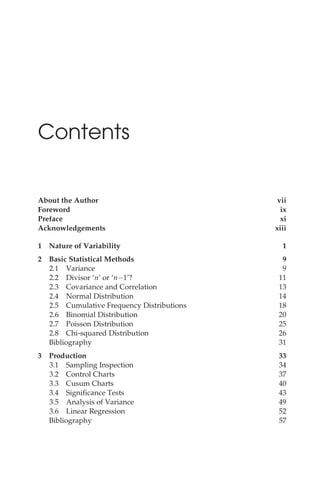
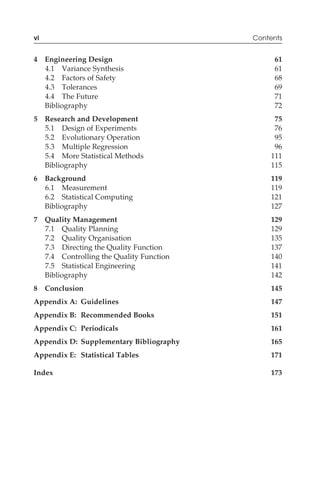
Contents
About the Authorvii
Foreword ix
Preface xi
Acknowledgements xiii
1 Nature of Variability 1
2 Basic Statistical Methods 9
2.1 Variance 9
2.2 Divisor ‘n’ or ‘n 1’? 11
2.3 Covariance and Correlation 13
2.4 Normal Distribution 14
2.5 Cumulative Frequency Distributions 18
2.6 Binomial Distribution 20
2.7 Poisson Distribution 25
2.8 Chi-squared Distribution 26
Bibliography 31
3 Production 33
3.1 Sampling Inspection 34
3.2 Control Charts 37
3.3 Cusum Charts 40
3.4 Significance Tests 43
3.5 Analysis of Variance 49
3.6 Linear Regression 52
Bibliography 57
12.
4 Engineering Design61
4.1 Variance Synthesis 61
4.2 Factors of Safety 68
4.3 Tolerances 69
4.4 The Future 71
Bibliography 72
5 Research and Development 75
5.1 Design of Experiments 76
5.2 Evolutionary Operation 95
5.3 Multiple Regression 96
5.4 More Statistical Methods 111
Bibliography 115
6 Background 119
6.1 Measurement 119
6.2 Statistical Computing 121
Bibliography 127
7 Quality Management 129
7.1 Quality Planning 129
7.2 Quality Organisation 135
7.3 Directing the Quality Function 137
7.4 Controlling the Quality Function 140
7.5 Statistical Engineering 141
Bibliography 142
8 Conclusion 145
Appendix A: Guidelines 147
Appendix B: Recommended Books 151
Appendix C: Periodicals 161
Appendix D: Supplementary Bibliography 165
Appendix E: Statistical Tables 171
Index 173
vi Contents
13.
About the Author
S.J.Morrison is a Fellow of the Institution of Mechanical Engineering, the
Royal Statistical Society and the Chartered Management Institute.
Morrison is also a Senior Member of the American Society for Quality.
15.
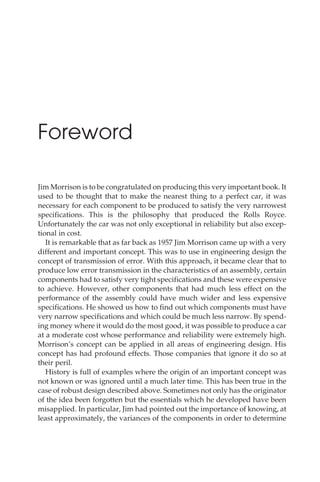
Foreword
Jim Morrison isto be congratulated on producing this very important book. It
used to be thought that to make the nearest thing to a perfect car, it was
necessary for each component to be produced to satisfy the very narrowest
specifications. This is the philosophy that produced the Rolls Royce.
Unfortunately the car was not only exceptional in reliability but also excep-
tional in cost.
It is remarkable that as far back as 1957 Jim Morrison came up with a very
different and important concept. This was to use in engineering design the
concept of transmission of error. With this approach, it became clear that to
produce low error transmission in the characteristics of an assembly, certain
components had to satisfy very tight specifications and these were expensive
to achieve. However, other components that had much less effect on the
performance of the assembly could have much wider and less expensive
specifications. He showed us how to find out which components must have
very narrow specifications and which could be much less narrow. By spend-
ing money where it would do the most good, it was possible to produce a car
at a moderate cost whose performance and reliability were extremely high.
Morrison’s concept can be applied in all areas of engineering design. His
concept has had profound effects. Those companies that ignore it do so at
their peril.
History is full of examples where the origin of an important concept was
not known or was ignored until a much later time. This has been true in the
case of robust design described above. Sometimes not only has the originator
of the idea been forgotten but the essentials which he developed have been
misapplied. In particular, Jim had pointed out the importance of knowing, at
least approximately, the variances of the components in order to determine
16.
the variance ofthe assembly. In later versions of this concept such matters
have been given far too little attention. We are particularly grateful, there-
fore, for this book in which Jim describes these techniques with clarity and
accuracy.
George E.P. Box, FRS
Emeritus Professor, University of Wisconsin, USA
Honorary Member of the American Society for Quality
Inaugural holder of the George Box Medal for outstanding
contributions to business and industrial statistics awarded by the
European Network of Business and Industrial Statisticians (ENBIS)
x Foreword
17.
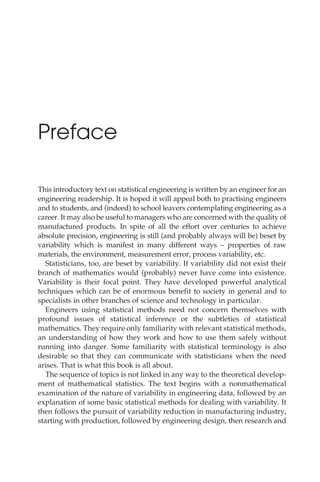
Preface
This introductory texton statistical engineering is written by an engineer for an
engineering readership. It is hoped it will appeal both to practising engineers
and to students, and (indeed) to school leavers contemplating engineering as a
career. It may also be useful to managers who are concerned with the quality of
manufactured products. In spite of all the effort over centuries to achieve
absolute precision, engineering is still (and probably always will be) beset by
variability which is manifest in many different ways – properties of raw
materials, the environment, measurement error, process variability, etc.
Statisticians, too, are beset by variability. If variability did not exist their
branch of mathematics would (probably) never have come into existence.
Variability is their focal point. They have developed powerful analytical
techniques which can be of enormous benefit to society in general and to
specialists in other branches of science and technology in particular.
Engineers using statistical methods need not concern themselves with
profound issues of statistical inference or the subtleties of statistical
mathematics. They require only familiarity with relevant statistical methods,
an understanding of how they work and how to use them safely without
running into danger. Some familiarity with statistical terminology is also
desirable so that they can communicate with statisticians when the need
arises. That is what this book is all about.
The sequence of topics is not linked in any way to the theoretical develop-
ment of mathematical statistics. The text begins with a nonmathematical
examination of the nature of variability in engineering data, followed by an
explanation of some basic statistical methods for dealing with variability. It
then follows the pursuit of variability reduction in manufacturing industry,
starting with production, followed by engineering design, then research and
18.
development. Finally, measurement,statistical computing, and quality
management are dealt with as background topics. Although it is convenient
to use the manufacturing industry as a vehicle for demonstrating the use of
statistical methods, it must be emphasised they are widely applicable in
other branches of engineering.
Statistical methods provide the only satisfactory way of dealing with the
variability that exists in every engineering situation. The buck doesn’t stop at
ground level. The responsibility for dealing with variability is carried by
engineers and managers at all levels, right up to chief executive. The engineer
who is lacking in statistical skill is less than competent to handle variability.
For that reason statistical engineering should be a continuing professional
development interest for practising engineers, irrespective of seniority.
Engineering students must recognise that statistical skills will be important
to them in their future careers, no matter what branch of technology they
enter or how high they set their sights. As fee-payers they are entitled to look
critically at their academic curricula. If they graduate in an academic
establishment at which no provision is made for teaching the elements of
statistical engineering, they will find themselves later in life competing on
unequal terms with statistically competent engineers who are better
equipped to deal with the reality of the world.
There is a message here, too, for school leavers who are considering a
professional career in engineering. They should enquire carefully about the
curriculum of any engineering degree course they are thinking of entering. If
there is no evidence of statistical engineering content they should pass it by
and look at the next on their list before committing themselves.
This book introduces a broad range of statistical methods that are relevant
to engineering. These are presented with the minimum of mathematics and
the maximum of explanation. Where statistical jargon is used the words
and phrases are printed in italics at the first entry so that the meaning will
be self-evident from the context. The object is to build bridges of under-
standing between the professional disciplines of engineering and statistics.
To assist the readers who may wish to take the subject further than a basic
introduction (particularly in areas of research) extensive reference lists are
provided at each chapter end. In addition, four appendices offer guidance for
further study. A fifth appendix accommodates statistical tables.
Lastly, by linking together the basic elements of quality – technology,
management, and statistics – in a compact readable text this book
should assist academic engineering schools to satisfy the requirements of
the accreditation committees of professional institutions making their
assessments of degree courses.
xii Preface
19.
Acknowledgements
The Institution ofElectrical Engineers has agreed to parts of the article
‘Engineering Design – The Fount of Quality’, published in the August 2000
issue of Engineering Management Journal, and repeated under the title ‘Quality
Engineering Design’ in the June 2001 issue of Manufacturing Engineer, to be
included in Chapter 4. Thanks are due to Tim Davis, Henry Ford Technical
Fellow for Quality Engineering at the Ford Motor Company, for permission
to use his case study in this chapter as an example of the application of
variance synthesis.
Material in Chapter 7 has been reproduced from ‘Quality Management’ in
the Proceedings of the Institution of Mechanical Engineers 1985, vol. 199, No. B3,
153–159 pp. by permission of the Council of the Institution of Mechanical
Engineers.
The author is grateful to Elwyn Davies and Hefin Rowlands of the former
IEE Quality Management Professional Group and to Clare Morris and Dan
Grove of the RSS Quality Improvement Committee for their support and
encouragement in organising joint discussions in 1999/2000 on statistical
engineering issues between the Institution of Electrical Engineers and the
Royal Statistical Society in London.
Thanks are due to Julian Booker, Simon Edwards, Allan Reese and Dave
Stewardson who have all been helpful in a variety of ways. Thanks are also
due to the staff of the Industrial Statistics Research Unit at the University of
Newcastle upon Tyne for assistance in preparing the text for distribution on
disc in CD ROM format in 2004, and also to Dan Grove for updating
references to computer software in Chapter 6.
21.
1
Nature of Variability
Thereis no engineering product so simple that only one source of variability
affects its dimensions or properties. Take two examples of products which
are relatively simple in their physical appearance – high-carbon steel wire
and milk bottles.
The tensile strength of steel wire depends on numerous factors: the carbon
content of the ingot from which rods were made in the rolling mill; the
temperature of the heat treatment furnace through which the rods were
passed; the rate of passage through the furnace; the temperature of the
quenching bath; the ambient temperature in the heat treatment shop;
the number of dies through which the rods were drawn to finished wire
size; the rate of drawing; the ambient temperature in the wire mill, etc.
Variability in any of these factors is likely to generate variability in tensile
strength.
One of the hazards of a milkman’s life is the possibility of being stopped in
the street by a weights and measures inspector. Milk bottles are filled to a
predetermined level on automatic machines. The capacity at that level is
determined by the external profile of the bottle and by its wall thickness. The
bottles are made on multi-head automatic machines by dropping gobs of
molten glass into metal moulds (one at each work station), piercing them
hollow, then inflating them with compressed air until they fill the moulds.
The external profile can be affected by different settings at each work station,
by mould differences, by fluctuations in air pressure, by sagging after release
from the moulds, and by malfunctioning of the automatic timing gear which
Statistics for Engineers: an Introduction S.J. Morrison
Ó 2009 John Wiley & Sons, Ltd
22.
controls the variousfunctions. The wall thickness is determined by the
setting of the gob feeder and this in its turn is affected by the viscosity of
the glass, the forehearth temperature, and the action of the shears which cut
off successive gobs from the continuous flow of the feeder. Variability in any
of these process factors may contribute to variability in the volumetric
capacity of bottles in continuous production.
It must be assumed that most engineering products which are infinitely
more complex than steel wire or milk bottles will be equally susceptible to a
multitude of factors located in raw materials, components, processes and the
environment which are capable of affecting the properties and dimensions of
a finished product. It is therefore important for engineers to have an under-
standing of the way in which random combinations of independent sources
can affect the variability of a finished product.
This can be demonstrated with random combinations of the variables R, Y
and B in Table 1.1. These single-digit numbers in the range 0–9 were gener-
ated by throwing twenty-faced icosahedron coloured dice (red, yellow and
blue) with the numbers zero to nine engraved twice on each die. The dice
were invented in 1950/60 by Mr Yasushi Ishida and patented by Tokyo-
Shibaura Electric Company. They were marketed and distributed by the
Japanese Standards Association for demonstrating the principles of statisti-
cal quality control. In the discussion that follows the data in Table 1.1 will be
used to demonstrate some of the phenomena of variability that are encoun-
tered in engineering data without resort to the mathematics of probability
theory. It is hoped this will help the reader to understand the relevance of
statistical methods to be described later.
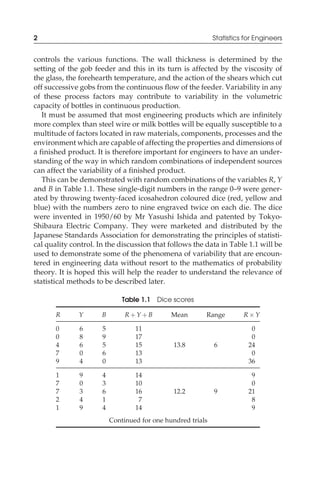
Table 1.1 Dice scores
R Y B R þ Y þ B Mean Range R Y
0 6 5 11 0
0 8 9 17 0
4 6 5 15 13.8 6 24
7 0 6 13 0
9 4 0 13 36
1 9 4 14 9
7 0 3 10 0
7 3 6 16 12.2 9 21
2 4 1 7 8
1 9 4 14 9
Continued for one hundred trials
2 Statistics for Engineers
23.
One hundred trialswere conducted, but only the first ten are recorded in
the table.
Readers who are not convinced that the trials are properly reported are at
liberty to conduct their own time-consuming experiments. Also recorded in
the table are the sums R þ Y þ B, and the products R Y, along with the mean
and the range of groups of five. In statistical terms, the mean of a set of data is
the sum of the individuals divided by the number of individuals. The range
is the difference between the largest and smallest individuals.
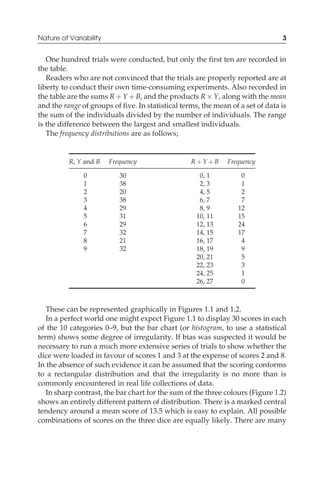
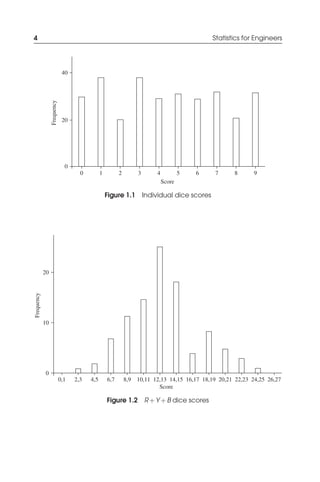
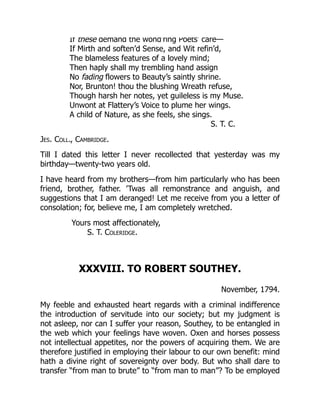
The frequency distributions are as follows;
R, Y and B Frequency R þ Y þ B Frequency
0 30 0, 1 0
1 38 2, 3 1
2 20 4, 5 2
3 38 6, 7 7
4 29 8, 9 12
5 31 10, 11 15
6 29 12, 13 24
7 32 14, 15 17
8 21 16, 17 4
9 32 18, 19 9
20, 21 5
22, 23 3
24, 25 1
26, 27 0
These can be represented graphically in Figures 1.1 and 1.2.
In a perfect world one might expect Figure 1.1 to display 30 scores in each
of the 10 categories 0–9, but the bar chart (or histogram, to use a statistical
term) shows some degree of irregularity. If bias was suspected it would be
necessary to run a much more extensive series of trials to show whether the
dice were loaded in favour of scores 1 and 3 at the expense of scores 2 and 8.
In the absence of such evidence it can be assumed that the scoring conforms
to a rectangular distribution and that the irregularity is no more than is
commonly encountered in real life collections of data.
In sharp contrast, the bar chart for the sum of the three colours (Figure 1.2)
shows an entirely different pattern of distribution. There is a marked central
tendency around a mean score of 13.5 which is easy to explain. All possible
combinations of scores on the three dice are equally likely. There are many
Nature of Variability 3
24.
0
0
20
40
Frequency
Score
1 2 34 5 6 7 8 9
Figure 1.1 Individual dice scores
0
0,1 2,3 4,5 6,7 8,9 10,11 12,13 14,15 16,17 18,19 20,21 22,23 24,25 26,27
10
20
Frequency
Score
Figure 1.2 R þ Y þ B dice scores
4 Statistics for Engineers
If these demandthe wond’ring Poets’ care—
If Mirth and soften’d Sense, and Wit refin’d,
The blameless features of a lovely mind;
Then haply shall my trembling hand assign
No fading flowers to Beauty’s saintly shrine.
Nor, Brunton! thou the blushing Wreath refuse,
Though harsh her notes, yet guileless is my Muse.
Unwont at Flattery’s Voice to plume her wings.
A child of Nature, as she feels, she sings.
S. T. C.
Jes. Coll., Cambridge.
Till I dated this letter I never recollected that yesterday was my
birthday—twenty-two years old.
I have heard from my brothers—from him particularly who has been
friend, brother, father. ’Twas all remonstrance and anguish, and
suggestions that I am deranged! Let me receive from you a letter of
consolation; for, believe me, I am completely wretched.
Yours most affectionately,
S. T. Coleridge.
XXXVIII. TO ROBERT SOUTHEY.
November, 1794.
My feeble and exhausted heart regards with a criminal indifference
the introduction of servitude into our society; but my judgment is
not asleep, nor can I suffer your reason, Southey, to be entangled in
the web which your feelings have woven. Oxen and horses possess
not intellectual appetites, nor the powers of acquiring them. We are
therefore justified in employing their labour to our own benefit: mind
hath a divine right of sovereignty over body. But who shall dare to
transfer “from man to brute” to “from man to man”? To be employed
27.
in the toilof the field, while we are pursuing philosophical studies—
can earldoms or emperorships boast so huge an inequality? Is there
a human being of so torpid a nature as that placed in our society he
would not feel it? A willing slave is the worst of slaves! His soul is a
slave. Besides, I must own myself incapable of perceiving even the
temporary convenience of the proposed innovation. The men do not
want assistance, at least none that Shad can particularly give; and to
the women, what assistance can little Sally, the wife of Shad, give
more than any other of our married women? Is she to have no
domestic cares of her own? No house? No husband to provide for?
No children? Because Mr. and Mrs. Roberts are not likely to have
children, I see less objection to their accompanying us. Indeed,
indeed, Southey, I am fearful that Lushington’s prophecy may not be
altogether vain. “Your system, Coleridge, appears strong to the head
and lovely to the heart; but depend upon it, you will never give your
women sufficient strength of mind, liberality of heart, or vigilance of
attention. They will spoil it.”
I am extremely unwell; have run a nail into my heel, and before me
stand “Embrocation for the throbbing of the head,” “To be shaked up
well that the ether may mix,” “A wineglass full to be taken when
faint.” ’Sdeath! how I hate the labels of apothecary’s bottles. Ill as I
am, I must go out to supper. Farewell for a few hours.
’Tis past one o’clock in the morning. I sat down at twelve o’clock to
read the “Robbers” of Schiller.[66] I had read, chill and trembling,
when I came to the part where the Moor fixes a pistol over the
robbers who are asleep. I could read no more. My God, Southey,
who is this Schiller, this convulser of the heart? Did he write his
tragedy amid the yelling of fiends? I should not like to be able to
describe such characters. I tremble like an aspen leaf. Upon my soul,
I write to you because I am frightened. I had better go to bed. Why
have we ever called Milton sublime? that Count de Moor horrible
wielder of heart-withering virtues? Satan is scarcely qualified to
attend his execution as gallows chaplain.
28.
Tuesday morning.—I havereceived your letter. Potter of Emanuel[67]
drives me up to town in his phaeton on Saturday morning. I hope to
be with you by Wednesday week. Potter is a “Son of Soul”—a poet
of liberal sentiments in politics—yet (would you believe it?)
possesses six thousand a year independent.
I feel grateful to you for your sympathy. There is a feverish
distemperature of brain, during which some horrible phantom
threatens our eyes in every corner, until, emboldened by terror, we
rush on it, and then—why then we return, the heart indignant at its
own palpitation! Even so will the greater part of our mental miseries
vanish before an effort. Whatever of mind we will to do, we can do!
What, then, palsies the will? The joy of grief. A mysterious pleasure
broods with dusky wings over the tumultuous mind, “and the Spirit
of God moveth on the darkness of the waters.” She was very lovely,
Southey! We formed each other’s minds; our ideas were blended.
Heaven bless her! I cannot forget her. Every day her memory sinks
deeper into my heart.
Nutrito vulnere tabens
Impatiensque mei feror undique, solus et excors,
Et desideriis pascor!
I wish, Southey, in the stern severity of judgment, that the two
mothers were not to go, and that the children stayed with them. Are
you wounded by my want of feeling? No! how highly must I think of
your rectitude of soul, that I should dare to say this to so
affectionate a son! That Mrs. Fricker! We shall have her teaching the
infants Christianity,—I mean, that mongrel whelp that goes under its
name,—teaching them by stealth in some ague fit of superstition.
There is little danger of my being confined. Advice offered with
respect from a brother; affected coldness, an assumed alienation
mixed with involuntary bursts of anguish and disappointed affection;
questions concerning the mode in which I would have it mentioned
to my aged mother—these are the daggers which are plunged into
29.
my peace. Enough!I should rather be offering consolation to your
sorrows than be wasting my feelings in egotistic complaints. “Verily
my complaint is bitter, yet my stroke is heavier than my groaning.”
God love you, my dear Southey!
S. T. Coleridge.
A friend of mine hath lately departed this life in a frenzy fever
induced by anxiety. Poor fellow, a child of frailty like me! Yet he was
amiable. I poured forth these incondite lines[68] in a moment of
melancholy dissatisfaction:—
30.
——! thy gravewith aching eye I scan,
And inly groan for Heaven’s poor outcast—Man!
’Tis tempest all, or gloom! In earliest youth
If gifted with th’ Ithuriel lance of Truth
He force to start amid the feign’d caress
Vice, siren-hag, in native ugliness;
A brother’s fate shall haply rouse the tear,
And on he goes in heaviness and fear!
But if his fond heart call to Pleasure’s bower
Some pigmy Folly in a careless hour,
The faithless Guest quick stamps th’ enchanted ground,
And mingled forms of Misery threaten round:
Heart-fretting Fear, with pallid look aghast,
That courts the future woe to hide the past;
Remorse, the poison’d arrow in his side,
And loud lewd Mirth to Anguish close allied;
Till Frenzy, frantic child of moping Pain,
Darts her hot lightning-flash athwart the brain!
Rest, injur’d Shade! shall Slander, squatting near,
Spit her cold venom in a dead man’s ear?
’Twas thine to feel the sympathetic glow
In Merit’s joy and Poverty’s meek woe:
Thine all that cheer the moment as it flies,
The zoneless Cares and smiling Courtesies.
Nurs’d in thy heart the generous Virtues grew,
And in thy heart they wither’d! such chill dew
Wan Indolence on each young blossom shed;
And Vanity her filmy network spread,
With eye that prowl’d around in asking gaze,
And tongue that trafficked in the trade of praise!
Thy follies such the hard world mark’d them well.
Were they more wise, the proud who never fell?
Rest, injur’d Shade! the poor man’s grateful prayer,
On heavenward wing, thy wounded soul shall bear!
As oft in Fanc ’s tho ght th g a e I pass
31.
As oft inFancy’s thought thy grave I pass,
And sit me down upon its recent grass,
With introverted eye I contemplate
Similitude of soul—perhaps of fate!
To me hath Heaven with liberal hand assign’d
Energic reason and a shaping mind,
The daring soul of Truth, the patriot’s part,
And Pity’s sigh, that breathes the gentle heart—
Sloth-jaundiced all! and from my graspless hand
Drop Friendship’s precious pearls, like hour-glass sand.
I weep, yet stoop not! the faint anguish flows,
A dreamy pang in Morning’s fev’rish doze!
Is that pil’d earth our Being’s passless mound?
Tell me, cold Grave! is Death with poppies crown’d?
Tir’d Sentinel! with fitful starts I nod,
And fain would sleep, though pillow’d on a clod!
SONG.
32.
When Youth hisfairy reign began[69]
Ere Sorrow had proclaim’d me Man;
While Peace the present hour beguil’d,
And all the lovely Prospect smil’d;
Then, Mary, mid my lightsome glee
I heav’d the painless Sigh for thee!
And when, along the wilds of woe
My harass’d Heart was doom’d to know
The frantic burst of Outrage keen,
And the slow Pang that gnaws unseen;
Then shipwreck’d on Life’s stormy sea
I heav’d an anguish’d Sigh for thee!
But soon Reflection’s hand imprest
A stiller sadness on my breast;
And sickly Hope with waning eye
Was well content to droop and die:
I yielded to the stern decree,
Yet heav’d the languid Sigh for thee!
And though in distant climes to roam,
A wanderer from my native home,
I fain would woo a gentle Fair
To soothe the aching sense of care,
Thy Image may not banish’d be—
Still, Mary! still I sigh for thee!
S. T. C.
God love you.
XXXIX. TO THE SAME.
33.
Autumn, 1794.
Last night,dear Southey, I received a special invitation from Dr.
Edwards[70] (the great Grecian of Cambridge and heterodox divine)
to drink tea and spend the evening. I there met a councillor whose
name is Lushington, a democrat, and a man of the most powerful
and Briarean intellect. I was challenged on the subject of
pantisocracy, which is, indeed, the universal topic at the University. A
discussion began and continued for six hours. In conclusion,
Lushington and Edwards declared the system impregnable,
supposing the assigned quantum of virtue and genius in the first
individuals. I came home at one o’clock this morning in the honest
consciousness of having exhibited closer argument in more elegant
and appropriate language than I had ever conceived myself capable
of. Then my heart smote me, for I saw your letter on the propriety
of taking servants with us. I had answered that letter, and feel
conviction that you will perceive the error into which the tenderness
of your nature had led you. But other queries obtruded themselves
on my understanding. The more perfect our system is, supposing
the necessary premises, the more eager in anxiety am I that the
necessary premises exist. O for that Lyncean eye that can discover in
the acorn of Error the rooted and widely spreading oak of Misery!
Quære: should not all who mean to become members of our
community be incessantly meliorating their temper and elevating
their understandings? Qu.: whether a very respectable quantity of
acquired knowledge (History, Politics, above all, Metaphysics, without
which no man can reason but with women and children) be not a
prerequisite to the improvement, of the head and heart? Qu.:
whether our Women have not been taught by us habitually to
contemplate the littleness of individual comforts and a passion for
the novelty of the scheme rather than a generous enthusiasm of
Benevolence? Are they saturated with the Divinity of Truth
sufficiently to be always wakeful? In the present state of their minds,
whether it is not probable that the Mothers will tinge the minds of
the infants with prejudication? The questions are meant merely as
motives to you, Southey, to the strengthening the minds of the
34.
Women, and stimulatingthem to literary acquirements. But,
Southey, there are Children going with us. Why did I never dare in
my disputations with the unconvinced to hint at this circumstance?
Was it not because I knew, even to certainty of conviction, that it is
subversive of rational hopes of a permanent system? These children,
—the little Frickers, for instance, and your brothers,—are they not
already deeply tinged with the prejudices and errors of society?
Have they not learned from their schoolfellows Fear and Selfishness,
of which the necessary offsprings are Deceit and desultory Hatred?
How are we to prevent them from infecting the minds of our
children? By reforming their judgments? At so early an age, can they
have felt the ill consequences of their errors in a manner sufficiently
vivid to make this reformation practicable? How can we insure their
silence concerning God, etc.? Is it possible they should enter into our
motives for this silence? If not, we must produce their Obedience by
Terror. Obedience? Terror? The repetition is sufficient. I need not
inform you that they are as inadequate as inapplicable. I have told
you, Southey, that I will accompany you on an imperfect system. But
must our system be thus necessarily imperfect? I ask the question
that I may know whether or not I should write the Book of
Pantisocracy.
I received your letter of Oyez; it brought a smile on a countenance
that for these three weeks has been cloudy and stern in its solitary
hours. In company, wit and laughter are Duties. Slovenly? I could
mention a lady of fashionable rank, and most fashionable ideas, who
declared to Caldwell that I (S. T. Coleridge) was a man of the most
courtly and polished manners, of the most gentlemanly address she
had ever met with. But I will not crow! Slovenly, indeed!
XL. TO THE REV. GEORGE COLERIDGE.
Thursday, November 6, 1794.
35.
My dear Brother,—Yourletter of this morning gave me inexpressible
consolation. I thought that I perceived in your last the cold and
freezing features of alienated affection. Surely, said I, I have trifled
with the spirit of love, and it has passed away from me! There is a
vice of such powerful venom, that one grain of it will poison the
overflowing goblet of a thousand virtues. This vice constitution
seems to have implanted in me, and habit has made it almost
Omnipotent. It is indolence![71] Hence, whatever web of friendship
my presence may have woven, my absence has seldom failed to
unravel. Anxieties that stimulate others infuse an additional narcotic
into my mind. The appeal of duty to my judgment, and the pleadings
of affection at my heart, have been heard indeed, and heard with
deep regard. Ah! that they had been as constantly obeyed. But so it
has been. Like some poor labourer, whose night’s sleep has but
imperfectly refreshed his overwearied frame, I have sate in drowsy
uneasiness, and doing nothing have thought what a deal I had to
do. But I trust that the kingdom of reason is at hand, and even now
cometh!
How often and how unkindly are the ebullitions of youthful
disputations mistaken for the result of fixed principles. People have
resolved that I am a dηmocrat, and accordingly look at everything I
do through the spectacles of prejudication. In the feverish
distemperature of a bigoted aristocrat’s brain, some phantom of
Dηmocracy threatens him in every corner of my writings.
And Hébert’s atheist crew, whose maddening hand
Hurl’d down the altars of the living God
With all the infidel intolerance.[72]
“Are these lines in character,” observed a sensible friend of mine, “in
a speech on the death of the man whom it just became the fashion
to style ‘The ambitious Theocrat’?” “I fear not,” was my answer, “I
gave way to my feelings.” The first speech of Adelaide,[73] whose
Automaton is this character? Who spoke through Le Gendre’s mouth,
36.
[74] when hesays, “Oh, what a precious name is Liberty To scare or
cheat the simple into slaves”? But in several parts I have, it seems,
in the strongest language boasted the impossibility of subduing
France. Is not this sentiment highly characteristic? Is it forced into
the mouths of the speakers? Could I have even omitted it without
evident absurdity? But, granted that it is my own opinion, is it an
anti-pacific one? I should have classed it among the anti-polemics.
Again, are all who entertain and express this opinion dηmocrats?
God forbid! They would be a formidable party indeed! I know many
violent anti-reformists, who are as violent against the war on the
ground that it may introduce that reform, which they (perhaps not
unwisely) imagine would chant the dirge of our constitution.
Solemnly, my brother, I tell you, I am not a dηmocrat. I see,
evidently, that the present is not the highest state of society of
which we are capable. And after a diligent, I may say an intense,
study of Locke, Hartley, and others who have written most wisely on
the nature of man, I appear to myself to see the point of possible
perfection, at which the world may perhaps be destined to arrive.
But how to lead mankind from one point to the other is a process of
such infinite complexity, that in deep-felt humility I resign it to that
Being “Who shaketh the Earth out of her place, and the pillars
thereof tremble,” “Who purifieth with Whirlwinds, and maketh the
Pestilence his Besom,” Who hath said, “that violence shall no more
be heard of; the people shall not build and another inhabit; they
shall not plant and another eat;” “the wolf and the lamb shall feed
together.” I have been asked what is the best conceivable mode of
meliorating society. My answer has been this: “Slavery is an
abomination to my feeling of the head and the heart. Did Jesus
teach the abolition of it? No! He taught those principles of which the
necessary effect was to abolish all slavery. He prepared the mind for
the reception before he poured the blessing.” You ask me what the
friend of universal equality should do. I answer: “Talk not politics.
Preach the Gospel!”
Yea, my brother! I have at all times in all places exerted my power in
the defence of the Holy One of Nazareth against the learning of the
37.
historian, the libertinismof the wit, and (his worst enemy) the
mystery of the bigot! But I am an infidel, because I cannot thrust my
head into a mud gutter, and say, “How deep I am!” And I am a
dηmocrat, because I will not join in the maledictions of the despotist
—because I will bless all men and curse no one! I have been a fool
even to madness; and I am, therefore, an excellent hit for calumny
to aim her poisoned probabilities at! As the poor flutterer, who by
hard struggling has escaped from the bird-limed thornbush, still
bears the clammy incumbrance on his feet and wings, so I am
doomed to carry about with me the sad mementos of past
imprudence and anguish from which I have been imperfectly
released.
Mr. Potter of Emanuel drives me up to town in his phaeton, on
Saturday morning. Of course I shall see you on Sunday. Poor
Smerdon! the reports concerning his literary plagiarism (as far as
concerns my assistance) are falsehoods. I have felt much for him,
and on the morning I received your letter I poured forth these
incondite rhymes. Of course they are meant for a brother’s eye.
38.
Smerdon! thy gravewith aching eye I scan, etc.[75]
God love you, dear brother, and your affectionate and grateful
S. T. Coleridge.
XLI. TO ROBERT SOUTHEY.
December 11, 1794.
My dear Southey,—I sit down to write to you, not that I have anything
particular to say, but it is a relief, and forms a very respectable part
in my theory of “Escapes from the Folly of Melancholy.” I am so
habituated to philosophizing that I cannot divest myself of it, even
when my own wretchedness is the subject. I appear to myself like a
sick physician, feeling the pang acutely, yet deriving a wonted
pleasure from examining its progress and developing its causes.
Your poems and Bowles’ are my only morning companions. “The
Retrospect!”[76] Quod qui non prorsus amat et deperit, illum omnes
et virtutes et veneres odere! It is a most lovely poem, and in the
next edition of your works shall be a perfect one. The “Ode to
Romance”[77] is the best of the odes. I dislike that to Lycon,
excepting the last stanza, which is superlatively fine. The phrase of
“let honest truth be vain” is obscure. Of your blank verse odes, “The
Death of Mattathias”[78] is by far the best. That you should ever
write another, Pulcher Apollo veta! Musæ prohibete venustæ! They
are to poetry what dumb-bells are to music; they can be read only
for exercise, or to make a man tired that he may be sleepy. The
sonnets are wonderfully inferior to those which I possess of yours, of
which that “To Valentine”[79] (“If long and lingering seem one little
day The motley crew of travellers among”); that on “The Fire”[80]
(not your last, a very so-so one); on “The Rainbow”[81] (particularly
the four last lines), and two or three others, are all divine and fully
39.
equal to Bowles.Some parts of “Miss Rosamund”[82] are beautiful—
the working scene, and that line with which the poem ought to have
concluded, “And think who lies so cold and pale below.” Of the
“Pauper’s Funeral,”[83] that part in which you have done me the
honour to imitate me is by far the worst; the thought has been so
much better expressed by Gray. On the whole (like many of yours),
it wants compactness and totality; the same thought is repeated too
frequently in different words. That all these faults may be remedied
by compression, my editio purgata of the poem shall show you.
40.
What! and notone to heave the pious sigh?
Not one whose sorrow-swoln and aching eye,
For social scenes, for life’s endearments fled,
Shall drop a tear and dwell upon the dead?
Poor wretched Outcast! I will sigh for thee,
And sorrow for forlorn humanity!
Yes, I will sigh! but not that thou art come
To the stern Sabbath of the silent tomb:
For squalid Want and the black scorpion Care,
(Heart-withering fiends) shall never enter there.
I sorrow for the ills thy life has known,
As through the world’s long pilgrimage, alone,
Haunted by Poverty and woe-begone,
Unloved, unfriended, thou didst journey on;
Thy youth in ignorance and labour past,
And thy old age all barrenness and blast!
Hard was thy fate, which, while it doom’d to woe,
Denied thee wisdom to support the blow;
And robb’d of all its energy thy mind,
Ere yet it cast thee on thy fellow-kind,
Abject of thought, the victim of distress,
To wander in the world’s wide wilderness.
Poor Outcast! sleep in peace! The winter’s storm
Blows bleak no more on thy unsheltered form!
Thy woes are past; thou restest in the tomb;—
I pause ... and ponder on the days to come.
Now! Is it not a beautiful poem? Of the sonnet, “No more the
visionary soul shall dwell,”[84] I wrote the whole but the second and
third lines. Of the “Old Man in the Snow,”[85] ten last lines entirely,
and part of the four first. Those ten lines are, perhaps, the best I
ever did write.
Lovell has no taste or simplicity of feeling. I remarked that when a
man read Lovell’s poems he mus cus (that is a rapid way of
41.
pronouncing “must curse”),but when he thought of Southey’s, he’d
“buy on!” For God’s sake let us have no more Bions or Gracchus’s. I
abominate them! Southey is a name much more proper and
handsome, and, I venture to prophesy, will be more famous. Your
“Chapel Bell”[86] I love, and have made it, by a few alterations and
the omission of one stanza (which, though beautiful quoad se,
interrupted the run of the thought “I love to see the aged spirit
soar”), a perfect poem. As it followed the “Exiled Patriots,” I altered
the second and fourth lines to, “So freedom taught, in high-voiced
minstrel’s weed;” “For cap and gown to leave the patriot’s meed.”
The last verse now runs thus:—
“But thou, Memorial of monastic gall!
What fancy sad or lightsome hast thou given?
Thy vision-scaring sounds alone recall
The prayer that trembles on a yawn to Heaven,
And this Dean’s gape, and that Dean’s nasal tone.”
Would not this be a fine subject for a wild ode?
St. Withold footed thrice the Oulds,
He met the nightmare and her nine foals;
He bade her alight and her troth plight,
And, “Aroynt thee, Witch!” he said.
I shall set about one when I am in a humour to abandon myself to
all the diableries that ever met the eye of a Fuseli!
Le Grice has jumbled together all the quaint stupidity he ever wrote,
amounting to about thirty pages, and published it in a book about
the size and dimensions of children’s twopenny books. The
dedication is pretty. He calls the publication “Tineum;”[87] for what
reason or with what meaning would give Madame Sphinx a complete
victory over Œdipus.
42.
A wag hashanded about, I hear, an obtuse angle of wit, under the
name of “An Epigram.” ’Tis almost as bad as the subject.
“A tiny man of tiny wit
A tiny book has published.
But not alas! one tiny bit
His tiny fame established.”
TO BOWLES.[88]
My heart has thank’d thee, Bowles! for those soft strains,
That, on the still air floating, tremblingly
Woke in me Fancy, Love, and Sympathy!
For hence, not callous to a Brother’s pains
Thro’ Youth’s gay prime and thornless paths I went;
And when the darker day of life began,
And I did roam, a thought-bewildered man!
Thy kindred Lays an healing solace lent,
Each lonely pang with dreamy joys combin’d,
And stole from vain Regret her scorpion stings;
While shadowy Pleasure, with mysterious wings,
Brooded the wavy and tumultuous mind,
Like that great Spirit, who with plastic sweep
Mov’d on the darkness of the formless Deep!
Of the following sonnet, the four last lines were written by Lamb, a
man of uncommon genius. Have you seen his divine sonnet of “O! I
could laugh to hear the winter winds,” etc.?
SONNET.[89]
43.
O gentle look,that didst my soul beguile,
Why hast thou left me? Still in some fond dream
Revisit my sad heart, auspicious smile!
As falls on closing flowers the lunar beam;
What time in sickly mood, at parting day
I lay me down and think of happier years;
Of joys, that glimmered in Hope’s twilight ray,
Then left me darkling in a vale of tears.
O pleasant days of Hope—for ever flown!
Could I recall one!—But that thought is vain.
Availeth not Persuasion’s sweetest tone
To lure the fleet-winged travellers back again:
Anon, they haste to everlasting night,
Nor can a giant’s arm arrest them in their flight.
The four last lines are beautiful, but they have no particular meaning
which “that thought is vain” does not convey. And I cannot write
without a body of thought. Hence my poetry is crowded and sweats
beneath a heavy burden of ideas and imagery! It has seldom ease.
The little song ending with “I heav’d the painless sigh for thee!” is an
exception, and, accordingly, I like it the best of all I ever wrote. My
sonnets to eminent contemporaries are among the better things I
have written. That to Erskine is a bad specimen. I have written ten,
and mean to write six more. In “Fayette” I unwittingly (for I did not
know it at the time) borrowed a thought from you.
I will conclude with a little song of mine,[90] which has no other
merit than a pretty simplicity of silliness.
44.
If while mypassion I impart,
You deem my words untrue,
O place your hand upon my heart—
Feel how it throbs for you!
Ah no! reject the thoughtless claim
In pity to your Lover!
That thrilling touch would aid the flame
It wishes to discover!
I am a complete necessitarian, and understand the subject as well
almost as Hartley himself, but I go farther than Hartley, and believe
the corporeality of thought, namely, that it is motion. Boyer thrashed
Favell most cruelly the day before yesterday, and I sent him the
following note of consolation: “I condole with you on the unpleasant
motions, to which a certain uncouth automaton has been
mechanized; and am anxious to know the motives that impinged on
its optic or auditory nerves so as to be communicated in such rude
vibrations through the medullary substance of its brain, thence
rolling their stormy surges into the capillaments of its tongue, and
the muscles of its arm. The diseased violence of its thinking
corporealities will, depend upon it, cure itself by exhaustion. In the
mean time I trust that you have not been assimilated in degradation
by losing the ataxy of your temper, and that necessity which
dignified you by a sentience of the pain has not lowered you by the
accession of anger or resentment.”
God love you, Southey! My love to your mother!
S. T. Coleridge.
XLII. TO THE SAME.
45.
Wednesday, December 17,1794.
When I am unhappy a sigh or a groan does not feel sufficient to
relieve the oppression of my heart. I give a long whistle. This by way
of a detached truth.
“How infinitely more to be valued is integrity of heart than
effulgence of intellect!” A noble sentiment, and would have come
home to me, if for “integrity” you had substituted “energy.” The
skirmishes of sensibility are indeed contemptible when compared
with the well-disciplined phalanx of right-onward feelings. O ye
invincible soldiers of virtue, who arrange yourselves under the
generalship of fixed principles, that you would throw up your
fortifications around my heart! I pronounce this a very sensible,
apostrophical, metaphorical rant.
I dined yesterday with Perry and Grey (the proprietor and editor of
the “Morning Chronicle”) at their house, and met Holcroft. He either
misunderstood Lovell, or Lovell misunderstood him. I know not
which, but it is very clear to me that neither of them understands
nor enters into the views of our system. Holcroft opposes it violently
and thinks it not virtuous. His arguments were such as Nugent and
twenty others have used to us before him; they were nothing. There
is a fierceness and dogmatism of conversation in Holcroft for which
you receive little compensation either from the veracity of his
information, the closeness of his reasoning, or the splendour of his
language. He talks incessantly of metaphysics, of which he appears
to me to know nothing, to have read nothing. He is ignorant as a
scholar, and neglectful of the smaller humanities as a man. Compare
him with Porson! My God! to hear Porson crush Godwin, Holcroft,
etc. They absolutely tremble before him! I had the honour of
working H. a little, and by my great coolness and command of
impressive language certainly did him over. “Sir!” said he, “I never
knew so much real wisdom and so much rank error meet in one
mind before!” “Which,” answered I, “means, I suppose, that in some
things, sir, I agree with you, and in others I do not.” He absolutely
infests you with atheism; and his arguments are such that the
46.
nonentities of Nugentconsolidate into oak or ironwood by
comparison! As to his taste in poetry, he thinks lightly, or rather
contemptuously, of Bowles’ sonnets; the language flat and prosaic
and inharmonious, and the sentiments only fit for girls! Come, come,
Mr. Holcroft, as much unintelligible metaphysics and as much bad
criticism as you please, but no blasphemy against the divinity of a
Bowles! Porson idolizes the sonnets. However it happened, I am
higher in his good graces than he in mine. If I am in town I dine
with him and Godwin, etc., at his house on Sunday.
I am astonished at your preference of the “Elegy.” I think it the
worst thing you ever wrote.
“Qui Gratio non odit, amet tua carmina, Avaro!”[91]
Why, ’tis almost as bad as Lovell’s “Farmhouse,” and that would be
at least a thousand fathoms deep in the dead sea of pessimism.
“The hard world scoff’d my woes, the chaste one’s pride,
Mimic of virtue, mock’d my keen distress,
[92]And Vice alone would shelter wretchedness.
Even life is loathsome now,” etc.
These two stanzas are exquisite, but the lovely thought of the “hot
sun,” etc., as pitiless as proud prosperity loses part of its beauty by
the time being night. It is among the chief excellences of Bowles
that his imagery appears almost always prompted by surrounding
scenery.
Before you write a poem you should say to yourself, “What do I
intend to be the character of this poem; which feature is to be
predominant in it?” So you make it unique. But in this poem now
Charlotte speaks and now the Poet. Assuredly the stanzas of
Memory, “three worst of fiends,” etc., and “gay fancy fond and frolic”
are altogether poetical. You have repeated the same rhymes
47.
ungracefully, and thethought on which you harp so long recalls too
forcibly the Εὕδεις βρέφος of Simonides. Unfortunately the
“Adventurer” has made this sweet fragment an object of popular
admiration. On the whole, I think it unworthy of your other “Botany
Bay Eclogues,” yet deem the two stanzas above selected superior
almost to anything you ever wrote; quod est magna res dicere, a
great thing to say.
SONNET.[93]
Though king-bred rage with lawless Tumult rude
Have driv’n our Priestley o’er the ocean swell;
Though Superstition and her wolfish brood
Bay his mild radiance, impotent and fell;
Calm in his halls of brightness he shall dwell!
For lo! Religion at his strong behest
Disdainful rouses from the Papal spell,
And flings to Earth her tinsel-glittering vest,
Her mitred state and cumbrous pomp unholy;
And Justice wakes to bid th’ oppression wail,
That ground th’ ensnared soul of patient Folly;
And from her dark retreat by Wisdom won,
Meek Nature slowly lifts her matron veil,
To smile with fondness on her gazing son!
SONNET.
48.
O what aloud and fearful shriek was there,
As though a thousand souls one death-groan poured!
Great Kosciusko ’neath an hireling’s sword
The warriors view’d! Hark! through the list’ning air
(When pauses the tir’d Cossack’s barbarous yell
Of triumph) on the chill and midnight gale
Rises with frantic burst or sadder swell
The “Dirge of Murder’d Hope!” while Freedom pale
Bends in such anguish o’er her destined bier,
As if from eldest time some Spirit meek
Had gathered in a mystic urn each tear
That ever furrowed a sad Patriot’s cheek,
And she had drench’d the sorrows of the bowl
Ev’n till she reel’d, intoxicate of soul!
Tell me which you like the best of the above two. I have written one
to Godwin, but the mediocrity of the eight first lines is most
miserably magazinish! I have plucked, therefore, these scentless
road-flowers from the chaplet, and entreat thee, thou river god of
Pieria, to weave into it the gorgeous water-lily from thy stream, or
the far-smelling violets on thy bank. The last six lines are these:—
Nor will I not thy holy guidance bless
And hymn thee, Godwin! with an ardent lay;
For that thy voice, in Passion’s stormy day,
When wild I roam’d the bleak Heath of Distress,
Bade the bright form of Justice meet my way,—
And told me that her name was Happiness.
Give me your minutest opinion concerning the following sonnet,
whether or no I shall admit it into the number. The move of
bepraising a man by enumerating the beauties of his polygraph is at
least an original one; so much so that I fear it will be somewhat
unintelligible to those whose brains are not του ἀμείνονος πηλοῦ.
49.
(You have readS.’s poetry and know that the fancy displayed in it is
sweet and delicate to the highest degree.)
TO R. B. SHERIDAN, ESQ.
Some winged Genius, Sheridan! imbreath’d
His various influence on thy natal hour:
My fancy bodies forth the Guardian Power,
His temples with Hymettian flowerets wreath’d;
And sweet his voice, as when o’er Laura’s bier
Sad music trembled through Vauclusa’s glade;
Sweet, as at dawn the lovelorn serenade
That bears soft dreams to Slumber’s listening ear!
Now patriot Zeal and Indignation high
Swell the full tones! and now his eye-beams dance
Meanings of Scorn and Wit’s quaint revelry!
Th’ Apostate by the brainless rout adored,
Writhes inly from the bosom-probing glance,
As erst that nobler Fiend beneath great Michael’s sword!
I will give the second number as deeming that it possesses mind:—
50.
As late Iroamed through Fancy’s shadowy vale,
With wetted cheek and in a mourner’s guise,
I saw the sainted form of Freedom rise:
He spake:—not sadder moans th’ autumnal gale—
“Great Son of Genius! sweet to me thy name,
Ere in an evil hour with altered voice
Thou badst Oppression’s hireling crew rejoice,
Blasting with wizard spell my laurell’d fame.
Yet never, Burke! thou drank’st Corruption’s bowl!
Thee stormy Pity and the cherish’d lure
Of Pomp and proud precipitance of soul
Urged on with wild’ring fires. Ah, spirit pure!
That Error’s mist had left thy purged eye;
So might I clasp thee with a Mother’s joy.”
ADDRESS TO A YOUNG JACKASS AND ITS TETHERED MOTHER.[94]
51.
Poor little foalof an oppressed race!
I love the languid patience of thy face:
And oft with friendly hand I give thee bread,
And clap thy ragged coat and pat thy head.
But what thy dulled spirit hath dismay’d,
That never thou dost sport upon the glade?
And (most unlike the nature of things young)
That still to earth thy moping head is hung?
Do thy prophetic tears anticipate,
Meek Child of Misery, thy future fate?
The starving meal and all the thousand aches
That “patient Merit of the Unworthy takes”?
Or is thy sad heart thrill’d with filial pain
To see thy wretched mother’s lengthened chain?
And truly, very piteous is her lot,
Chained to a log upon a narrow spot,
Where the close-eaten grass is scarcely seen,
While sweet around her waves the tempting green!
Poor Ass! thy master should have learnt to show
Pity best taught by fellowship of Woe!
For much I fear me that He lives like thee
Half-famish’d in a land of Luxury!
How askingly its steps towards me bend!
It seems to say, “And have I then one friend?”
Innocent foal! thou poor, despis’d forlorn!
I hail thee Brother, spite of the fool’s scorn!
And fain I’d take thee with me in the Dell
Of high-souled Pantisocracy to dwell;
Where Toil shall call the charmer Health his bride,
And Laughter tickle Plenty’s ribless side!
How thou wouldst toss thy heels in gamesome play,
And frisk about, as lamb or kitten gay.
Yea, and more musically sweet to me
Thy dissonant harsh bray of joy would be,
Than Banti’s warbled airs, that soothe to rest
The t m lt of a sco nd el Mona ch’s b east!
52.
The tumult ofa scoundrel Monarch’s breast!
How do you like it?
I took the liberty—Gracious God! pardon me for the aristocratic
frigidity of that expression—I indulged my feelings by sending this
among my Contemporary Sonnets:
Southey! Thy melodies steal o’er mine ear
Like far-off joyance, or the murmuring
Of wild bees in the sunny showers of Spring—
Sounds of such mingled import as may cheer
The lonely breast, yet rouse a mindful tear:
Waked by the song doth Hope-born Fancy fling
Rich showers of dewy fragrance from her wing,
Till sickly Passion’s drooping Myrtles sear
Blossom anew! But O! more thrill’d I prize
Thy sadder strains, that bid in Memory’s Dream
The faded forms of past Delight arise;
Then soft on Love’s pale cheek the tearful gleam
Of Pleasure smiles as faint yet beauteous lies
The imaged Rainbow on a willowy stream.
God love you and your mother and Edith and Sara and Mary and
little Eliza, etc., etc., etc., etc., etc., and
S. T. Coleridge.
[The following lines in Southey’s handwriting are attached to this
letter:—
53.
What though oppression’sblood-cemented force
Stands proudly threatening arrogant in state,
Not thine his savage priests to immolate
Or hurl the fabric on the encumber’d plain
As with a whirlwind’s fury. It is thine
When dark Revenge masked in the form adored
Of Justice lifts on high the murderer’s sword
To save the erring victims from her shrine.
To Godwin.]
XLIII. TO THE SAME.
Monday morning, December, 1794.
My dear Southey,—I will not say that you treat me coolly or
mysteriously, yet assuredly you seem to look upon me as a man
whom vanity, or some other inexplicable cause, has alienated from
the system, or what could build so injurious a suspicion? Wherein,
when roused to the recollection of my duty, have I shrunk from the
performance of it? I hold my life and my feeble feelings as ready
sacrifices to justice—καυκάω ὑπορᾶς γάρ. I dismiss a subject so
painful to me as self-vindication; painful to me only as addressing
you on whose esteem and affection I have rested with the whole
weight of my soul.
Southey! I must tell you that you appear to me to write as a man
who is aweary of the world because it accords not with his ideas of
perfection. Your sentiments look like the sickly offspring of disgusted
pride. It flies not away from the couches of imperfection because the
patients are fretful and loathsome.
Why, my dear, very dear Southey, do you wrap yourself in the
mantle of self-centring resolve, and refuse to us your bounden quota
54.
of intellect? Whydo you say, “I, I, I will do so and so,” instead of
saying, as you were wont to do, “It is all our duty to do so and so,
for such and such reasons”?
For God’s sake, my dear fellow, tell me what we are to gain by
taking a Welsh farm. Remember the principles and proposed
consequences of pantisocracy, and reflect in what degree they are
attainable by Coleridge, Southey, Lovell, Burnett, and Co., some five
men going partners together? In the next place, supposing that we
have proved the preponderating utility of our aspheterizing in Wales,
let us by our speedy and united inquiries discover the sum of money
necessary, whether such a farm with so very large a house is to be
procured without launching our frail and unpiloted bark on a rough
sea of anxieties. How much is necessary for the maintenance of so
large a family—eighteen people for a year at least?
I have read my objections to Lovell. If he has not answered them
altogether to my fullest conviction, he has however shown me the
wretchedness that would fall on the majority of our party from any
delay in so forcible a light, that if three hundred pounds be adequate
to the commencement of the system (which I very much doubt), I
am most willing to give up all my views and embark immediately
with you.
If it be determined that we shall go to Wales (for which I now give
my vote), in what time? Mrs. Lovell thinks it impossible that we
should go in less than three months. If this be the case, I will accept
of the reporter’s place to the “Telegraph,” live upon a guinea a week,
and transmit the [? balance], finishing in the same time my
“Imitations.”
However, I will walk to Bath to-morrow morning and return in the
evening.
Mr. and Mrs. Lovell, Sarah, Edith, all desire their best love to you,
and are anxious concerning your health.
May God love you and your affectionate
55.
S. T. Coleridge.
XLIV.TO MARY EVANS.
(?) December, 1794.
Too long has my heart been the torture house of suspense. After
infinite struggles of irresolution, I will at last dare to request of you,
Mary, that you will communicate to me whether or no you are
engaged to Mr. ——. I conjure you not to consider this request as
presumptuous indelicacy. Upon mine honour, I have made it with no
other design or expectation than that of arming my fortitude by total
hopelessness. Read this letter with benevolence—and consign it to
oblivion.
For four years I have endeavoured to smother a very ardent
attachment; in what degree I have succeeded you must know better
than I can. With quick perceptions of moral beauty, it was impossible
for me not to admire in you your sensibility regulated by judgment,
your gaiety proceeding from a cheerful heart acting on the stores of
a strong understanding. At first I voluntarily invited the recollection
of these qualities into my mind. I made them the perpetual object of
my reveries, yet I entertained no one sentiment beyond that of the
immediate pleasure annexed to the thinking of you. At length it
became a habit. I awoke from the delusion, and found that I had
unwittingly harboured a passion which I felt neither the power nor
the courage to subdue. My associations were irrevocably formed,
and your image was blended with every idea. I thought of you
incessantly; yet that spirit (if spirit there be that condescends to
record the lonely beatings of my heart), that spirit knows that I
thought of you with the purity of a brother. Happy were I, had it
been with no more than a brother’s ardour!
The man of dependent fortunes, while he fosters an attachment,
commits an act of suicide on his happiness. I possessed no
56.
Welcome to ourwebsite – the perfect destination for book lovers and
knowledge seekers. We believe that every book holds a new world,
offering opportunities for learning, discovery, and personal growth.
That’s why we are dedicated to bringing you a diverse collection of
books, ranging from classic literature and specialized publications to
self-development guides and children's books.
More than just a book-buying platform, we strive to be a bridge
connecting you with timeless cultural and intellectual values. With an
elegant, user-friendly interface and a smart search system, you can
quickly find the books that best suit your interests. Additionally,
our special promotions and home delivery services help you save time
and fully enjoy the joy of reading.
Join us on a journey of knowledge exploration, passion nurturing, and
personal growth every day!
ebookbell.com









![in the toil of the field, while we are pursuing philosophical studies—
can earldoms or emperorships boast so huge an inequality? Is there
a human being of so torpid a nature as that placed in our society he
would not feel it? A willing slave is the worst of slaves! His soul is a
slave. Besides, I must own myself incapable of perceiving even the
temporary convenience of the proposed innovation. The men do not
want assistance, at least none that Shad can particularly give; and to
the women, what assistance can little Sally, the wife of Shad, give
more than any other of our married women? Is she to have no
domestic cares of her own? No house? No husband to provide for?
No children? Because Mr. and Mrs. Roberts are not likely to have
children, I see less objection to their accompanying us. Indeed,
indeed, Southey, I am fearful that Lushington’s prophecy may not be
altogether vain. “Your system, Coleridge, appears strong to the head
and lovely to the heart; but depend upon it, you will never give your
women sufficient strength of mind, liberality of heart, or vigilance of
attention. They will spoil it.”
I am extremely unwell; have run a nail into my heel, and before me
stand “Embrocation for the throbbing of the head,” “To be shaked up
well that the ether may mix,” “A wineglass full to be taken when
faint.” ’Sdeath! how I hate the labels of apothecary’s bottles. Ill as I
am, I must go out to supper. Farewell for a few hours.
’Tis past one o’clock in the morning. I sat down at twelve o’clock to
read the “Robbers” of Schiller.[66] I had read, chill and trembling,
when I came to the part where the Moor fixes a pistol over the
robbers who are asleep. I could read no more. My God, Southey,
who is this Schiller, this convulser of the heart? Did he write his
tragedy amid the yelling of fiends? I should not like to be able to
describe such characters. I tremble like an aspen leaf. Upon my soul,
I write to you because I am frightened. I had better go to bed. Why
have we ever called Milton sublime? that Count de Moor horrible
wielder of heart-withering virtues? Satan is scarcely qualified to
attend his execution as gallows chaplain.](https://image.slidesharecdn.com/2351344-250527032913-8025b8f4/85/Statistics-For-Engineers-An-Introduction-S-J-Morrison-27-320.jpg)
![Tuesday morning.—I have received your letter. Potter of Emanuel[67]
drives me up to town in his phaeton on Saturday morning. I hope to
be with you by Wednesday week. Potter is a “Son of Soul”—a poet
of liberal sentiments in politics—yet (would you believe it?)
possesses six thousand a year independent.
I feel grateful to you for your sympathy. There is a feverish
distemperature of brain, during which some horrible phantom
threatens our eyes in every corner, until, emboldened by terror, we
rush on it, and then—why then we return, the heart indignant at its
own palpitation! Even so will the greater part of our mental miseries
vanish before an effort. Whatever of mind we will to do, we can do!
What, then, palsies the will? The joy of grief. A mysterious pleasure
broods with dusky wings over the tumultuous mind, “and the Spirit
of God moveth on the darkness of the waters.” She was very lovely,
Southey! We formed each other’s minds; our ideas were blended.
Heaven bless her! I cannot forget her. Every day her memory sinks
deeper into my heart.
Nutrito vulnere tabens
Impatiensque mei feror undique, solus et excors,
Et desideriis pascor!
I wish, Southey, in the stern severity of judgment, that the two
mothers were not to go, and that the children stayed with them. Are
you wounded by my want of feeling? No! how highly must I think of
your rectitude of soul, that I should dare to say this to so
affectionate a son! That Mrs. Fricker! We shall have her teaching the
infants Christianity,—I mean, that mongrel whelp that goes under its
name,—teaching them by stealth in some ague fit of superstition.
There is little danger of my being confined. Advice offered with
respect from a brother; affected coldness, an assumed alienation
mixed with involuntary bursts of anguish and disappointed affection;
questions concerning the mode in which I would have it mentioned
to my aged mother—these are the daggers which are plunged into](https://image.slidesharecdn.com/2351344-250527032913-8025b8f4/85/Statistics-For-Engineers-An-Introduction-S-J-Morrison-28-320.jpg)
![my peace. Enough! I should rather be offering consolation to your
sorrows than be wasting my feelings in egotistic complaints. “Verily
my complaint is bitter, yet my stroke is heavier than my groaning.”
God love you, my dear Southey!
S. T. Coleridge.
A friend of mine hath lately departed this life in a frenzy fever
induced by anxiety. Poor fellow, a child of frailty like me! Yet he was
amiable. I poured forth these incondite lines[68] in a moment of
melancholy dissatisfaction:—](https://image.slidesharecdn.com/2351344-250527032913-8025b8f4/85/Statistics-For-Engineers-An-Introduction-S-J-Morrison-29-320.jpg)
![When Youth his fairy reign began[69]
Ere Sorrow had proclaim’d me Man;
While Peace the present hour beguil’d,
And all the lovely Prospect smil’d;
Then, Mary, mid my lightsome glee
I heav’d the painless Sigh for thee!
And when, along the wilds of woe
My harass’d Heart was doom’d to know
The frantic burst of Outrage keen,
And the slow Pang that gnaws unseen;
Then shipwreck’d on Life’s stormy sea
I heav’d an anguish’d Sigh for thee!
But soon Reflection’s hand imprest
A stiller sadness on my breast;
And sickly Hope with waning eye
Was well content to droop and die:
I yielded to the stern decree,
Yet heav’d the languid Sigh for thee!
And though in distant climes to roam,
A wanderer from my native home,
I fain would woo a gentle Fair
To soothe the aching sense of care,
Thy Image may not banish’d be—
Still, Mary! still I sigh for thee!
S. T. C.
God love you.
XXXIX. TO THE SAME.](https://image.slidesharecdn.com/2351344-250527032913-8025b8f4/85/Statistics-For-Engineers-An-Introduction-S-J-Morrison-32-320.jpg)
![Autumn, 1794.
Last night, dear Southey, I received a special invitation from Dr.
Edwards[70] (the great Grecian of Cambridge and heterodox divine)
to drink tea and spend the evening. I there met a councillor whose
name is Lushington, a democrat, and a man of the most powerful
and Briarean intellect. I was challenged on the subject of
pantisocracy, which is, indeed, the universal topic at the University. A
discussion began and continued for six hours. In conclusion,
Lushington and Edwards declared the system impregnable,
supposing the assigned quantum of virtue and genius in the first
individuals. I came home at one o’clock this morning in the honest
consciousness of having exhibited closer argument in more elegant
and appropriate language than I had ever conceived myself capable
of. Then my heart smote me, for I saw your letter on the propriety
of taking servants with us. I had answered that letter, and feel
conviction that you will perceive the error into which the tenderness
of your nature had led you. But other queries obtruded themselves
on my understanding. The more perfect our system is, supposing
the necessary premises, the more eager in anxiety am I that the
necessary premises exist. O for that Lyncean eye that can discover in
the acorn of Error the rooted and widely spreading oak of Misery!
Quære: should not all who mean to become members of our
community be incessantly meliorating their temper and elevating
their understandings? Qu.: whether a very respectable quantity of
acquired knowledge (History, Politics, above all, Metaphysics, without
which no man can reason but with women and children) be not a
prerequisite to the improvement, of the head and heart? Qu.:
whether our Women have not been taught by us habitually to
contemplate the littleness of individual comforts and a passion for
the novelty of the scheme rather than a generous enthusiasm of
Benevolence? Are they saturated with the Divinity of Truth
sufficiently to be always wakeful? In the present state of their minds,
whether it is not probable that the Mothers will tinge the minds of
the infants with prejudication? The questions are meant merely as
motives to you, Southey, to the strengthening the minds of the](https://image.slidesharecdn.com/2351344-250527032913-8025b8f4/85/Statistics-For-Engineers-An-Introduction-S-J-Morrison-33-320.jpg)
![My dear Brother,—Your letter of this morning gave me inexpressible
consolation. I thought that I perceived in your last the cold and
freezing features of alienated affection. Surely, said I, I have trifled
with the spirit of love, and it has passed away from me! There is a
vice of such powerful venom, that one grain of it will poison the
overflowing goblet of a thousand virtues. This vice constitution
seems to have implanted in me, and habit has made it almost
Omnipotent. It is indolence![71] Hence, whatever web of friendship
my presence may have woven, my absence has seldom failed to
unravel. Anxieties that stimulate others infuse an additional narcotic
into my mind. The appeal of duty to my judgment, and the pleadings
of affection at my heart, have been heard indeed, and heard with
deep regard. Ah! that they had been as constantly obeyed. But so it
has been. Like some poor labourer, whose night’s sleep has but
imperfectly refreshed his overwearied frame, I have sate in drowsy
uneasiness, and doing nothing have thought what a deal I had to
do. But I trust that the kingdom of reason is at hand, and even now
cometh!
How often and how unkindly are the ebullitions of youthful
disputations mistaken for the result of fixed principles. People have
resolved that I am a dηmocrat, and accordingly look at everything I
do through the spectacles of prejudication. In the feverish
distemperature of a bigoted aristocrat’s brain, some phantom of
Dηmocracy threatens him in every corner of my writings.
And Hébert’s atheist crew, whose maddening hand
Hurl’d down the altars of the living God
With all the infidel intolerance.[72]
“Are these lines in character,” observed a sensible friend of mine, “in
a speech on the death of the man whom it just became the fashion
to style ‘The ambitious Theocrat’?” “I fear not,” was my answer, “I
gave way to my feelings.” The first speech of Adelaide,[73] whose
Automaton is this character? Who spoke through Le Gendre’s mouth,](https://image.slidesharecdn.com/2351344-250527032913-8025b8f4/85/Statistics-For-Engineers-An-Introduction-S-J-Morrison-35-320.jpg)
![[74] when he says, “Oh, what a precious name is Liberty To scare or
cheat the simple into slaves”? But in several parts I have, it seems,
in the strongest language boasted the impossibility of subduing
France. Is not this sentiment highly characteristic? Is it forced into
the mouths of the speakers? Could I have even omitted it without
evident absurdity? But, granted that it is my own opinion, is it an
anti-pacific one? I should have classed it among the anti-polemics.
Again, are all who entertain and express this opinion dηmocrats?
God forbid! They would be a formidable party indeed! I know many
violent anti-reformists, who are as violent against the war on the
ground that it may introduce that reform, which they (perhaps not
unwisely) imagine would chant the dirge of our constitution.
Solemnly, my brother, I tell you, I am not a dηmocrat. I see,
evidently, that the present is not the highest state of society of
which we are capable. And after a diligent, I may say an intense,
study of Locke, Hartley, and others who have written most wisely on
the nature of man, I appear to myself to see the point of possible
perfection, at which the world may perhaps be destined to arrive.
But how to lead mankind from one point to the other is a process of
such infinite complexity, that in deep-felt humility I resign it to that
Being “Who shaketh the Earth out of her place, and the pillars
thereof tremble,” “Who purifieth with Whirlwinds, and maketh the
Pestilence his Besom,” Who hath said, “that violence shall no more
be heard of; the people shall not build and another inhabit; they
shall not plant and another eat;” “the wolf and the lamb shall feed
together.” I have been asked what is the best conceivable mode of
meliorating society. My answer has been this: “Slavery is an
abomination to my feeling of the head and the heart. Did Jesus
teach the abolition of it? No! He taught those principles of which the
necessary effect was to abolish all slavery. He prepared the mind for
the reception before he poured the blessing.” You ask me what the
friend of universal equality should do. I answer: “Talk not politics.
Preach the Gospel!”
Yea, my brother! I have at all times in all places exerted my power in
the defence of the Holy One of Nazareth against the learning of the](https://image.slidesharecdn.com/2351344-250527032913-8025b8f4/85/Statistics-For-Engineers-An-Introduction-S-J-Morrison-36-320.jpg)
![Smerdon! thy grave with aching eye I scan, etc.[75]
God love you, dear brother, and your affectionate and grateful
S. T. Coleridge.
XLI. TO ROBERT SOUTHEY.
December 11, 1794.
My dear Southey,—I sit down to write to you, not that I have anything
particular to say, but it is a relief, and forms a very respectable part
in my theory of “Escapes from the Folly of Melancholy.” I am so
habituated to philosophizing that I cannot divest myself of it, even
when my own wretchedness is the subject. I appear to myself like a
sick physician, feeling the pang acutely, yet deriving a wonted
pleasure from examining its progress and developing its causes.
Your poems and Bowles’ are my only morning companions. “The
Retrospect!”[76] Quod qui non prorsus amat et deperit, illum omnes
et virtutes et veneres odere! It is a most lovely poem, and in the
next edition of your works shall be a perfect one. The “Ode to
Romance”[77] is the best of the odes. I dislike that to Lycon,
excepting the last stanza, which is superlatively fine. The phrase of
“let honest truth be vain” is obscure. Of your blank verse odes, “The
Death of Mattathias”[78] is by far the best. That you should ever
write another, Pulcher Apollo veta! Musæ prohibete venustæ! They
are to poetry what dumb-bells are to music; they can be read only
for exercise, or to make a man tired that he may be sleepy. The
sonnets are wonderfully inferior to those which I possess of yours, of
which that “To Valentine”[79] (“If long and lingering seem one little
day The motley crew of travellers among”); that on “The Fire”[80]
(not your last, a very so-so one); on “The Rainbow”[81] (particularly
the four last lines), and two or three others, are all divine and fully](https://image.slidesharecdn.com/2351344-250527032913-8025b8f4/85/Statistics-For-Engineers-An-Introduction-S-J-Morrison-38-320.jpg)
![equal to Bowles. Some parts of “Miss Rosamund”[82] are beautiful—
the working scene, and that line with which the poem ought to have
concluded, “And think who lies so cold and pale below.” Of the
“Pauper’s Funeral,”[83] that part in which you have done me the
honour to imitate me is by far the worst; the thought has been so
much better expressed by Gray. On the whole (like many of yours),
it wants compactness and totality; the same thought is repeated too
frequently in different words. That all these faults may be remedied
by compression, my editio purgata of the poem shall show you.](https://image.slidesharecdn.com/2351344-250527032913-8025b8f4/85/Statistics-For-Engineers-An-Introduction-S-J-Morrison-39-320.jpg)
![What! and not one to heave the pious sigh?
Not one whose sorrow-swoln and aching eye,
For social scenes, for life’s endearments fled,
Shall drop a tear and dwell upon the dead?
Poor wretched Outcast! I will sigh for thee,
And sorrow for forlorn humanity!
Yes, I will sigh! but not that thou art come
To the stern Sabbath of the silent tomb:
For squalid Want and the black scorpion Care,
(Heart-withering fiends) shall never enter there.
I sorrow for the ills thy life has known,
As through the world’s long pilgrimage, alone,
Haunted by Poverty and woe-begone,
Unloved, unfriended, thou didst journey on;
Thy youth in ignorance and labour past,
And thy old age all barrenness and blast!
Hard was thy fate, which, while it doom’d to woe,
Denied thee wisdom to support the blow;
And robb’d of all its energy thy mind,
Ere yet it cast thee on thy fellow-kind,
Abject of thought, the victim of distress,
To wander in the world’s wide wilderness.
Poor Outcast! sleep in peace! The winter’s storm
Blows bleak no more on thy unsheltered form!
Thy woes are past; thou restest in the tomb;—
I pause ... and ponder on the days to come.
Now! Is it not a beautiful poem? Of the sonnet, “No more the
visionary soul shall dwell,”[84] I wrote the whole but the second and
third lines. Of the “Old Man in the Snow,”[85] ten last lines entirely,
and part of the four first. Those ten lines are, perhaps, the best I
ever did write.
Lovell has no taste or simplicity of feeling. I remarked that when a
man read Lovell’s poems he mus cus (that is a rapid way of](https://image.slidesharecdn.com/2351344-250527032913-8025b8f4/85/Statistics-For-Engineers-An-Introduction-S-J-Morrison-40-320.jpg)
![pronouncing “must curse”), but when he thought of Southey’s, he’d
“buy on!” For God’s sake let us have no more Bions or Gracchus’s. I
abominate them! Southey is a name much more proper and
handsome, and, I venture to prophesy, will be more famous. Your
“Chapel Bell”[86] I love, and have made it, by a few alterations and
the omission of one stanza (which, though beautiful quoad se,
interrupted the run of the thought “I love to see the aged spirit
soar”), a perfect poem. As it followed the “Exiled Patriots,” I altered
the second and fourth lines to, “So freedom taught, in high-voiced
minstrel’s weed;” “For cap and gown to leave the patriot’s meed.”
The last verse now runs thus:—
“But thou, Memorial of monastic gall!
What fancy sad or lightsome hast thou given?
Thy vision-scaring sounds alone recall
The prayer that trembles on a yawn to Heaven,
And this Dean’s gape, and that Dean’s nasal tone.”
Would not this be a fine subject for a wild ode?
St. Withold footed thrice the Oulds,
He met the nightmare and her nine foals;
He bade her alight and her troth plight,
And, “Aroynt thee, Witch!” he said.
I shall set about one when I am in a humour to abandon myself to
all the diableries that ever met the eye of a Fuseli!
Le Grice has jumbled together all the quaint stupidity he ever wrote,
amounting to about thirty pages, and published it in a book about
the size and dimensions of children’s twopenny books. The
dedication is pretty. He calls the publication “Tineum;”[87] for what
reason or with what meaning would give Madame Sphinx a complete
victory over Œdipus.](https://image.slidesharecdn.com/2351344-250527032913-8025b8f4/85/Statistics-For-Engineers-An-Introduction-S-J-Morrison-41-320.jpg)
![A wag has handed about, I hear, an obtuse angle of wit, under the
name of “An Epigram.” ’Tis almost as bad as the subject.
“A tiny man of tiny wit
A tiny book has published.
But not alas! one tiny bit
His tiny fame established.”
TO BOWLES.[88]
My heart has thank’d thee, Bowles! for those soft strains,
That, on the still air floating, tremblingly
Woke in me Fancy, Love, and Sympathy!
For hence, not callous to a Brother’s pains
Thro’ Youth’s gay prime and thornless paths I went;
And when the darker day of life began,
And I did roam, a thought-bewildered man!
Thy kindred Lays an healing solace lent,
Each lonely pang with dreamy joys combin’d,
And stole from vain Regret her scorpion stings;
While shadowy Pleasure, with mysterious wings,
Brooded the wavy and tumultuous mind,
Like that great Spirit, who with plastic sweep
Mov’d on the darkness of the formless Deep!
Of the following sonnet, the four last lines were written by Lamb, a
man of uncommon genius. Have you seen his divine sonnet of “O! I
could laugh to hear the winter winds,” etc.?
SONNET.[89]](https://image.slidesharecdn.com/2351344-250527032913-8025b8f4/85/Statistics-For-Engineers-An-Introduction-S-J-Morrison-42-320.jpg)
![O gentle look, that didst my soul beguile,
Why hast thou left me? Still in some fond dream
Revisit my sad heart, auspicious smile!
As falls on closing flowers the lunar beam;
What time in sickly mood, at parting day
I lay me down and think of happier years;
Of joys, that glimmered in Hope’s twilight ray,
Then left me darkling in a vale of tears.
O pleasant days of Hope—for ever flown!
Could I recall one!—But that thought is vain.
Availeth not Persuasion’s sweetest tone
To lure the fleet-winged travellers back again:
Anon, they haste to everlasting night,
Nor can a giant’s arm arrest them in their flight.
The four last lines are beautiful, but they have no particular meaning
which “that thought is vain” does not convey. And I cannot write
without a body of thought. Hence my poetry is crowded and sweats
beneath a heavy burden of ideas and imagery! It has seldom ease.
The little song ending with “I heav’d the painless sigh for thee!” is an
exception, and, accordingly, I like it the best of all I ever wrote. My
sonnets to eminent contemporaries are among the better things I
have written. That to Erskine is a bad specimen. I have written ten,
and mean to write six more. In “Fayette” I unwittingly (for I did not
know it at the time) borrowed a thought from you.
I will conclude with a little song of mine,[90] which has no other
merit than a pretty simplicity of silliness.](https://image.slidesharecdn.com/2351344-250527032913-8025b8f4/85/Statistics-For-Engineers-An-Introduction-S-J-Morrison-43-320.jpg)

![nonentities of Nugent consolidate into oak or ironwood by
comparison! As to his taste in poetry, he thinks lightly, or rather
contemptuously, of Bowles’ sonnets; the language flat and prosaic
and inharmonious, and the sentiments only fit for girls! Come, come,
Mr. Holcroft, as much unintelligible metaphysics and as much bad
criticism as you please, but no blasphemy against the divinity of a
Bowles! Porson idolizes the sonnets. However it happened, I am
higher in his good graces than he in mine. If I am in town I dine
with him and Godwin, etc., at his house on Sunday.
I am astonished at your preference of the “Elegy.” I think it the
worst thing you ever wrote.
“Qui Gratio non odit, amet tua carmina, Avaro!”[91]
Why, ’tis almost as bad as Lovell’s “Farmhouse,” and that would be
at least a thousand fathoms deep in the dead sea of pessimism.
“The hard world scoff’d my woes, the chaste one’s pride,
Mimic of virtue, mock’d my keen distress,
[92]And Vice alone would shelter wretchedness.
Even life is loathsome now,” etc.
These two stanzas are exquisite, but the lovely thought of the “hot
sun,” etc., as pitiless as proud prosperity loses part of its beauty by
the time being night. It is among the chief excellences of Bowles
that his imagery appears almost always prompted by surrounding
scenery.
Before you write a poem you should say to yourself, “What do I
intend to be the character of this poem; which feature is to be
predominant in it?” So you make it unique. But in this poem now
Charlotte speaks and now the Poet. Assuredly the stanzas of
Memory, “three worst of fiends,” etc., and “gay fancy fond and frolic”
are altogether poetical. You have repeated the same rhymes](https://image.slidesharecdn.com/2351344-250527032913-8025b8f4/85/Statistics-For-Engineers-An-Introduction-S-J-Morrison-46-320.jpg)
![ungracefully, and the thought on which you harp so long recalls too
forcibly the Εὕδεις βρέφος of Simonides. Unfortunately the
“Adventurer” has made this sweet fragment an object of popular
admiration. On the whole, I think it unworthy of your other “Botany
Bay Eclogues,” yet deem the two stanzas above selected superior
almost to anything you ever wrote; quod est magna res dicere, a
great thing to say.
SONNET.[93]
Though king-bred rage with lawless Tumult rude
Have driv’n our Priestley o’er the ocean swell;
Though Superstition and her wolfish brood
Bay his mild radiance, impotent and fell;
Calm in his halls of brightness he shall dwell!
For lo! Religion at his strong behest
Disdainful rouses from the Papal spell,
And flings to Earth her tinsel-glittering vest,
Her mitred state and cumbrous pomp unholy;
And Justice wakes to bid th’ oppression wail,
That ground th’ ensnared soul of patient Folly;
And from her dark retreat by Wisdom won,
Meek Nature slowly lifts her matron veil,
To smile with fondness on her gazing son!
SONNET.](https://image.slidesharecdn.com/2351344-250527032913-8025b8f4/85/Statistics-For-Engineers-An-Introduction-S-J-Morrison-47-320.jpg)
![As late I roamed through Fancy’s shadowy vale,
With wetted cheek and in a mourner’s guise,
I saw the sainted form of Freedom rise:
He spake:—not sadder moans th’ autumnal gale—
“Great Son of Genius! sweet to me thy name,
Ere in an evil hour with altered voice
Thou badst Oppression’s hireling crew rejoice,
Blasting with wizard spell my laurell’d fame.
Yet never, Burke! thou drank’st Corruption’s bowl!
Thee stormy Pity and the cherish’d lure
Of Pomp and proud precipitance of soul
Urged on with wild’ring fires. Ah, spirit pure!
That Error’s mist had left thy purged eye;
So might I clasp thee with a Mother’s joy.”
ADDRESS TO A YOUNG JACKASS AND ITS TETHERED MOTHER.[94]](https://image.slidesharecdn.com/2351344-250527032913-8025b8f4/85/Statistics-For-Engineers-An-Introduction-S-J-Morrison-50-320.jpg)
![What though oppression’s blood-cemented force
Stands proudly threatening arrogant in state,
Not thine his savage priests to immolate
Or hurl the fabric on the encumber’d plain
As with a whirlwind’s fury. It is thine
When dark Revenge masked in the form adored
Of Justice lifts on high the murderer’s sword
To save the erring victims from her shrine.
To Godwin.]
XLIII. TO THE SAME.
Monday morning, December, 1794.
My dear Southey,—I will not say that you treat me coolly or
mysteriously, yet assuredly you seem to look upon me as a man
whom vanity, or some other inexplicable cause, has alienated from
the system, or what could build so injurious a suspicion? Wherein,
when roused to the recollection of my duty, have I shrunk from the
performance of it? I hold my life and my feeble feelings as ready
sacrifices to justice—καυκάω ὑπορᾶς γάρ. I dismiss a subject so
painful to me as self-vindication; painful to me only as addressing
you on whose esteem and affection I have rested with the whole
weight of my soul.
Southey! I must tell you that you appear to me to write as a man
who is aweary of the world because it accords not with his ideas of
perfection. Your sentiments look like the sickly offspring of disgusted
pride. It flies not away from the couches of imperfection because the
patients are fretful and loathsome.
Why, my dear, very dear Southey, do you wrap yourself in the
mantle of self-centring resolve, and refuse to us your bounden quota](https://image.slidesharecdn.com/2351344-250527032913-8025b8f4/85/Statistics-For-Engineers-An-Introduction-S-J-Morrison-53-320.jpg)
![of intellect? Why do you say, “I, I, I will do so and so,” instead of
saying, as you were wont to do, “It is all our duty to do so and so,
for such and such reasons”?
For God’s sake, my dear fellow, tell me what we are to gain by
taking a Welsh farm. Remember the principles and proposed
consequences of pantisocracy, and reflect in what degree they are
attainable by Coleridge, Southey, Lovell, Burnett, and Co., some five
men going partners together? In the next place, supposing that we
have proved the preponderating utility of our aspheterizing in Wales,
let us by our speedy and united inquiries discover the sum of money
necessary, whether such a farm with so very large a house is to be
procured without launching our frail and unpiloted bark on a rough
sea of anxieties. How much is necessary for the maintenance of so
large a family—eighteen people for a year at least?
I have read my objections to Lovell. If he has not answered them
altogether to my fullest conviction, he has however shown me the
wretchedness that would fall on the majority of our party from any
delay in so forcible a light, that if three hundred pounds be adequate
to the commencement of the system (which I very much doubt), I
am most willing to give up all my views and embark immediately
with you.
If it be determined that we shall go to Wales (for which I now give
my vote), in what time? Mrs. Lovell thinks it impossible that we
should go in less than three months. If this be the case, I will accept
of the reporter’s place to the “Telegraph,” live upon a guinea a week,
and transmit the [? balance], finishing in the same time my
“Imitations.”
However, I will walk to Bath to-morrow morning and return in the
evening.
Mr. and Mrs. Lovell, Sarah, Edith, all desire their best love to you,
and are anxious concerning your health.
May God love you and your affectionate](https://image.slidesharecdn.com/2351344-250527032913-8025b8f4/85/Statistics-For-Engineers-An-Introduction-S-J-Morrison-54-320.jpg)