Quantifiers and Past Continuous
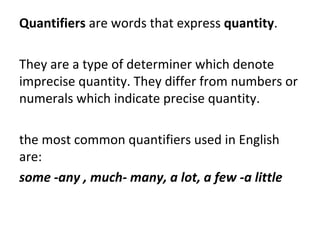
Quantifiers  are words that express  quantity .  They are a type of determiner which denote imprecise quantity. They differ from numbers or numerals which indicate precise quantity. the most common quantifiers used in English are: some -any , much- many, a lot, a few -a little
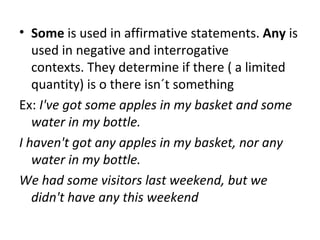
Some  is used in affirmative statements.  Any  is used in negative and interrogative contexts. They determine if there ( a limited quantity) is o there isn´t something Ex:  I've got some apples in my basket and some water in my bottle. I haven't got any apples in my basket, nor any water in my bottle. We had some visitors last weekend, but we didn't have any this weekend
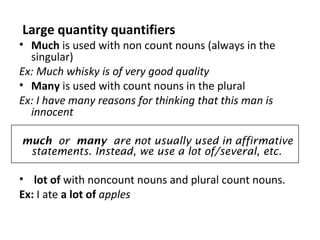
  Large quantity quantifiers Much  is used with non count nouns (always in the singular) Ex: Much whisky is of very good quality Many  is used with count nouns in the plural Ex: I have many reasons for thinking that this man is innocent    much  or  many  are not usually used in affirmative statements. Instead, we use a lot of/several, etc. lot of  with noncount nouns and plural count nouns. Ex:  I ate  a lot of   apples
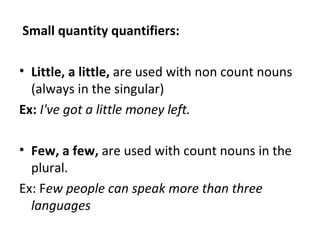
Small quantity quantifiers: Little, a little,  are used with non count nouns (always in the singular) Ex:  I've got a little money left. Few, a few,  are used with count nouns in the plural. Ex: F ew people can speak more than three languages
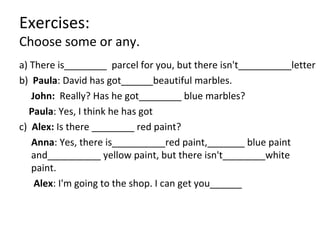
Exercises:  Choose some or any. a) There is________  parcel for you, but there isn't__________ letter b)   Paula : David has got______ beautiful marbles. John:   Really? Has he got________ blue marbles? Paula : Yes, I think he has got c)   Alex:  Is there ________ red paint? Anna : Yes, there is__________red paint,_______ blue paint and__________  yellow paint, but there isn't________ white paint.   Alex : I'm going to the shop. I can get you______
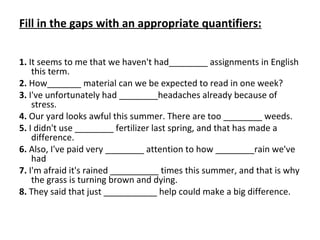
Fill in the gaps with an appropriate quantifiers: 1.  It seems to me that we haven't had________ assignments in English this term. 2.  How_______  material can we be expected to read in one week? 3.  I've unfortunately had ________ headaches already because of stress. 4.  Our yard looks awful this summer. There are too  ________ weeds. 5.  I didn't use ________  fertilizer last spring, and that has made a difference.   6.  Also, I've paid very ________  attention to how ________rain we've had 7.  I'm afraid it's rained __________ times this summer, and that is why the grass is turning brown and dying. 8.  They said that just ___________ help could make a big difference.
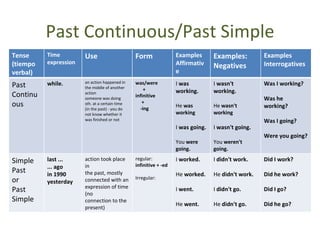
Past Continuous/Past Simple Tense (tiempo verbal) Time expression Use Form Examples Affirmative Examples: Negatives Examples Interrogatives Past Continuous while . an action happened in the middle of another action someone was doing sth. at a certain time (in the past) - you do not know whether it was finished or not was/were  +  infinitive  +  -ing I  was working. He  was working I  was going. You  were going. I  wasn't working. He  wasn't working I  wasn't going. You  weren't going. Was I working? Was he working? Was I going? Were you going? Simple Past or Past Simple last ... ... ago in 1990 yesterday action took place in the past, mostly connected with an expression of time (no connection to the present) regular: infinitive + -ed Irregular: I  worked. He  worked. I  went. He  went. I  didn't work. He  didn't work. I  didn't go. He  didn't go. Did I work? Did he work? Did I go? Did he go?
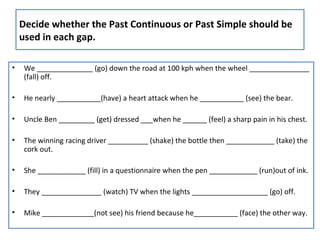
Decide whether the Past Continuous or Past Simple should be used in each gap. We ______________ (go) down the road at 100 kph when the wheel _______________ (fall) off. He nearly ___________(have) a heart attack when he ___________ (see) the bear. Uncle Ben _________ (get) dressed ___when he ______ (feel) a sharp pain in his chest. The winning racing driver __________ (shake) the bottle then ____________ (take) the cork out. She ____________ (fill) in a questionnaire when the pen ____________ (run)out of ink. They _______________ (watch) TV when the lights ___________________ (go) off. Mike _____________(not see) his friend because he___________ (face) the other way.

Quantifiers and past continuous

  • 1.
  • 2.
    Quantifiers arewords that express quantity . They are a type of determiner which denote imprecise quantity. They differ from numbers or numerals which indicate precise quantity. the most common quantifiers used in English are: some -any , much- many, a lot, a few -a little
  • 3.
    Some  is usedin affirmative statements. Any  is used in negative and interrogative contexts. They determine if there ( a limited quantity) is o there isn´t something Ex: I've got some apples in my basket and some water in my bottle. I haven't got any apples in my basket, nor any water in my bottle. We had some visitors last weekend, but we didn't have any this weekend
  • 4.
      Large quantityquantifiers Much  is used with non count nouns (always in the singular) Ex: Much whisky is of very good quality Many  is used with count nouns in the plural Ex: I have many reasons for thinking that this man is innocent    much  or  many  are not usually used in affirmative statements. Instead, we use a lot of/several, etc. lot of  with noncount nouns and plural count nouns. Ex: I ate  a lot of   apples
  • 5.
    Small quantity quantifiers:Little, a little, are used with non count nouns (always in the singular) Ex: I've got a little money left. Few, a few,  are used with count nouns in the plural. Ex: F ew people can speak more than three languages
  • 6.
    Exercises: Choosesome or any. a) There is________ parcel for you, but there isn't__________ letter b)  Paula : David has got______ beautiful marbles. John:   Really? Has he got________ blue marbles? Paula : Yes, I think he has got c)  Alex: Is there ________ red paint? Anna : Yes, there is__________red paint,_______ blue paint and__________ yellow paint, but there isn't________ white paint.   Alex : I'm going to the shop. I can get you______
  • 7.
    Fill in thegaps with an appropriate quantifiers: 1.  It seems to me that we haven't had________ assignments in English this term. 2.  How_______ material can we be expected to read in one week? 3.  I've unfortunately had ________ headaches already because of stress. 4.  Our yard looks awful this summer. There are too ________ weeds. 5.  I didn't use ________ fertilizer last spring, and that has made a difference. 6.  Also, I've paid very ________ attention to how ________rain we've had 7.  I'm afraid it's rained __________ times this summer, and that is why the grass is turning brown and dying. 8.  They said that just ___________ help could make a big difference.
  • 8.
    Past Continuous/Past SimpleTense (tiempo verbal) Time expression Use Form Examples Affirmative Examples: Negatives Examples Interrogatives Past Continuous while . an action happened in the middle of another action someone was doing sth. at a certain time (in the past) - you do not know whether it was finished or not was/were + infinitive + -ing I was working. He was working I was going. You were going. I wasn't working. He wasn't working I wasn't going. You weren't going. Was I working? Was he working? Was I going? Were you going? Simple Past or Past Simple last ... ... ago in 1990 yesterday action took place in the past, mostly connected with an expression of time (no connection to the present) regular: infinitive + -ed Irregular: I worked. He worked. I went. He went. I didn't work. He didn't work. I didn't go. He didn't go. Did I work? Did he work? Did I go? Did he go?
  • 9.
    Decide whether the PastContinuous or Past Simple should be used in each gap. We ______________ (go) down the road at 100 kph when the wheel _______________ (fall) off. He nearly ___________(have) a heart attack when he ___________ (see) the bear. Uncle Ben _________ (get) dressed ___when he ______ (feel) a sharp pain in his chest. The winning racing driver __________ (shake) the bottle then ____________ (take) the cork out. She ____________ (fill) in a questionnaire when the pen ____________ (run)out of ink. They _______________ (watch) TV when the lights ___________________ (go) off. Mike _____________(not see) his friend because he___________ (face) the other way.