Quantification of
Internal Carotid Artery Stenosis
        with Duplex US


            2011. 03. 31
          Hye seon Jeong
Carotid stenosis measured by
              ultrasound


• B-mode imaging of carotid plaques
• Color-coded flow imaging of carotid
  stenosis
• Angle corrected Doppler velocimetry of
  carotid stenosis
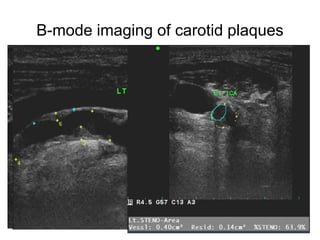
B-mode imaging of carotid plaques

                  • Intima-media
                    thickness (IMT)
                  • Fatty streak or
                    soft plaques
                  • Small non-
                    stenotic plaque
Plaque description

1. location
2. length
3. Composition – assessed for its;
   1. echogenicity (brightness)
   2. texture
   3. extent
   4. edge
4. surface of the lesion: smooth or irregular
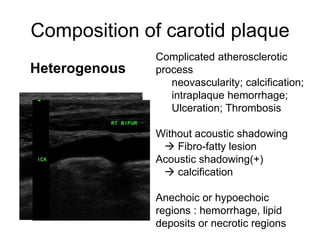
Composition of carotid plaque
               Complicated atherosclerotic
Heterogenous   process
                  neovascularity; calcification;
                  intraplaque hemorrhage;
                  Ulceration; Thrombosis

               Without acoustic shadowing
                 Fibro-fatty lesion
               Acoustic shadowing(+)
                 calcification

               Anechoic or hypoechoic
               regions : hemorrhage, lipid
               deposits or necrotic regions
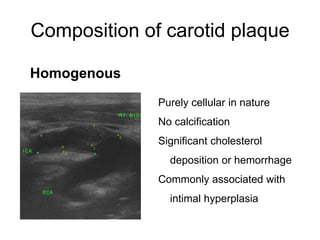
Composition of carotid plaque

Homogenous
              Purely cellular in nature
              No calcification
              Significant cholesterol
                deposition or hemorrhage
              Commonly associated with
                intimal hyperplasia
Advantages of B-mode grading of the
             carotid stenosis

• Quantification of early atherosclerotic changes
• Visualization of plaque structure and extent
• The possibility of ‘on-site’ diameter reduction
  measurements

• Disadvantages
   – common imaging artifact
       • inappropriate gain setting
       • shadowing due to calcium deposition and scattering
   – Inability to differentiate fresh clot from moving blood
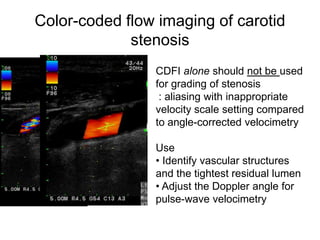
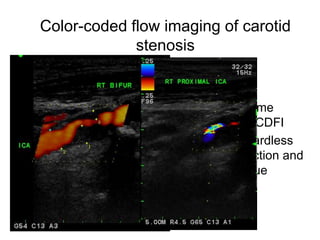
Color-coded flow imaging of carotid
             stenosis
                CDFI alone should not be used
                for grading of stenosis
                 : aliasing with inappropriate
                velocity scale setting compared
                to angle-corrected velocimetry

                Use
                • Identify vascular structures
                and the tightest residual lumen
                • Adjust the Doppler angle for
                pulse-wave velocimetry
Color-coded flow imaging of carotid
             stenosis

                   Power mode
                   • Used for same
                     purpose of CDFI
                   • display regardless
                     of flow direction and
                     velocity value
Angle corrected Doppler velocimetry
          of carotid stenosis
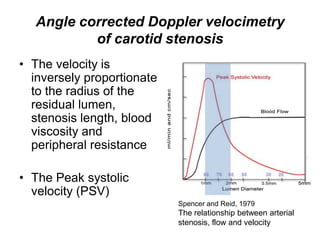
• The velocity is
  inversely proportionate
  to the radius of the
  residual lumen,
  stenosis length, blood
  viscosity and
  peripheral resistance

• The Peak systolic
  velocity (PSV)
                            Spencer and Reid, 1979
                            The relationship between arterial
                            stenosis, flow and velocity
Angle corrected Doppler velocimetry

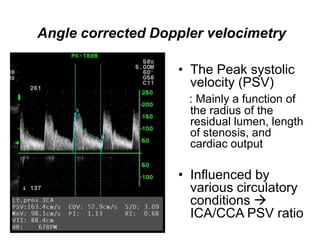
                   • The Peak systolic
                     velocity (PSV)
                     : Mainly a function of
                     the radius of the
                     residual lumen, length
                     of stenosis, and
                     cardiac output

                   • Influenced by
                     various circulatory
                     conditions 
                     ICA/CCA PSV ratio
Angle corrected Doppler velocimetry

• Advantages
  – Direct physiologic measurement of flow
    acceleration at the stenosis site
  – Widespread use
  – Availability of validated diagnostic criteria

• Disadvantages
  – Operator dependency
  – Velocity changes due to cardiac output, bilateral
    stenosis, flow volume reduction
  – Equipment dependency
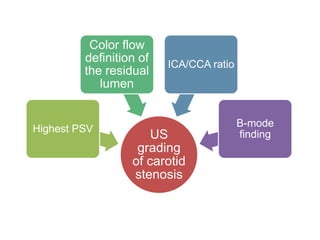
Color flow
         definition of   ICA/CCA ratio
         the residual
            lumen


                                         B-mode
Highest PSV
                      US                 finding
                   grading
                  of carotid
                  stenosis
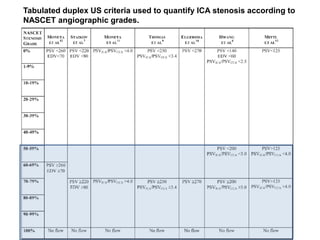
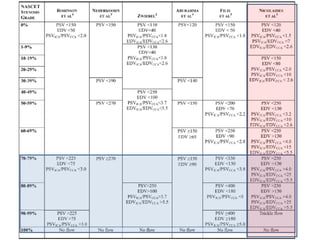
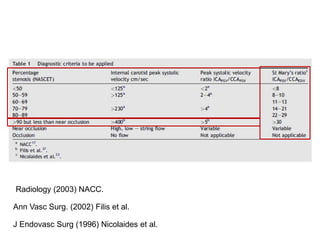
Tabulated duplex US criteria used to quantify ICA stenosis according to
NASCET angiographic grades.
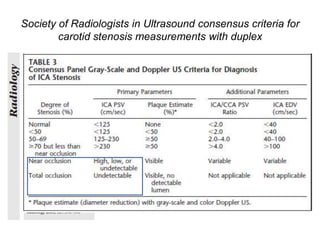
Society of Radiologists in Ultrasound consensus criteria for
        carotid stenosis measurements with duplex
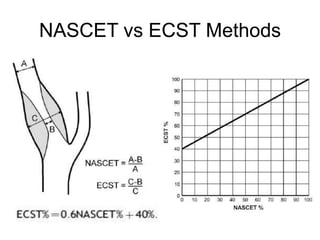
NASCET vs ECST Methods
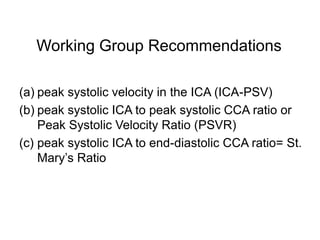
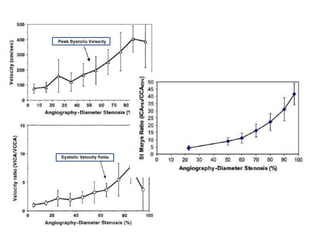
Working Group Recommendations

(a) peak systolic velocity in the ICA (ICA-PSV)
(b) peak systolic ICA to peak systolic CCA ratio or
    Peak Systolic Velocity Ratio (PSVR)
(c) peak systolic ICA to end-diastolic CCA ratio= St.
    Mary’s Ratio
Radiology (2003) NACC.

Ann Vasc Surg. (2002) Filis et al.

J Endovasc Surg (1996) Nicolaides et al.

Quantification of ica stenosis(정혜선) 20110331

  • 1.
    Quantification of Internal CarotidArtery Stenosis with Duplex US 2011. 03. 31 Hye seon Jeong
  • 2.
    Carotid stenosis measuredby ultrasound • B-mode imaging of carotid plaques • Color-coded flow imaging of carotid stenosis • Angle corrected Doppler velocimetry of carotid stenosis
  • 3.
    B-mode imaging ofcarotid plaques • Intima-media thickness (IMT) • Fatty streak or soft plaques • Small non- stenotic plaque
  • 4.
    Plaque description 1. location 2.length 3. Composition – assessed for its; 1. echogenicity (brightness) 2. texture 3. extent 4. edge 4. surface of the lesion: smooth or irregular
  • 5.
    Composition of carotidplaque Complicated atherosclerotic Heterogenous process neovascularity; calcification; intraplaque hemorrhage; Ulceration; Thrombosis Without acoustic shadowing  Fibro-fatty lesion Acoustic shadowing(+)  calcification Anechoic or hypoechoic regions : hemorrhage, lipid deposits or necrotic regions
  • 6.
    Composition of carotidplaque Homogenous Purely cellular in nature No calcification Significant cholesterol deposition or hemorrhage Commonly associated with intimal hyperplasia
  • 7.
    Advantages of B-modegrading of the carotid stenosis • Quantification of early atherosclerotic changes • Visualization of plaque structure and extent • The possibility of ‘on-site’ diameter reduction measurements • Disadvantages – common imaging artifact • inappropriate gain setting • shadowing due to calcium deposition and scattering – Inability to differentiate fresh clot from moving blood
  • 8.
    Color-coded flow imagingof carotid stenosis CDFI alone should not be used for grading of stenosis : aliasing with inappropriate velocity scale setting compared to angle-corrected velocimetry Use • Identify vascular structures and the tightest residual lumen • Adjust the Doppler angle for pulse-wave velocimetry
  • 9.
    Color-coded flow imagingof carotid stenosis Power mode • Used for same purpose of CDFI • display regardless of flow direction and velocity value
  • 10.
    Angle corrected Dopplervelocimetry of carotid stenosis • The velocity is inversely proportionate to the radius of the residual lumen, stenosis length, blood viscosity and peripheral resistance • The Peak systolic velocity (PSV) Spencer and Reid, 1979 The relationship between arterial stenosis, flow and velocity
  • 11.
    Angle corrected Dopplervelocimetry • The Peak systolic velocity (PSV) : Mainly a function of the radius of the residual lumen, length of stenosis, and cardiac output • Influenced by various circulatory conditions  ICA/CCA PSV ratio
  • 12.
    Angle corrected Dopplervelocimetry • Advantages – Direct physiologic measurement of flow acceleration at the stenosis site – Widespread use – Availability of validated diagnostic criteria • Disadvantages – Operator dependency – Velocity changes due to cardiac output, bilateral stenosis, flow volume reduction – Equipment dependency
  • 13.
    Color flow definition of ICA/CCA ratio the residual lumen B-mode Highest PSV US finding grading of carotid stenosis
  • 14.
    Tabulated duplex UScriteria used to quantify ICA stenosis according to NASCET angiographic grades.
  • 16.
    Society of Radiologistsin Ultrasound consensus criteria for carotid stenosis measurements with duplex
  • 18.
  • 19.
    Working Group Recommendations (a)peak systolic velocity in the ICA (ICA-PSV) (b) peak systolic ICA to peak systolic CCA ratio or Peak Systolic Velocity Ratio (PSVR) (c) peak systolic ICA to end-diastolic CCA ratio= St. Mary’s Ratio
  • 21.
    Radiology (2003) NACC. AnnVasc Surg. (2002) Filis et al. J Endovasc Surg (1996) Nicolaides et al.