
Quality in distance education:  a macro-analysis of recent trends and issues Terumi Miyazoe  Pusan, Korea, 2007/09/07
Outline Foci:  What is quality in distance education? Recent trends and research findings  Problems and issues for future research and practice Pusan, Korea, 2007/09/07
Limitation/Delimitation The information and data come largely from English sources. The scope of the presentation is specifically distance education.  Pusan, Korea, 2007/09/07
State of the issue Quality issues in distance education  Relatively new No fixed definition, approach, or framework yet  Pusan, Korea, 2007/09/07
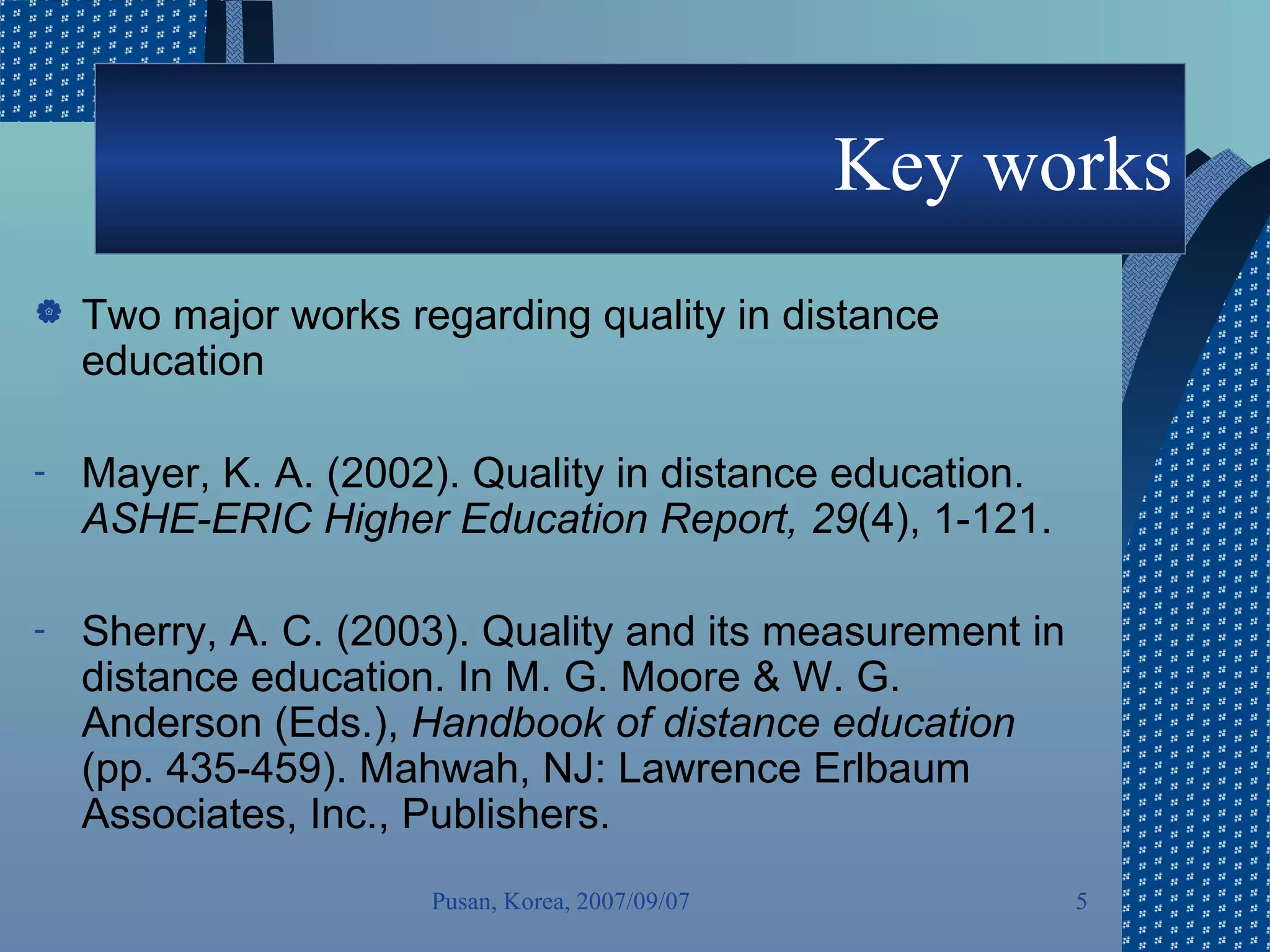
Key works Two major works regarding quality in distance education Mayer, K. A. (2002). Quality in distance education.  ASHE-ERIC Higher Education Report, 29 (4), 1-121. Sherry, A. C. (2003). Quality and its measurement in distance education. In M. G. Moore & W. G. Anderson (Eds.),  Handbook of distance education  (pp. 435-459). Mahwah, NJ: Lawrence Erlbaum Associates, Inc., Publishers.  Pusan, Korea, 2007/09/07
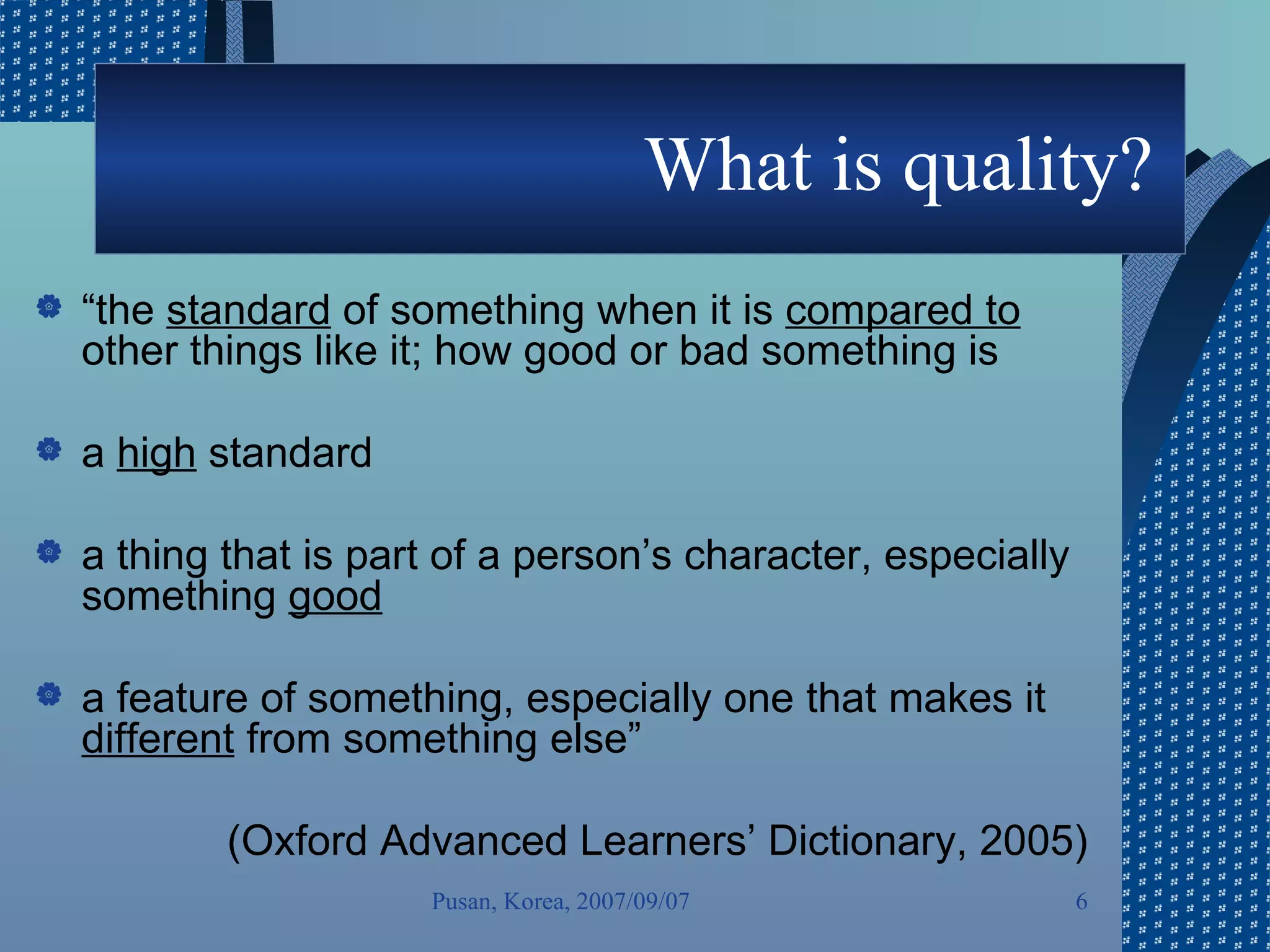
What is quality?  “ the  standard  of something when it is  compared to  other things like it; how good or bad something is a  high  standard a thing that is part of a person’s character, especially something  good a feature of something, especially one that makes it  different  from something else” (Oxford Advanced Learners’ Dictionary, 2005) Pusan, Korea, 2007/09/07
What is quality? (cont ’ d) The concept of quality includes  standard,  comparison,  goodness (or betterness), and  uniqueness.  Pusan, Korea, 2007/09/07
What is evaluation? Three common categories:  Relative vs. absolute evaluation  (Stake, 1967) Formative vs. summative evaluation (Scriven, 1967) Descriptive vs. judgmental evaluation (Cronbach, 1963; Scriven, 1967) Pusan, Korea, 2007/09/07
A framework Conceptualization of quality issues in distance education     Pusan, Korea, 2007/09/07
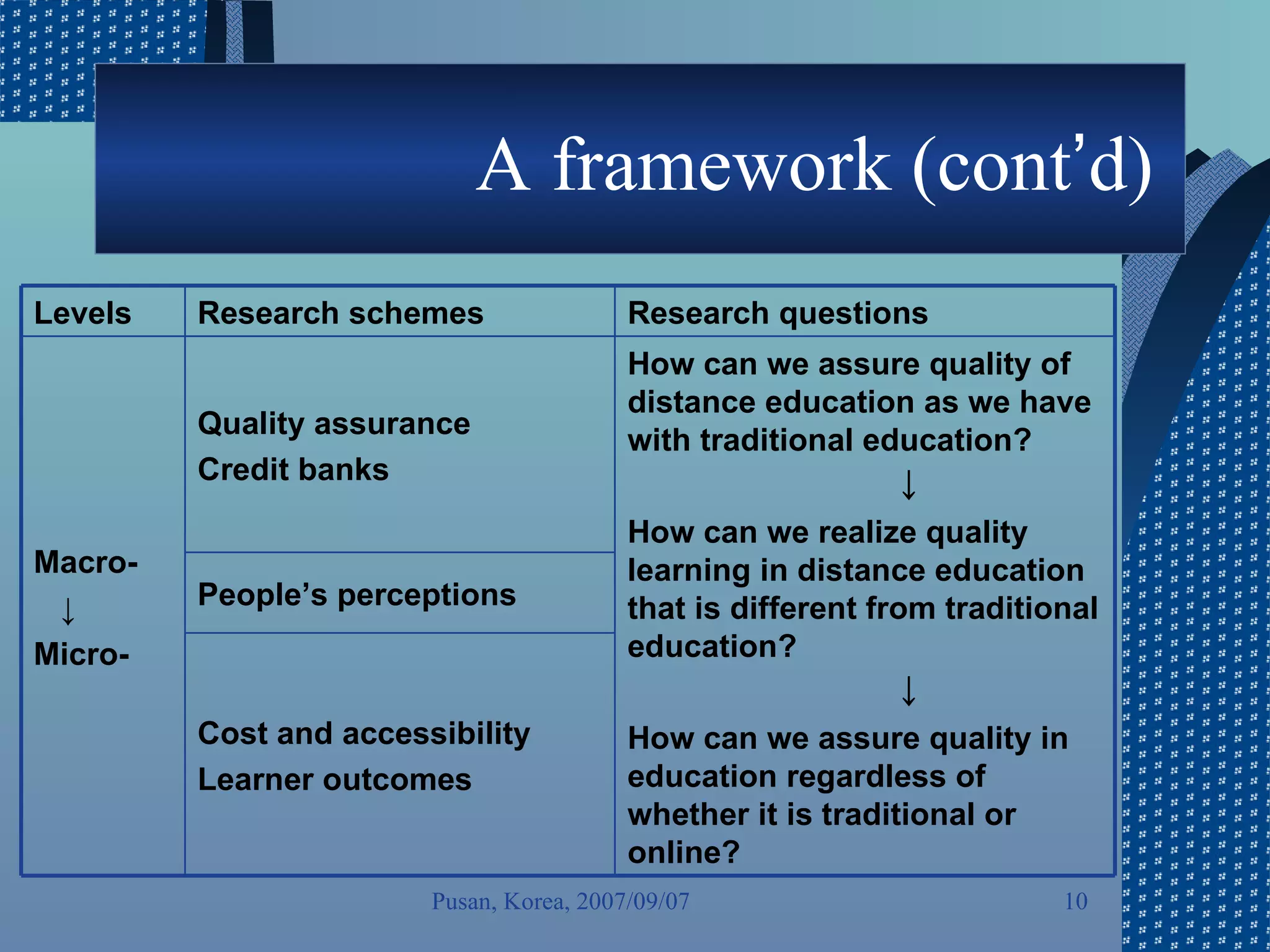
A framework (cont ’ d)  Pusan, Korea, 2007/09/07 Levels   Research schemes   Research questions   Macro- ↓ Micro-   Quality assurance  Credit banks   How can we assure quality of distance education as we have with traditional education?         ↓  How can we realize quality learning in distance education that is different from traditional education?          ↓  How can we assure quality in education regardless of whether it is traditional or online?   People’s perceptions   Cost and accessibility  Learner outcomes
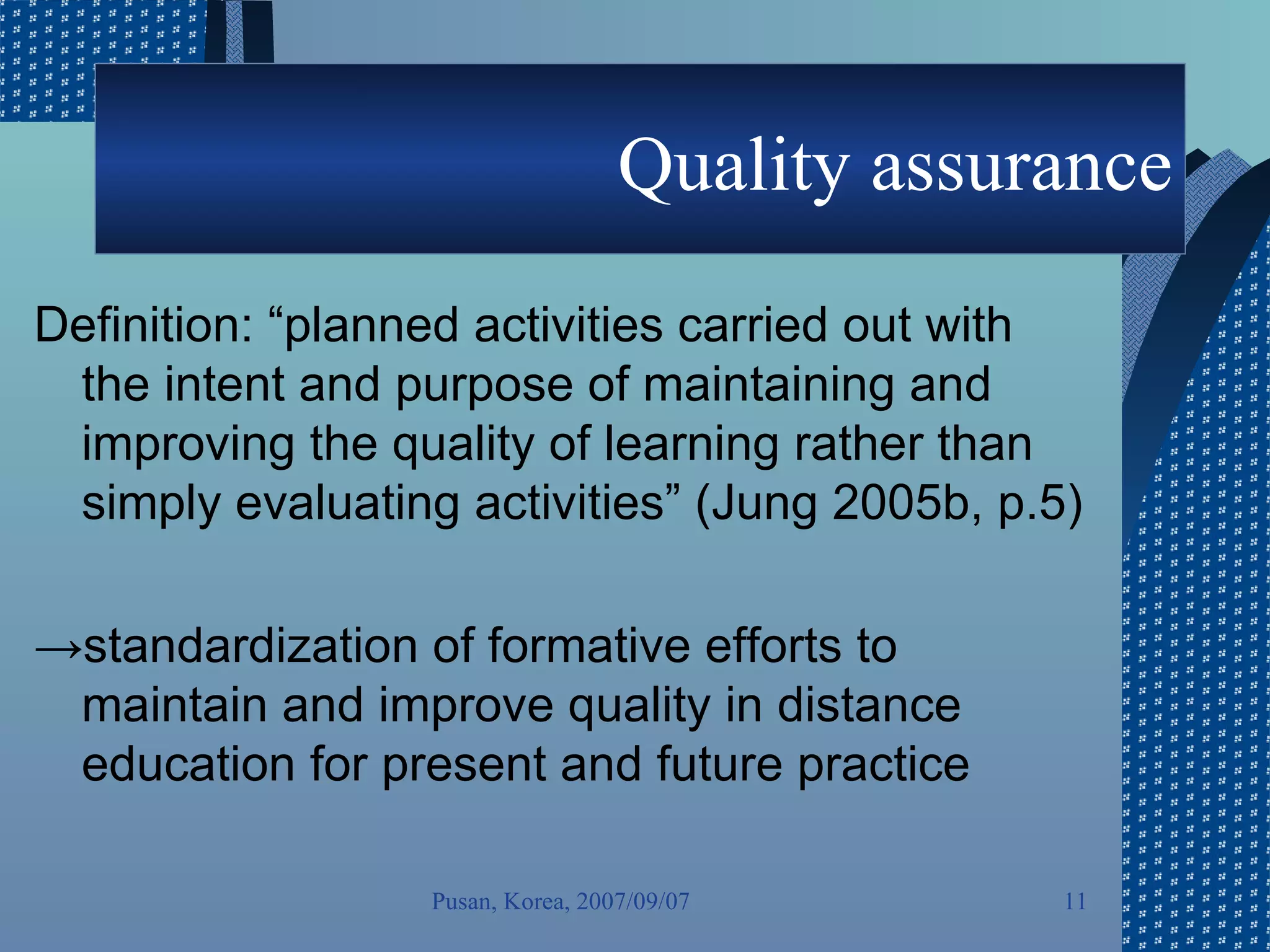
Quality assurance Definition: “planned activities carried out with the intent and purpose of maintaining and improving the quality of learning rather than simply evaluating activities” (Jung 2005b, p.5) -> standardization of formative efforts to maintain and improve quality in distance education for present and future practice Pusan, Korea, 2007/09/07
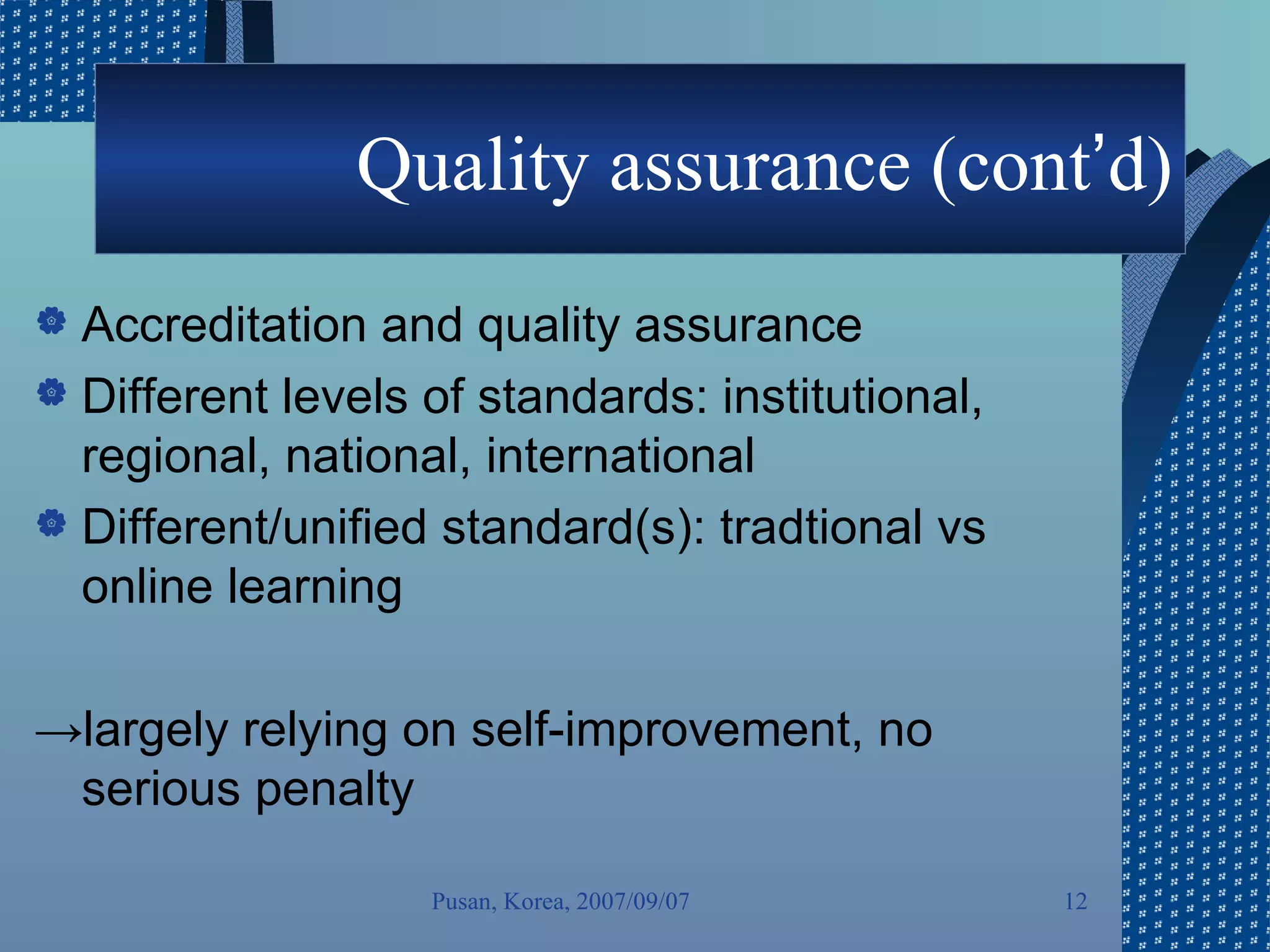
Quality assurance (cont ’ d) Accreditation and quality assurance Different levels of standards: institutional, regional, national, international Different/unified standard(s): tradtional vs online learning -> largely relying on self-improvement, no serious penalty Pusan, Korea, 2007/09/07
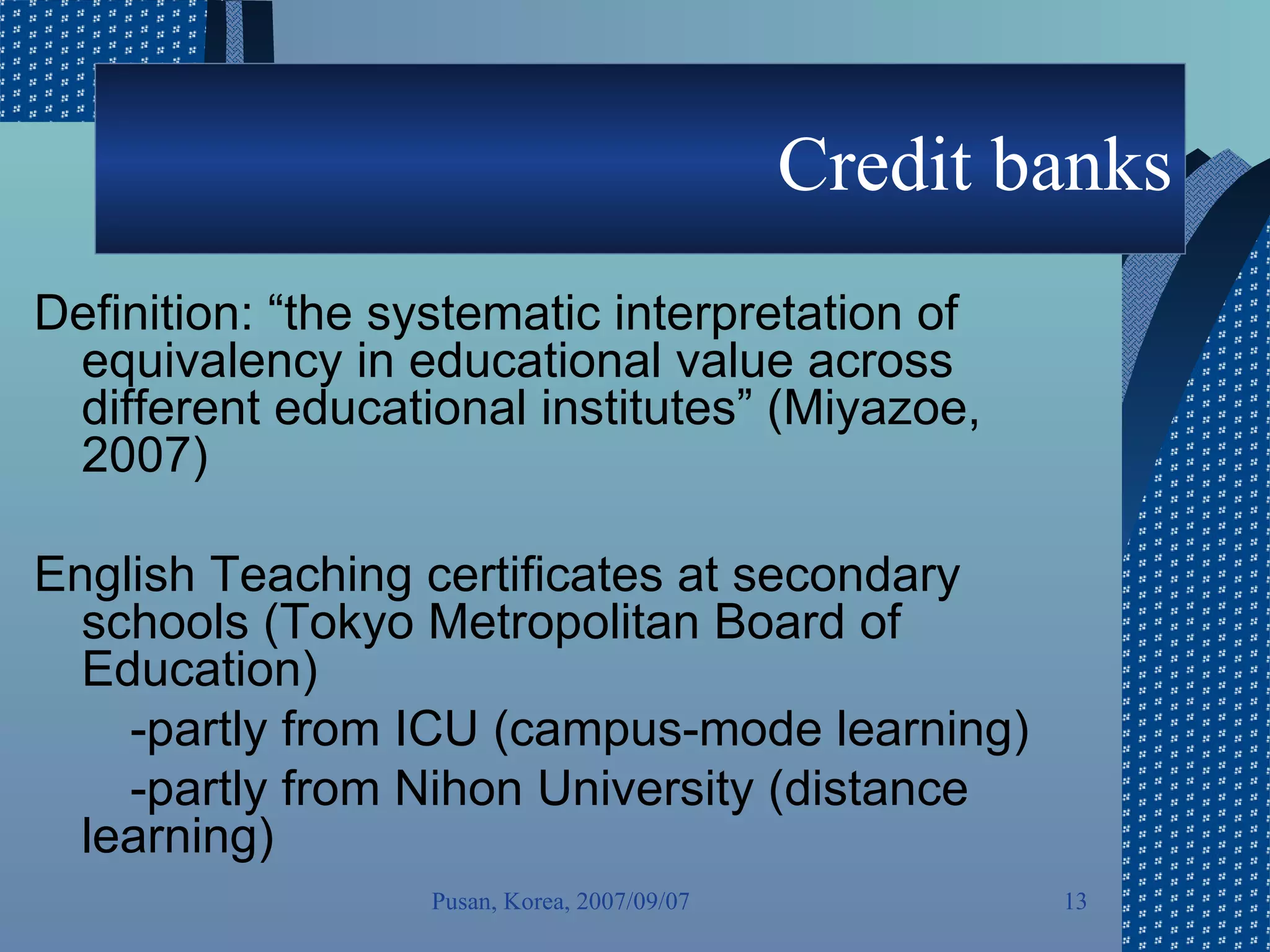
Credit banks Definition: “the systematic interpretation of equivalency in educational value across different educational institutes” (Miyazoe, 2007) English Teaching certificates at secondary schools (Tokyo Metropolitan Board of Education) -partly from ICU (campus-mode learning) -partly from Nihon University (distance learning) Pusan, Korea, 2007/09/07
Credit banks (cont ’ d) University Certificates, diplomas, degrees: NIAD-UE (National Institute for Academic Degrees and University Evaluation, Japan)  Risks of relying on the credit system of other country/countries National and international needs  ->  “ international credit banks” Pusan, Korea, 2007/09/07
People ’ s perceptions Historically, negative perceptions towards distance education and online learning - “Learning at the Back Door” (Wedemeyer, 1981)  - “Digital Diploma Mills”  (Nobel, 2001)  Pusan, Korea, 2007/09/07
People ’ s perceptions (cont ’ d) New trends towards distance education and online learning Sloan-C (Sloan Consortium) 2006 survey: 4,491 higher institutions in the US -> 62% of chief academic officers  believe  online learning is  equal or superio r to face-to-face learning  More and more degree seeking online programs open including master’s and doctoral levels in North America and Europe Pusan, Korea, 2007/09/07
Cost and accessibility External triangle of education (Daniel, 2003): quality, cost, and accessibility Productivity paradox  Opportunity cost  Pusan, Korea, 2007/09/07
Cost and accessibility (cont ’ d) Some counter-arguments  Very limited number of educational institutes can assure mega size (100,000+) enrollment Wider accessibility of  anyone anywhere anytime  philosophy   could conflict with the notion of  uniqueness Pusan, Korea, 2007/09/07
Learner outcomes Traditionally, people were skeptical about the effectiveness of distance education and online learning Lower academic readiness  Poor completion rates Pusan, Korea, 2007/09/07
Learner outcomes (cont ’ d) More results that support equal or higher learner outcomes of distance education and online learning than F2F learning No significant difference phenomenon (Russell, 1991) followed up by Phillips and Merisotis (1991) and Bernard et al. (2004) Pusan, Korea, 2007/09/07
Conclusions  “ How can we assure quality in education regardless of whether it is traditional or online?” Two axes of quality: betterness and uniqueness  Need for a framework unique to distance education Pusan, Korea, 2007/09/07
Thank you very much! Note: This presentation was later collected in International Journal of Media Education and Technology, 2/15-26, 2008  (http://members3.jcom.home.ne.jp/t.miyazoe/IJETM_2008_Miyazoe_final.pdf) Pusan, Korea, 2007/09/07

Quality in Distance Education

  • 1.
    Quality in distanceeducation: a macro-analysis of recent trends and issues Terumi Miyazoe Pusan, Korea, 2007/09/07
  • 2.
    Outline Foci: What is quality in distance education? Recent trends and research findings Problems and issues for future research and practice Pusan, Korea, 2007/09/07
  • 3.
    Limitation/Delimitation The informationand data come largely from English sources. The scope of the presentation is specifically distance education. Pusan, Korea, 2007/09/07
  • 4.
    State of theissue Quality issues in distance education Relatively new No fixed definition, approach, or framework yet Pusan, Korea, 2007/09/07
  • 5.
    Key works Twomajor works regarding quality in distance education Mayer, K. A. (2002). Quality in distance education. ASHE-ERIC Higher Education Report, 29 (4), 1-121. Sherry, A. C. (2003). Quality and its measurement in distance education. In M. G. Moore & W. G. Anderson (Eds.), Handbook of distance education (pp. 435-459). Mahwah, NJ: Lawrence Erlbaum Associates, Inc., Publishers. Pusan, Korea, 2007/09/07
  • 6.
    What is quality? “ the standard of something when it is compared to other things like it; how good or bad something is a high standard a thing that is part of a person’s character, especially something good a feature of something, especially one that makes it different from something else” (Oxford Advanced Learners’ Dictionary, 2005) Pusan, Korea, 2007/09/07
  • 7.
    What is quality?(cont ’ d) The concept of quality includes standard, comparison, goodness (or betterness), and uniqueness. Pusan, Korea, 2007/09/07
  • 8.
    What is evaluation?Three common categories: Relative vs. absolute evaluation (Stake, 1967) Formative vs. summative evaluation (Scriven, 1967) Descriptive vs. judgmental evaluation (Cronbach, 1963; Scriven, 1967) Pusan, Korea, 2007/09/07
  • 9.
    A framework Conceptualizationof quality issues in distance education   Pusan, Korea, 2007/09/07
  • 10.
    A framework (cont’ d) Pusan, Korea, 2007/09/07 Levels Research schemes Research questions Macro- ↓ Micro- Quality assurance Credit banks How can we assure quality of distance education as we have with traditional education?       ↓ How can we realize quality learning in distance education that is different from traditional education?         ↓ How can we assure quality in education regardless of whether it is traditional or online? People’s perceptions Cost and accessibility Learner outcomes
  • 11.
    Quality assurance Definition:“planned activities carried out with the intent and purpose of maintaining and improving the quality of learning rather than simply evaluating activities” (Jung 2005b, p.5) -> standardization of formative efforts to maintain and improve quality in distance education for present and future practice Pusan, Korea, 2007/09/07
  • 12.
    Quality assurance (cont’ d) Accreditation and quality assurance Different levels of standards: institutional, regional, national, international Different/unified standard(s): tradtional vs online learning -> largely relying on self-improvement, no serious penalty Pusan, Korea, 2007/09/07
  • 13.
    Credit banks Definition:“the systematic interpretation of equivalency in educational value across different educational institutes” (Miyazoe, 2007) English Teaching certificates at secondary schools (Tokyo Metropolitan Board of Education) -partly from ICU (campus-mode learning) -partly from Nihon University (distance learning) Pusan, Korea, 2007/09/07
  • 14.
    Credit banks (cont’ d) University Certificates, diplomas, degrees: NIAD-UE (National Institute for Academic Degrees and University Evaluation, Japan) Risks of relying on the credit system of other country/countries National and international needs ->  “ international credit banks” Pusan, Korea, 2007/09/07
  • 15.
    People ’ sperceptions Historically, negative perceptions towards distance education and online learning - “Learning at the Back Door” (Wedemeyer, 1981) - “Digital Diploma Mills” (Nobel, 2001) Pusan, Korea, 2007/09/07
  • 16.
    People ’ sperceptions (cont ’ d) New trends towards distance education and online learning Sloan-C (Sloan Consortium) 2006 survey: 4,491 higher institutions in the US -> 62% of chief academic officers believe online learning is equal or superio r to face-to-face learning More and more degree seeking online programs open including master’s and doctoral levels in North America and Europe Pusan, Korea, 2007/09/07
  • 17.
    Cost and accessibilityExternal triangle of education (Daniel, 2003): quality, cost, and accessibility Productivity paradox Opportunity cost Pusan, Korea, 2007/09/07
  • 18.
    Cost and accessibility(cont ’ d) Some counter-arguments Very limited number of educational institutes can assure mega size (100,000+) enrollment Wider accessibility of anyone anywhere anytime philosophy could conflict with the notion of uniqueness Pusan, Korea, 2007/09/07
  • 19.
    Learner outcomes Traditionally,people were skeptical about the effectiveness of distance education and online learning Lower academic readiness Poor completion rates Pusan, Korea, 2007/09/07
  • 20.
    Learner outcomes (cont’ d) More results that support equal or higher learner outcomes of distance education and online learning than F2F learning No significant difference phenomenon (Russell, 1991) followed up by Phillips and Merisotis (1991) and Bernard et al. (2004) Pusan, Korea, 2007/09/07
  • 21.
    Conclusions “How can we assure quality in education regardless of whether it is traditional or online?” Two axes of quality: betterness and uniqueness Need for a framework unique to distance education Pusan, Korea, 2007/09/07
  • 22.
    Thank you verymuch! Note: This presentation was later collected in International Journal of Media Education and Technology, 2/15-26, 2008 (http://members3.jcom.home.ne.jp/t.miyazoe/IJETM_2008_Miyazoe_final.pdf) Pusan, Korea, 2007/09/07