Qualitative Approaches
to Research
April
2007
Objectives
1. Distinguish qualitative research from quantitative
research.
2. Recognize uses of qualitative research for nursing.
3. Identify the processes of phenomenological, grounded
theory, ethnographic, and historical methods.
4. Recognize nursing phenomena that lend themselves to
use of case study methodology.
5. Identify research methodology emerging from nursing
theory.
6. Discuss significant issues that arise in conducting
qualitative research.
7. Apply the critiquing criteria to evaluate a report of
qualitative research.
By the end of this session, participants will be able
to:
4
Qualitative Research Definition
“Qualitative research involves broadly
stated questions about human
experiences and realities, studied
through sustained contact with people
in their natural environment,
generating rich, descriptive data that
help up to understand their
experiences" (Boyed, 1990).
5
Common Characteristics of
Qualitative Research
6
Qualitative Research Emphasizes
 A belief in multiple realities
 A commitment to identifying an approach to
understanding that will support the phenomenon
studied
 Commitment to the participants’ point of view
 Conduct of inquiry in a way that does not disturb
the natural context of the phenomena of interest
 Acknowledged participation of the researcher in
the research (acknowledged subjectivity)
 Conveyance of the understanding of phenomena
by reporting in a literary style rich with
participants’ commentary
11 12
22
17
36
0
5
10
15
20
25
30
35
40
1988 1989 1990 1991 1992
No. of Qualitative nursing research articles
published in four Journals, more than tripled
Comparison Of Researcher
Beliefs, Activities, &
Questions When Using
Quantitative & Qualitative
Research Approaches
9
Researcher beliefs when using
quantitative Vs. Qualitative approach
Humans are
biopsychosocially
(psychological,
physiological, social)
Truth is objective
reality that can be
experienced &
measured.
•Humans are complex beings.
Focusing on human experience
in naturalistic settings.
•Truth is the subjective
expression perceived by
participant, shared with
researcher.
10
Researcher activities when using
quantitative Vs Qualitative approach
 Selects a representative
sample, determine size
before data collection.
 Uses an extensive
approach to collect data.
 Questionnaires and
measurement devices to
be administered in one
setting by unbiased
individual to control
extraneous variables.
 Larger number of
subjects.
• Selects participants who are
experiencing the phenomenon of interest
and collects data until saturation.
• Uses an extensive approach to collect
data.
• Conducts interviews and participant or
nonparticipant observation in
environments.
• Smaller number of subjects.
11
Researcher activities when using
quantitative Vs Qualitative approach
 Eliminate extraneous
variables.
 Reliability and validity of
instruments and internal and
external validity permit
judgment of scientific rigor.
 Deductive analysis is used,
generating a numerical
summary that allows the
researcher to reject or accept
the null hypothesis. .
• Researcher is responsible to recognize
personal biases and set aside.
• Explores all dimensions of human
uniqueness.
• Creditability, auditability, fittingness, and
conformability permit judgment of scientific
rigor.
• Inductive analysis is used, leading to a
narrative summary, which synthesizes
participant information, creating a descriptive
of human experience.
12
Researcher activities when using
quantitative Vs Qualitative approach
 What is the
essential
structure of
the lived
experience of
postpartum
depression?
(Beck, 1992)
• What is the relationship between the incidence
of maternity blues during the first week after
birth and postpartum depression in primiparas
at 1, 6, and 12 weeks postpartum?
• What are the differences in the incidence and
severity of maternity blues and post partum
depression for women experiencing early hospital
discharge and those with customary lengths of
hospital discharge and those with customary
lengths of hospital stay?
(Beck, Reynolds & Rutowski, 1992)
Qualitative Research
Methods
14
 Phenomenological method
 Grounded theory method
 Ethnographic method
 Historical method
Basic Elements Of
Quantitative Or
Qualitative Research
Methods
16
1. Identifying the phenomenon
2. Structuring the study
3. Gathering the data
4. Analyzing the data
5. Describing the findings
Uses Of Qualitative
Research In Nursing
18
 It is suited to study human experience
of health.
 Guides nursing practice , contribute to
instrument & theory development and
to high quality care as well.
 Generate rich, descriptive data &
increase sensitivity to health
experiences.
19
 Serves the purpose of conceptualization or
theory development.
 Helps to uncover life processes that
contributed to the outcome.
 Helps to increase understanding and
provides a basis for intervention that may
enhance quality of life
Qualitative Research
Methods
I. Phenomenological
Method
22
Phenomenology is a science whose purpose is to describe
particular phenomena, or the appearance of things, as
lived experience
Lived experience of the world of every day life is the central
focus of phenomenological inquiry
It is a process of learning and constructing the meaning of
human experience through intensive dialogue with
persons who are living the experience.
Phenomenology is as much a way of
thinking or perceiving as it is a method of inquiry.
23
It's focus is the lived experience,
used to study some dimensions of
day to day existence for a
particular group of individuals.
e.g. ask people about their
experience because of cancer.
1. Identifying The Phenomenon
24
To describe structuring
- Research question: e.g. what is the experience of
hope for persons who have cancer?
(phenomenological lived experience)
- Researcher's perspective. the researcher’s
Perspective is bracketed.
The researcher is expected to set aside personal
biases researcher.
- Sample selection: will be living the experience
the researcher is querying.
2. Structuring The Study
25
3. Data Gathering
Written or oral data may be
collected when using the
phenomenological method.
26
4. Data Analysis
 Thorough reading and sensitive presence
with the entire transcription of the
participant's description.
 Identification of shifts in participant
thought.
 Specification of the significant phrases.
 Distillation of each significant phrase, with a
focus on the studied the phenomenon being.
 Final synthesis of all participants'
descriptions.
27
5. Describing The Findings
The researcher provides the reader with a
path of information leading from the
research question, through samples of
participant's significant phrases, researcher's
interpretation, and leading to the final
synthesis that elaborates the lived
experience.
II. Grounded Theory
Method
29
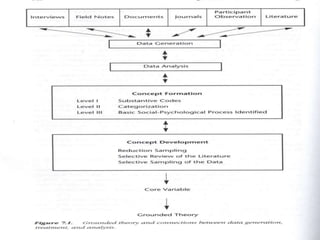
 It is a form of field research that explores and describes
phenomena in naturalistic settings
 It is an inductive approach that implements set of procedures to
arrive at theory about basic social processes.
 The goal of grounded theory investigations is discovery of
theoretically complete explanations about particular phenomena
 It holds that the relationship between self and theory is an
ongoing process of symbolic communication, whereby
individuals create a social reality.
31
Glaser developed the systematic approach
to the study of interactions, known as the
grounded theory method, to bridge a
perceived gap between theory and
research and consequent undervaluing of
the qualitative studies. (Glaser and Strauss, 1967)
32
1. Identifying The Phenomenon
Researchers uses the grounded
method when they are
interested in social processes
from the perspective of human
interactions.
33
2. Structuring The Study
 Research question. It can be a statement or a broad
question that permits in-depth explanation of the
phenomenon.
 Researchers' perspective. A study of the processes that
occur as individuals interact with others in the social
setting.
 Sample selection. Involves choosing participants who
are experiencing the circumstance, and selecting events
and incidents related to the social process under
investigation.
34
3.Data Gathering
Data are collected through interviews and
through skilled observations of individuals
interacting in a social setting. Interviews
are audiotaped and then transcribed, and
observations are recorded as field notes.
Open-ended questions are used initially to
identify concepts.
35
4. Data Analysis
The initial analytic process is called open
coding (Strauss, 1987). Data are examined
carefully line by line, broken down into
discrete parts, and compared for similarities
and differences (Strauss & Corbin, 1990).
Data are compared with other data
continuously.
36
5. Describing The Findings
It is reported in sufficient details to
provide the reader with the steps of
data collection, theoretical
sampling, constant comparison,
and three levels of coding to a
schematic model that depicts the
process. (Price 1993)
III. Ethnographical
Method
38
 Ethnography is the work of describing culture it means
learning from people
 It focuses on scientific description of cultural group.
Aims to understand the natives' view of their world.
 Culture is a set of abstract ideas-the patterns, values,
expectations, and traditions by which a group of
people order life.
 Fieldwork is the method that the researcher goes "into
the field to study a group of people and events in their
natural settings.
39
1. Identifying the Phenomenon
Ethnographic study will vary in
scope from a long-term study of a
very complex culture, the clinical
utility of ethnography in describing
the "local world" of groups of
patients who are experiencing a
particular phenomenon, such as
suffering. (Kleinman (1992)
40
2. Structuring the Study
 Research questions asked about life ways
or particular patterns of behavior within the
social context of a culture or subculture, that
allows the researcher to interpret or make sense of
their world (Aamodt, 1991).
 Researchers' perspective
Ethnographic make their own beliefs explicit
and bracket, or set aside, their personal
biases as they seek to understand the world
view of others (Parse et al., 1985).
41
 Sample Selection
The ethnographer selects a cultural group
who are living the phenomenon under
investigation (Parse, 1985).
The researcher gathers information from
general informants and from key
informants, who have special knowledge,
status, or communication skills, and who
are willing to teach the ethnographer about
phenomenon (Crabtree & Miller, 1992).
42
Ethnographic data gathering
involves:
 participant observation in the
setting
 informant interviews, and
 interpretation.
3. Data Gathering
43
There are three types of questions for
ethnographic inquiry:
 Descriptive, or broad, open-ended
questions;
 Structural, or in-depth questions that
expand and verify the unit of analysis;
 Contrast, or questions that further clarify
and provide criteria for exclusion.
44
Data analysis proceeds through
several levels as the researcher
looks for the meaning of cultural
symbols in the informants'
language.
4. Data Analysis
45
 Ethnographic studies yield large quantities of
data through observation, interview
transcriptions, and other artifacts, such as
photographs.
 When critiquing, be aware that the report finding
usually provides examples from data, through
description of the analytic process, & statement
of the hypothetical propositions & their
relationship to the ethnographer’s frame of
reference.
5. Describing The Findings
IV. Historical Method
47
 Historical method is defined as
"the systematic compilation of data and
critical presentation, evaluation and
interpretation of facts regarding people,
events and occurrences of the past“
Used to shed light on the past so that it can
guide the present and the future.
Ex. of historical research is the biography
48
1. Identifying the phenomenon
The historical method requires
that the phenomenon of interest
is a past event that can be
circumscribed to permit
distinction from other events.
49
2. Structuring the study
 Research question. When critiquing , expect to
find the research question embedded in the
phenomenon to be studied. The question is
implicitly rather than explicitly stated. How nurses
get caught in shifting social priorities?
 Researcher’s perspective. Researcher's first
responsibility is to understand the
information being acquired without imposing
her own interpretation & being aware of
personal biases that may color the
interpretation. (Christy, 1975)
50
Sample selection is accomplished by
identifying data sources. The more clearly a
researcher delineates the phenomenon, the
more specifically data sources can be
identified.
Data may include written or video documents,
interviews with persons who witnessed the
phenomenon, or photographs.
51
3. Data Gathering
The researcher will begin the process of
learning what is available, to determine
which data sources were used when
reviewing a published study, Baer (1992)
used official university documents,
diaries, newspapers and personal letters.
52
 Primary sources: are original
documents, films, diaries,
records, artifacts, periodicals, or
tapes.
 Secondary sources: provide a
view of the phenomenon from
another's perspective
53
4.Data Analysis
Data analyzed first for importance and
then for validity and reliability, to judge
importance, the researcher separates.
The unimportant data will be discarded
and data clear value are included. Mildly
interesting data require further review
before they are included or discarded.
54
Validity of documents is established by
external criticism; reliability is
established by internal criticism.
Primary source provides a more reliable
account than a secondary source.
55
Historical methods attempt to
establish:
1. Facts
2. Probability
3. Possibility
56
 Two independent primary sources that
agree with each other.
Or
 One independent primary source that
receives critical evaluation and one
independent secondary source that is in
agreement and receives critical
evaluation and no substantive
conflicting data.
Fact
57
Probability
 One primary source that receives critical
evaluation and no substantive conflicting
data.
OR
 Two primary sources that agree about
particular points.
58
Possibility
 One primary sources that provides
information but is not adequate to
receive critical evaluation.
OR
 Only secondary or tertiary sources.
59
5. Describing The Findings
The findings of study are presented as a
well-synthesized chronicle.
If the synthesis successful, the reader
thinks the research and the writing have
been effortless. Reader is not aware of
the painstaking work, to details.
60
The qualitative approach: Nursing methodology
 The qualitative methodology in nursing are
derived from other disciplines, such as
sociology, anthropology, and philosophy.
 Nurse theorists created research methods
specific to their theories to advance nursing
knowledge through inquiry that is congruent
with their theory.
61
Significant Issues In
Qualitative Research
62
The case method focuses on a selected
contemporary phenomenon over time
to provide an in depth description of
its essential dimensions and processes.
This is an underused methodology but
promising
Case Study Methodology:
63
Ethical issues present the demand for the
protection of human subjects in all
research steps
It involves issues related to the
naturalistic setting, research-participant
interaction, researcher as instrument,
and the emergent nature of the design.
Ethics
64
Naturalistic Setting
Some researchers using methods that rely on
participant observation may believe that
consent is not always possible or necessary.
Some researchers collect data without informing
participants
Such circumstances is most likely to occur when
collecting data in public settings, where the
researcher can easily gain entry as an accepted
member of the community without
explanation.
65
Relationship developed between the
researcher and participant may allow the
participant to expect other than research
behaviors.
The nature of the research-participant
interaction over time introduces the
possibility that the research experience
becomes a therapeutic one
Researcher-Participant Interaction:
66
The researcher is the study instrument,
collecting data and interpreting the
participant's reality.
The researcher may return to the subjects
at critical interpretive points and ask for
clarification or validation
Research As Instrument
67
The emergent nature of the research design creates a
need for ongoing negotiation of consent with the
participant
In the course of study, situations change and what was
agreeable at the beginning may become intrusive
Planning for questioning and observation emerges
over the time of the study. So it is difficult to inform
the participant precisely of potential threats before
he or she agrees to participate.
Emergent Nature Of Design
68
Credibility, Auditability, fittingness
Quantitative studies use reliability and
validity of instruments as well as internal
and external validity criteria, as measures
of scientific rigor
In qualitative research, scientific rigor is
judged by: credibility, auditability,
fittingness and confirmability
Credibility: truth of findings judged by
participants and others within the discipline.
Auditability: Accountability as judged by the
adequacy of information leading the reader
from the research question and raw data
through various steps of analysis to the
interpretation of findings.
Fittingness: faithfulness to everyday reality
of the participants, described in enough
detail so that others in the discipline can
evaluate importance for their own
practice, research, and theory
development.
Confirmability: findings that reflect
implementation of creditability,
Auditability, and fittingness standards.
71
Combining Qualitative & Quantitative Approaches
There has been debate about combining
qualitative and quantitative approaches
(Boyed, 1990). Leininger (1992) offers
two principles to guide the researcher in
this matter:
 The researcher should not mix research
methods across approaches because it
violates the integrity of the approach;
 It is acceptable & desirable to mix
methods within an approach.
72
Morse (1991) provided another view
that methods from two approaches
may be combined , the combination
of methods is labeled simultaneous
or sequential triangulation.
73
A. Simultaneous triangulation is the
combination of qualitative & quantitative or
quantitative & qualitative methods in one
study at the same time used to provide
complementary information &
to test hypotheses
e.g. the researcher interested in the experience
of feeling depressed after loss of a spouse.
74
B. Sequential triangulation. one
approach precedes the other. Morse is like
Leininger in her emphasis that findings
from each approach complement each other.
E.g. Qualitative → Quantitative
or
Quantitative → Qualitative
75
Computer Management Of Qualitative Data
 Data preparation: entry of data from field
notes, interviews, and various other sources ;
cleaning of data to assure that spelling is
correct and data are easy to evaluate.
 Data identification: dividing data into
meaningful segments for analysis/synthesis.
 Data manipulation: searching for particular
words or phrases and sorting them from the
text.
76
Thank You

dokumen.tips_qualitative-approaches-to-research-april-2007-objectives.ppt

  • 1.
  • 2.
  • 3.
    1. Distinguish qualitativeresearch from quantitative research. 2. Recognize uses of qualitative research for nursing. 3. Identify the processes of phenomenological, grounded theory, ethnographic, and historical methods. 4. Recognize nursing phenomena that lend themselves to use of case study methodology. 5. Identify research methodology emerging from nursing theory. 6. Discuss significant issues that arise in conducting qualitative research. 7. Apply the critiquing criteria to evaluate a report of qualitative research. By the end of this session, participants will be able to:
  • 4.
    4 Qualitative Research Definition “Qualitativeresearch involves broadly stated questions about human experiences and realities, studied through sustained contact with people in their natural environment, generating rich, descriptive data that help up to understand their experiences" (Boyed, 1990).
  • 5.
  • 6.
    6 Qualitative Research Emphasizes A belief in multiple realities  A commitment to identifying an approach to understanding that will support the phenomenon studied  Commitment to the participants’ point of view  Conduct of inquiry in a way that does not disturb the natural context of the phenomena of interest  Acknowledged participation of the researcher in the research (acknowledged subjectivity)  Conveyance of the understanding of phenomena by reporting in a literary style rich with participants’ commentary
  • 7.
    11 12 22 17 36 0 5 10 15 20 25 30 35 40 1988 19891990 1991 1992 No. of Qualitative nursing research articles published in four Journals, more than tripled
  • 8.
    Comparison Of Researcher Beliefs,Activities, & Questions When Using Quantitative & Qualitative Research Approaches
  • 9.
    9 Researcher beliefs whenusing quantitative Vs. Qualitative approach Humans are biopsychosocially (psychological, physiological, social) Truth is objective reality that can be experienced & measured. •Humans are complex beings. Focusing on human experience in naturalistic settings. •Truth is the subjective expression perceived by participant, shared with researcher.
  • 10.
    10 Researcher activities whenusing quantitative Vs Qualitative approach  Selects a representative sample, determine size before data collection.  Uses an extensive approach to collect data.  Questionnaires and measurement devices to be administered in one setting by unbiased individual to control extraneous variables.  Larger number of subjects. • Selects participants who are experiencing the phenomenon of interest and collects data until saturation. • Uses an extensive approach to collect data. • Conducts interviews and participant or nonparticipant observation in environments. • Smaller number of subjects.
  • 11.
    11 Researcher activities whenusing quantitative Vs Qualitative approach  Eliminate extraneous variables.  Reliability and validity of instruments and internal and external validity permit judgment of scientific rigor.  Deductive analysis is used, generating a numerical summary that allows the researcher to reject or accept the null hypothesis. . • Researcher is responsible to recognize personal biases and set aside. • Explores all dimensions of human uniqueness. • Creditability, auditability, fittingness, and conformability permit judgment of scientific rigor. • Inductive analysis is used, leading to a narrative summary, which synthesizes participant information, creating a descriptive of human experience.
  • 12.
    12 Researcher activities whenusing quantitative Vs Qualitative approach  What is the essential structure of the lived experience of postpartum depression? (Beck, 1992) • What is the relationship between the incidence of maternity blues during the first week after birth and postpartum depression in primiparas at 1, 6, and 12 weeks postpartum? • What are the differences in the incidence and severity of maternity blues and post partum depression for women experiencing early hospital discharge and those with customary lengths of hospital discharge and those with customary lengths of hospital stay? (Beck, Reynolds & Rutowski, 1992)
  • 13.
  • 14.
    14  Phenomenological method Grounded theory method  Ethnographic method  Historical method
  • 15.
    Basic Elements Of QuantitativeOr Qualitative Research Methods
  • 16.
    16 1. Identifying thephenomenon 2. Structuring the study 3. Gathering the data 4. Analyzing the data 5. Describing the findings
  • 17.
  • 18.
    18  It issuited to study human experience of health.  Guides nursing practice , contribute to instrument & theory development and to high quality care as well.  Generate rich, descriptive data & increase sensitivity to health experiences.
  • 19.
    19  Serves thepurpose of conceptualization or theory development.  Helps to uncover life processes that contributed to the outcome.  Helps to increase understanding and provides a basis for intervention that may enhance quality of life
  • 20.
  • 21.
  • 22.
    22 Phenomenology is ascience whose purpose is to describe particular phenomena, or the appearance of things, as lived experience Lived experience of the world of every day life is the central focus of phenomenological inquiry It is a process of learning and constructing the meaning of human experience through intensive dialogue with persons who are living the experience. Phenomenology is as much a way of thinking or perceiving as it is a method of inquiry.
  • 23.
    23 It's focus isthe lived experience, used to study some dimensions of day to day existence for a particular group of individuals. e.g. ask people about their experience because of cancer. 1. Identifying The Phenomenon
  • 24.
    24 To describe structuring -Research question: e.g. what is the experience of hope for persons who have cancer? (phenomenological lived experience) - Researcher's perspective. the researcher’s Perspective is bracketed. The researcher is expected to set aside personal biases researcher. - Sample selection: will be living the experience the researcher is querying. 2. Structuring The Study
  • 25.
    25 3. Data Gathering Writtenor oral data may be collected when using the phenomenological method.
  • 26.
    26 4. Data Analysis Thorough reading and sensitive presence with the entire transcription of the participant's description.  Identification of shifts in participant thought.  Specification of the significant phrases.  Distillation of each significant phrase, with a focus on the studied the phenomenon being.  Final synthesis of all participants' descriptions.
  • 27.
    27 5. Describing TheFindings The researcher provides the reader with a path of information leading from the research question, through samples of participant's significant phrases, researcher's interpretation, and leading to the final synthesis that elaborates the lived experience.
  • 28.
  • 29.
    29  It isa form of field research that explores and describes phenomena in naturalistic settings  It is an inductive approach that implements set of procedures to arrive at theory about basic social processes.  The goal of grounded theory investigations is discovery of theoretically complete explanations about particular phenomena  It holds that the relationship between self and theory is an ongoing process of symbolic communication, whereby individuals create a social reality.
  • 31.
    31 Glaser developed thesystematic approach to the study of interactions, known as the grounded theory method, to bridge a perceived gap between theory and research and consequent undervaluing of the qualitative studies. (Glaser and Strauss, 1967)
  • 32.
    32 1. Identifying ThePhenomenon Researchers uses the grounded method when they are interested in social processes from the perspective of human interactions.
  • 33.
    33 2. Structuring TheStudy  Research question. It can be a statement or a broad question that permits in-depth explanation of the phenomenon.  Researchers' perspective. A study of the processes that occur as individuals interact with others in the social setting.  Sample selection. Involves choosing participants who are experiencing the circumstance, and selecting events and incidents related to the social process under investigation.
  • 34.
    34 3.Data Gathering Data arecollected through interviews and through skilled observations of individuals interacting in a social setting. Interviews are audiotaped and then transcribed, and observations are recorded as field notes. Open-ended questions are used initially to identify concepts.
  • 35.
    35 4. Data Analysis Theinitial analytic process is called open coding (Strauss, 1987). Data are examined carefully line by line, broken down into discrete parts, and compared for similarities and differences (Strauss & Corbin, 1990). Data are compared with other data continuously.
  • 36.
    36 5. Describing TheFindings It is reported in sufficient details to provide the reader with the steps of data collection, theoretical sampling, constant comparison, and three levels of coding to a schematic model that depicts the process. (Price 1993)
  • 37.
  • 38.
    38  Ethnography isthe work of describing culture it means learning from people  It focuses on scientific description of cultural group. Aims to understand the natives' view of their world.  Culture is a set of abstract ideas-the patterns, values, expectations, and traditions by which a group of people order life.  Fieldwork is the method that the researcher goes "into the field to study a group of people and events in their natural settings.
  • 39.
    39 1. Identifying thePhenomenon Ethnographic study will vary in scope from a long-term study of a very complex culture, the clinical utility of ethnography in describing the "local world" of groups of patients who are experiencing a particular phenomenon, such as suffering. (Kleinman (1992)
  • 40.
    40 2. Structuring theStudy  Research questions asked about life ways or particular patterns of behavior within the social context of a culture or subculture, that allows the researcher to interpret or make sense of their world (Aamodt, 1991).  Researchers' perspective Ethnographic make their own beliefs explicit and bracket, or set aside, their personal biases as they seek to understand the world view of others (Parse et al., 1985).
  • 41.
    41  Sample Selection Theethnographer selects a cultural group who are living the phenomenon under investigation (Parse, 1985). The researcher gathers information from general informants and from key informants, who have special knowledge, status, or communication skills, and who are willing to teach the ethnographer about phenomenon (Crabtree & Miller, 1992).
  • 42.
    42 Ethnographic data gathering involves: participant observation in the setting  informant interviews, and  interpretation. 3. Data Gathering
  • 43.
    43 There are threetypes of questions for ethnographic inquiry:  Descriptive, or broad, open-ended questions;  Structural, or in-depth questions that expand and verify the unit of analysis;  Contrast, or questions that further clarify and provide criteria for exclusion.
  • 44.
    44 Data analysis proceedsthrough several levels as the researcher looks for the meaning of cultural symbols in the informants' language. 4. Data Analysis
  • 45.
    45  Ethnographic studiesyield large quantities of data through observation, interview transcriptions, and other artifacts, such as photographs.  When critiquing, be aware that the report finding usually provides examples from data, through description of the analytic process, & statement of the hypothetical propositions & their relationship to the ethnographer’s frame of reference. 5. Describing The Findings
  • 46.
  • 47.
    47  Historical methodis defined as "the systematic compilation of data and critical presentation, evaluation and interpretation of facts regarding people, events and occurrences of the past“ Used to shed light on the past so that it can guide the present and the future. Ex. of historical research is the biography
  • 48.
    48 1. Identifying thephenomenon The historical method requires that the phenomenon of interest is a past event that can be circumscribed to permit distinction from other events.
  • 49.
    49 2. Structuring thestudy  Research question. When critiquing , expect to find the research question embedded in the phenomenon to be studied. The question is implicitly rather than explicitly stated. How nurses get caught in shifting social priorities?  Researcher’s perspective. Researcher's first responsibility is to understand the information being acquired without imposing her own interpretation & being aware of personal biases that may color the interpretation. (Christy, 1975)
  • 50.
    50 Sample selection isaccomplished by identifying data sources. The more clearly a researcher delineates the phenomenon, the more specifically data sources can be identified. Data may include written or video documents, interviews with persons who witnessed the phenomenon, or photographs.
  • 51.
    51 3. Data Gathering Theresearcher will begin the process of learning what is available, to determine which data sources were used when reviewing a published study, Baer (1992) used official university documents, diaries, newspapers and personal letters.
  • 52.
    52  Primary sources:are original documents, films, diaries, records, artifacts, periodicals, or tapes.  Secondary sources: provide a view of the phenomenon from another's perspective
  • 53.
    53 4.Data Analysis Data analyzedfirst for importance and then for validity and reliability, to judge importance, the researcher separates. The unimportant data will be discarded and data clear value are included. Mildly interesting data require further review before they are included or discarded.
  • 54.
    54 Validity of documentsis established by external criticism; reliability is established by internal criticism. Primary source provides a more reliable account than a secondary source.
  • 55.
    55 Historical methods attemptto establish: 1. Facts 2. Probability 3. Possibility
  • 56.
    56  Two independentprimary sources that agree with each other. Or  One independent primary source that receives critical evaluation and one independent secondary source that is in agreement and receives critical evaluation and no substantive conflicting data. Fact
  • 57.
    57 Probability  One primarysource that receives critical evaluation and no substantive conflicting data. OR  Two primary sources that agree about particular points.
  • 58.
    58 Possibility  One primarysources that provides information but is not adequate to receive critical evaluation. OR  Only secondary or tertiary sources.
  • 59.
    59 5. Describing TheFindings The findings of study are presented as a well-synthesized chronicle. If the synthesis successful, the reader thinks the research and the writing have been effortless. Reader is not aware of the painstaking work, to details.
  • 60.
    60 The qualitative approach:Nursing methodology  The qualitative methodology in nursing are derived from other disciplines, such as sociology, anthropology, and philosophy.  Nurse theorists created research methods specific to their theories to advance nursing knowledge through inquiry that is congruent with their theory.
  • 61.
  • 62.
    62 The case methodfocuses on a selected contemporary phenomenon over time to provide an in depth description of its essential dimensions and processes. This is an underused methodology but promising Case Study Methodology:
  • 63.
    63 Ethical issues presentthe demand for the protection of human subjects in all research steps It involves issues related to the naturalistic setting, research-participant interaction, researcher as instrument, and the emergent nature of the design. Ethics
  • 64.
    64 Naturalistic Setting Some researchersusing methods that rely on participant observation may believe that consent is not always possible or necessary. Some researchers collect data without informing participants Such circumstances is most likely to occur when collecting data in public settings, where the researcher can easily gain entry as an accepted member of the community without explanation.
  • 65.
    65 Relationship developed betweenthe researcher and participant may allow the participant to expect other than research behaviors. The nature of the research-participant interaction over time introduces the possibility that the research experience becomes a therapeutic one Researcher-Participant Interaction:
  • 66.
    66 The researcher isthe study instrument, collecting data and interpreting the participant's reality. The researcher may return to the subjects at critical interpretive points and ask for clarification or validation Research As Instrument
  • 67.
    67 The emergent natureof the research design creates a need for ongoing negotiation of consent with the participant In the course of study, situations change and what was agreeable at the beginning may become intrusive Planning for questioning and observation emerges over the time of the study. So it is difficult to inform the participant precisely of potential threats before he or she agrees to participate. Emergent Nature Of Design
  • 68.
    68 Credibility, Auditability, fittingness Quantitativestudies use reliability and validity of instruments as well as internal and external validity criteria, as measures of scientific rigor In qualitative research, scientific rigor is judged by: credibility, auditability, fittingness and confirmability
  • 69.
    Credibility: truth offindings judged by participants and others within the discipline. Auditability: Accountability as judged by the adequacy of information leading the reader from the research question and raw data through various steps of analysis to the interpretation of findings.
  • 70.
    Fittingness: faithfulness toeveryday reality of the participants, described in enough detail so that others in the discipline can evaluate importance for their own practice, research, and theory development. Confirmability: findings that reflect implementation of creditability, Auditability, and fittingness standards.
  • 71.
    71 Combining Qualitative &Quantitative Approaches There has been debate about combining qualitative and quantitative approaches (Boyed, 1990). Leininger (1992) offers two principles to guide the researcher in this matter:  The researcher should not mix research methods across approaches because it violates the integrity of the approach;  It is acceptable & desirable to mix methods within an approach.
  • 72.
    72 Morse (1991) providedanother view that methods from two approaches may be combined , the combination of methods is labeled simultaneous or sequential triangulation.
  • 73.
    73 A. Simultaneous triangulationis the combination of qualitative & quantitative or quantitative & qualitative methods in one study at the same time used to provide complementary information & to test hypotheses e.g. the researcher interested in the experience of feeling depressed after loss of a spouse.
  • 74.
    74 B. Sequential triangulation.one approach precedes the other. Morse is like Leininger in her emphasis that findings from each approach complement each other. E.g. Qualitative → Quantitative or Quantitative → Qualitative
  • 75.
    75 Computer Management OfQualitative Data  Data preparation: entry of data from field notes, interviews, and various other sources ; cleaning of data to assure that spelling is correct and data are easy to evaluate.  Data identification: dividing data into meaningful segments for analysis/synthesis.  Data manipulation: searching for particular words or phrases and sorting them from the text.
  • 76.