Qualitative Data Documentation Management
Analysis and Report Writing
Dr. A. K. M. Dawlat Khan, PhD
Institute of Epidemiology, Disease Control and
Research (IEDCR)
akmdawlatkhan@gmail.com
01712-171214
Discussion topics
 Qualitative data
 Qualitative data documentation management and
analysis
Qualitative Data
What is qualitative data?
 Data that are related to concepts, opinions, values
and behaviours of people in social context
 Transcripts of individual interviews and focus
groups, field notes from observation of certain
activities, copies of documents, audio/video
recordings..
Types of Qualitative Data
 Structure text (writings, stories, survey comments,
news articles, books, etc)
 Unstructured text ( transcription, interviews focus
group, conversion)
 Audio recording, music
 Video recordings (graphics, art, pictures, visuals)
 Voice Recorder
 Camera(Photo and Video)
 Notebook/diary
 Voice Recorder verses Notebook/diary
Data Documentation
Qualitative data management and analysis
What is qualitative data analysis?
 Qualitative Data Analysis (QDA) is the range of
processes and procedures whereby we move from the
qualitative data that have been collected into some
form of explanation, understanding or interpretation
of people and situations we are investigating.
 QDA is usually based on an interpretative
philosophy. The idea is to examine the meaningful
and symbolic content of qualitative data.
The process of qualitative data analysis
 Organize the data
 Identify Framework
 Sort data in to framework
 Use the framework for descriptive analysis
 Second order analysis
Step 1: Organize the data
 Transcribe the data
 Translate the data
 Data cleaning
 Label the data
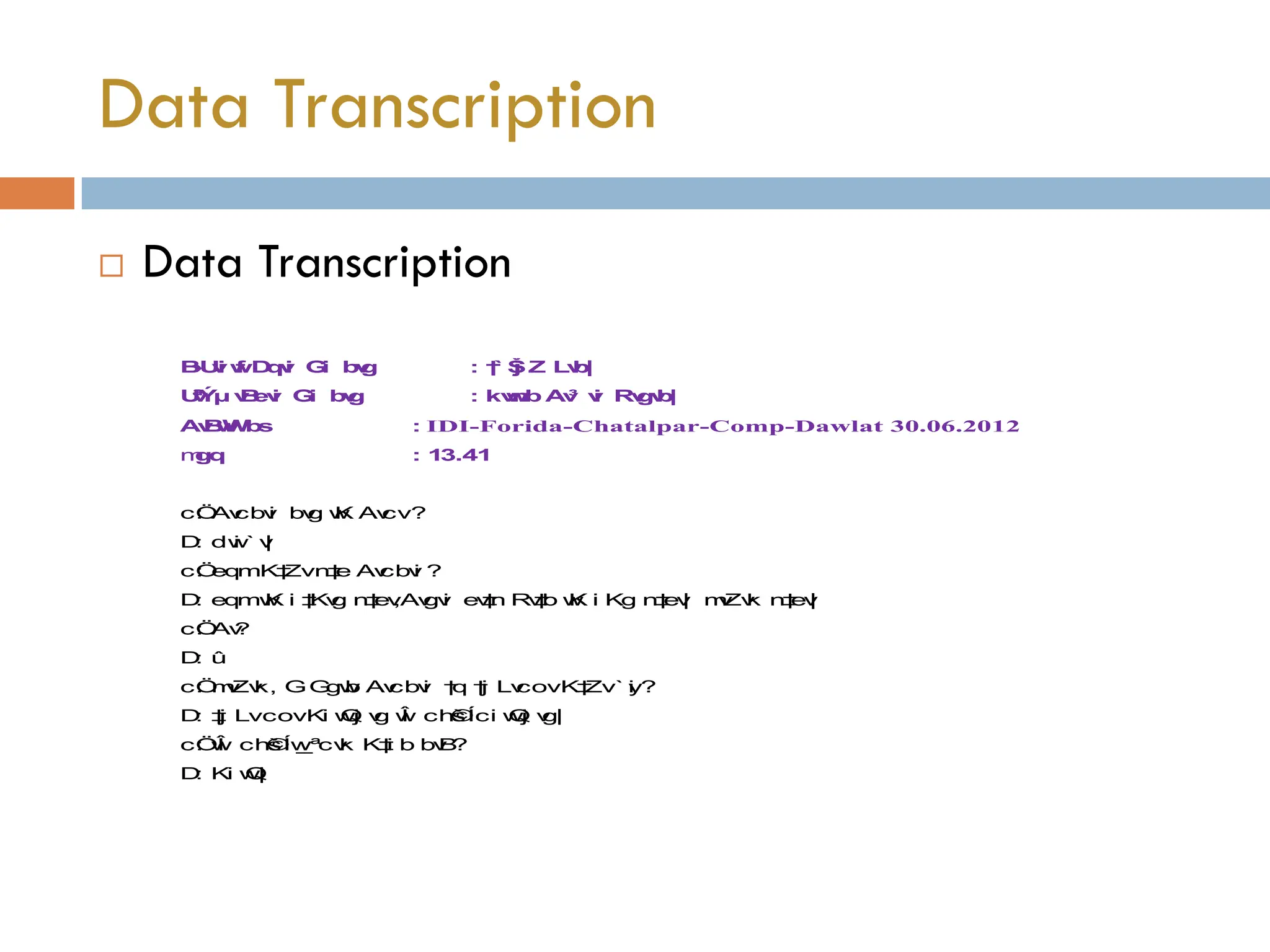
 Data Transcription
Data Transcription
B
›
U
v
i w
f D
q
v
i G
i b
v
g : †
` Š
j Z L
v
b
|
U
ª
v
Ý
µ v
B
ev
i G
i b
v
g : kv
w
n
b A
v
³ v
i R
v
g
v
b
|
A
v
B
w
W
b
s : IDI-Forida-Chatalpar-Comp-Dawlat 30.06.2012
m
g
q : 1
3.41
cÖ
: Av
cbv
i bv
g w
K Av
cv?
D
: dw
i ` v
|
cÖ
: eqmK‡
Zvn
‡
e Av
cbv
i ?
D
: eqmw
K i ‡
Kv
g n
‡
ev
,Av
gv
i ev
‡
n R
v
‡
b w
K i Kg n
‡
ev
| m
v
Zv
k n
‡
ev
|
cÖ
: Av
?
D
: û
cÖ
: m
v
Zv
k, GG
gw
b Av
cbv
i †
q †
j Lv
covK‡
Zv` y
i ?
D
: ‡
j LvcovKi w
Q
j v
g w
Î ch©
šÍci w
Q
j v
g|
cÖ
: w
Î ch©
šÍw
_ªcv
k K‡
i b bv
B
?
D
: Ki w
Q
|
 Data labeling and backup
 Data labeling
◼ IDI-Forida-Chatalpar-Comp-Dawlat 30.06.2012
◼ IDI-Khalida-Aherkandi-Gain-Farida 28.06.2012
 Data backup
 Adolescent Nutrition Recorded Interview
◼ IDI-Forida-Chatalpar-Comp-Dawlat 30.06.2012
◼ IDI-Khalida-Aherkandi-Gain-Farida 28.06.2012
 Adolescent Nutrition Recorded Interview_backup
◼ IDI-Forida-Chatalpar-Comp-Dawlat 30.06.2012
◼ IDI-Khalida-Aherkandi-Gain-Farida 28.06.2012
Data management Cont…
Step 2: identify a Framework
 Read, Read, Read…
 Identify a framework
 Explanatory- Guided by the research question
 Exploratory- Guided by the data
 Framework will structure, label and define data
 Framework=Coding plan
Step 3: Sort data into a Framework
 Code the data
 Modify the Framework
 Data entry if use computer packages
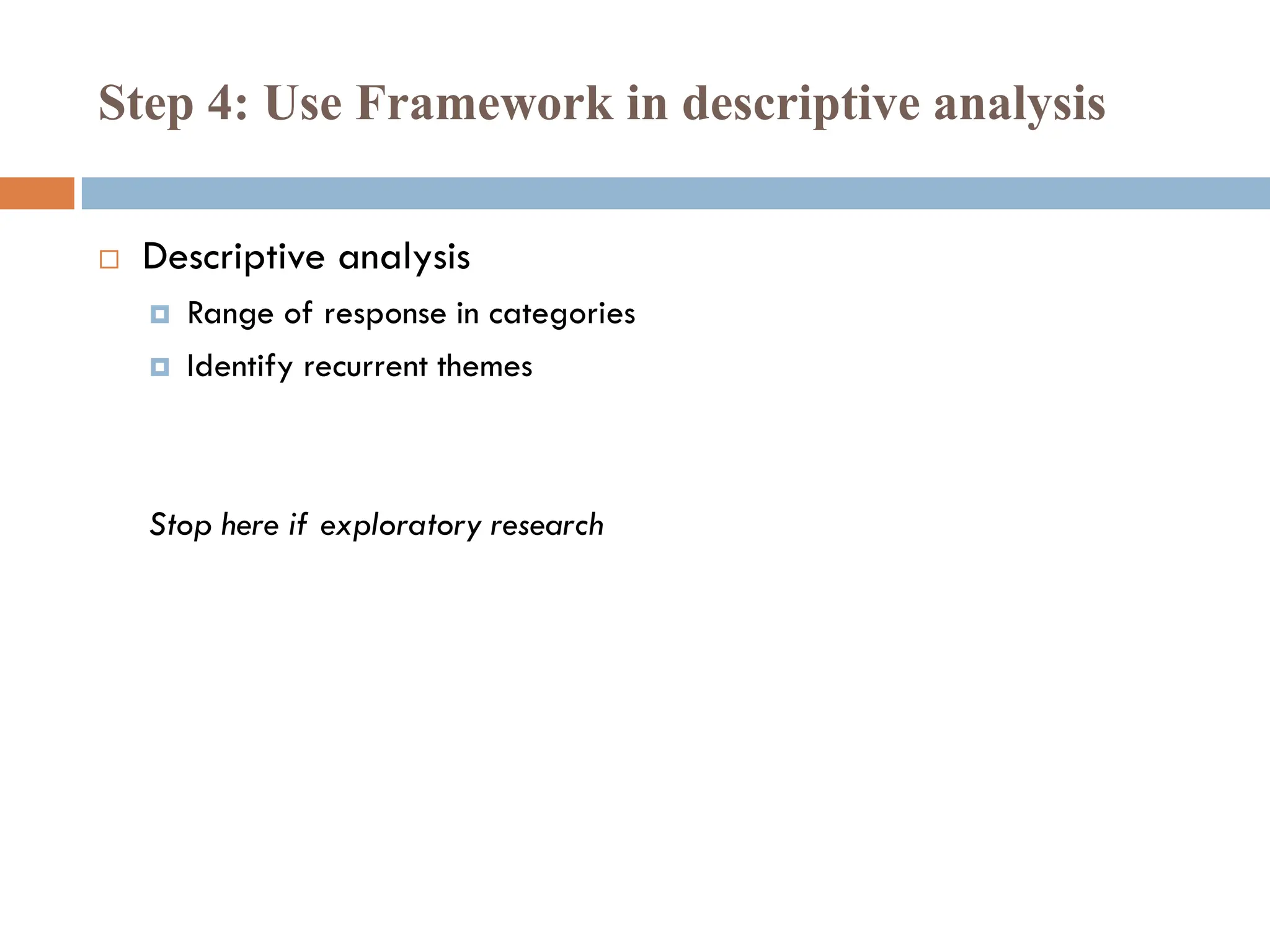
Step 4: Use Framework in descriptive analysis
 Descriptive analysis
 Range of response in categories
 Identify recurrent themes
Stop here if exploratory research
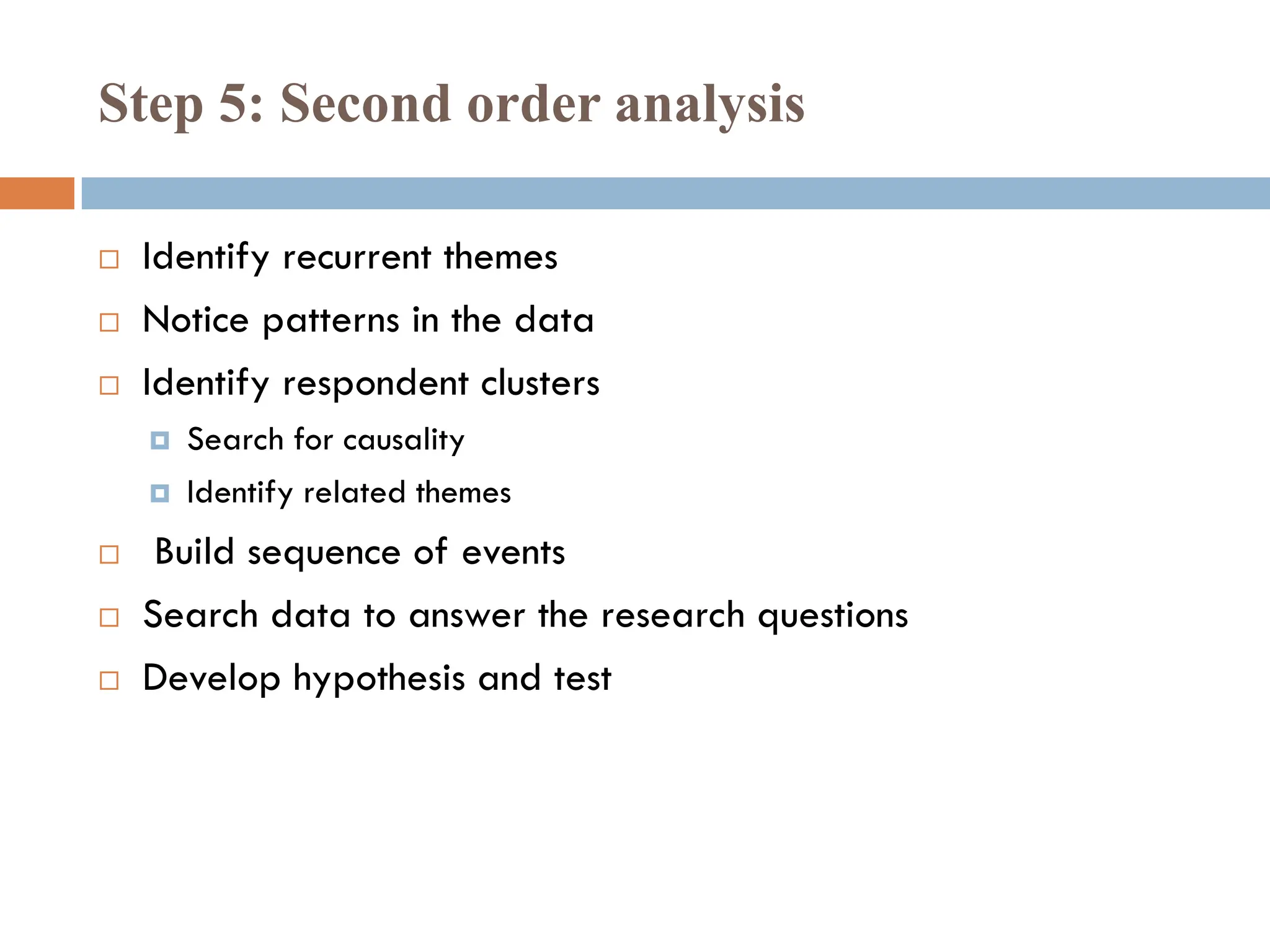
Step 5: Second order analysis
 Identify recurrent themes
 Notice patterns in the data
 Identify respondent clusters
 Search for causality
 Identify related themes
 Build sequence of events
 Search data to answer the research questions
 Develop hypothesis and test
Qualitative data management for all researcher

  • 1.
    Qualitative Data DocumentationManagement Analysis and Report Writing Dr. A. K. M. Dawlat Khan, PhD Institute of Epidemiology, Disease Control and Research (IEDCR) akmdawlatkhan@gmail.com 01712-171214
  • 3.
    Discussion topics  Qualitativedata  Qualitative data documentation management and analysis
  • 4.
  • 5.
    What is qualitativedata?  Data that are related to concepts, opinions, values and behaviours of people in social context  Transcripts of individual interviews and focus groups, field notes from observation of certain activities, copies of documents, audio/video recordings..
  • 6.
    Types of QualitativeData  Structure text (writings, stories, survey comments, news articles, books, etc)  Unstructured text ( transcription, interviews focus group, conversion)  Audio recording, music  Video recordings (graphics, art, pictures, visuals)
  • 7.
     Voice Recorder Camera(Photo and Video)  Notebook/diary  Voice Recorder verses Notebook/diary Data Documentation
  • 8.
  • 9.
    What is qualitativedata analysis?  Qualitative Data Analysis (QDA) is the range of processes and procedures whereby we move from the qualitative data that have been collected into some form of explanation, understanding or interpretation of people and situations we are investigating.  QDA is usually based on an interpretative philosophy. The idea is to examine the meaningful and symbolic content of qualitative data.
  • 10.
    The process ofqualitative data analysis  Organize the data  Identify Framework  Sort data in to framework  Use the framework for descriptive analysis  Second order analysis
  • 11.
    Step 1: Organizethe data  Transcribe the data  Translate the data  Data cleaning  Label the data
  • 12.
     Data Transcription DataTranscription B › U v i w f D q v i G i b v g : † ` Š j Z L v b | U ª v Ý µ v B ev i G i b v g : kv w n b A v ³ v i R v g v b | A v B w W b s : IDI-Forida-Chatalpar-Comp-Dawlat 30.06.2012 m g q : 1 3.41 cÖ : Av cbv i bv g w K Av cv? D : dw i ` v | cÖ : eqmK‡ Zvn ‡ e Av cbv i ? D : eqmw K i ‡ Kv g n ‡ ev ,Av gv i ev ‡ n R v ‡ b w K i Kg n ‡ ev | m v Zv k n ‡ ev | cÖ : Av ? D : û cÖ : m v Zv k, GG gw b Av cbv i † q † j Lv covK‡ Zv` y i ? D : ‡ j LvcovKi w Q j v g w Î ch© šÍci w Q j v g| cÖ : w Î ch© šÍw _ªcv k K‡ i b bv B ? D : Ki w Q |
  • 13.
     Data labelingand backup  Data labeling ◼ IDI-Forida-Chatalpar-Comp-Dawlat 30.06.2012 ◼ IDI-Khalida-Aherkandi-Gain-Farida 28.06.2012  Data backup  Adolescent Nutrition Recorded Interview ◼ IDI-Forida-Chatalpar-Comp-Dawlat 30.06.2012 ◼ IDI-Khalida-Aherkandi-Gain-Farida 28.06.2012  Adolescent Nutrition Recorded Interview_backup ◼ IDI-Forida-Chatalpar-Comp-Dawlat 30.06.2012 ◼ IDI-Khalida-Aherkandi-Gain-Farida 28.06.2012 Data management Cont…
  • 14.
    Step 2: identifya Framework  Read, Read, Read…  Identify a framework  Explanatory- Guided by the research question  Exploratory- Guided by the data  Framework will structure, label and define data  Framework=Coding plan
  • 15.
    Step 3: Sortdata into a Framework  Code the data  Modify the Framework  Data entry if use computer packages
  • 16.
    Step 4: UseFramework in descriptive analysis  Descriptive analysis  Range of response in categories  Identify recurrent themes Stop here if exploratory research
  • 17.
    Step 5: Secondorder analysis  Identify recurrent themes  Notice patterns in the data  Identify respondent clusters  Search for causality  Identify related themes  Build sequence of events  Search data to answer the research questions  Develop hypothesis and test