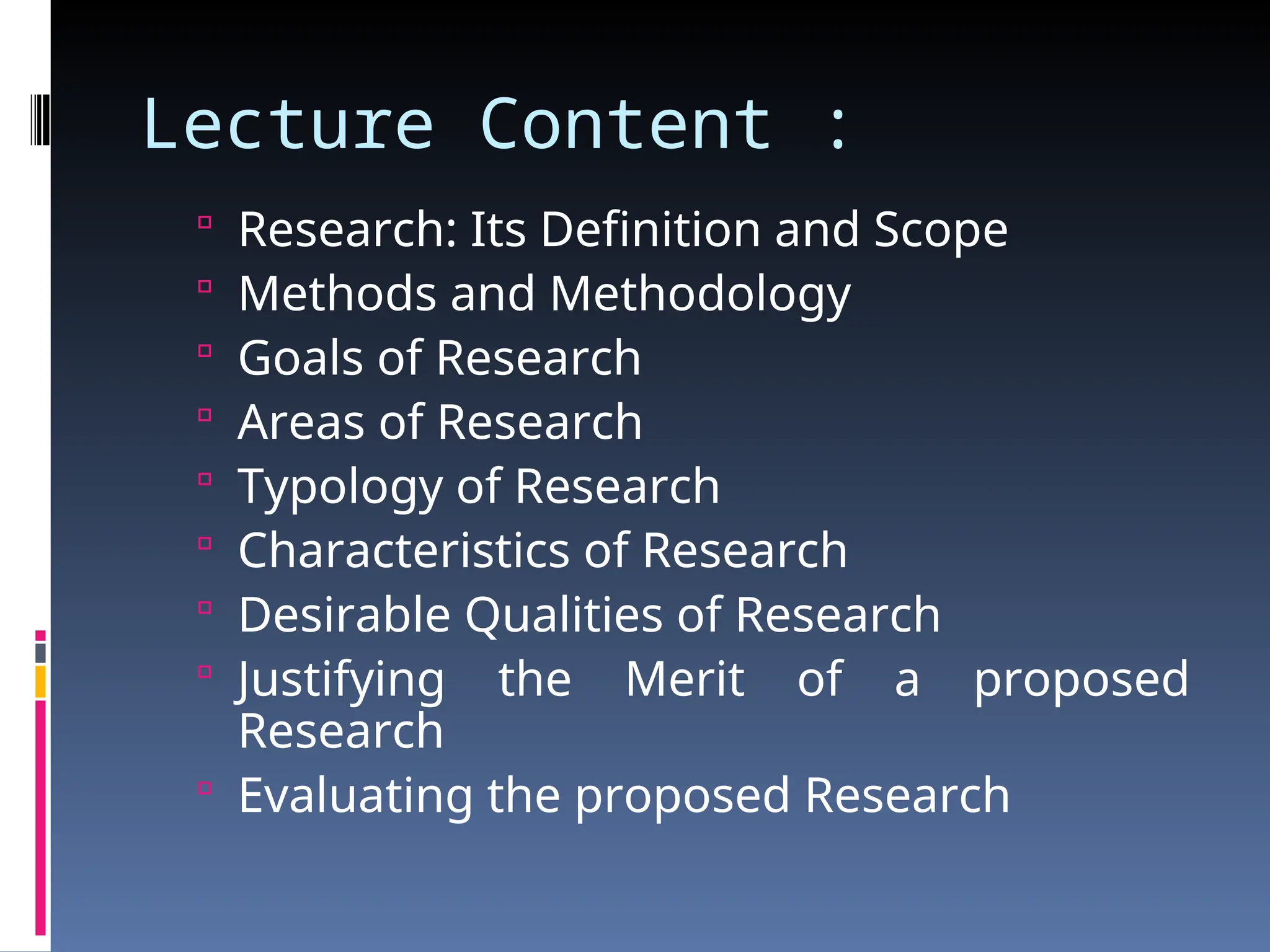
Lecture Content :
Research: Its Definition and Scope
Methods and Methodology
Goals of Research
Areas of Research
Typology of Research
Characteristics of Research
Desirable Qualities of Research
Justifying the Merit of a proposed
Research
Evaluating the proposed Research
3.
1.1. Research: ItsDefinition and
Scope
The word research perhaps originates
from the old French word researcher
that meant to search again . It implicitly
assumes that the earlier search was not
exhaustive and complete and hence a
repeated search is called for. In practice,
the term research refers to a scientific
process of generating an unexplored
horizon of knowledge aiming at
discovering facts. Solving a problem and
reaching a decision.
4.
DEFINITION:
Definition: Researchis a scientific approach
of answering a research question. Solving
a problem or generating new knowledge
through a systematic and orderly collection
organization and analysis of information
with an ultimate goal of making the
research useful in decision-making.
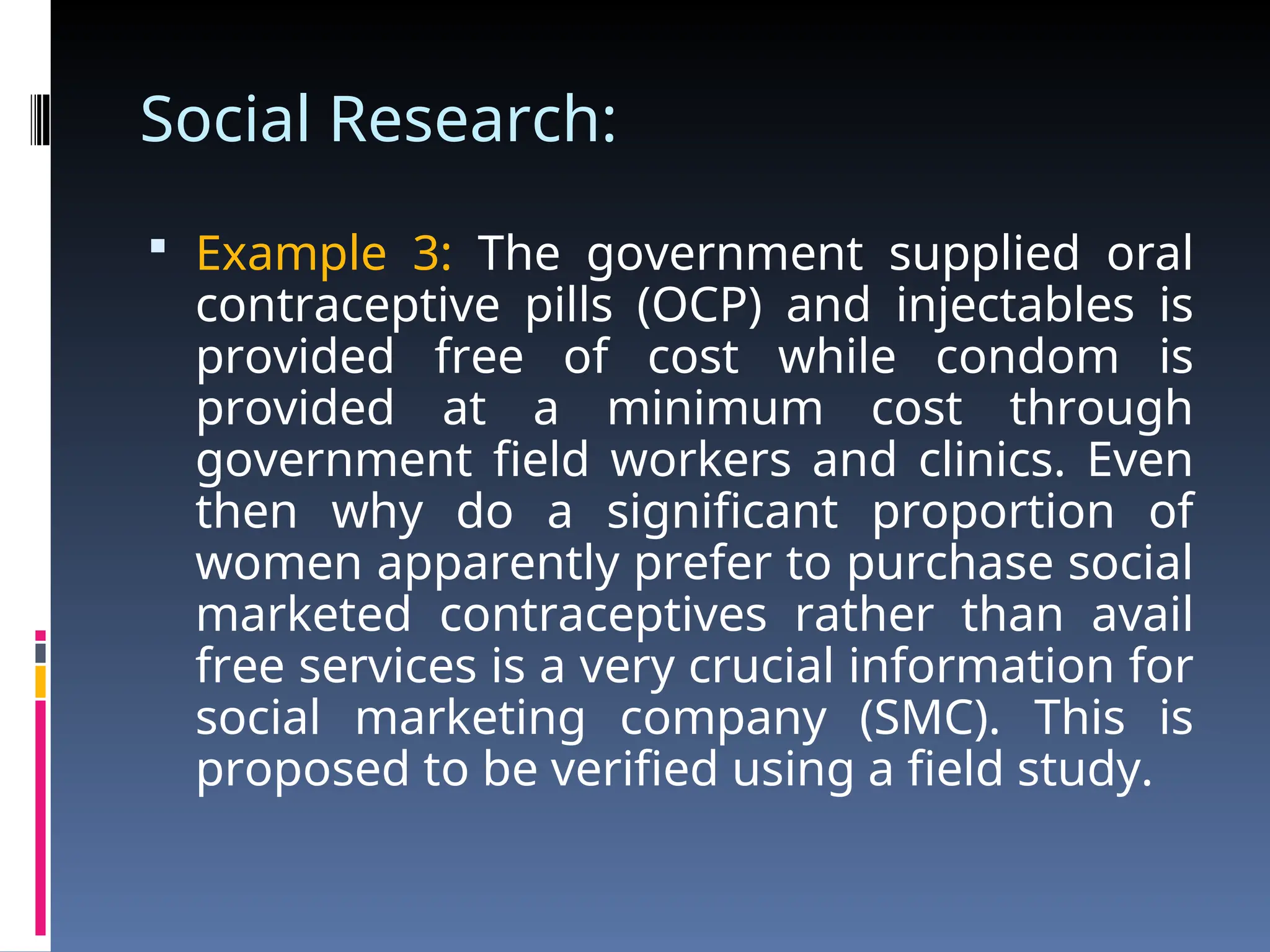
Systematic research in any field of inquiry
involves three basic operations: data
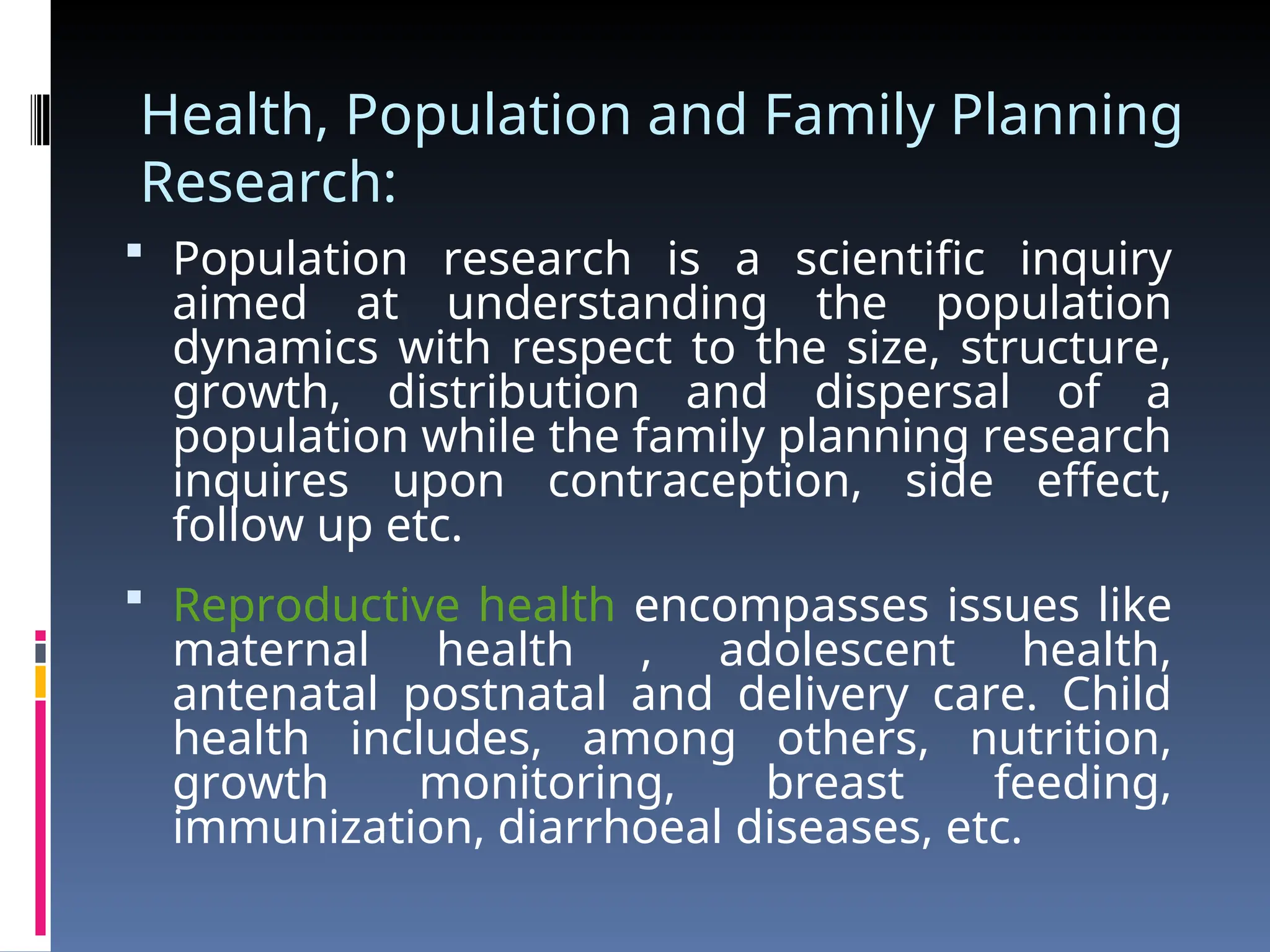
collection data analysis and report writing.
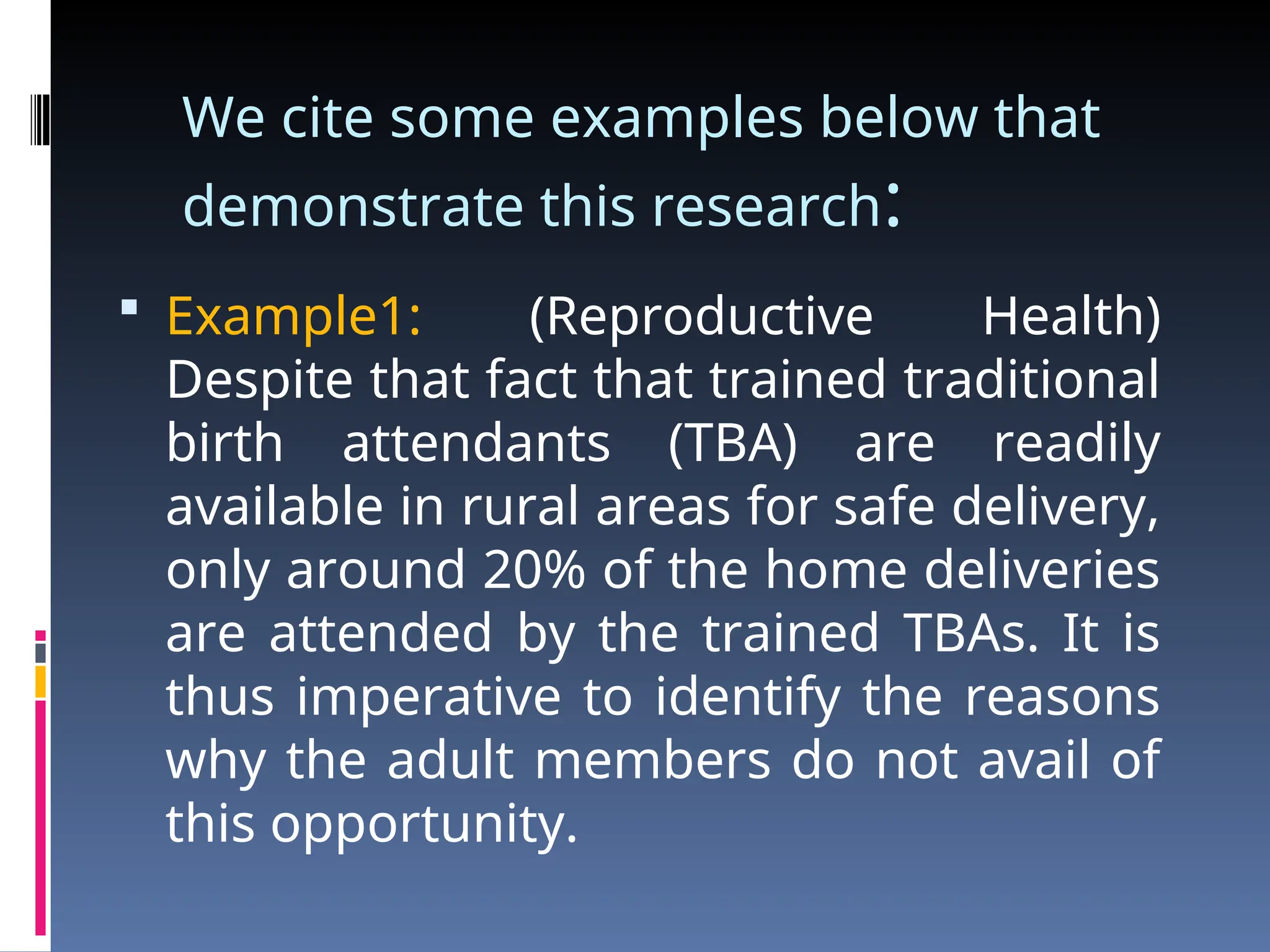
Data collection refers to observing
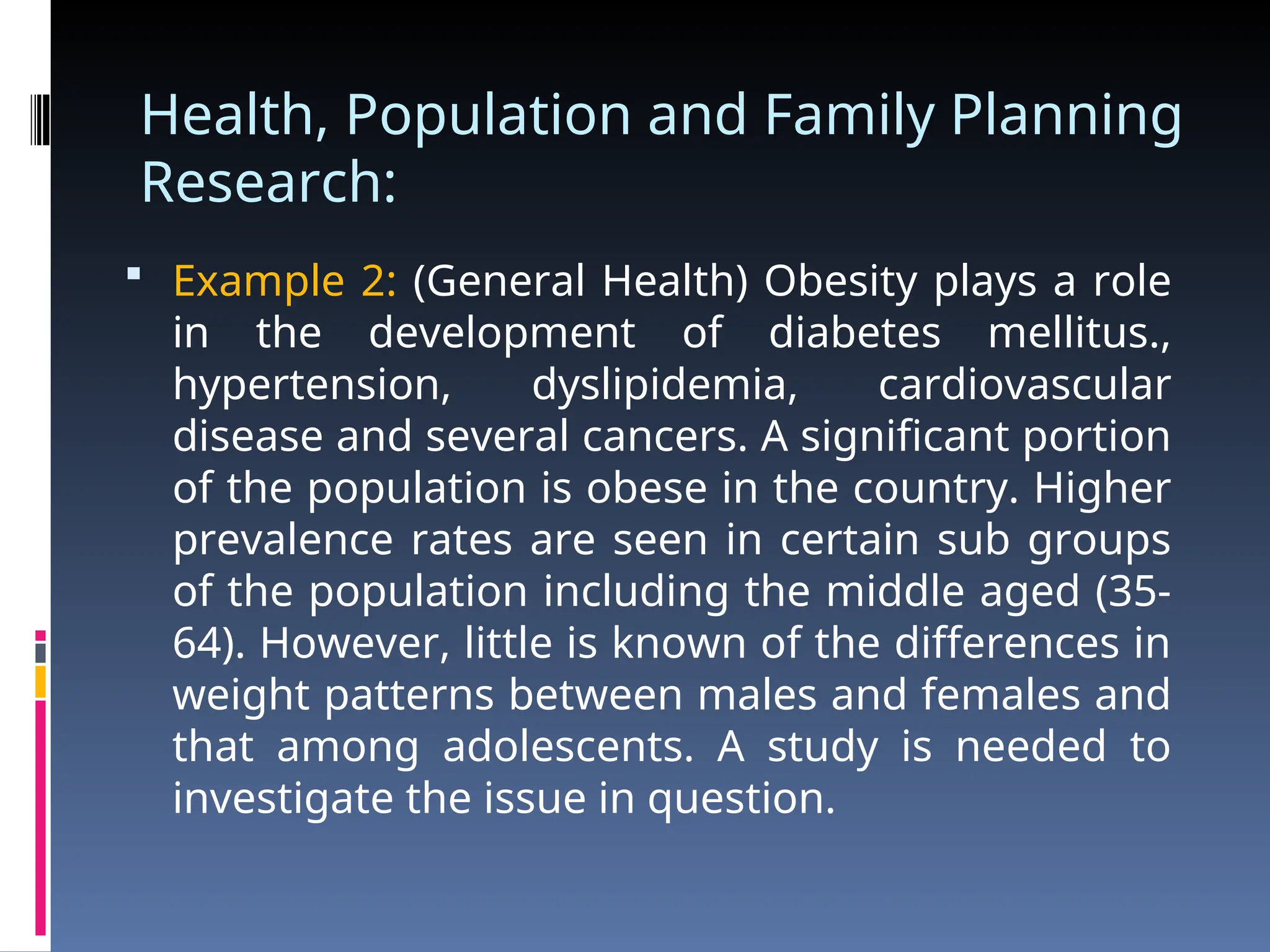
measuring and recording information.
5.
DEFINITION:
Data analysison the other hand refers to arranging
and organizing the collected data so that we may be
able to find out what their significance is and
generalize about them. Report writing is an inseparable
part of research study . It is the final out come of the
study . Its purpose is to convey information contained
in it to the readers or audience..
If you note down for example the reading habit of news
papers of a group of residents of a community that
would be the data collection . If you then divide these
residents, say into three categories regular occasional
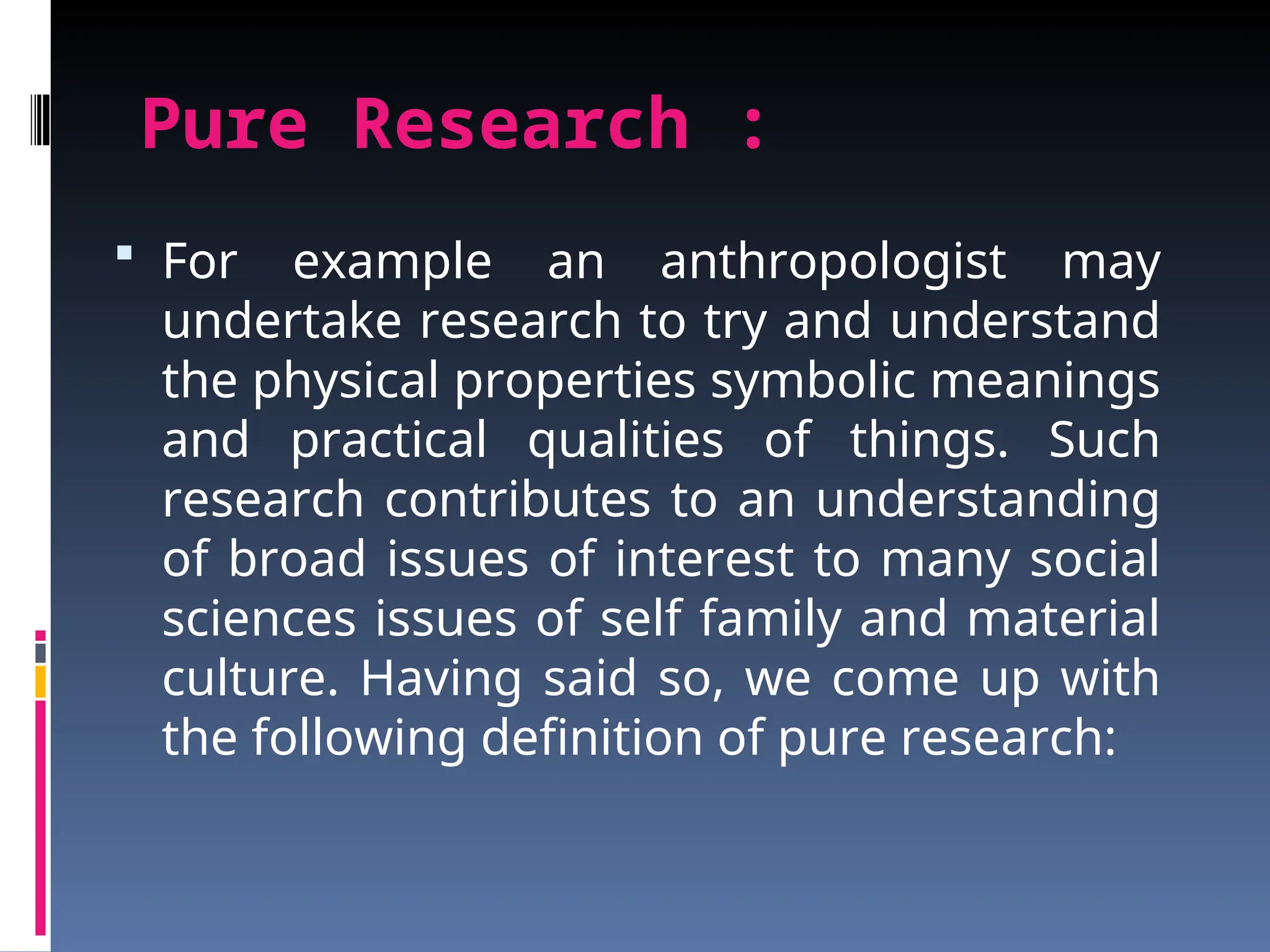
and never you have performed a simple data analysis
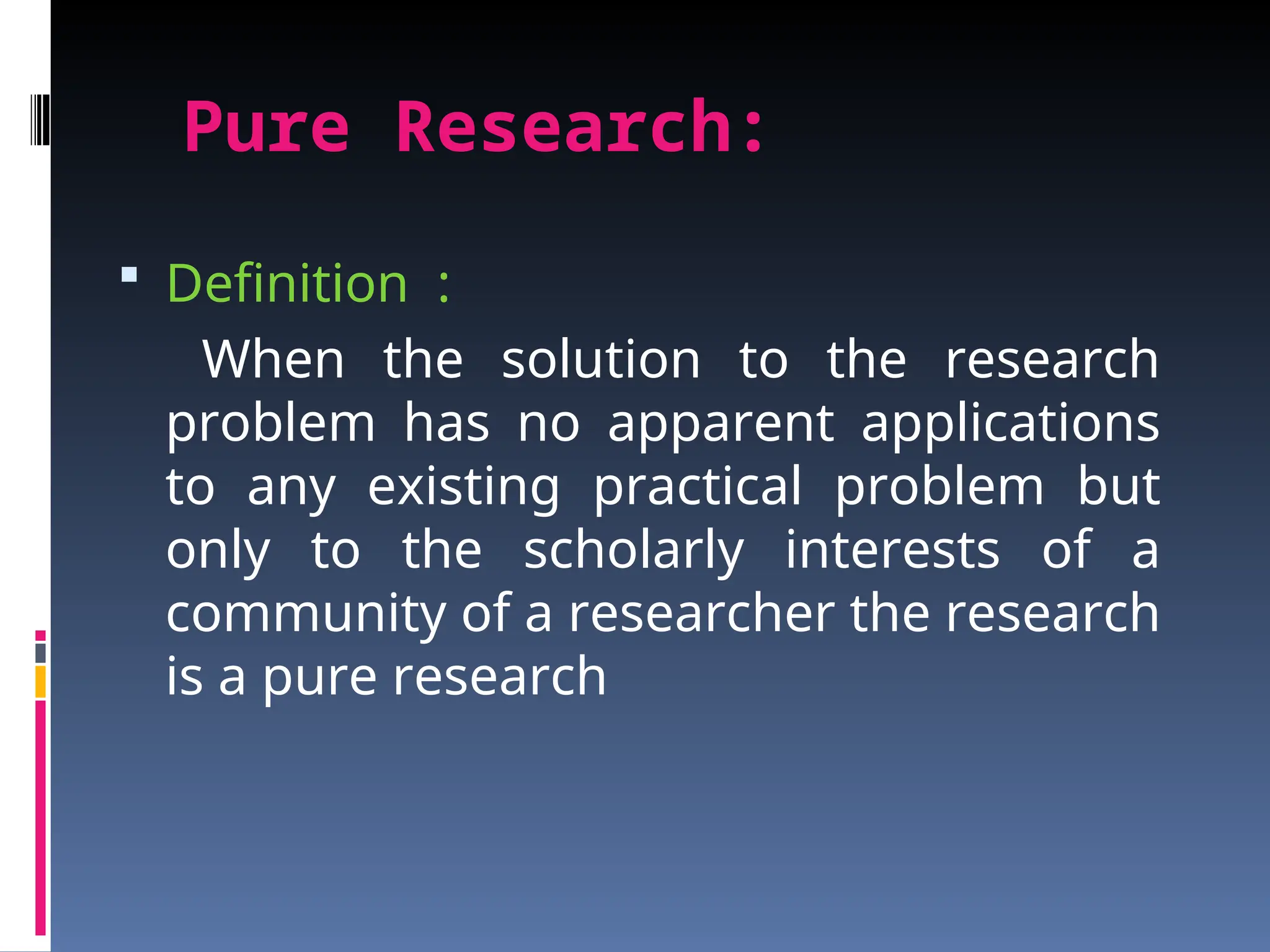
your findings may now be presented in a report form.
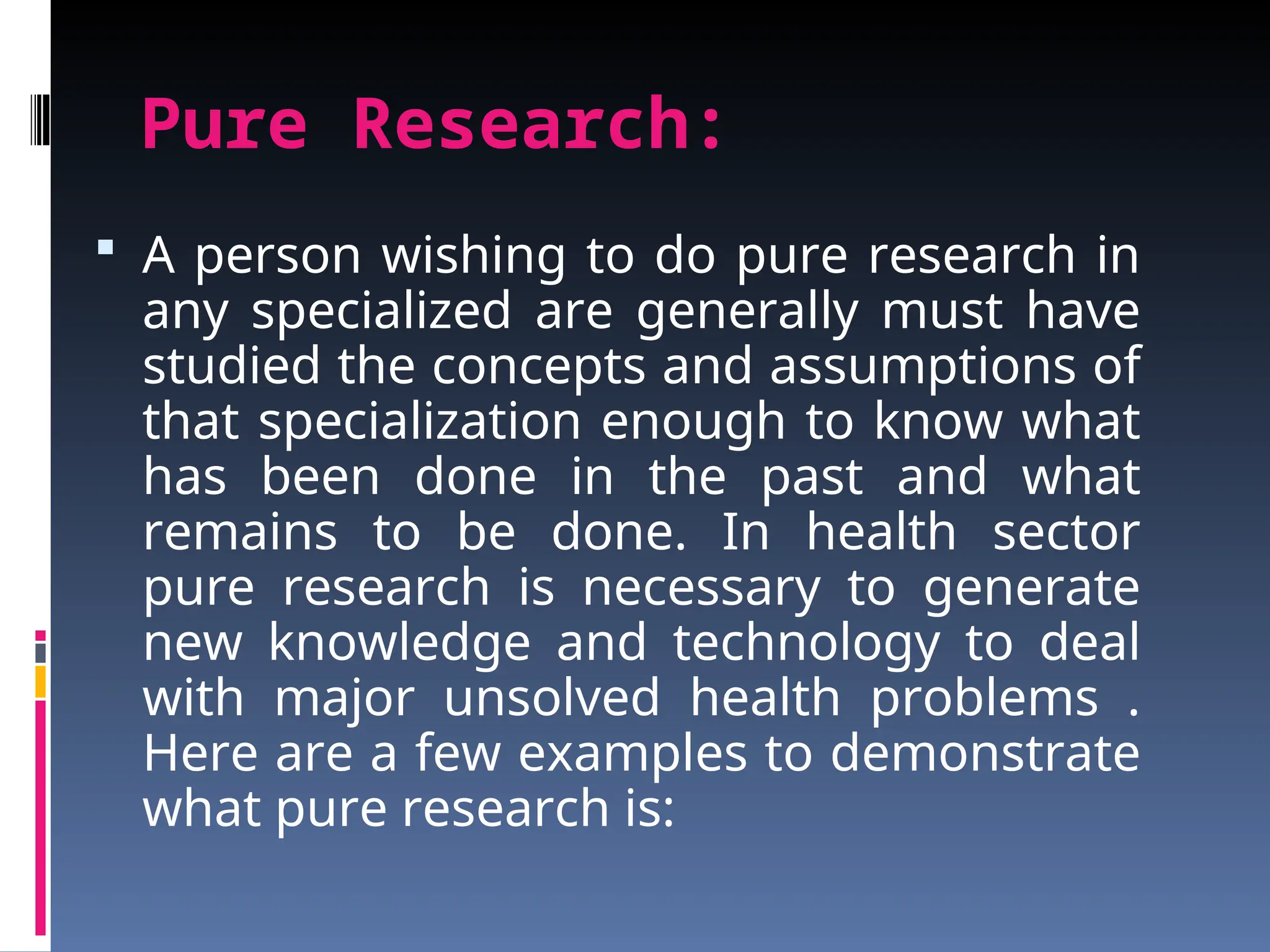
6.
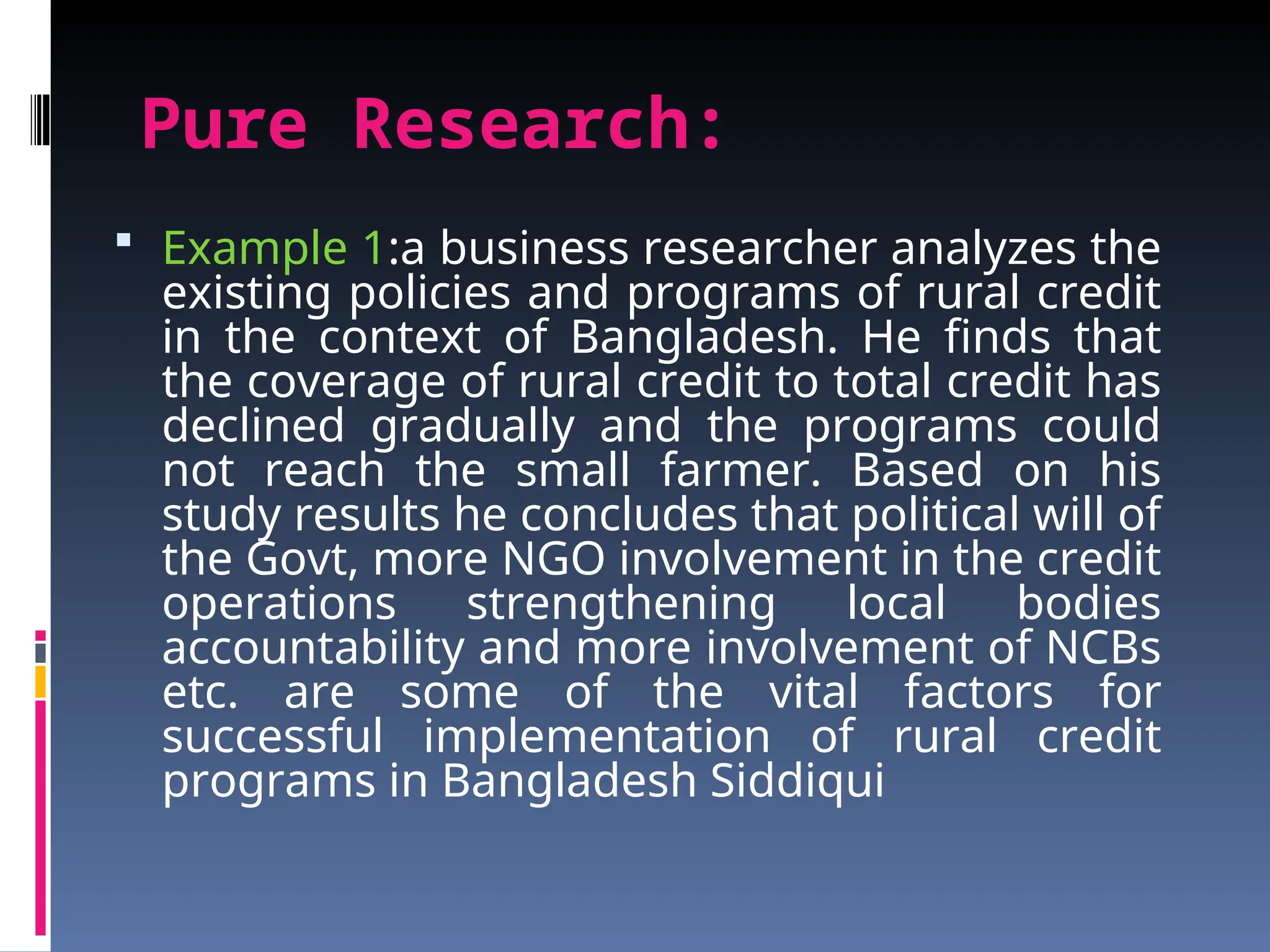
Here are someexamples that
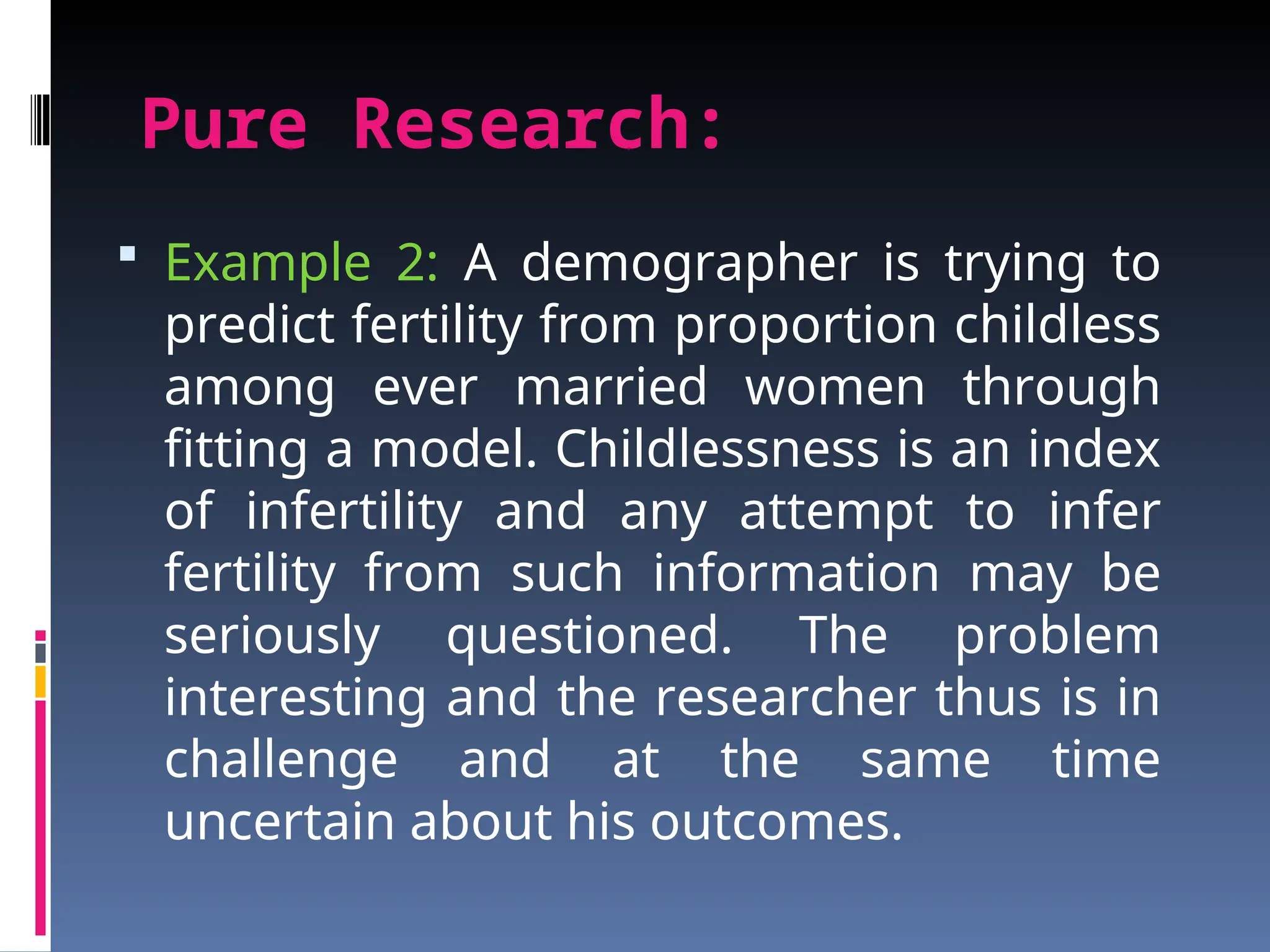
demonstrate what research is:
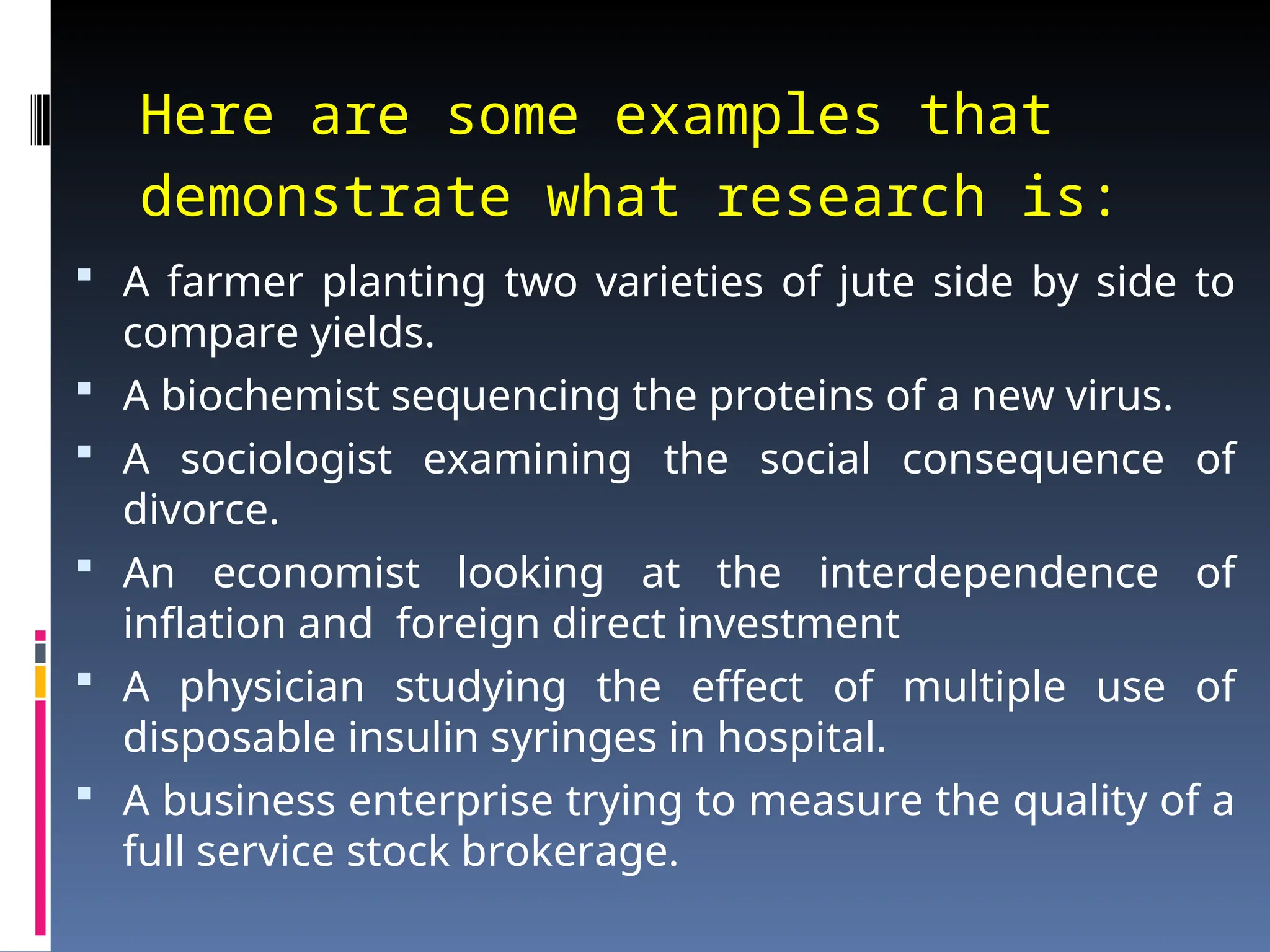
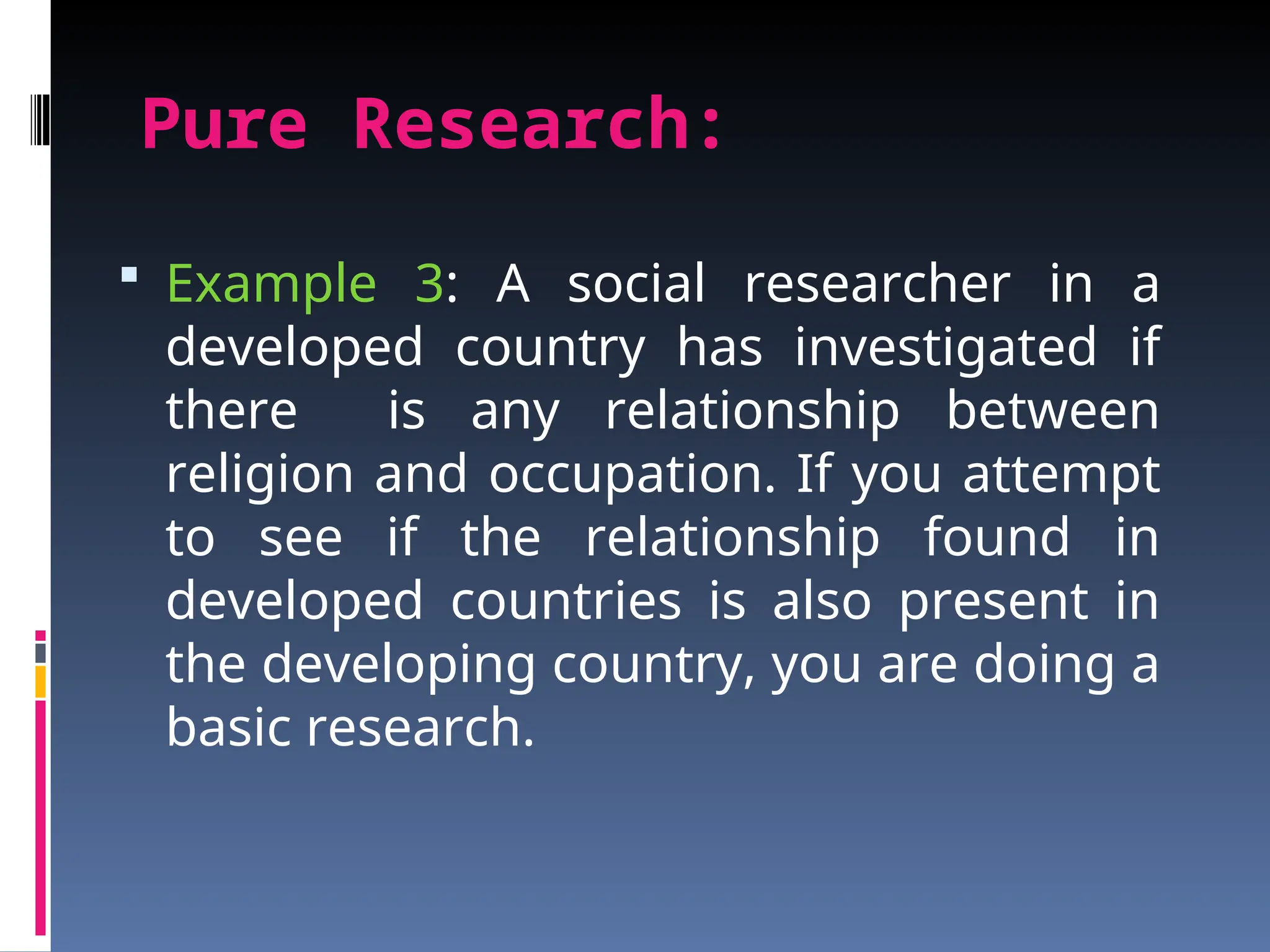
A farmer planting two varieties of jute side by side to
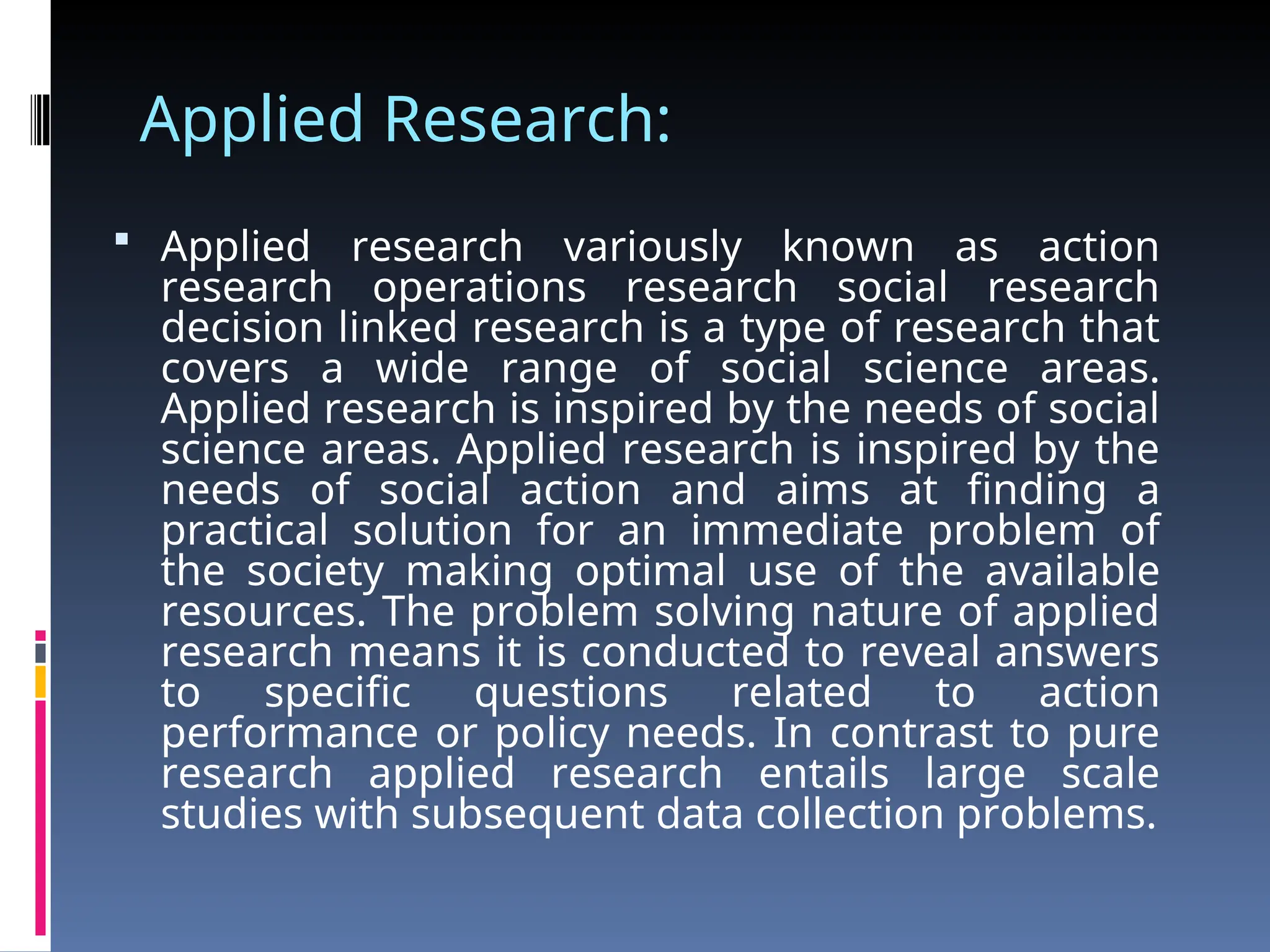
compare yields.
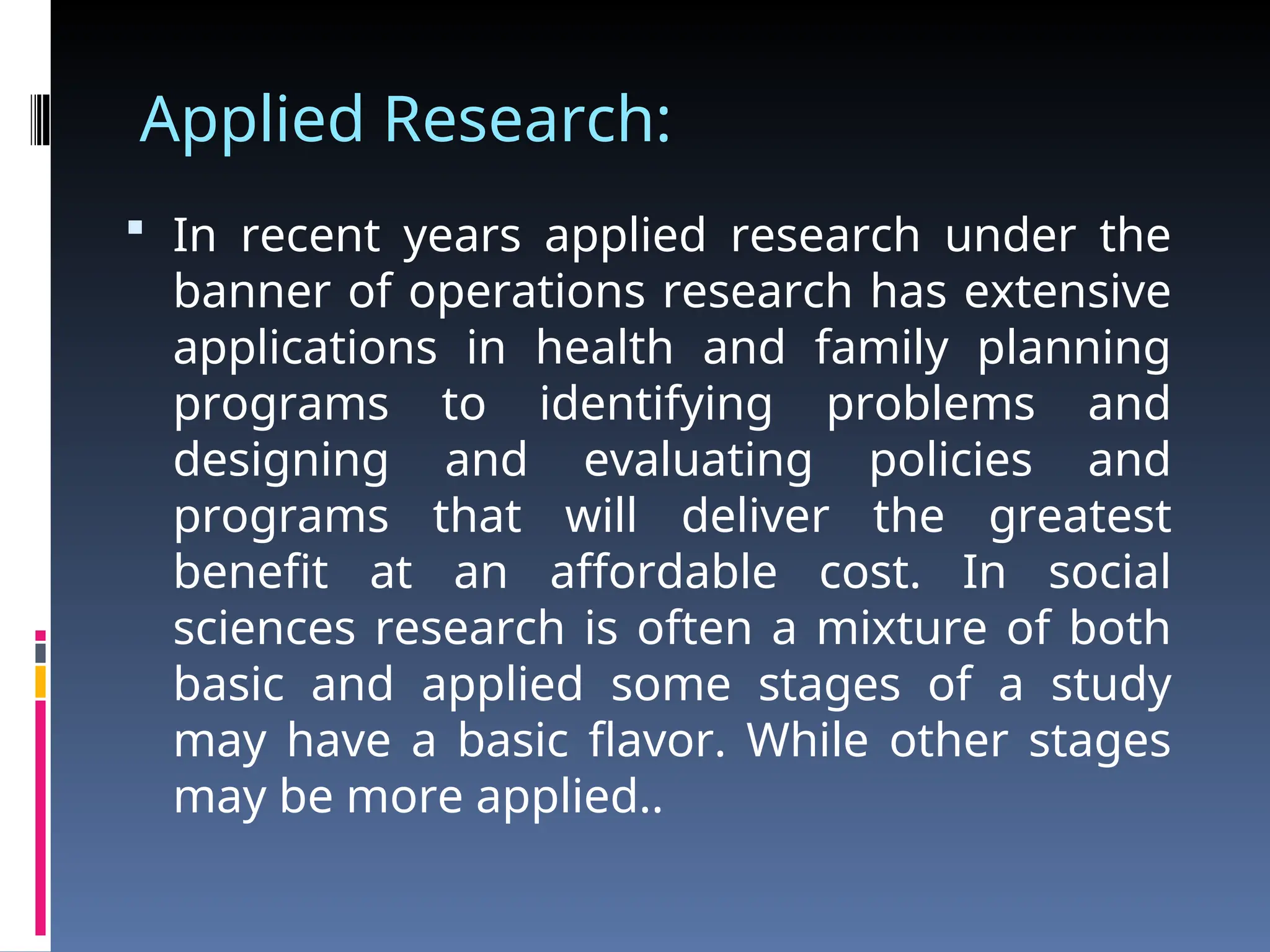
A biochemist sequencing the proteins of a new virus.
A sociologist examining the social consequence of
divorce.
An economist looking at the interdependence of
inflation and foreign direct investment
A physician studying the effect of multiple use of
disposable insulin syringes in hospital.
A business enterprise trying to measure the quality of a
full service stock brokerage.
7.
DEFINITION:
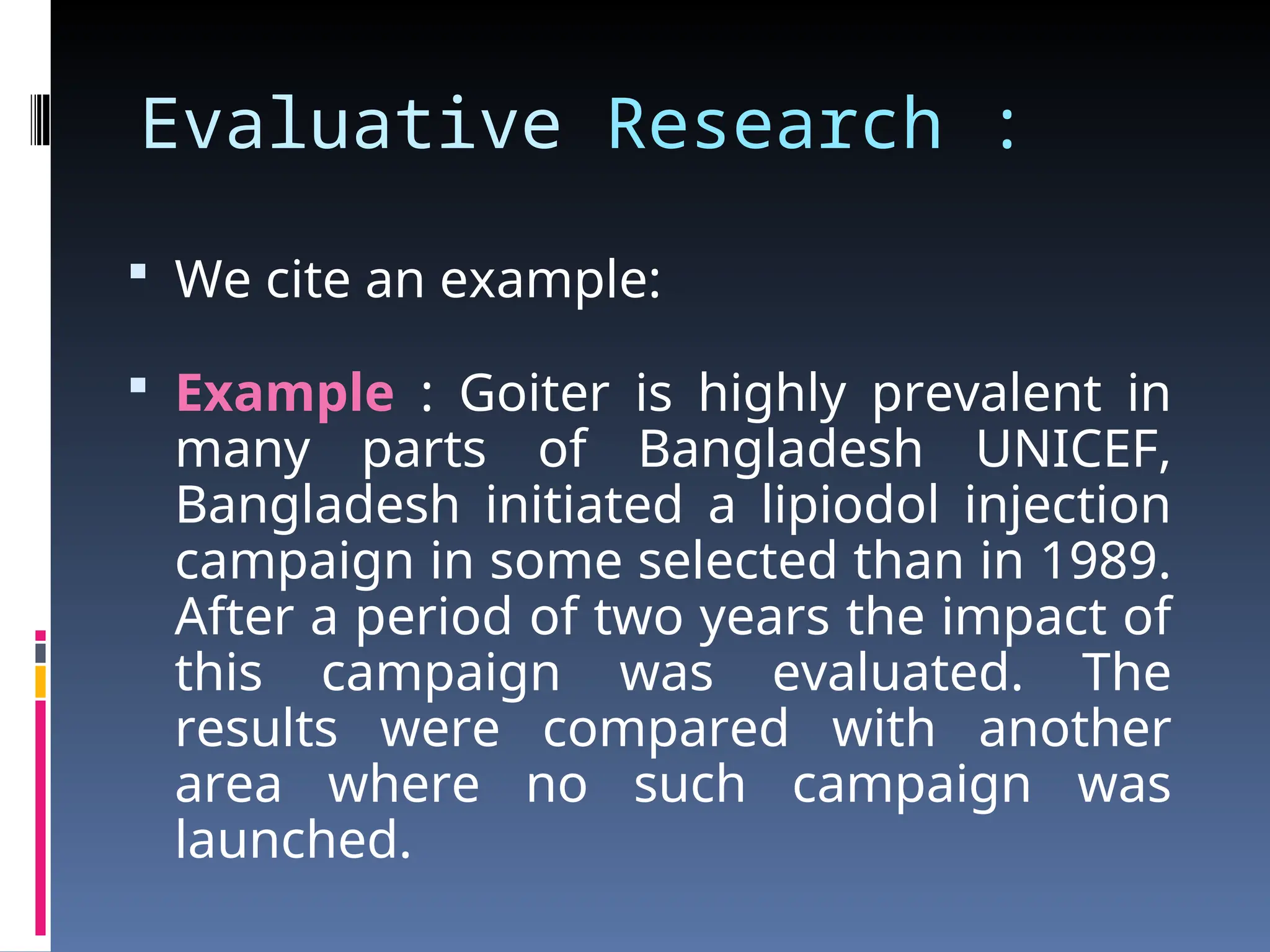
All aredoing research whether the
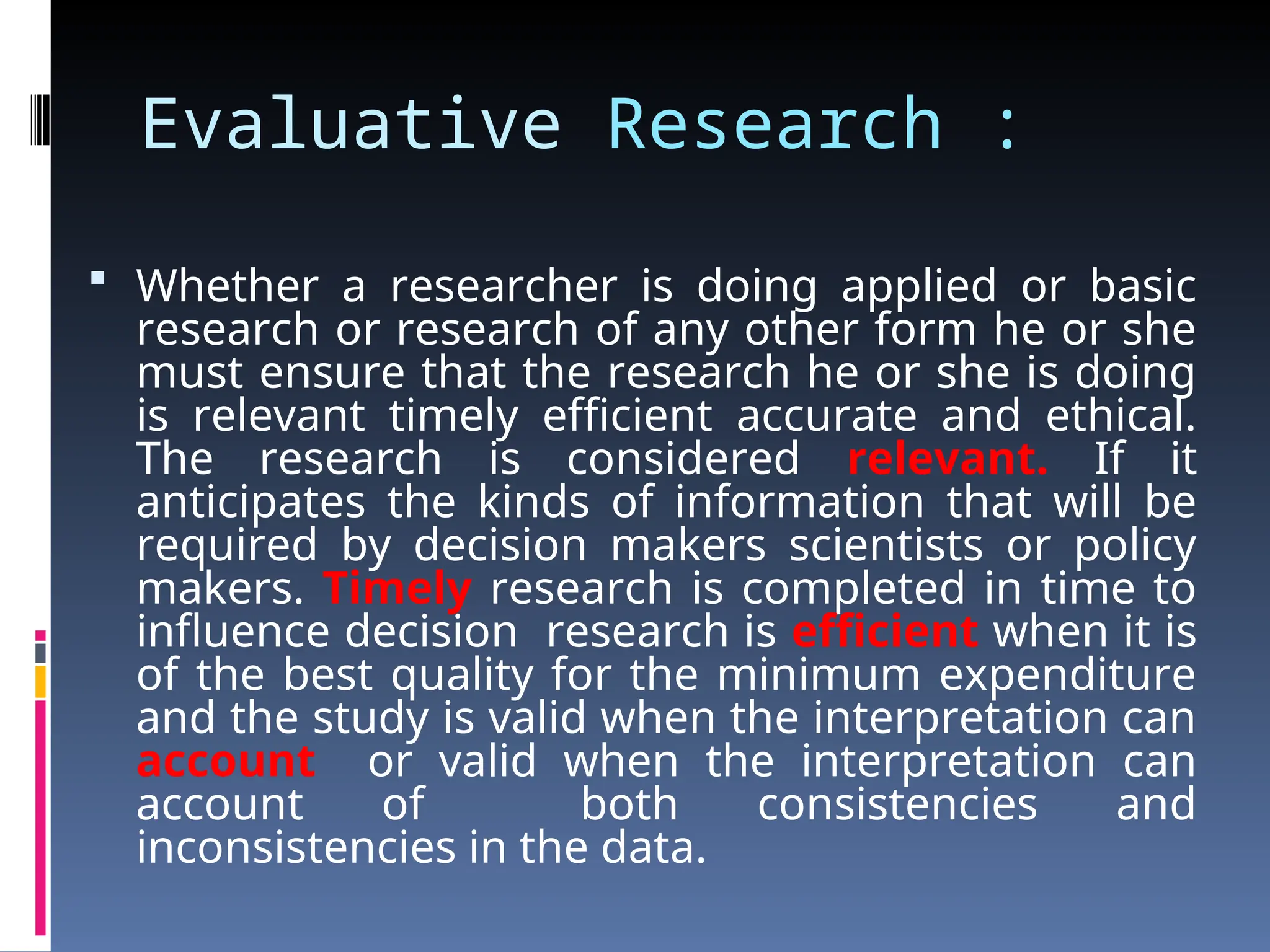
instrument is an electronic microscope
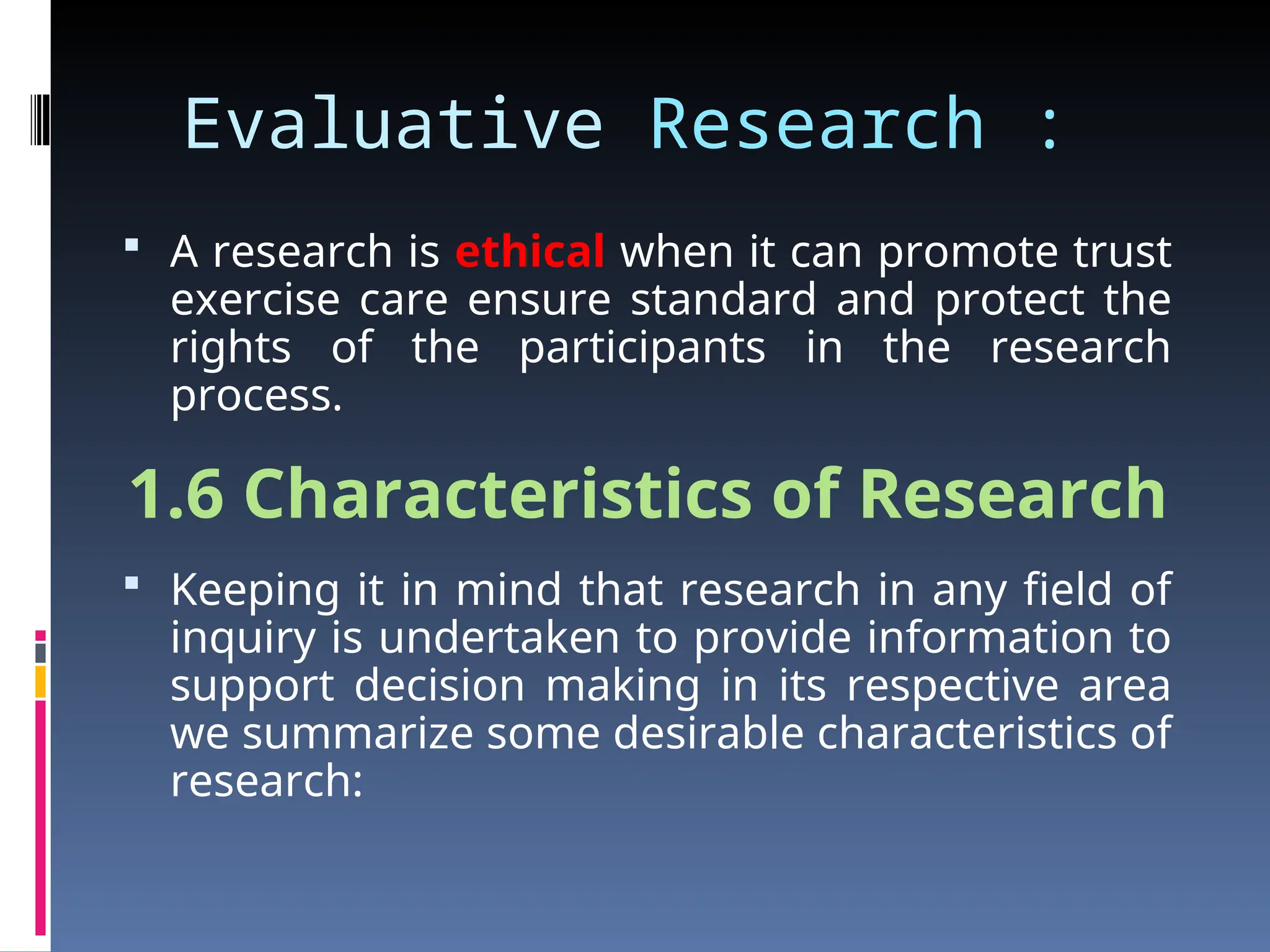
a hospital records, a microcomputer or
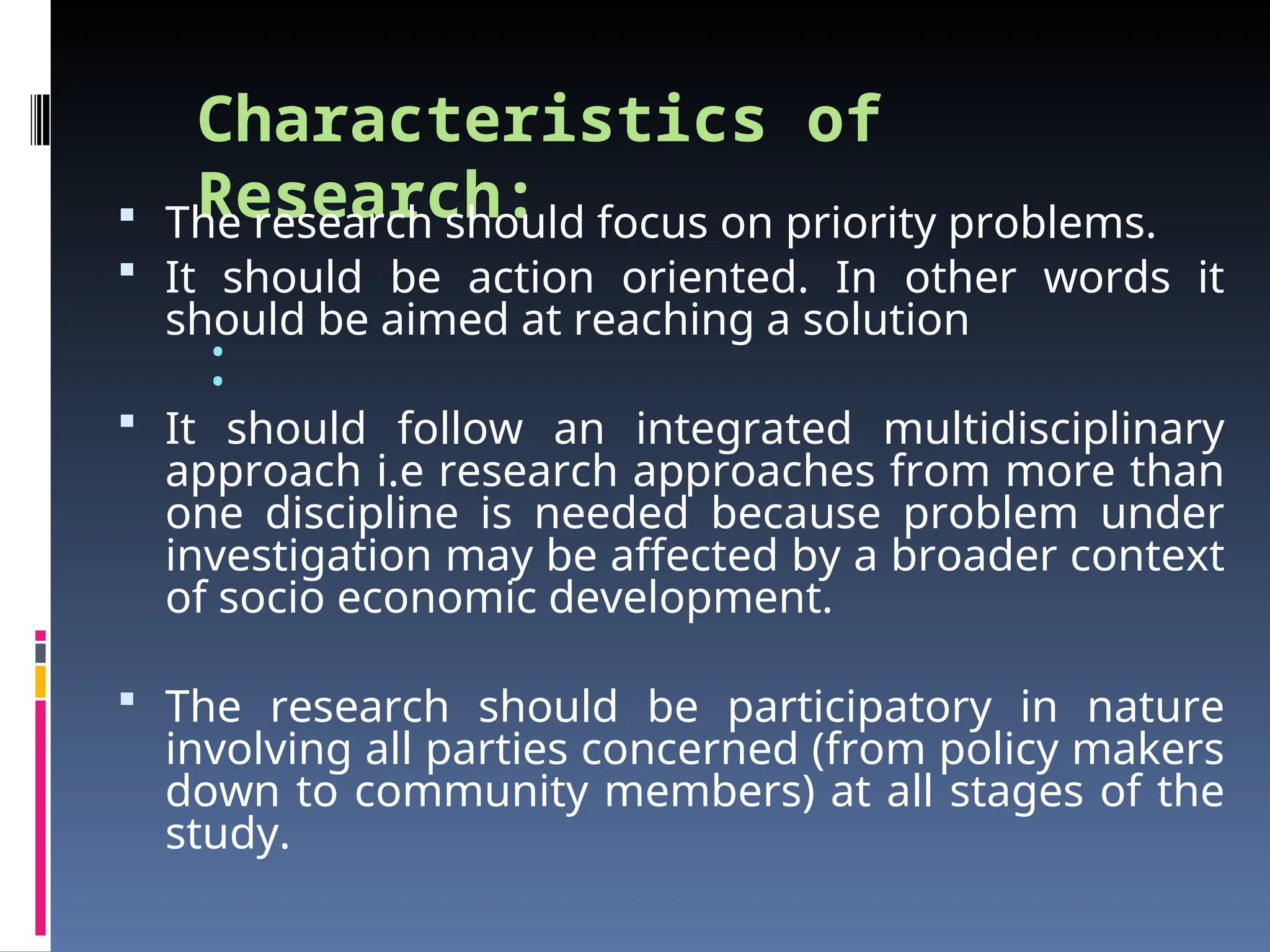
a pencil and a paper.
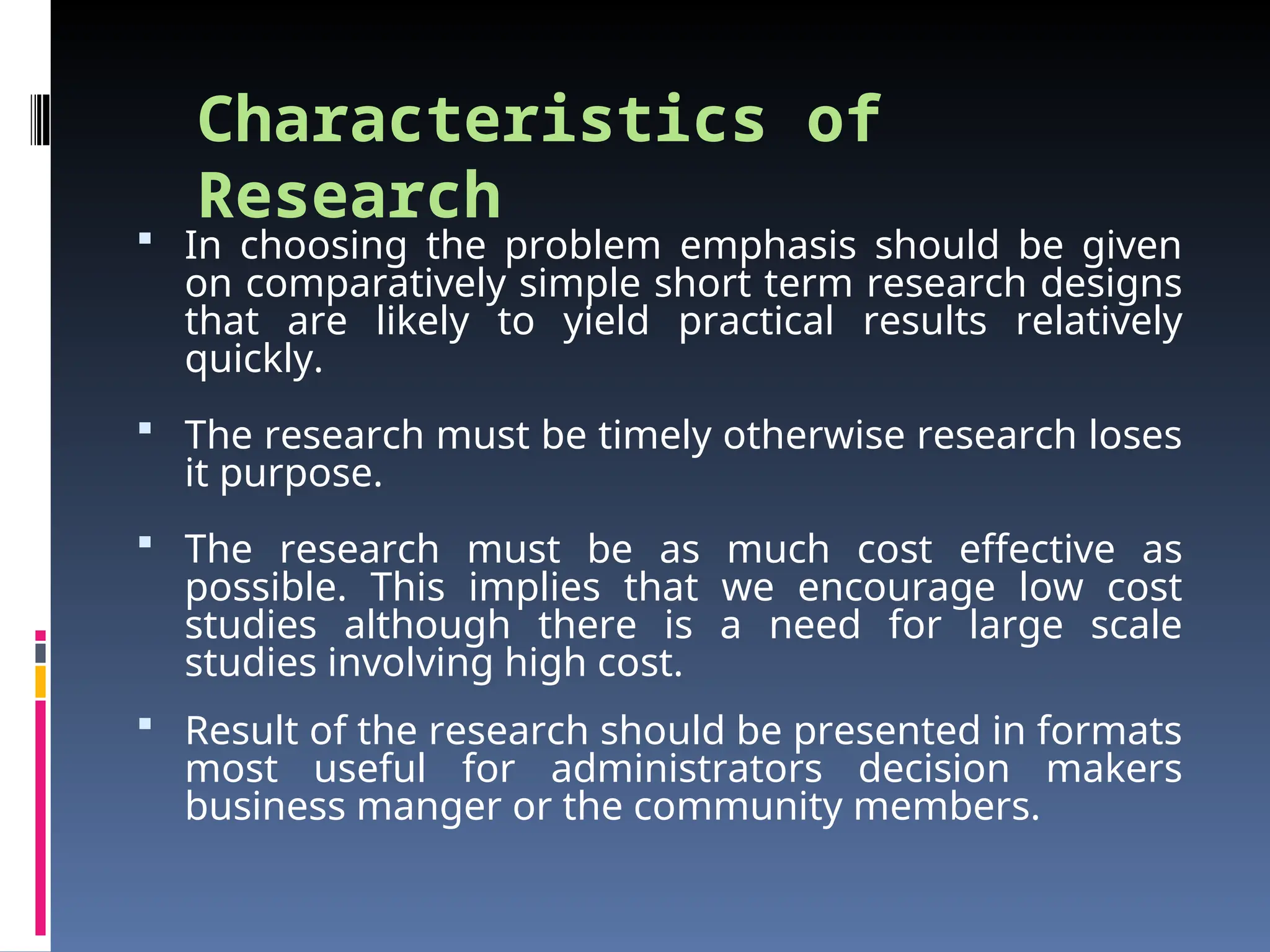
What makes one motivated to
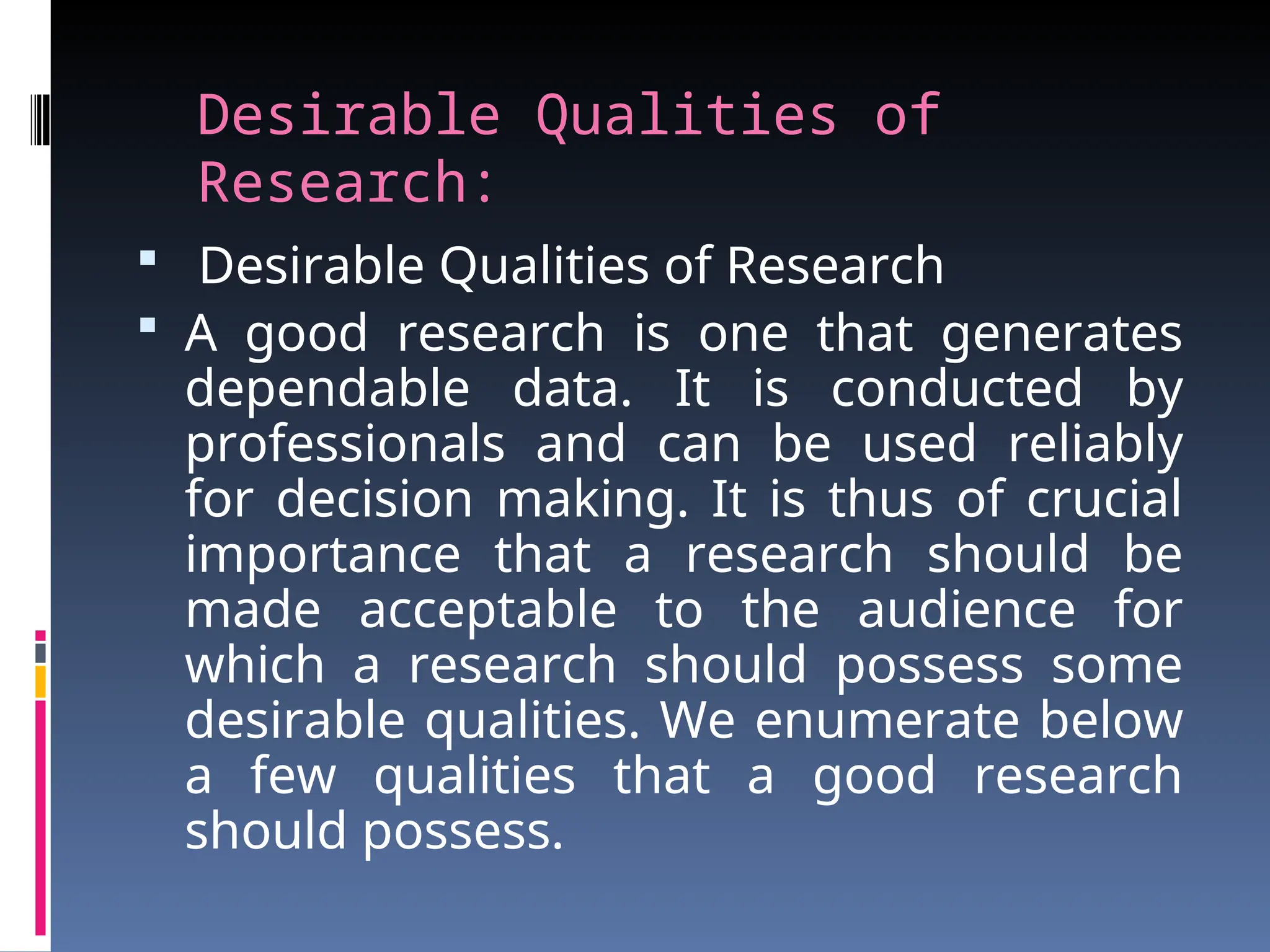
undertake research
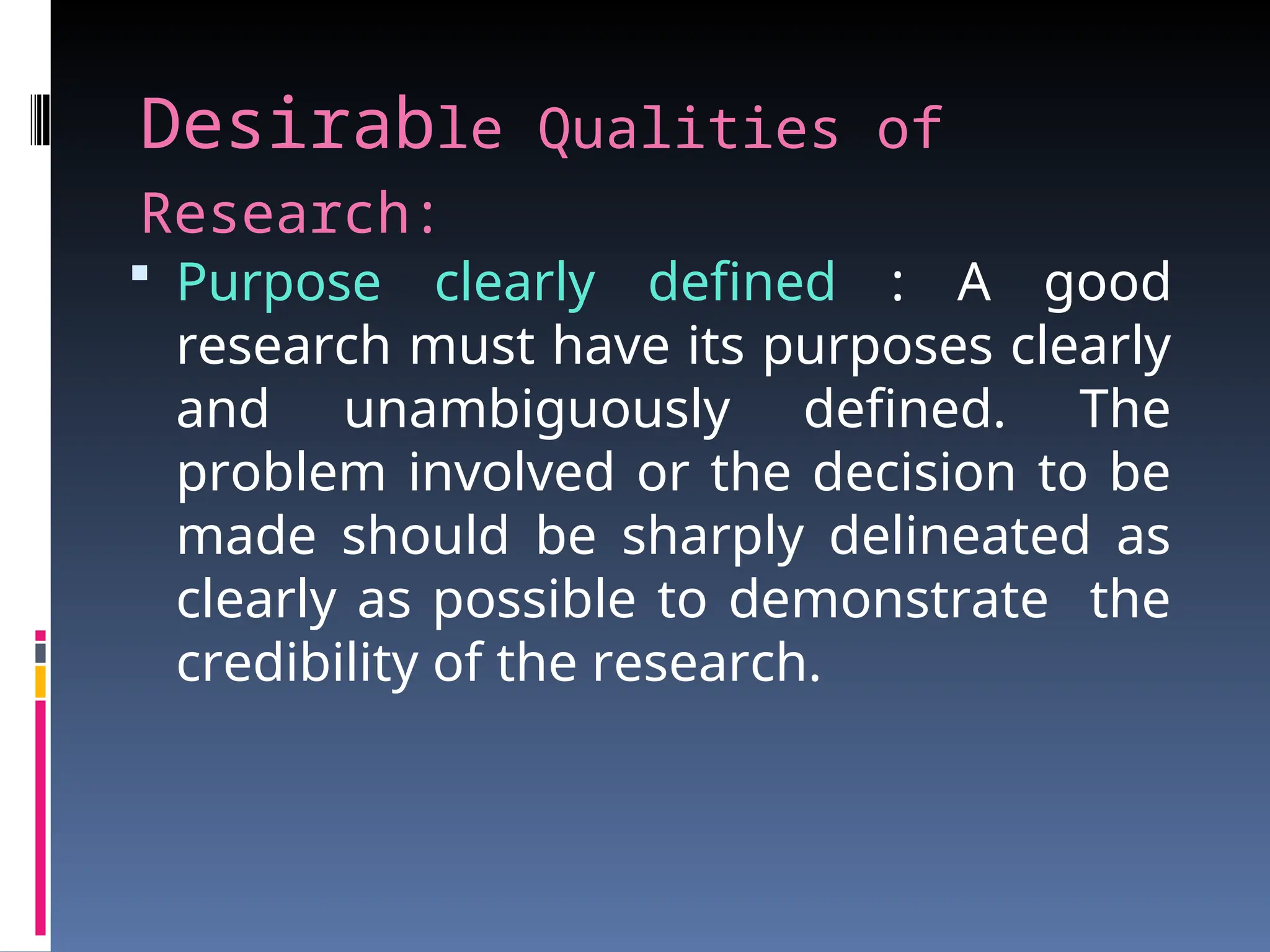
A person may be stimulated or
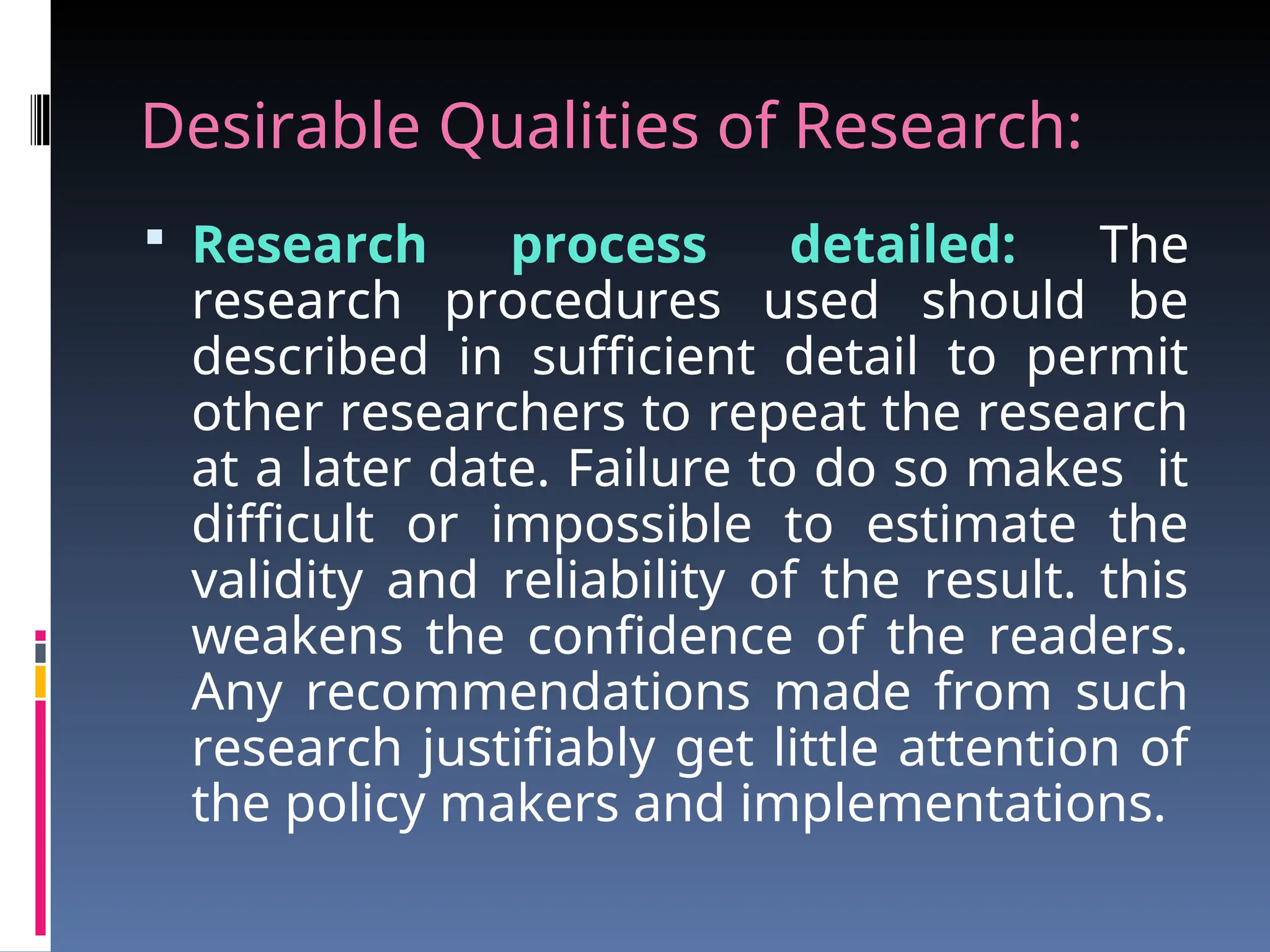
motivated to undertake research
activities because
8.
What makes onemotivated to
undertake research
He might have genuine interest and
curiosity in the existing body of
knowledge and understanding of the
problem.
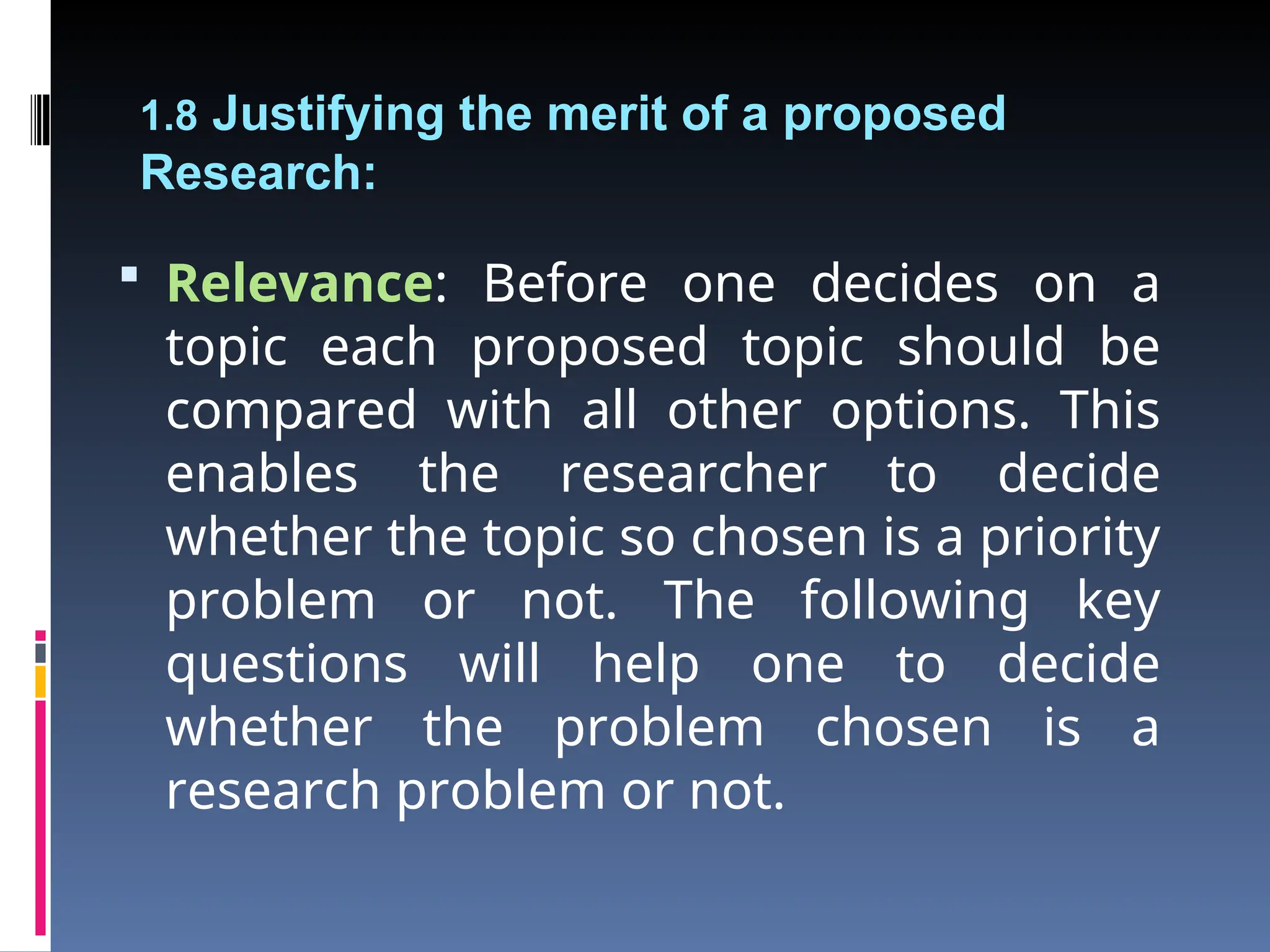
He is looking for answers to questions
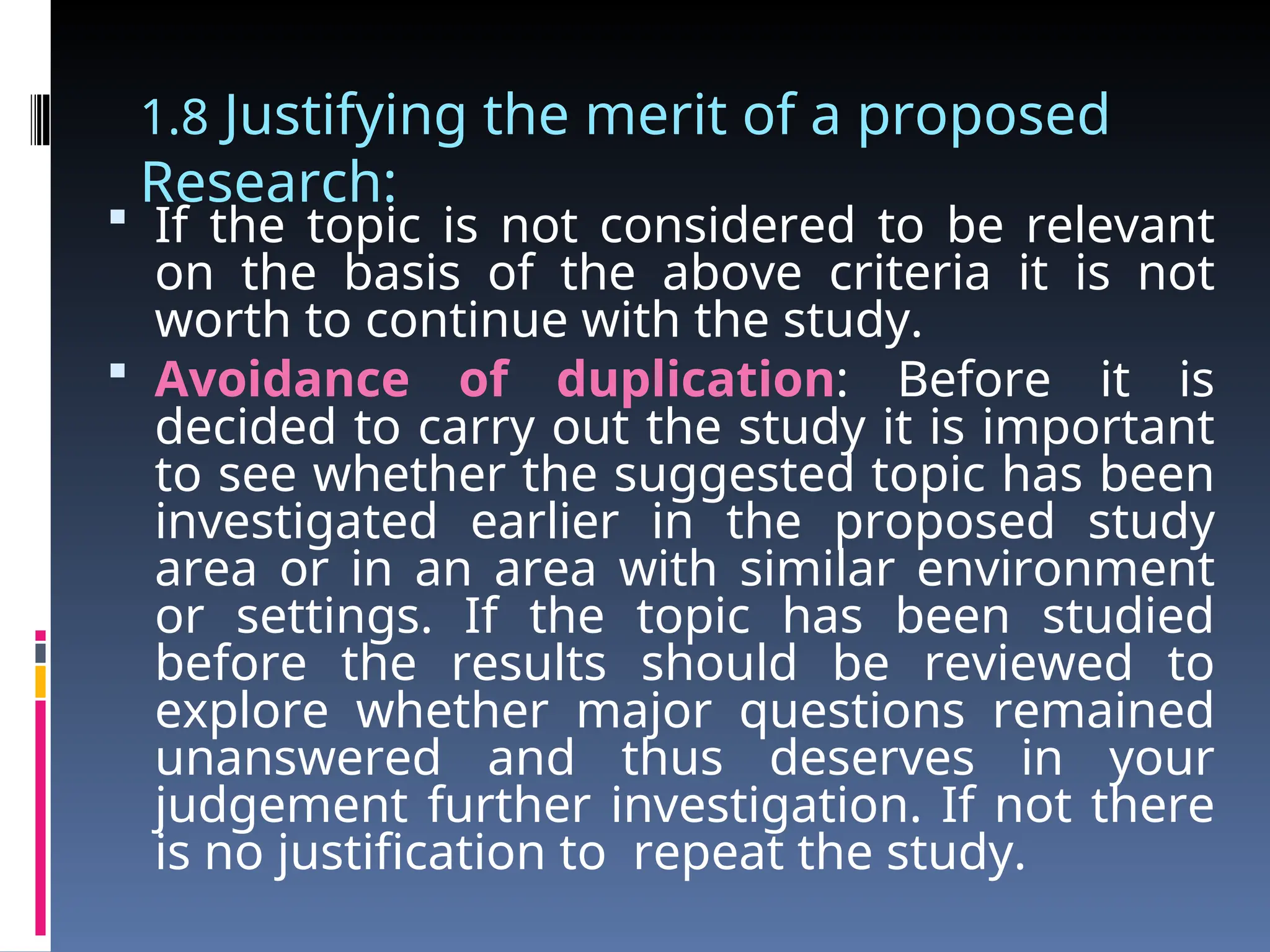
which remained unanswered so far and
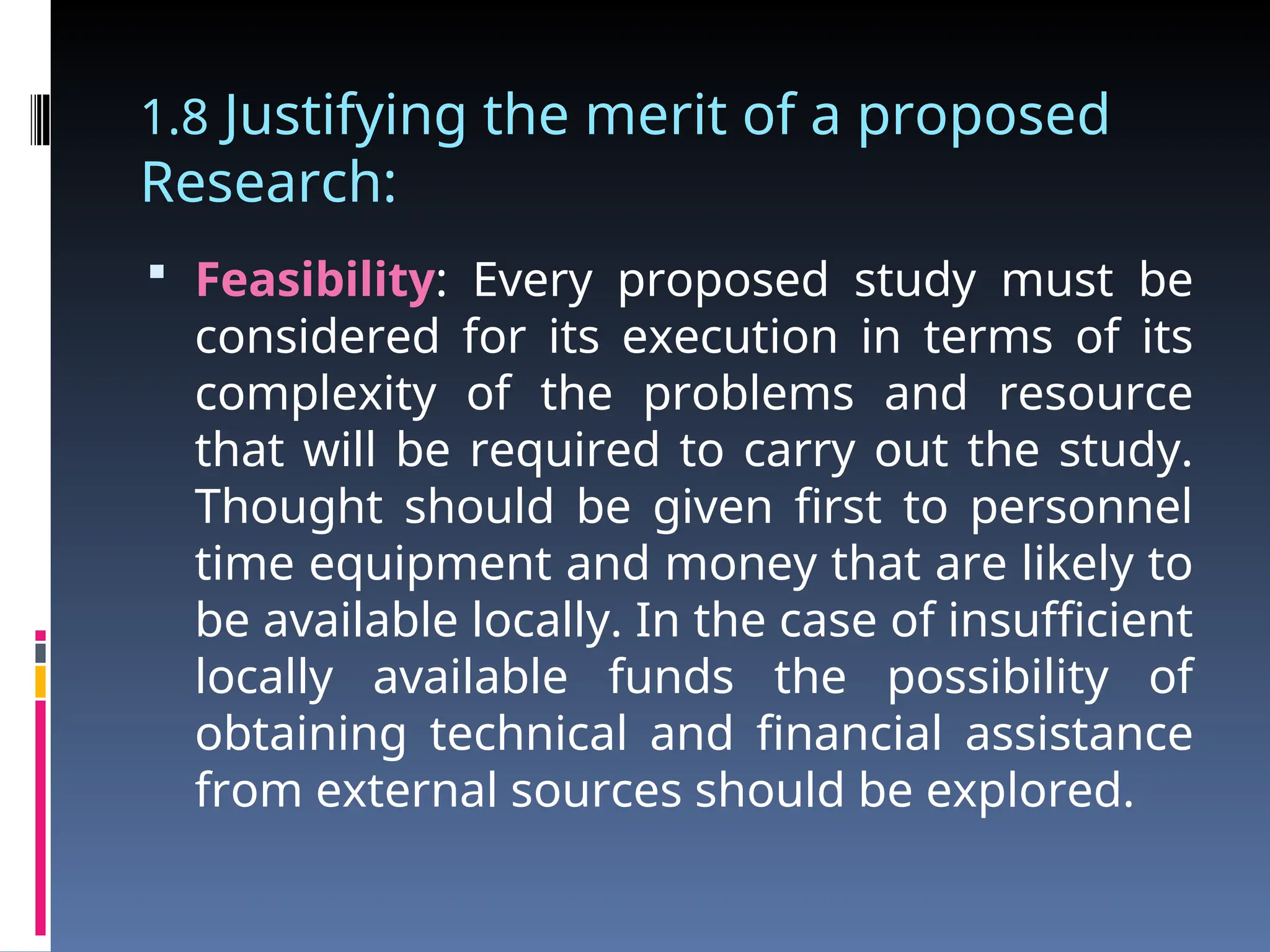
trying to unfold the truth.
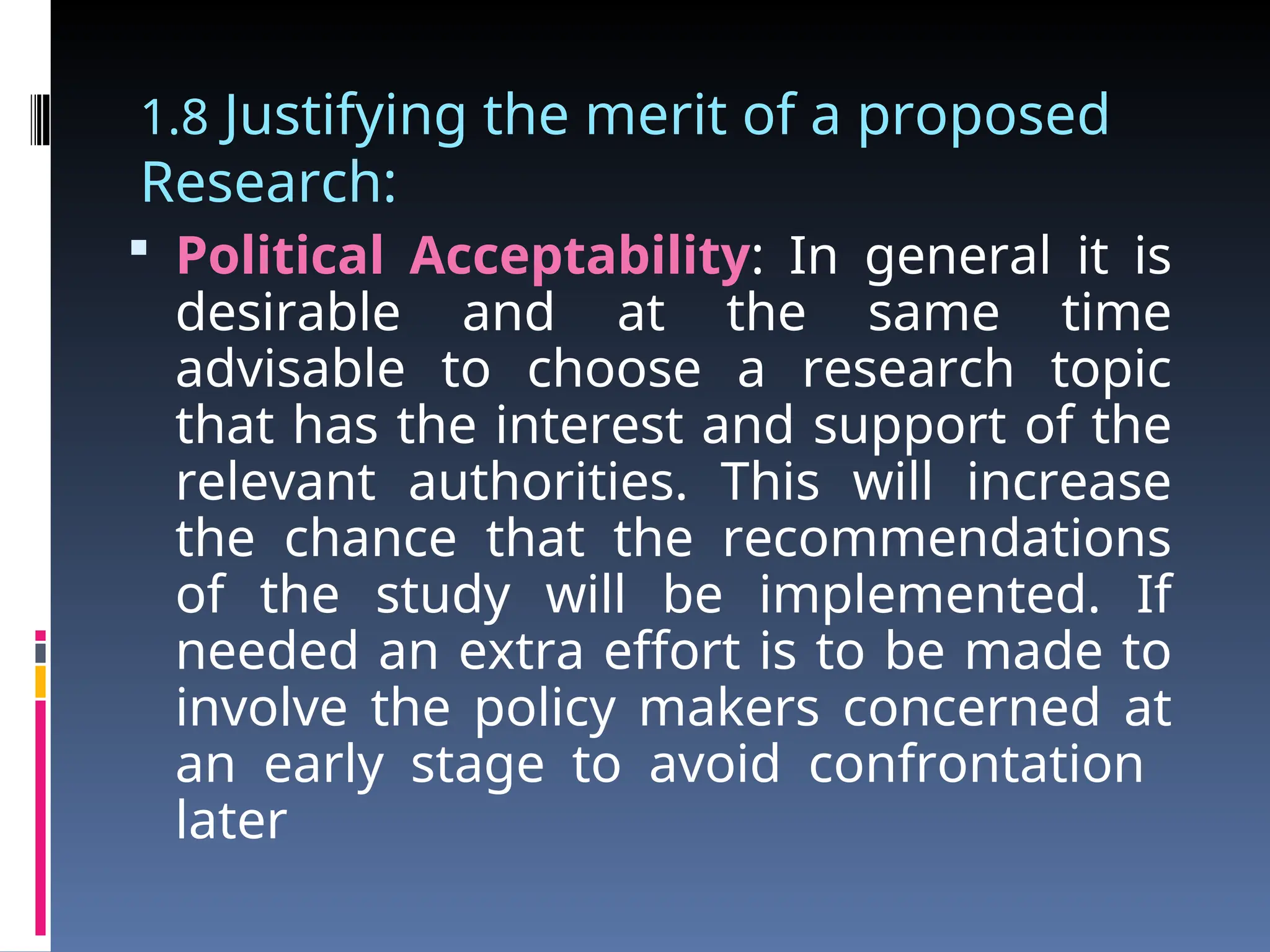
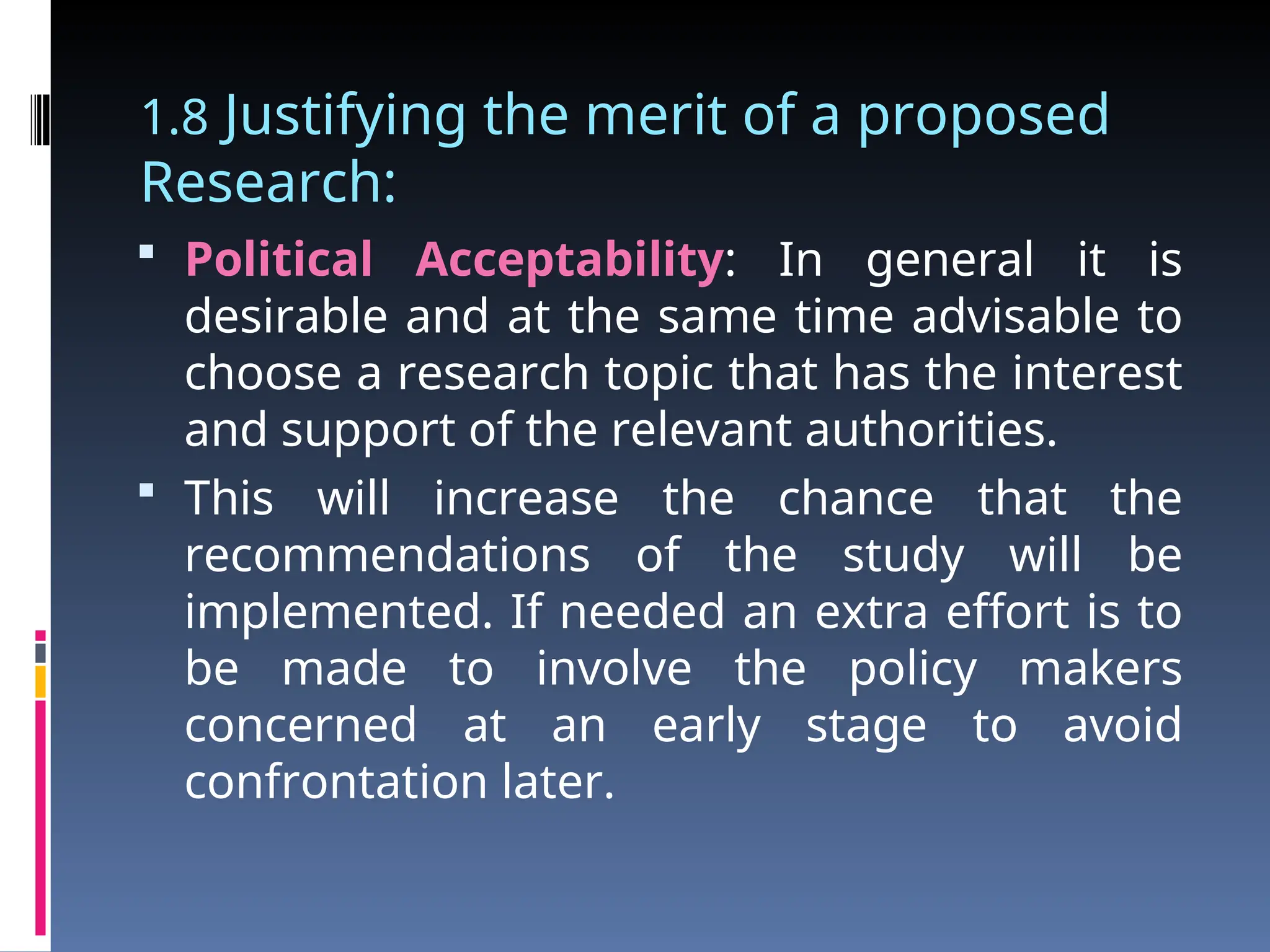
The existing tools and methods available
to him and others may need modification
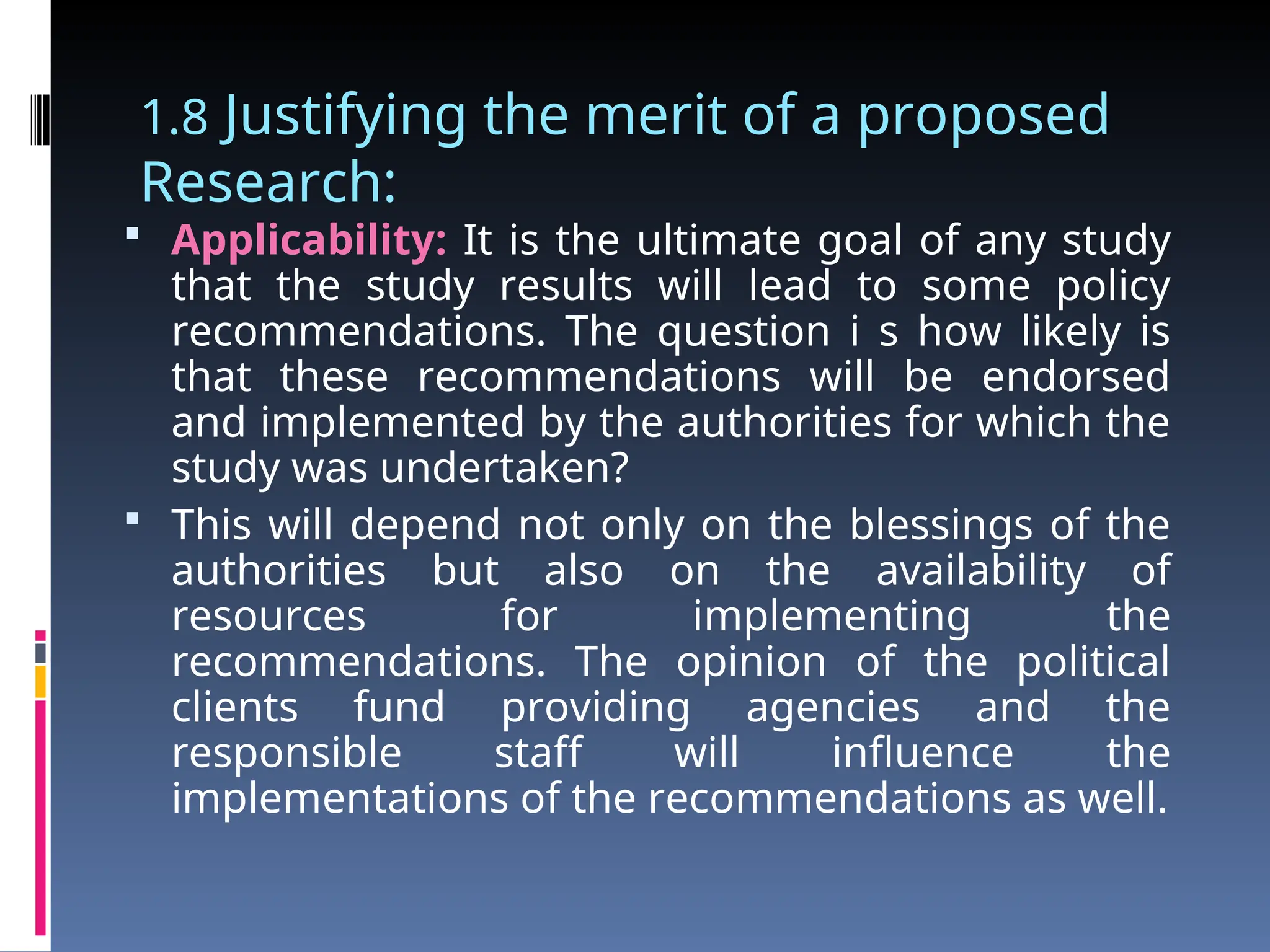
and change to suit the current needs.
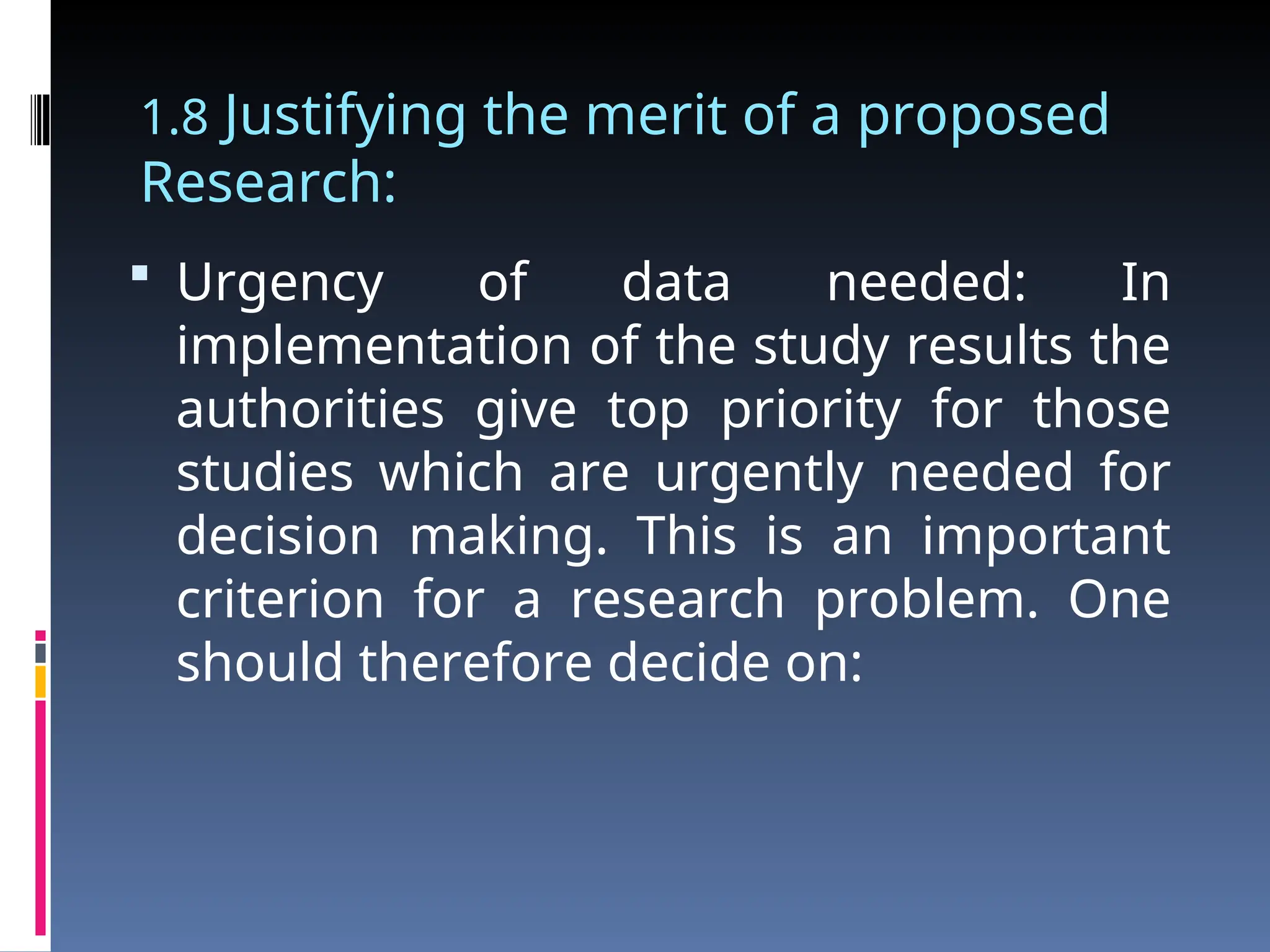
9.
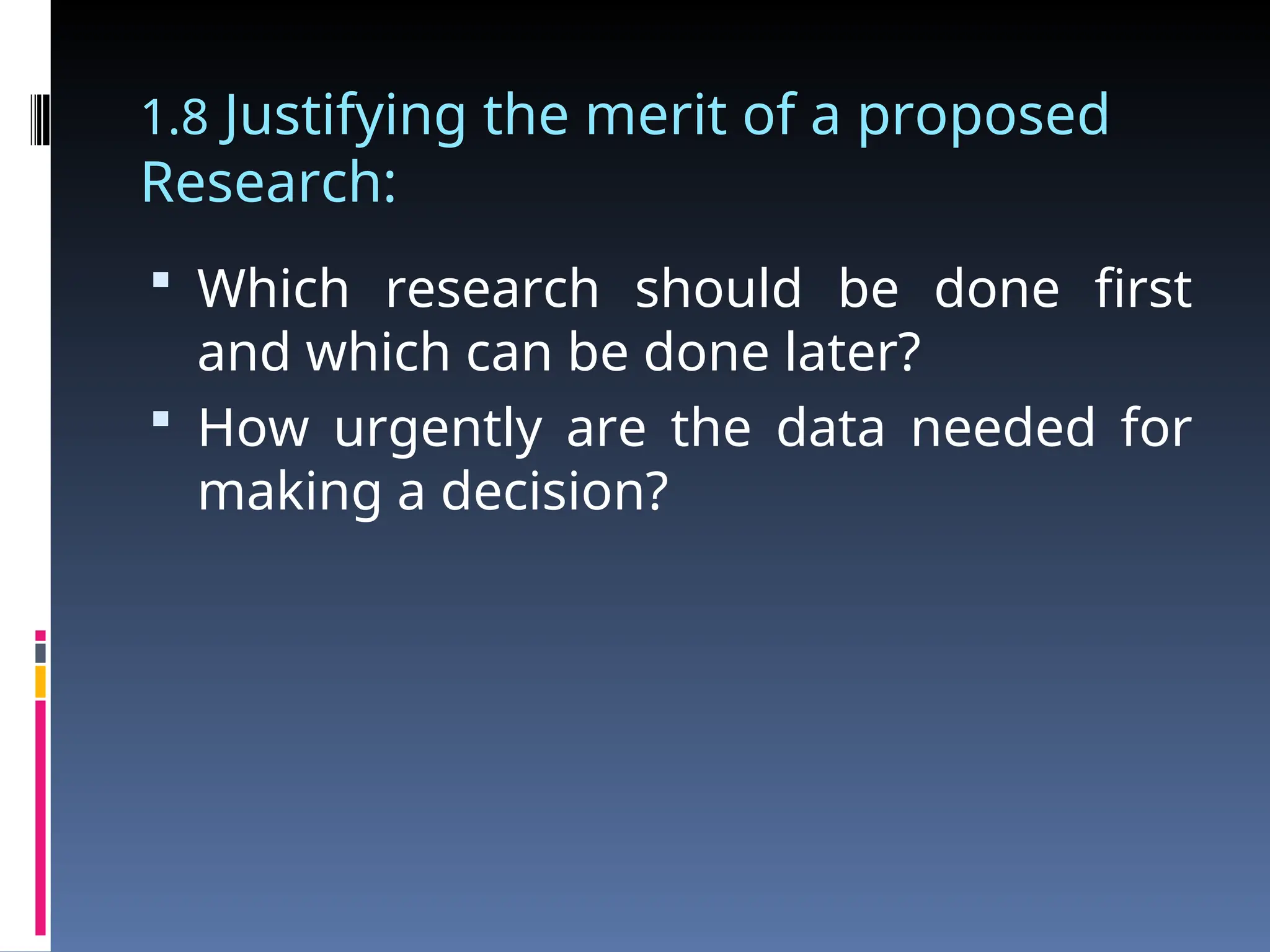
People might doresearch for
personal interest too. These
include among others:
People might do research for personal
interest too. These include among
others:
Better livelihood
Better career opportunity
Higher position, prestige and dignity
Academic achievement
Self-gratification
10.
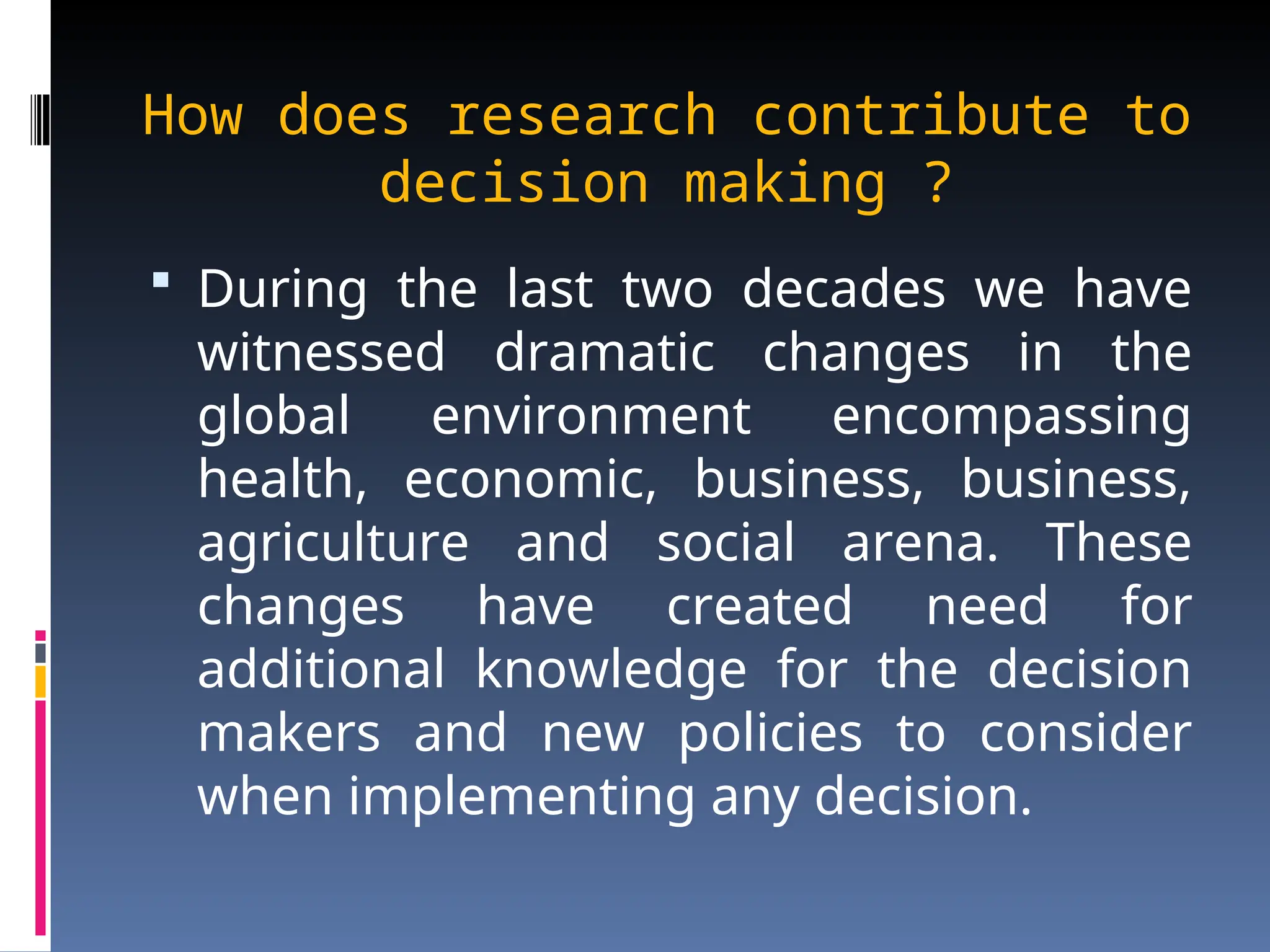
How does researchcontribute to
decision making ?
During the last two decades we have
witnessed dramatic changes in the
global environment encompassing
health, economic, business, business,
agriculture and social arena. These
changes have created need for
additional knowledge for the decision
makers and new policies to consider
when implementing any decision.
11.
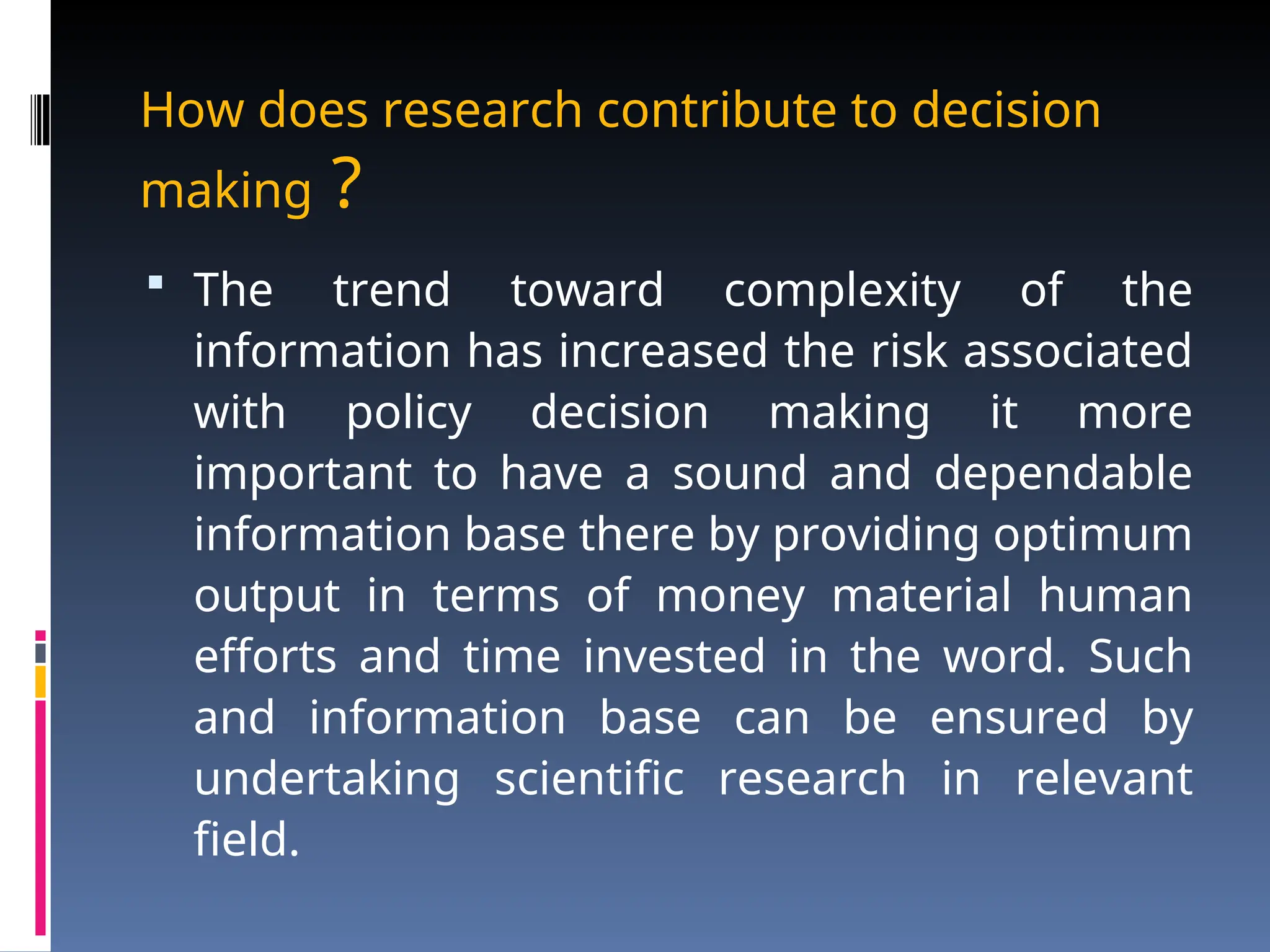
How does researchcontribute to decision
making ?
The trend toward complexity of the
information has increased the risk associated
with policy decision making it more
important to have a sound and dependable
information base there by providing optimum
output in terms of money material human
efforts and time invested in the word. Such
and information base can be ensured by
undertaking scientific research in relevant
field.
12.
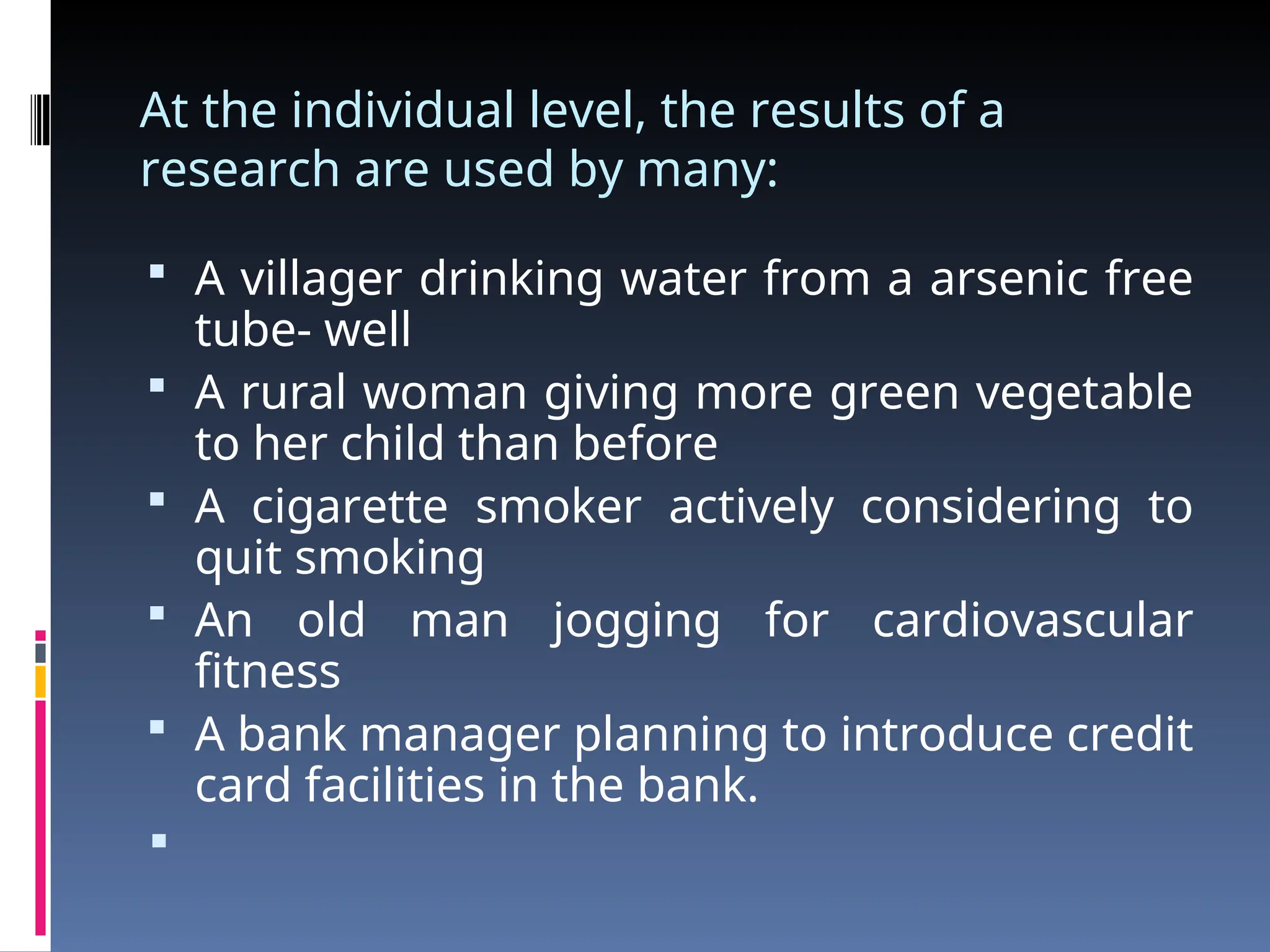
At the individuallevel, the results of a
research are used by many:
A villager drinking water from a arsenic free
tube- well
A rural woman giving more green vegetable
to her child than before
A cigarette smoker actively considering to
quit smoking
An old man jogging for cardiovascular
fitness
A bank manager planning to introduce credit
card facilities in the bank.
13.
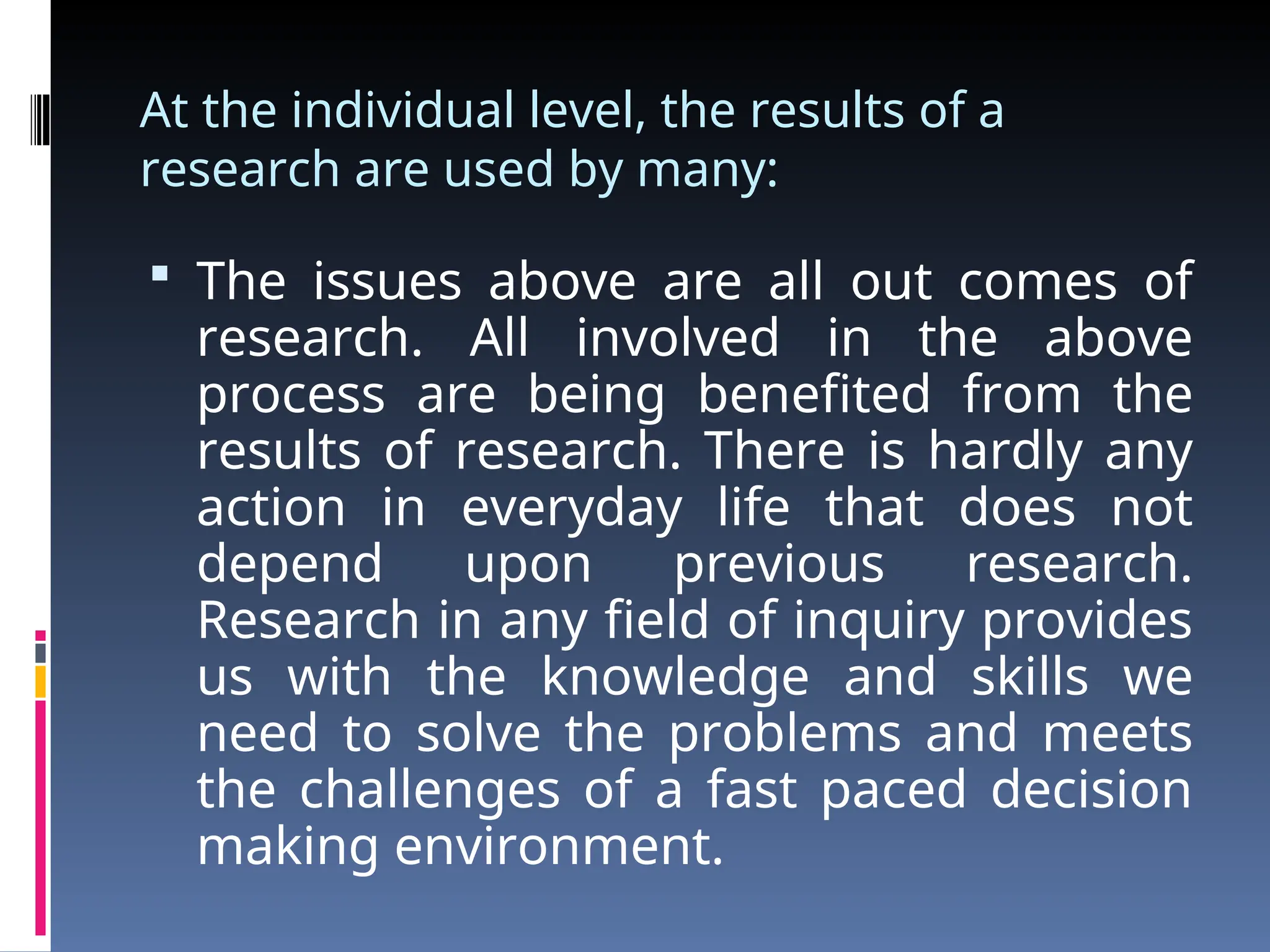
At the individuallevel, the results of a
research are used by many:
The issues above are all out comes of
research. All involved in the above
process are being benefited from the
results of research. There is hardly any
action in everyday life that does not
depend upon previous research.
Research in any field of inquiry provides
us with the knowledge and skills we
need to solve the problems and meets
the challenges of a fast paced decision
making environment.
14.
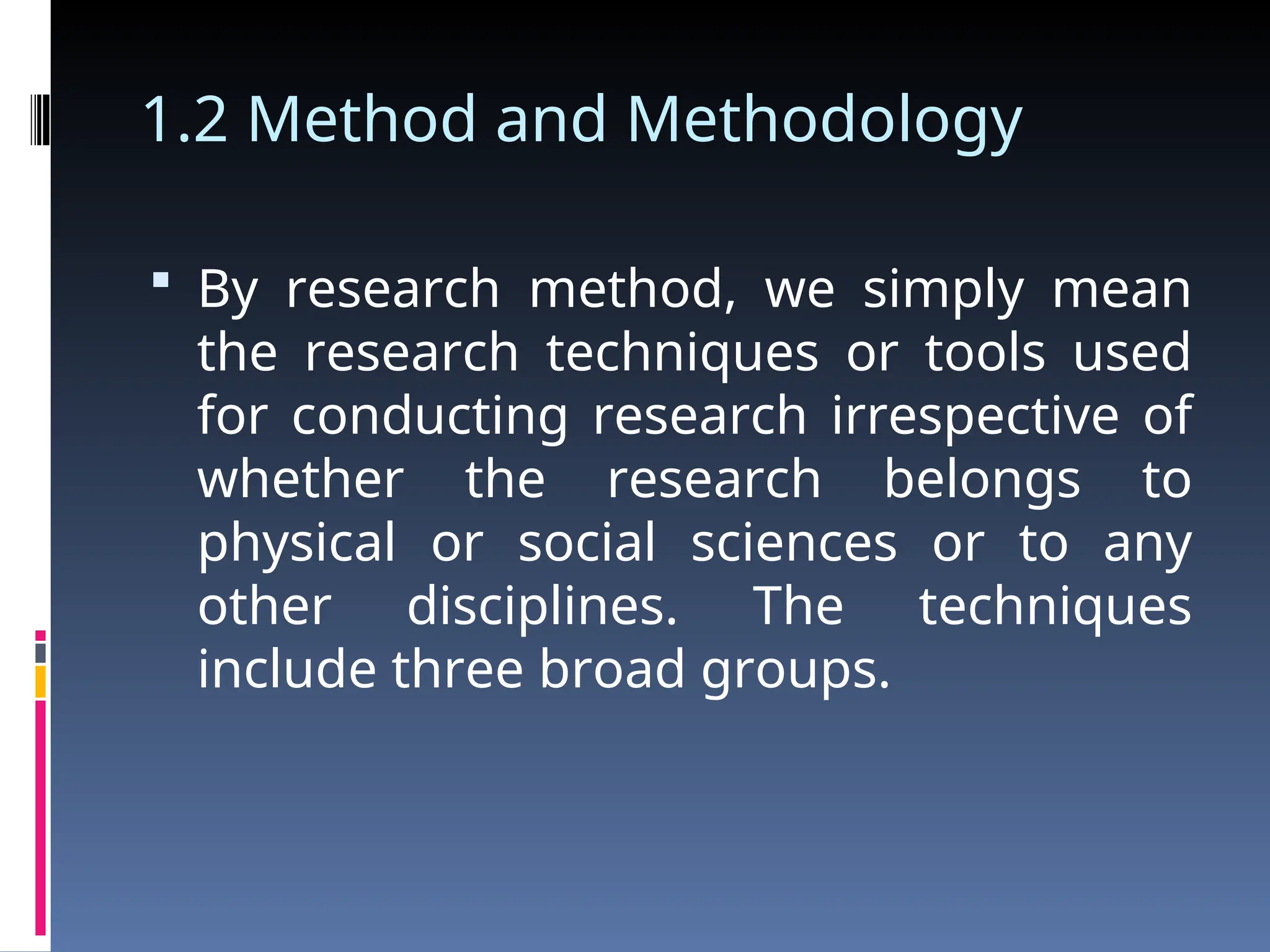
1.2 Method andMethodology
By research method, we simply mean
the research techniques or tools used
for conducting research irrespective of
whether the research belongs to
physical or social sciences or to any
other disciplines. The techniques
include three broad groups.
15.
Method and Methodology:
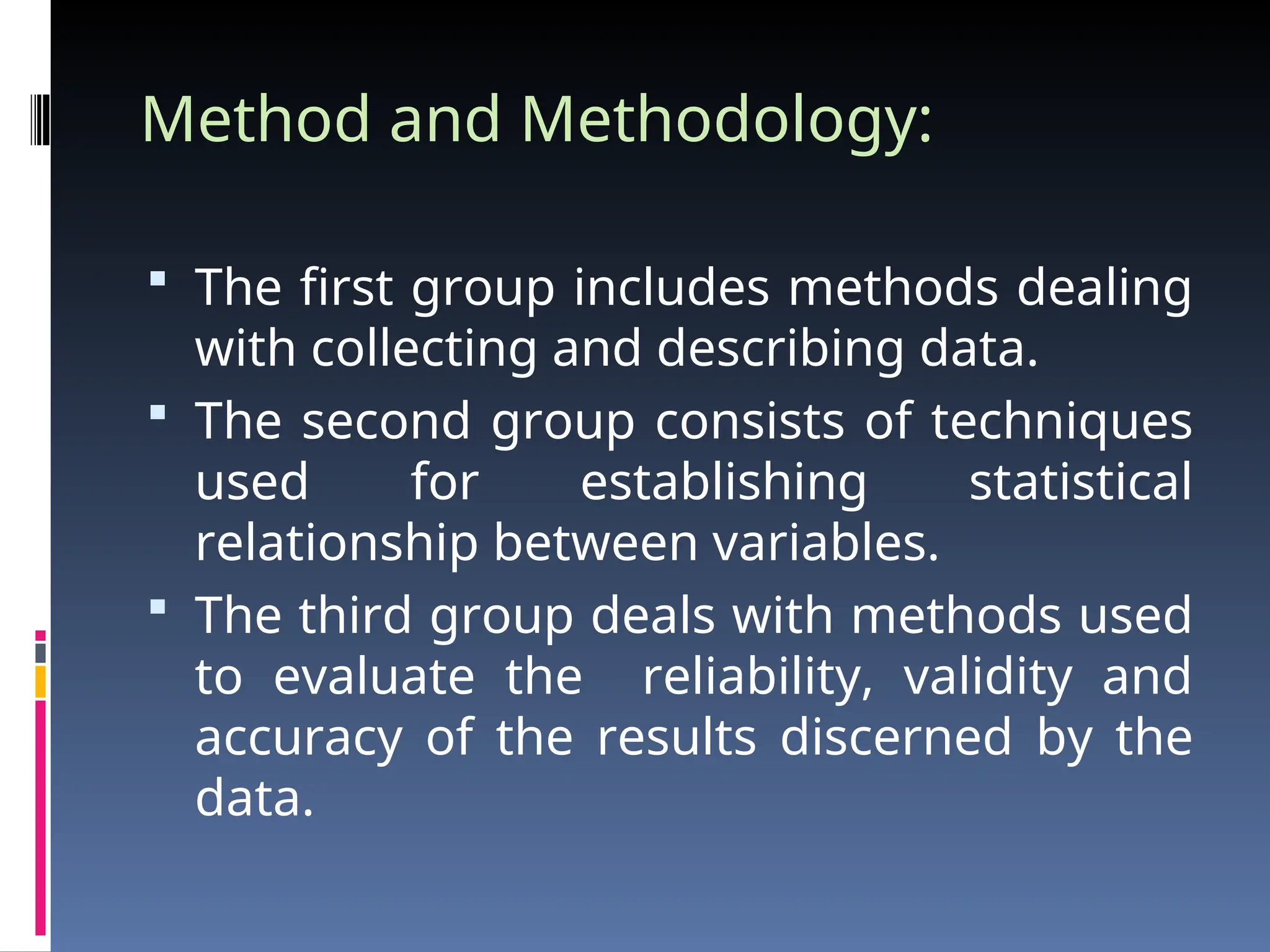
The first group includes methods dealing
with collecting and describing data.
The second group consists of techniques
used for establishing statistical
relationship between variables.
The third group deals with methods used
to evaluate the reliability, validity and
accuracy of the results discerned by the
data.
16.
Method and Methodology:
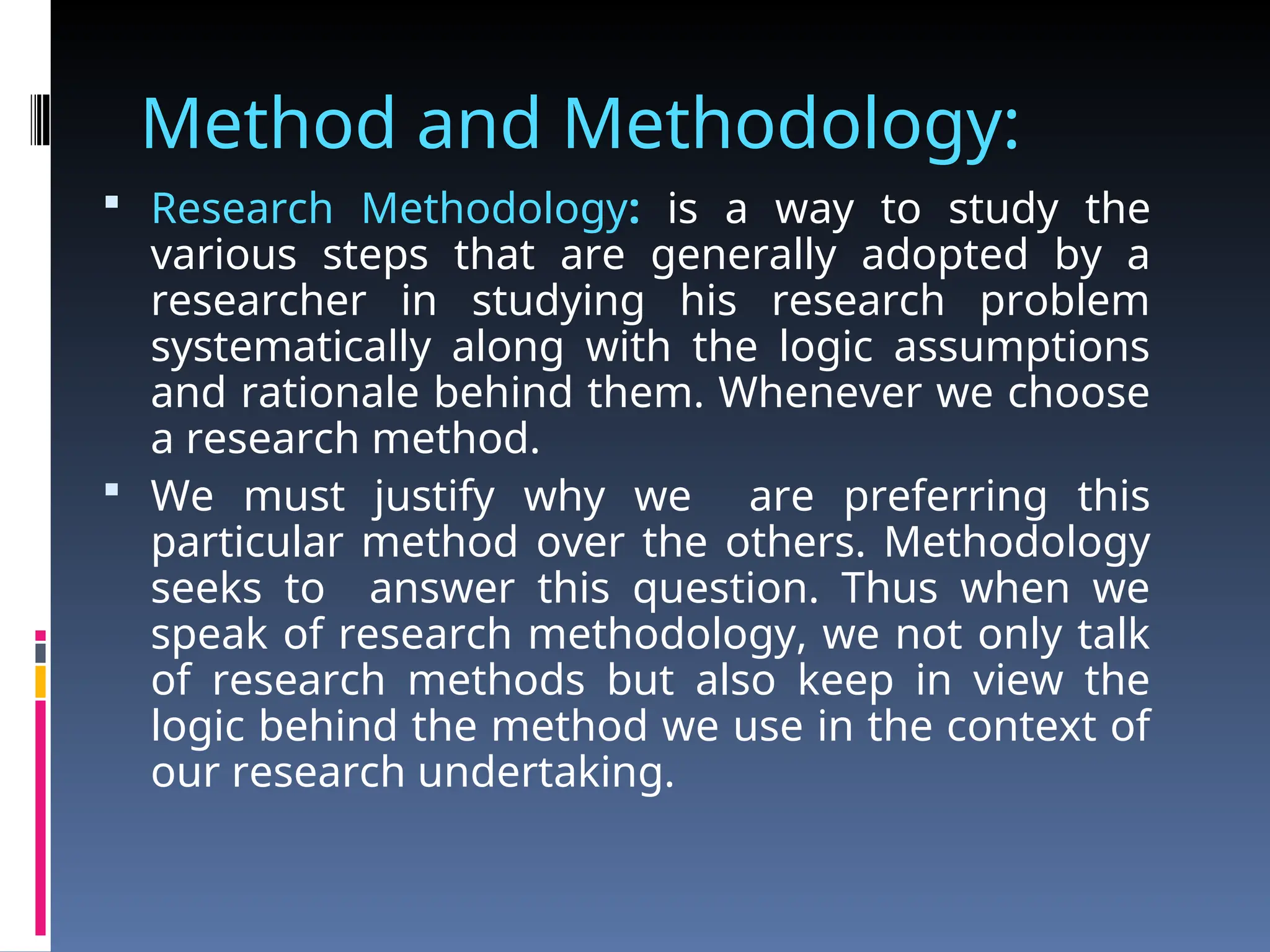
Research Methodology: is a way to study the
various steps that are generally adopted by a
researcher in studying his research problem
systematically along with the logic assumptions
and rationale behind them. Whenever we choose
a research method.
We must justify why we are preferring this
particular method over the others. Methodology
seeks to answer this question. Thus when we
speak of research methodology, we not only talk
of research methods but also keep in view the
logic behind the method we use in the context of
our research undertaking.
17.
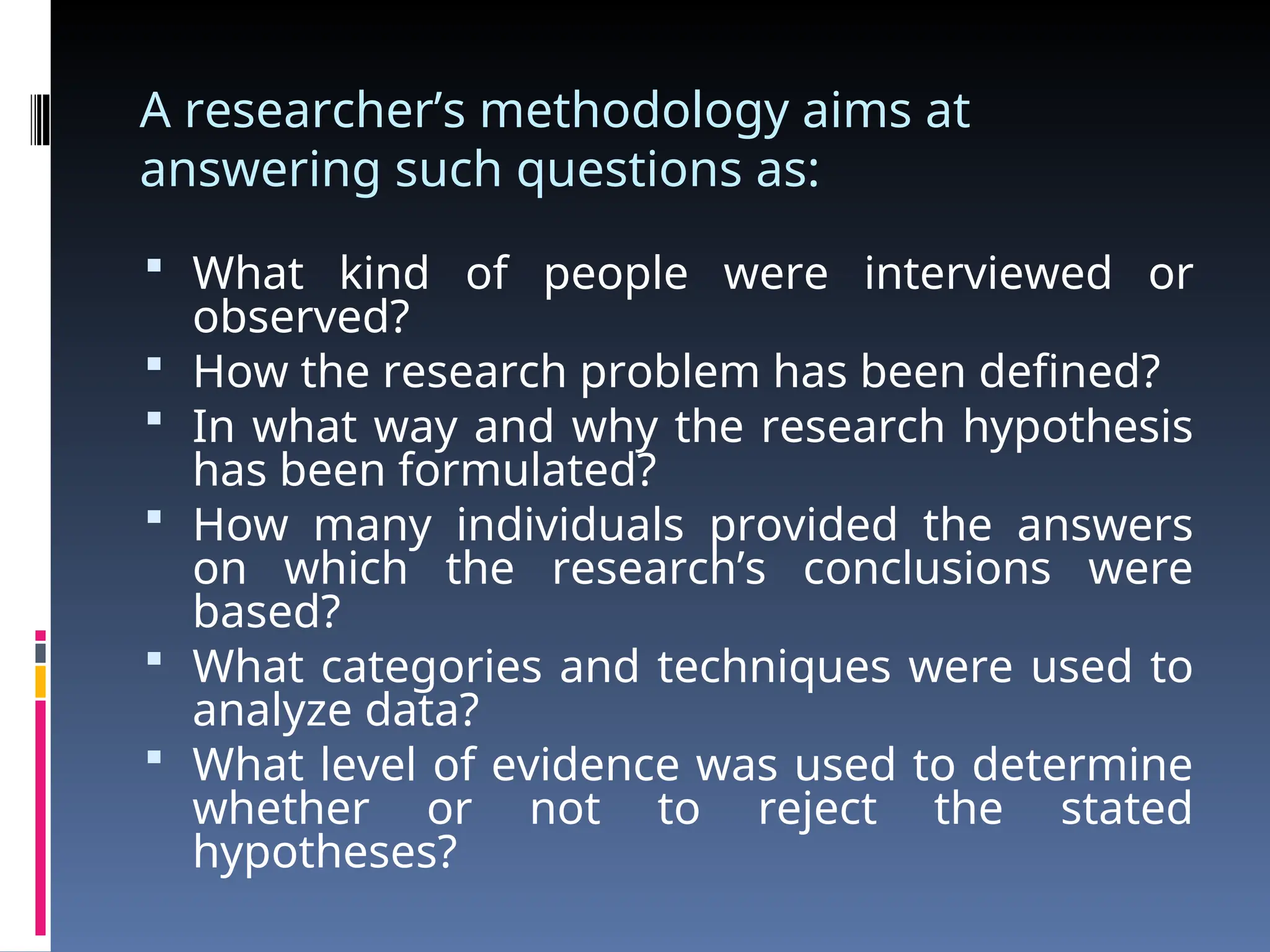
A researcher’s methodologyaims at
answering such questions as:
What kind of people were interviewed or
observed?
How the research problem has been defined?
In what way and why the research hypothesis
has been formulated?
How many individuals provided the answers
on which the research’s conclusions were
based?
What categories and techniques were used to
analyze data?
What level of evidence was used to determine
whether or not to reject the stated
hypotheses?
18.
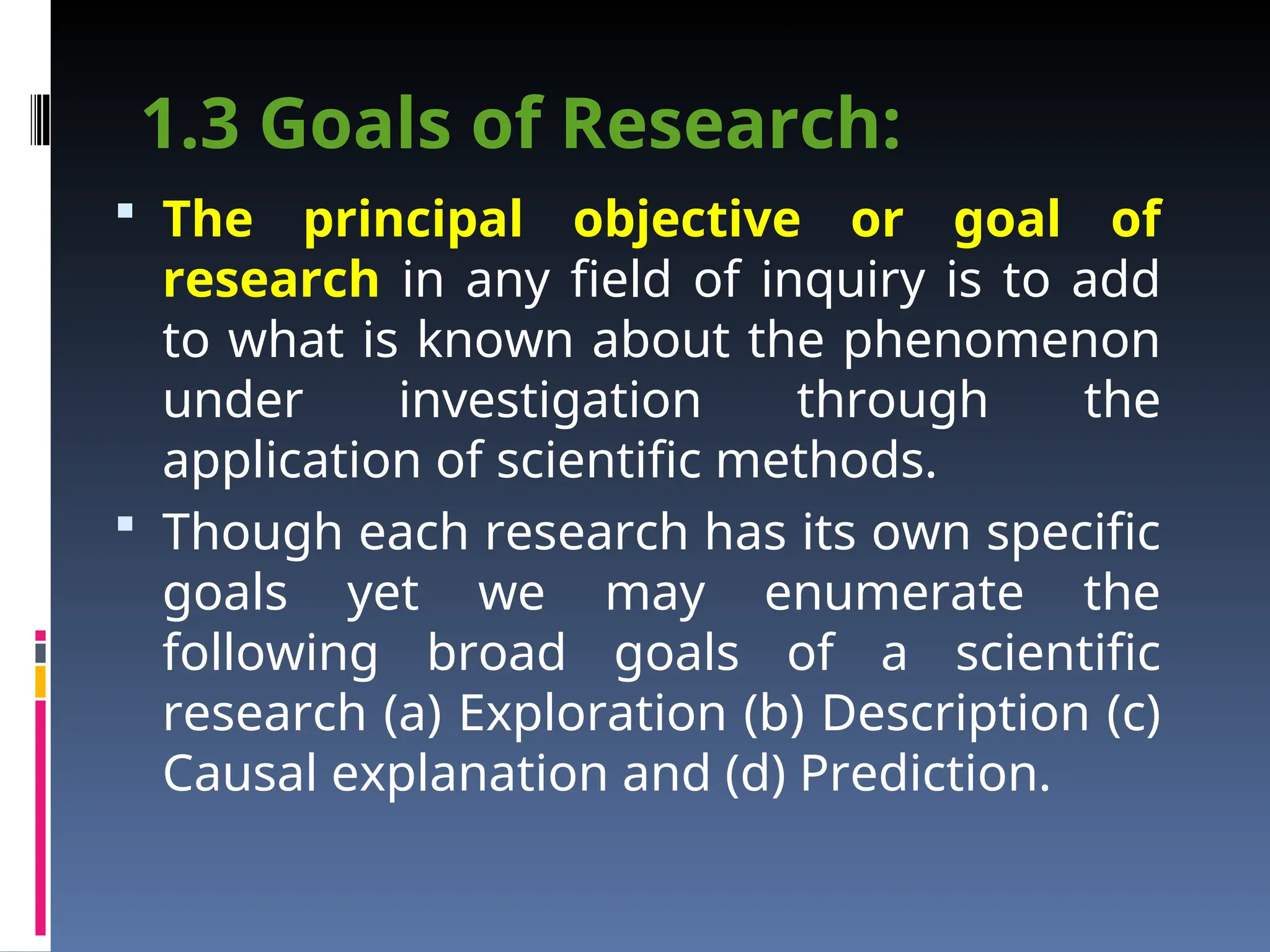
1.3 Goals ofResearch:
The principal objective or goal of
research in any field of inquiry is to add
to what is known about the phenomenon
under investigation through the
application of scientific methods.
Though each research has its own specific
goals yet we may enumerate the
following broad goals of a scientific
research (a) Exploration (b) Description (c)
Causal explanation and (d) Prediction.
19.
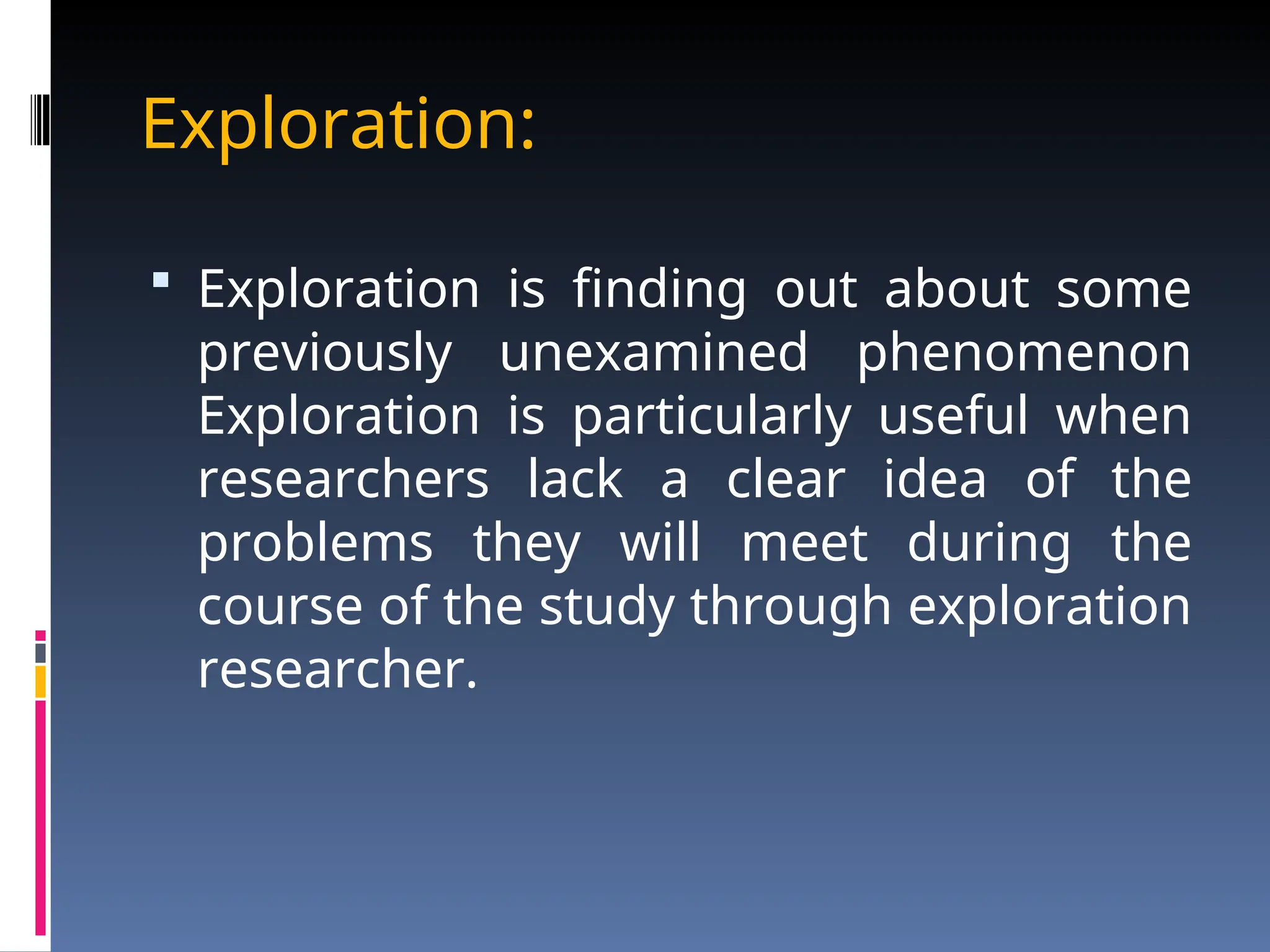
Exploration:
Exploration isfinding out about some
previously unexamined phenomenon
Exploration is particularly useful when
researchers lack a clear idea of the
problems they will meet during the
course of the study through exploration
researcher.
20.
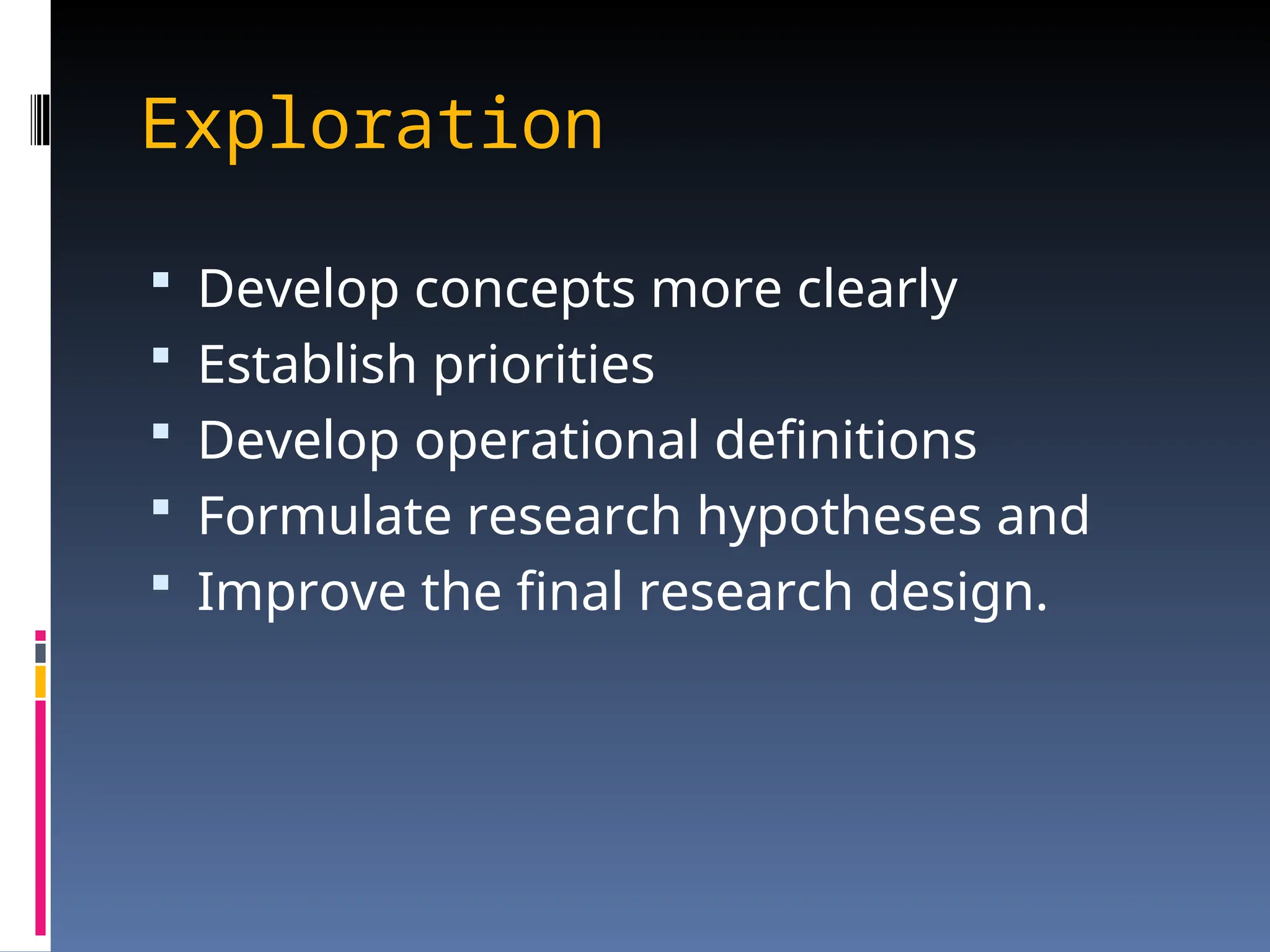
Exploration
Develop conceptsmore clearly
Establish priorities
Develop operational definitions
Formulate research hypotheses and
Improve the final research design.
21.
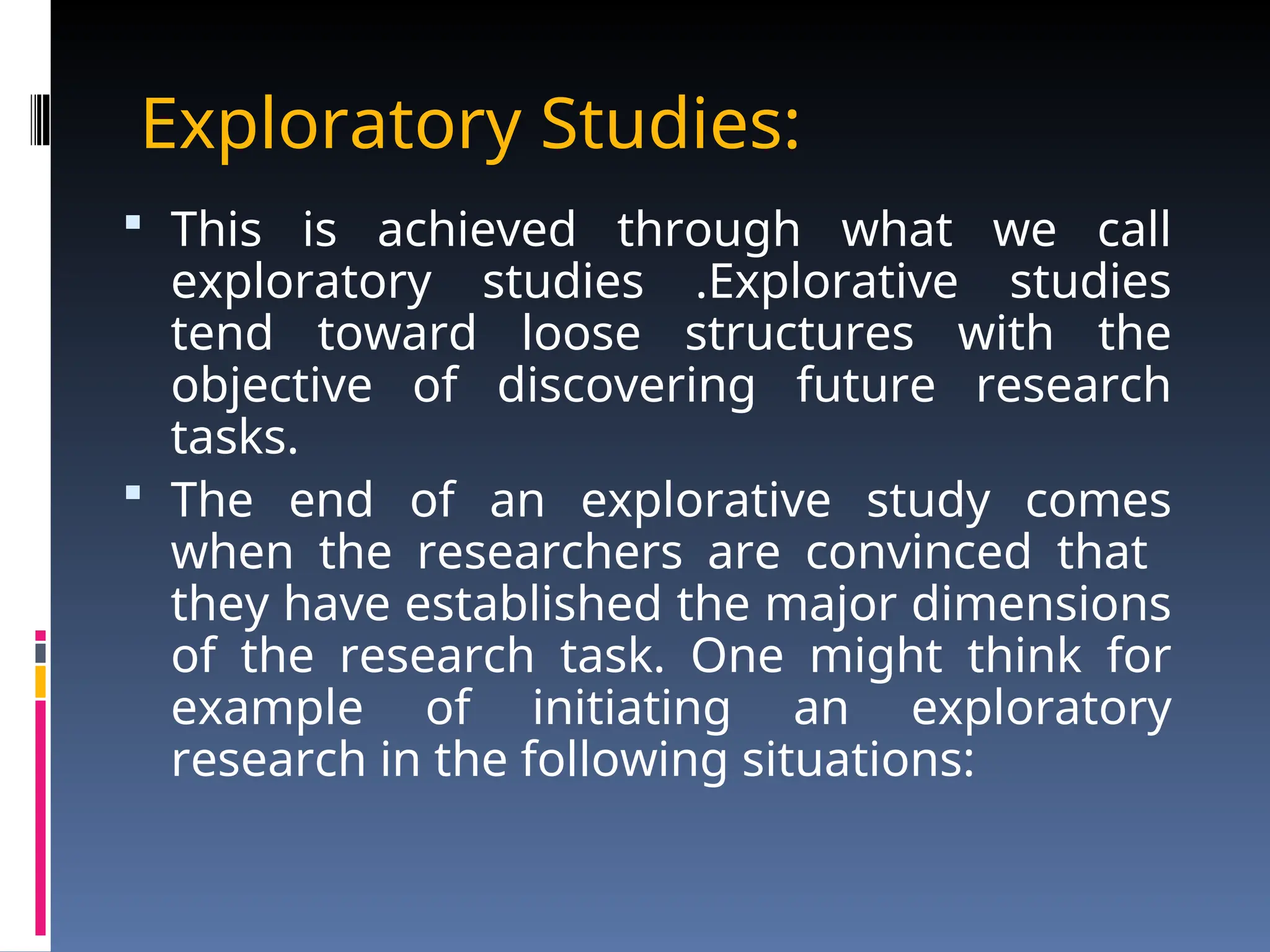
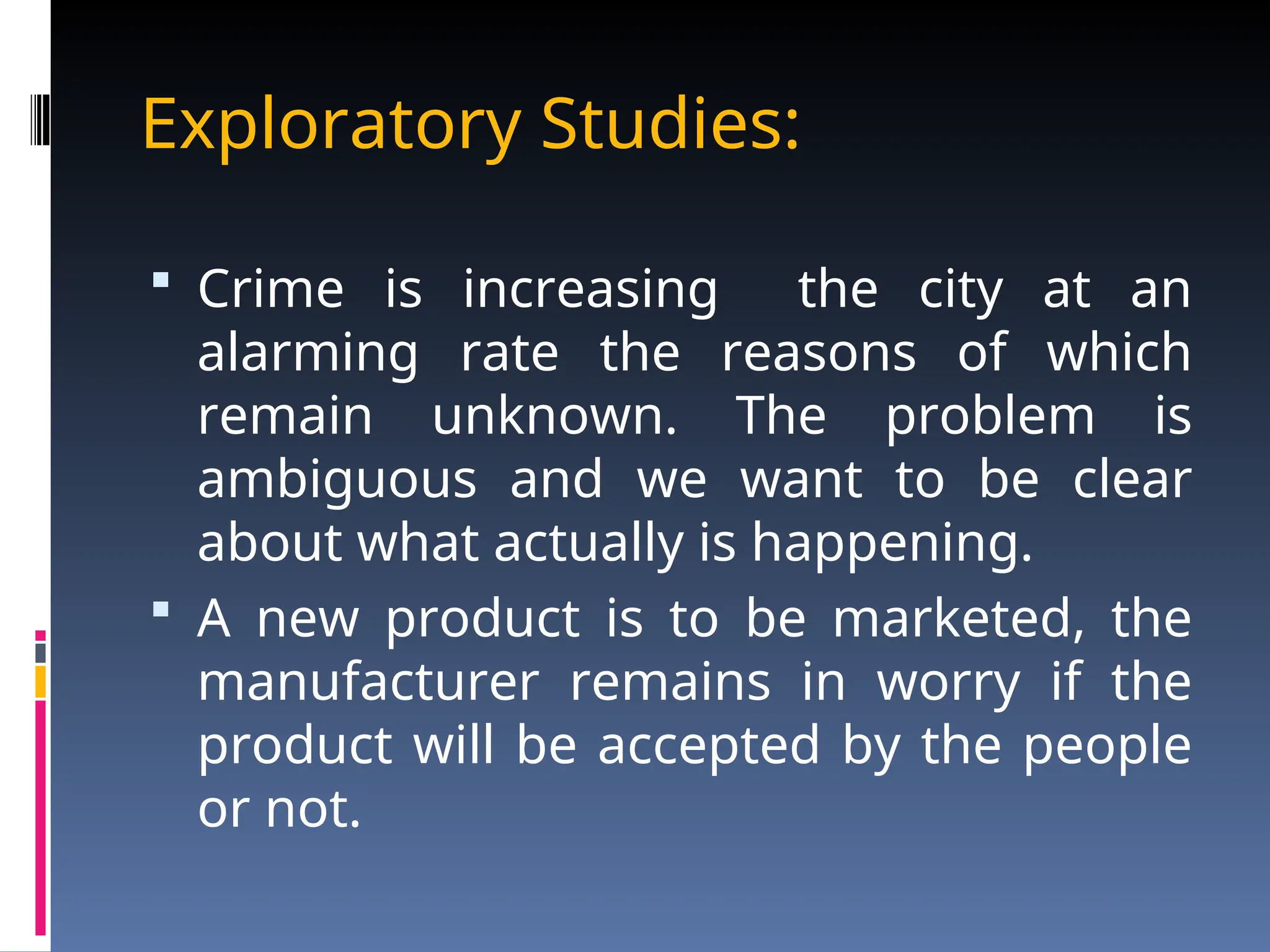
Exploratory Studies:
Thisis achieved through what we call
exploratory studies .Explorative studies
tend toward loose structures with the
objective of discovering future research
tasks.
The end of an explorative study comes
when the researchers are convinced that
they have established the major dimensions
of the research task. One might think for
example of initiating an exploratory
research in the following situations:
22.
Exploratory Studies:
Crimeis increasing the city at an
alarming rate the reasons of which
remain unknown. The problem is
ambiguous and we want to be clear
about what actually is happening.
A new product is to be marketed, the
manufacturer remains in worry if the
product will be accepted by the people
or not.
23.
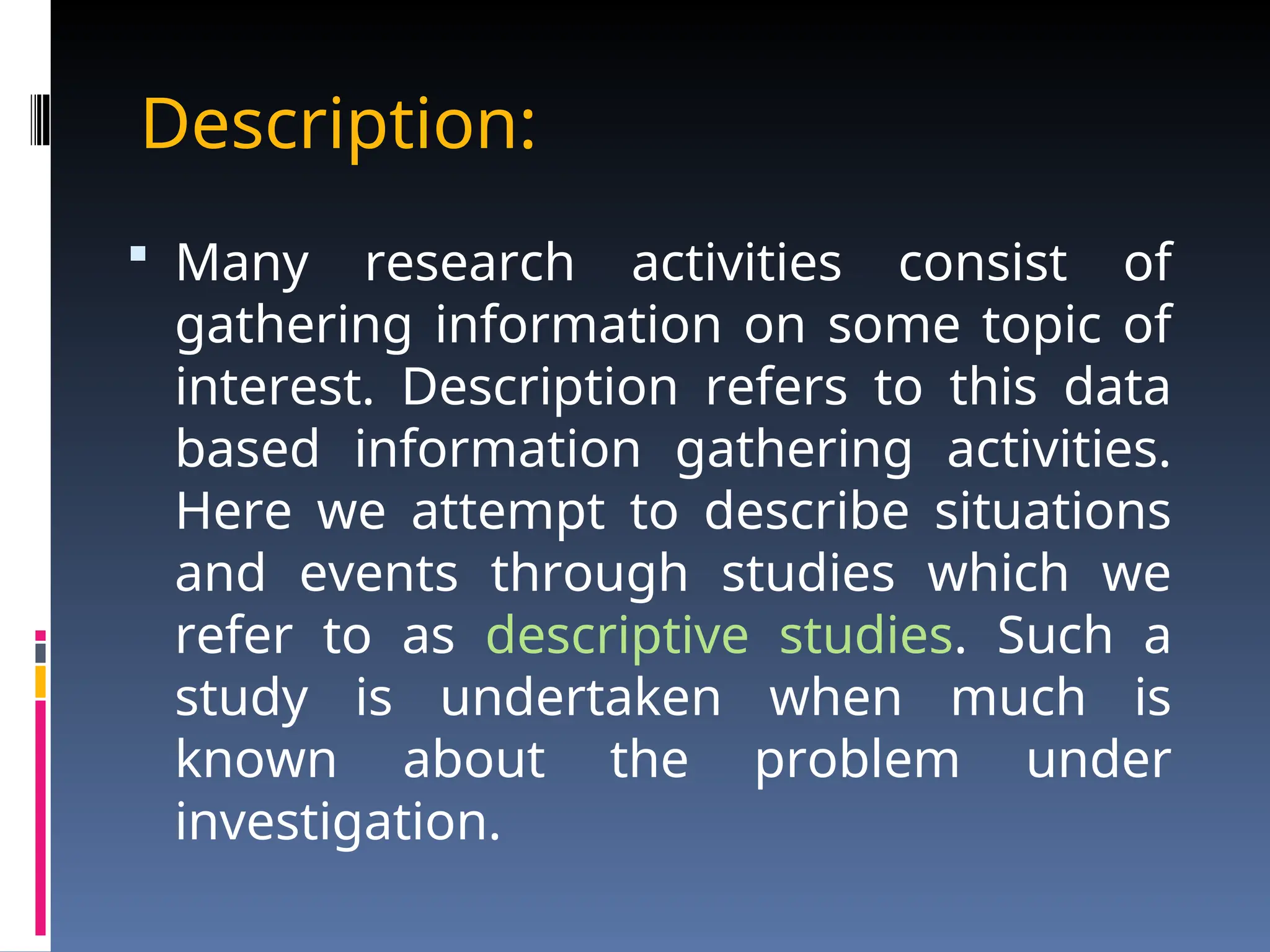
Description:
Many researchactivities consist of
gathering information on some topic of
interest. Description refers to this data
based information gathering activities.
Here we attempt to describe situations
and events through studies which we
refer to as descriptive studies. Such a
study is undertaken when much is
known about the problem under
investigation.
24.
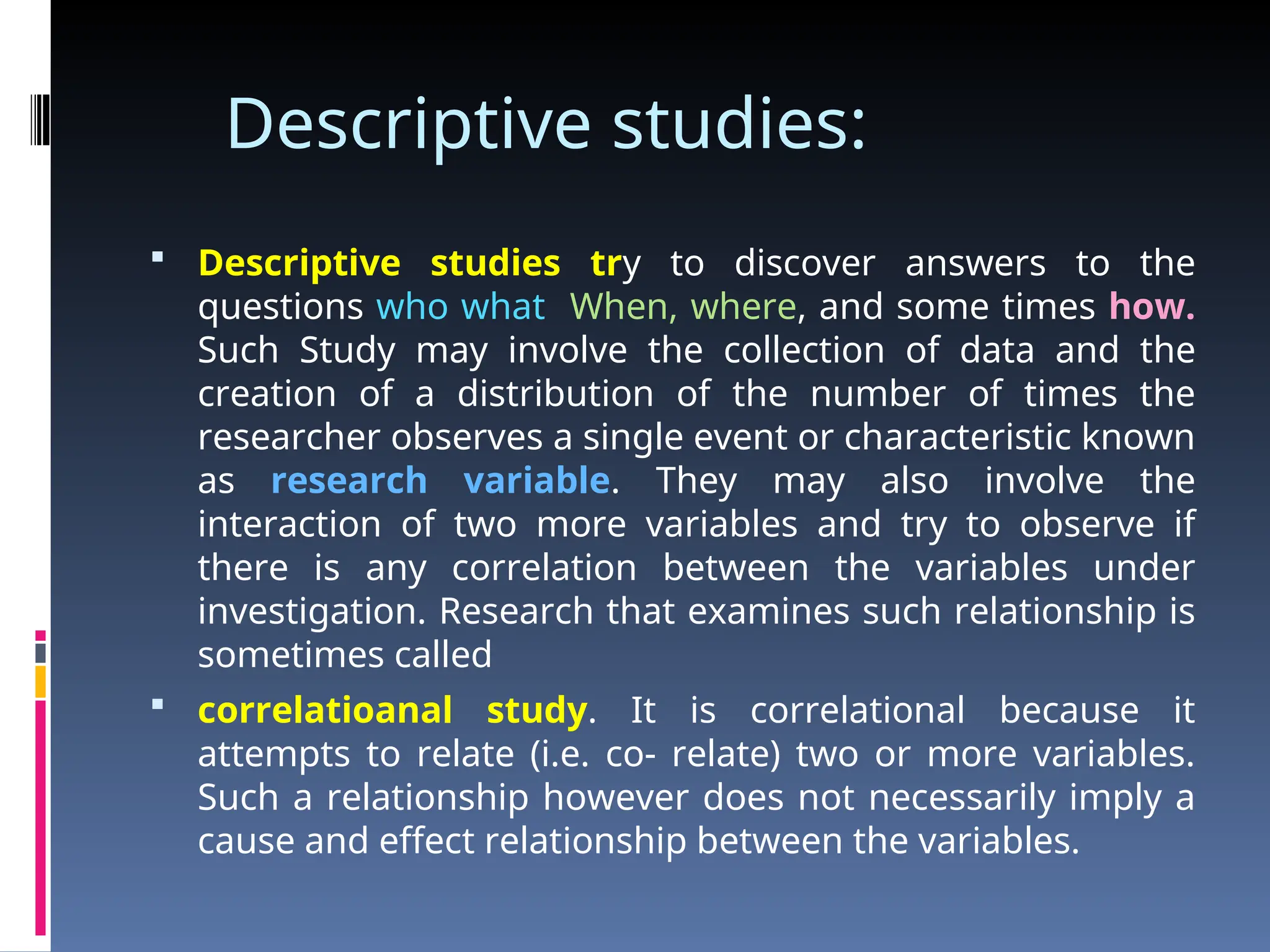
Descriptive studies:
Descriptivestudies try to discover answers to the
questions who what When, where, and some times how.
Such Study may involve the collection of data and the
creation of a distribution of the number of times the
researcher observes a single event or characteristic known
as research variable. They may also involve the
interaction of two more variables and try to observe if
there is any correlation between the variables under
investigation. Research that examines such relationship is
sometimes called
correlatioanal study. It is correlational because it
attempts to relate (i.e. co- relate) two or more variables.
Such a relationship however does not necessarily imply a
cause and effect relationship between the variables.
25.
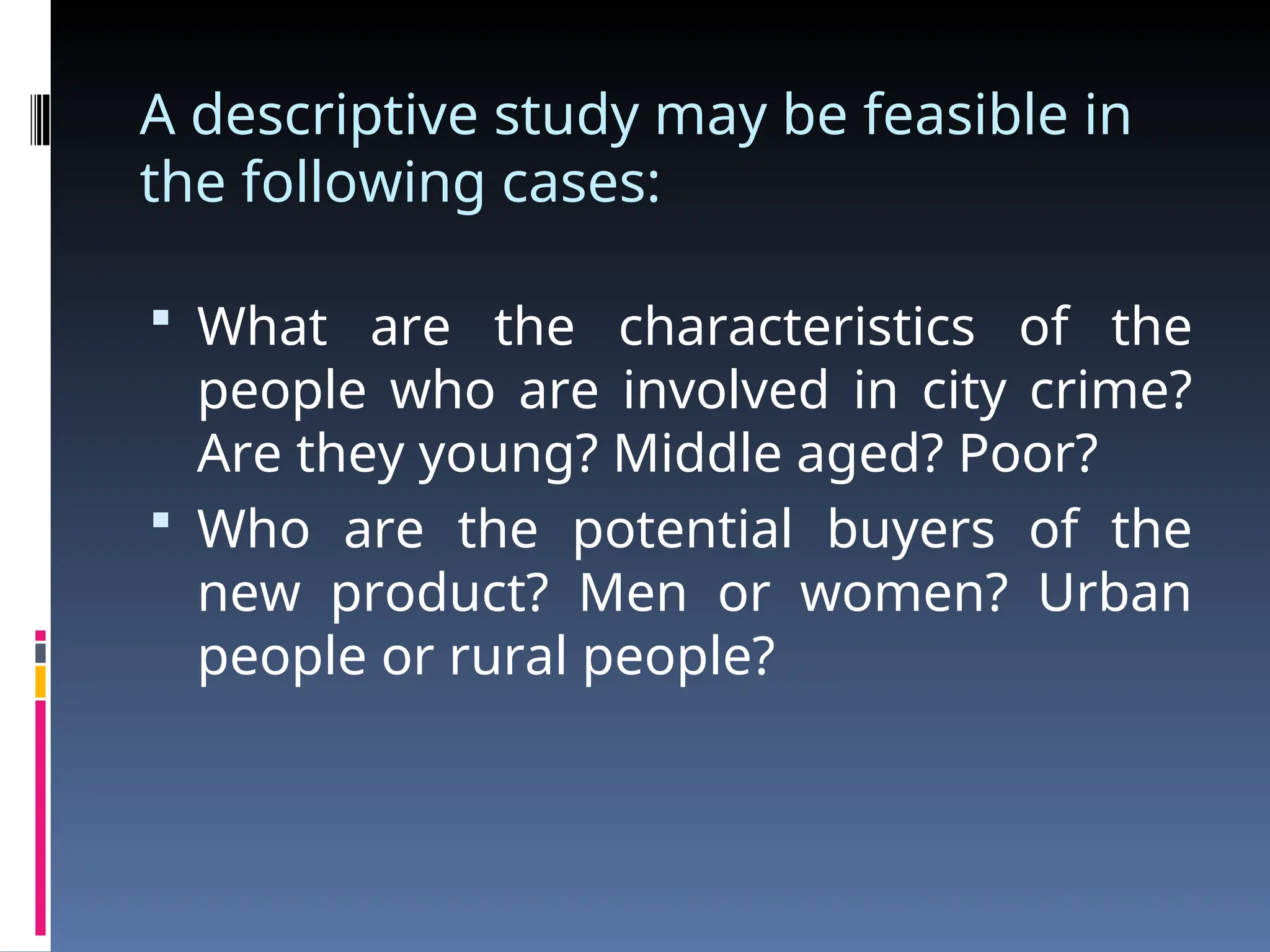
A descriptive studymay be feasible in
the following cases:
What are the characteristics of the
people who are involved in city crime?
Are they young? Middle aged? Poor?
Who are the potential buyers of the
new product? Men or women? Urban
people or rural people?
26.
Casual Explanation:
Explanationis telling why and how something is
happening. An explanatory study goes beyond
description and attempts to establish cause- and –
effect relationship between variables. It explains
the reason for the phenomenon that the
descriptive study observed.
Thus if a researcher finds that communities
having higher family size have higher child death
or that smoking is correlated with lung cancer he
is performing a descriptive study. If he is
explaining why it is so and tries to establish cause
and effect relationship he is performing and
explanatory study. Such studies are also called
causal studies. The researcher uses theories or at
least hypotheses to account for the factors that
caused a certain phenomenon to occur.
27.
Look at thefollowing examples that fit
to causal studies:
Why people are involved in crime? Can
we explain this as a consequence of
present crisis in the job market? Or for
lack of parental care?
Will buyers be motivated to purchase
the new product in a new container?
Can attractive advertisement motivate
them?
28.
Prediction:
Prediction seeksto answer: when and in what
situations the event will occur, if we can provide a
plausible explanation for the event in question.
The precise nature of the relationship between
explanation and prediction. However, has been a
subject of debate. One view is that explanation
and prediction are basically the same
phenomenon except that prediction precedes the
event while explanation takes place after the
event has occurred. Another view is that
explanation and prediction are fundamentally
different processes. We need not be concerned
with this debate here but can simply state that in
addition to being able to explain an event after it
has occurred. We would also like to be able to
predict when the event will occur.
29.
Areas of Research:
Research may be conducted in many
fields of inquiry. The most important
fields of research. Among others are
social research health research and
business research. We provide a brief
over view of these research areas.
30.
Social Research:
Astraditionally defined, social research is an
enquiry to identifying, describing,
understanding, explaining, evaluating and
predicting social phenomena involving
human behavior. Social research is a broad
category with in which there are many sub
classes. As defined by Young (1949). Social
research is the systematic method of
discovering new facts or verifying old facts
their sequences interrelationships, causal
explanations and the natural laws which
govern them.
31.
Social Research:
Asit is implicit in the definition social
research involves the application of scientific
methods through data collection, for
understanding , studying and analyzing the
social life in order to modify, correct or verify
the existing knowledge as a system. The
information contained in the data would
benefit society either through the direct
application of findings to the amelioration of
social ills or through the use of t he findings
to test theoretical issues in social sciences.
Here are a few examples of social research:
32.
Social Research:
Example1: Marriage is universal in
Bangladesh. People marry at a very
young age. It is particularly true for
women. Apart from demographic
impact on fertility and mortality
adolescence marriage has serous social
consequences too. A study is designed
to examine these consequences.
33.
Social Research:
Example2: Although dowry demand is illegal
under dowry prohibition
Act 1980, the practice still persists as a
custom, especially in the rural areas of
Bangladesh. As a consequence of unpaid
dowry women are tortured by their husbands
and in- laws, burnt by acid or even murdered.
Despite serious growing concerns with in
government and civil societies practice of
dowry has not decreased. In most cases males
attitudes were unfavorable. It is important to
undertake a study for exploring possible ways
to eliminate discriminations towards women
and girls due to dowry.
34.
Social Research:
Example3: The government supplied oral
contraceptive pills (OCP) and injectables is
provided free of cost while condom is
provided at a minimum cost through
government field workers and clinics. Even
then why do a significant proportion of
women apparently prefer to purchase social
marketed contraceptives rather than avail
free services is a very crucial information for
social marketing company (SMC). This is
proposed to be verified using a field study.
35.
Health, Population andFamily Planning
Research:
Health research is primarily concerned with
improving the health of a community by
enhancing the efficiency and effectiveness of the
health system as an integral part of the over all
process of socioeconomic development. The
health research attempts to describe what people
believe. And know about health and illness and
what they do to remain healthy and cure diseases.
Data are gathered from health related sectors
that include, among others the agricultural and
food distribution, Education (formal and no
formal). Water and sanitation and transport and
communication. All these sectors contribute to
health either directly or indirectly.
36.
Health, Population andFamily Planning
Research:
Population research is a scientific inquiry
aimed at understanding the population
dynamics with respect to the size, structure,
growth, distribution and dispersal of a
population while the family planning research
inquires upon contraception, side effect,
follow up etc.
Reproductive health encompasses issues like
maternal health , adolescent health,
antenatal postnatal and delivery care. Child
health includes, among others, nutrition,
growth monitoring, breast feeding,
immunization, diarrhoeal diseases, etc.
37.
We cite someexamples below that
demonstrate this research:
Example1: (Reproductive Health)
Despite that fact that trained traditional
birth attendants (TBA) are readily
available in rural areas for safe delivery,
only around 20% of the home deliveries
are attended by the trained TBAs. It is
thus imperative to identify the reasons
why the adult members do not avail of
this opportunity.
38.
Health, Population andFamily Planning
Research:
Example 2: (General Health) Obesity plays a role
in the development of diabetes mellitus.,
hypertension, dyslipidemia, cardiovascular
disease and several cancers. A significant portion
of the population is obese in the country. Higher
prevalence rates are seen in certain sub groups
of the population including the middle aged (35-
64). However, little is known of the differences in
weight patterns between males and females and
that among adolescents. A study is needed to
investigate the issue in question.
39.
Health, Population andFamily Planning
Research:
Example3: (Population Dynamics): Kabir et. Al.
(1997) utilizing the data from various sources
examined the prospect for stabilization of
Bangladesh population under alternative
demographic scenarios. They further
examined prospect for achieving zero
population growth visa vis NRR =1 by the end
of 2010 based on their findings they
concluded that if the fertility target can be
achieved as envisaged. Bangladesh
population will be more or less stable by 2050.
40.
Health, Population andFamily Planning
Research:
Example 4 Family Planning): Duston and
miller (1995) initiated a research to
ascertain how to improve community
based family planning services and the
potential for increasing contraceptive
prevalence in Bangladesh. The specific
objectives of the study were to investigate
the degree to which improved service
delivery in Bangladesh can increase
contraceptive use in the present status of
demand, programmatic factors most
associated with increased prevalence and
make these projects more widely known.
41.
Business Research:
Businessresearch is defined as a
systematic inquiry that provides
information to solve managerial
problems aiming at reaching business
decisions. The emphasis of business
research is on shifting decision makers
from intuitive information gathering to
systematic and objective investigation.
Like other researches, business research
is also accomplished through exploration
description, explanation and prediction.
42.
Business Research:
Businessresearch is of much recent origin and is
largely supported by Business organizations, while
public domain has sponsored much physical
research, some of it for hundreds of years. The
development of scientific methods in Business
research lags behind similar development in the
physical sciences. Physical scientists have been
more rigorous in their concepts and research
procedures. They are much more advanced in
their theory development than are business
scientists . Business research operates in a less
favorable environment in other ways too. Physical
research is normally conducted under conducted
under controlled laboratory conditions; while
business research seldom is. Here are three
examples illustrating what business research is.
43.
Business Research:
Example1: Micro credit programs from both
institutional and non institutional sources
have been found to have great impact to raise
the standard of living of the rural people
especially of women. But there are ample
evidences that these credit facilities are being
misused and misdirected in many instances.
This feeling has led to the high rate of default
putting institutions in hesitance in financing
the rural people. In this context, it is
imperative to examine the status of utilization
of credit and assess the extent and magnitude
of misuse and diversion of credit in rural
areas.
44.
Business Research:
Example2: Tea is an important cash crop of
Bangladesh. A large number of tea industries have
been established in Bangladesh depending on the
tea as raw materials. But processing and
marketing system of tea are subdued by manifold
problems hampering the interest of the tea
producers. A wide range of variations was
observed in yield cost and return among different
types of tea estates. Furthermore price so tea is so
volatile that it is very difficult to anticipate future
price. Till to day no study has been undertaken to
identify the exact nature of the tea processing
problems and marketing of the same. An attempt
should be taken to examine the existing marketing
system and price behavior of tea.
45.
Business Research:
Example3: This example is drawn from an
adventure travel survey in a US country ,
where many small firms operate on a half
dozen rivers and provide half day to multi day
trips to thousands of clients every year. The
managers of a group of country river basin
out fitters wanted to know how to increase
customer satisfaction and repeat business for
their multi day river trips. They wanted to
verify the hypothesis that customer
satisfaction is related to concerns with the
quality of food and amenities provided safety,
and lore about the natural and historical
setting of the trips.
46.
Agricultural Research:
Agriculturalresearch is a specialized
kind of research system which can be
carried out using both laboratory and
field facilities as well as by interacting
with farmers as key informants for their
betterment and raising their day to day
level of livelihood.
47.
Agricultural Research:
Agriculturalresearch is basically based on
crops. Livestock. Fisheries forests and
environment as well. Until 1970s, major
focus was on cropped based research in
order to meet growing demand of food
grains to feed the millions of population in
the global context. As such it was known as
cropping system research. Since 1980 it has
made a major shift from cropping system to
farming system research as a holistic
approach encompassing all sectors of food
production such as crops livestock fisheries
and forests including environment.
48.
Agricultural Research:
Example1: It is a long felt demand in
agricultural sector to know the extent of
participation of rural households in
livestock production activities. A study
was designed there fore to identify the
type of livestock activities usually done
by the rural farmer. The study further
aimed at assessing the labor
contribution of males, females, children
and the paid workers to each of the
identified activities.
49.
Agricultural Research:
Example2:Rahman (1999) carried out an
analysis of costs and benefits for the
production of different varieties of rice
in Bangladesh. Based on the partial
measures of costs and benefits the
researcher asserted that production of
rice is profitable in Bangladesh . Boro
rice produces the highest yield and net
return followed by a man rice and aus
rice.
50.
Typology of Research:
Research may be broadly classified to
fall into one of the following types:
Pure research
Applied research and
Evaluative research
51.
We elaborate thesethree types of
research below:
Pure Research
Pure research (also called basic research)
attempts to generate and expand the
fundamental knowledge about social world,
in particular with the development and
testing of theories. It has no immediate
practical value or has little direct impact on
action performance or policy decision. It
deals with questions that are intellectually
interesting and challenging to the
investigator. Basic researchers are more
detached and academic in their approach,
and tend to have their own motives.
52.
Pure Research :
For example an anthropologist may
undertake research to try and understand
the physical properties symbolic meanings
and practical qualities of things. Such
research contributes to an understanding
of broad issues of interest to many social
sciences issues of self family and material
culture. Having said so, we come up with
the following definition of pure research:
53.
Pure Research:
Definition:
When the solution to the research
problem has no apparent applications
to any existing practical problem but
only to the scholarly interests of a
community of a researcher the research
is a pure research
54.
Pure Research:
Aperson wishing to do pure research in
any specialized are generally must have
studied the concepts and assumptions of
that specialization enough to know what
has been done in the past and what
remains to be done. In health sector
pure research is necessary to generate
new knowledge and technology to deal
with major unsolved health problems .
Here are a few examples to demonstrate
what pure research is:
55.
Pure Research:
Example1:a business researcher analyzes the
existing policies and programs of rural credit
in the context of Bangladesh. He finds that
the coverage of rural credit to total credit has
declined gradually and the programs could
not reach the small farmer. Based on his
study results he concludes that political will of
the Govt, more NGO involvement in the credit
operations strengthening local bodies
accountability and more involvement of NCBs
etc. are some of the vital factors for
successful implementation of rural credit
programs in Bangladesh Siddiqui
56.
Pure Research:
Example2: A demographer is trying to
predict fertility from proportion childless
among ever married women through
fitting a model. Childlessness is an index
of infertility and any attempt to infer
fertility from such information may be
seriously questioned. The problem
interesting and the researcher thus is in
challenge and at the same time
uncertain about his outcomes.
57.
Pure Research:
Example3: A social researcher in a
developed country has investigated if
there is any relationship between
religion and occupation. If you attempt
to see if the relationship found in
developed countries is also present in
the developing country, you are doing a
basic research.
58.
Applied Research:
Appliedresearch variously known as action
research operations research social research
decision linked research is a type of research that
covers a wide range of social science areas.
Applied research is inspired by the needs of social
science areas. Applied research is inspired by the
needs of social action and aims at finding a
practical solution for an immediate problem of
the society making optimal use of the available
resources. The problem solving nature of applied
research means it is conducted to reveal answers
to specific questions related to action
performance or policy needs. In contrast to pure
research applied research entails large scale
studies with subsequent data collection problems.
59.
Applied Research:
Inrecent years applied research under the
banner of operations research has extensive
applications in health and family planning
programs to identifying problems and
designing and evaluating policies and
programs that will deliver the greatest
benefit at an affordable cost. In social
sciences research is often a mixture of both
basic and applied some stages of a study
may have a basic flavor. While other stages
may be more applied..
60.
Applied Research:
Example1: It has been observed that in
Bangladesh the proportion of women
who are delivered through Caesarian
section is very high . It is suspected that
small height is one of the risk factors to
difficult deliveries. A study may
therefore be conducted to verify if this
is the case.
61.
Applied Research:
Example2: This example is drawn from
Hakim (1994) who undertook a study of
Bangladeshi ethnic enterprises in Britain.
Ethnic minority businesses are in existence in
many parts of the world. Their effort to enter
into business is often explained as an
essential alternative means of earning and
maintaining their livelihood. Afro Caribbean.
Indian Pakistan and Bangladeshi settlers in
Britain comprise a majority of ethnic business
community. These ethnic business
entrepreneurs are facing various problems
which inhibit their business development and
activities.
62.
Applied Research:
Alarge number of organizations and services
were developed to redress the small enterprises
sectors in Britain. The author undertook a study
to identify the awareness and uses of different
kinds of services by the Bangladeshi ethnic
entrepreneurs covering available advisory
services and sources of assistance in Britain .
Based on his study findings the author concluded
that Bangladeshi ethnic entrepreneurs were not
sufficiently aware of the advisory services and
assistance provided by different organizations.
Those who were aware they do not fully utilized
these services. The author then made a number
of recommendations for favorable and positive
action by the concerned authority.
63.
Applied Research:
Example3 : Migrants of rural origin
marry earlier than their urban
counterparts. This feature is observed by
a sociologist. He conducts a social study
to find an answer why this is so. The study
will help him to arrive at a conclusion and
lead him to specific recommendations
that may be implemented for the benefit
of the society raising age at marriage
among the migrant in question.
64.
Applied Research:
Example5: In the adventure travel survey in
a US country the managers of a group of
country river basin outfitters wanted to know
how to increase customer satisfaction and
repeat business for their multi day river trips.
They wanted to make their business more
predictable and profitable. To achieve their
goals they conducted applied consumer
research with several river outfitting
companies to help answer questions of
interest to managers.
65.
Applied Research:
Example5: In the adventure travel survey in a
US country the managers of a group of
country river basin outfitters wanted to know
how to increase customer satisfaction and
repeat business for their multi day river trips.
They wanted to make their business more
predictable and profitable. To achieve their
goals they conducted applied consumer
research with several river outfitting
companies to help answer questions of
interest to managers.
66.
We now comparebasic and applied research
in the accompanying table:
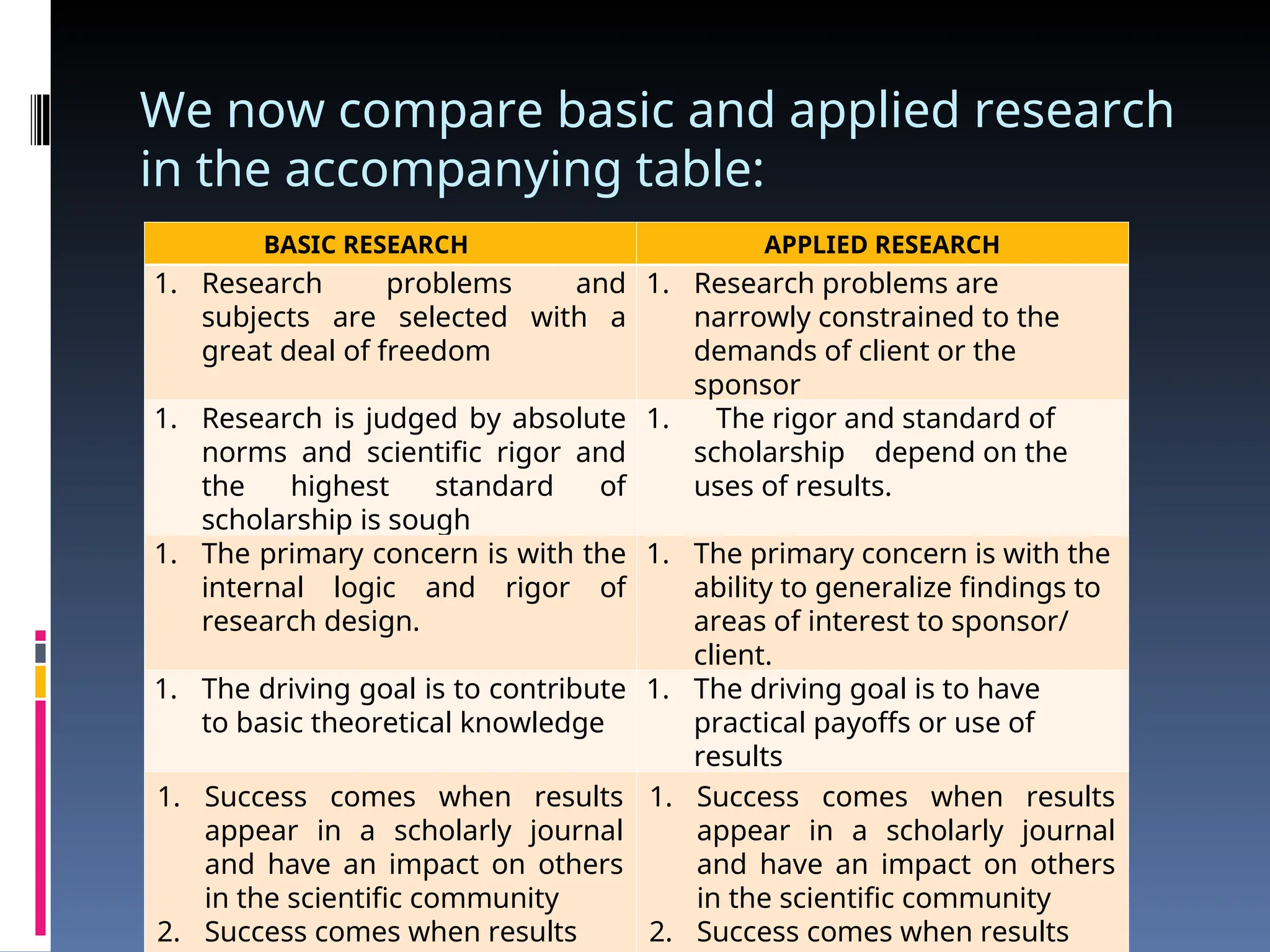
BASIC RESEARCH APPLIED RESEARCH
1. Research problems and
subjects are selected with a
great deal of freedom
1. Research problems are
narrowly constrained to the
demands of client or the
sponsor
1. Research is judged by absolute
norms and scientific rigor and
the highest standard of
scholarship is sough
1. The rigor and standard of
scholarship depend on the
uses of results.
1. The primary concern is with the
internal logic and rigor of
research design.
1. The primary concern is with the
ability to generalize findings to
areas of interest to sponsor/
client.
1. The driving goal is to contribute
to basic theoretical knowledge
1. The driving goal is to have
practical payoffs or use of
results
1. Success comes when results
appear in a scholarly journal
and have an impact on others
in the scientific community
2. Success comes when results
1. Success comes when results
appear in a scholarly journal
and have an impact on others
in the scientific community
2. Success comes when results
67.
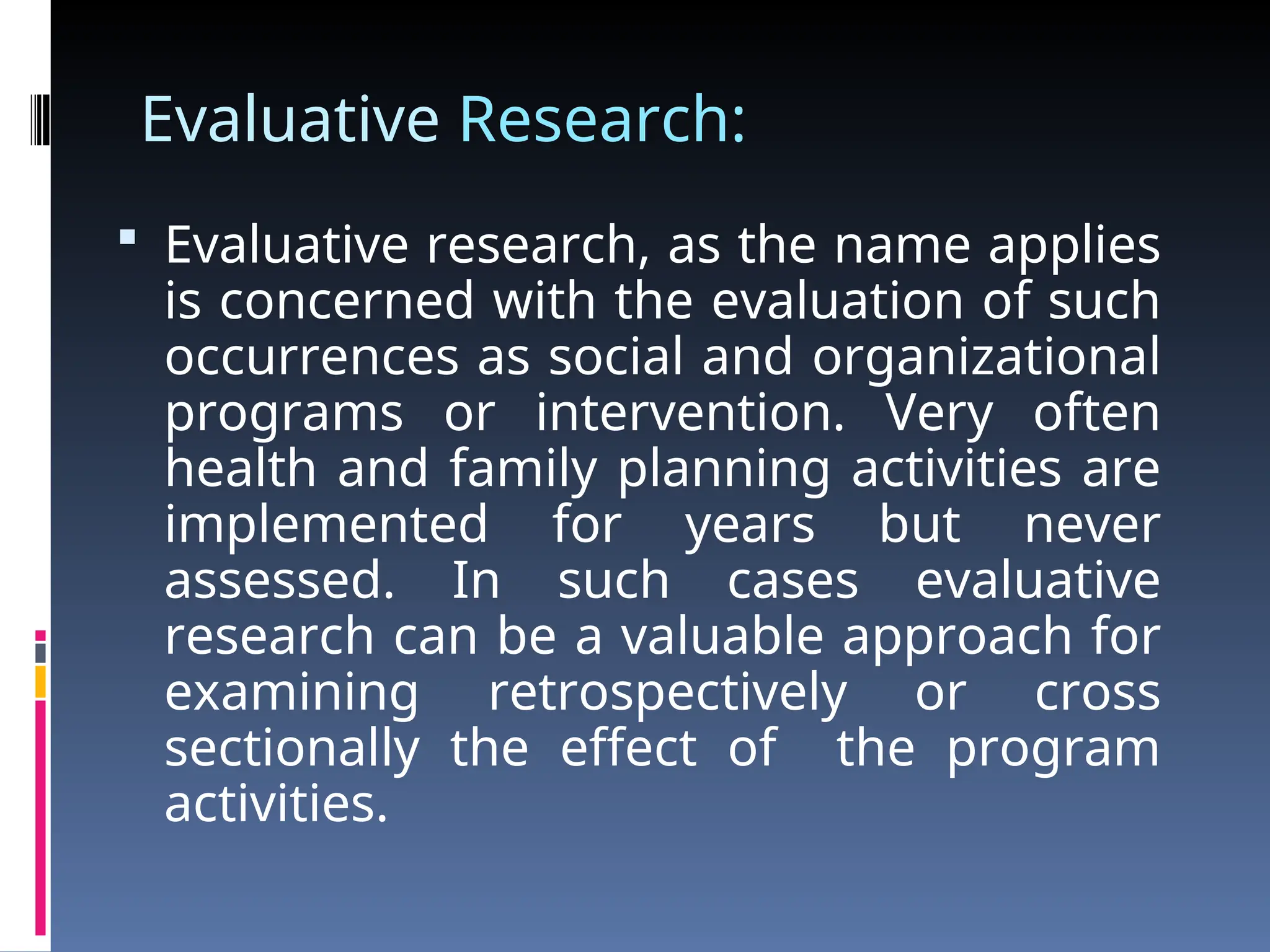
Evaluative Research:
Evaluativeresearch, as the name applies
is concerned with the evaluation of such
occurrences as social and organizational
programs or intervention. Very often
health and family planning activities are
implemented for years but never
assessed. In such cases evaluative
research can be a valuable approach for
examining retrospectively or cross
sectionally the effect of the program
activities.
68.
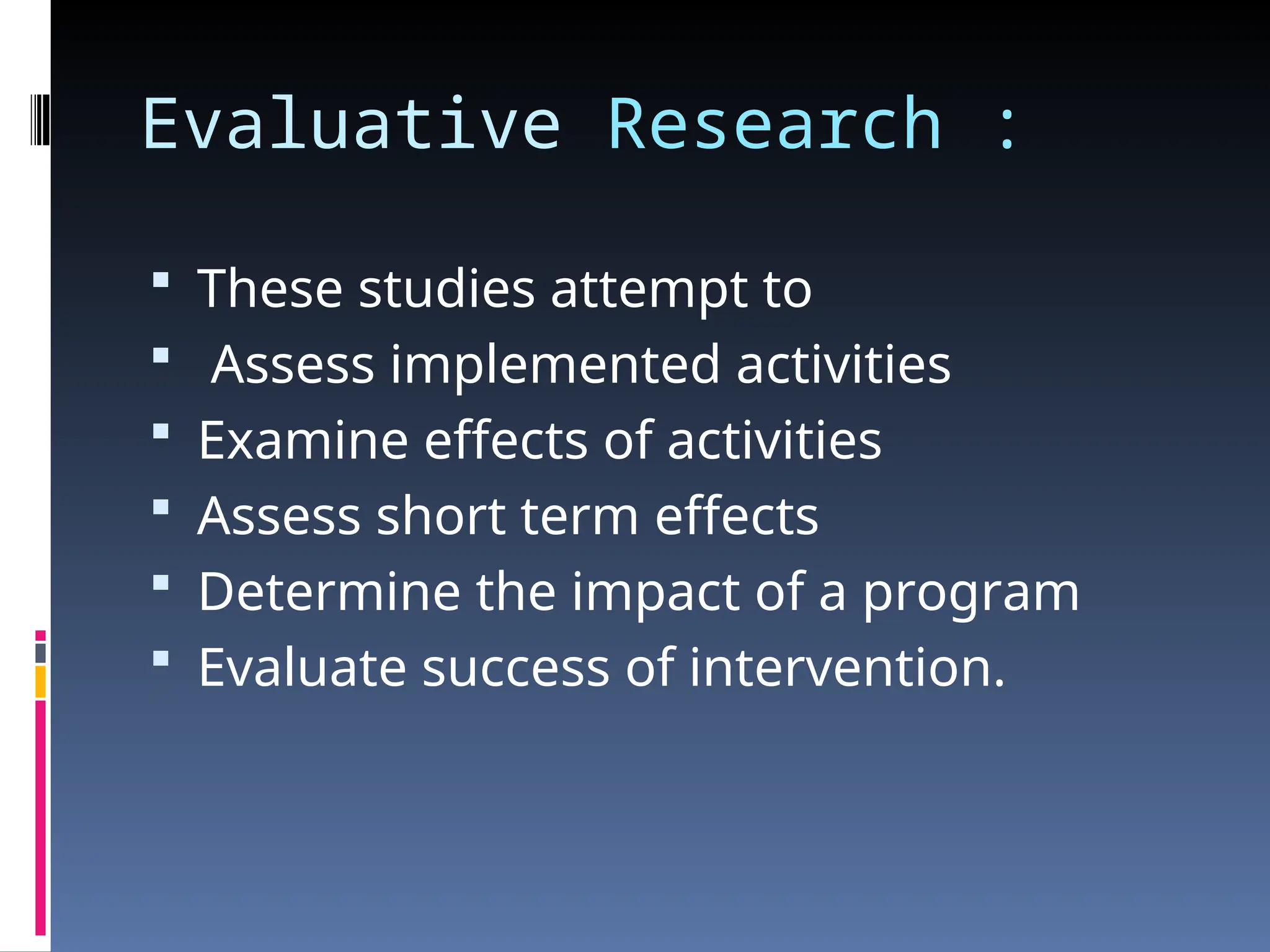
Evaluative Research :
These studies attempt to
Assess implemented activities
Examine effects of activities
Assess short term effects
Determine the impact of a program
Evaluate success of intervention.
69.
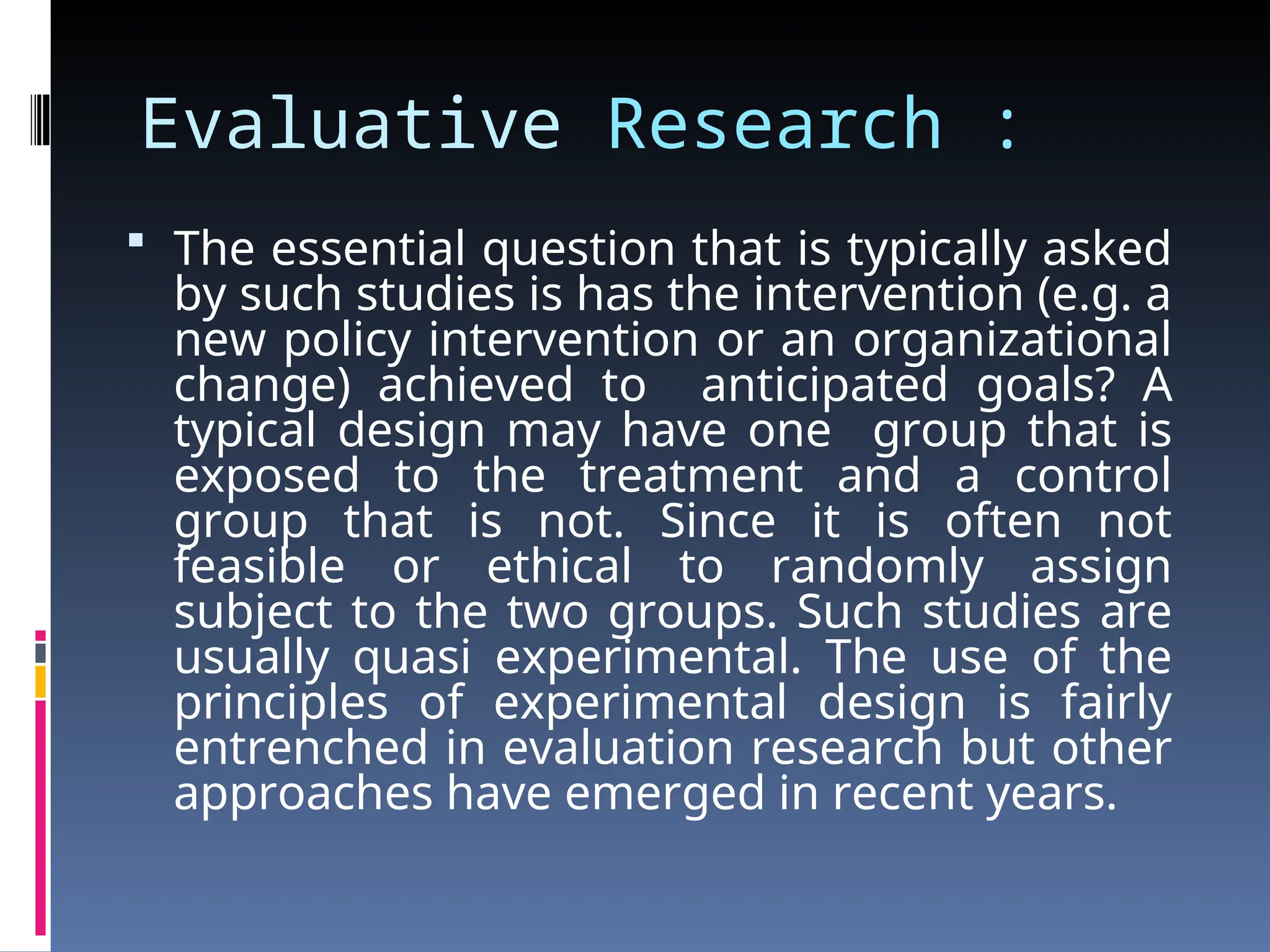
Evaluative Research :
The essential question that is typically asked
by such studies is has the intervention (e.g. a
new policy intervention or an organizational
change) achieved to anticipated goals? A
typical design may have one group that is
exposed to the treatment and a control
group that is not. Since it is often not
feasible or ethical to randomly assign
subject to the two groups. Such studies are
usually quasi experimental. The use of the
principles of experimental design is fairly
entrenched in evaluation research but other
approaches have emerged in recent years.
70.
Evaluative Research :
We cite an example:
Example : Goiter is highly prevalent in
many parts of Bangladesh UNICEF,
Bangladesh initiated a lipiodol injection
campaign in some selected than in 1989.
After a period of two years the impact of
this campaign was evaluated. The
results were compared with another
area where no such campaign was
launched.
71.
Evaluative Research :
Whether a researcher is doing applied or basic
research or research of any other form he or she
must ensure that the research he or she is doing
is relevant timely efficient accurate and ethical.
The research is considered relevant. If it
anticipates the kinds of information that will be
required by decision makers scientists or policy
makers. Timely research is completed in time to
influence decision research is efficient when it is
of the best quality for the minimum expenditure
and the study is valid when the interpretation can
account or valid when the interpretation can
account of both consistencies and
inconsistencies in the data.
72.
Evaluative Research :
A research is ethical when it can promote trust
exercise care ensure standard and protect the
rights of the participants in the research
process.
1.6 Characteristics of Research
Keeping it in mind that research in any field of
inquiry is undertaken to provide information to
support decision making in its respective area
we summarize some desirable characteristics of
research:
73.
Characteristics of
Research:
:
Theresearch should focus on priority problems.
It should be action oriented. In other words it
should be aimed at reaching a solution
It should follow an integrated multidisciplinary
approach i.e research approaches from more than
one discipline is needed because problem under
investigation may be affected by a broader context
of socio economic development.
The research should be participatory in nature
involving all parties concerned (from policy makers
down to community members) at all stages of the
study.
74.
Characteristics of
Research
Inchoosing the problem emphasis should be given
on comparatively simple short term research designs
that are likely to yield practical results relatively
quickly.
The research must be timely otherwise research loses
it purpose.
The research must be as much cost effective as
possible. This implies that we encourage low cost
studies although there is a need for large scale
studies involving high cost.
Result of the research should be presented in formats
most useful for administrators decision makers
business manger or the community members.
75.
Desirable Qualities of
Research:
Desirable Qualities of Research
A good research is one that generates
dependable data. It is conducted by
professionals and can be used reliably
for decision making. It is thus of crucial
importance that a research should be
made acceptable to the audience for
which a research should possess some
desirable qualities. We enumerate below
a few qualities that a good research
should possess.
76.
Desirable Qualities of
Research:
Purpose clearly defined : A good
research must have its purposes clearly
and unambiguously defined. The
problem involved or the decision to be
made should be sharply delineated as
clearly as possible to demonstrate the
credibility of the research.
77.
Desirable Qualities ofResearch:
Research process detailed: The
research procedures used should be
described in sufficient detail to permit
other researchers to repeat the research
at a later date. Failure to do so makes it
difficult or impossible to estimate the
validity and reliability of the result. this
weakens the confidence of the readers.
Any recommendations made from such
research justifiably get little attention of
the policy makers and implementations.
78.
Desirable Qualities of
Research:
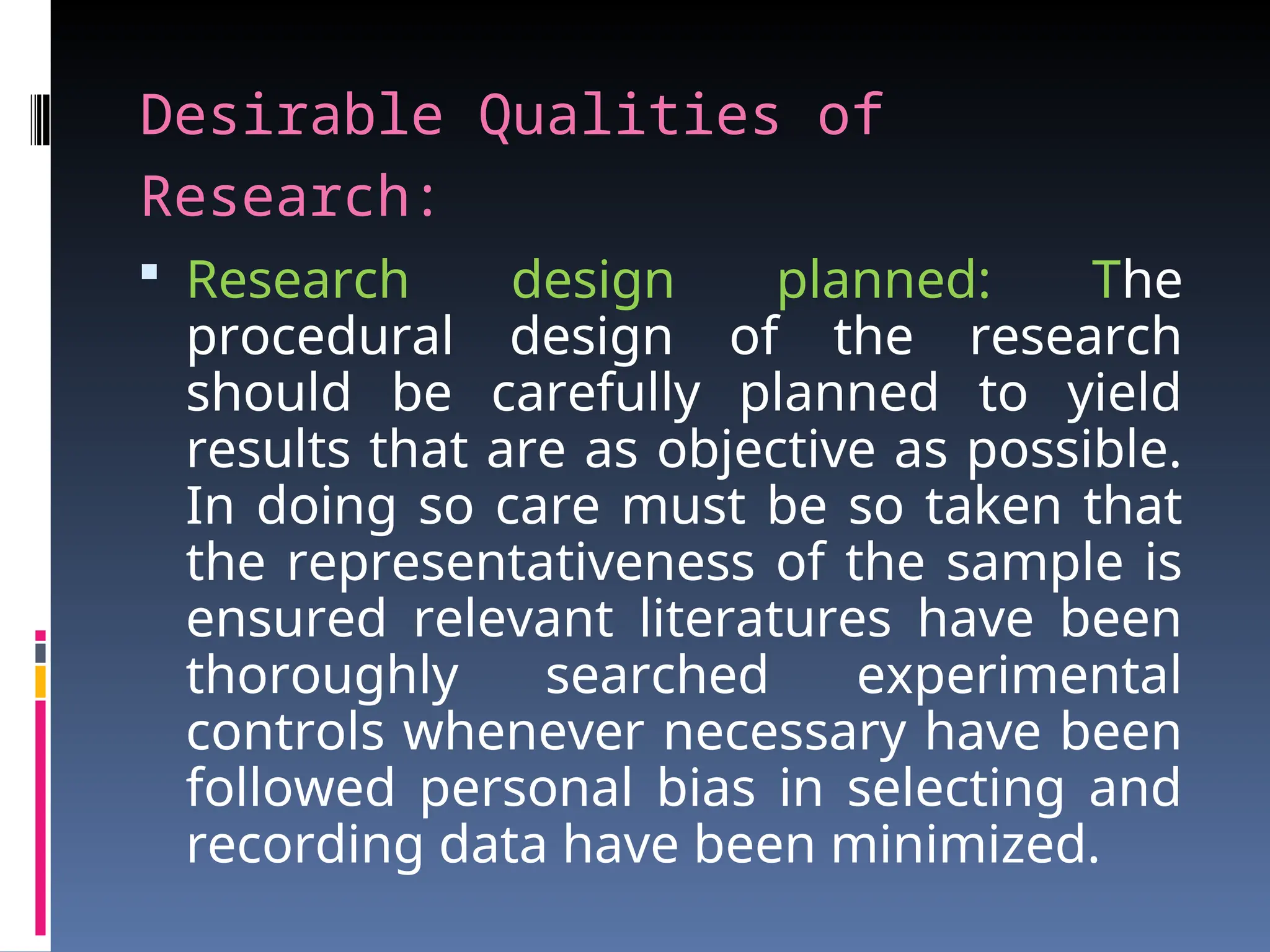
Research design planned: The
procedural design of the research
should be carefully planned to yield
results that are as objective as possible.
In doing so care must be so taken that
the representativeness of the sample is
ensured relevant literatures have been
thoroughly searched experimental
controls whenever necessary have been
followed personal bias in selecting and
recording data have been minimized.
79.
Desirable Qualities of
Research:
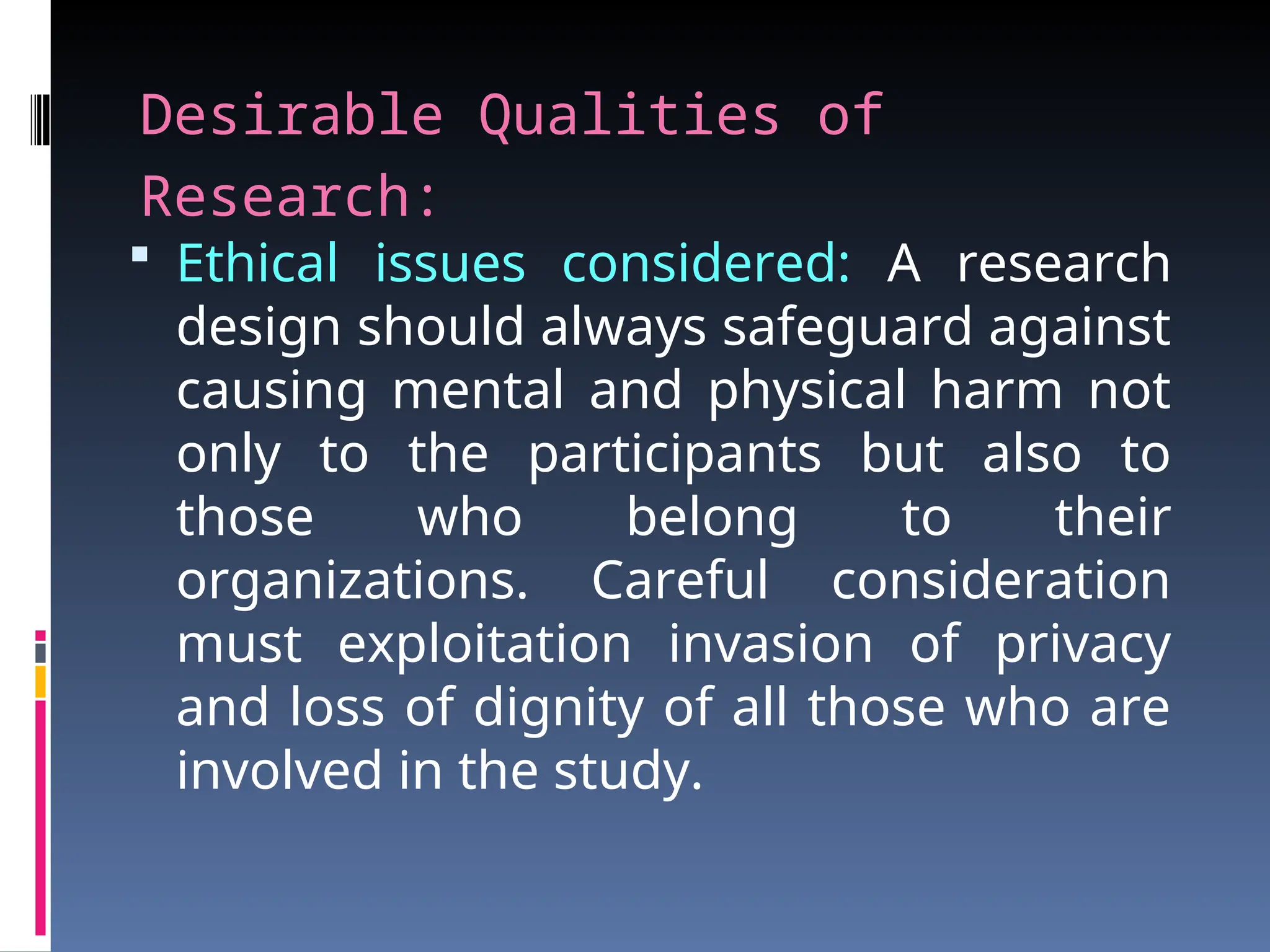
Ethical issues considered: A research
design should always safeguard against
causing mental and physical harm not
only to the participants but also to
those who belong to their
organizations. Careful consideration
must exploitation invasion of privacy
and loss of dignity of all those who are
involved in the study.
80.
Desirable Qualities ofResearch:
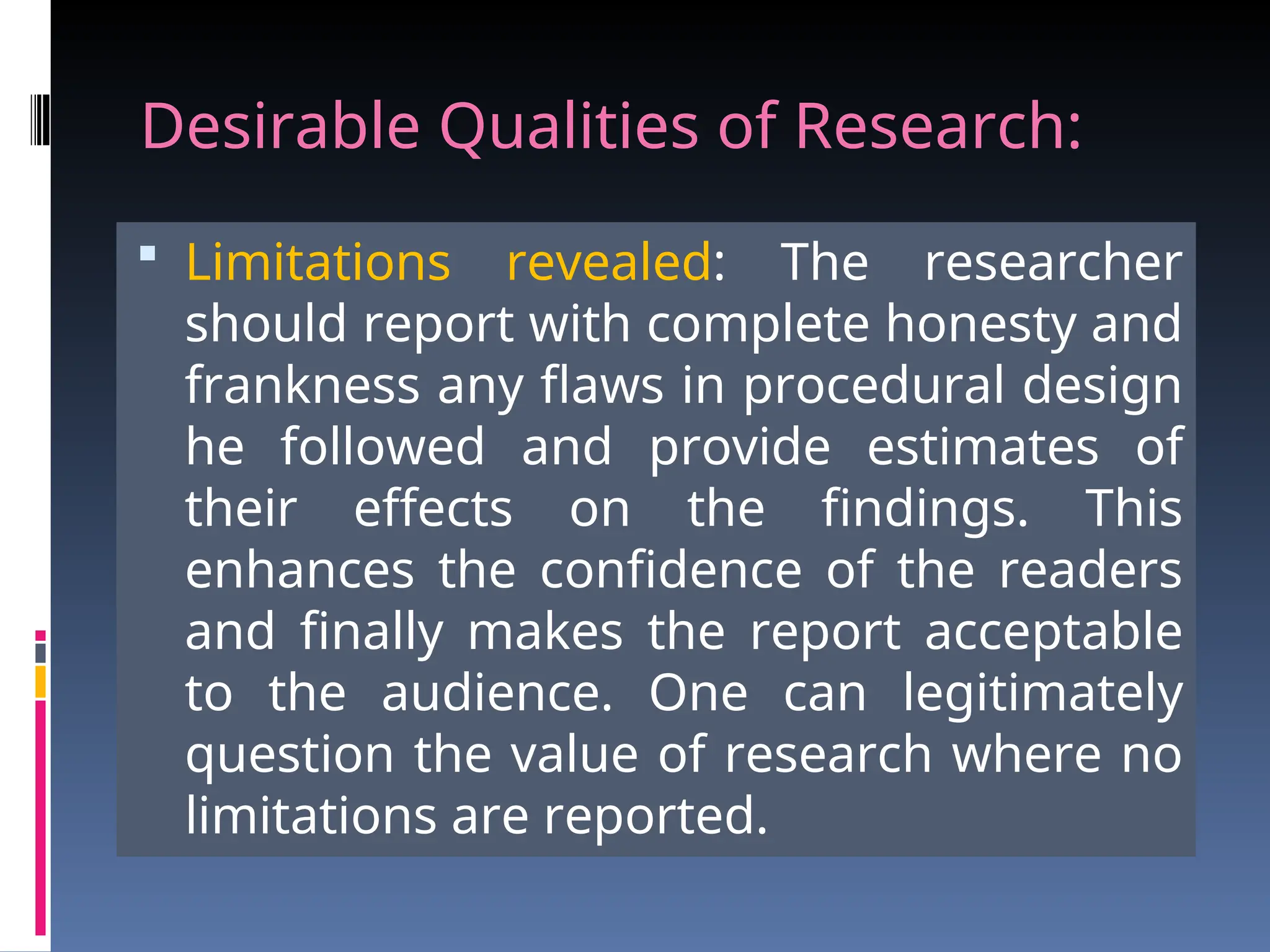
Limitations revealed: The researcher
should report with complete honesty and
frankness any flaws in procedural design
he followed and provide estimates of
their effects on the findings. This
enhances the confidence of the readers
and finally makes the report acceptable
to the audience. One can legitimately
question the value of research where no
limitations are reported.
81.
Desirable Qualities ofResearch:
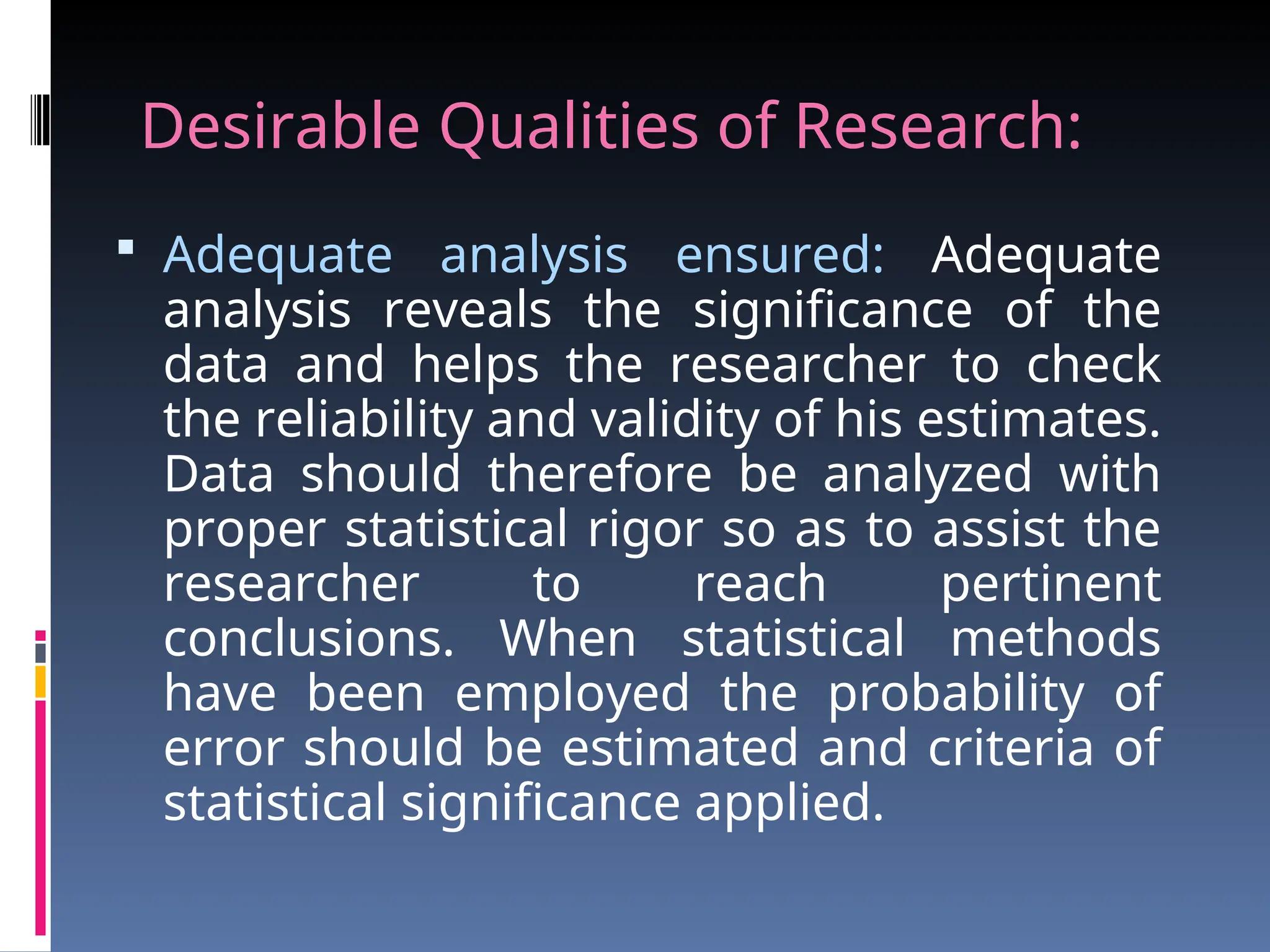
Adequate analysis ensured: Adequate
analysis reveals the significance of the
data and helps the researcher to check
the reliability and validity of his estimates.
Data should therefore be analyzed with
proper statistical rigor so as to assist the
researcher to reach pertinent
conclusions. When statistical methods
have been employed the probability of
error should be estimated and criteria of
statistical significance applied.
82.
Desirable Qualities ofResearch:
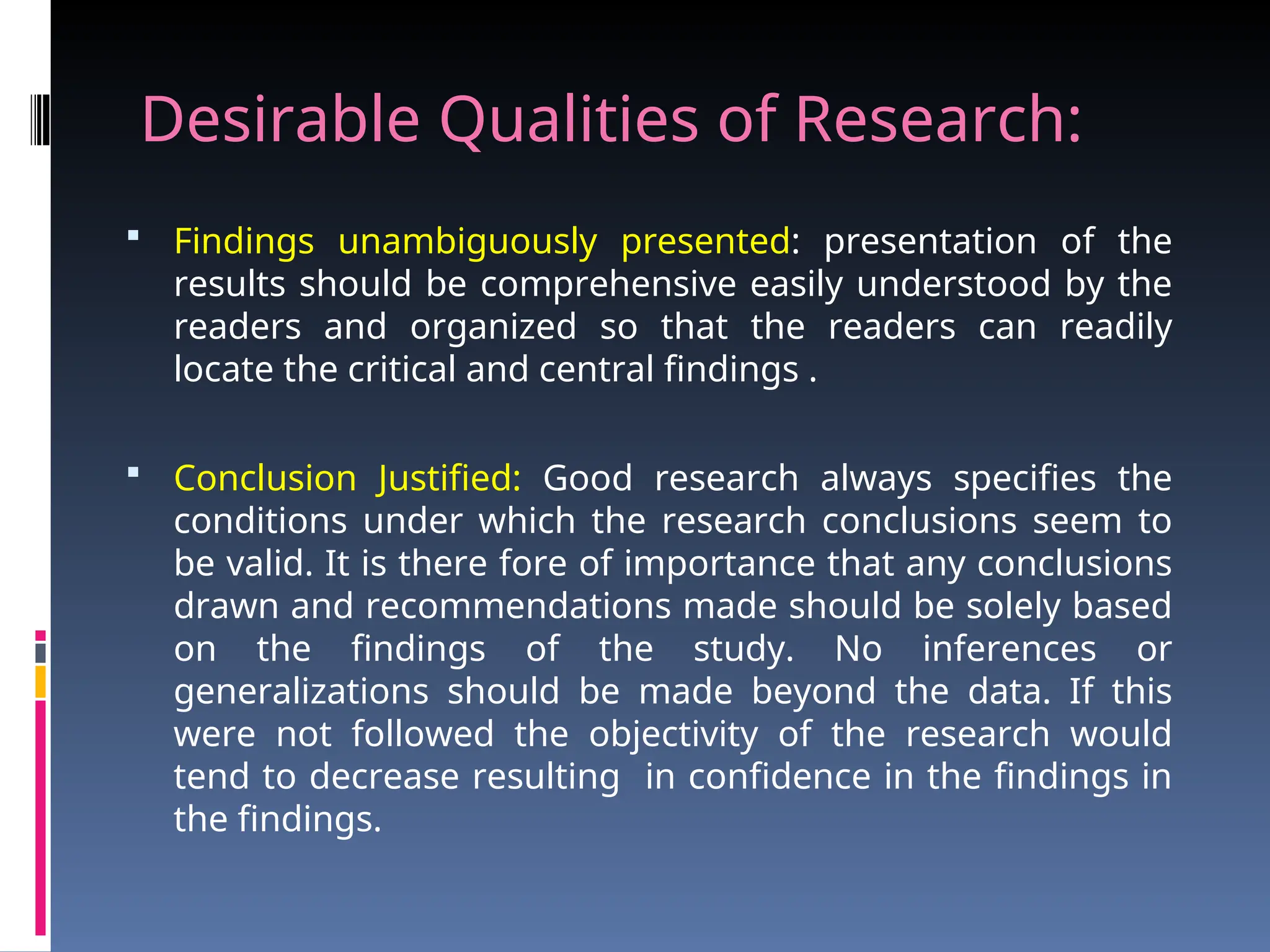
Findings unambiguously presented: presentation of the
results should be comprehensive easily understood by the
readers and organized so that the readers can readily
locate the critical and central findings .
Conclusion Justified: Good research always specifies the
conditions under which the research conclusions seem to
be valid. It is there fore of importance that any conclusions
drawn and recommendations made should be solely based
on the findings of the study. No inferences or
generalizations should be made beyond the data. If this
were not followed the objectivity of the research would
tend to decrease resulting in confidence in the findings in
the findings.
83.
Desirable Qualities ofResearch:
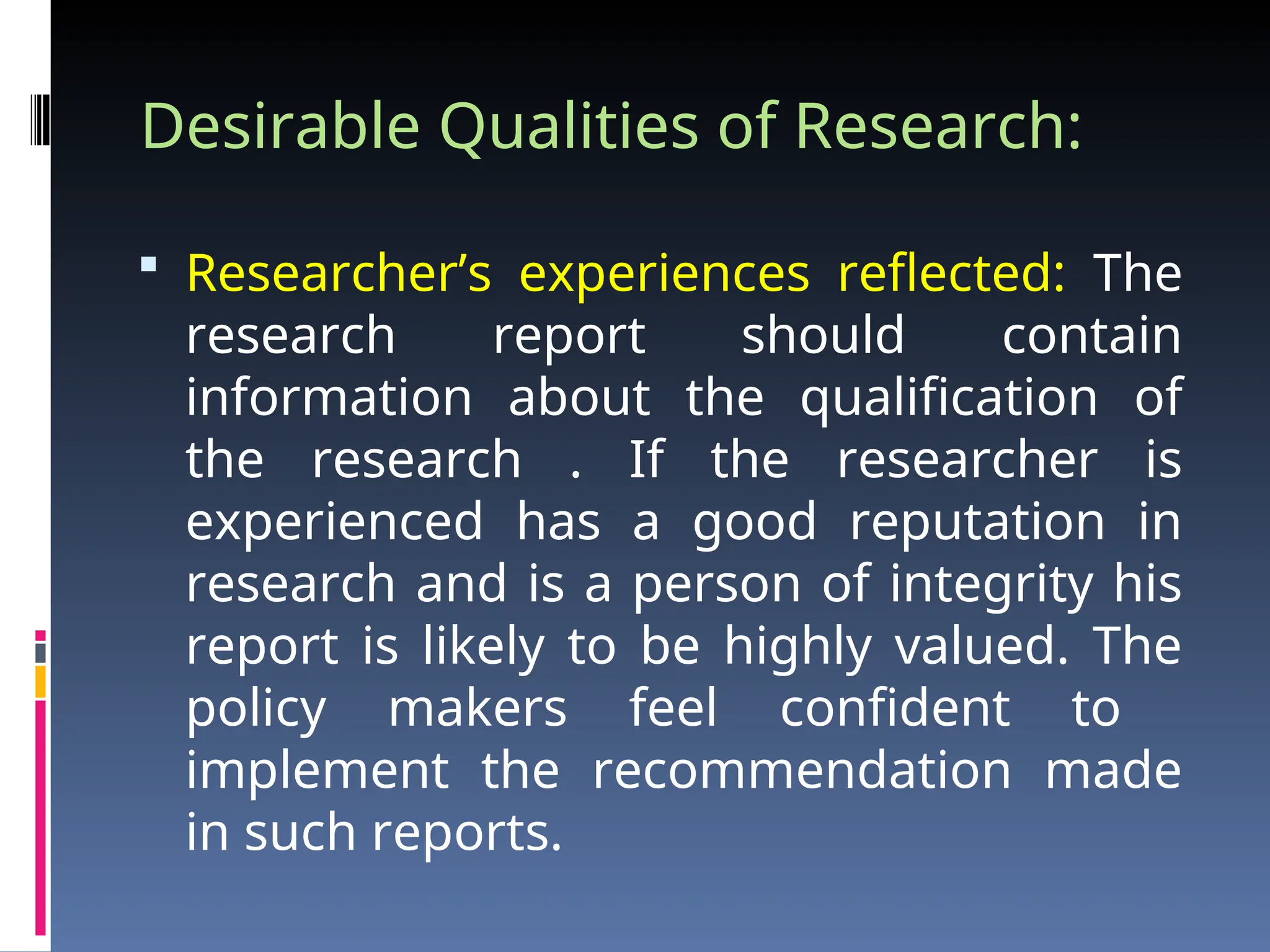
Researcher’s experiences reflected: The
research report should contain
information about the qualification of
the research . If the researcher is
experienced has a good reputation in
research and is a person of integrity his
report is likely to be highly valued. The
policy makers feel confident to
implement the recommendation made
in such reports.
84.
1.8 Justifying themerit of a proposed
Research:
Each problem that is proposed for
research has to be judged for its merit
in terms of a few guidelines or criteria.
85.
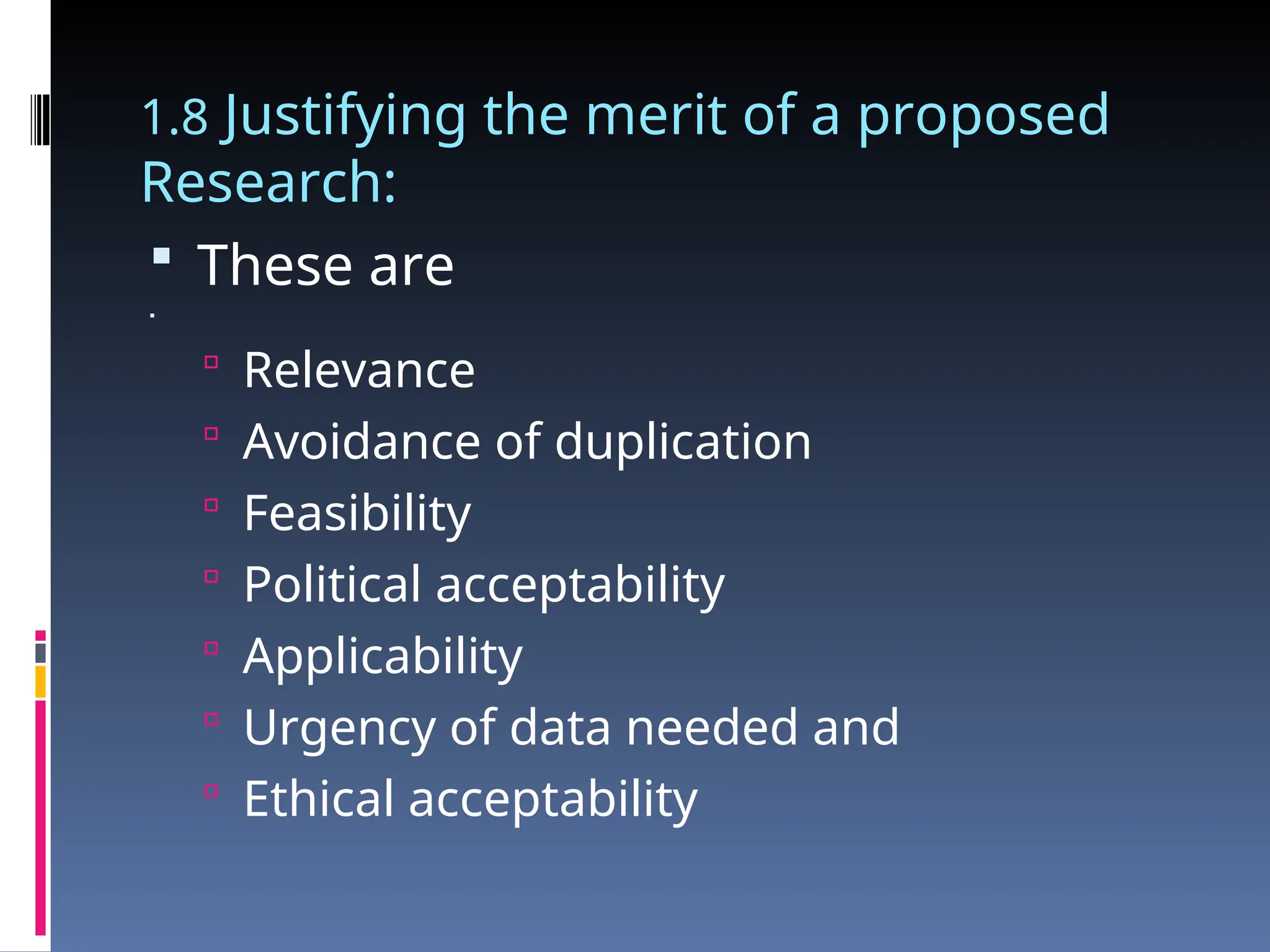
1.8 Justifying themerit of a proposed
Research:
These are
Relevance
Avoidance of duplication
Feasibility
Political acceptability
Applicability
Urgency of data needed and
Ethical acceptability
86.
1.8 Justifying themerit of a proposed
Research:
Relevance: Before one decides on a
topic each proposed topic should be
compared with all other options. This
enables the researcher to decide
whether the topic so chosen is a priority
problem or not. The following key
questions will help one to decide
whether the problem chosen is a
research problem or not.
87.
1.8 Justifying themerit of a proposed
Research:
If the topic is not considered to be relevant
on the basis of the above criteria it is not
worth to continue with the study.
Avoidance of duplication: Before it is
decided to carry out the study it is important
to see whether the suggested topic has been
investigated earlier in the proposed study
area or in an area with similar environment
or settings. If the topic has been studied
before the results should be reviewed to
explore whether major questions remained
unanswered and thus deserves in your
judgement further investigation. If not there
is no justification to repeat the study.
88.
1.8 Justifying themerit of a proposed
Research:
Feasibility: Every proposed study must be
considered for its execution in terms of its
complexity of the problems and resource
that will be required to carry out the study.
Thought should be given first to personnel
time equipment and money that are likely to
be available locally. In the case of insufficient
locally available funds the possibility of
obtaining technical and financial assistance
from external sources should be explored.
89.
1.8 Justifying themerit of a proposed
Research:
Political Acceptability: In general it is
desirable and at the same time
advisable to choose a research topic
that has the interest and support of the
relevant authorities. This will increase
the chance that the recommendations
of the study will be implemented. If
needed an extra effort is to be made to
involve the policy makers concerned at
an early stage to avoid confrontation
later
90.
1.8 Justifying themerit of a proposed
Research:
Political Acceptability: In general it is
desirable and at the same time advisable to
choose a research topic that has the interest
and support of the relevant authorities.
This will increase the chance that the
recommendations of the study will be
implemented. If needed an extra effort is to
be made to involve the policy makers
concerned at an early stage to avoid
confrontation later.
91.
1.8 Justifying themerit of a proposed
Research:
Applicability: It is the ultimate goal of any study
that the study results will lead to some policy
recommendations. The question i s how likely is
that these recommendations will be endorsed
and implemented by the authorities for which the
study was undertaken?
This will depend not only on the blessings of the
authorities but also on the availability of
resources for implementing the
recommendations. The opinion of the political
clients fund providing agencies and the
responsible staff will influence the
implementations of the recommendations as well.
92.
1.8 Justifying themerit of a proposed
Research:
Urgency of data needed: In
implementation of the study results the
authorities give top priority for those
studies which are urgently needed for
decision making. This is an important
criterion for a research problem. One
should therefore decide on:
93.
1.8 Justifying themerit of a proposed
Research:
Which research should be done first
and which can be done later?
How urgently are the data needed for
making a decision?
94.
1.8 Justifying themerit of a proposed
Research:
Ethical consideration: In choosing a research
problem one must carefully consider its
acceptability to those who are being studied.
Care must be taken so that the subjects of the
studies are harmed neither physically nor
psychologically and their fundamental rights are
not ignored.
Careful considerations must be given to research
situations when there is a possibility of such
harms exploitation invasion of privacy and loss
of integrity. Ethical issues in research reflect
important moral concerns about the practice of
responsible behavior in society.
95.
Evaluating the proposed
research:
Each research topic outlined in the previous
section should be evaluated to judge its
merits for implementation. This evaluation
can be based on a 3 point rating scale. A
group of experts may be employed to judge
the merit of the topic who will rank the
proposed topic on the basis of the 3 point
scaling . Each expert in his own judgment
will assign a score from 1 through 3 for
each criterion. A research topic receiving the
highest score will be considered for
execution.
96.
Evaluating the proposed
research:
The scaling process is enumerated
below:
Criteria Scores
Relevance
Not relevant [ 1 ]
Relevant [ 2 ]
Very relevant [ 3 ]
97.
Evaluating the proposed
research:
Avoidanceof duplication :
Sufficient information already available
[ 1 ]
Some information available but major
issues not covered
[ 2 ]
No sound information available to base
problem- solving [ 3 ]
98.
Evaluating the proposed
research:
Feasibility:
Not feasible considering available
resources [ 1 ]
Feasible considering available resources [
2 ]
Very Feasible considering available
resources [ 3 ]
Evaluating the proposed
research:
Applicability
No chance of recommendations being
implemented [ 1 ]
Some chance of recommendations
being implemented [ 2 ]
Good chance of recommendations
being implemented [ 3 ]
101.
Evaluating the proposed
research:
Urgency
Information not urgently needed [ 1 ]
Information could be used right away but a
delay of some
months would be acceptable [ 2 ]
3. Data very urgently needed for decision-
making [ 3 ]
102.
Evaluating the proposed
research:
Ethical acceptability:
Major ethical problems
[ 1 ]
Minor ethical problems
[ 2 ]
No ethical problems
[ 3 ]





![Evaluating the proposed
research :
The scaling process is enumerated
below:
Criteria Scores
Relevance
Not relevant [ 1 ]
Relevant [ 2 ]
Very relevant [ 3 ]](https://image.slidesharecdn.com/researchmethodology1-250606052418-2037f36f/75/RESEARCH-METHODOLOGY-for-all-learners-and-researchers-96-2048.jpg)
![Evaluating the proposed
research:
Avoidance of duplication :
Sufficient information already available
[ 1 ]
Some information available but major
issues not covered
[ 2 ]
No sound information available to base
problem- solving [ 3 ]](https://image.slidesharecdn.com/researchmethodology1-250606052418-2037f36f/75/RESEARCH-METHODOLOGY-for-all-learners-and-researchers-97-2048.jpg)
![Evaluating the proposed
research:
Feasibility :
Not feasible considering available
resources [ 1 ]
Feasible considering available resources [
2 ]
Very Feasible considering available
resources [ 3 ]](https://image.slidesharecdn.com/researchmethodology1-250606052418-2037f36f/75/RESEARCH-METHODOLOGY-for-all-learners-and-researchers-98-2048.jpg)
![Evaluating the proposed
research:
Political acceptability :
Not acceptable to high level policymakers
[ 1 ]
More or less acceptable [ 2 ]
Fully acceptable [ 3 ]](https://image.slidesharecdn.com/researchmethodology1-250606052418-2037f36f/75/RESEARCH-METHODOLOGY-for-all-learners-and-researchers-99-2048.jpg)
![Evaluating the proposed
research:
Applicability
No chance of recommendations being
implemented [ 1 ]
Some chance of recommendations
being implemented [ 2 ]
Good chance of recommendations
being implemented [ 3 ]](https://image.slidesharecdn.com/researchmethodology1-250606052418-2037f36f/75/RESEARCH-METHODOLOGY-for-all-learners-and-researchers-100-2048.jpg)
![Evaluating the proposed
research:
Urgency
Information not urgently needed [ 1 ]
Information could be used right away but a
delay of some
months would be acceptable [ 2 ]
3. Data very urgently needed for decision-
making [ 3 ]](https://image.slidesharecdn.com/researchmethodology1-250606052418-2037f36f/75/RESEARCH-METHODOLOGY-for-all-learners-and-researchers-101-2048.jpg)
![Evaluating the proposed
research :
Ethical acceptability:
Major ethical problems
[ 1 ]
Minor ethical problems
[ 2 ]
No ethical problems
[ 3 ]](https://image.slidesharecdn.com/researchmethodology1-250606052418-2037f36f/75/RESEARCH-METHODOLOGY-for-all-learners-and-researchers-102-2048.jpg)



![RM_Unit__1-2016(1)[1].pdf economics course](https://cdn.slidesharecdn.com/ss_thumbnails/rmunit1-201611-240802123239-1772834e-thumbnail.jpg?width=640&height=640&fit=bounds)


