Decision Analysis
Gp Capt(Dr.) RM Saxena
1
Introduction to Decision Analysis
• The field of decision analysis provides a
framework for making important decisions.
• Decision analysis allows us to select a decision
from a set of possible decision alternatives when
uncertainties regarding the future exist.
• The goal is to optimize the resulting payoff in
terms of a decision criterion.
2
Introduction to Decision Analysis
• Maximizing expected profit is a
common criterion when probabilities
can be assessed.
3
• Maximizing the decision maker’s
utility function is the mechanism
used when risk is factored into the
decision making process.
Payoff Table Analysis
• Payoff Tables
– Payoff table analysis can be applied when:
• There is a finite set of discrete decision alternatives.
• The outcome of a decision is a function of a single future event.
– In a Payoff table -
• The rows correspond to the possible decision alternatives.
• The columns correspond to the possible future events.
• Events (states of nature) are mutually exclusive and collectively
exhaustive.
• The table entries are the payoffs.
4
INVESTMENT DECISION
• Someone has inherited $1000.
• He has to decide how to invest the money for
one year.
• A broker has suggested five potential
investments.
– Gold
– Junk Bond
– Growth Stock
– Certificate of Deposit
– Stock Option Hedge
5
• The return on each investment depends on
the (uncertain) market behavior during the
year.
• He would build a payoff table to help make
the investment decision
6
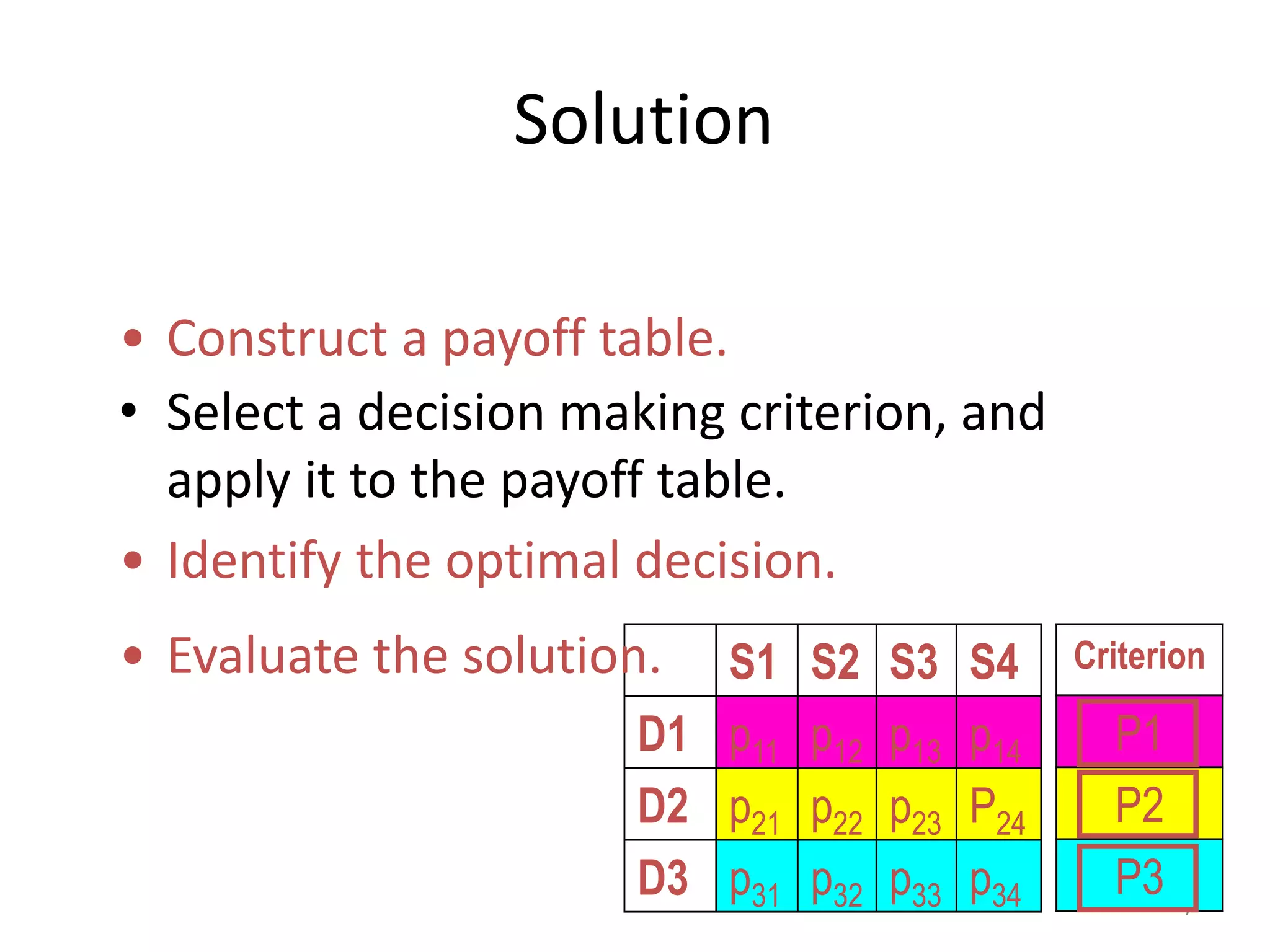
Solution
• Select a decision making criterion, and
apply it to the payoff table.
7
S1 S2 S3 S4
D1 p11 p12 p13 p14
D2 p21 p22 p23 P24
D3 p31 p32 p33 p34
S1 S2 S3 S4
D1 p11 p12 p13 p14
D2 p21 p22 p23 P24
D3 p31 p32 p33 p34
Criterion
P1
P2
P3
• Construct a payoff table.
• Identify the optimal decision.
• Evaluate the solution.
The Payoff Table
8
The states of nature are mutually exclusive and
collectively exhaustive.
Define the states of nature.
Sensex is down mo
than 800 points
Sensex is down
[-300, -800]
Sensex
moves
within
[-300,+300]
sensex is up
[+300,+1000]
sensex is up more
than1000 points
The Payoff Table
9
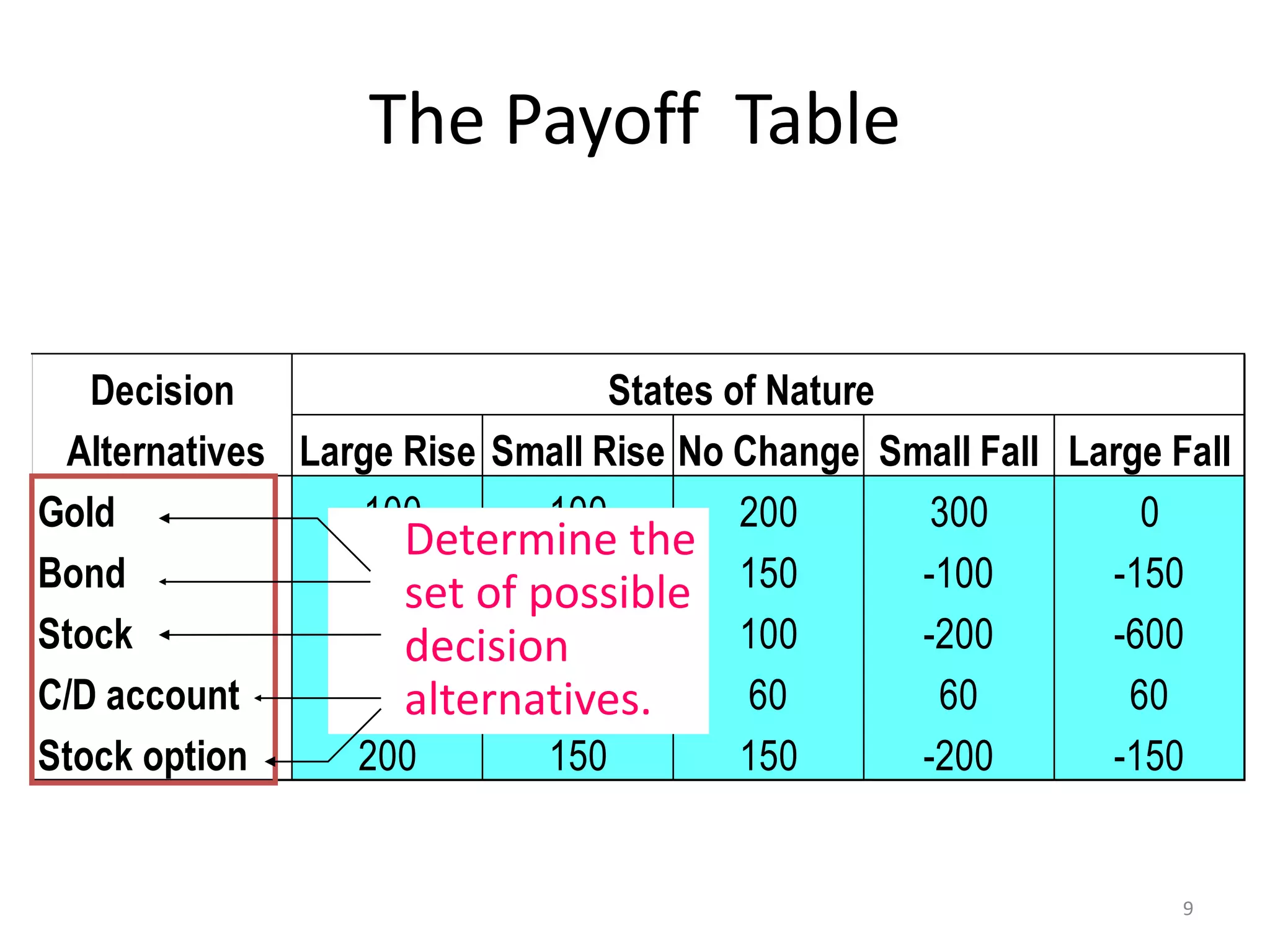
Decision States of Nature
Alternatives Large Rise Small Rise No Change Small Fall Large Fall
Gold -100 100 200 300 0
Bond 250 200 150 -100 -150
Stock 500 250 100 -200 -600
C/D account 60 60 60 60 60
Stock option 200 150 150 -200 -150
Determine the
set of possible
decision
alternatives.
The Payoff Table
10
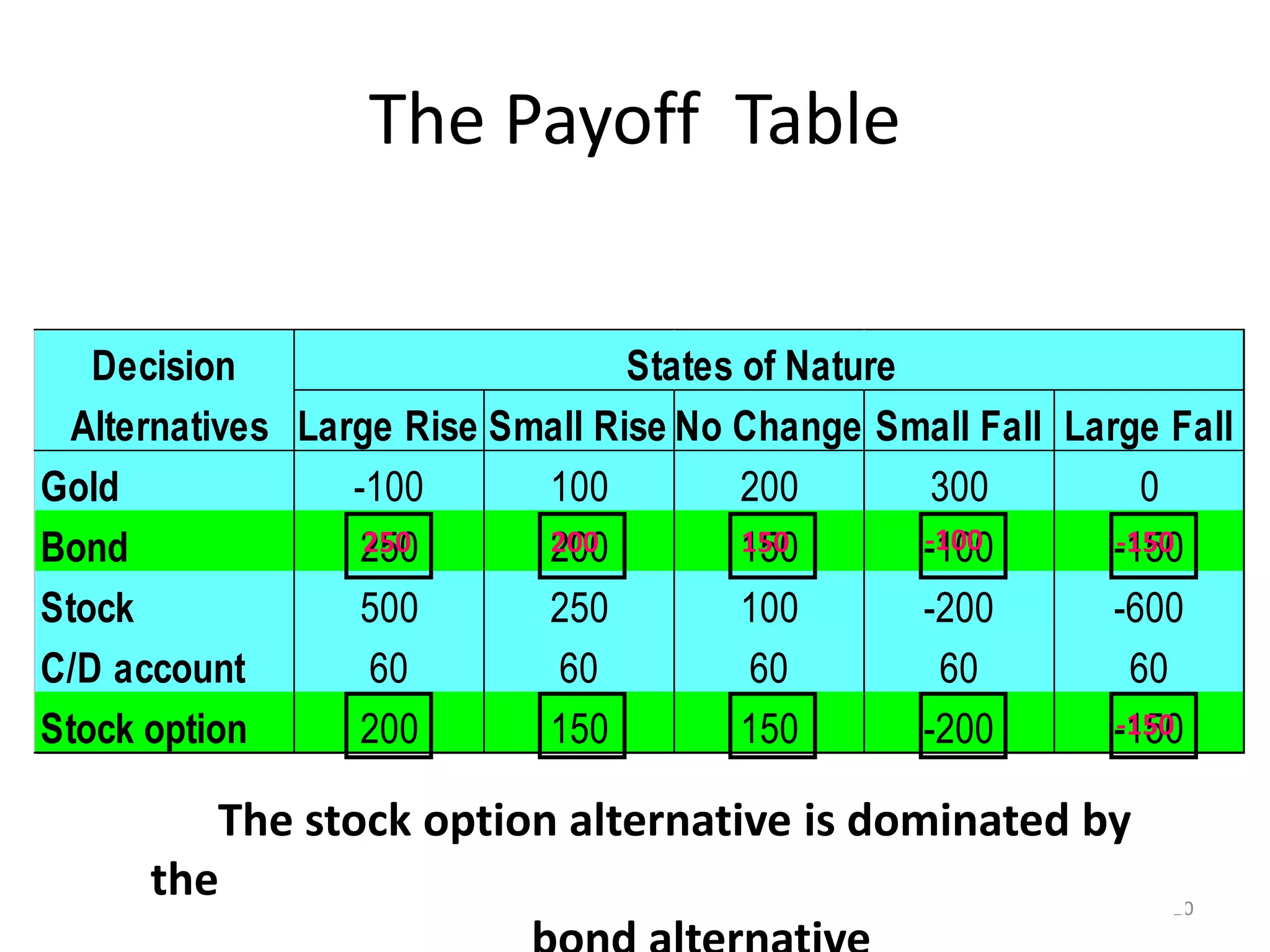
Decision States of Nature
Alternatives Large Rise Small Rise No Change Small Fall Large Fall
Gold -100 100 200 300 0
Bond 250 200 150 -100 -150
Stock 500 250 100 -200 -600
C/D account 60 60 60 60 60
Stock option 200 150 150 -200 -150
The stock option alternative is dominated by
the
250 200 150 -100 -150
-150
Decision Making Criteria
• Classifying decision-making criteria
– Decision making under certainty.
• The future state-of-nature is assumed known.
– Decision making under risk.
• There is some knowledge of the probability of the states
of nature occurring.
– Decision making under uncertainty.
• There is no knowledge about the probability of the states
of nature occurring.
11
Decision Making Under Uncertainty
• The decision criteria are based on the decision maker’s
attitude toward life.
• The criteria include the
– Maximin Criterion - pessimistic or conservative approach.
– Minimax Regret Criterion - pessimistic or conservative approach.
– Maximax Criterion - optimistic or aggressive approach.
– Principle of Insufficient Reasoning – no information about the
likelihood of the various states of nature.
12
Decision Making Under Uncertainty -
The Maximin Criterion
13
Decision Making Under Uncertainty -
The Maximin Criterion
• This criterion is based on the worst-case scenario.
– It fits both a pessimistic and a conservative decision
maker’s styles.
– A pessimistic decision maker believes that the worst
possible result will always occur.
– A conservative decision maker wishes to ensure a
guaranteed minimum possible payoff.
14
The Maximin Criterion
• To find an optimal decision
– Record the minimum payoff across all states of nature for
each decision.
– Identify the decision with the maximum “minimum payoff.”
15
The Maximin Criterion Minimum
Decisions Large Rise Small rise No Change Small Fall Large Fall Payoff
Gold -100 100 200 300 0 -100
Bond 250 200 150 -100 -150 -150
Stock 500 250 100 -200 -600 -600
C/D account 60 60 60 60 60 60
The Maximin Criterion Minimum
Decisions Large Rise Small rise No Change Small Fall Large Fall Payoff
Gold -100 100 200 300 0 -100
Bond 250 200 150 -100 -150 -150
Stock 500 250 100 -200 -600 -600
C/D account 60 60 60 60 60 60
Decision Making Under Uncertainty -
The Minimax Regret Criterion
18
Decision Making Under Uncertainty -
The Minimax Regret Criterion
• The Minimax Regret Criterion
– This criterion fits both a pessimistic and a
conservative decision maker approach.
– The payoff table is based on “lost opportunity,”
or “regret.”
– The decision maker incurs regret by failing to
choose the “best” decision.
19
Decision Making Under Uncertainty -
The Minimax Regret Criterion
• The Minimax Regret Criterion
– To find an optimal decision, for each state of
nature:
• Determine the best payoff over all decisions.
• Calculate the regret for each decision alternative as
the difference between its payoff value and this best
payoff value.
– For each decision find the maximum regret over
all states of nature.
– Select the decision alternative that has the
minimum of these “maximum regrets.”
20
Regret Table
21
The Payoff Table
Decision Large rise Small rise No change Small fall Large fall
Gold -100 100 200 300 0
Bond 250 200 150 -100 -150
Stock 500 250 100 -200 -600
C/D 60 60 60 60 60
The Payoff Table
Decision Large rise Small rise No change Small fall Large fall
Gold -100 100 200 300 0
Bond 250 200 150 -100 -150
Stock 500 250 100 -200 -600
C/D 60 60 60 60 60
Let us build the Regret Table
The Regret Table
Decision Large rise Small rise No change Small fall Large fall
Gold 600 150 0 0 60
Bond 250 50 50 400 210
Stock 0 0 100 500 660
C/D 440 190 140 240 0
Investing in Stock generates no regret
when the market exhibits
a large rise
TOM BROWN – Regret Table
22
The Payoff Table
Decision Large rise Small rise No change Small fall Large fall
Gold -100 100 200 300 0
Bond 250 200 150 -100 -150
Stock 500 250 100 -200 -600
C/D 60 60 60 60 60
The Payoff Table
Decision Large rise Small rise No change Small fall Large fall
Gold -100 100 200 300 0
Bond 250 200 150 -100 -150
Stock 500 250 100 -200 -600
C/D 60 60 60 60 60
The Regret Table Maximum
Decision Large rise Small rise No change Small fall Large fall Regret
Gold 600 150 0 0 60 600
Bond 250 50 50 400 210 400
Stock 0 0 100 500 660 660
C/D 440 190 140 240 0 440
The Regret Table Maximum
Decision Large rise Small rise No change Small fall Large fall Regret
Gold 600 150 0 0 60 600
Bond 250 50 50 400 210 400
Stock 0 0 100 500 660 660
C/D 440 190 140 240 0 440
Investing in gold generates a regret of 600
when the market exhibits
a large rise
500 – (-100) = 600
Decision Making Under Uncertainty -
The Maximax Criterion
• This criterion is based on the best possible scenario.
It fits both an optimistic and an aggressive decision
maker.
• An optimistic decision maker believes that the best
possible outcome will always take place regardless of
the decision made.
• An aggressive decision maker looks for the decision with
the highest payoff (when payoff is profit).
24
• To find an optimal decision.
– Find the maximum payoff for each decision
alternative.
– Select the decision alternative that has the
maximum of the “maximum” payoff.
25
Decision Making Under Uncertainty
- The Maximax Criterion
The Maximax Criterion
26
The Maximax Criterion Maximum
Decision Large rise Small rise No change Small fall Large fall Payoff
Gold -100 100 200 300 0 300
Bond 250 200 150 -100 -150 200
Stock 500 250 100 -200 -600 500
C/D 60 60 60 60 60 60
• This criterion might appeal to a decision maker
who is neither pessimistic nor optimistic.
– It assumes all the states of nature are equally likely
to occur.
– The procedure to find an optimal decision.
• For each decision add all the payoffs.
• Select the decision with the largest sum (for profits).
27
Decision Making Under Uncertainty
- The Principle of Insufficient Reason
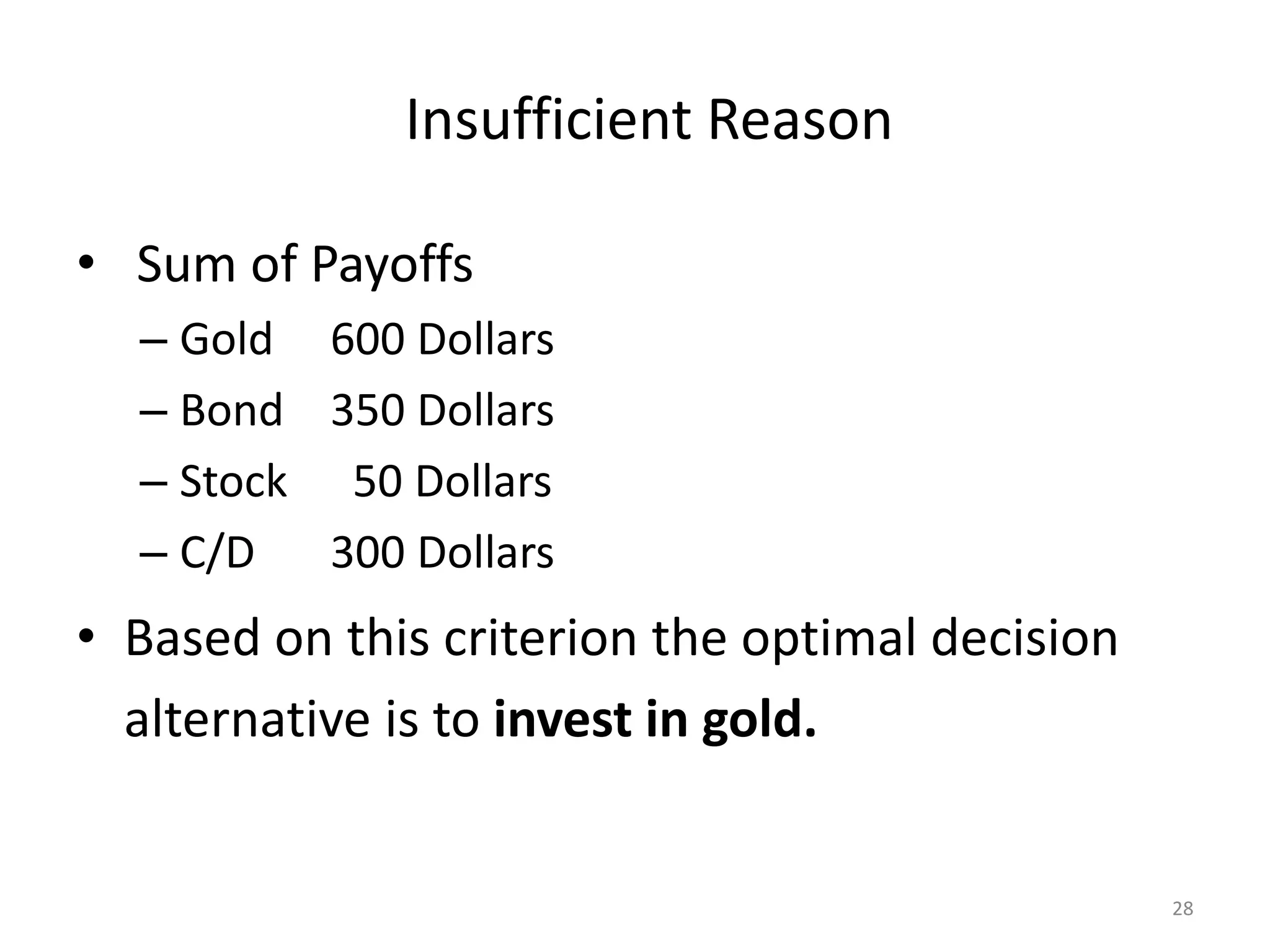
Insufficient Reason
• Sum of Payoffs
– Gold 600 Dollars
– Bond 350 Dollars
– Stock 50 Dollars
– C/D 300 Dollars
• Based on this criterion the optimal decision
alternative is to invest in gold.
28
Decision Making Under Risk
30
• The probability estimate for the occurrence
of
each state of nature (if available) can be
incorporated in the search for the optimal
decision.
• For each decision calculate its expected
payoff.
Decision Making Under Risk –
The Expected Value Criterion
• For each decision calculate the expected
payoff as follows:
(The summation is calculated across all the states of nature)
• Select the decision with the best expected
payoff
31
Expected Payoff = S(Probability)(Payoff)
The Expected Value Criterion
32
The Expected Value Criterion Expected
Decision Large rise Small rise No change Small fall Large fall Value
Gold -100 100 200 300 0 100
Bond 250 200 150 -100 -150 130
Stock 500 250 100 -200 -600 125
C/D 60 60 60 60 60 60
Prior Prob. 0.2 0.3 0.3 0.1 0.1
EV = (0.2)(250) + (0.3)(200) + (0.3)(150) + (0.1)(-100) + (0.1)(-150) = 130
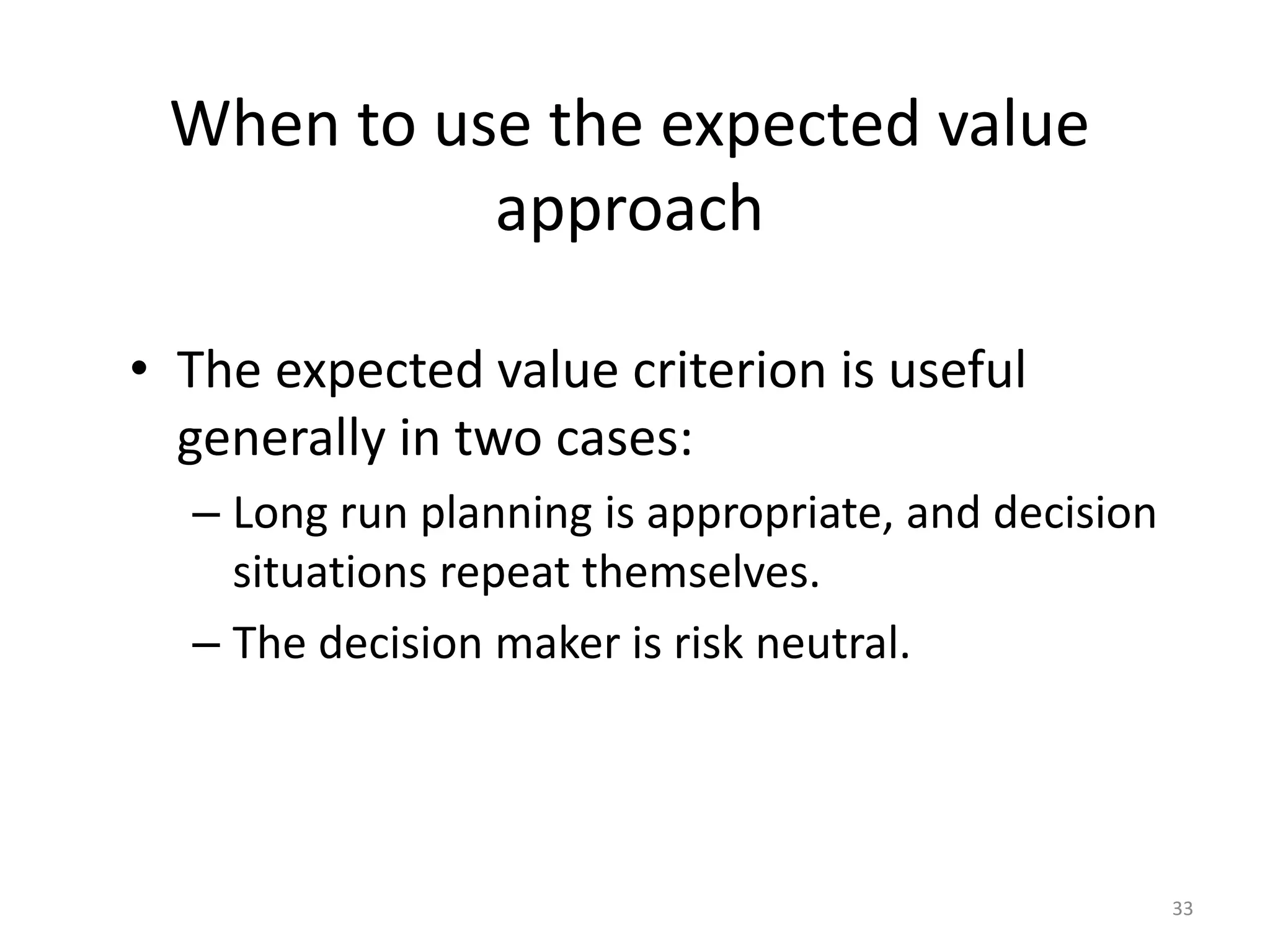
When to use the expected value
approach
• The expected value criterion is useful
generally in two cases:
– Long run planning is appropriate, and decision
situations repeat themselves.
– The decision maker is risk neutral.
33
Expected Value of Perfect Information
• The gain in expected return obtained from
knowing with certainty the future state of
nature is called:
Expected Value of Perfect Information
(EVPI)
34
EVPI
35
The Expected Value of Perfect Information
Decision Large rise Small rise No change Small fall Large fall
Gold -100 100 200 300 0
Bond 250 200 150 -100 -150
Stock 500 250 100 -200 -600
C/D 60 60 60 60 60
Probab. 0.2 0.3 0.3 0.1 0.1
If it were known with certainty that there will be a “Large Rise” in the market
Large rise
... the optimal decision would be to invest in...
-100
250
500
60
Stock
Similarly,…
EVPI
36
The Expected Value of Perfect Information
Decision Large rise Small rise No change Small fall Large fall
Gold -100 100 200 300 0
Bond 250 200 150 -100 -150
Stock 500 250 100 -200 -600
C/D 60 60 60 60 60
Probab. 0.2 0.3 0.3 0.1 0.1
-100
250
500
60
Expected Return with Perfect information =
ERPI = 0.2(500)+0.3(250)+0.3(200)+0.1(300)+0.1(60) = $271
Expected Return without additional information =
Expected Return of the EV criterion = $130
EVPI = ERPI - EREV = $271 - $130 = $141
Decision Trees
• The Payoff Table approach is useful for a non-
sequential or single stage.
• Many real-world decision problems consists of
a sequence of dependent decisions.
• Decision Trees are useful in analyzing multi-
stage decision processes.
37
Characteristics of a decision tree
• A Decision Tree is a chronological representation of
the decision process.
• The tree is composed of nodes and branches.
38
A branch emanating from a state of
nature (chance) node corresponds
to a particular state of nature, and
includes the probability of this state
of nature.
Decision
node
Chance
node
P(S2)
P(S2)
A branch emanating from a
decision node corresponds to
a decision alternative. It
includes a cost or benefit
value.
Any questions?
THANK YOU!!
39

Decision analysis.1

  • 1.
  • 2.
    Introduction to DecisionAnalysis • The field of decision analysis provides a framework for making important decisions. • Decision analysis allows us to select a decision from a set of possible decision alternatives when uncertainties regarding the future exist. • The goal is to optimize the resulting payoff in terms of a decision criterion. 2
  • 3.
    Introduction to DecisionAnalysis • Maximizing expected profit is a common criterion when probabilities can be assessed. 3 • Maximizing the decision maker’s utility function is the mechanism used when risk is factored into the decision making process.
  • 4.
    Payoff Table Analysis •Payoff Tables – Payoff table analysis can be applied when: • There is a finite set of discrete decision alternatives. • The outcome of a decision is a function of a single future event. – In a Payoff table - • The rows correspond to the possible decision alternatives. • The columns correspond to the possible future events. • Events (states of nature) are mutually exclusive and collectively exhaustive. • The table entries are the payoffs. 4
  • 5.
    INVESTMENT DECISION • Someonehas inherited $1000. • He has to decide how to invest the money for one year. • A broker has suggested five potential investments. – Gold – Junk Bond – Growth Stock – Certificate of Deposit – Stock Option Hedge 5
  • 6.
    • The returnon each investment depends on the (uncertain) market behavior during the year. • He would build a payoff table to help make the investment decision 6
  • 7.
    Solution • Select adecision making criterion, and apply it to the payoff table. 7 S1 S2 S3 S4 D1 p11 p12 p13 p14 D2 p21 p22 p23 P24 D3 p31 p32 p33 p34 S1 S2 S3 S4 D1 p11 p12 p13 p14 D2 p21 p22 p23 P24 D3 p31 p32 p33 p34 Criterion P1 P2 P3 • Construct a payoff table. • Identify the optimal decision. • Evaluate the solution.
  • 8.
    The Payoff Table 8 Thestates of nature are mutually exclusive and collectively exhaustive. Define the states of nature. Sensex is down mo than 800 points Sensex is down [-300, -800] Sensex moves within [-300,+300] sensex is up [+300,+1000] sensex is up more than1000 points
  • 9.
    The Payoff Table 9 DecisionStates of Nature Alternatives Large Rise Small Rise No Change Small Fall Large Fall Gold -100 100 200 300 0 Bond 250 200 150 -100 -150 Stock 500 250 100 -200 -600 C/D account 60 60 60 60 60 Stock option 200 150 150 -200 -150 Determine the set of possible decision alternatives.
  • 10.
    The Payoff Table 10 DecisionStates of Nature Alternatives Large Rise Small Rise No Change Small Fall Large Fall Gold -100 100 200 300 0 Bond 250 200 150 -100 -150 Stock 500 250 100 -200 -600 C/D account 60 60 60 60 60 Stock option 200 150 150 -200 -150 The stock option alternative is dominated by the 250 200 150 -100 -150 -150
  • 11.
    Decision Making Criteria •Classifying decision-making criteria – Decision making under certainty. • The future state-of-nature is assumed known. – Decision making under risk. • There is some knowledge of the probability of the states of nature occurring. – Decision making under uncertainty. • There is no knowledge about the probability of the states of nature occurring. 11
  • 12.
    Decision Making UnderUncertainty • The decision criteria are based on the decision maker’s attitude toward life. • The criteria include the – Maximin Criterion - pessimistic or conservative approach. – Minimax Regret Criterion - pessimistic or conservative approach. – Maximax Criterion - optimistic or aggressive approach. – Principle of Insufficient Reasoning – no information about the likelihood of the various states of nature. 12
  • 13.
    Decision Making UnderUncertainty - The Maximin Criterion 13
  • 14.
    Decision Making UnderUncertainty - The Maximin Criterion • This criterion is based on the worst-case scenario. – It fits both a pessimistic and a conservative decision maker’s styles. – A pessimistic decision maker believes that the worst possible result will always occur. – A conservative decision maker wishes to ensure a guaranteed minimum possible payoff. 14
  • 15.
    The Maximin Criterion •To find an optimal decision – Record the minimum payoff across all states of nature for each decision. – Identify the decision with the maximum “minimum payoff.” 15 The Maximin Criterion Minimum Decisions Large Rise Small rise No Change Small Fall Large Fall Payoff Gold -100 100 200 300 0 -100 Bond 250 200 150 -100 -150 -150 Stock 500 250 100 -200 -600 -600 C/D account 60 60 60 60 60 60 The Maximin Criterion Minimum Decisions Large Rise Small rise No Change Small Fall Large Fall Payoff Gold -100 100 200 300 0 -100 Bond 250 200 150 -100 -150 -150 Stock 500 250 100 -200 -600 -600 C/D account 60 60 60 60 60 60
  • 16.
    Decision Making UnderUncertainty - The Minimax Regret Criterion 18
  • 17.
    Decision Making UnderUncertainty - The Minimax Regret Criterion • The Minimax Regret Criterion – This criterion fits both a pessimistic and a conservative decision maker approach. – The payoff table is based on “lost opportunity,” or “regret.” – The decision maker incurs regret by failing to choose the “best” decision. 19
  • 18.
    Decision Making UnderUncertainty - The Minimax Regret Criterion • The Minimax Regret Criterion – To find an optimal decision, for each state of nature: • Determine the best payoff over all decisions. • Calculate the regret for each decision alternative as the difference between its payoff value and this best payoff value. – For each decision find the maximum regret over all states of nature. – Select the decision alternative that has the minimum of these “maximum regrets.” 20
  • 19.
    Regret Table 21 The PayoffTable Decision Large rise Small rise No change Small fall Large fall Gold -100 100 200 300 0 Bond 250 200 150 -100 -150 Stock 500 250 100 -200 -600 C/D 60 60 60 60 60 The Payoff Table Decision Large rise Small rise No change Small fall Large fall Gold -100 100 200 300 0 Bond 250 200 150 -100 -150 Stock 500 250 100 -200 -600 C/D 60 60 60 60 60 Let us build the Regret Table The Regret Table Decision Large rise Small rise No change Small fall Large fall Gold 600 150 0 0 60 Bond 250 50 50 400 210 Stock 0 0 100 500 660 C/D 440 190 140 240 0 Investing in Stock generates no regret when the market exhibits a large rise
  • 20.
    TOM BROWN –Regret Table 22 The Payoff Table Decision Large rise Small rise No change Small fall Large fall Gold -100 100 200 300 0 Bond 250 200 150 -100 -150 Stock 500 250 100 -200 -600 C/D 60 60 60 60 60 The Payoff Table Decision Large rise Small rise No change Small fall Large fall Gold -100 100 200 300 0 Bond 250 200 150 -100 -150 Stock 500 250 100 -200 -600 C/D 60 60 60 60 60 The Regret Table Maximum Decision Large rise Small rise No change Small fall Large fall Regret Gold 600 150 0 0 60 600 Bond 250 50 50 400 210 400 Stock 0 0 100 500 660 660 C/D 440 190 140 240 0 440 The Regret Table Maximum Decision Large rise Small rise No change Small fall Large fall Regret Gold 600 150 0 0 60 600 Bond 250 50 50 400 210 400 Stock 0 0 100 500 660 660 C/D 440 190 140 240 0 440 Investing in gold generates a regret of 600 when the market exhibits a large rise 500 – (-100) = 600
  • 21.
    Decision Making UnderUncertainty - The Maximax Criterion • This criterion is based on the best possible scenario. It fits both an optimistic and an aggressive decision maker. • An optimistic decision maker believes that the best possible outcome will always take place regardless of the decision made. • An aggressive decision maker looks for the decision with the highest payoff (when payoff is profit). 24
  • 22.
    • To findan optimal decision. – Find the maximum payoff for each decision alternative. – Select the decision alternative that has the maximum of the “maximum” payoff. 25 Decision Making Under Uncertainty - The Maximax Criterion
  • 23.
    The Maximax Criterion 26 TheMaximax Criterion Maximum Decision Large rise Small rise No change Small fall Large fall Payoff Gold -100 100 200 300 0 300 Bond 250 200 150 -100 -150 200 Stock 500 250 100 -200 -600 500 C/D 60 60 60 60 60 60
  • 24.
    • This criterionmight appeal to a decision maker who is neither pessimistic nor optimistic. – It assumes all the states of nature are equally likely to occur. – The procedure to find an optimal decision. • For each decision add all the payoffs. • Select the decision with the largest sum (for profits). 27 Decision Making Under Uncertainty - The Principle of Insufficient Reason
  • 25.
    Insufficient Reason • Sumof Payoffs – Gold 600 Dollars – Bond 350 Dollars – Stock 50 Dollars – C/D 300 Dollars • Based on this criterion the optimal decision alternative is to invest in gold. 28
  • 26.
    Decision Making UnderRisk 30 • The probability estimate for the occurrence of each state of nature (if available) can be incorporated in the search for the optimal decision. • For each decision calculate its expected payoff.
  • 27.
    Decision Making UnderRisk – The Expected Value Criterion • For each decision calculate the expected payoff as follows: (The summation is calculated across all the states of nature) • Select the decision with the best expected payoff 31 Expected Payoff = S(Probability)(Payoff)
  • 28.
    The Expected ValueCriterion 32 The Expected Value Criterion Expected Decision Large rise Small rise No change Small fall Large fall Value Gold -100 100 200 300 0 100 Bond 250 200 150 -100 -150 130 Stock 500 250 100 -200 -600 125 C/D 60 60 60 60 60 60 Prior Prob. 0.2 0.3 0.3 0.1 0.1 EV = (0.2)(250) + (0.3)(200) + (0.3)(150) + (0.1)(-100) + (0.1)(-150) = 130
  • 29.
    When to usethe expected value approach • The expected value criterion is useful generally in two cases: – Long run planning is appropriate, and decision situations repeat themselves. – The decision maker is risk neutral. 33
  • 30.
    Expected Value ofPerfect Information • The gain in expected return obtained from knowing with certainty the future state of nature is called: Expected Value of Perfect Information (EVPI) 34
  • 31.
    EVPI 35 The Expected Valueof Perfect Information Decision Large rise Small rise No change Small fall Large fall Gold -100 100 200 300 0 Bond 250 200 150 -100 -150 Stock 500 250 100 -200 -600 C/D 60 60 60 60 60 Probab. 0.2 0.3 0.3 0.1 0.1 If it were known with certainty that there will be a “Large Rise” in the market Large rise ... the optimal decision would be to invest in... -100 250 500 60 Stock Similarly,…
  • 32.
    EVPI 36 The Expected Valueof Perfect Information Decision Large rise Small rise No change Small fall Large fall Gold -100 100 200 300 0 Bond 250 200 150 -100 -150 Stock 500 250 100 -200 -600 C/D 60 60 60 60 60 Probab. 0.2 0.3 0.3 0.1 0.1 -100 250 500 60 Expected Return with Perfect information = ERPI = 0.2(500)+0.3(250)+0.3(200)+0.1(300)+0.1(60) = $271 Expected Return without additional information = Expected Return of the EV criterion = $130 EVPI = ERPI - EREV = $271 - $130 = $141
  • 33.
    Decision Trees • ThePayoff Table approach is useful for a non- sequential or single stage. • Many real-world decision problems consists of a sequence of dependent decisions. • Decision Trees are useful in analyzing multi- stage decision processes. 37
  • 34.
    Characteristics of adecision tree • A Decision Tree is a chronological representation of the decision process. • The tree is composed of nodes and branches. 38 A branch emanating from a state of nature (chance) node corresponds to a particular state of nature, and includes the probability of this state of nature. Decision node Chance node P(S2) P(S2) A branch emanating from a decision node corresponds to a decision alternative. It includes a cost or benefit value.
  • 35.