Driving a complimentary strategy
              Greater than the sum of its parts
                       Dan Warren, GSMA
                         10th October 2012


© GSMA 2012
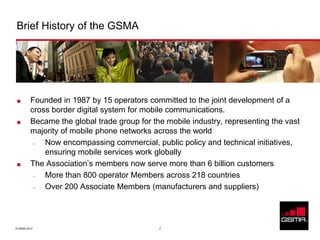
Brief History of the GSMA


        Founded in 1987 by 15 operators committed to the joint development of a
         cross border digital system for mobile communications.
        Became the global trade group for the mobile industry, representing the vast
         majority of mobile phone networks across the world
          –  Now encompassing commercial, public policy and technical initiatives,
             ensuring mobile services work globally
        The Association’s members now serve more than 6 billion customers
          –  More than 800 operator Members across 218 countries
          –  Over 200 Associate Members (manufacturers and suppliers)


© GSMA 2012                                  2
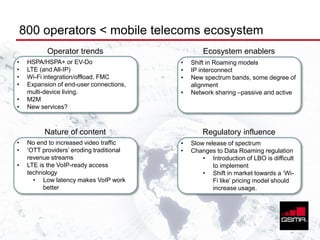
800 operators < mobile telecoms ecosystem
                Operator trends                            Ecosystem enablers
 •       HSPA/HSPA+ or EV-Do                       •   Shift in Roaming models
 •       LTE (and All-IP)                          •   IP interconnect
 •       Wi-Fi integration/offload, FMC            •   New spectrum bands, some degree of
 •       Expansion of end-user connections,            alignment
         multi-device living.                      •   Network sharing –passive and active
 •       M2M
 •       New services?


               Nature of content                           Regulatory influence
 •       No end to increased video traffic         •   Slow release of spectrum
 •       ‘OTT providers’ eroding traditional       •   Changes to Data Roaming regulation
         revenue streams                                   • Introduction of LBO is difficult
 •       LTE is the VoIP-ready access                          to implement
         technology                                        • Shift in market towards a ‘Wi-
           • Low latency makes VoIP work                       Fi like’ pricing model should
               better                                          increase usage.


Confidential                                   3
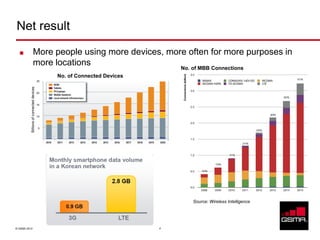
Net result
                     More people using more devices, more often for more purposes in
                      more locations
                                                                              No. of MBB Connections
                                               No. of Connected Devices
                                          25
          Billions of connected devices


                                          20


                                          15


                                          10


                                           5
                                                    Source:
                                                   Ericsson


                                                                                  Source: Wireless Intelligence


© GSMA 2012                                                               4
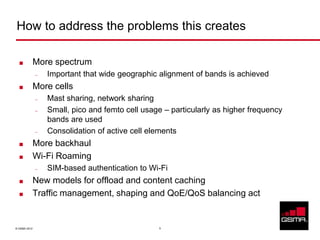
How to address the problems this creates

             More spectrum
              –   Important that wide geographic alignment of bands is achieved
             More cells
              –   Mast sharing, network sharing
              –   Small, pico and femto cell usage – particularly as higher frequency
                  bands are used
              –   Consolidation of active cell elements
             More backhaul
             Wi-Fi Roaming
              –   SIM-based authentication to Wi-Fi
             New models for offload and content caching
             Traffic management, shaping and QoE/QoS balancing act


© GSMA 2012                                      5
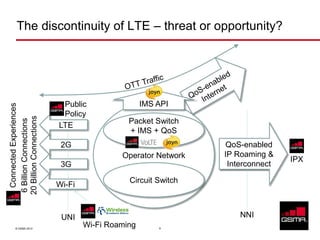
The discontinuity of LTE – threat or opportunity?


                           Public                 IMS API
  Connected Experiences


                           Policy
20 Billion Connections


                                             Packet Switch
6 Billion Connections


                          LTE
                                             + IMS + QoS
                           2G                                   Roaming
                                                              QoS-enabled
                                           Operator Network   IP Roaming &
                                                                              IPX
                           3G                                  Interconnect
                                                              Interconnect

                                             Circuit Switch
                          Wi-Fi


                           UNI                                    NNI
    © GSMA 2012
                                  Wi-Fi Roaming       6
Conclusions

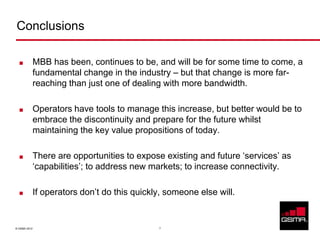
             MBB has been, continues to be, and will be for some time to come, a
              fundamental change in the industry – but that change is more far-
              reaching than just one of dealing with more bandwidth.

             Operators have tools to manage this increase, but better would be to
              embrace the discontinuity and prepare for the future whilst
              maintaining the key value propositions of today.

             There are opportunities to expose existing and future ‘services’ as
              ‘capabilities’; to address new markets; to increase connectivity.

             If operators don’t do this quickly, someone else will.


© GSMA 2012                                    7

Mobile.Broadband Dan.Warren 101012

  • 1.
    Driving a complimentarystrategy Greater than the sum of its parts Dan Warren, GSMA 10th October 2012 © GSMA 2012
  • 2.
    Brief History ofthe GSMA  Founded in 1987 by 15 operators committed to the joint development of a cross border digital system for mobile communications.  Became the global trade group for the mobile industry, representing the vast majority of mobile phone networks across the world – Now encompassing commercial, public policy and technical initiatives, ensuring mobile services work globally  The Association’s members now serve more than 6 billion customers – More than 800 operator Members across 218 countries – Over 200 Associate Members (manufacturers and suppliers) © GSMA 2012 2
  • 3.
    800 operators <mobile telecoms ecosystem Operator trends Ecosystem enablers • HSPA/HSPA+ or EV-Do • Shift in Roaming models • LTE (and All-IP) • IP interconnect • Wi-Fi integration/offload, FMC • New spectrum bands, some degree of • Expansion of end-user connections, alignment multi-device living. • Network sharing –passive and active • M2M • New services? Nature of content Regulatory influence • No end to increased video traffic • Slow release of spectrum • ‘OTT providers’ eroding traditional • Changes to Data Roaming regulation revenue streams • Introduction of LBO is difficult • LTE is the VoIP-ready access to implement technology • Shift in market towards a ‘Wi- • Low latency makes VoIP work Fi like’ pricing model should better increase usage. Confidential 3
  • 4.
    Net result  More people using more devices, more often for more purposes in more locations No. of MBB Connections No. of Connected Devices 25 Billions of connected devices 20 15 10 5 Source: Ericsson Source: Wireless Intelligence © GSMA 2012 4
  • 5.
    How to addressthe problems this creates  More spectrum – Important that wide geographic alignment of bands is achieved  More cells – Mast sharing, network sharing – Small, pico and femto cell usage – particularly as higher frequency bands are used – Consolidation of active cell elements  More backhaul  Wi-Fi Roaming – SIM-based authentication to Wi-Fi  New models for offload and content caching  Traffic management, shaping and QoE/QoS balancing act © GSMA 2012 5
  • 6.
    The discontinuity ofLTE – threat or opportunity? Public IMS API Connected Experiences Policy 20 Billion Connections Packet Switch 6 Billion Connections LTE + IMS + QoS 2G Roaming QoS-enabled Operator Network IP Roaming & IPX 3G Interconnect Interconnect Circuit Switch Wi-Fi UNI NNI © GSMA 2012 Wi-Fi Roaming 6
  • 7.
    Conclusions  MBB has been, continues to be, and will be for some time to come, a fundamental change in the industry – but that change is more far- reaching than just one of dealing with more bandwidth.  Operators have tools to manage this increase, but better would be to embrace the discontinuity and prepare for the future whilst maintaining the key value propositions of today.  There are opportunities to expose existing and future ‘services’ as ‘capabilities’; to address new markets; to increase connectivity.  If operators don’t do this quickly, someone else will. © GSMA 2012 7