Jan 2014
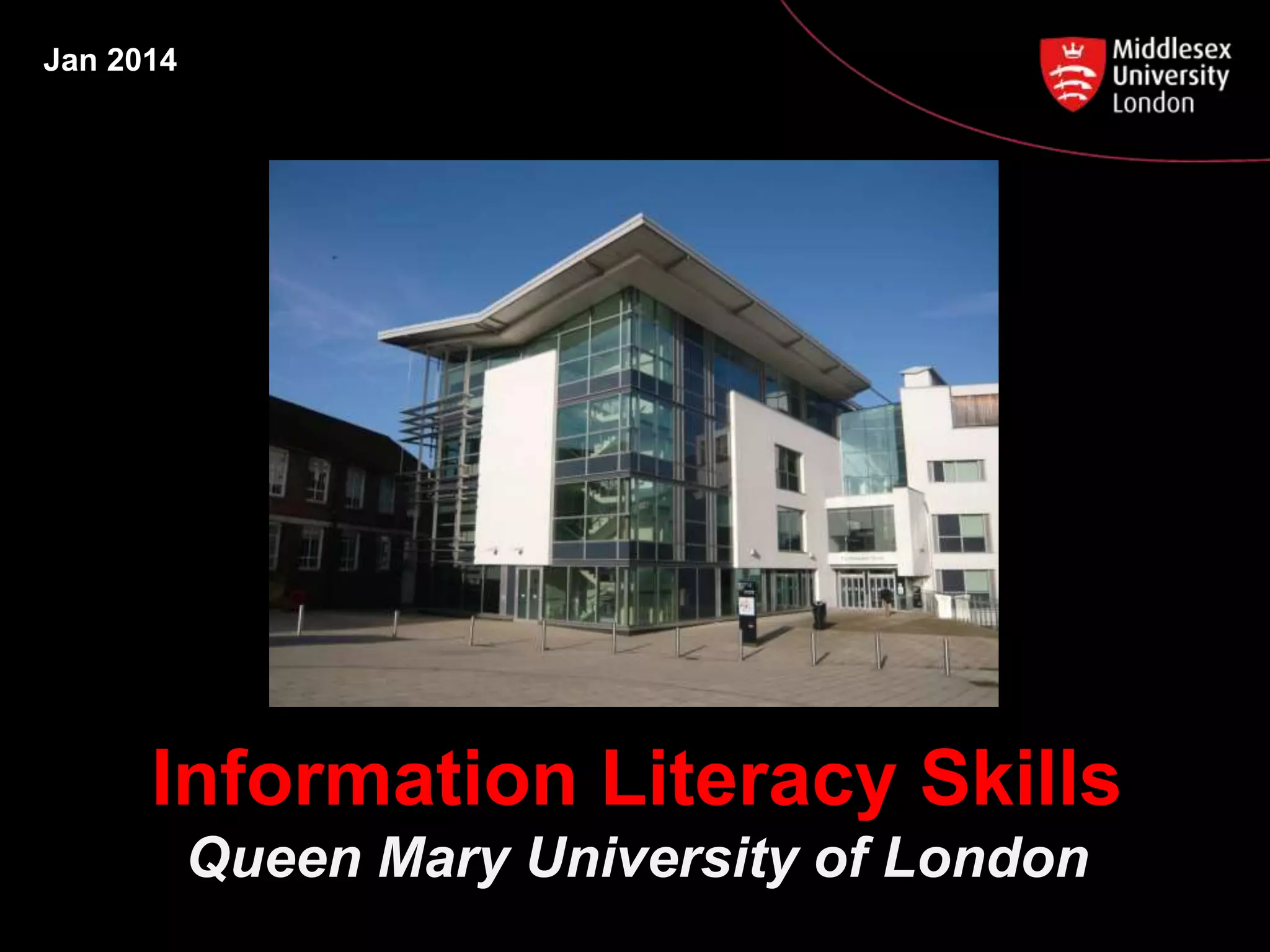
Information Literacy Skills
Queen Mary University of London
Welcome
09:30-10:00 Introductions and overview of MDX
10:00-10:30 Tour
10:30-11.00 Coffee/Tea
11:00-13:00 The winner takes it all
13:00-14:00 Dinner
14:00-16:00 Information Literacy skills for A&D students
16:00-16:30 Questions/close
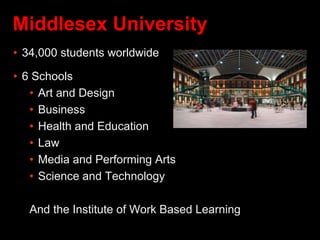
Middlesex University
• 34,000 students worldwide
• 6 Schools
• Art and Design
• Business
• Health and Education
• Law
• Media and Performing Arts
• Science and Technology
And the Institute of Work Based Learning
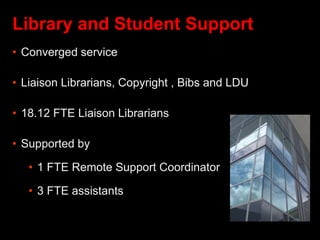
Library and Student Support
• Converged service
• Liaison Librarians, Copyright , Bibs and LDU
• 18.12 FTE Liaison Librarians
• Supported by
• 1 FTE Remote Support Coordinator
• 3 FTE assistants
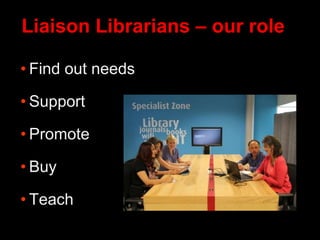
Liaison Librarians – our role
• Find out needs
• Support
• Promote
• Buy
• Teach
And now….
Enhancing the quality and impact of Library Workshops
Adam Edwards and Vanessa Hill Jan 2014
The winner takes it all
Knowing me, knowing you
• Issues
• Collaboration
• Inspiration
• Solutions
• Impact
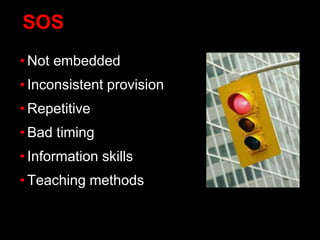
SOS
• Not embedded
• Inconsistent provision
• Repetitive
• Bad timing
• Information skills
• Teaching methods
Librarians and teaching
• Relevance
• Too much
• Tools based
• Didactic
• Uninspiring
• Subject
• Teaching skills
http://www.flickr.com/photos/vicchi/4079403111/
Gimme, Gimme, Gimme
• Answers
• Facts
• References
• Reporting back
• Easy option
• Fear
Librarians reinforce this!
http://www.flickr.com/photos/nottsexminer/6270679714/
Arrival
Teaching qualifications:
•PGCertHE @ MDX
•Teaching Fellowships
•FHEA
•TESOL
Benefits:
•Equivalent
•Learning together
•Language
•Respect
•Understanding
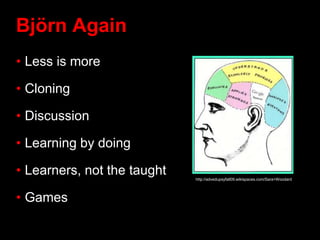
Björn Again
• Less is more
• Cloning
• Discussion
• Learning by doing
• Learners, not the taught
• Games
http://advedupsyfall09.wikispaces.com/Sara+Woodard
The name of the game
• Fun
• Quick
• Simple
• Easy
• Need or objective
Adapted from Susan Boyle, Lilac 2011
I have a dream
Move from
“ …lifting and transporting textual substance from
one location, the library, to another, their
teacher’s briefcases.”
To
“…searching, analyzing, evaluating, synthesizing,
selecting, rejecting…”
Kleine 1987
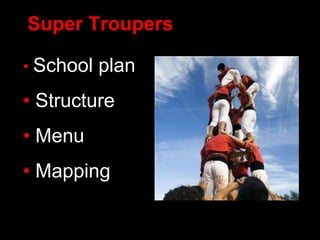
Super Troupers
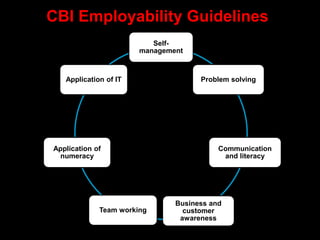
• School plan
• Structure
• Menu
• Mapping
Self-
management
Problem solving
Communication
and literacy
Business and
customer
awareness
Team working
Application of
numeracy
Application of IT
CBI Employability Guidelines
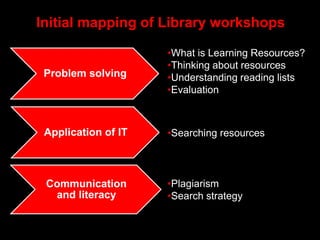
Initial mapping of Library workshops
Problem solving
Application of IT
Communication
and literacy
•What is Learning Resources?
•Thinking about resources
•Understanding reading lists
•Evaluation
•Searching resources
•Plagiarism
•Search strategy
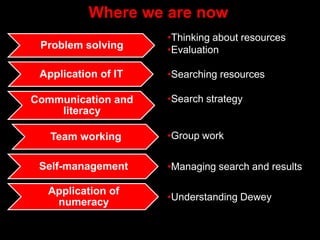
Where we are now
Problem solving
Application of IT
Communication and
literacy
Team working
Self-management
Application of
numeracy
•Thinking about resources
•Evaluation
•Searching resources
•Search strategy
•Group work
•Managing search and results
•Understanding Dewey
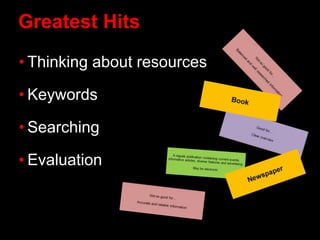
Greatest Hits
• Thinking about resources
• Keywords
• Searching
• Evaluation
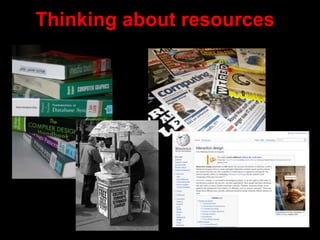
Thinking about resources
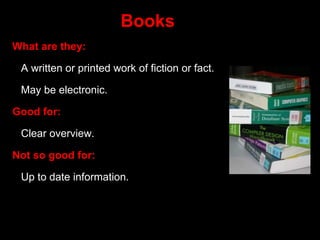
Books
What are they:
A written or printed work of fiction or fact.
May be electronic.
Good for:
Clear overview.
Not so good for:
Up to date information.
Web page
What are they:
An information resource which can be easily created by
anyone on any topic.
Electronic.
Good for:
Very up to date information.
Not so good for:
Accurate and reliable information.
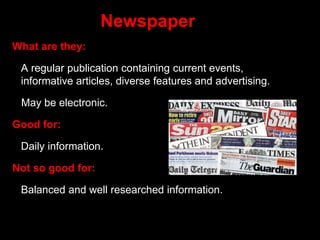
Newspaper
What are they:
A regular publication containing current events,
informative articles, diverse features and advertising.
May be electronic.
Good for:
Daily information.
Not so good for:
Balanced and well researched information.
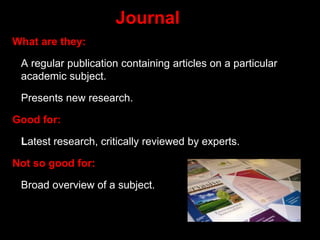
Journal
What are they:
A regular publication containing articles on a particular
academic subject.
Presents new research.
Good for:
Latest research, critically reviewed by experts.
Not so good for:
Broad overview of a subject.
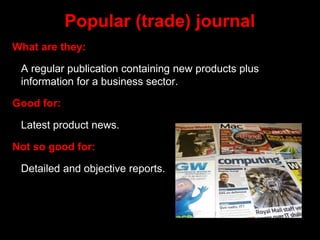
Popular (trade) journal
What are they:
A regular publication containing new products plus
information for a business sector.
Good for:
Latest product news.
Not so good for:
Detailed and objective reports.
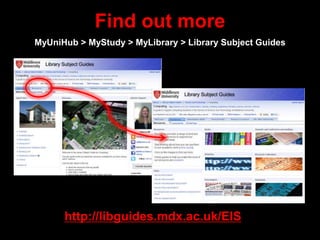
Find out more
MyUniHub > MyStudy > MyLibrary > Library Subject Guides
http://libguides.mdx.ac.uk/EIS
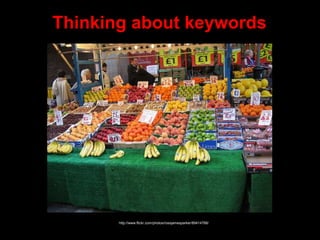
Thinking about keywords
http://www.flickr.com/photos/rossjamesparker/89414788/
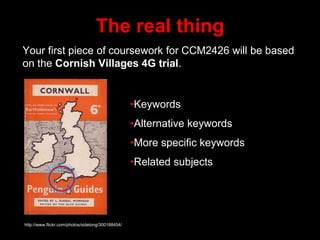
The real thing
http://www.flickr.com/photos/sidelong/300188454/
Your first piece of coursework for CCM2426 will be based
on the Cornish Villages 4G trial.
•Keywords
•Alternative keywords
•More specific keywords
•Related subjects
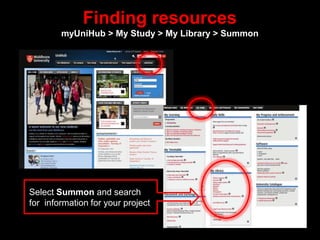
Finding resources
myUniHub > My Study > My Library > Summon
Select Summon and search
for information for your project
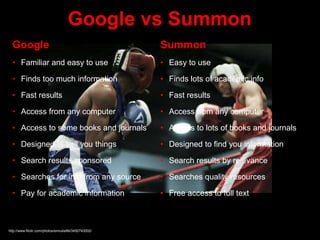
Google vs Summon
http://www.flickr.com/photos/ennuiislife/3450743002/
Google
• Familiar and easy to use
• Finds too much information
• Fast results
• Access from any computer
• Access to some books and journals
• Designed to sell you things
• Search results sponsored
• Searches for info from any source
• Pay for academic information
Summon
• Easy to use
• Finds lots of academic info
• Fast results
• Access from any computer
• Access to lots of books and journals
• Designed to find you information
• Search results by relevance
• Searches quality resources
• Free access to full text
Evaluating information
Imagine you are writing an essay on ‘Network Security’.
Have a look at the 4 items that you have been given and
consider the following:
• Which items are the most relevant to your essay?
• Which items would be no use?
• Which item has the most academic authority?
• Which items might have bias?
• Which item is the most current?
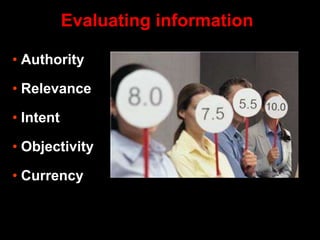
• Authority
• Relevance
• Intent
• Objectivity
• Currency
Evaluating information
How are books arranged in the library?
004.19 PRE
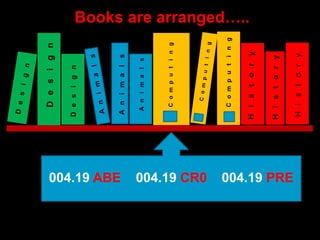
Books are arranged…..
Computing
Design
Design
Animals
Animals
Computing
History
History
History
004.19 ABE 004.19 CR0 004.19 PRE
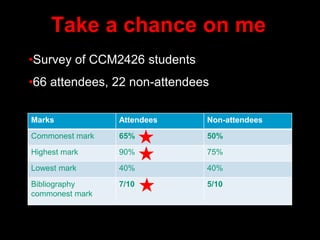
Take a chance on me
Marks Attendees Non-attendees
Commonest mark 65% 50%
Highest mark 90% 75%
Lowest mark 40% 40%
Bibliography
commonest mark
7/10 5/10
•Survey of CCM2426 students
•66 attendees, 22 non-attendees
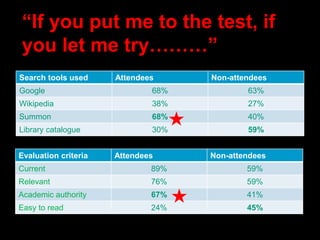
“If you put me to the test, if
you let me try………”
Search tools used Attendees Non-attendees
Google 68% 63%
Wikipedia 38% 27%
Summon 68% 40%
Library catalogue 30% 59%
Evaluation criteria Attendees Non-attendees
Current 89% 59%
Relevant 76% 59%
Academic authority 67% 41%
Easy to read 24% 45%
On and on and on
•Roll-out framework
•Develop activities
•Improve attendance
•Revalidation
•Moodle
The winner takes it all
• Successful collaboration
• Changes have worked
• Teaching is more fun
• Impact…
...Library training gets you better marks!
http://www.flickr.com/photos/naturalturn/3264726560/
Mamma Mia it’s……………
Adam Edwards
a.edwards@mdx.ac.uk
Vanessa Hill
v.hill@mdx.ac.uk
http://bit.ly/GamesMDX
When all is said and done
• Boyle, S. (2011) Using games to enhance information literacy
sessions, Presented at LILAC 2011.
http://www.slideshare.net/infolit_group/boyle-using-games-to-
enchance-information-literacy
• Kleine, M. (1987), What is it we do when we write articles like this
one-Or how can we get students to join us?, Writing Instructor 6,
151.
• Markless, S., (2010), Teaching information literacy in HE: What?
Where? How?, presented at King’s College London, 9/12/10.
[Notes taken at the event.]
http://bit.ly/OurGames
Tearoom

QMUofL 23rd Jan 2014 Morning

  • 1.
    Jan 2014 Information LiteracySkills Queen Mary University of London
  • 2.
    Welcome 09:30-10:00 Introductions andoverview of MDX 10:00-10:30 Tour 10:30-11.00 Coffee/Tea 11:00-13:00 The winner takes it all 13:00-14:00 Dinner 14:00-16:00 Information Literacy skills for A&D students 16:00-16:30 Questions/close
  • 3.
    Middlesex University • 34,000students worldwide • 6 Schools • Art and Design • Business • Health and Education • Law • Media and Performing Arts • Science and Technology And the Institute of Work Based Learning
  • 4.
    Library and StudentSupport • Converged service • Liaison Librarians, Copyright , Bibs and LDU • 18.12 FTE Liaison Librarians • Supported by • 1 FTE Remote Support Coordinator • 3 FTE assistants
  • 5.
    Liaison Librarians –our role • Find out needs • Support • Promote • Buy • Teach
  • 6.
  • 7.
    Enhancing the qualityand impact of Library Workshops Adam Edwards and Vanessa Hill Jan 2014 The winner takes it all
  • 8.
    Knowing me, knowingyou • Issues • Collaboration • Inspiration • Solutions • Impact
  • 9.
    SOS • Not embedded •Inconsistent provision • Repetitive • Bad timing • Information skills • Teaching methods
  • 10.
    Librarians and teaching •Relevance • Too much • Tools based • Didactic • Uninspiring • Subject • Teaching skills http://www.flickr.com/photos/vicchi/4079403111/
  • 11.
    Gimme, Gimme, Gimme •Answers • Facts • References • Reporting back • Easy option • Fear Librarians reinforce this! http://www.flickr.com/photos/nottsexminer/6270679714/
  • 12.
    Arrival Teaching qualifications: •PGCertHE @MDX •Teaching Fellowships •FHEA •TESOL Benefits: •Equivalent •Learning together •Language •Respect •Understanding
  • 13.
    Björn Again • Lessis more • Cloning • Discussion • Learning by doing • Learners, not the taught • Games http://advedupsyfall09.wikispaces.com/Sara+Woodard
  • 14.
    The name ofthe game • Fun • Quick • Simple • Easy • Need or objective Adapted from Susan Boyle, Lilac 2011
  • 15.
    I have adream Move from “ …lifting and transporting textual substance from one location, the library, to another, their teacher’s briefcases.” To “…searching, analyzing, evaluating, synthesizing, selecting, rejecting…” Kleine 1987
  • 16.
    Super Troupers • Schoolplan • Structure • Menu • Mapping
  • 17.
    Self- management Problem solving Communication and literacy Businessand customer awareness Team working Application of numeracy Application of IT CBI Employability Guidelines
  • 18.
    Initial mapping ofLibrary workshops Problem solving Application of IT Communication and literacy •What is Learning Resources? •Thinking about resources •Understanding reading lists •Evaluation •Searching resources •Plagiarism •Search strategy
  • 19.
    Where we arenow Problem solving Application of IT Communication and literacy Team working Self-management Application of numeracy •Thinking about resources •Evaluation •Searching resources •Search strategy •Group work •Managing search and results •Understanding Dewey
  • 20.
    Greatest Hits • Thinkingabout resources • Keywords • Searching • Evaluation
  • 21.
  • 22.
    Books What are they: Awritten or printed work of fiction or fact. May be electronic. Good for: Clear overview. Not so good for: Up to date information.
  • 23.
    Web page What arethey: An information resource which can be easily created by anyone on any topic. Electronic. Good for: Very up to date information. Not so good for: Accurate and reliable information.
  • 24.
    Newspaper What are they: Aregular publication containing current events, informative articles, diverse features and advertising. May be electronic. Good for: Daily information. Not so good for: Balanced and well researched information.
  • 25.
    Journal What are they: Aregular publication containing articles on a particular academic subject. Presents new research. Good for: Latest research, critically reviewed by experts. Not so good for: Broad overview of a subject.
  • 26.
    Popular (trade) journal Whatare they: A regular publication containing new products plus information for a business sector. Good for: Latest product news. Not so good for: Detailed and objective reports.
  • 27.
    Find out more MyUniHub> MyStudy > MyLibrary > Library Subject Guides http://libguides.mdx.ac.uk/EIS
  • 28.
  • 29.
    The real thing http://www.flickr.com/photos/sidelong/300188454/ Yourfirst piece of coursework for CCM2426 will be based on the Cornish Villages 4G trial. •Keywords •Alternative keywords •More specific keywords •Related subjects
  • 30.
    Finding resources myUniHub >My Study > My Library > Summon Select Summon and search for information for your project
  • 31.
    Google vs Summon http://www.flickr.com/photos/ennuiislife/3450743002/ Google •Familiar and easy to use • Finds too much information • Fast results • Access from any computer • Access to some books and journals • Designed to sell you things • Search results sponsored • Searches for info from any source • Pay for academic information Summon • Easy to use • Finds lots of academic info • Fast results • Access from any computer • Access to lots of books and journals • Designed to find you information • Search results by relevance • Searches quality resources • Free access to full text
  • 32.
  • 33.
    Evaluating information Imagine youare writing an essay on ‘Network Security’. Have a look at the 4 items that you have been given and consider the following: • Which items are the most relevant to your essay? • Which items would be no use? • Which item has the most academic authority? • Which items might have bias? • Which item is the most current?
  • 34.
    • Authority • Relevance •Intent • Objectivity • Currency Evaluating information
  • 35.
    How are booksarranged in the library?
  • 36.
    004.19 PRE Books arearranged….. Computing Design Design Animals Animals Computing History History History 004.19 ABE 004.19 CR0 004.19 PRE
  • 37.
    Take a chanceon me Marks Attendees Non-attendees Commonest mark 65% 50% Highest mark 90% 75% Lowest mark 40% 40% Bibliography commonest mark 7/10 5/10 •Survey of CCM2426 students •66 attendees, 22 non-attendees
  • 38.
    “If you putme to the test, if you let me try………” Search tools used Attendees Non-attendees Google 68% 63% Wikipedia 38% 27% Summon 68% 40% Library catalogue 30% 59% Evaluation criteria Attendees Non-attendees Current 89% 59% Relevant 76% 59% Academic authority 67% 41% Easy to read 24% 45%
  • 39.
    On and onand on •Roll-out framework •Develop activities •Improve attendance •Revalidation •Moodle
  • 40.
    The winner takesit all • Successful collaboration • Changes have worked • Teaching is more fun • Impact… ...Library training gets you better marks!
  • 41.
    http://www.flickr.com/photos/naturalturn/3264726560/ Mamma Mia it’s…………… AdamEdwards a.edwards@mdx.ac.uk Vanessa Hill v.hill@mdx.ac.uk http://bit.ly/GamesMDX
  • 42.
    When all issaid and done • Boyle, S. (2011) Using games to enhance information literacy sessions, Presented at LILAC 2011. http://www.slideshare.net/infolit_group/boyle-using-games-to- enchance-information-literacy • Kleine, M. (1987), What is it we do when we write articles like this one-Or how can we get students to join us?, Writing Instructor 6, 151. • Markless, S., (2010), Teaching information literacy in HE: What? Where? How?, presented at King’s College London, 9/12/10. [Notes taken at the event.] http://bit.ly/OurGames
  • 43.