The life science business of Merck KGaA,
Darmstadt, Germany operates as
MilliporeSigma in the U.S. and Canada.
Quality by Design (QBD)
for Downstream
Virus Filtration
Tathagata Ray
Nov 6, 2020
The life science business
of Merck KGaA, Darmstadt,
Germany operates as
MilliporeSigma in the U.S.
and Canada
Agenda
1
2
3
Quality by Design
Virus Filtration
QbD in Virus Filtration
Quality by
Design
Introduction
LOW
HIGH
Concept Design Testing Production
Quality by Design (QBD) for Downstream Virus Filtration | 6 November 2020
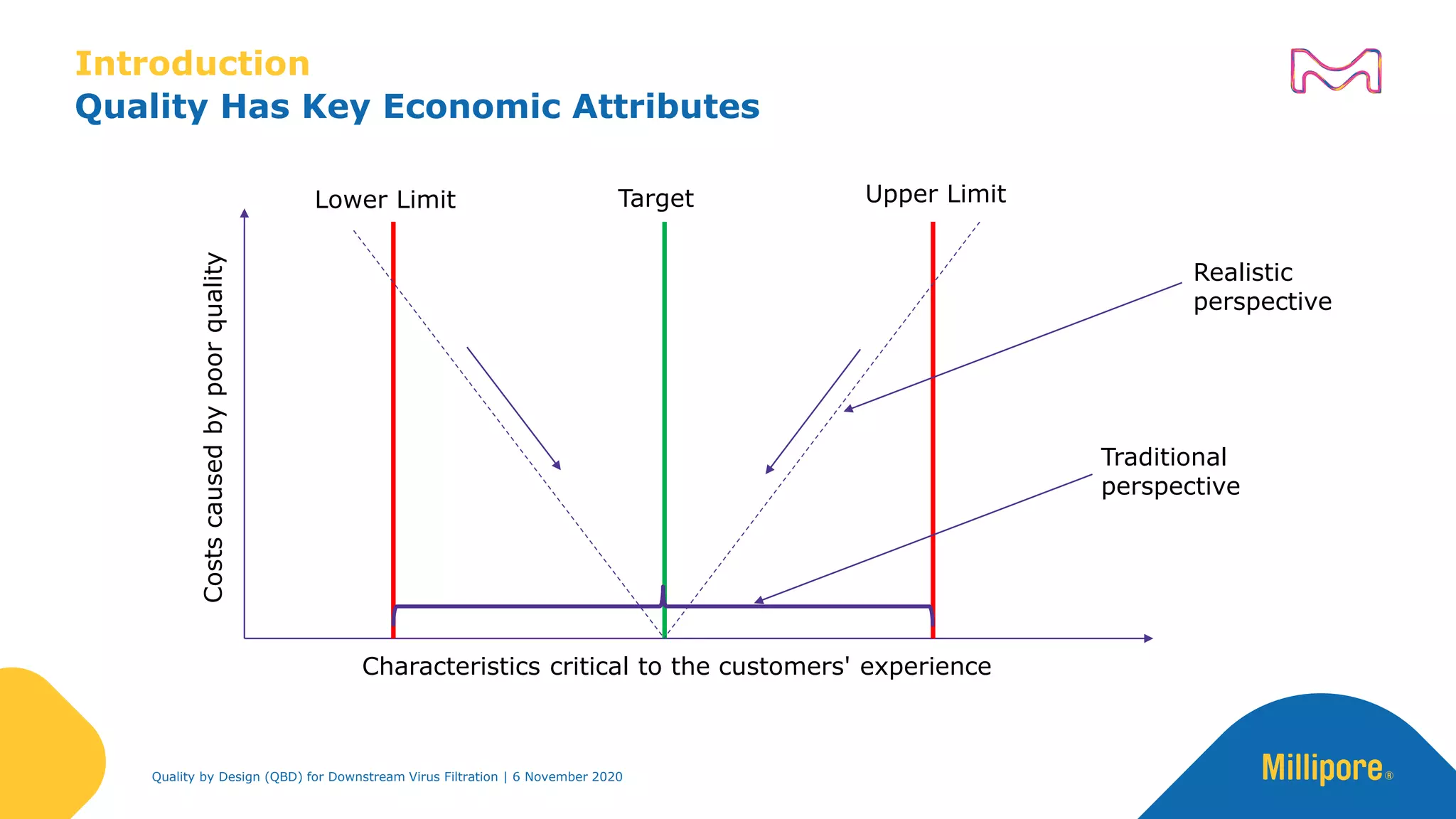
Quality Has Key Economic Attributes
Introduction
Costscausedbypoorquality
Characteristics critical to the customers' experience
Lower Limit Upper LimitTarget
Traditional
perspective
Realistic
perspective
Quality by Design (QBD) for Downstream Virus Filtration | 6 November 2020
Quality in Biopharmaceuticals
Introduction
1
100
10000
1000000
2σ 4σ 6σ
DPMO
Restaurant bills
Airline baggage arrival
Aviation industry
Nuclear industry
Quality to
patient
How do we follow “absolute” quality? By Testing!
Or, it has to be built in by design...
DPMO – Defects per million opportunities
Healthcare industry
Quality by Design (QBD) for Downstream Virus Filtration | 6 November 2020
Quality Can Be A Key Regulatory Concern
Introduction
Does the production process result in
product/residues that interfere with final
product strength or efficacy?
Does the production process result in
product/residues that interfere with final
product purity?
Does the production process result in
product/residues that are toxic to the
patient?
Suitability of either a drug substance or product for its intended use (ICH Q6A)
Quality by Design (QBD) for Downstream Virus Filtration | 6 November 2020
QbD: Overall Approach
Introduction
CQ
A 4
CQA
2CQA
1
CQ
A 3
PRODUCT DESIGN SPACECLINICAL DESIGN SPACE PROCESS DESIGN SPACE
TARGET PRODUCT PROFILE
CONCEPT > DESIGN > PRE-CLINICAL > CLINICAL > MASS PRODUCTION
Animal studies
PROCESS
PARAMETER
S
Quality by Design (QBD) for Downstream Virus Filtration | 6 November 2020
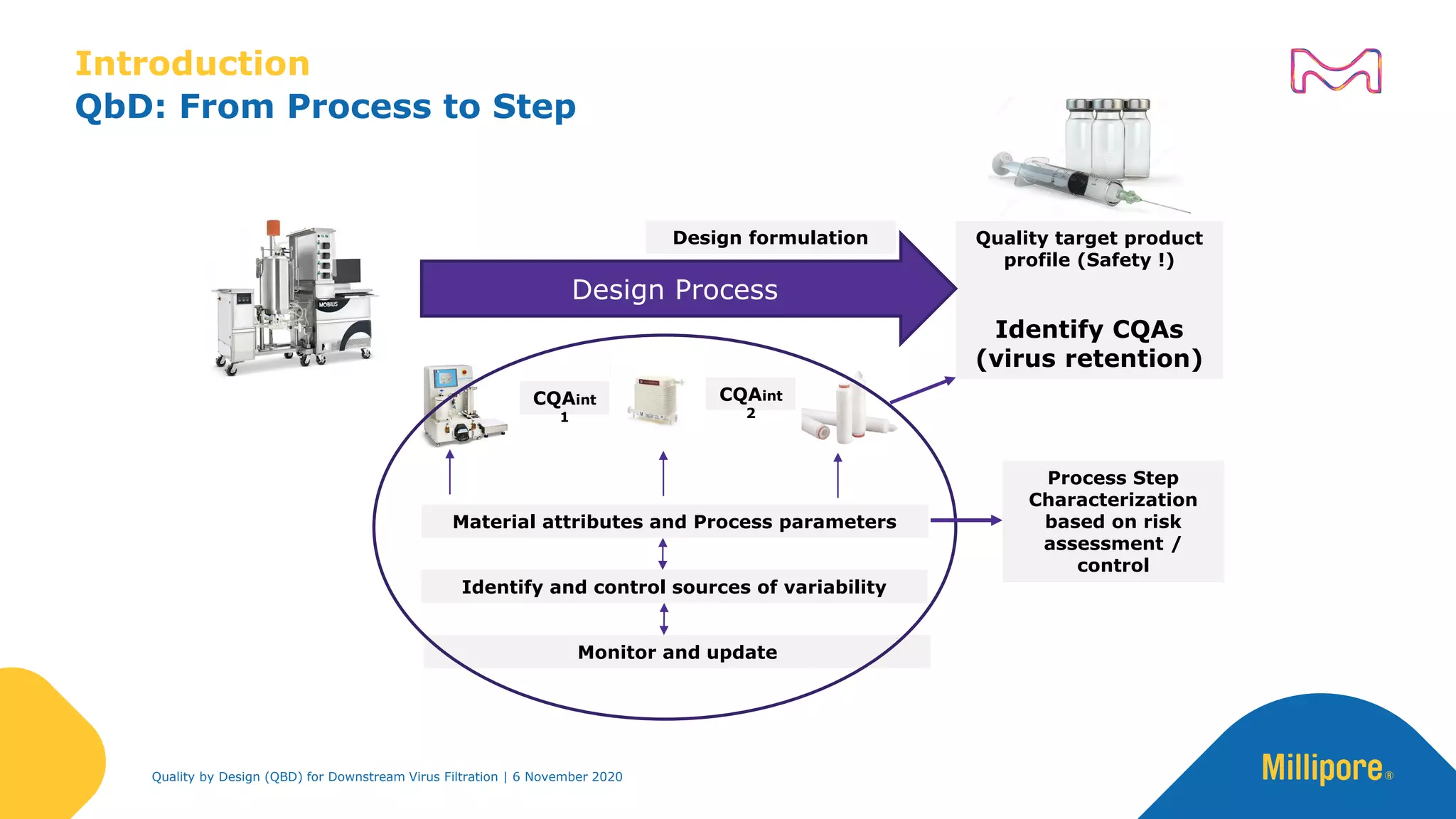
QbD: From Process to Step
Introduction
Quality target product
profile (Safety !)
Identify CQAs
(virus retention)
Design Process
Design formulation
Material attributes and Process parameters
CQAint
1
CQAint
2
Identify and control sources of variability
Monitor and update
Process Step
Characterization
based on risk
assessment /
control
Quality by Design (QBD) for Downstream Virus Filtration | 6 November 2020
Risk Management
 Minimizes risk by identifying high risk/impact
parameters and implementing a
control/monitoring strategy
 Results in a more robust/controlled/consistent
process
 Reduces chance of out of spec. batches,
deviations, etc.
Simplifies Process Development
 Holistic development of a design space to
accommodate multiple diverse molecules within
a pipeline
 Less repetitive “reinventing the wheel” studies
with each new molecule using a bracketing
approach
Simplifies Validation
 Differentiating critical vs. non-critical processing
parameters enables more compact validation
study designs
 Facilitates a modular validation approach for a
multi-molecule pipeline
 Faster validation time and lower associated costs
Stronger Regulatory Submission
 Demonstrates a proactive understanding of your
process to regulatory bodies
 Rationale for design space makes regulatory
submission package more defendable
Why Apply QbD?
Introduction
1
2
3
4
Quality by Design (QBD) for Downstream Virus Filtration | 6 November 2020
Poll Question
Virus
filtration in
DSP
A Key Component of Viral Safety Assurance
Virus Filtration
Quality by Design (QBD) for Downstream Virus Filtration | 6 November 2020
Virus Removal via Size Exclusion
Virus Filtration
Membrane Pore Size Distribution
 All membrane pore paths < virus size: expect complete retention
 Reality: membrane morphology is complex and has an inherit size distribution
 Other parameters may impact retention in extreme cases
− E.g. very high flux decay => preferential plugging of smaller pores leaving larger
pores more accessible to virus passage
Vendor Controls: Viresolve® Pro Device
 Recurring (every lot)
− Membrane pore size distribution measurement and control via liquid – liquid
porometry
− Membrane and finished goods device binary gas and air/water diffusion testing
− Selective layering process to increase performance consistency
 Control factors can be incorporated into the FMEA
Quality by Design (QBD) for Downstream Virus Filtration | 6 November 2020
How Could Plugging/ Flux Decay be a CPP?
Virus Filtration
Breakthrough at High Flux Decay / Plugging
 Membrane has an inherent pore size distribution
 Pores on the upper end of the distribution could be non-retentive
 Preferential plugging of smaller pores first
− Redirects more flow through the larger pores
− At higher plugged states, virus breakthrough is possible
 Different filters exhibit different behaviors!
− Membrane pore size distribution ultimately dictates retention performance
− Process endpoints of V90 or more are possible without significant loss of retention
(Viresolve® Pro Device)
Breakthrough in
Large
(Non-Retentive)
Pores
Functional
(Retentive)
Pores
1 nm 100 nm10 nm
MVM
(20–25 nm)
fX-174
(25–30 nm)
Quality by Design (QBD) for Downstream Virus Filtration | 6 November 2020
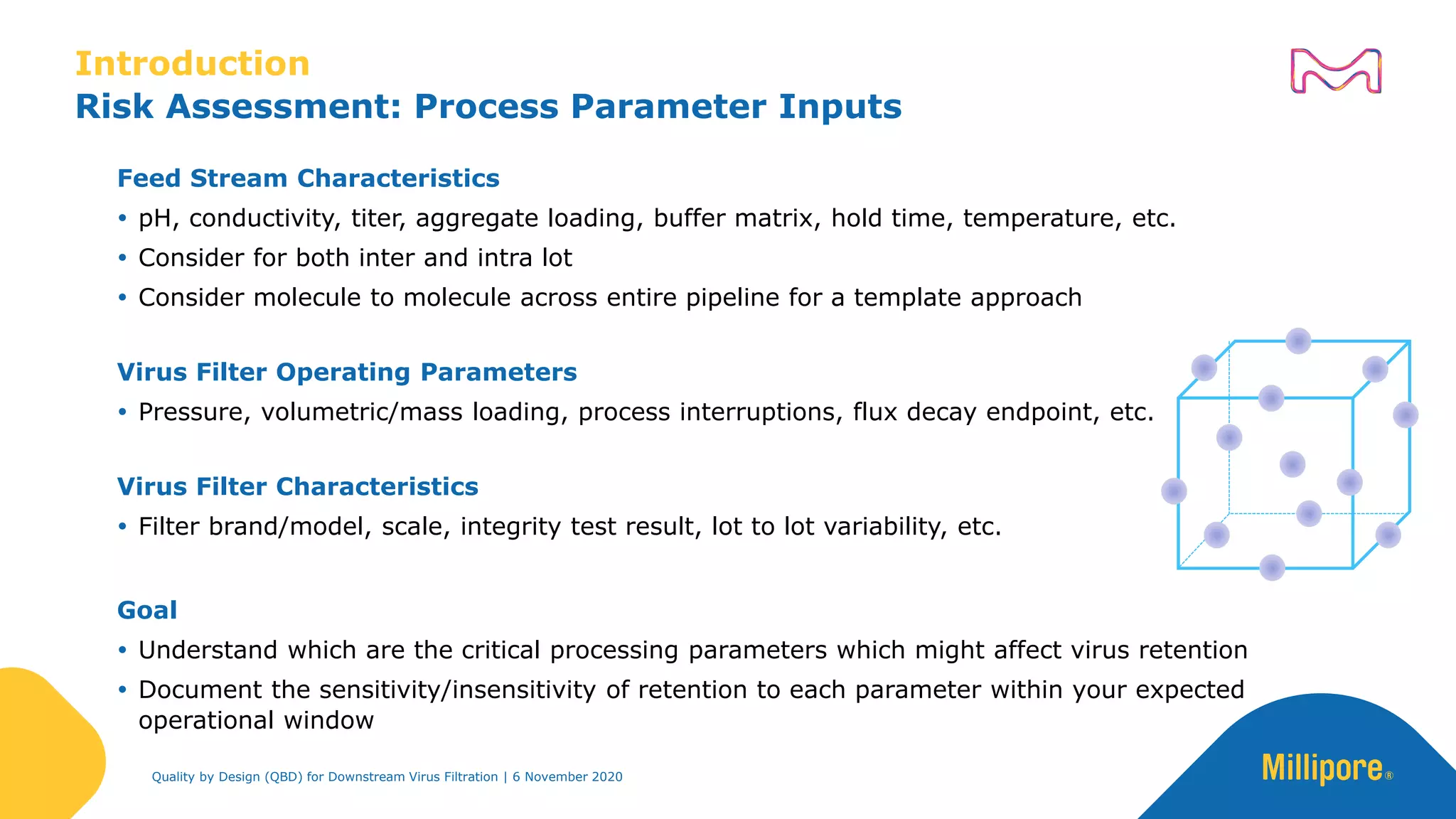
Risk Assessment: Process Parameter Inputs
Introduction
Feed Stream Characteristics
 pH, conductivity, titer, aggregate loading, buffer matrix, hold time, temperature, etc.
 Consider for both inter and intra lot
 Consider molecule to molecule across entire pipeline for a template approach
Virus Filter Operating Parameters
 Pressure, volumetric/mass loading, process interruptions, flux decay endpoint, etc.
Virus Filter Characteristics
 Filter brand/model, scale, integrity test result, lot to lot variability, etc.
Goal
 Understand which are the critical processing parameters which might affect virus retention
 Document the sensitivity/insensitivity of retention to each parameter within your expected
operational window
Quality by Design (QBD) for Downstream Virus Filtration | 6 November 2020
Risk Assessment: FMEA
Introduction
Too Many Variables!
 Limit parameters to those rationally significant (i.e. operator, feed turbidity not likely critical)
FMEA Approach Example (not prescriptive)
 Rank each parameter based on:
− Severity (impact on LRV): 1 – 10 (low – high)
− Probability of occurrence: 1 – 10 (low – high)
− Detectability via controls: 1 – 10 (detectable – undetectable)
− Risk priority number (RPN): Severity x Probability x Detectability => prioritize and work top down
Estimating Severity
 How would you know if flux decay, process interruptions, etc. would impact retention?
 Leverage internal data sets for previously tested molecules
 Leverage vendor supplied / industry publication data sets
 The goal is to minimize the exploratory testing required
Quality by Design (QBD) for Downstream Virus Filtration | 6 November 2020
QbD Approach for Virus Filtration
Introduction
1
2
3
4
Risk Assessment
 What are the theoretical processing parameters
that could impact viral retention performance?
 Not all parameters are critical or equal…
 Use an FMEA approach
 How can we determine the relative risk
(severity/probability/detectability)?
Characterization Studies
 Which processing parameters actually affect retention
and to what extent?
 Every commercially available filter behaves differently!
 How can we determine the effect?
 Univariate or multivariate analysis?
 In house and/or vendor supplied data
 Update FMEA based on findings
Design Space Establishment
 Understanding of what to expect for retention at
the boundaries of your multidimensional design
space
 Establishment of allowable ranges of processing
parameters to ensure CQA is met
 Can be established for single or multiple molecules
Control Strategy
 Develop control/monitoring strategy for CPPs to
ensure operation within the established design
space validated during spiking studies
 Focus top down on high risk items from FMEA
Virus Filtration: CQA is achievement of a predetermined LRV of virus from drug product
Quality by Design (QBD) for Downstream Virus Filtration | 6 November 2020
Poll Question
Quality by Design (QBD) for Downstream Virus Filtration | 6 November 2020
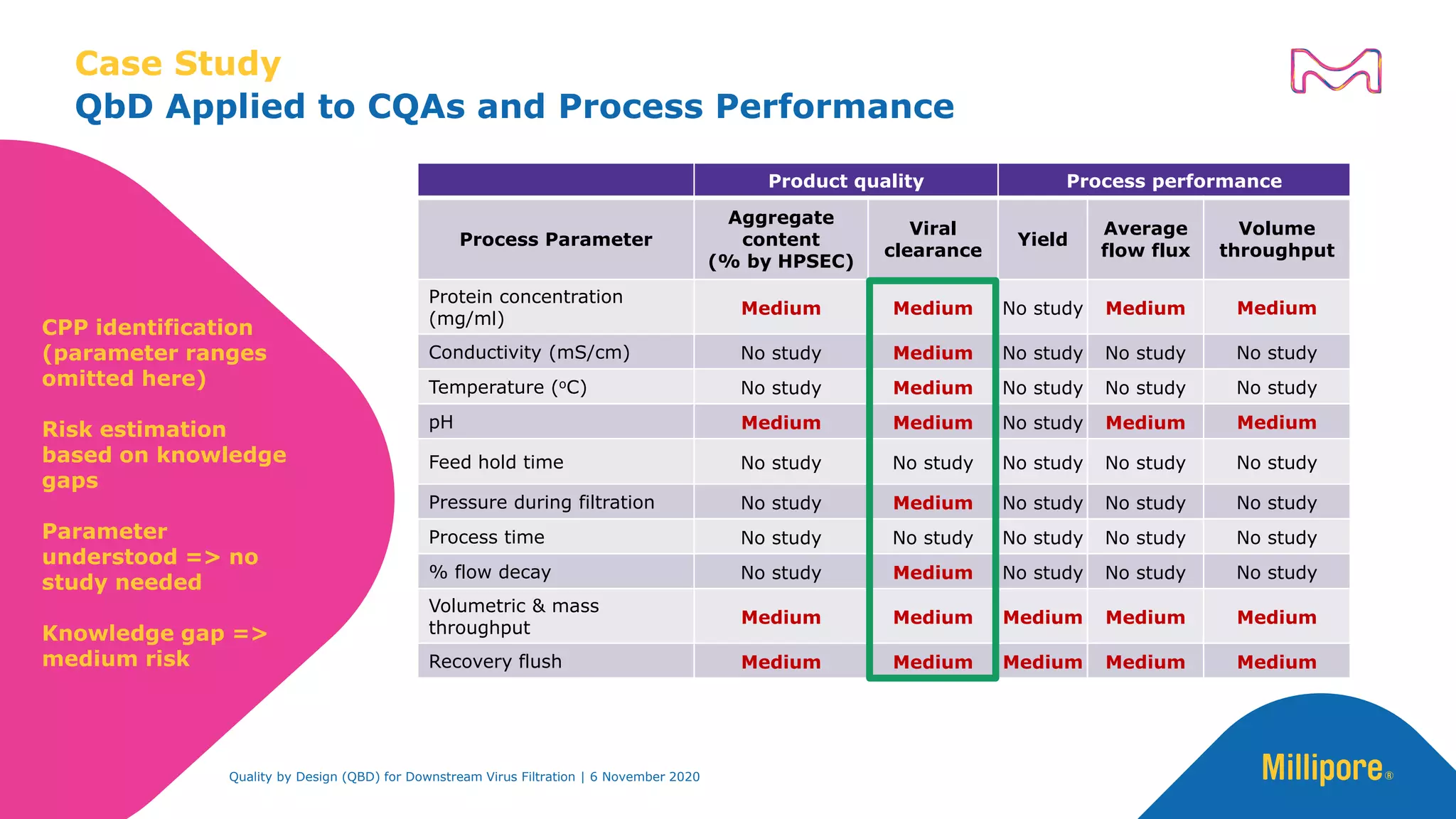
QbD Applied to CQAs and Process Performance
Case Study
CPP identification
(parameter ranges
omitted here)
Risk estimation
based on knowledge
gaps
Parameter
understood => no
study needed
Knowledge gap =>
medium risk
Product quality Process performance
Process Parameter
Aggregate
content
(% by HPSEC)
Viral
clearance
Yield
Average
flow flux
Volume
throughput
Protein concentration
(mg/ml)
Medium Medium No study Medium Medium
Conductivity (mS/cm) No study Medium No study No study No study
Temperature (oC) No study Medium No study No study No study
pH Medium Medium No study Medium Medium
Feed hold time No study No study No study No study No study
Pressure during filtration No study Medium No study No study No study
Process time No study No study No study No study No study
% flow decay No study Medium No study No study No study
Volumetric & mass
throughput
Medium Medium Medium Medium Medium
Recovery flush Medium Medium Medium Medium Medium
Quality by Design (QBD) for Downstream Virus Filtration | 6 November 2020
QbD Applied to CQAs and Process Performance
Case Study
Vendor supplied
data sets
addressed most
knowledge gaps
Constituted a
significant
reduction
of study effort
needed
to implement QbD
Product quality Process performance
Process Parameter
Aggregate
content
(% by HPSEC)
Viral
clearance
Yield
Average
flow
flux
Volume
throughput
Protein concentration
(mg/ml)
Medium Medium No study Medium Medium
Conductivity (mS/cm) No study No study No study No study No study
Temperature (oC) No study Medium No study No study No study
pH Medium Medium No study Medium Medium
Feed hold time No study No study No study No study No study
Pressure during filtration No study Medium No study No study No study
Process time No study No study No study No study No study
% flow decay No study Medium No study No study No study
Volumetric & mass
throughput
Medium Medium Medium Medium Medium
Recovery flush Medium Medium Medium Medium Medium
Vendor
supplied
data
Quality by Design (QBD) for Downstream Virus Filtration | 6 November 2020
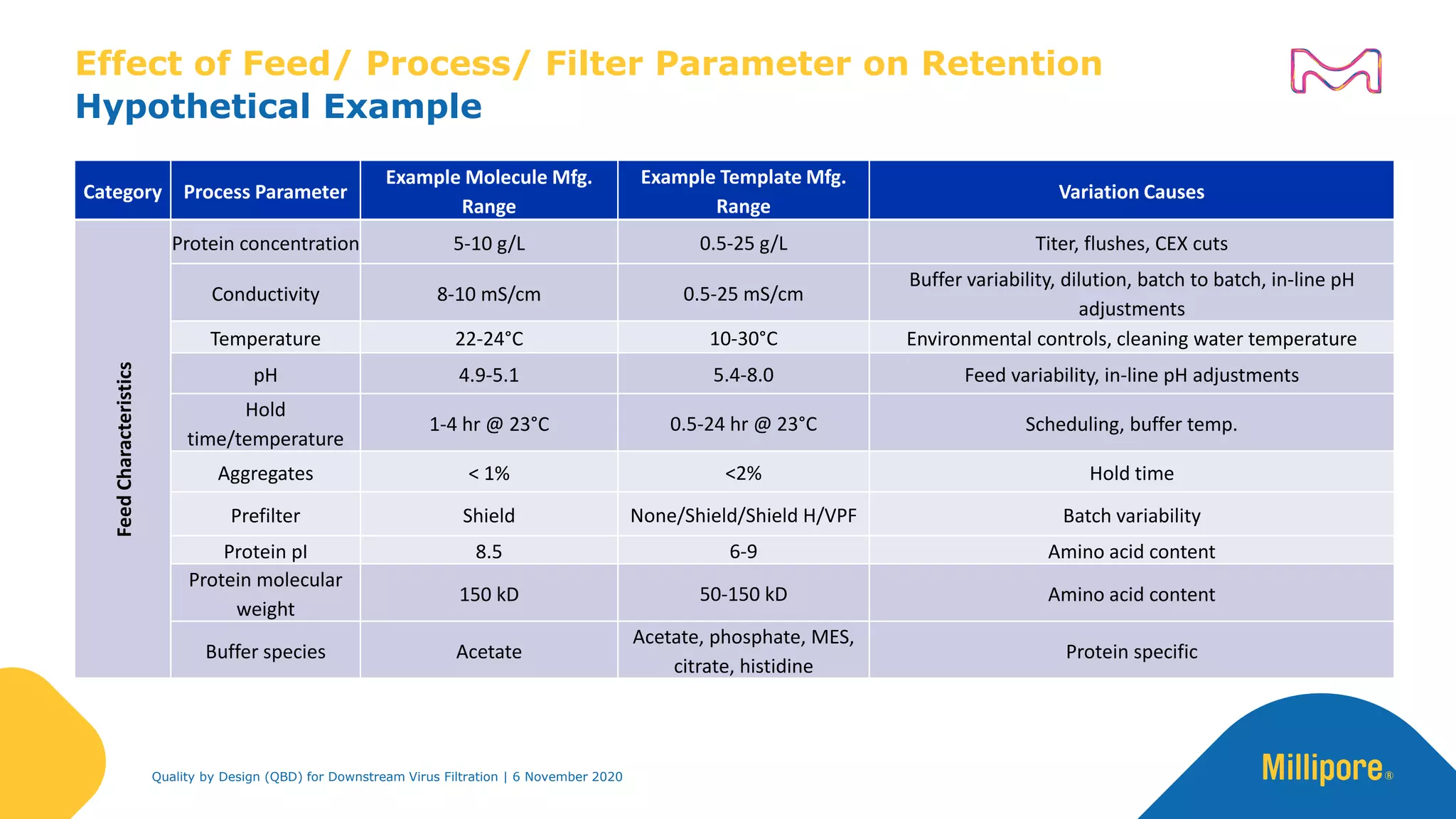
Hypothetical Example
Effect of Feed/ Process/ Filter Parameter on Retention
Category Process Parameter
Example Molecule Mfg.
Range
Example Template Mfg.
Range
Variation Causes
FeedCharacteristics
Protein concentration 5-10 g/L 0.5-25 g/L Titer, flushes, CEX cuts

Conductivity 8-10 mS/cm 0.5-25 mS/cm
Buffer variability, dilution, batch to batch, in-line pH
adjustments
Temperature 22-24°C 10-30°C Environmental controls, cleaning water temperature
pH 4.9-5.1 5.4-8.0 Feed variability, in-line pH adjustments
Hold
time/temperature
1-4 hr @ 23°C 0.5-24 hr @ 23°C Scheduling, buffer temp.
Aggregates < 1% <2% Hold time
Prefilter Shield None/Shield/Shield H/VPF Batch variability
Protein pI 8.5 6-9 Amino acid content
Protein molecular
weight
150 kD 50-150 kD Amino acid content
Buffer species Acetate
Acetate, phosphate, MES,
citrate, histidine
Protein specific
Quality by Design (QBD) for Downstream Virus Filtration | 6 November 2020
Hypothetical Example
Effect of Feed/ Process/ Filter Parameter on Retention
Category Process Parameter Example Molecule Mfg. Range Example Template Mfg. Range Variation CausesVirusFilterOperatingParameters
Constant flow or pressure operation Constant pressure Constant pressure Plant preference
Pressure 25-35 psig 20-50 psig Gauge error
Recovery flush 8-12 L/m2 0-100L/m2 Batch variability
% flow decay (plugging) 0-30% 0-50% Hold time
L/m2 Volumetric Throughput 700-900L/m2 400-2000L/m2 Batch variability
Kg/m2 Mass throughput 3.5-6.5 kg/m2 1-10 kg/m2 Batch variability
Interruption hold durations <10 min 0-30 min Scheduling
Process time 0.5-2 hrs 0.5-6 hrs Scheduling
Pre-use caustic flush 0 L/m2 0-50 L/m2 Plant decision
VirusFilter
Char.
Shelf time 0-1 yr 0-1 yr Scheduling & demand
Device lots Magnus 2.2 lot Magnus 2.2 lot Batch variability
Integrity test value 0.5-0.784 sccm/m2-psi 0.5-0.784 sccm/m2-psi
Batch variability,
temperature, wetting
Quality by Design (QBD) for Downstream Virus Filtration | 6 November 2020
Feed: Protein Concentration
Effect of Parameter on Retention with Viresolve® Pro Device
Conclusion
No significant impact of protein
concentration on LRV
(2 – 25 g/L)
ϕX-174 LRV (grab samples) vs. mAb1 concentration
Impact of feed concentration and flow decay on MVM pool LRV
MVM retention in triplicate devices for two mAb
concentrations at processing endpoints of V75 and
V90
Quality by Design (QBD) for Downstream Virus Filtration | 6 November 2020
Feed: Conductivity and pH
Effect of Parameter on Retention with Viresolve® Pro Device
Conclusion
No significant impact of pH (5-7)and
Conductivity (8-25 mS/cm) on LRV
MVM LRV including pH, Conductivity and % Flow Decay.
Quality by Design (QBD) for Downstream Virus Filtration | 6 November 2020
Feed: Temperature
Effect of Parameter on Retention with Viresolve® Pro Device
conclusion
No significant impact of Temperature
(5-21 degree C) on LRV
ϕX-174 LRV vs. filtration temperature at different operating pressures
Quality by Design (QBD) for Downstream Virus Filtration | 6 November 2020
Operation: Operating Pressure
Effect of Parameter on Retention with Viresolve® Pro Device
conclusion
No significant impact of Pressure
(10 – 50 psi) on LRV
MVM @ V75
ϕX-174 @ V50
Quality by Design (QBD) for Downstream Virus Filtration | 6 November 2020
Operation: Processing Endpoint: % Flow Decay, Throughput
(L/m2) or Mass Loading (kg/m2)
Effect of Parameter on Retention with Viresolve® Pro Device
conclusion
No significant impact
of mass loading (2-25
kg/m2), Throughput
(10 – 2200 L/m2) and
% Flow decay (25% -
90%) on LRV
MVM @ V75
Quality by Design (QBD) for Downstream Virus Filtration | 6 November 2020
Operation: Process Interruption – Recovery Flush and Operating
Process Hold
Effect of Parameter on Retention with Viresolve® Pro Device
conclusion
No significant impact of process
interruption (0-300 min) / Flush
volume (0-50 L/m2) on LRV
No impact from membrane lot No impact from molecule type or concentration
• No impact from pause intervals
• No impact from pause duration
• No impact from flush volume
• No impact from pressure (up-down)
• No impact on single membrane lot
Quality by Design (QBD) for Downstream Virus Filtration | 6 November 2020
Operation: Pre-use Caustic Flush
Effect of Parameter on Retention with Viresolve® Pro Device
conclusion
No significant impact
of pre-post use
caustic flush (0-17
hrs; 0-0.5N NaOH;
room temperature) on
LRV
Viresolve® Pro devices (Micro, Modus and Magnus) were caustic sanitized with 0.5N NaOH (for 1h dynamic
and 16 hours static) then challenged with ϕX-174 in 24 g/L BSA in FA buffer pH 7.2 at 30 psig. Filtrate grab
samples were collected at V75 and LRVs were compared to LRVs from non-caustic treated devices.
Quality by Design (QBD) for Downstream Virus Filtration | 6 November 2020
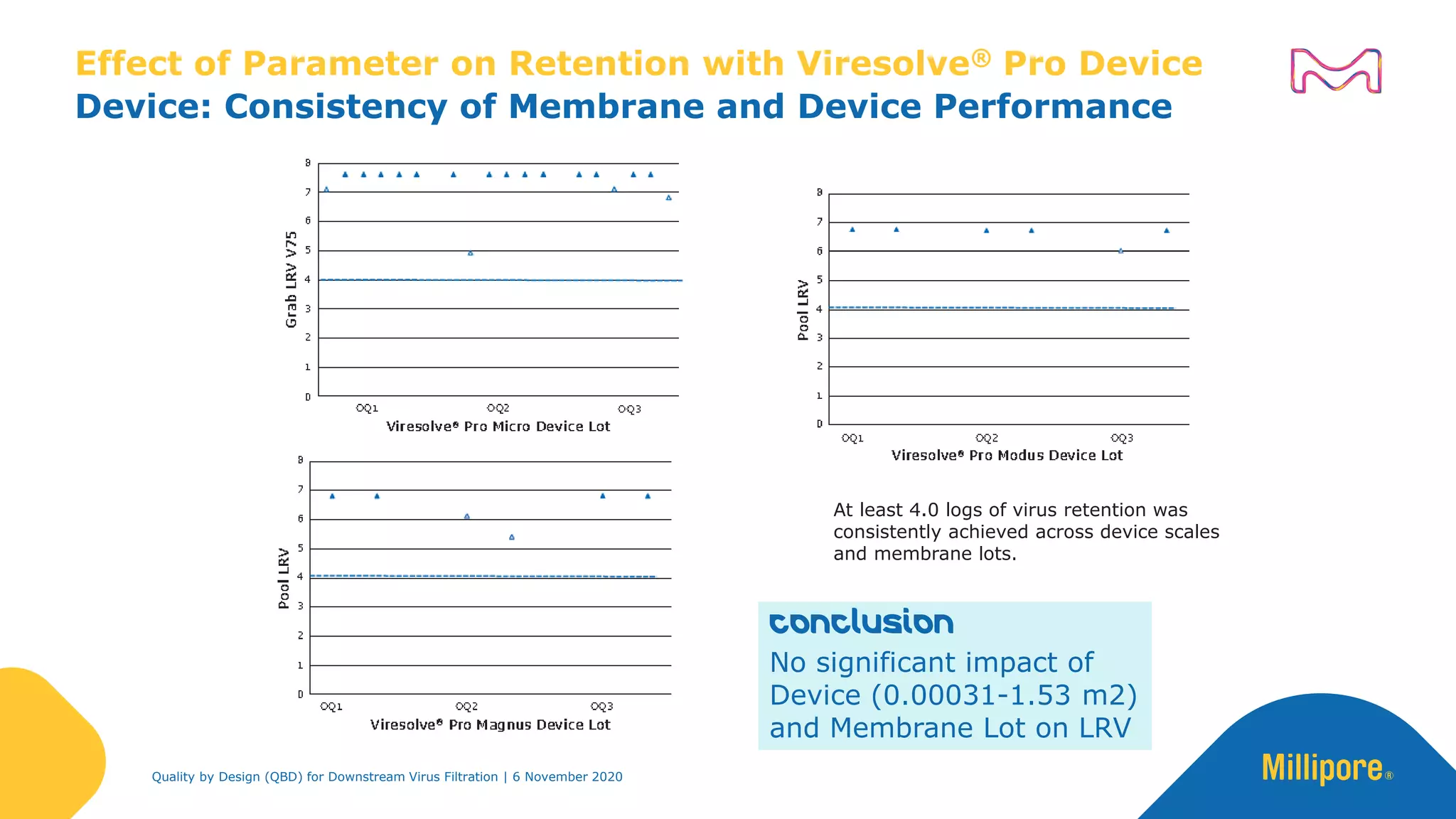
Device: Consistency of Membrane and Device Performance
Effect of Parameter on Retention with Viresolve® Pro Device
conclusion
No significant impact of
Device (0.00031-1.53 m2)
and Membrane Lot on LRV
At least 4.0 logs of virus retention was
consistently achieved across device scales
and membrane lots.
Quality by Design (QBD) for Downstream Virus Filtration | 6 November 2020
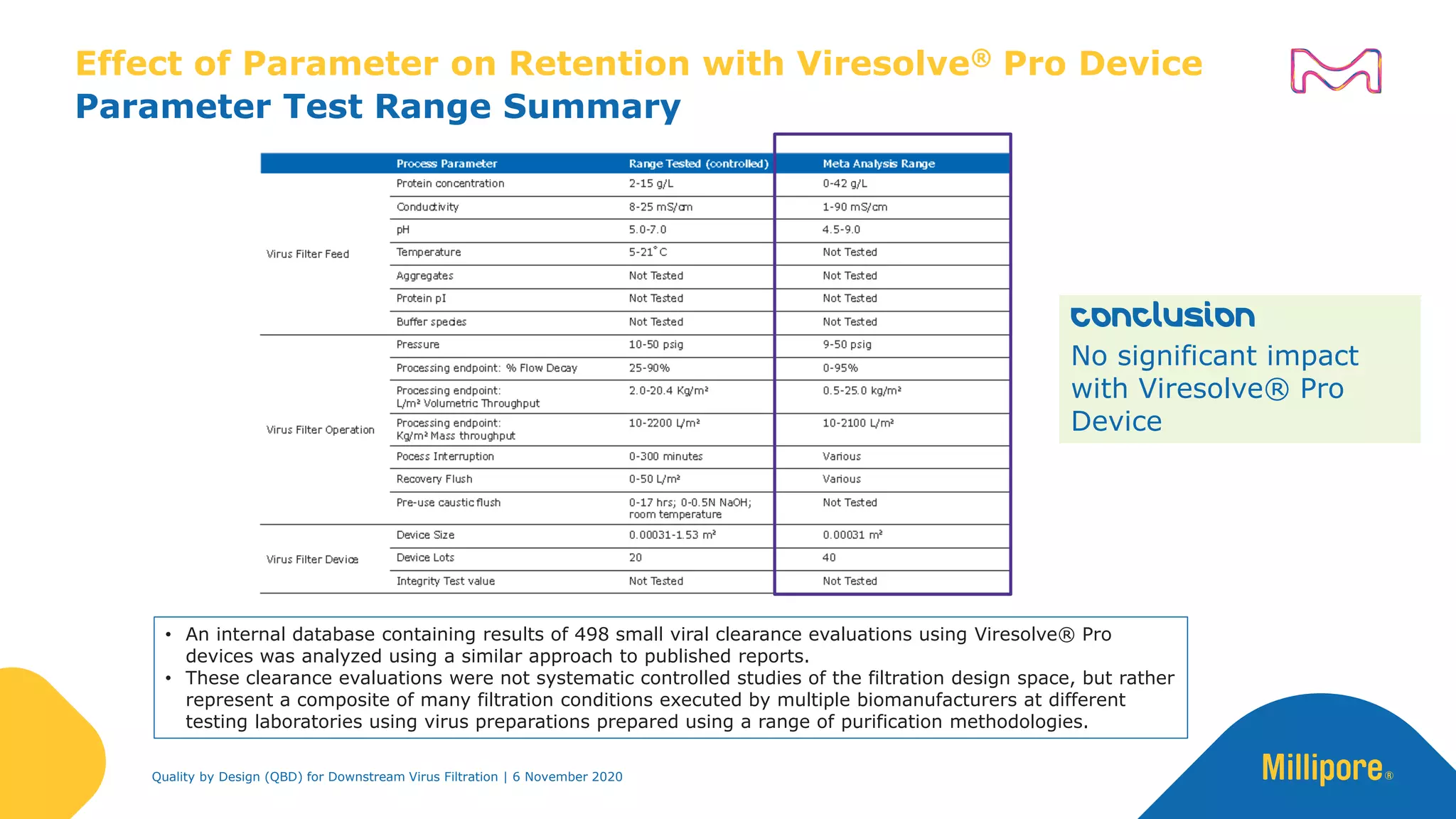
Parameter Test Range Summary
Effect of Parameter on Retention with Viresolve® Pro Device
conclusion
No significant impact
with Viresolve® Pro
Device
• An internal database containing results of 498 small viral clearance evaluations using Viresolve® Pro
devices was analyzed using a similar approach to published reports.
• These clearance evaluations were not systematic controlled studies of the filtration design space, but rather
represent a composite of many filtration conditions executed by multiple biomanufacturers at different
testing laboratories using virus preparations prepared using a range of purification methodologies.
Quality by Design (QBD) for Downstream Virus Filtration | 6 November 2020
Feed Titer and Operational Pressure
Effect of Parameter on Retention with Viresolve® Pro Device
0.0
1.0
2.0
3.0
4.0
5.0
6.0
7.0
8.0
0
5
10
15
20
25
30
35
40
45
VirusLogReductionValue
Drug Product Concentration (g/L)
0.0
1.0
2.0
3.0
4.0
5.0
6.0
7.0
8.0
0
10
20
30
40
50
VirusLogReductionValue
Feed Pressure(psi)
O = non-detects (assay limit) + = detects
Quality by Design (QBD) for Downstream Virus Filtration | 6 November 2020
Download Here
Reference
Quality by Design (QBD) for Downstream Virus Filtration | 6 November 2020
Poll Question
Q&A
Welcome
Sterile Filtration of Complex Injectables | 20 October 2020
Tathagata Ray
Head of Technology
Management
Indian Subcontinent and
South-East Asia
The vibrant M, Viresolve® Pro are trademarks of Merck KGaA, Darmstadt, Germany or its affiliates. All other trademarks are the property of their respective
owners. Detailed information on trademarks is available via publicly accessible resources.
© 2020 Merck KGaA, Darmstadt, Germany and/or its affiliates. All Rights Reserved.

QBD for Downstream Virus Filtration

  • 1.
    The life sciencebusiness of Merck KGaA, Darmstadt, Germany operates as MilliporeSigma in the U.S. and Canada. Quality by Design (QBD) for Downstream Virus Filtration Tathagata Ray Nov 6, 2020
  • 2.
    The life sciencebusiness of Merck KGaA, Darmstadt, Germany operates as MilliporeSigma in the U.S. and Canada
  • 3.
    Agenda 1 2 3 Quality by Design VirusFiltration QbD in Virus Filtration
  • 4.
  • 5.
    Introduction LOW HIGH Concept Design TestingProduction Quality by Design (QBD) for Downstream Virus Filtration | 6 November 2020
  • 6.
    Quality Has KeyEconomic Attributes Introduction Costscausedbypoorquality Characteristics critical to the customers' experience Lower Limit Upper LimitTarget Traditional perspective Realistic perspective Quality by Design (QBD) for Downstream Virus Filtration | 6 November 2020
  • 7.
    Quality in Biopharmaceuticals Introduction 1 100 10000 1000000 2σ4σ 6σ DPMO Restaurant bills Airline baggage arrival Aviation industry Nuclear industry Quality to patient How do we follow “absolute” quality? By Testing! Or, it has to be built in by design... DPMO – Defects per million opportunities Healthcare industry Quality by Design (QBD) for Downstream Virus Filtration | 6 November 2020
  • 8.
    Quality Can BeA Key Regulatory Concern Introduction Does the production process result in product/residues that interfere with final product strength or efficacy? Does the production process result in product/residues that interfere with final product purity? Does the production process result in product/residues that are toxic to the patient? Suitability of either a drug substance or product for its intended use (ICH Q6A) Quality by Design (QBD) for Downstream Virus Filtration | 6 November 2020
  • 9.
    QbD: Overall Approach Introduction CQ A4 CQA 2CQA 1 CQ A 3 PRODUCT DESIGN SPACECLINICAL DESIGN SPACE PROCESS DESIGN SPACE TARGET PRODUCT PROFILE CONCEPT > DESIGN > PRE-CLINICAL > CLINICAL > MASS PRODUCTION Animal studies PROCESS PARAMETER S Quality by Design (QBD) for Downstream Virus Filtration | 6 November 2020
  • 10.
    QbD: From Processto Step Introduction Quality target product profile (Safety !) Identify CQAs (virus retention) Design Process Design formulation Material attributes and Process parameters CQAint 1 CQAint 2 Identify and control sources of variability Monitor and update Process Step Characterization based on risk assessment / control Quality by Design (QBD) for Downstream Virus Filtration | 6 November 2020
  • 11.
    Risk Management  Minimizesrisk by identifying high risk/impact parameters and implementing a control/monitoring strategy  Results in a more robust/controlled/consistent process  Reduces chance of out of spec. batches, deviations, etc. Simplifies Process Development  Holistic development of a design space to accommodate multiple diverse molecules within a pipeline  Less repetitive “reinventing the wheel” studies with each new molecule using a bracketing approach Simplifies Validation  Differentiating critical vs. non-critical processing parameters enables more compact validation study designs  Facilitates a modular validation approach for a multi-molecule pipeline  Faster validation time and lower associated costs Stronger Regulatory Submission  Demonstrates a proactive understanding of your process to regulatory bodies  Rationale for design space makes regulatory submission package more defendable Why Apply QbD? Introduction 1 2 3 4 Quality by Design (QBD) for Downstream Virus Filtration | 6 November 2020
  • 12.
  • 13.
  • 14.
    A Key Componentof Viral Safety Assurance Virus Filtration Quality by Design (QBD) for Downstream Virus Filtration | 6 November 2020
  • 15.
    Virus Removal viaSize Exclusion Virus Filtration Membrane Pore Size Distribution  All membrane pore paths < virus size: expect complete retention  Reality: membrane morphology is complex and has an inherit size distribution  Other parameters may impact retention in extreme cases − E.g. very high flux decay => preferential plugging of smaller pores leaving larger pores more accessible to virus passage Vendor Controls: Viresolve® Pro Device  Recurring (every lot) − Membrane pore size distribution measurement and control via liquid – liquid porometry − Membrane and finished goods device binary gas and air/water diffusion testing − Selective layering process to increase performance consistency  Control factors can be incorporated into the FMEA Quality by Design (QBD) for Downstream Virus Filtration | 6 November 2020
  • 16.
    How Could Plugging/Flux Decay be a CPP? Virus Filtration Breakthrough at High Flux Decay / Plugging  Membrane has an inherent pore size distribution  Pores on the upper end of the distribution could be non-retentive  Preferential plugging of smaller pores first − Redirects more flow through the larger pores − At higher plugged states, virus breakthrough is possible  Different filters exhibit different behaviors! − Membrane pore size distribution ultimately dictates retention performance − Process endpoints of V90 or more are possible without significant loss of retention (Viresolve® Pro Device) Breakthrough in Large (Non-Retentive) Pores Functional (Retentive) Pores 1 nm 100 nm10 nm MVM (20–25 nm) fX-174 (25–30 nm) Quality by Design (QBD) for Downstream Virus Filtration | 6 November 2020
  • 17.
    Risk Assessment: ProcessParameter Inputs Introduction Feed Stream Characteristics  pH, conductivity, titer, aggregate loading, buffer matrix, hold time, temperature, etc.  Consider for both inter and intra lot  Consider molecule to molecule across entire pipeline for a template approach Virus Filter Operating Parameters  Pressure, volumetric/mass loading, process interruptions, flux decay endpoint, etc. Virus Filter Characteristics  Filter brand/model, scale, integrity test result, lot to lot variability, etc. Goal  Understand which are the critical processing parameters which might affect virus retention  Document the sensitivity/insensitivity of retention to each parameter within your expected operational window Quality by Design (QBD) for Downstream Virus Filtration | 6 November 2020
  • 18.
    Risk Assessment: FMEA Introduction TooMany Variables!  Limit parameters to those rationally significant (i.e. operator, feed turbidity not likely critical) FMEA Approach Example (not prescriptive)  Rank each parameter based on: − Severity (impact on LRV): 1 – 10 (low – high) − Probability of occurrence: 1 – 10 (low – high) − Detectability via controls: 1 – 10 (detectable – undetectable) − Risk priority number (RPN): Severity x Probability x Detectability => prioritize and work top down Estimating Severity  How would you know if flux decay, process interruptions, etc. would impact retention?  Leverage internal data sets for previously tested molecules  Leverage vendor supplied / industry publication data sets  The goal is to minimize the exploratory testing required Quality by Design (QBD) for Downstream Virus Filtration | 6 November 2020
  • 19.
    QbD Approach forVirus Filtration Introduction 1 2 3 4 Risk Assessment  What are the theoretical processing parameters that could impact viral retention performance?  Not all parameters are critical or equal…  Use an FMEA approach  How can we determine the relative risk (severity/probability/detectability)? Characterization Studies  Which processing parameters actually affect retention and to what extent?  Every commercially available filter behaves differently!  How can we determine the effect?  Univariate or multivariate analysis?  In house and/or vendor supplied data  Update FMEA based on findings Design Space Establishment  Understanding of what to expect for retention at the boundaries of your multidimensional design space  Establishment of allowable ranges of processing parameters to ensure CQA is met  Can be established for single or multiple molecules Control Strategy  Develop control/monitoring strategy for CPPs to ensure operation within the established design space validated during spiking studies  Focus top down on high risk items from FMEA Virus Filtration: CQA is achievement of a predetermined LRV of virus from drug product Quality by Design (QBD) for Downstream Virus Filtration | 6 November 2020
  • 20.
  • 21.
    Quality by Design(QBD) for Downstream Virus Filtration | 6 November 2020
  • 22.
    QbD Applied toCQAs and Process Performance Case Study CPP identification (parameter ranges omitted here) Risk estimation based on knowledge gaps Parameter understood => no study needed Knowledge gap => medium risk Product quality Process performance Process Parameter Aggregate content (% by HPSEC) Viral clearance Yield Average flow flux Volume throughput Protein concentration (mg/ml) Medium Medium No study Medium Medium Conductivity (mS/cm) No study Medium No study No study No study Temperature (oC) No study Medium No study No study No study pH Medium Medium No study Medium Medium Feed hold time No study No study No study No study No study Pressure during filtration No study Medium No study No study No study Process time No study No study No study No study No study % flow decay No study Medium No study No study No study Volumetric & mass throughput Medium Medium Medium Medium Medium Recovery flush Medium Medium Medium Medium Medium Quality by Design (QBD) for Downstream Virus Filtration | 6 November 2020
  • 23.
    QbD Applied toCQAs and Process Performance Case Study Vendor supplied data sets addressed most knowledge gaps Constituted a significant reduction of study effort needed to implement QbD Product quality Process performance Process Parameter Aggregate content (% by HPSEC) Viral clearance Yield Average flow flux Volume throughput Protein concentration (mg/ml) Medium Medium No study Medium Medium Conductivity (mS/cm) No study No study No study No study No study Temperature (oC) No study Medium No study No study No study pH Medium Medium No study Medium Medium Feed hold time No study No study No study No study No study Pressure during filtration No study Medium No study No study No study Process time No study No study No study No study No study % flow decay No study Medium No study No study No study Volumetric & mass throughput Medium Medium Medium Medium Medium Recovery flush Medium Medium Medium Medium Medium Vendor supplied data Quality by Design (QBD) for Downstream Virus Filtration | 6 November 2020
  • 24.
    Hypothetical Example Effect ofFeed/ Process/ Filter Parameter on Retention Category Process Parameter Example Molecule Mfg. Range Example Template Mfg. Range Variation Causes FeedCharacteristics Protein concentration 5-10 g/L 0.5-25 g/L Titer, flushes, CEX cuts Conductivity 8-10 mS/cm 0.5-25 mS/cm Buffer variability, dilution, batch to batch, in-line pH adjustments Temperature 22-24°C 10-30°C Environmental controls, cleaning water temperature pH 4.9-5.1 5.4-8.0 Feed variability, in-line pH adjustments Hold time/temperature 1-4 hr @ 23°C 0.5-24 hr @ 23°C Scheduling, buffer temp. Aggregates < 1% <2% Hold time Prefilter Shield None/Shield/Shield H/VPF Batch variability Protein pI 8.5 6-9 Amino acid content Protein molecular weight 150 kD 50-150 kD Amino acid content Buffer species Acetate Acetate, phosphate, MES, citrate, histidine Protein specific Quality by Design (QBD) for Downstream Virus Filtration | 6 November 2020
  • 25.
    Hypothetical Example Effect ofFeed/ Process/ Filter Parameter on Retention Category Process Parameter Example Molecule Mfg. Range Example Template Mfg. Range Variation CausesVirusFilterOperatingParameters Constant flow or pressure operation Constant pressure Constant pressure Plant preference Pressure 25-35 psig 20-50 psig Gauge error Recovery flush 8-12 L/m2 0-100L/m2 Batch variability % flow decay (plugging) 0-30% 0-50% Hold time L/m2 Volumetric Throughput 700-900L/m2 400-2000L/m2 Batch variability Kg/m2 Mass throughput 3.5-6.5 kg/m2 1-10 kg/m2 Batch variability Interruption hold durations <10 min 0-30 min Scheduling Process time 0.5-2 hrs 0.5-6 hrs Scheduling Pre-use caustic flush 0 L/m2 0-50 L/m2 Plant decision VirusFilter Char. Shelf time 0-1 yr 0-1 yr Scheduling & demand Device lots Magnus 2.2 lot Magnus 2.2 lot Batch variability Integrity test value 0.5-0.784 sccm/m2-psi 0.5-0.784 sccm/m2-psi Batch variability, temperature, wetting Quality by Design (QBD) for Downstream Virus Filtration | 6 November 2020
  • 26.
    Feed: Protein Concentration Effectof Parameter on Retention with Viresolve® Pro Device Conclusion No significant impact of protein concentration on LRV (2 – 25 g/L) ϕX-174 LRV (grab samples) vs. mAb1 concentration Impact of feed concentration and flow decay on MVM pool LRV MVM retention in triplicate devices for two mAb concentrations at processing endpoints of V75 and V90 Quality by Design (QBD) for Downstream Virus Filtration | 6 November 2020
  • 27.
    Feed: Conductivity andpH Effect of Parameter on Retention with Viresolve® Pro Device Conclusion No significant impact of pH (5-7)and Conductivity (8-25 mS/cm) on LRV MVM LRV including pH, Conductivity and % Flow Decay. Quality by Design (QBD) for Downstream Virus Filtration | 6 November 2020
  • 28.
    Feed: Temperature Effect ofParameter on Retention with Viresolve® Pro Device conclusion No significant impact of Temperature (5-21 degree C) on LRV ϕX-174 LRV vs. filtration temperature at different operating pressures Quality by Design (QBD) for Downstream Virus Filtration | 6 November 2020
  • 29.
    Operation: Operating Pressure Effectof Parameter on Retention with Viresolve® Pro Device conclusion No significant impact of Pressure (10 – 50 psi) on LRV MVM @ V75 ϕX-174 @ V50 Quality by Design (QBD) for Downstream Virus Filtration | 6 November 2020
  • 30.
    Operation: Processing Endpoint:% Flow Decay, Throughput (L/m2) or Mass Loading (kg/m2) Effect of Parameter on Retention with Viresolve® Pro Device conclusion No significant impact of mass loading (2-25 kg/m2), Throughput (10 – 2200 L/m2) and % Flow decay (25% - 90%) on LRV MVM @ V75 Quality by Design (QBD) for Downstream Virus Filtration | 6 November 2020
  • 31.
    Operation: Process Interruption– Recovery Flush and Operating Process Hold Effect of Parameter on Retention with Viresolve® Pro Device conclusion No significant impact of process interruption (0-300 min) / Flush volume (0-50 L/m2) on LRV No impact from membrane lot No impact from molecule type or concentration • No impact from pause intervals • No impact from pause duration • No impact from flush volume • No impact from pressure (up-down) • No impact on single membrane lot Quality by Design (QBD) for Downstream Virus Filtration | 6 November 2020
  • 32.
    Operation: Pre-use CausticFlush Effect of Parameter on Retention with Viresolve® Pro Device conclusion No significant impact of pre-post use caustic flush (0-17 hrs; 0-0.5N NaOH; room temperature) on LRV Viresolve® Pro devices (Micro, Modus and Magnus) were caustic sanitized with 0.5N NaOH (for 1h dynamic and 16 hours static) then challenged with ϕX-174 in 24 g/L BSA in FA buffer pH 7.2 at 30 psig. Filtrate grab samples were collected at V75 and LRVs were compared to LRVs from non-caustic treated devices. Quality by Design (QBD) for Downstream Virus Filtration | 6 November 2020
  • 33.
    Device: Consistency ofMembrane and Device Performance Effect of Parameter on Retention with Viresolve® Pro Device conclusion No significant impact of Device (0.00031-1.53 m2) and Membrane Lot on LRV At least 4.0 logs of virus retention was consistently achieved across device scales and membrane lots. Quality by Design (QBD) for Downstream Virus Filtration | 6 November 2020
  • 34.
    Parameter Test RangeSummary Effect of Parameter on Retention with Viresolve® Pro Device conclusion No significant impact with Viresolve® Pro Device • An internal database containing results of 498 small viral clearance evaluations using Viresolve® Pro devices was analyzed using a similar approach to published reports. • These clearance evaluations were not systematic controlled studies of the filtration design space, but rather represent a composite of many filtration conditions executed by multiple biomanufacturers at different testing laboratories using virus preparations prepared using a range of purification methodologies. Quality by Design (QBD) for Downstream Virus Filtration | 6 November 2020
  • 35.
    Feed Titer andOperational Pressure Effect of Parameter on Retention with Viresolve® Pro Device 0.0 1.0 2.0 3.0 4.0 5.0 6.0 7.0 8.0 0 5 10 15 20 25 30 35 40 45 VirusLogReductionValue Drug Product Concentration (g/L) 0.0 1.0 2.0 3.0 4.0 5.0 6.0 7.0 8.0 0 10 20 30 40 50 VirusLogReductionValue Feed Pressure(psi) O = non-detects (assay limit) + = detects Quality by Design (QBD) for Downstream Virus Filtration | 6 November 2020
  • 36.
    Download Here Reference Quality byDesign (QBD) for Downstream Virus Filtration | 6 November 2020
  • 37.
  • 38.
  • 39.
    Welcome Sterile Filtration ofComplex Injectables | 20 October 2020 Tathagata Ray Head of Technology Management Indian Subcontinent and South-East Asia
  • 40.
    The vibrant M,Viresolve® Pro are trademarks of Merck KGaA, Darmstadt, Germany or its affiliates. All other trademarks are the property of their respective owners. Detailed information on trademarks is available via publicly accessible resources. © 2020 Merck KGaA, Darmstadt, Germany and/or its affiliates. All Rights Reserved.