PILOT IMPLEMENTATION OF THE MATATAG K TO 10 CURRICULUM
Lesson Exemplar
for TLE
Lesson
2
8
Quarter 2
Lesson Exemplar for TLE Grade 8
Quarter 2: Lesson 2 (Week 2)
SY 2024-2025
This material is intended exclusively for the use of teachers participating in the pilot implementation of the MATATAG K to 10 Curriculum during the
School Year 2024-2025. It aims to assist in delivering the curriculum content, standards, and lesson competencies. Any unauthorized reproduction, distribution,
modification, or utilization of this material beyond the designated scope is strictly prohibited and may result in appropriate legal actions and disciplinary measures.
Borrowed content included in this material are owned by their respective copyright holders. Every effort has been made to locate and obtain permission
to use these materials from their respective copyright owners. The publisher and development team do not represent nor claim ownership over them.
Every care has been taken to ensure the accuracy of the information provided in this material. For inquiries or feedback, please write or call the Office
of the Director of the Bureau of Learning Resources via telephone numbers (02) 8634-1072 and 8631-6922 or by email at blr.od@deped.gov.ph
Development Team
Writer:
 Gracelyn B. Honrada (Nicolas L. Galvez Memorial Integrated National
High School)
Validator:
 Maria Gracia R. Samson (Philippine Normal University-South Luzon)
Management Team
Philippine Normal University
Research Center for Teacher Quality
SiMERR National Research Centre
1
TLE /QUARTER 2/ GRADE 8
I. CURRICULUM CONTENT, STANDARDS, AND LESSON COMPETENCIES
A. Content
Standards
The learners demonstrate an understanding of the concepts and skills in fisheries
B. Performance
Standards
The learners perform the skills in fisheries following safety precautions
C. Learning
Competencies
and Objectives
Learning Competency
 Discuss the phases of fish culture
 Identify common fishes according to their habitat
Learning objectives
At the end of the lesson, the students are expected to:
1. Explain the phases of fish culture
2. Differentiate fish cultivation, propagation and conservation
3. Classify fish according to their habitat
C. Content Phases of Fish Culture
D. Integration SDG 14: Life Below Water
II. LEARNING RESOURCES
Asuncion Jr., R. G. (1997). ABIVA Technology and Home Economics Series. Culture of Aquatic Resources.
Basa, A. (2022, November 19). Why there’s “closed season” for fishing certain fishes in specific waters. Manila Bulletin.
https://mb.com.ph/2022/11/19/why-theres-closed-season-for-fishing-certain-fishes-in-specific-waters
Canadian Aquaculture. I. Careers in Aquaculture Index — Canadian Aquaculture Industry Alliance
Cudis, C. (2020, October 13). Philippine News Agency. https://www.pna.gov.ph/articles/1118394 How is my Food Made.
https://www.futurelearn.com/courses/how-is-my-food-made
2
Debutify. (2023, July 29). Traditional vs. Modern Fishing Methods: Comparing Time-Tested Techniqu. BUZZERFISH.
https://buzzerfish.com/blogs/fishing-tips/traditional-vs-modern-fishing-methods-comparing-time-tested-techniques
Meinam, M. (2022, July 22). International Journal of Science and Research Archive. Importance of fish biodiversity conservation and
managemen (ijsra.net)
OmsonsLabs. (n.d.). Laboratory Thermometer. Omsons Labs. https://omsonslabs.com/laboratory-thermometer/
Sheilamea, A. K. (2016, December 27). LESSON2 FISH CULTURE Arajane Karen Sheilamea | Download Free PDF | Spawn (Biology) | Fish.
Scribd. https://www.scribd.com/presentation/406453564/LESSON2-FISH-CULTURE-Arajane-Karen-Sheilamea
III. TEACHING AND LEARNING PROCEDURE NOTES TO TEACHERS
A. Activating Prior
Knowledge
DAY 1
1. Short Review
The students will identify whether CAREER or BUSINESS OPPORTUNITIES
are the following:
_____1. Fish Handler _____6. Fish Farm Owner
_____2. Fish Caretaker _____7. Fishery Technician
_____3. Research Officer _____ 8. Fish Wharf Operator
_____4. Aqua Culturist _____ 9. Fish Distributor
_____5. Fish Supplier _____10. Fish Trader
2. Feedback (Optional)
Answers:
1. BUSINESS 6. BUSINESS
2. CAREER 7. CAREER
3. CAREER 8. CAREER
4. CAREER 9. BUSINESS
5. BUSINESS 10. BUSINESS
B. Establishing
Lesson Purpose
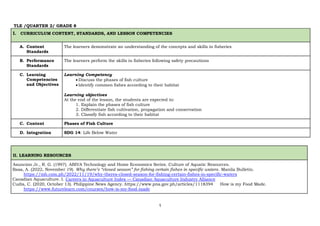
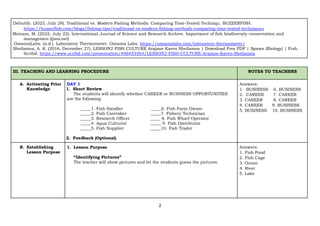
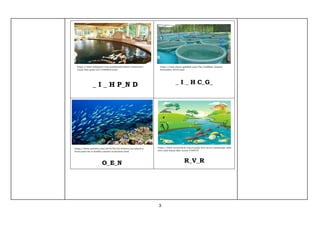
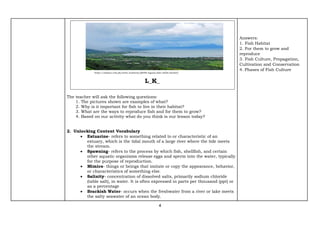
1. Lesson Purpose
“Identifying Pictures”
The teacher will show pictures and let the students guess the pictures.
Answers:
1. Fish Pond
2. Fish Cage
3. Ocean
4. River
5. Lake
3
_ I _ H P_N D _ I _ H C_G_
O_E_N R_V_R
https://www.indiamart.com/proddetail/indoor-restaurant-
touch-fish-pond-22113460833.html
https://www.about-goldfish.com/The_Goldfish_Gazette-
September-2016.html
https://www.nytimes.com/2016/02/23/science/an-island-a-
focal-point-for-a-healthy-marine-ecosystem.html
https://www.vectorstock.com/royalty-free-vector/landscape-with-
river-and-funny-fish-vector-4198737
4
L_K_
The teacher will ask the following questions:
1. The pictures shown are examples of what?
2. Why is it important for fish to live in their habitat?
3. What are the ways to reproduce fish and for them to grow?
4. Based on our activity what do you think is our lesson today?
2. Unlocking Content Vocabulary
 Estuarine- refers to something related to or characteristic of an
estuary, which is the tidal mouth of a large river where the tide meets
the stream.
 Spawning- refers to the process by which fish, shellfish, and certain
other aquatic organisms release eggs and sperm into the water, typically
for the purpose of reproduction.
 Mimics- things or beings that imitate or copy the appearance, behavior,
or characteristics of something else.
 Salinity- concentration of dissolved salts, primarily sodium chloride
(table salt), in water. It is often expressed in parts per thousand (ppt) or
as a percentage
 Brackish Water- occurs when the freshwater from a river or lake meets
the salty seawater of an ocean body.
Answers:
1. Fish Habitat
2. For them to grow and
reproduce
3. Fish Culture, Propagation,
Cultivation and Conservation
4. Phases of Fish Culture
https://malaya.com.ph/news_business/p609b-laguna-lake-rehab-backed/
5
C. Developing and
Deepening
Understanding
SUB-TOPIC 1: Phases of Fish Culture
Fish culture embodies the human effort in raising or maintaining the maximum
productivity of all bodies of water, and in maintaining fish supply in order to satisfy
human needs. To attain these, fish culture has three different aspects namely: fish
cultivation, fish propagation, and fish conservation.
Phases or Aspects of Fish Culture:
1. Fish Cultivation- the rearing of fish under controlled or semi- controlled
condition. It seeks to produce as high a quantity as possible of graded fish (uniform
size) or two to produce the most weight. Classifications of fish cultivation are the
following:
a. intensive- utilize limited area with very high investment
b. extensive- utilize wide area with minimal capital and very low production
c. semi-intensive- employ some or the majority of the modern techniques of
production.
2. Fish Propagation- the process of increasing fish life either by natural or artificial
means of reproduction. This means that fish may be allowed to mature and multiply
by themselves. Types of fish propagation:
a. natural propagation- fish reproduce naturally in their habitat through
spawning, where eggs are fertilized externally or internally
b. semi-natural propagation- refers to a breeding approach that involves a
combination of natural and artificial methods. In this method, fish are allowed
to breed in a controlled environment that mimics their natural habitat to some
extent, but with some level of human intervention.
c. artificial propagation- this involves human intervention to control the
breeding process. It includes methods like stripping eggs and milt (sperm)
from fish and then fertilizing the eggs externally.
DAY 2
3. Fish Conservation- The scientific means of utilizing fish and other fishery
aquatic products/resources. This could be accompanied by observing fishery laws,
rules and regulations affecting fishery products.
6
Importance of Fish Conservation
Conservation and sustainable management of fish biodiversity are essential for
the well-being of both aquatic ecosystems and human societies, supporting
ecological integrity, economic development, and the cultural heritage tied to these
remarkable aquatic creatures.
Local Endangered Species
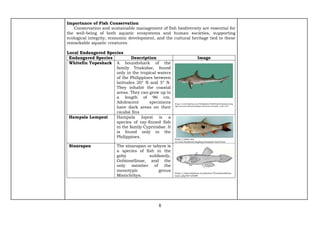
Endangered Species Description Image
Whitefin Topeshark A houndshark of the
family Triakidae, found
only in the tropical waters
of the Philippines between
latitudes 20° N and 5° N.
They inhabit the coastal
areas. They can grow up to
a length of 96 cm.
Adolescent specimens
have dark areas on their
caudal fins
https://www.fishbase.se/Fieldguide/FieldGuideSummary.php
?genusname=Mustelus&speciesname=mosis&c_code=144
Hampala Lompezi Hampala lopezi is a
species of ray-finned fish
in the family Cyprinidae. It
is found only in the
Philippines. https://www.sea-
ex.com/thailand/angling/hampala-barb.htm
Sinarapan The sinarapan or tabyos is
a species of fish in the
goby subfamily,
Gobionellinae, and the
only member of the
monotypic genus
Mistichthys.
https://www.fishbase.se/photos/ThumbnailsSum
mary.php?ID=25089
7
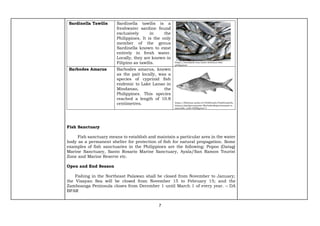
Sardinella Tawilis Sardinella tawilis is a
freshwater sardine found
exclusively in the
Philippines. It is the only
member of the genus
Sardinella known to exist
entirely in fresh water.
Locally, they are known in
Filipino as tawilis. https://strawpoll.com/most-delicious-fish-
philippines
Barbodes Amarus Barbodes amarus, known
as the pait locally, was a
species of cyprinid fish
endemic to Lake Lanao in
Mindanao, the
Philippines. This species
reached a length of 10.8
centimetres. https://fishbase.mnhn.fr/FieldGuide/FieldGuideSu
mmary.php?genusname=Barbodes&speciesname=a
marus&c_code=608&print=1
Fish Sanctuary
Fish sanctuary means to establish and maintain a particular area in the water
body as a permanent shelter for protection of fish for natural propagation. Some
examples of fish sanctuaries in the Philippines are the following: Popoo (Datag)
Marine Sanctuary, Santo Rosario Marine Sanctuary, Ayala/San Ramon Tourist
Zone and Marine Reserve etc.
Open and End Season
Fishing in the Northeast Palawan shall be closed from November to January;
the Visayan Sea will be closed from November 15 to February 15; and the
Zamboanga Peninsula closes from December 1 until March 1 of every year. – DA
BFAR
8
The practice of a “closed season” for fishing is defined by the Philippine
Fisheries Code of 1998, as amended in 2015, as “the period during which the taking
of specified fishery species by a specified fishing gear is prohibited in a specified
area or areas in Philippine waters.”
Closed fishing season helps important fish species to reproduce or spawn, fry
and juvenile fishes to mature, and fish stocks to recover, the Bureau of Fisheries
and Aquatic Resources (BFAR) said in its Fish Files magazine in 2021.
DAY 3
Classification of Fish According to their Habitat
 Marine or Open Sea Fishes- Marine or sea water fishes are those that
primarily inhabit oceans and seas with high salinity levels. Examples are
tuna, cod, salmon, flounder, mackerel, sword fish, sardines etc.
 Fresh Water Fishes or Inland Fishes- These fish species primarily inhabit
rivers, lakes, ponds, and streams with low salinity levels. Examples include
trout, bass, catfish, and carp.
 Brackish Water Fishes or Estuarine Fish- Estuarine fish live in the
transition zone between freshwater and saltwater, such as estuaries and
brackish water habitats. Examples include flounder, striped bass, and
mullet.
2. Worked Example
“Navigating the Waters: Exploring Fish Cultivation, Propagation, and
Conservation”
Using the Venn Diagram, the students will give the differences and similarities of
fish cultivation, propagation and conservation.
9
DAY 4
3. Lesson Activity
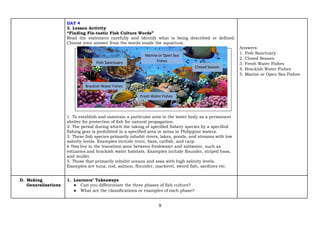
“Finding Fin-tastic Fish Culture Words”
Read the statement carefully and identify what is being described or defined.
Choose your answer from the words inside the aquarium.
1. To establish and maintain a particular area in the water body as a permanent
shelter for protection of fish for natural propagation.
2. The period during which the taking of specified fishery species by a specified
fishing gear is prohibited in a specified area or areas in Philippine waters.
3. These fish species primarily inhabit rivers, lakes, ponds, and streams with low
salinity levels. Examples include trout, bass, catfish, and carp.
4. They live in the transition zone between freshwater and saltwater, such as
estuaries and brackish water habitats. Examples include flounder, striped bass,
and mullet.
5. Those that primarily inhabit oceans and seas with high salinity levels.
Examples are tuna, cod, salmon, flounder, mackerel, sword fish, sardines etc.
Answers:
1. Fish Sanctuary
2. Closed Season
3. Fresh Water Fishes
4. Brackish Water Fishes
5. Marine or Open Sea Fishes
D. Making
Generalizations
1. Learners’ Takeaways
● Can you differentiate the three phases of fish culture?
● What are the classifications or examples of each phase?
Fish Sanctuary
Closed Season
Marine or Open Sea
Fishes
Fresh Water Fishes
Brackish Water Fishes
10
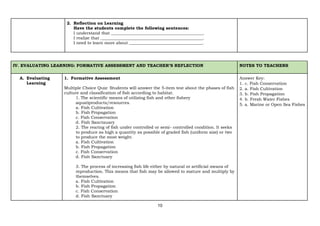
2. Reflection on Learning
Have the students complete the following sentences:
I understand that ____________________________________________.
I realize that _________________________________________________.
I need to learn more about ___________________________________.
IV. EVALUATING LEARNING: FORMATIVE ASSESSMENT AND TEACHER’S REFLECTION NOTES TO TEACHERS
A. Evaluating
Learning
1. Formative Assessment
Multiple Choice Quiz: Students will answer the 5-item test about the phases of fish
culture and classification of fish according to habitat.
1. The scientific means of utilizing fish and other fishery
aquatiproducts/resources.
a. Fish Cultivation
b. Fish Propagation
c. Fish Conservation
d. Fish Sanctauary
2. The rearing of fish under controlled or semi- controlled condition. It seeks
to produce as high a quantity as possible of graded fish (uniform size) or two
to produce the most weight.
a. Fish Cultivation
b. Fish Propagation
c. Fish Conservation
d. Fish Sanctuary
3. The process of increasing fish life either by natural or artificial means of
reproduction. This means that fish may be allowed to mature and multiply by
themselves.
a. Fish Cultivation
b. Fish Propagation
c. Fish Conservation
d. Fish Sanctuary
Answer Key:
1. c. Fish Conservation
2. a. Fish Cultivation
3. b. Fish Propagation
4. b. Fresh Water Fishes
5. a. Marine or Open Sea Fishes
11
4. These fish species primarily inhabit rivers, lakes, ponds, and streams with
low salinity levels.
a. Marine or Open Sea Fishes
b. Fresh Water Fishes or Inland Fishes
c. Brackish Water Fishes or Estuarine Fish
d. Anadromous Fishes
5. Those that primarily inhabit oceans and seas with high salinity levels.
a. Marine or Open Sea Fishes
b. Fresh Water Fishes or Inland Fishes
c. Brackish Water Fishes or Estuarine Fish
d. Anadromous Fishes
2. Homework
 Let the students interview a fish farm owner. The students may ask what
phase of fish culture they apply on their farm.
B. Teacher’s
Remarks
Note observations on
any of the following
areas:
Effective Practices Problems Encountered
strategies explored
materials used
learner engagement/
interaction
others
C. Teacher’s
Reflection
Reflection guide or prompt can be on:
▪ principles behind the teaching
12
What principles and beliefs informed my lesson?
Why did I teach the lesson the way I did?
▪ students
What roles did my students play in my lesson?
What did my students learn? How did they learn?
▪ ways forward
What could I have done differently?
What can I explore in the next lesson?

Q2_LE_TLE 8_Lesson 2_Week 2.pdflllllllll

  • 1.
    PILOT IMPLEMENTATION OFTHE MATATAG K TO 10 CURRICULUM Lesson Exemplar for TLE Lesson 2 8 Quarter 2
  • 2.
    Lesson Exemplar forTLE Grade 8 Quarter 2: Lesson 2 (Week 2) SY 2024-2025 This material is intended exclusively for the use of teachers participating in the pilot implementation of the MATATAG K to 10 Curriculum during the School Year 2024-2025. It aims to assist in delivering the curriculum content, standards, and lesson competencies. Any unauthorized reproduction, distribution, modification, or utilization of this material beyond the designated scope is strictly prohibited and may result in appropriate legal actions and disciplinary measures. Borrowed content included in this material are owned by their respective copyright holders. Every effort has been made to locate and obtain permission to use these materials from their respective copyright owners. The publisher and development team do not represent nor claim ownership over them. Every care has been taken to ensure the accuracy of the information provided in this material. For inquiries or feedback, please write or call the Office of the Director of the Bureau of Learning Resources via telephone numbers (02) 8634-1072 and 8631-6922 or by email at blr.od@deped.gov.ph Development Team Writer:  Gracelyn B. Honrada (Nicolas L. Galvez Memorial Integrated National High School) Validator:  Maria Gracia R. Samson (Philippine Normal University-South Luzon) Management Team Philippine Normal University Research Center for Teacher Quality SiMERR National Research Centre
  • 3.
    1 TLE /QUARTER 2/GRADE 8 I. CURRICULUM CONTENT, STANDARDS, AND LESSON COMPETENCIES A. Content Standards The learners demonstrate an understanding of the concepts and skills in fisheries B. Performance Standards The learners perform the skills in fisheries following safety precautions C. Learning Competencies and Objectives Learning Competency  Discuss the phases of fish culture  Identify common fishes according to their habitat Learning objectives At the end of the lesson, the students are expected to: 1. Explain the phases of fish culture 2. Differentiate fish cultivation, propagation and conservation 3. Classify fish according to their habitat C. Content Phases of Fish Culture D. Integration SDG 14: Life Below Water II. LEARNING RESOURCES Asuncion Jr., R. G. (1997). ABIVA Technology and Home Economics Series. Culture of Aquatic Resources. Basa, A. (2022, November 19). Why there’s “closed season” for fishing certain fishes in specific waters. Manila Bulletin. https://mb.com.ph/2022/11/19/why-theres-closed-season-for-fishing-certain-fishes-in-specific-waters Canadian Aquaculture. I. Careers in Aquaculture Index — Canadian Aquaculture Industry Alliance Cudis, C. (2020, October 13). Philippine News Agency. https://www.pna.gov.ph/articles/1118394 How is my Food Made. https://www.futurelearn.com/courses/how-is-my-food-made
  • 4.
    2 Debutify. (2023, July29). Traditional vs. Modern Fishing Methods: Comparing Time-Tested Techniqu. BUZZERFISH. https://buzzerfish.com/blogs/fishing-tips/traditional-vs-modern-fishing-methods-comparing-time-tested-techniques Meinam, M. (2022, July 22). International Journal of Science and Research Archive. Importance of fish biodiversity conservation and managemen (ijsra.net) OmsonsLabs. (n.d.). Laboratory Thermometer. Omsons Labs. https://omsonslabs.com/laboratory-thermometer/ Sheilamea, A. K. (2016, December 27). LESSON2 FISH CULTURE Arajane Karen Sheilamea | Download Free PDF | Spawn (Biology) | Fish. Scribd. https://www.scribd.com/presentation/406453564/LESSON2-FISH-CULTURE-Arajane-Karen-Sheilamea III. TEACHING AND LEARNING PROCEDURE NOTES TO TEACHERS A. Activating Prior Knowledge DAY 1 1. Short Review The students will identify whether CAREER or BUSINESS OPPORTUNITIES are the following: _____1. Fish Handler _____6. Fish Farm Owner _____2. Fish Caretaker _____7. Fishery Technician _____3. Research Officer _____ 8. Fish Wharf Operator _____4. Aqua Culturist _____ 9. Fish Distributor _____5. Fish Supplier _____10. Fish Trader 2. Feedback (Optional) Answers: 1. BUSINESS 6. BUSINESS 2. CAREER 7. CAREER 3. CAREER 8. CAREER 4. CAREER 9. BUSINESS 5. BUSINESS 10. BUSINESS B. Establishing Lesson Purpose 1. Lesson Purpose “Identifying Pictures” The teacher will show pictures and let the students guess the pictures. Answers: 1. Fish Pond 2. Fish Cage 3. Ocean 4. River 5. Lake
  • 5.
    3 _ I _H P_N D _ I _ H C_G_ O_E_N R_V_R https://www.indiamart.com/proddetail/indoor-restaurant- touch-fish-pond-22113460833.html https://www.about-goldfish.com/The_Goldfish_Gazette- September-2016.html https://www.nytimes.com/2016/02/23/science/an-island-a- focal-point-for-a-healthy-marine-ecosystem.html https://www.vectorstock.com/royalty-free-vector/landscape-with- river-and-funny-fish-vector-4198737
  • 6.
    4 L_K_ The teacher willask the following questions: 1. The pictures shown are examples of what? 2. Why is it important for fish to live in their habitat? 3. What are the ways to reproduce fish and for them to grow? 4. Based on our activity what do you think is our lesson today? 2. Unlocking Content Vocabulary  Estuarine- refers to something related to or characteristic of an estuary, which is the tidal mouth of a large river where the tide meets the stream.  Spawning- refers to the process by which fish, shellfish, and certain other aquatic organisms release eggs and sperm into the water, typically for the purpose of reproduction.  Mimics- things or beings that imitate or copy the appearance, behavior, or characteristics of something else.  Salinity- concentration of dissolved salts, primarily sodium chloride (table salt), in water. It is often expressed in parts per thousand (ppt) or as a percentage  Brackish Water- occurs when the freshwater from a river or lake meets the salty seawater of an ocean body. Answers: 1. Fish Habitat 2. For them to grow and reproduce 3. Fish Culture, Propagation, Cultivation and Conservation 4. Phases of Fish Culture https://malaya.com.ph/news_business/p609b-laguna-lake-rehab-backed/
  • 7.
    5 C. Developing and Deepening Understanding SUB-TOPIC1: Phases of Fish Culture Fish culture embodies the human effort in raising or maintaining the maximum productivity of all bodies of water, and in maintaining fish supply in order to satisfy human needs. To attain these, fish culture has three different aspects namely: fish cultivation, fish propagation, and fish conservation. Phases or Aspects of Fish Culture: 1. Fish Cultivation- the rearing of fish under controlled or semi- controlled condition. It seeks to produce as high a quantity as possible of graded fish (uniform size) or two to produce the most weight. Classifications of fish cultivation are the following: a. intensive- utilize limited area with very high investment b. extensive- utilize wide area with minimal capital and very low production c. semi-intensive- employ some or the majority of the modern techniques of production. 2. Fish Propagation- the process of increasing fish life either by natural or artificial means of reproduction. This means that fish may be allowed to mature and multiply by themselves. Types of fish propagation: a. natural propagation- fish reproduce naturally in their habitat through spawning, where eggs are fertilized externally or internally b. semi-natural propagation- refers to a breeding approach that involves a combination of natural and artificial methods. In this method, fish are allowed to breed in a controlled environment that mimics their natural habitat to some extent, but with some level of human intervention. c. artificial propagation- this involves human intervention to control the breeding process. It includes methods like stripping eggs and milt (sperm) from fish and then fertilizing the eggs externally. DAY 2 3. Fish Conservation- The scientific means of utilizing fish and other fishery aquatic products/resources. This could be accompanied by observing fishery laws, rules and regulations affecting fishery products.
  • 8.
    6 Importance of FishConservation Conservation and sustainable management of fish biodiversity are essential for the well-being of both aquatic ecosystems and human societies, supporting ecological integrity, economic development, and the cultural heritage tied to these remarkable aquatic creatures. Local Endangered Species Endangered Species Description Image Whitefin Topeshark A houndshark of the family Triakidae, found only in the tropical waters of the Philippines between latitudes 20° N and 5° N. They inhabit the coastal areas. They can grow up to a length of 96 cm. Adolescent specimens have dark areas on their caudal fins https://www.fishbase.se/Fieldguide/FieldGuideSummary.php ?genusname=Mustelus&speciesname=mosis&c_code=144 Hampala Lompezi Hampala lopezi is a species of ray-finned fish in the family Cyprinidae. It is found only in the Philippines. https://www.sea- ex.com/thailand/angling/hampala-barb.htm Sinarapan The sinarapan or tabyos is a species of fish in the goby subfamily, Gobionellinae, and the only member of the monotypic genus Mistichthys. https://www.fishbase.se/photos/ThumbnailsSum mary.php?ID=25089
  • 9.
    7 Sardinella Tawilis Sardinellatawilis is a freshwater sardine found exclusively in the Philippines. It is the only member of the genus Sardinella known to exist entirely in fresh water. Locally, they are known in Filipino as tawilis. https://strawpoll.com/most-delicious-fish- philippines Barbodes Amarus Barbodes amarus, known as the pait locally, was a species of cyprinid fish endemic to Lake Lanao in Mindanao, the Philippines. This species reached a length of 10.8 centimetres. https://fishbase.mnhn.fr/FieldGuide/FieldGuideSu mmary.php?genusname=Barbodes&speciesname=a marus&c_code=608&print=1 Fish Sanctuary Fish sanctuary means to establish and maintain a particular area in the water body as a permanent shelter for protection of fish for natural propagation. Some examples of fish sanctuaries in the Philippines are the following: Popoo (Datag) Marine Sanctuary, Santo Rosario Marine Sanctuary, Ayala/San Ramon Tourist Zone and Marine Reserve etc. Open and End Season Fishing in the Northeast Palawan shall be closed from November to January; the Visayan Sea will be closed from November 15 to February 15; and the Zamboanga Peninsula closes from December 1 until March 1 of every year. – DA BFAR
  • 10.
    8 The practice ofa “closed season” for fishing is defined by the Philippine Fisheries Code of 1998, as amended in 2015, as “the period during which the taking of specified fishery species by a specified fishing gear is prohibited in a specified area or areas in Philippine waters.” Closed fishing season helps important fish species to reproduce or spawn, fry and juvenile fishes to mature, and fish stocks to recover, the Bureau of Fisheries and Aquatic Resources (BFAR) said in its Fish Files magazine in 2021. DAY 3 Classification of Fish According to their Habitat  Marine or Open Sea Fishes- Marine or sea water fishes are those that primarily inhabit oceans and seas with high salinity levels. Examples are tuna, cod, salmon, flounder, mackerel, sword fish, sardines etc.  Fresh Water Fishes or Inland Fishes- These fish species primarily inhabit rivers, lakes, ponds, and streams with low salinity levels. Examples include trout, bass, catfish, and carp.  Brackish Water Fishes or Estuarine Fish- Estuarine fish live in the transition zone between freshwater and saltwater, such as estuaries and brackish water habitats. Examples include flounder, striped bass, and mullet. 2. Worked Example “Navigating the Waters: Exploring Fish Cultivation, Propagation, and Conservation” Using the Venn Diagram, the students will give the differences and similarities of fish cultivation, propagation and conservation.
  • 11.
    9 DAY 4 3. LessonActivity “Finding Fin-tastic Fish Culture Words” Read the statement carefully and identify what is being described or defined. Choose your answer from the words inside the aquarium. 1. To establish and maintain a particular area in the water body as a permanent shelter for protection of fish for natural propagation. 2. The period during which the taking of specified fishery species by a specified fishing gear is prohibited in a specified area or areas in Philippine waters. 3. These fish species primarily inhabit rivers, lakes, ponds, and streams with low salinity levels. Examples include trout, bass, catfish, and carp. 4. They live in the transition zone between freshwater and saltwater, such as estuaries and brackish water habitats. Examples include flounder, striped bass, and mullet. 5. Those that primarily inhabit oceans and seas with high salinity levels. Examples are tuna, cod, salmon, flounder, mackerel, sword fish, sardines etc. Answers: 1. Fish Sanctuary 2. Closed Season 3. Fresh Water Fishes 4. Brackish Water Fishes 5. Marine or Open Sea Fishes D. Making Generalizations 1. Learners’ Takeaways ● Can you differentiate the three phases of fish culture? ● What are the classifications or examples of each phase? Fish Sanctuary Closed Season Marine or Open Sea Fishes Fresh Water Fishes Brackish Water Fishes
  • 12.
    10 2. Reflection onLearning Have the students complete the following sentences: I understand that ____________________________________________. I realize that _________________________________________________. I need to learn more about ___________________________________. IV. EVALUATING LEARNING: FORMATIVE ASSESSMENT AND TEACHER’S REFLECTION NOTES TO TEACHERS A. Evaluating Learning 1. Formative Assessment Multiple Choice Quiz: Students will answer the 5-item test about the phases of fish culture and classification of fish according to habitat. 1. The scientific means of utilizing fish and other fishery aquatiproducts/resources. a. Fish Cultivation b. Fish Propagation c. Fish Conservation d. Fish Sanctauary 2. The rearing of fish under controlled or semi- controlled condition. It seeks to produce as high a quantity as possible of graded fish (uniform size) or two to produce the most weight. a. Fish Cultivation b. Fish Propagation c. Fish Conservation d. Fish Sanctuary 3. The process of increasing fish life either by natural or artificial means of reproduction. This means that fish may be allowed to mature and multiply by themselves. a. Fish Cultivation b. Fish Propagation c. Fish Conservation d. Fish Sanctuary Answer Key: 1. c. Fish Conservation 2. a. Fish Cultivation 3. b. Fish Propagation 4. b. Fresh Water Fishes 5. a. Marine or Open Sea Fishes
  • 13.
    11 4. These fishspecies primarily inhabit rivers, lakes, ponds, and streams with low salinity levels. a. Marine or Open Sea Fishes b. Fresh Water Fishes or Inland Fishes c. Brackish Water Fishes or Estuarine Fish d. Anadromous Fishes 5. Those that primarily inhabit oceans and seas with high salinity levels. a. Marine or Open Sea Fishes b. Fresh Water Fishes or Inland Fishes c. Brackish Water Fishes or Estuarine Fish d. Anadromous Fishes 2. Homework  Let the students interview a fish farm owner. The students may ask what phase of fish culture they apply on their farm. B. Teacher’s Remarks Note observations on any of the following areas: Effective Practices Problems Encountered strategies explored materials used learner engagement/ interaction others C. Teacher’s Reflection Reflection guide or prompt can be on: ▪ principles behind the teaching
  • 14.
    12 What principles andbeliefs informed my lesson? Why did I teach the lesson the way I did? ▪ students What roles did my students play in my lesson? What did my students learn? How did they learn? ▪ ways forward What could I have done differently? What can I explore in the next lesson?